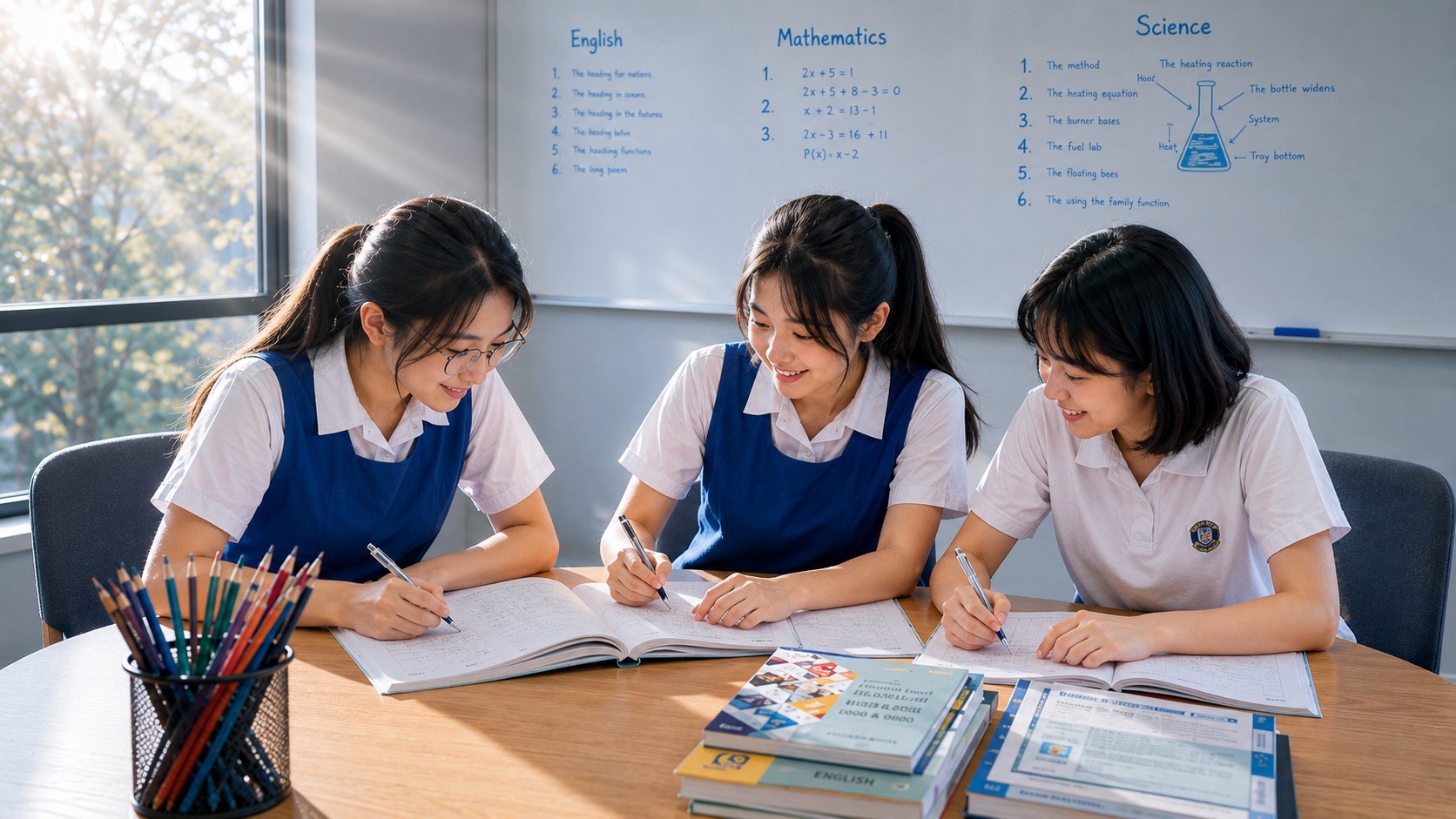
Secondary 2 Science becomes easier to explain when a student can connect what is visible with what particles are doing. Bukit Timah parents looking for small groups tuition can start with a simple check: can your child explain why air can be compressed, why a wet surface dries, and why droplets form outside a cold glass? In a three-student tutorial, these familiar situations provide a useful starting point for drawing models, correcting misconceptions and writing answers that show the reasoning.
This guide teaches the particle model and changes of state through original examples, diagrams and practice. The MOE G2/G3 lower-secondary Science syllabus includes particle arrangement, movement, diffusion and thermal expansion; explaining melting and boiling through particle models is marked optional for G2. G1 has its own practical Science syllabus, including changes of state. Schools sequence lower-secondary topics differently, so use this article for the relevant lesson or revision, with your child’s current subject level and school instructions beside it.
- Start here: distinguish a visible observation from a particle explanation.
- Core ideas: particles, spacing, arrangement, movement, compression, diffusion and expansion.
- Changes of state: melting, freezing, boiling, evaporation and condensation, with careful explanations of what changes and what stays the same.
- Level matching: select the depth required by the school; particle explanations of melting and boiling are an optional G2 extension.
- Practice: original questions, model answers, a teaching dataset and correction exercises appear below.
- Tuition format: three students, with individual explanations and independent checks; confirm the current subject arrangement and availability when enquiring.
- Assessment: Secondary 2 assessments are school-based; the later SEC examination is a separate stage.
EDUKATESINGAPORE · SECONDARY 2
Find your next learning step
Start with the section closest to your child’s current question, then continue through the worked examples.
Open the complete chapter index · Parent questions and next steps
Contents
Chapters 1–5
Chapters 6–10
Bring one recent Science question to the first conversation about support. A question asking a student to name condensation requires a different answer from one asking the student to explain condensation using a particle model. Both concern the same event, but the second requires a connection between an invisible process and an observable result. Extra worksheets are useful only when they practise the missing connection.
The national documents cover the lower-secondary phase rather than imposing one identical Secondary 2 weekly timetable. A topic may be introduced earlier, revisited in an investigation, or combined with heat transfer. Ask what the class has already learnt and what the next assessment includes. A familiar chapter title does not establish the required depth.
For G1 Science, start from the observable states and the names of their changes. The G1 lower-secondary syllabus is a separate programme. A diagram may support understanding without becoming an extra assessed requirement. For G2 and G3, check whether the task calls for arrangement, movement, spacing or a combination. A stronger answer is a more relevant answer, rather than the longest possible account.
The Singapore-Cambridge Secondary Education Certificate begins with the 2027 graduating cohort. A child in Secondary 2 does not automatically sit that examination in 2027. At this stage, the practical task is to build understanding for the present school programme and review later choices with the school.
A useful tuition starting record therefore has four entries: the Science subject level, the current topic, one independent answer and the teacher’s feedback. These give the tutor something concrete to teach. They also help parents distinguish a vocabulary difficulty from a scientific misconception.
Ask three questions without showing a model answer: “What is between gas particles?”, “What changes when a solid becomes warmer?” and “Where does the water outside a cold glass come from?” Listen to the explanation before correcting it. A student may know the words expansion and condensation while imagining particles that grow larger or water that passes through glass.
Record the student’s actual sentence. “The particles expand” is more useful diagnostic evidence than a general label such as careless. It suggests confusion between a substance becoming larger and its constituent particles becoming larger. The next teaching step is a comparison diagram with unchanged particle sizes and changed spacing.
Another student may say, “The gas particles spread because they want more space.” The general direction is recognisable, but the explanation gives particles intentions. Replace that with movement: particles move randomly, collide and continue moving in different directions. A model should explain the pattern without giving matter a purpose.
A third student may give a correct explanation orally but write only “particles move” in an answer. This student needs help selecting the relevant difference: more rapidly, further apart on average, or able to move past one another. The missing skill is precision, so another long demonstration of the basic states may have little value.
Parents can ask, “Which part would you change, and why?” after the student compares their answer with an explanation. Copying the correct paragraph is a first correction. Being able to explain the changed phrase is stronger evidence of learning. Later, ask a similar question with a different everyday context to see whether the idea transfers.
A particle model is a simplified representation of matter. The circles on a worksheet stand for tiny particles; they are not photographs, and the number shown is chosen to make a pattern readable. At this level, “particle” is a useful general word. Depending on the substance, a more detailed model may describe atoms, molecules or ions.
Before interpreting a diagram, read its key. Different colours might represent different substances, while arrows might indicate movement. If the key says nothing about colour, do not invent an explanation. A dark circle is not automatically heavier, hotter or more energetic than a pale circle.
When comparing the same sample before and after a physical change in a closed system, a teaching diagram should preserve the number and identity of its particles. It may change their arrangement or spacing. A drawing that turns eight circles into twelve has introduced a different claim, unless the question explicitly says particles entered the system.
Separate the model’s purpose from its limits. A simple diagram can help explain why a gas occupies the available container. It cannot, by itself, provide the actual size of a molecule or the exact distance travelled in one second. Those quantities require information that the drawing has not supplied.
An effective checking question is, “What feature of the picture supports your answer?” If a student points to the large spaces between gas particles, the model is doing useful work. If the answer depends entirely on a memorised sentence unrelated to the picture, ask the student to label the relevant feature first. This connects the visual model to the written explanation.
CHAPTER 4 OF 15 · Explain the behaviour
4. Compare solids, liquids and gases precisely

Open the full-size teaching diagram.

For the usual lower-secondary model, solid particles are closely packed and vibrate about fixed positions. The particles are moving, but they do not freely exchange positions throughout the sample. This helps explain why an ordinary solid retains its shape. Saying that solid particles are completely motionless removes a central part of the model.
Liquid particles are also close together, but they can move past one another. A liquid therefore changes shape to fit the part of the container it occupies while retaining an approximately fixed volume under ordinary conditions. “Close together” does not mean locked permanently into one arrangement.
Gas particles are far apart compared with their own size and move randomly through the available space. Their movement helps explain why a gas fills a closed container. The gaps are not automatically filled with another substance. Air itself is a mixture of gases, so saying that the space between every air particle contains more air merely repeats the question.
| State | Arrangement and spacing | Movement | Useful consequence |
|---|---|---|---|
| Solid | Particles close together; fixed relative positions in the simple model | Vibrate about those positions | Retains its shape |
| Liquid | Particles close together without one fixed arrangement | Move past one another | Flows and takes the container’s shape |
| Gas | Particles widely separated | Move randomly through available space | Fills its container and is readily compressed |
Use this comparison to explain a property, rather than reciting every row. For a question about a liquid flowing, movement past neighbouring particles matters. For a question about a gas being compressed, spacing matters. Relevance makes the explanation clearer and prevents contradictory statements from accumulating.
CHAPTER 5 OF 15 · Explain the behaviour
5. Explain compression without shrinking particles
Imagine an idealised sealed syringe containing air. Its outlet is closed, the plunger can move, and no air leaks out. When the plunger is pushed inward, the air occupies a smaller volume. In the particle model, the same particles become closer together on average. The individual particles do not need to become smaller.
Notice the system boundary: the syringe and its trapped contents. If the outlet were open, some air could leave, and a smaller occupied volume would no longer tell us that the original sample had simply been compressed. Conditions in the question determine which explanation is valid.
Compare this with a syringe filled with water and no trapped air. Liquids are much harder to compress under ordinary classroom conditions because their particles are already close together. Avoid saying that liquids have absolutely no spaces between particles or can never change volume. The useful school comparison is that gases are readily compressible while liquids and solids are much less so.
A complete answer might read: “The air is compressed because there are large spaces between its particles. Pushing the plunger inward reduces the spacing, so the same trapped air occupies less volume.” The first sentence identifies the relevant feature; the second links it to the observation.
Now change one condition. Suppose a teacher releases the plunger and it moves outward again. The student should explain the new observation with the same particle model, rather than assuming that new particles have appeared. Discuss this as a diagram or teacher-led demonstration. There is no need for a child to test strong pressure, sealed heated containers or improvised equipment at home.
Diffusion concerns the overall spreading of particles from a region of higher concentration to a region of lower concentration through their random motion. “Net” matters: it describes the overall result, while individual particles may move in many directions. They do not all travel directly along a single arrow from one side to the other.
Consider an idealised diagram of two connected equal-sized regions. Initially, twenty particles of a particular gas are on the left and four are on the right. Their motion is random. Because more of those particles begin on the left, the overall tendency is for the imbalance to reduce as particles cross between the regions.
Eventually the concentration can become approximately uniform. This does not mean all particles stop moving. Random movement continues, with no continuing net transfer in one direction once the distribution is balanced. A student who says “diffusion ends because the particles stop” has confused a stable overall pattern with motionless individual particles.
Concentration compares the amount of a substance with volume. Counting particles alone is insufficient when the regions have different sizes. Ten model particles in one small square may represent a higher concentration than fifteen in a much larger region. Check the size of each region before comparing the dots.
Everyday spreading may involve more than diffusion. A fan can carry scented air across a room by bulk air movement, and stirring can move coloured liquid around a beaker. These do not disprove diffusion; they add other transport processes. In an answer, use the conditions supplied instead of treating every example of spreading as evidence of diffusion alone.
Many substances expand when warmed and contract when cooled over an ordinary temperature range without a change of state. In a solid, heating generally increases the particles’ vibration and their average separation. The sample can become longer or occupy more volume without each particle becoming a larger version of itself.
A useful correction is to replace “the particles expand” with “the substance expands because its particles become further apart on average”. The second explanation identifies what is changing. The same distinction appears in a crowd: people may occupy a larger area by standing further apart without each person becoming wider. The analogy describes spacing, although particles do not choose where to stand.
Thermal expansion does not create additional matter. Suppose a metal sample has a mass of 120 g before heating and undergoes only thermal expansion, with no material added or removed and no chemical reaction. Its mass remains 120 g for this school-level explanation, while its volume may change. Mass and volume answer different questions, so they should not be exchanged in an answer.
Here is an original calculation for students whose programme uses density. A sample has mass 120 g and volume 40 cm³, giving a density of 3 g/cm³. If its volume becomes 41 cm³ while its mass stays constant, its density becomes 120 ÷ 41, approximately 2.93 g/cm³. The numbers are chosen for practice; they are not measurements of a named metal.
Use the word generally with care. Water has unusual behaviour near freezing, and different materials expand by different amounts. The lesson is to apply an appropriate model within its stated conditions. Students should not turn a useful general pattern into a claim that every substance changes volume in precisely the same way.
Melting is a change from solid to liquid. Freezing is the reverse change from liquid to solid. For the same pure substance, these physical changes preserve its chemical identity. In a particle explanation of melting, the particles gain sufficient energy to leave their fixed positions and move past one another. They do not become liquid because the individual particles themselves melt.
For G2, the detailed particle explanation of melting and boiling is an optional part of the national lower-secondary syllabus. Follow the depth taught by the school. A student may first need to identify the state change accurately; a student ready for the model can then explain arrangement and movement. These are different stages of understanding.
Dissolving is a different process. When salt dissolves in water, the resulting solution contains both substances. The salt has not turned into a liquid sample of pure molten salt. At this stage, the useful distinction is between a solid becoming a liquid and a solute becoming distributed through a solvent.
Compare two original descriptions: “An ice cube becomes liquid water in a bowl” and “Sugar is stirred into water until the crystals are no longer visible.” The first describes melting. The second describes dissolving. Visibility alone cannot identify the process; the student must consider what substances are present and what has happened to them.
During freezing, particles lose energy and settle into a fixed arrangement appropriate to the solid. They continue to vibrate; “frozen” does not mean that all particle motion has ceased. A good answer names the change, states the energy transfer in the right direction and selects the appropriate particle description without introducing a new substance.
Evaporation and boiling both change a liquid into a gas, but the processes have different observable features. Evaporation occurs at the surface and can take place below the boiling point. Boiling occurs throughout the liquid at its boiling temperature for the prevailing pressure, with bubbles of vapour forming within it.
A wet cloth can dry in a room even though the water never boils. Some particles at the surface have enough energy to escape into the surrounding air. The particles in a liquid do not all have exactly the same energy. This helps explain why evaporation is possible at ordinary room temperature.
For students working at the appropriate depth, evaporation can cool the remaining liquid because the escaping particles tend to have above-average energy. As they carry energy away, the average kinetic energy of the remaining particles can fall, lowering the temperature unless sufficient energy is supplied from elsewhere. Avoid explaining cooling by saying that cold particles enter the water.
Warmer conditions, a larger exposed surface and moving air can affect the rate of evaporation. A fair comparison needs other relevant conditions kept similar. For example, comparing the drying of equal amounts of water in a wide dish and a narrow dish is meaningful only if the surroundings and other conditions are suitably controlled.
When pure water is boiling steadily, the bubbles within it contain water vapour. Early small bubbles during warming can include dissolved air, so describe the stage precisely. Water boils at about 100°C at standard atmospheric pressure; it does not have an unchanging boiling temperature under every possible pressure. At school, use the conditions stated in the question instead of adding an unconditional rule.
Place a cold drink on a table and droplets may appear on the outside of its glass. The water can come from water vapour in the surrounding air. Air near the cold surface cools, and water vapour can condense into liquid droplets. The glass does not need to leak for this to happen.
Trace the explanation across three stages: there is water vapour in the air; the cold surface causes nearby vapour to lose thermal energy; some of that vapour changes into liquid water on the surface. This chain connects the source of the water with the physical process. “Because it is cold” names a condition without completing the explanation.
Suppose the drink is red but the outside droplets are colourless. That observation is consistent with condensation from the air. It is useful evidence, although the general lesson is to test explanations against observations rather than assuming one small observation settles every possible situation.
Water vapour is invisible. The visible mist above a hot drink consists of tiny liquid droplets formed as water vapour cools and condenses. Everyday language may call the visible cloud steam, but an examination answer should distinguish gaseous water from suspended droplets when the distinction matters.
A cold surface does not guarantee the same amount of condensation in every environment. The moisture in the air and the surface temperature affect the outcome. If a question supplies different conditions, use them. The student should be able to explain both why condensation occurs in one situation and why a warmer surface might not show the same droplets.
Temperature and energy transferred are related, but they are not the same quantity. Heating can increase a substance’s temperature. During a change of state of a pure substance at constant pressure, energy can instead change the particle arrangement while the temperature remains steady. Use this extension when it is part of the student’s school programme.
The following values form an original idealised teaching dataset. The sample is a pure substance with a melting point of 50°C. It is heated at constant pressure; the conditions are simplified so the melting stage is easy to identify. These are not actual laboratory measurements.
| Time / min | Temperature / °C | Observation |
|---|---|---|
| 0 | 30 | Solid |
| 1 | 40 | Solid |
| 2 | 50 | Melting begins |
| 3 | 50 | Solid and liquid present |
| 4 | 50 | Melting just finishes |
| 5 | 60 | Liquid |
From minute 0 to minute 2, the temperature rises. From minute 2 to minute 4, the substance changes state while its temperature stays at 50°C. The flat temperature interval does not show that the heater stopped working. Energy is still being transferred to the sample during melting.
After minute 4, all of the sample is liquid and its temperature rises again. A student should use the accompanying observations as well as the numbers. Without information about the substance, the pressure and the state, a flat section alone is not sufficient evidence for every conclusion someone might propose.
The data do not give the sample’s mass, heater power or energy losses, so they cannot determine the total energy required to melt it. Recognising this limit is part of scientific reading. Real experimental graphs may be less tidy because of measurement and experimental conditions; the idealised example isolates one idea for learning.
CHAPTER 12 OF 15 · Read the evidence
12. Improve the scientific explanation sentence by sentence
A useful answer starts with the event in the question, adds the relevant particle behaviour and connects that behaviour to the observed property. This is a teaching structure, not a compulsory national marking formula. The school may use different prompts, and the required detail depends on the question.
| Initial answer | Improved explanation | Reason for the change |
|---|---|---|
| Gas becomes smaller because its particles shrink. | Gas is compressed as the spaces between its particles decrease. | The occupied volume changes; the model does not shrink individual particles. |
| A liquid flows because its particles are far apart. | A liquid flows because its closely packed particles can move past one another. | Flow depends on movement; liquid particles remain close together. |
| The glass produces water because it is cold. | Water vapour in the surrounding air loses energy near the cold surface and condenses into liquid droplets. | The explanation identifies the source of the water and the state change. |
| Particles stop after diffusion. | Particles continue moving randomly after the concentration becomes uniform. | An even distribution does not mean the particles stop. |
Ask the student to underline the phrase that explains the observation. If the answer contains only a process name, add the missing connection. If the answer contains several correct facts but none addresses the question, remove the unrelated material and write the connection first.
Precision also means avoiding contradictions. “Particles are close together and far apart” cannot describe the same comparison without further qualification. “The mass stays the same because more particles are formed” joins two incompatible ideas. Reading an answer aloud often exposes these clashes.
Finally, compare the answer with the diagram or data. If the question shows a closed container, do not explain the outcome through particles escaping. If it shows an open container losing water, recognise that water can cross the system boundary. Correct scientific vocabulary works only when it describes the actual situation.
Attempt these original questions before reading the explanations. Use short answers with enough reasoning to make the connection visible. The set is a learning check, not an official examination paper or a prediction of a school’s assessment.
- A sealed flexible bag of gas is compressed without leaking. What changes in the particle model: particle size, particle number or average spacing?
- A student draws a liquid with particles much further apart than their own size. Which feature should be corrected?
- A small puddle dries on a day when its temperature remains well below the boiling point. Name the process and state where it occurs.
- Droplets form on the outside of a sealed bottle taken from a refrigerator. Identify the source of the water.
- In the heating dataset, what states are present at minute 3, and why does the steady temperature not mean heating has stopped?
- After a dissolved substance becomes evenly distributed, what happens to the motion of its particles?
Answers and reasoning
1. Average spacing decreases. Particle number remains the same because none enters or leaves; particle size is unchanged in this model. 2. Bring the liquid particles close together while retaining an arrangement that allows movement past one another. Widely separated particles represent a gas more appropriately.
3. Evaporation occurs at the liquid surface. It does not require the whole puddle to reach its boiling point. 4. The water comes from water vapour in the surrounding air, which condenses on the cold outside surface. Water need not pass through the bottle.
5. Solid and liquid are both present. Energy continues to enter the sample and supports the change of state while the temperature remains at the melting point under the stated conditions. 6. The particles continue random motion. An approximately uniform concentration can remain while particles move in different directions.
To extend the check, change one condition in a question. Open the bag, warm the bottle or add stirring to a diffusion situation. Ask which part of the answer must now change. This tests whether the student understands the conditions rather than recognising a familiar sentence.
Three students can study the same cold-glass example while needing different help. One may need to recognise gas and liquid. Another may identify condensation but place the source of the water inside the glass. A third may explain the event accurately and be ready to discuss how moisture and surface temperature affect the outcome.
A useful lesson begins with separate answers. Each student draws a simple explanation before discussion, so the tutor can see all three starting points. The tutor then selects the shared concept, teaches it clearly and gives each student a suitable follow-up. The class size supports attention; it does not automatically guarantee that the tasks are well matched.
During discussion, one student can describe the observation, another can explain the particle behaviour, and a third can test whether the explanation fits the conditions. Rotate these roles. Every student then writes an independent answer to a new question. Participation should lead to personal understanding rather than one confident student supplying the group’s answers.
Parents can ask to see a before-and-after correction. Useful progress might be a student consistently distinguishing mass from volume, preserving particle number in a closed-system diagram, or explaining condensation without prompting. These changes are more informative than a worksheet completion total.
At home, a brief routine is enough to create a clear check: recall one idea, draw one model, answer one question and explain one correction. Revisit the idea later in a changed context. Adjust the workload with the child’s existing commitments and school work. A manageable routine that reveals understanding is preferable to a large task that only produces copying or rushed guesses.
If your child can name the changes of state but cannot explain them, ask for work that connects observations, diagrams and sentences. If the diagrams are accurate but the written answer is incomplete, focus on precise comparisons and cause-and-effect language. If both are secure, move to unfamiliar conditions and questions that ask what evidence is still missing.
Discuss the current Science subject level separately from the child’s other subjects. Ask the school about the topic sequence, assessment scope and any level-specific expectations before arranging additional work. A tutor should be able to explain why a particular activity belongs in the student’s programme and how independent understanding will be checked.
Questions parents can bring to a consultation
- Which misconception appears in my child’s current work?
- Does the next task require naming, describing or explaining?
- How will the lesson match the Science subject level and school sequence?
- Will each student complete an independent check?
- What should improve first, and what example will show that improvement?
For the wider habits of fair testing and interpreting results, continue with our Secondary 2 Science data and experimental skills guide. Families considering three-student support can use the eduKate contact page to discuss the current subject arrangement, availability and practical details. Bring recent schoolwork so the conversation can begin with the student’s actual needs.
Official curriculum references
Curriculum references checked on 16 November 2026: MOE G2/G3 lower-secondary Science syllabus, updated April 2024; MOE G1 lower-secondary Science syllabus, updated April 2024; and SEAB’s SEC information. Damai Secondary School’s Science page also links the separate lower-secondary syllabuses. The diagrams, questions, data and model explanations in this article are original teaching materials, rather than official examination items.