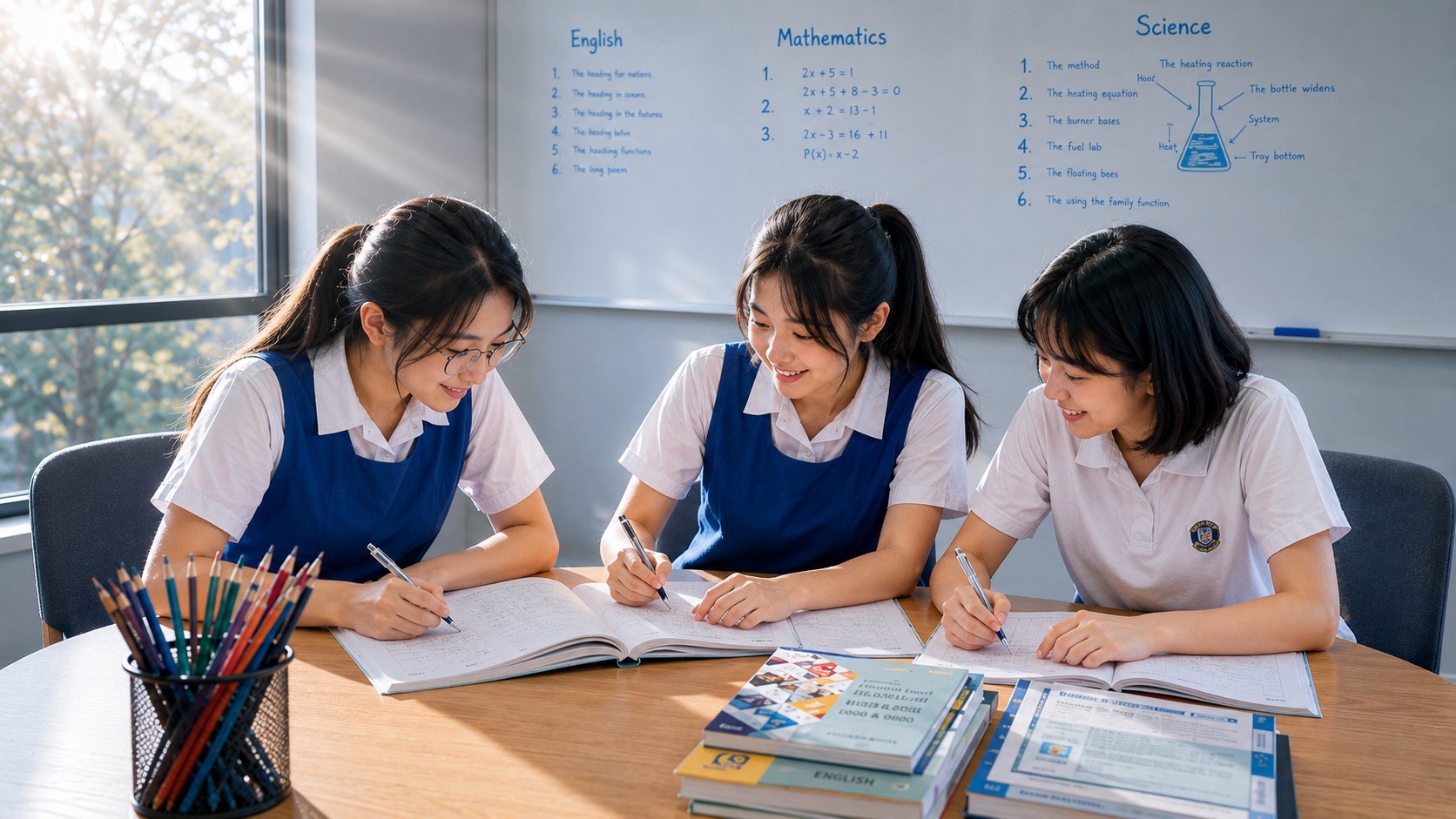
A Bukit Timah tutor teaching Secondary 2 Mathematics should help students recognise the shape before choosing a formula. For Pythagoras and mensuration, that means identifying a right angle, finding the hypotenuse, distinguishing a length from an area, and deciding which surfaces or spaces a question includes. Useful small groups tuition connects these decisions to clear working and independent checks. A student should know why squares are added or subtracted, which height belongs in a formula, and whether the answer needs centimetres, square centimetres or cubic centimetres.
Match the work to your child’s Mathematics subject level and current school programme. The MOE G1 syllabus and G2 and G3 syllabuses share Pythagoras at Secondary 2, while their mensuration coverage differs. This guide begins with foundations that support the topic, then labels work on pyramids, cones and spheres for the relevant G2/G3 programme. The original examples show parents what a helpful explanation looks like and give students a way to practise without guessing which formula comes next.
- First check: identify the student’s subject level, school topic sequence and recent mistakes.
- Pythagoras: use a² + b² = c² for a right-angled triangle, with c opposite the right angle.
- Missing side: add squares to find the hypotenuse; rearrange the same equation to find a shorter side.
- Mensuration: separate perimeter, area, surface area and volume before calculating.
- Level matching: secure prism and cylinder understanding; add the appropriate pyramid, cone and sphere work.
- Checking: inspect dimensions, units, included faces and the reasonableness of the result.
- Three-pupil support: expect each student to draw, explain, attempt and correct their own work.
- Parent decision: choose support that addresses a visible learning need and fits the child’s existing commitments.
EDUKATESINGAPORE · SECONDARY 2
Find your next learning step
Start with the section closest to your child’s current question, then continue through the worked examples.
Open the complete chapter index · Parent questions and next steps
Contents
Chapters 1–5
Chapters 6–10
CHAPTER 1 OF 15 · Find the starting point
1. Match the topic to the actual subject level
Secondary 2 Mathematics is not one identical list for every learner. Before choosing a worksheet, check the subject level recorded by the school. A child may need to strengthen a shared idea while working towards different content expectations.
| Subject level | Relevant content | How to use this guide |
|---|---|---|
| G1 | Pythagoras and checking for a right angle; prism and cylinder volume and surface area; square and cubic unit conversions. | Start with right triangles, units, prisms and cylinders. |
| G2 | Pythagoras and checking for a right angle; pyramid, cone and sphere volume and surface area. | Repair earlier mensuration knowledge, then connect it to the specified solids. |
| G3 | Pythagoras and checking for a right angle; pyramid, cone and sphere volume and surface area. Right-triangle trigonometric ratios also appear. | Use this guide for Pythagoras and mensuration; treat trigonometry as a separate topic. |
The table draws on the G1 document and G2/G3 document. It is a focused comparison, not a complete syllabus. In particular, excluding trigonometry from this article does not mean that it is absent from G3 Secondary 2.
Within that framework, use the school’s current teaching and assessment information to choose the immediate task. If a pupil is revising cylinders while classmates discuss cones, first establish whether they are following different programmes or whether earlier knowledge needs repair.
A useful tutor explains both the destination and the starting point. “We are checking unit conversions before returning to surface area” gives a parent something concrete to understand. “We must do harder questions” does not explain which learning connection is missing.
CHAPTER 2 OF 15 · Find the starting point
2. Diagnose the prerequisite before teaching the formula
A wrong Pythagoras answer may begin with arithmetic, shape recognition or an algebraic step. A wrong surface area answer may begin with counting the wrong faces. These are different problems. A short diagnostic should reveal the first uncertain decision.
Ask the student to calculate 6², √81 and 3² + 4². The answers are 36, 9 and 25. Then ask what √25 means. It is the non-negative number whose square is 25, so √25 = 5. Squaring and taking a square root are related operations; neither means multiplying or dividing by two.
Check the drawing as well as the number work
Show a right-angled triangle in an unfamiliar orientation. Ask the learner to point to the right angle and then the side opposite it. If they select the side that looks horizontal, return to the definition before using letters. A rotated diagram changes the appearance, not the geometry.
Next, ask what a question about wrapping a box would measure, and what a question about the space inside the box would measure. Wrapping concerns surface area; internal space concerns volume. The exact faces and dimensions still depend on the question, but the distinction should come before formula substitution.
A simple unit check is equally revealing: 2 m = 200 cm, but 2 m² is not 200 cm². Ask the student to explain why the second situation is different. If they cannot, squared units need a visual explanation before more conversion exercises.
Record a specific finding: “recognises the hypotenuse but forgets the square root,” or “knows each face area but includes the open top.” The next lesson can then address that decision. This is more useful than treating every incorrect answer as evidence that the whole chapter must be repeated.
CHAPTER 3 OF 15 · Find the starting point
3. Identify the right triangle and the hypotenuse
Pythagoras relates the three side lengths of a right-angled triangle. If a and b are the sides meeting at the right angle, and c is the opposite side, then a² + b² = c². The side c is the hypotenuse and is the longest side of that triangle.
The letters are labels, not fixed positions on the page. In another question, the hypotenuse might be named x, PQ or AB. Find the right angle first; the side across from it is the hypotenuse. Labelling it correctly protects every later step.
Understand what the squares represent
Imagine a square drawn outward on each side of the right triangle. Their areas are a², b² and c². Pythagoras states that the areas of the two smaller squares add to the area of the square on the hypotenuse. It does not state that the two shorter lengths add to the longest length.
For sides 3 cm, 4 cm and 5 cm, the areas are 9 cm², 16 cm² and 25 cm². The relationship is 9 + 16 = 25. Adding the lengths gives 3 + 4 = 7, which is a different calculation. The square-root step returns from a square’s area to the associated side length.
Do not decide that a triangle is right-angled just because the drawing looks close to a right angle. Look for a right-angle marker, a stated perpendicular relationship or information that proves it. Diagrams may not be drawn to scale.
A helpful teaching question is, “What in the question allows this formula?” The answer should identify the right angle. If that information is missing, the student needs further reasoning or a different method. Recognising a formula includes recognising the conditions under which it works.
Consider a right-angled triangle whose perpendicular sides are 8 cm and 15 cm. Let c be the hypotenuse. The equation is c² = 8² + 15² = 64 + 225 = 289. Therefore c = √289 = 17 cm.
The answer is 17 cm, not 289 cm and not 17 cm². The value 289 arose after squaring lengths; it represents c². The question asks for c, so taking the square root is necessary. This distinction should be visible in the working.
Use a quick size check
The hypotenuse must be longer than either perpendicular side. Seventeen is greater than fifteen and eight. It must also be shorter than their sum, twenty-three, because these lengths form a triangle. These checks do not replace the calculation, but they can catch an implausible result.
A different triangle has perpendicular sides 4 cm and 7 cm. Its hypotenuse is √(4² + 7²) = √65 cm, approximately 8.062 cm. If the task requests two decimal places, report 8.06 cm. Keep sufficient precision until the final answer, especially if the length will be used in another calculation.
The square root must apply to the complete sum. The expression √(16 + 49) is not equal to √16 + √49. The latter gives 11, which incorrectly adds the original side lengths. On a calculator, brackets and the displayed expression help check what was entered.
Ask the learner to explain the sequence without numbers: identify the hypotenuse, square the two perpendicular sides, add those squares, take the square root and state the length with its unit. Then rotate the diagram and change the values. Understanding should survive both changes.
CHAPTER 5 OF 15 · Use Pythagoras
5. Find a shorter side by rearranging the same relationship
Now suppose the hypotenuse is 13 cm and one perpendicular side is 5 cm. Let the other side be x. Start with the same relationship: x² + 5² = 13². Hence x² = 169 − 25 = 144, and x = 12 cm.
We subtract because we are finding one contribution to the square on the hypotenuse. The known hypotenuse square already represents the total. Adding 169 and 25 would answer a different question in which 13 cm and 5 cm were the two perpendicular sides.
Do not let a remembered instruction replace the diagram
Students sometimes remember “Pythagoras means add and square-root.” That incomplete rule works only when the unknown is the hypotenuse. Writing the equation first gives a more dependable method. The largest-side square stays alone on one side; rearrangement follows from what is unknown.
For a second example, a right triangle has hypotenuse 10 m and one perpendicular side 6 m. The remaining side satisfies b² = 10² − 6² = 64, so b = 8 m. Check: 6² + 8² = 36 + 64 = 100 = 10².
If the subtraction produces a negative value for a squared length, inspect the labels and information. A shorter side cannot exceed the hypotenuse. The correct response is to investigate, not to remove the negative sign to make the calculator accept the expression.
There is also a useful algebra distinction. The equation x² = 144 has algebraic solutions x = 12 and x = −12. Here x represents a side length, so the positive value is appropriate. Meaning determines which mathematical solutions fit the situation.
During practice, mix questions asking for the longest and shorter sides. Ask the student to state which type they have before calculating. That tests recognition rather than repetition of the last demonstrated procedure.
CHAPTER 6 OF 15 · Use Pythagoras
6. Check whether three lengths form a right triangle
The converse of Pythagoras allows us to test a triangle’s side lengths. First identify the longest side. Square it separately, then compare it with the sum of the squares of the other two sides. For a triangle, equality establishes that the angle opposite the longest side is a right angle.
Take lengths 7 cm, 24 cm and 25 cm. The comparison is 7² + 24² = 49 + 576 = 625, while 25² = 625. Since the values are equal, the triangle is right-angled, with the right angle opposite the 25 cm side.
For lengths 7 cm, 24 cm and 26 cm, the comparison gives 625 and 676. They are unequal, so this triangle is not right-angled. Do not force the longest side to become 25 merely because the other numbers resemble a familiar triple.
Check that a triangle is possible
Three positive lengths do not automatically make a triangle. The two shorter lengths must add to more than the longest. Lengths 1 cm, 2 cm and 4 cm fail this condition because 1 + 2 is less than 4. There is no triangle to classify. If the sum equals the longest length, the segments form a straight arrangement rather than a non-degenerate triangle.
The examples above use exact values. If lengths come from approximate measurements, a small discrepancy can reflect measurement and rounding. Follow the problem’s information: exact side lengths support an exact test, while measured data may require a conclusion that acknowledges their precision.
Ask students to explain the comparison in a sentence. “The two smaller squares sum to the largest square” is a mathematical reason. “It looks like a right triangle” is an observation about the drawing. Learning to separate them strengthens later geometry reasoning.
CHAPTER 7 OF 15 · Measure the shape
7. Find the missing height before calculating area
Pythagoras often supplies a length needed by another formula. A triangle’s area is half its base multiplied by its perpendicular height. A sloping side is not automatically that height. Before substituting, identify which length meets the chosen base at a right angle.
For a right triangle with perpendicular sides 5 cm and 12 cm, the hypotenuse is 13 cm, but its area is ½ × 5 × 12 = 30 cm². Using ½ × 12 × 13 would incorrectly treat the hypotenuse as perpendicular to the 12 cm base.
An original trapezium example
Consider an isosceles trapezium with parallel sides of 14 cm and 8 cm, and equal sloping sides of 5 cm. The shorter parallel side is centred above the longer one. Drawing perpendicular heights creates a central rectangle and two matching right triangles.
The difference between the parallel lengths is 14 − 8 = 6 cm. Each right triangle therefore has a horizontal side of 3 cm. Its hypotenuse is 5 cm, so the perpendicular height h satisfies h² = 5² − 3² = 16. Thus h = 4 cm.
Now calculate the trapezium’s area: ½ × (14 + 8) × 4 = 44 cm². The geometry came first: symmetry justified dividing the extra width equally, and Pythagoras supplied the perpendicular height. Only then could the area formula be used correctly.
If the trapezium were not stated to be isosceles or otherwise given that symmetry, the equal split would need justification. A drawing that appears balanced is insufficient evidence.
This is a useful lesson in sequencing. List the required output, identify the missing information and find the smaller problem that supplies it. Students need not see the complete solution immediately; they need a valid next step that moves towards the required area.
CHAPTER 8 OF 15 · Measure the shape
8. Separate the boundary, the surface and the space
Mensuration questions become clearer when the student names the quantity being measured. Perimeter measures a boundary’s length. Area measures a flat region. Surface area measures the combined area of specified surfaces. Volume measures three-dimensional space.
| Quantity | Example question | Typical unit |
|---|---|---|
| Perimeter | How long is the outer boundary? | cm |
| Area | How much of the flat region is covered? | cm² |
| Surface area | What is the area of the specified faces? | cm² |
| Volume | How much space does the solid occupy? | cm³ |
Imagine a 10 cm by 8 cm rectangle with a 4 cm by 3 cm rectangle removed from its top-right corner. The remaining L-shaped area is 80 − 12 = 68 cm². The boundary lengths are 10, 5, 4, 3, 6 and 8 cm, giving a perimeter of 36 cm.
The corner removal changes the area but leaves this particular perimeter equal to the original rectangle’s perimeter. The removed outer lengths are replaced by equal inner lengths. This is a feature of the stated shape, not a rule that cutting material never changes a perimeter.
If the same 4 cm by 3 cm rectangle were removed as an interior hole, the remaining area would still be 68 cm². However, the combined length of the outer boundary and the hole’s boundary would be 36 + 14 = 50 cm. Read whether the question asks for the outer boundary alone or all exposed edges.
For composite figures, label missing lengths and trace the required boundary before adding. For area, divide into non-overlapping regions or subtract a clearly defined missing region. Explain the partition so that the working can be checked against the diagram.
CHAPTER 9 OF 15 · Measure the shape
9. Build prism calculations from the cross-section
A prism has the same cross-sectional shape and size along its length. Its volume is cross-sectional area multiplied by the perpendicular distance between the parallel end faces. This gives the calculation a meaning: the cross-sectional area is extended through the prism.
Take a right prism whose triangular cross-section is a right triangle with perpendicular sides 6 cm and 8 cm. The prism is 12 cm long. The triangle’s third side is √(6² + 8²) = 10 cm, and its area is ½ × 6 × 8 = 24 cm².
The volume is 24 × 12 = 288 cm³. The 10 cm side was not needed for that volume calculation. It becomes useful when finding the surface area because one rectangular face has width 10 cm.
Count the faces explicitly
The closed prism has two triangular ends, each with area 24 cm². Its three rectangular faces have areas 6 × 12 = 72 cm², 8 × 12 = 96 cm² and 10 × 12 = 120 cm². Total surface area is 48 + 72 + 96 + 120 = 336 cm².
For this right prism, the rectangular face areas can also be grouped as the triangle’s perimeter multiplied by prism length: (6 + 8 + 10) × 12. The grouped method is efficient, but students should understand which faces it represents.
If a face is absent or joined to another solid, the surface calculation must be adjusted. Volume does not require adding face areas, and surface area does not require multiplying three dimensions together. Ask the learner to name the object represented by each term.
A simple paper net can support this reasoning. Mark each face once, label its dimensions and match it to the corresponding calculation. The net is useful because it exposes omitted or double-counted surfaces.
CHAPTER 10 OF 15 · Understand the solid
10. Distinguish a cylinder’s volume from its curved surface
For a cylinder of radius r and perpendicular height h, the volume is πr²h. The circular cross-section has area πr², which extends through height h. A cylinder with radius 3 cm and height 10 cm therefore has volume π × 3² × 10 = 90π cm³, approximately 282.7 cm³ to one decimal place.
The curved surface uses a different relationship. Unrolling it produces a rectangle with length equal to the base circumference, 2πr, and width equal to h. Its area is therefore 2πrh. For this cylinder, the curved surface area is 2π × 3 × 10 = 60π cm².
Read which ends are included
A closed cylinder has two circular ends. Their combined area is 2πr² = 18π cm², so the total surface area is 60π + 18π = 78π cm², approximately 245.0 cm² to one decimal place.
If the model is an open-top container with one circular base, the material area is 60π + 9π = 69π cm², approximately 216.8 cm². These calculations treat the surface as having negligible thickness. A question with substantial wall thickness would need additional dimensions and a more detailed model.
Check whether the given circular measurement is the radius or diameter. A diameter of 6 cm gives a radius of 3 cm. Substituting six as the radius would multiply the circular area by four, not merely two.
Follow any instruction about π and rounding. If no specific approximation is supplied and a decimal answer is required, using the calculator’s π value avoids unnecessary early rounding. When an exact answer in terms of π is requested, keep it in that form.
Parents can ask one revealing question: “Which part of the cylinder does each term measure?” A student who explains the curved rectangle and circular ends is doing more than recalling a formula.
CHAPTER 11 OF 15 · Understand the solid
11. Use the correct height for pyramids and cones

Open the full-size teaching diagram.
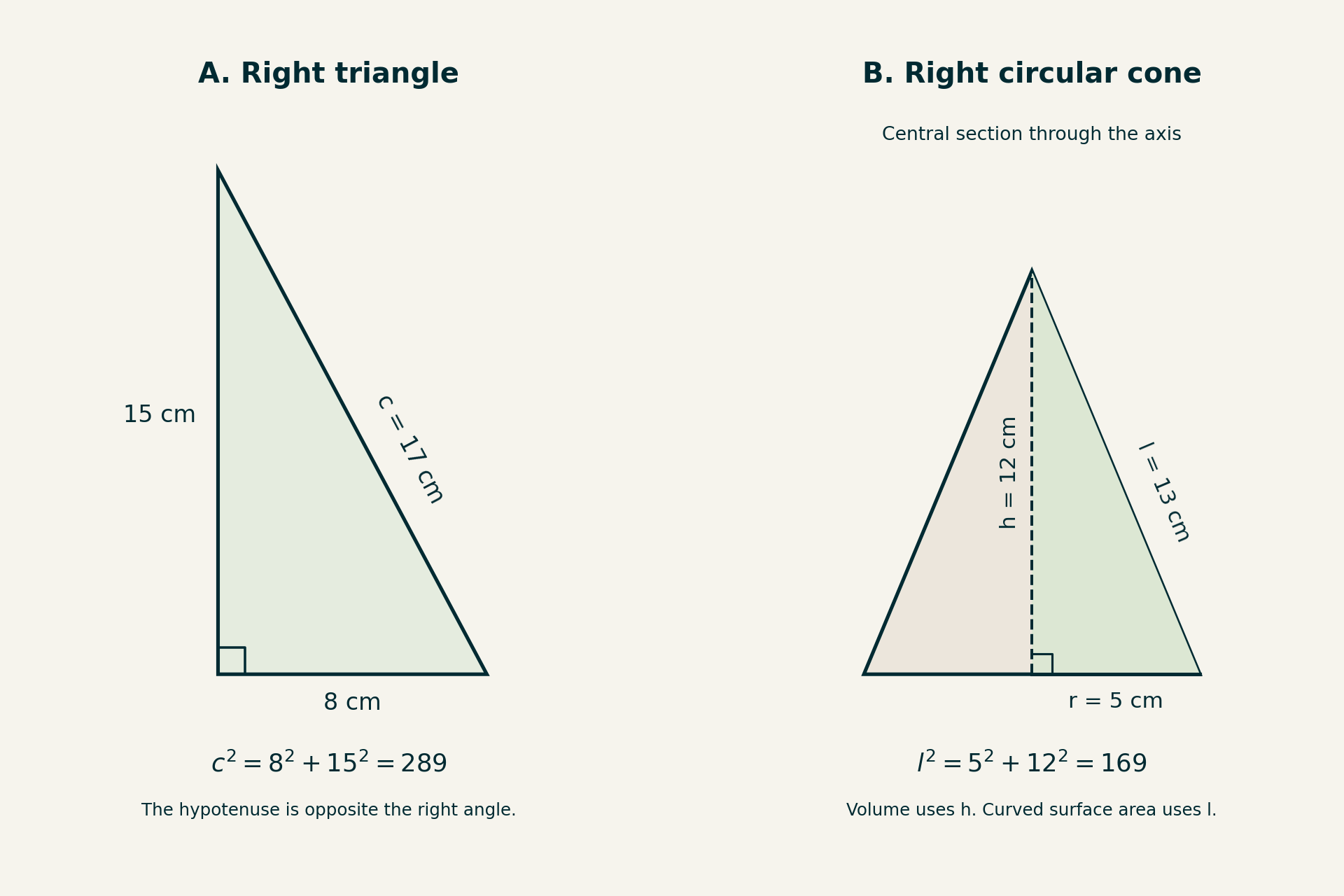
This section develops the pyramid and cone content relevant to the G2/G3 programme. The central distinction is between perpendicular height and a sloping length. Volume uses the perpendicular height from the apex to the base plane. Surface calculations may require a face’s slant height instead.
A right square pyramid
Suppose a square pyramid has base side 6 cm and its apex is directly above the centre, 4 cm above the base. From the centre to the midpoint of one base side is 3 cm. The slant height of the corresponding triangular face is √(4² + 3²) = 5 cm.
The volume is one-third of base area multiplied by perpendicular height: ⅓ × 6² × 4 = 48 cm³. Each triangular face has area ½ × 6 × 5 = 15 cm². Adding four such faces and the square base gives a total surface area of 4(15) + 36 = 96 cm².
The face slant height ends at a side’s midpoint. It is not the sloping edge from the apex to a corner. Those lines should not be exchanged simply because both appear diagonal.
A right circular cone
For a cone with radius 5 cm and perpendicular height 12 cm, the slant height l is √(5² + 12²) = 13 cm. Its volume is ⅓πr²h = ⅓π(25)(12) = 100π cm³.
The curved surface area is πrl = π(5)(13) = 65π cm². Including the circular base gives 65π + 25π = 90π cm². The 12 cm height belongs in the volume formula; the 13 cm slant height belongs in the curved surface formula.
Draw the internal right triangle before calculating. Mark its perpendicular sides and hypotenuse, then connect the required length to the relevant formula. This prevents one remembered “height” from being inserted into every calculation.
CHAPTER 12 OF 15 · Understand the solid
12. Handle spheres and joined solids without double counting
For a sphere of radius r, surface area is 4πr² and volume is ⁴⁄₃πr³. A sphere of radius 2 cm therefore has surface area 16π cm² and volume 32π/3 cm³. The powers of r reflect the different dimensions of area and volume.
A hemisphere contains half the sphere’s volume and half its curved surface. Its flat circular face is an additional surface if the question includes it. For radius 3 cm, the hemisphere’s volume is 18π cm³, its curved area is 18π cm², and its circular base has area 9π cm².
Identify the exposed surfaces of a composite solid
Imagine a solid made from a cylinder of radius 3 cm and height 8 cm, topped by a hemisphere of the same radius. The shapes meet exactly along a circular face. The total volume is the cylinder volume plus hemisphere volume: π(3²)(8) + 18π = 90π cm³.
For the exterior surface area, include the cylinder’s curved wall, the hemisphere’s curved surface and the cylinder’s flat bottom. Their areas are 48π, 18π and 9π cm², giving 75π cm². The joined circle is inside the solid and contributes no exposed area.
Adding the complete surface areas of both separate pieces would count the hidden joining faces. Before calculating, imagine tracing the outside with a finger and name the surfaces encountered. A simple labelled sketch makes the decision visible.
This combination is an application for learners working with these solids, not a compulsory starting exercise for every subject level. Students who are still securing cylinder calculations should practise those first. When combining shapes, the new challenge should be the connection between them, rather than several unresolved formula difficulties at once.
Length, area and volume conversions use different powers. One metre equals one hundred centimetres. A square measuring one metre by one metre therefore measures one hundred centimetres by one hundred centimetres: 1 m² = 10,000 cm².
A cube with side one metre has dimensions one hundred centimetres in all three directions, so 1 m³ = 1,000,000 cm³. The extra factors come from the additional dimensions, not from an arbitrary conversion rule.
Thus 0.75 m² = 7,500 cm², and 0.004 m³ = 4,000 cm³. For capacity, 1 cm³ corresponds to 1 millilitre and 1,000 cm³ to 1 litre. A capacity of 2,400 cm³ is therefore 2.4 litres.
Convert before combining incompatible measurements
A cuboid measures 30 cm by 20 cm by 0.5 m. Convert 0.5 m to 50 cm before multiplying in centimetres. Its volume is 30 × 20 × 50 = 30,000 cm³. Alternatively, using metres throughout gives 0.3 × 0.2 × 0.5 = 0.03 m³. The two answers represent the same volume.
Scaling offers a related reasoning exercise when it fits the current lesson. If every length of a shape is multiplied by two, its areas multiply by four. For a similarly enlarged solid, volumes multiply by eight. Doubling only one dimension is a different change and does not justify those factors.
Use a cube to see this directly. Increasing its side from 2 cm to 4 cm changes one face area from 4 cm² to 16 cm² and its volume from 8 cm³ to 64 cm³. A student who understands this can question an answer claiming that doubling every length merely doubles the volume.
End every calculation with a dimensional check: did the question ask for a length, an area, a volume or a capacity? The written unit should match that quantity.
Attempt these questions before reading the answers. The first four practise foundations and prism/cylinder-related reasoning. The final two extend into the pyramid and cone work discussed above. Choose questions that match the student’s current programme; these are teaching examples, not official school examination questions.
- A right triangle has perpendicular sides of 9 cm and 12 cm. Find its hypotenuse and area.
- A right triangle has hypotenuse 10 cm and one perpendicular side 6 cm. Find the other side.
- A triangle has sides 6 cm, 8 cm and 11 cm. Is it right-angled? Explain.
- A closed cylinder has radius 2 cm and height 9 cm. Find its volume and total surface area in terms of π.
- A right circular cone has radius 3 cm and perpendicular height 4 cm. Find its slant height, volume and total surface area.
- A square pyramid has base side 10 cm. Its apex is directly above the base centre, at a perpendicular height of 12 cm. Find its face slant height, volume and total surface area.
Worked answer checks
1. The hypotenuse is √(9² + 12²) = √225 = 15 cm. The area is ½ × 9 × 12 = 54 cm². The two perpendicular sides provide the base and height for this area calculation.
2. The missing side is √(10² − 6²) = √64 = 8 cm. Check that 6² + 8² = 10². The result is shorter than the hypotenuse.
3. The longest side is 11 cm. Since 6² + 8² = 100 but 11² = 121, the triangle is not right-angled. The side lengths do form a triangle because 6 + 8 exceeds 11.
4. Volume is π(2²)(9) = 36π cm³. Total surface area is 2π(2)(9) + 2π(2²) = 36π + 8π = 44π cm².
5. Slant height is √(3² + 4²) = 5 cm. Volume is ⅓π(3²)(4) = 12π cm³. Total surface area is π(3)(5) + π(3²) = 24π cm².
6. The face slant height is √(12² + 5²) = 13 cm. Volume is ⅓(10²)(12) = 400 cm³. Total surface area is 100 + 4(½ × 10 × 13) = 360 cm².
When reviewing, identify the first incorrect decision. Was it the selected side, the perpendicular height, the formula, a missing face or the arithmetic? Correct that decision, then try a new question without copying the previous solution.
CHAPTER 15 OF 15 · Apply and check
15. Choose support that makes the reasoning visible
In a three-student tutorial, each learner should do more than watch a diagram being labelled. Ask how every pupil will identify the required quantity, attempt a solution and explain a check. One student might reconstruct a net, another explain a missing height and another compare two methods, with roles changing as they learn.
Group work still needs individual assessment. A student who follows a friend’s explanation may not yet recognise the same structure alone. A fresh closing question can show whether the lesson has become usable knowledge. Feedback should identify what the student managed independently and what still needs support.
Bring evidence to the conversation
Bring the current school topic list, recent marked work and one question the child could not begin. Ask the tutor which prerequisite they would check first, how the group matches the child’s subject level and how practice will fit existing school commitments. Confirm current fees, availability and lesson arrangements directly through the eduKate contact page.
For Bukit Timah families, include the whole journey in planning: school dismissal, CCA, travel and the return home. At home, a short task with one deliberate check can be useful. Ask your child to name the quantity, justify the formula and explain whether the answer makes sense.
Keep the assessment context accurate. SEAB’s SEC information concerns the national examination introduced from 2027, with subjects taken at their respective levels. A Secondary 2 school assessment must be prepared for using the school’s actual coverage and instructions. A tutor’s practice score does not decide a school subject-level change.
For another way to connect quantities and representations, continue with the Secondary 2 linear graphs and simultaneous equations guide. The shared habit is to understand what each number represents before operating on it.
Official sources
- MOE G1 Mathematics syllabus — the relevant Secondary 2 curriculum.
- MOE G2 and G3 Mathematics syllabuses — level-specific content and progression.
- SEAB Secondary Education Certificate — national examination context.