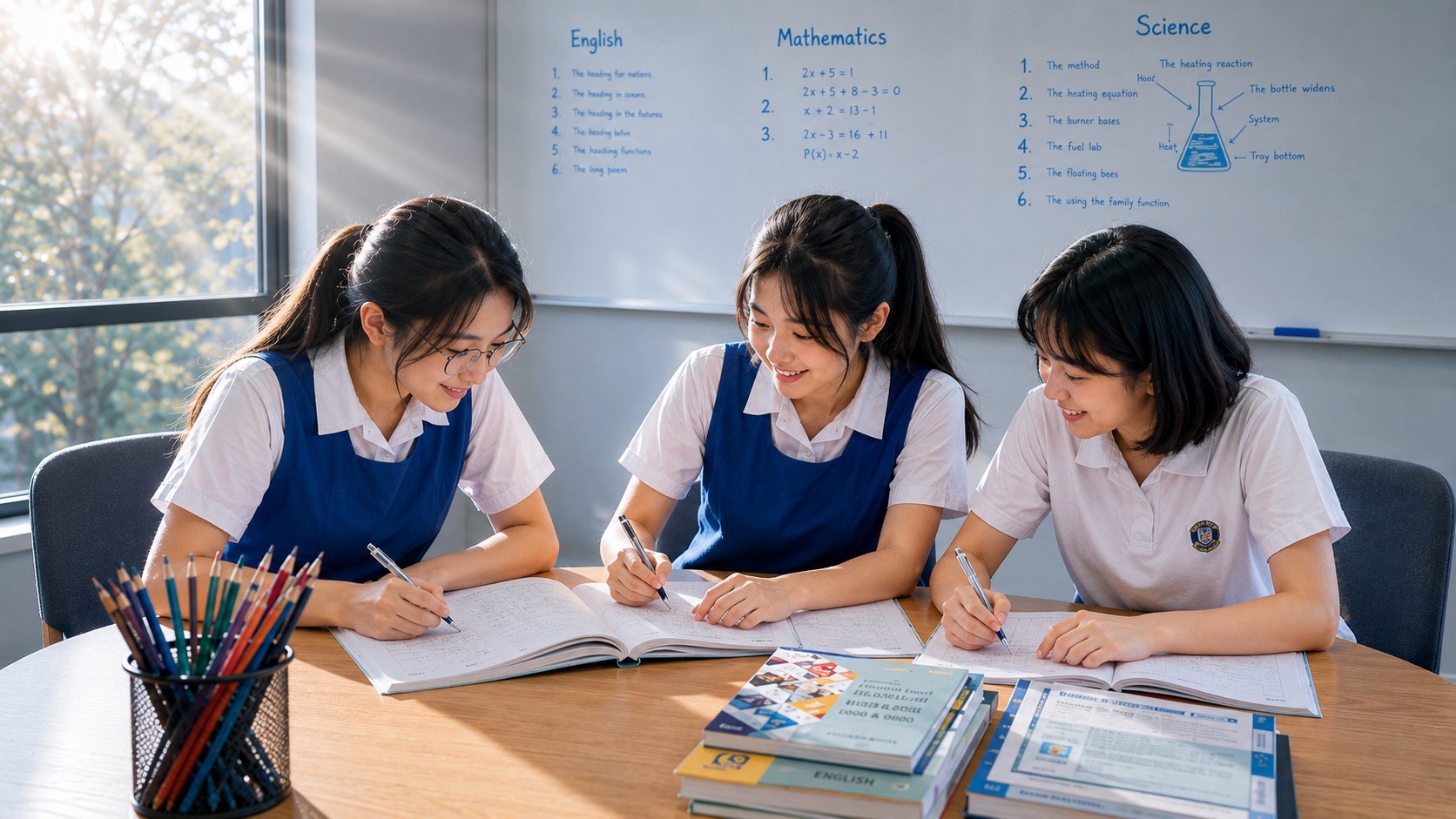
A Bukit Timah tutor for Secondary 2 History should help students explain what a historical source supports, how they know and where the evidence stops. Historical sources and evidence small groups tuition can focus on reading documents, interpreting images, making supported inferences and comparing accounts. The useful starting point is a marked school answer: does your child misunderstand the source, select weak evidence, miss its context or struggle to express the reasoning? Those difficulties require different teaching, even when they produce the same test score.
Start with the school’s History programme and the student’s actual subject level. G2 and G3 History must be distinguished from History exposure within G1 Humanities. Schools set their Secondary 2 assessments and teaching sequence; there is no separate national Secondary 2 SEAB History examination. This guide uses short, attributed examples from Singapore’s public heritage collections to teach transferable reading habits. A three-student lesson can make room for individual explanation and correction, but families should confirm current subject provision, tutor suitability and available places directly.
- Begin with the question: decide what the source is being used to investigate.
- Identify its origin: check creator, date, form, audience and circumstances where these are known.
- Separate layers: an original document, its modern caption and a later historian’s explanation are different pieces of evidence.
- Support each inference: connect a precise detail to a conclusion that the detail can justify.
- Compare on a shared issue: explain a meaningful similarity or difference, rather than summarising two sources separately.
- Judge a specific claim: reliability and usefulness depend on the question being asked.
- Practise independently: check whether the student can improve a fresh answer without being supplied every sentence.
EDUKATESINGAPORE · SECONDARY 2
Find your next learning step
Start with the section closest to your child’s current question, then continue through the worked examples.
Open the complete chapter index · Parent questions and next steps
Contents
Chapters 1–5
Chapters 6–10
History involves reconstructing and explaining a past that students cannot directly revisit. They work with surviving traces, accounts and later interpretations. An answer becomes stronger when it distinguishes what is stated, what is inferred and what remains uncertain. That distinction can be taught through a short paragraph or image; it does not require a large pile of additional notes.
The MOE lower-secondary G2 and G3 History syllabus includes historical inquiry, interpreting sources, drawing inferences, comparing views and communicating understanding. The level of detail required in a particular school task should come from its instructions and teacher feedback. The exercises here develop those skills without claiming to reproduce a school’s marking scheme.
For a student taking G1 Humanities, begin with the Social Studies and Humanities Exposure Modules syllabus and the actual module being taught. History exposure is not an identical standalone G1 version of G2 or G3 History. An appropriate tutor selects the depth, vocabulary and task that fit the pupil.
Ask for the current chapter, the latest assessment instructions and one ordinary piece of classwork. A student can produce a weak source answer because the historical setting is unfamiliar, even when their general English is strong. Another may know the events well but never explain how the selected evidence supports the point.
Identify one priority before designing a programme. It might be distinguishing observation from inference, understanding what a comparison question asks or writing an explanation after a quotation. The wider Secondary 2 History guide provides the broader subject introduction. This article concentrates on the work between reading a source and producing a justified answer.
CHAPTER 2 OF 15 · Identify the evidence
2. Let the inquiry question guide the reading
The same document can answer one question well and another poorly. Before analysing its details, identify the historical issue being investigated. A speech can reveal what its speaker publicly argued. It may offer less direct evidence of how every listener reacted. A photograph can show a scene within its frame, but not everything happening outside it.
Underline the focus of the question and turn it into plain language. “What can you infer about…” asks the student to draw a supported conclusion. “How similar…” requires a comparison. “How useful…” requires considering what the source contributes to a specified inquiry. Treating every question as “write everything you remember” leads to long answers with little direction.
Next divide the task into what must be established. If the issue concerns public reaction, ask which evidence actually records reaction. If it concerns a policy’s stated aim, look for a declaration of that aim. If it concerns an outcome, search for evidence of what happened after the policy was introduced.
A student might read a confident announcement and conclude that the announced plan succeeded. The announcement establishes an intention or claim; success requires suitable outcome evidence. This is a useful teaching moment because the source has been read correctly at the sentence level but used to answer a different question.
During practice, ask the student to finish two sentences before writing the answer: “The question wants me to establish…” and “This source can help because…”. The wording need not appear in the final response. It is a check that the reading has a purpose.
When a source seems irrelevant, return to the inquiry before discarding it. A source may contribute background, a contrasting perspective or a limitation. However, an interesting detail should not be forced into the answer merely because the student knows something about it.
CHAPTER 3 OF 15 · Identify the evidence
3. Separate the original record from its modern presentation
Online historical material usually contains several layers. There may be an original object, a catalogue description, a modern explanatory article and links to related records. Students should identify which layer supplies each claim. A date at the top of a webpage may be its publication date rather than the date of the historical event.
The National Archives of Singapore presentation of the Proclamation of Singapore is a useful example. Its article is dated 14 August 2015, while the reproduced proclamation is dated 9 August 1965. The archive’s accompanying discussion also draws on E. W. Barker’s later oral history recollection. The original document, the interview and the 2015 explanation should not be treated as one source created at one moment.
For practice, make a three-column record: item, date and what it can help establish. This does not require copying a full catalogue entry. It requires noticing whether the student is examining a contemporaneous document, a later memory or a present-day description of an older object.
Use careful attribution in answers. “The document states…” means something different from “The archive’s explanation notes…”. “The interviewee recalled…” identifies a remembered experience rather than pretending that the interview was recorded during the event. These small verbs make the evidence chain visible.
Missing information should remain missing. If the available caption does not identify a photographer, do not invent one. If a source was translated, abridged or reproduced, retain that information when it matters to the question. An adapted school extract is useful, but the learner should understand that it may represent only part of the original.
The aim is not to burden every paragraph with bibliographic detail. It is to prevent a confident argument from resting on the wrong date, the wrong author or the mistaken belief that a modern summary was an eyewitness account.
CHAPTER 4 OF 15 · Build an interpretation
4. Make an inference that the evidence can support
An inference goes beyond repeating a source, but it remains connected to identifiable evidence. The student needs to explain that connection. A sentence such as “This shows life was difficult” is too broad unless the source contains a relevant detail and the answer explains what kind of difficulty that detail indicates.
Consider the National Heritage Board’s record of Chua Mia Tee’s National Language Class. The catalogue dates the painting to 1959 and describes Chinese students learning Malay. This can support an inquiry into how language learning and national identity were represented in art. It cannot, by itself, establish how many residents attended such classes or whether every learner felt the same way.
That distinction gives students a practical test. Ask whether the conclusion is about what is represented, what occurred in the whole population or what someone privately believed. A source may support the first strongly while giving limited evidence for the others. The answer should match the strength and scale of the evidence.
Build the explanation in three steps. State a relevant inference. Identify a precise detail. Explain why that detail supports the inference. These are thinking steps, not a rule that every answer must contain exactly three sentences. The school’s question and available marks determine the appropriate length.
Compare “The source shows unity” with “The source presents people engaged in a shared activity, which suggests the creator wanted to emphasise participation around that activity.” The second is more specific, although the proposed intention would still need checking against provenance and context. Stronger wording does not remove the need for evidence.
Teach uncertainty as part of accuracy. “Suggests” can be appropriate when the conclusion is inferential. “Proves” is usually too strong for a broad claim based on one limited source. The goal is confident reasoning with properly sized claims.
Context is the relevant historical setting that helps explain a source. It may include events, institutions, social conditions or the choices available at the time. It should illuminate the source rather than replace it with an unrelated account of the whole chapter.
Start with a short timeline around the source. What had already happened? What was happening when it was produced? Which later developments were still unknown to its creator? This helps students avoid reading the past as though everyone already knew the outcome.
Then examine the language in its setting. A phrase might refer to a particular policy, dispute or public concern. If the student does not understand that reference, a literal reading may miss the point. Relevant knowledge can explain why the source emphasises one problem and leaves another unmentioned.
Be careful with hindsight. A plan that later failed may have appeared plausible when it was announced. A decision that later became important may initially have seemed uncertain. Historical explanation asks what people could know and what constraints they faced, rather than judging every decision solely by the eventual result.
Parents can help with a simple question: “What would someone at that time have known?” The student can then distinguish evidence available to the historical actor from knowledge acquired by later readers. This is particularly useful when analysing announcements, predictions and remembered experiences.
Use context selectively in written answers. One accurate sentence connecting the source to a relevant event can be more valuable than a long paragraph of dates. If a contextual claim is uncertain, verify it before using it to evaluate the source. Unsupported background does not become stronger merely because it appears beside an authentic document.
A useful correction exercise is to remove each background sentence temporarily. If the argument becomes no less clear, that sentence may not be doing necessary work. Restore only the context that helps explain the evidence or answer the question.
CHAPTER 6 OF 15 · Build an interpretation
6. Distinguish purpose from audience and outcome
Audience means the people a source was intended to reach. Purpose concerns what its creator hoped to achieve. Outcome concerns what actually happened. These ideas are connected, but they are not interchangeable. A persuasive message does not prove that its audience was persuaded.
The National Museum’s 1958 poster for The True Story of Ah Q, documented on Roots, provides a clear starting point. The catalogue identifies it as advertising for a Mandarin film. That supports a claim about promotional purpose. The existence of the poster alone does not establish ticket sales, the size of its audience or whether viewers enjoyed the film.
For other sources, purpose may need to be inferred. Look at the creator’s position, the content selected, the tone and the occasion. Ask what response the source appears designed to encourage. Avoid assigning a motive simply because the writer belonged to a particular group.
A student may write, “The purpose was to inform.” Ask what information was being communicated and why it mattered to that audience at that moment. Sometimes informing is part of a larger aim: explaining a decision, encouraging participation, defending an action or securing support. The answer needs evidence for the more specific interpretation.
Also consider that a source may serve more than one purpose. An announcement can provide practical information while presenting its issuer positively. Recognising that possibility should lead to closer reading, rather than an automatic verdict that the whole source is false.
A useful classroom routine is to label three separate questions: Who was meant to encounter this? What response may have been intended? What evidence would show the actual response? Students learn to avoid using an intended effect as though it were an observed result.
A comparison needs a common basis. Two sources may concern the same event yet discuss different aspects of it. One might describe an official decision; another might describe a family’s experience. Their differences do not automatically mean that one contradicts the other.
Begin by naming the issue being compared. It could be the scale of a problem, attitudes towards a policy, a proposed cause or the experience of a particular group. Find what each source says about that issue before drafting the answer.
A weak response often contains two separate summaries: “Source A says this. Source B says that.” The reader is left to work out the relationship. Improve it by stating the comparison directly, then using relevant evidence from each source and explaining the connection.
For example, an answer might establish that both accounts recognise disruption, while emphasising different consequences. One could focus on immediate practical difficulties and the other on longer-term change. The shared point and the difference should be identified precisely; “both are about Singapore” does little analytical work.
Check whether apparent disagreement comes from different dates, locations or definitions. One source may describe conditions before a change and another afterwards. One may count households while another counts individuals. Without checking those details, a student may announce a contradiction where none exists.
Where sources genuinely differ, ask what might account for the difference. Their creators may have had different access to information, responsibilities, interests or experiences. Such an explanation should be supported by provenance and context, not guessed from stereotypes.
A useful planning table has four entries: comparison issue, evidence from the first source, evidence from the second, and the relationship. This keeps the student focused on comparison rather than producing two memorised source descriptions. Use the table during practice; the final answer can be connected prose.
“Is this source reliable?” becomes more useful when followed by “for which claim?” A record may be dependable evidence of what someone said while offering uncertain evidence that every statement they made was true. Reliability should be considered in relation to the information being used.
The National Library’s account of the Bukit Ho Swee fire dates the disaster to 25 May 1961 and states that its cause remains unknown. That is an important boundary. A student should not turn an appealing story about the fire’s ignition into an established fact simply because the story offers a neat explanation.
Ask how the creator could know the claim. Were they present? Did they have access to relevant records? Were they reporting another person’s words? Did the source distinguish observation from rumour? These questions help the student investigate the route by which information reached the source.
Timing also matters, but not mechanically. A contemporary account may contain immediate observation and incomplete information. A later account may benefit from more records while being affected by memory or subsequent interpretation. Neither date alone settles the judgment.
Look for a reasoned conclusion rather than an absolute label. “This is useful evidence of the speaker’s stated position, but it does not independently verify the outcome” is more precise than “reliable because it is official”. Likewise, “unreliable because it is biased” leaves the actual claim unexamined.
When students use another source to check a claim, require a clear connection. What exact point agrees or disagrees? Is the checking source well placed to know? Do both ultimately rely on the same information? The quality of the check matters more than the mere presence of a second citation.
An answer can reasonably reach a qualified judgment. Historical evidence is often partial. The task is to explain how much weight the source can bear, rather than pretend every record is either entirely trustworthy or entirely worthless.
Usefulness concerns what a source contributes to a particular investigation. A source can be valuable even when it has limitations. An advertisement can reveal an attempt to persuade. A selective account can show the emphasis its creator wanted to give. The limitation becomes part of the interpretation.
An archived speech delivered by Dr Lee Boon Yang at a hotel fire-safety seminar on 6 March 1989 refers back to the Bukit Ho Swee fire. Its setting makes it useful for investigating how a past disaster was invoked in a later safety discussion. It is not a contemporaneous report written during the 1961 fire. The event date and the speech date answer different questions.
To evaluate usefulness, identify a contribution and explain its relevance. Then identify a specific limit and explain how it affects the inquiry. “It does not tell us everything” is true of almost every source and adds little. “It describes the official position but provides no direct testimony from affected families” is more informative.
Next consider what additional evidence would address that limit. Do not simply request “more sources”. Name the kind of record needed: personal testimony, administrative records, later outcomes or another perspective. Explain what that additional material could establish.
A strong answer avoids moving from limitation to total rejection. If a source cannot answer a question about private feelings, it may still help establish a public statement or official priority. Keep the judgment linked to the investigation rather than grading the source’s overall worth.
This approach also helps parents assess tuition feedback. Useful feedback identifies what an answer already contributes, where its evidence is insufficient and how the student could improve it. A large cross beside a paragraph does not teach those distinctions by itself.
Corroboration means checking a claim against other relevant evidence. Agreement can strengthen an interpretation, but several webpages repeating one original report are not several independent observations. Students need to follow the information back far enough to understand whether they are checking one source against itself.
The National Library’s BiblioAsia article Stories of the Little People discusses both the value and the difficulties of oral history. Among its examples is a remembered suggestion about the Bukit Ho Swee fire’s cause, followed by the warning that the actual cause was not established. The article is a later discussion of testimony; it should not be presented as the original interview.
For any corroboration exercise, write down the exact claim being checked. Then list where each source obtained its information. A newspaper may quote a government announcement. A modern museum page may reproduce the same announcement. Their agreement confirms consistent reproduction, but it does not create a new eyewitness to the underlying event.
Independence does not guarantee correctness either. Two people can separately make the same mistake. Consider their access, the specificity of their observations and whether other evidence supports them. The aim is to build a reasoned account, not count votes among documents.
Oral history deserves careful listening. A person’s account can illuminate experience, language and remembered priorities. Specific factual details may still need checking. Respecting an interviewee and evaluating a particular claim are compatible activities.
In a lesson, ask one student to identify the claim, another to trace the source relationship and a third to propose a meaningful check. Rotate the roles. This makes corroboration a concrete reasoning task rather than a sentence beginning “Source B agrees, therefore Source A is reliable”.
CHAPTER 11 OF 15 · Read with care
11. Read visual sources without inventing what they show
Images can feel immediately convincing because students can see them. Yet a visual source still has a creator, a frame, a date and a purpose. A photograph records what was within its frame at a particular moment. A painting or poster involves additional choices about representation. Each form needs appropriate questions.
Roots catalogues a photograph of a crowd at a Singapore People’s Alliance rally in 1959. Its title and date establish the catalogue’s identification of the scene. A crowd photograph does not, by itself, establish how everyone pictured voted, whether all were supporters or the balance of opinion across Singapore.
Before inferring attitudes, identify visible evidence carefully. Avoid claiming to recognise an emotion that the image does not clearly establish. If a face is indistinct, say so. If the photograph is cropped, recognise that the original scene may have been wider. A caption can help, but students should distinguish its information from what they can independently observe.
Ask what is included and what is absent. Who appears? What action or setting is visible? What does the composition emphasise? Absence requires caution: a person missing from one photograph was not necessarily absent from the event. The frame is a selection, not a complete inventory.
When a worksheet supplies only a small reproduction, do not demand conclusions that depend on unreadable details. The learner can identify the limit and use the available provenance. If the original is accessible, compare it with the reproduction and check whether cropping or resolution affects interpretation.
Practice can begin with a two-column note: “visible in the image” and “information supplied by the caption”. Add a third column for inferences. That separation makes it easier to detect when a plausible story has entered the answer without supporting evidence.
A timeline places events in order. Causation explains how and why one development contributed to another. Consequences concern what followed from an event or decision. These are related tasks, but a sequence alone does not prove a causal relationship.
If two events occur close together, ask what connects them. What action, pressure, resource or change links the earlier event to the later outcome? Without a mechanism, “this happened, then that happened” remains chronology. A strong explanation makes the connection visible.
Distinguish an immediate trigger from a background condition. A long-standing problem may make a society vulnerable, while a particular event brings the problem to a crisis. Different causes can operate together. Students should avoid searching for one dramatic sentence that replaces a more complex explanation.
Also separate an outcome from a claim made about that outcome. An announcement that help will be provided records a commitment. Evidence of delivery is needed to assess what followed. Different groups may experience the same change differently, so one account may describe an improvement while another reveals continuing difficulty.
Use a simple planning sequence: condition, event, response, outcome and remaining problem. It is not a compulsory essay structure. It is a way to check whether the student has skipped the steps that connect evidence to a conclusion.
For significance, ask why a development matters to the inquiry. Was its impact extensive, lasting or important for a particular group? Support the judgment with relevant evidence. “It was important because it changed history” repeats the claim without explaining it.
When revising, encourage the student to replace vague connectors with precise relationships. “This increased pressure on…”, “This created an opportunity for…” and “This limited the choices available to…” can clarify an explanation when the evidence supports them. The wording must express a real connection rather than decorate an unsupported argument.
CHAPTER 13 OF 15 · Improve the answer
13. Practise improving an answer in visible steps
Improvement is easier when students can see what changed. Keep the first attempt, identify one weakness and rewrite only what needs attention. The aim is to improve the reasoning, not to replace the pupil’s voice with a polished paragraph supplied by an adult.
For a short authentic-source exercise, use the NAS page Berita Singapura: Singapore Grand Prix, 1966. The modern page is dated 17 September 2015 and presents archival material associated with the 1966 event. Ask: “Does the webpage’s date mean the pictured event happened in 2015?” A supported answer distinguishes the modern publication date from the date of the historical material.
Next use an unfamiliar source supplied by the teacher and complete the following review. First, underline the answer’s main claim. Second, mark the evidence used. Third, locate the explanation connecting them. If any part is absent, the student knows what to repair.
| What appears in the answer | What needs attention | A useful revision |
|---|---|---|
| A quotation with no explanation | The evidence has not been connected to the claim | Explain what the detail suggests about the question |
| A broad statement about everyone | The conclusion exceeds the source’s reach | Limit the claim to the people, place or view supported |
| Two separate source summaries | The comparison is left unstated | Name the shared issue and explain the relationship |
| “Biased, therefore useless” | The judgment ignores the inquiry | Identify what the source reveals and what needs checking |
After revision, give a fresh source with a similar skill demand. This checks whether the student can use the correction beyond the original paragraph. Later, change the format: move from a written extract to a captioned image, or from an inference question to a comparison. The learner must decide which parts of the earlier method still apply.
A model answer should explain its choices. Ask why one detail was selected and another left out. Ask which sentence would become unsupported if the evidence changed. This turns the model into an example of reasoning rather than a paragraph to memorise for a different question.
CHAPTER 14 OF 15 · Improve the answer
14. Use three-pupil lessons and home practice purposefully
In a three-student lesson, everyone should have time to attempt an answer independently. The tutor can then compare how students approached the same source. One may misread its date, another may overstate an inference, and a third may choose good evidence but leave the explanation unfinished.
Those differences should guide the teaching. A short explanation of provenance helps the first student. Testing the limits of a claim helps the second. Asking how the evidence supports the point helps the third. Showing one final paragraph to the whole group does not automatically resolve all three difficulties.
Discussion can make the reasoning visible. One pupil proposes an inference, another identifies the supporting detail and the third tests whether the conclusion goes too far. Rotate the roles. A confident speaker should not always do the interpreting while quieter learners accept the answer without testing their own thinking.
Finish with a brief individual task. The tutor should distinguish a result reached independently from one completed after several prompts. Both can be useful stages in learning, but they indicate different next steps. Parents can ask what the student managed alone and what still required help.
At home, use manageable practice. Revisit one marked answer, explain the correction and try a short new question later. Keep a small record of recurring difficulties: confusing publication and event dates, giving an unsupported motive or failing to compare the same issue. A precise record is more helpful than labelling every mistake “careless”.
Respect school rules for assessed investigations and group work. General skill practice and discussion of feedback can support learning; having another person write the submission conceals what the pupil understands. If the permitted level of assistance is unclear, ask the teacher before completing the task.
A useful weekly review is simple: one thing understood, one answer improved and one question still unresolved. It gives the student ownership of the next learning step without turning every evening into another examination.
CHAPTER 15 OF 15 · Improve the answer
15. Choose support using the student’s actual work
Bring a recent marked source question, a piece of ordinary homework and the current topic list to a consultation. Ask the tutor what they notice first. A useful answer identifies a particular reading or reasoning need and explains how it would be taught.
Ask how the tutor matches different schools’ content and assessment demands. Check whether students receive feedback on their own explanations, how group discussion leads back to independent work and how progress is reviewed. Confirm the current subject offering, lesson arrangements and availability directly; a general educational article does not establish a running class or a vacancy.
For Bukit Timah families, include the full journey and weekly workload in the decision. The student needs enough time to participate, complete schoolwork and reflect on feedback. A nearby class is useful only if the teaching matches the learner’s needs. If school support and a manageable practice routine are sufficient, additional tuition may not be necessary.
The Singapore-Cambridge Secondary Education Certificate begins from 2027 for the graduating examination framework. It should not be confused with a national Secondary 2 History paper. Discuss later subject choices with the school using the relevant cohort’s requirements, the student’s interests and sustained evidence of readiness.
For questions about eduKate arrangements, use the current contact page and describe the precise learning need. “My child can quote a source but cannot explain the inference” gives a clearer starting point than asking for more History worksheets.
Source and teaching notes
The official links beside the examples identify the records or later descriptions being discussed. The explanations and practice questions are original teaching material, not official examination questions. No archival quotation has been invented. Modern catalogue descriptions are distinguished from original objects, and the examples do not replace the school’s assigned sources or marking guidance.
- MOE: lower-secondary G2/G3 History and G1 Humanities syllabuses.
- National Archives of Singapore: the 1965 Proclamation, archived speeches and Berita Singapura material.
- National Library Board: the Bukit Ho Swee account and BiblioAsia discussion of oral history.
- National Heritage Board, Roots: collection records for paintings, posters and photographs.
- SEAB: the Secondary Education Certificate framework.