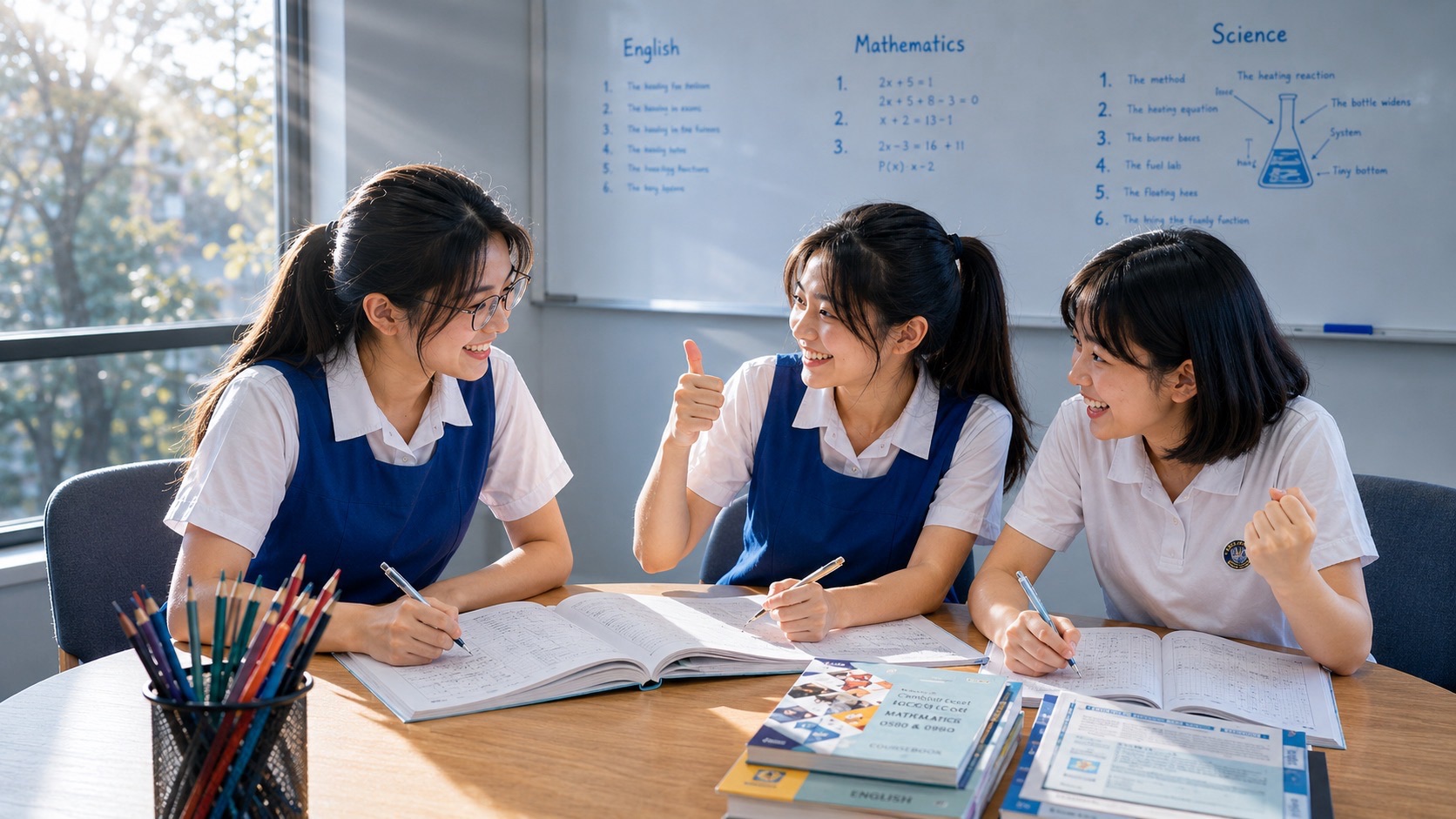
Current local Punggol owner: for present-day Secondary 1 Mathematics class suitability, timing, availability, consultation and the live 3-student programme route, use Punggol Secondary 1 Mathematics Tutor | 3-Student Small-Group Tutorials on eduKatePunggol. This eduKateSingapore page is retained as a Secondary 1 Mathematics learning and parent-reference guide; it is not the current local programme owner.
Punggol · Secondary 1 Mathematics · Maximum 3 Students
Secondary 1
Maths Tuition
Begin with Structure.
Secondary 1 is the year Mathematics changes its language—but the transition can be made calmly.
Numbers now sit beside symbols, algebra, equations, graphs and formal notation. A good tutor helps the student understand what has changed, repair any missing foundation and establish the habits that the next four years will depend upon.
Secondary 1 should introduce a new mathematical language without making the child feel that everything learnt in Primary School has become useless. Preserve what still works, explain what has changed and build the new system carefully.
Punggol Secondary 1 Mathematics tuition at a glance
Build the language of secondary Mathematics before weak habits become expensive.
Primary Mathematics gives students valuable numerical reasoning, visual models and problem-solving experience. Secondary 1 does not discard these abilities. It asks students to express relationships more formally through algebra, notation, graphs and structured working.
The aim is not to finish the syllabus fastest. It is to make the first layer dependable: number control, algebraic meaning, method selection, clear presentation and the ability to work without continuous prompting.
At eduKate Singapore, classes of up to three students allow the tutor to observe how each learner begins, represents, calculates, checks and responds when the question changes—not merely whether the final answer is correct.
| Level | Secondary 1 Mathematics under Full Subject-Based Banding | Foundation year for lower-secondary Mathematics |
|---|---|---|
| Subject levels | G1, G2 and G3 Mathematics according to the student’s school offering | Teach the present level while building readiness for appropriate challenge |
| Class size | Up to three students per class | Close inspection of working and individual correction |
| Main areas | Number, ratio, percentage, rate, algebra, equations, graphs, geometry, mensuration and data | One connected mathematical system |
| Teaching priority | Find the earliest weak link, explain the idea and verify independent use | Not generic worksheet completion |
| Suitable for | Students recovering after a fall, moving from average towards distinction or preparing for stronger pathways | Teaching begins from the learner’s present profile |
| Next step | A consultation using current school work, corrections and assessment evidence | Find the weakness; choose the first build |
Why Secondary 1 Mathematics feels different
The calculations are familiar. The representation has changed.
The difficulty is not simply that every chapter becomes harder. Mathematics becomes more formal, symbolic and cumulative. Students must decide what a symbol means, preserve relationships and choose a method without being told which chapter to use.
Use arithmetic, models, ratios, fractions, percentages and multi-step problem solving.
Move into symbols, negative numbers, algebra, equations, graphs and formal working.
Use algebra, graphs and geometry across less direct and increasingly mixed questions.
Enter upper-secondary Mathematics and, where applicable, Additional Mathematics with secure foundations.
Integrate knowledge, manage time and solve unfamiliar examination problems accurately.
The common mistake
Following an example ≠ choosing a method
A student may understand every step while the tutor is explaining and still be unable to begin a fresh question alone. Recognition must become independent route selection.
The stronger model
Meaning + Method + Practice + Feedback + Transfer
Mathematics becomes secure when the student understands the relationship, executes the method and recognises when the same idea appears in a different form.
Primary methods remain valuable.
Models, arithmetic reasoning and estimation should not be dismissed. Students should see how these ideas connect to algebra and why a newer representation may be more efficient.
Symbols must carry meaning.
Every letter, sign, bracket, equation and graph represents a relationship. Procedures become easier to retain when students understand what the notation is doing.
Secondary 1 is a foundation year, not a waiting year.
Algebraic fluency, clear working and topic connections now support Secondary 2, upper-secondary Mathematics and possible Additional Mathematics later.
The subject level describes where the student is learning now—not the limit of future ability.
Students may offer Mathematics at G1, G2 or G3. Tuition should secure the present course and develop the understanding, independence and consistency required for suitable future challenge.
The certificate changes in 2027; the need for dependable foundations does not.
Students will sit subjects at their respective levels under the Singapore-Cambridge SEC. Secondary 1 should build the habits that later examinations require without manufacturing final-year pressure early.
Why capable students begin to lose marks
The student may understand the lesson—and still lack independent control.
A mark can fall because of concept, representation, method selection, calculation, notation, working, checking or time. “Careless” and “weak in Maths” are descriptions, not diagnoses.
The student knows methods—but cannot see which one belongs here.
The difficulty may lie in translating words into quantities, recognising structure, selecting a representation or connecting the new question to prior learning.
- Common symptom
- “I understand when it is shown, but I do not know how to start.”
- Possible cause
- Pattern dependence, weak question reading, missing prerequisites or uncertainty about what symbols represent
- What to inspect
- Annotations, diagrams, variable definitions, method choice and the student’s first written step
- What to build
- Structure recognition rather than example imitation
- Proof of progress
- The student can begin a changed question without a hint
The student sees the route—but loses accuracy while travelling through it.
The difficulty may lie in sign control, equivalent transformations, compressed working, unit conversion, calculator use, checking or maintaining several steps accurately.
- Common symptom
- “I knew how to do it. I just lost marks along the way.”
- Possible cause
- Weak number fluency, rushed notation, skipped steps, poor checking or fragile procedural memory
- What to inspect
- Intermediate lines, copied values, signs, brackets, units, calculator entries and correction habits
- What to build
- Visible, checkable mathematical control
- Proof of progress
- The method survives time pressure with fewer repeated errors
| Visible pattern | What may be happening underneath | Useful first response |
|---|---|---|
| The student follows examples but cannot begin alone | The procedure is recognisable, but the structure of a fresh question is not | Compare question forms and practise selecting the method |
| Algebra looks like a collection of arbitrary rules | Symbols and transformations were learnt without meaning | Connect each operation to balance, equivalence and representation |
| Primary methods are used for every question | The familiar method feels safer than an abstract one | Show the connection, then explain when algebra is more efficient |
| Working is too compressed | Several operations are performed mentally and cannot be checked | Install a minimum visible-working standard |
| Negative signs and brackets keep disappearing | Sign control has not become an explicit checking routine | Track where the error appears and add a targeted checkpoint |
| Homework is strong but tests are weak | Support, familiarity or unlimited time may be hiding fragile independence | Use mixed, unseen and gradually timed questions |
| Recent revision produces a temporary recovery | The topic was stored as short-term procedure rather than connected knowledge | Use spaced retrieval and mixed-topic practice |
| The student practises only comfortable questions | Repetition creates fluency without flexibility | Progress from direct → mixed → unfamiliar → multi-step → timed |
| “Careless mistakes” repeat every paper | The errors have a stable cause that has not been identified | Build a personal error profile and checking sequence |
The first question
Where does the solution first stop being reliable?
The earliest weak link may sit several steps before the final visible mistake: fractions before percentages, negative numbers before algebra or substitution before graphs.
The second question
Can the student now use the repair without the tutor?
A corrected worksheet is not enough. The improvement must survive a new question, delayed recall and reduced prompting.
What Secondary 1 students learn
Eight areas. One mathematical operating system.
Topics should not become isolated chapters that disappear after the test. Number supports algebra. Algebra supports equations and graphs. Geometry requires properties. Data requires interpretation. Working protects the entire system.
Evidence worth bringing to a consultation
The mark shows the outcome. The working shows where control was lost.
- Recent weighted assessment or class test
- School worksheets with full working
- Completed corrections
- Questions that were left blank
- Repeated sign, unit or notation errors
- Examples of dependence on answer keys
- Current topic sequence and upcoming assessment
- The student’s own account of what feels difficult
The student profiles
Teach from where the student actually is.
“Secondary 1 Mathematics” names the school year. It does not reveal the student’s prerequisite knowledge, current independence, confidence or first useful repair.
The student fell sharply after doing reasonably well in Primary 6
First direction: diagnose the phase shiftSeparate adjustment to pace, weak prerequisites, unfamiliar notation, test presentation and confidence after the first setback.
The student is already anxious and says, “I am bad at Maths”
First direction: restore visible controlUse small, well-chosen successes and clear methods so confidence is supported by genuine competence.
The student understands in class but cannot begin homework
First direction: build method selectionPractise identifying what is known, what is unknown, the relationship and the most suitable representation.
The student leaves algebra questions blank
First direction: rebuild symbolic meaningReturn to negative numbers, operations, substitution and equivalence before adding more rules.
The student obtains average marks and wants a distinction
First direction: improve transfer and precisionUse mixed questions, less direct wording, cleaner working, stronger checking and gradually timed application.
The student scores well but depends heavily on familiar formats
First direction: increase flexibilityChange the representation, combine topics and ask the student to explain why the route works.
The student repeatedly makes “careless” mistakes
First direction: identify the patternTrack signs, brackets, copied values, units, calculator entries and the stage at which rushing begins.
The student completes homework slowly
First direction: distinguish understanding from fluencyFind whether time is lost through weak recall, uncertainty, over-checking, inefficient method choice or poor organisation.
The student remembers for tests and forgets afterwards
First direction: install retentionUse spaced retrieval, mixed practice and later reapplication so the topic remains available.
The strong student is no longer sufficiently challenged
First direction: deepen rather than merely rush aheadDevelop alternative methods, unfamiliar applications, explanation, efficiency and algebraic structure.
The student is learning Mathematics at G1 or G2 and may be ready for more
First direction: secure before stretchingBuild current mastery and evidence of independence while the school determines any subject-level adjustment.
The student wants future readiness for Additional Mathematics
First direction: strengthen the lower-secondary enginePrioritise algebra, equations, graphs, manipulation and careful reasoning rather than prematurely teaching disconnected A-Math chapters.
A deliberate teaching cycle
Explain the idea. Release the support. Inspect what remains.
A smooth lesson is not proof of learning. The important test is whether the student can select, execute and check the method after the tutor steps back.
Bring back the prerequisite and check whether earlier knowledge is still available.
Make the concept visible through numerical examples, diagrams, algebra and comparison.
Observe the student’s reasoning while giving only the prompts needed for successful use.
Remove step-by-step help and see whether the student can begin and complete the task.
Identify whether the error came from concept, method, calculation, notation, reading or checking.
Change the presentation and return later to verify that the learning remains usable.
The tutor must be close enough to see the working—not only collect the answer.
In a three-student class, the tutor can inspect each solution, ask individual questions, adjust difficulty and stop a misconception before it becomes normal.
The same final error does not imply the same repair.
One student may misunderstand the concept. Another may select the wrong method. A third may use the correct route but lose a negative sign. They should not receive identical correction.
Tuition should support school without becoming permanently reactive.
Secure current learning, repair prerequisites, prepare appropriately for what comes next, revisit older topics and build examination readiness gradually.
Immediate feedback is useful only when it preserves thinking.
Students should still explain why a method works, show complete working, recognise unreasonable answers and solve without dependence on automated hints. Read MOE’s AI-in-education overview ↗
A sensible Secondary 1 Mathematics roadmap
Move from readiness to language, independence and connection.
The strongest plan does not rush through every chapter before school begins. It strengthens prerequisites, follows the student’s present school needs and steadily reduces dependence.
Strengthen fractions, percentages, ratios, order of operations, negative-number readiness and clear working.
Become comfortable with notation, integers, approximation, algebraic expressions and new school expectations.
Reduce prompting, widen question forms and connect number, algebra, equations, graphs and geometry.
Use mixed-topic revision, suitable time limits, error analysis and targeted repetition.
Readiness is more valuable than premature syllabus completion.
A student who controls fractions, percentages, ratios, order of operations and written working enters algebra with a stronger platform.
Establish habits before rushed work becomes normal.
Students should learn how notation is used, how working is presented and how to ask a precise question when they become stuck.
Stop waiting for the chapter title to reveal the method.
As more topics accumulate, students should practise moving between representations and recognising which earlier idea the new question requires.
Revision should be a diagnosis—not a rapid replay of every worksheet.
Identify priority weaknesses, retrieve essential concepts, use mixed questions, analyse mistakes and repeat previously weak structures.
Questions parents commonly ask
Choose support according to the child—not simply the calendar.
Not every Secondary 1 student requires tuition. The decision is more useful when based on understanding, independence, repeated error patterns, confidence and the learning environment.
Is Secondary 1 Maths much harder than Primary 6 Maths?
The change is significant, but it is mainly a change in language and structure.Students meet more symbols, formal notation, cumulative topics and independent method selection.
Should tuition begin before Secondary 1 starts?
Preparation can help when prerequisites are known to be weak.Build fractions, ratios, percentages, negative-number readiness and working habits rather than rushing through the entire syllabus.
Can a student move from G2 Mathematics to G3 Mathematics?
The school determines any subject-level change.Tuition can build the mastery, consistency and confidence needed for more demanding work, but should not promise a level movement.
Is Secondary 1 too early to think about Additional Mathematics?
It is too early to manufacture A-Math pressure, but not too early to build its foundations.Algebra, equations, graphs, manipulation and careful working begin now.
My child did well at PSLE. Is tuition necessary?
Not automatically.The decision should depend on present adaptation, independence and whether the student remains appropriately challenged.
Can repeated careless mistakes be improved?
Usually—when the stable cause is identified.Look for compressed working, sign loss, unit errors, calculator entry, poor checking or rushing at predictable stages.
How much practice is enough?
Quality, spacing and variation matter more than page count.Students need enough retrieval, direct practice, mixed work and unfamiliar application to become independent without exhaustion.
How quickly should results improve?
The timeline depends on the starting point and depth of the gaps.Procedural gains may appear quickly; secure understanding, retention and examination consistency require sustained work.
How can parents help at home?
Ask about process rather than only the final mark.Try: What did the question require? Why did you choose that method? Where did the error begin? How would you check it?
The next practical step
Move from “Maths is weak” to a first repair that can be taught and measured.
The starting point is not another stack of worksheets. It is evidence: where the student begins, where the solution first becomes unreliable and what level of support is still required.
Bring the working.
Recent assessments, school worksheets, corrections, blank questions, repeated mistakes and the current topic sequence.
Find the earliest weak link.
Number, fraction, percentage, algebra, interpretation, method choice, notation, calculation, working or checking.
Choose the first build.
Repair the layer that will unlock the greatest number of present and future questions.
Verify independence.
Change the question, reduce the prompting and revisit the idea later to see whether it remains usable.
Can the tutor explain what is actually preventing progress?
Parents should ask whether the tutor diagnoses before assigning practice, explains algebra conceptually, inspects working, requires independent application and tracks repeated errors.
- Current pathway
- Does the tutor understand G1, G2 and G3 Mathematics?
- Diagnosis
- Can the tutor distinguish concept, method, calculation and checking errors?
- Independence
- Must the student complete fresh work without continuous hints?
- Correction
- Are recurring patterns tracked and revisited?
- Class size
- What is the true normal and maximum number of students?
Small-group Mathematics tuition built around visible thinking.
The three-student model preserves peer energy while keeping the tutor close enough to inspect every learner’s working, misconceptions and correction habits.
- After a fall
- Repair foundations, restore control and close the distance to school
- Average to distinction
- Improve method selection, mixed application, accuracy and checking
- Stronger pathways
- Deepen flexibility, reasoning and readiness for later Mathematics
- Teaching aim
- Greater independent mathematical control
- Class size
- Up to three students
Choose your next page
Not every family needs the same answer first.
Continue reading
Understand the transition. Build the system. Prepare the pathway.
These pages extend the parent journey without requiring families to read every Mathematics article at once.
Understand the local route
What Secondary 1 support is available in Punggol?
Begin with the main level guide, the three-student programme and another Secondary 1 Mathematics route.
Build the future route
What comes after a strong Secondary 1 foundation?
Secondary 2 asks students to connect their tools. Upper secondary raises the abstraction, and Additional Mathematics rewards secure algebraic structure.
The central idea
A strong beginning changes the years that follow.
Secondary 1 is not the year in which a child suddenly becomes weak at Mathematics.
It is the year the subject changes its language. Symbols become relationships. Working becomes communication. Methods must be selected rather than merely copied.
Good tuition makes that change visible, repairs what is missing and gradually removes support until the student can think, work and check with greater independence.
Understand the relationship.
Choose the method.
Move forward with control.
Official basis
Aligned to Singapore’s current Secondary Mathematics landscape.
Topic sequence, subject-level decisions, school assessment plans and national examination details should always be checked for the student’s own cohort and school.
Article basis updated July 2026. This page is an educational guide for parents and does not replace the student’s school instructions, subject-level advice or the latest MOE and SEAB notices.
Explore the Secondary 1 Maths Library
This page is the gateway. Each book below has one deeper job, so you can follow the question that matters without reading the same tuition article again under a different title.
- Why Secondary 1 Mathematics Is a Foundation Year — understand why the Primary-to-Secondary threshold has such a long downstream effect.
- How Secondary 1 Mathematics Works — open the machinery: representation, algebra, equivalence, retrieval, route selection and verification.
- Why Three Students Changes Mathematics Teaching — see how a three-student class changes observation, diagnosis and intervention precision.
- How Students Fall at the Secondary 1 Mathematics Threshold — trace the sequence from friction and slippage to compensation, accumulation, confidence loss and withdrawal.
- PSLE Mathematics vs Secondary 1 Mathematics: Completion vs Conversion — understand why PSLE is an endgame while Secondary 1 is an engine-building year.
- What Secondary 1 Mathematics Must Build for Secondary 2 — see the capabilities that should survive the year: algebra, working, retrieval, transfer, error correction, headroom and independence.
Continue the Voyage: Secondary 2 Mathematics
When the Secondary 1 foundation is ready, continue to Secondary 2 Mathematics in Punggol, where the learner must connect the tools under greater load and with greater independence.