Punggol Mathematics Tuition: Secondary 1 Maths Tutor for a Strong Start
Secondary 1 Mathematics is where a student’s relationship with mathematics begins to change.
In primary school, many students can still rely on familiar question types, repeated methods and a good memory for procedures. In secondary school, the questions become more abstract. Algebra becomes part of the language of mathematics. Working must be organised. Concepts begin to connect across chapters, and students are expected to decide which method to use without being guided through every step.
This transition can feel surprisingly large, even for a child who performed reasonably well at PSLE.
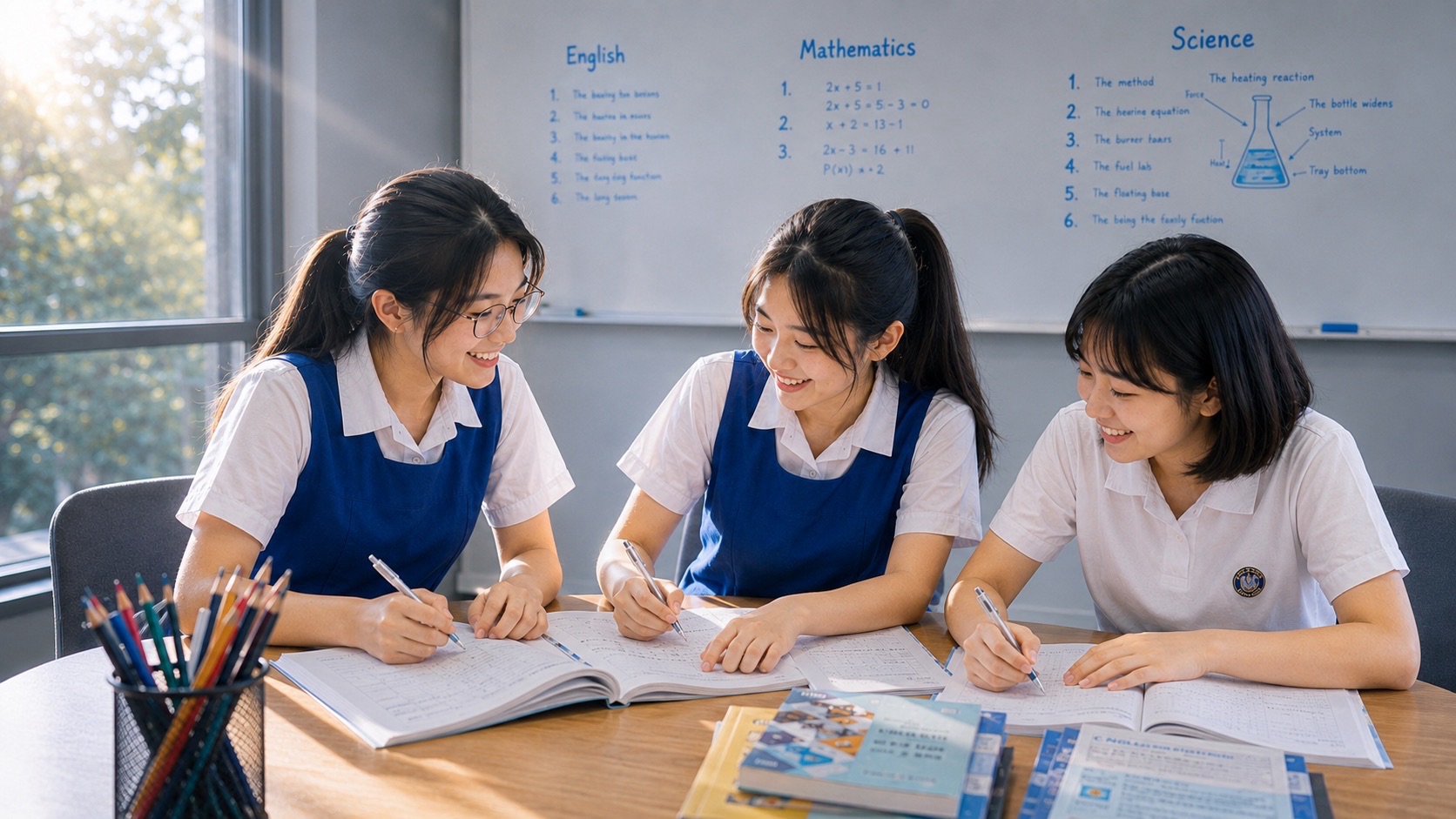
Our Punggol Secondary 1 Mathematics tuition helps students make this transition carefully. We teach in small groups of three students so that the tutor can see how each child thinks, locate the earliest point of difficulty and correct mistakes before they become habits.
The aim is not simply to complete more worksheets.
It is to help a student understand mathematics clearly, practise with purpose and develop the confidence to solve unfamiliar questions independently.
Secondary 1 Mathematics Is a New Beginning
Secondary 1 is often described as a continuation of Primary 6 Mathematics. That is only partly true.
The arithmetic foundation remains important, but the student is now entering a more formal mathematical system. Numbers, symbols, expressions, equations, graphs, angles, ratios and data are no longer taught as isolated topics. They begin to work together.
A student may understand each chapter when it is first taught but still struggle during a test because the question combines several ideas.
For example, a problem may require the student to:
- interpret the information correctly;
- form an algebraic expression;
- solve an equation;
- check whether the answer is reasonable; and
- present the working clearly enough to receive all the method marks.
This is why Secondary 1 Mathematics tuition should not be reduced to giving students more questions.
The student must learn how mathematical questions are constructed, how concepts are connected and how to move from one line of reasoning to the next.
Secondary 1 Mathematics Under Full Subject-Based Banding
Students entering Secondary 1 now study under Full Subject-Based Banding.
The former Express, Normal (Academic) and Normal (Technical) streams have been removed for Secondary 1 cohorts from 2024. Students are posted through Posting Groups 1, 2 and 3, while subjects such as Mathematics may be taken at G1, G2 or G3 according to the student’s starting point, strengths and learning needs.
A Posting Group is not intended to define a child permanently. It guides school admission and the initial subject levels offered at the beginning of Secondary 1. Students may subsequently take subjects at different levels where appropriate.
This creates greater flexibility, but it also makes strong subject foundations more valuable.
A student who develops sound mathematical understanding in Secondary 1 is better placed to manage more demanding work later. A student who carries unresolved weaknesses forward may find that the same weakness reappears in algebra, graphs, geometry and upper-secondary mathematics.
The Singapore-Cambridge Secondary Education Certificate also records the subjects and subject levels taken by each student. Mathematics is therefore no longer best understood only through an old stream label. The more useful question is whether the student is mastering the mathematics at the level being studied and building the capacity for the next stage.
Why Students Find Secondary 1 Maths Difficult
A child does not need to be weak in mathematics to experience difficulty in Secondary 1.
Many capable students struggle because the nature of the subject has changed faster than their study habits.
Mathematics becomes more abstract
Primary Mathematics often begins with quantities that students can imagine: objects, money, lengths, fractions or groups.
Secondary Mathematics increasingly uses symbols to represent quantities. Letters such as (x), (y), (a) and (b) may stand for numbers that are unknown, changing or related to one another.
A student who is comfortable calculating may still hesitate when asked to manipulate an expression containing several variables.
Familiar methods are no longer enough
At primary level, students may recognise a model-drawing question or a percentage question and apply a familiar procedure.
At secondary level, the method may not be immediately obvious. The student must identify the mathematical structure hidden inside the wording.
This is a different skill.
It requires the student to pause, organise the information and choose an approach before calculating.
Errors become more expensive
A missing negative sign, incorrect bracket or careless transfer of a term may affect the rest of the solution.
The child may understand the overall concept but still lose several marks because the working is not controlled.
This is why neat working is not merely a matter of presentation. It is part of mathematical accuracy.
The pace is faster
Secondary school lessons often move quickly. Once a chapter has been completed, the class proceeds to the next topic.
A student who has only partly understood one chapter may not have enough time to repair it before new material arrives. Homework, CCAs and other subjects also compete for attention.
The result is often a student who appears to be coping during lessons but becomes uncertain during tests.
Questions combine several chapters
A test does not always announce which method should be used.
The student may need to draw on number skills, algebra, ratio, geometry and interpretation within the same paper.
This is where memorised steps begin to fail. The student must understand why a method works and recognise when it should be used.
The Primary 6 to Secondary 1 Mathematics Transition
The first year of secondary school should be treated as a foundation year, not a waiting year.
A common mistake is to assume that Secondary 1 results are not important because major national examinations are still some distance away.
The immediate grade is not the only concern.
Secondary 1 establishes the habits and mathematical language that the student will use throughout secondary school.
These include:
- writing algebraic steps in the correct order;
- handling positive and negative numbers accurately;
- simplifying expressions without skipping essential working;
- interpreting graphs and mathematical diagrams;
- using formulas correctly;
- checking units and answers;
- explaining reasoning;
- managing time during tests; and
- correcting errors instead of simply looking at the final answer.
When these habits are established early, Secondary 2 and Secondary 3 Mathematics become more manageable.
When they are not, later chapters can feel unnecessarily difficult because the student is trying to learn new material while repairing old foundations at the same time.
What Students Learn in Secondary 1 Mathematics
The precise sequence varies between schools, textbooks and subject levels. However, Secondary 1 Mathematics generally develops the student across several broad areas.
Numbers and Numerical Reasoning
Students deepen their understanding of numbers and operations.
This may include integers, factors, multiples, prime numbers, fractions, decimals, percentages, ratios, rates and approximation.
These topics may sound familiar, but the questions are often more demanding than their primary-school versions. Students must work with greater precision and may need to combine several operations within one problem.
Negative numbers are particularly important.
A student who does not handle negative signs confidently may later struggle with algebraic manipulation, coordinates, graphs and equations.
Algebraic Language
Algebra is one of the most important developments in Secondary 1 Mathematics.
Students learn to use symbols to describe relationships and general patterns. They work with terms, coefficients, expressions, substitution, simplification and equations.
The difficulty is rarely the letter (x) itself.
The real difficulty is learning to see an algebraic expression as a structured mathematical object.
For example, a student must understand the difference between:
- (3x + 2);
- (3(x + 2));
- (3x^2); and
- ((3x)^2).
These expressions may look similar to a beginner, but they represent very different quantities.
A careful Secondary 1 Maths tutor will not rush through this distinction. The student must understand what each symbol, bracket and exponent is doing.
Geometry and Measurement
Students study geometrical properties, angles, shapes, constructions, perimeter, area, volume and other measurement concepts according to their school’s programme.
Geometry requires both visual understanding and precise reasoning.
A student may be able to see that two angles look equal, but mathematics requires a valid reason. Diagrams may also be drawn in ways that are not to scale, so students must learn to rely on the information given rather than appearance alone.
Ratio, Rate and Proportion
Ratio and proportion remain central because they connect mathematics to scale, speed, pricing, measurement and comparison.
Students who learnt ratio mainly through memorised primary-school procedures may need to rebuild the topic more conceptually.
They should understand what the quantities represent, how they relate and why a particular operation is appropriate.
Graphs and Relationships
Graphs introduce students to the idea that two quantities may vary together.
A graph is not simply a picture. It is a representation of a mathematical relationship.
Students need to read scales carefully, identify coordinates, interpret changes and understand what points or lines mean in context.
These skills later support coordinate geometry, functions, statistics and more advanced algebra.
Statistics and Data
Students may work with tables, charts, averages and data interpretation.
The calculations are only part of the task.
Students must also read information critically, compare values and explain what the data shows. Careless reading can lead to an incorrect answer even when the arithmetic is accurate.
The Most Important Secondary 1 Skill: Algebra Readiness
Algebra deserves particular attention because it becomes one of the main working languages of secondary mathematics.
A student who develops good algebraic habits in Secondary 1 gains an important advantage.
The child should become comfortable with:
- identifying like and unlike terms;
- understanding coefficients and constants;
- using brackets correctly;
- applying the order of operations;
- substituting values accurately;
- forming expressions from written information;
- simplifying expressions;
- solving elementary equations;
- checking solutions; and
- showing each transformation clearly.
These may appear to be small skills. Together, they form the machinery required for later mathematics.
By Secondary 2, algebra becomes more substantial. By Secondary 3, it is woven into graphs, geometry, simultaneous equations and, for students who take Additional Mathematics, a much more demanding symbolic system.
The best time to make algebra feel natural is before the student becomes afraid of it.
Different Students Need Different Forms of Help
Not every Secondary 1 student joins tuition for the same reason.
A good programme should identify the student’s actual starting point rather than placing everyone through the same worksheet sequence.
The student who has fallen behind
This student may already be confused by integers, algebra, fractions or basic problem-solving.
The priority is repair.
Giving the student difficult examination questions too early usually increases frustration. The tutor must first locate the earliest weak link and rebuild the missing skill in a calm, systematic way.
Once the foundation is stable, the student can return to current schoolwork with greater confidence.
The average student who wants to improve
This student may understand lessons but lose marks through careless errors, incomplete working or weak application.
The priority is consistency.
The tutor must improve method selection, accuracy, presentation and the ability to manage mixed questions.
The goal is to turn occasional correct answers into reliable performance.
The strong student aiming for distinction
This student may already perform well in routine exercises.
The priority is depth.
The student should encounter unfamiliar question structures, learn to compare possible methods and explain why a solution works. Faster work is useful only when it remains accurate.
Strong students should not be given endless repetition. They need carefully chosen variation that develops flexibility.
What Good Secondary 1 Mathematics Tuition Should Do
Parents sometimes evaluate tuition by asking how many chapters the tutor is ahead of school.
Being ahead can be useful, but it is not enough.
A student who has seen a chapter before may still fail to understand it. A good tuition programme should create readiness, not merely early exposure.
Diagnose before teaching
The tutor should first determine whether the difficulty comes from:
- weak arithmetic;
- incomplete primary-school foundations;
- misunderstanding of mathematical vocabulary;
- poor algebraic notation;
- careless working;
- difficulty interpreting questions;
- slow recall;
- low confidence; or
- insufficient practice.
Two students who receive the same mark may require entirely different forms of help.
Explain from first principles
Students should know more than the rule.
They should understand why the rule is valid, what the symbols mean and how the idea connects to earlier knowledge.
A clear explanation reduces the amount of material the student must memorise.
Demonstrate correct working
The tutor should model how to organise a solution.
This includes where to begin, what to write on each line, when to include units and how to make reasoning visible.
Students often lose marks not because they know nothing, but because their knowledge is presented in a confused form.
Provide guided practice
A new concept should first be practised with support.
The tutor can ask questions, provide prompts and correct misunderstandings before the student repeats them.
This is where a small class is especially valuable. The tutor can observe each step instead of seeing only the final answer.
Move towards independent work
Support should gradually be reduced.
The student must eventually decide what to do without hints. This is the point where understanding becomes usable examination skill.
Review mistakes intelligently
A wrong answer is useful when the cause is identified.
The student should know whether the error came from:
- a misunderstood concept;
- a calculation mistake;
- incorrect notation;
- poor reading;
- a missing step;
- weak time management; or
- choosing the wrong method.
Simply copying the correct solution does not prevent the error from returning.
Why We Teach Secondary 1 Maths in Groups of Three
Our Punggol Secondary 1 Mathematics tuition is conducted in small groups of three students.
This is intentionally small.
Mathematics is not learnt only by listening. The tutor needs to see what the student writes, how the student begins a question and where the reasoning changes direction.
In a three-student class, the tutor can:
- check individual working closely;
- ask each student questions;
- adjust the explanation when someone is unsure;
- correct notation immediately;
- select work according to ability;
- monitor careless habits;
- revisit an earlier weakness; and
- give stronger students more demanding extensions.
Students also benefit from learning beside a small number of peers.
They hear different questions, compare methods and realise that difficulty is a normal part of learning. At the same time, the group remains small enough for the tutor to maintain close attention.
The atmosphere is focused, personal and calm.
How Our Punggol Secondary 1 Maths Lessons Work
A lesson is not designed around completing the greatest possible number of pages.
It is organised around learning quality.
First, we check understanding
Before moving forward, the tutor checks whether the student understands the concepts required for the lesson.
A student beginning algebra may need a short review of negative numbers or the order of operations. Another student may understand the concept but need help presenting the working correctly.
This short diagnostic step prevents the lesson from being built on an unstable foundation.
Next, we teach the concept clearly
The tutor explains the idea using suitable examples and precise mathematical language.
The explanation is broken into manageable parts. Students are encouraged to ask questions before uncertainty becomes embarrassment.
Then, we practise with variation
Students work through questions that gradually change in structure.
The purpose is not to memorise one example. It is to recognise the underlying concept even when the numbers, wording or arrangement changes.
After that, we apply the concept independently
Students attempt questions without step-by-step guidance.
The tutor observes whether they can choose the correct method, organise the solution and complete the work accurately.
Finally, we correct and consolidate
Errors are discussed while the reasoning is still fresh.
Important methods are reviewed, and students leave the lesson knowing what they have mastered and what still requires attention.
Teaching Ahead Without Rushing
There is value in introducing a chapter before it is taught in school.
The student enters the school lesson with some familiarity. Mathematical vocabulary no longer sounds completely new, and the child can use the school lesson to deepen understanding rather than trying to understand everything for the first time.
However, teaching ahead must be done carefully.
Rushing through three chapters without proper mastery may create the illusion of progress. The student recognises the chapter title but cannot solve the questions independently.
Our approach is to move ahead where appropriate while protecting the quality of understanding.
The objective is not simply to arrive first.
It is to arrive prepared.
From Understanding to Examination Performance
Understanding is essential, but students must also learn to perform under test conditions.
A child may solve a question during tuition with unlimited time but struggle during a timed assessment.
Examination readiness requires additional skills.
Method selection
The student should recognise the likely method within a reasonable amount of time.
This improves when students practise mixed questions rather than completing only one chapter at a time.
Working discipline
Each line should follow logically from the previous line.
Good working reduces mistakes and allows the student to recover method marks even if the final answer is incorrect.
Time awareness
Students should not spend too long trying to rescue one difficult question while leaving easier marks unanswered.
They need to learn when to continue, when to leave space and when to return.
Checking
Checking should be specific.
Instead of merely looking at the answer again, students can check signs, brackets, substitutions, units, copied values and whether the answer is reasonable.
Emotional control
A difficult first question should not decide the rest of the paper.
Students need enough familiarity with uncertainty to remain calm, move forward and return later with a clearer mind.
Signs That Your Child May Need Secondary 1 Maths Tuition
A poor examination result is an obvious signal, but it is not the only one.
Parents may also notice that the child:
- understands examples but cannot begin homework independently;
- repeatedly makes errors with negative numbers;
- avoids algebraic questions;
- says that the teacher goes too quickly;
- copies solutions without understanding them;
- takes an unusually long time to complete basic work;
- leaves many questions blank;
- loses marks despite knowing the topic;
- cannot explain why a method works;
- becomes anxious before Mathematics tests; or
- performs well in topical worksheets but poorly in mixed papers.
These patterns should be investigated early.
A student who appears careless may actually be overloaded. A student who seems unmotivated may have missed an earlier concept and no longer knows how to re-enter the lesson.
The purpose of tuition is not to label the child.
It is to make the next step clear.
Should a Strong Secondary 1 Student Attend Maths Tuition?
Tuition is not only for students who are failing.
A strong student may benefit when the tuition provides something beyond ordinary repetition.
This may include:
- deeper conceptual questions;
- alternative solution methods;
- unfamiliar applications;
- disciplined mathematical writing;
- non-routine problem-solving;
- stronger algebraic fluency; and
- preparation for the increasing demands of Secondary 2 and upper-secondary Mathematics.
The important distinction is between acceleration and development.
Acceleration means covering later material earlier.
Development means improving the quality of thought.
A student who is genuinely strong should experience both, but development must come first.
How Parents Can Support Secondary 1 Maths at Home
Parents do not need to reteach the entire syllabus.
A calm home routine is often more useful.
Ask the child to explain one question
Instead of asking only whether homework is complete, ask the child to explain how one answer was obtained.
The ability to explain often reveals whether the concept is genuinely understood.
Encourage complete working
Mental calculation is useful, but complicated solutions should not exist only in the student’s head.
Writing the steps clearly makes mistakes easier to identify.
Keep a simple error record
The student can record recurring mistakes such as:
- forgetting negative signs;
- expanding brackets incorrectly;
- copying numbers wrongly;
- omitting units; or
- misreading the question.
The record does not need to be elaborate. Its purpose is to make repeated errors visible.
Protect a regular practice period
Short, consistent practice is usually more productive than a large amount of rushed work before a test.
Avoid turning every mistake into a crisis
Students need to take errors seriously without becoming afraid of them.
A mistake that is properly corrected can strengthen future performance.
Choosing a Secondary 1 Maths Tutor in Punggol
The right tutor should offer more than answers.
Parents can look for several qualities.
Clear explanations
The tutor should be able to explain the same idea in more than one way.
Repeating the original explanation more loudly does not help a confused student.
Close attention to working
A tutor who checks only final answers may miss the actual source of the problem.
Knowledge of secondary progression
Secondary 1 should be taught with an awareness of what students will meet in Secondary 2, Secondary 3 and upper-secondary Mathematics.
Appropriate pace
The tutor should know when to move forward and when to pause for repair.
Suitable class size
A small class gives the tutor more opportunities to observe, question and correct each student.
A calm learning environment
Students should feel comfortable admitting that they do not understand.
A child who hides confusion cannot be taught effectively.
A Local Mathematics Tuition Option for Punggol Families
For families living in Punggol, a nearby tuition arrangement can make a meaningful difference.
Secondary school schedules become increasingly full. Students manage school lessons, homework, CCAs, projects and travel.
A convenient weekly lesson is easier to sustain than an arrangement that consumes a large part of the child’s day.
However, convenience should support quality rather than replace it.
The most important considerations remain:
- whether the tutor understands the student;
- whether the class is small enough for meaningful attention;
- whether weaknesses are properly diagnosed;
- whether the teaching is aligned with the student’s schoolwork; and
- whether the student is becoming more independent over time.
Good tuition should reduce confusion, not add another layer of pressure.
When Is the Best Time to Start Secondary 1 Maths Tuition?
There is no single correct month for every student.
Some students benefit from beginning before Secondary 1 so that they can enter the year familiar with integers and basic algebra.
Others begin after the first school assessment reveals a gap.
The best time is generally before the student becomes deeply discouraged.
Early support tends to be simpler because the tutor is correcting a small number of weaknesses. Later intervention may require the student to learn current chapters while repairing several earlier topics.
Parents do not need to react to every disappointing mark immediately. One result may reflect adjustment, illness or poor time management.
The pattern matters.
When the child repeatedly struggles to understand, complete or retain the work, it is sensible to investigate.
What Improvement Should Parents Expect?
Mathematical improvement does not always appear immediately as a large increase in marks.
The first signs may be quieter.
The student may begin homework without delaying. Working may become neater. Fewer questions may be left blank. The child may ask more precise questions and recover more quickly after making a mistake.
These are important changes because they indicate that the student is regaining control.
Marks usually improve when several elements begin working together:
- the foundation is secure;
- the student understands the current topic;
- practice is consistent;
- mistakes are reviewed;
- working is accurate;
- time is managed; and
- confidence is based on genuine competence.
We aim for strong results, including distinctions where the student is ready for them. However, sustainable progress is built by improving the system behind the grade rather than chasing one test result at a time.
Frequently Asked Questions About Punggol Secondary 1 Maths Tuition
Is Secondary 1 Maths much harder than Primary 6 Maths?
It is different rather than simply harder.
Students encounter more abstract notation, greater use of algebra, faster lesson pacing and questions that combine several ideas. A student with strong Primary 6 foundations may still need time to adjust to the new language and expectations.
What is the most important Secondary 1 Maths topic?
Algebra is especially important because it supports much of later secondary mathematics.
However, algebra depends on accurate number skills, fractions, negative numbers and the order of operations. The strongest programme develops these foundations together.
Does my child need tuition before the first test?
Not necessarily.
Some students adjust well through school lessons and independent study. Tuition becomes useful when the child needs closer explanation, more guided practice, stronger challenge or a structured plan that is difficult to obtain in a larger classroom.
Can tuition help a student taking G2 or G3 Mathematics?
Yes. The teaching should be matched to the student’s actual subject level, school materials and current understanding.
The tutor should not assume that every Secondary 1 student is following the same pace or requires the same questions.
How many students are in the class?
Our Secondary 1 Mathematics tuition is conducted in three-student small groups.
This allows the tutor to monitor individual working while preserving the useful interaction of a small class.
Will the tutor follow my child’s school syllabus?
We work with the current Secondary Mathematics requirements while taking the student’s school sequence, worksheets, assessments and areas of difficulty into account.
Schools may teach chapters in different orders, so lessons should remain responsive to the student’s immediate needs.
Is one lesson a week enough?
For many students, one well-structured weekly lesson can provide a strong framework when it is supported by regular practice between lessons.
Students with significant foundational gaps may require a more intensive plan for a period of time.
How quickly will my child improve?
The answer depends on the starting point.
A student with one misunderstood chapter may improve relatively quickly. A student with several years of accumulated weaknesses will need more time.
We first look for clearer understanding, more accurate working and greater independence. These usually precede stable improvements in marks.
Do you provide trial lessons?
We begin with a consultation to understand the student’s level, present difficulties and learning needs. As classes are intentionally limited to three students, placement depends on suitable level, timing and available capacity.
A Strong Secondary 1 Foundation Changes What Comes Next
Secondary 1 Mathematics is not only about the first year of secondary school.
It prepares the student for the increasing algebraic and problem-solving demands of Secondary 2. It supports subject choices and mathematical confidence in upper secondary. It influences whether later chapters feel like a natural progression or a constant attempt to catch up.
A good start does not require perfection.
It requires clear teaching, accurate practice and enough individual attention for mistakes to be corrected while they are still small.
At our Punggol Secondary 1 Mathematics tuition, students learn in focused three-student groups with an experienced tutor who teaches from the child’s actual starting point.
We help students understand the concepts, organise their working, strengthen algebra and develop the confidence to solve questions independently.
For parents looking for a Secondary 1 Maths tutor in Punggol, the next step is a consultation to understand where your child is now, what is causing the difficulty and what should be done next.
A strong mathematical future is rarely created by one dramatic lesson.
It is built quietly, one clear idea at a time.