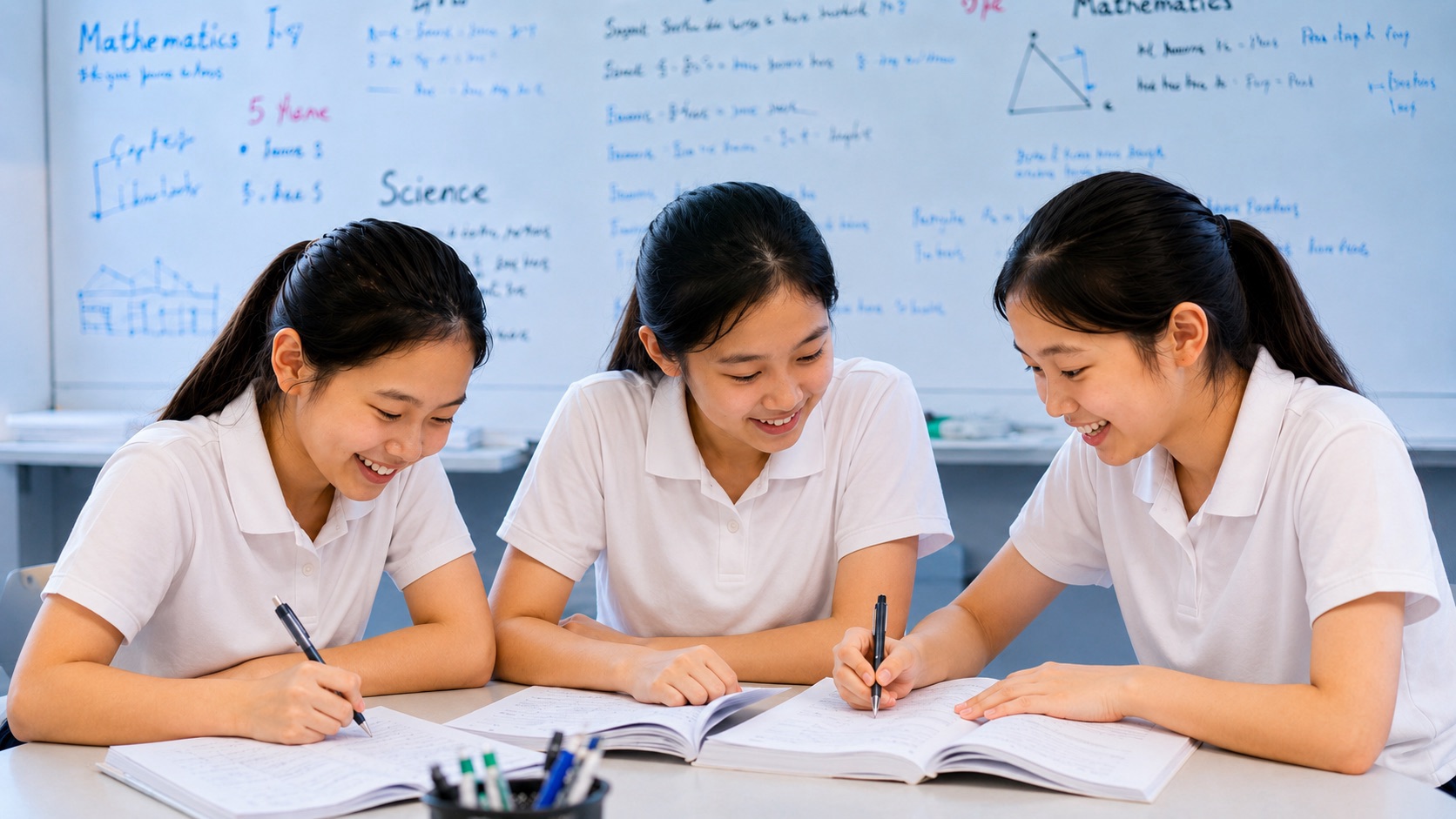
Punggol Secondary 1 E-Mathematics Tutor | Sec 1 Math Tuition in 3-Pax Small Groups
Current local Punggol owner: for present-day Secondary 1 Mathematics class suitability, timing, availability, consultation and the live small-group programme route, use Punggol Secondary 1 Mathematics Tutor | 3-Student Small-Group Tutorials on eduKatePunggol. This eduKateSingapore page is retained as a learning and parent-reference article; it is not the current local programme owner.
Secondary 1 Mathematics is the first important bridge between the familiar world of primary-school Mathematics and the more structured, algebra-driven Mathematics students will meet throughout secondary school.
The individual topics may not appear unusually difficult at first. The real challenge is that the subject begins to demand a different kind of thinking.
Students must now work comfortably with negative numbers, algebraic notation, formulae, graphs, geometrical reasoning and multi-step problems. They must show clear working, choose suitable methods and remain accurate even when a question is presented in an unfamiliar form.
A good Punggol Secondary 1 E-Mathematics Tutor therefore does more than help a student finish homework. The tutor should identify weak foundations, teach the new mathematical language carefully and help the student develop methods that will remain dependable in Secondary 2, upper-secondary Mathematics and future examinations.
This retained eduKateSingapore article documents the three-student teaching model used for Secondary 1 Mathematics in Punggol. The model gives each learner room to ask questions, receive close correction and work at an appropriate pace; current local class arrangements are confirmed through eduKatePunggol.
The Short Answer for Parents
A suitable Secondary 1 Math Tutor in Punggol should help your child:
- adjust from PSLE Mathematics to secondary-school Mathematics;
- understand algebra instead of memorising isolated steps;
- improve accuracy with signs, fractions, indices and calculations;
- present working clearly and logically;
- recognise which method a question requires;
- repair primary-school gaps before they become secondary-school weaknesses;
- prepare steadily for school assessments;
- build the foundation needed for Secondary 2 Mathematics and possible Additional Mathematics later.
The objective is not simply to complete more worksheets.
It is to help the student become increasingly independent, accurate and confident when solving Mathematics problems.
Is It Still Called Secondary 1 E-Mathematics?
Many parents continue to use familiar terms such as Secondary 1 E-Math, Elementary Mathematics or Express Mathematics when searching for tuition.
Under Singapore’s current Full Subject-Based Banding structure, however, students take subjects such as Mathematics at G1, G2 or G3. The former Express, Normal (Academic) and Normal (Technical) streams were removed beginning with the 2024 Secondary 1 cohort. Students are now posted through Posting Groups 1, 2 and 3, with greater flexibility to take different subjects at different levels as they progress. (Ministry of Education)
For parents, the practical question remains straightforward:
Is the Mathematics tuition correctly matched to my child’s present subject level, school pace and learning needs?
A student taking G3 Mathematics should receive work of the appropriate depth and demand. A student taking G2 Mathematics should not be rushed through unsuitable material simply to make the programme appear advanced.
Good tuition stretches a student from the correct starting point.
Why Secondary 1 Mathematics Feels Different
Primary-school Mathematics often allows students to rely on familiar models, arithmetic routines and repeated question formats.
Secondary Mathematics begins to compress ideas.
Numbers become letters. Relationships become formulae. Word problems must be translated into equations. A small error made at the beginning of a solution may affect every line that follows.
This is why a student who performed reasonably well for PSLE Mathematics can still feel unsettled in Secondary 1.
The child has not necessarily become weaker.
The subject has changed its language.
From answers to mathematical structure
At primary level, a student may ask:
What number should I calculate?
At secondary level, the better question becomes:
What relationship does this question describe?
That change is important.
A student who understands mathematical structure can approach a new problem calmly. A student who has memorised only surface procedures may become confused as soon as the wording changes.
From mental steps to visible working
Some primary-school students are accustomed to doing several steps mentally. In secondary school, that habit can become risky.
Clear working helps students:
- organise their thoughts;
- preserve method marks;
- locate errors;
- communicate reasoning;
- avoid skipping necessary steps;
- check whether an answer is sensible.
The current G3 Mathematics examination framework explicitly assesses the use of standard techniques, problem-solving in different contexts, and mathematical reasoning and communication. It also states that omitting essential working can lead to lost marks. (SEAB)
The habits that support later examination performance should therefore begin in Secondary 1.
What Students Learn in Secondary 1 Mathematics
Schools may sequence topics differently, but lower-secondary Mathematics generally develops the student across several connected areas.
The eventual G3 Mathematics syllabus is organised into three broad strands:
- Number and Algebra
- Geometry and Measurement
- Statistics and Probability
It also places emphasis on reasoning, communication, application and the ability to connect ideas across topics.
Secondary 1 is where many of these foundations begin to take a more formal shape.
1. Numbers, Accuracy and Mathematical Discipline
Students continue working with numbers, but the range and precision increase.
They may encounter:
- integers and negative numbers;
- factors, multiples and prime factorisation;
- squares, cubes and roots;
- rational numbers;
- approximation and estimation;
- significant figures;
- standard form;
- indices;
- ratio, percentage, rate and speed.
These topics may appear familiar, yet the secondary-school treatment is more exact.
For example, a student may know how to calculate a percentage increase but struggle with reverse percentages. Another may understand speed but make errors when converting kilometres per hour into metres per second.
The challenge is often not a complete lack of knowledge. It is incomplete control.
A strong Secondary 1 Mathematics programme revisits the underlying idea, then trains the student to apply it accurately in increasingly varied questions.
2. Algebra: The New Language of Secondary Mathematics
Algebra is one of the most important developments in Secondary 1.
Students begin using letters to represent numbers, quantities and relationships. They learn to read expressions, simplify terms, substitute values and translate real situations into mathematical statements.
The progression may include:
- understanding algebraic notation;
- collecting like terms;
- expanding brackets;
- simplifying expressions;
- substitution;
- forming expressions;
- solving linear equations;
- working with formulae;
- identifying patterns;
- finding unknown quantities.
The later G3 Mathematics syllabus requires students to evaluate expressions, translate real-world situations into algebra, manipulate formulae, expand and factorise expressions, and use algebra to model relationships.
These upper-secondary demands do not appear suddenly.
They grow from the algebraic habits established in Secondary 1.
Why students make algebra mistakes
Common difficulties include:
- treating unlike terms as though they can be combined;
- losing a negative sign;
- misunderstanding what a coefficient represents;
- expanding brackets incorrectly;
- changing the subject of a formula without preserving equality;
- performing an operation on only one side of an equation;
- copying expressions inaccurately;
- following steps without understanding why they work.
These are not merely careless mistakes.
Repeated errors often reveal that the student has not yet formed a secure mental model of algebra.
A careful tutor slows the process down, explains the structure and ensures that each step makes sense before increasing speed.
3. Geometry and Measurement
Secondary geometry requires more than recognising shapes or inserting numbers into formulae.
Students must begin reasoning from mathematical properties.
They may work with:
- angle relationships;
- polygons;
- parallel lines;
- geometrical constructions;
- perimeter and area;
- surface area and volume;
- scale drawings;
- symmetry;
- coordinates;
- simple geometrical arguments.
A student may know that two angles are equal but still struggle to explain why.
That explanation matters.
Mathematics becomes stronger when students can name the property, show the relationship and communicate the reasoning clearly.
4. Graphs and Mathematical Representation
Graphs allow students to see relationships that may not be obvious from a list of numbers.
Secondary 1 students may need to:
- plot points accurately;
- read coordinate axes;
- interpret scales;
- recognise patterns;
- connect tables, equations and graphs;
- extract information from visual representations;
- explain what a graph shows in context.
Students sometimes treat graphing as a drawing exercise. It is not.
A graph is another mathematical language. It represents how quantities are related.
A good tutor teaches the student to move comfortably between words, tables, equations and graphs.
5. Statistics, Data and Interpretation
Students may also work with tables, charts, averages and simple data analysis.
The arithmetic is only one part of the task.
Students must learn to ask:
- What does this data show?
- Which measure is most useful?
- Is the representation misleading?
- What conclusion can reasonably be drawn?
- Does the answer make sense in context?
This is where Mathematics begins to become visibly connected to decision-making in everyday life.
The Five Common Secondary 1 Mathematics Problems
1. “My child understands during class but cannot do the homework alone.”
This usually means the student can follow an explanation but cannot yet retrieve and apply the method independently.
Watching a worked example is not the same as solving a fresh question.
The tutor must gradually remove support:
- demonstrate the method;
- solve a similar question together;
- let the student attempt one with prompts;
- let the student solve independently;
- revisit the method later in a mixed exercise.
Independence is built through carefully reduced support.
2. “My child keeps making careless mistakes.”
The word careless can hide several different problems.
The student may be:
- rushing;
- copying inaccurately;
- weak with negative signs;
- skipping working;
- using the calculator incorrectly;
- failing to estimate;
- forgetting units;
- not checking whether the answer is reasonable.
The solution is not simply to tell the child to “be more careful”.
A tutor should identify the type of error, trace when it appears and install a specific checking habit.
For example:
- underline the required quantity;
- circle negative signs;
- write one algebraic operation per line;
- estimate before using the calculator;
- check units before finalising the answer;
- substitute the solution back into the equation.
Accuracy improves when checking becomes a method rather than a reminder.
3. “My child can do direct questions but struggles with word problems.”
This often reflects a translation problem.
The student has learned a mathematical procedure but cannot yet recognise when it should be used.
Word problems require the student to move through several stages:
- identify the known information;
- identify what must be found;
- recognise the mathematical relationship;
- choose a method;
- carry out the calculation;
- interpret the result.
Good tuition should therefore include questions in different forms, not just repeated copies of one template.
4. “My child studies, but the marks do not improve.”
More work does not always produce better results.
A student may be repeatedly practising questions that are already familiar while avoiding the exact skills that cause difficulty.
Improvement usually requires a more precise diagnosis:
- Is the concept misunderstood?
- Is the method incomplete?
- Is working poorly organised?
- Is the student too slow?
- Are topics forgotten after several weeks?
- Does performance collapse only during tests?
- Are primary-school gaps interfering with new work?
Once the cause is known, practice can become targeted.
5. “My child has lost confidence in Mathematics.”
Confidence is rarely repaired through encouragement alone.
A student becomes genuinely confident after experiencing a series of manageable successes:
- understanding an idea that once felt confusing;
- solving a question without help;
- correcting an error independently;
- completing a test with better control;
- seeing that improvement came from a repeatable method.
The most useful confidence is evidence-based.
The child knows, “I can do this because I understand what to do next.”
What a Good Punggol Secondary 1 E-Mathematics Tutor Should Do
Diagnose before accelerating
Before assigning more work, the tutor should understand the student’s present condition.
A useful diagnosis may examine:
- number accuracy;
- fraction and percentage control;
- confidence with negative numbers;
- algebraic notation;
- quality of written working;
- ability to understand question language;
- calculator habits;
- problem-solving stamina;
- retention of previously taught topics.
A student who struggles with algebra may actually have weak fraction skills. Another who appears careless may simply be trying to perform too many steps mentally.
The visible mistake is not always the original cause.
Teach from the student’s actual starting point
Some students need a concise correction.
Others need the topic rebuilt from the beginning.
A good tutor should be able to do both.
There is little value in giving advanced questions to a student who does not understand the basic notation. At the same time, a capable student should not spend an entire term repeating undemanding exercises.
The lesson must be appropriately pitched.
Explain why the method works
Students remember Mathematics more reliably when they understand the logic beneath the procedure.
Instead of teaching only:
Move this term to the other side and change the sign,
the tutor should help the student understand that the same operation must be applied to both sides of an equation to preserve equality.
The second explanation takes slightly longer.
It also produces stronger learning.
Build fluency after understanding
Understanding comes first, but fluency still matters.
Students need sufficient practice to carry out routine processes accurately and efficiently. This frees mental attention for more demanding parts of a problem.
The sequence should be:
Understand the idea → practise the method → recognise variations → apply it independently.
Practice without understanding becomes fragile.
Understanding without practice remains slow.
Students need both.
Mix topics after mastery
School examinations do not announce the method beside each question.
Students must identify what the problem requires.
Once individual topics are secure, tuition should include mixed practice. This trains students to distinguish between methods and retrieve the correct one without being told.
This is where genuine examination readiness begins.
Correct working, not only final answers
Two students may obtain the same wrong answer for entirely different reasons.
One misunderstood the concept. The other copied a number incorrectly.
The correction must therefore examine the working.
In a small group, the tutor can observe:
- how the student begins;
- where hesitation appears;
- which shortcuts are risky;
- whether notation is understood;
- whether the chosen method is efficient;
- whether the error is conceptual or procedural.
That level of observation is difficult in a large class.
Why eduKate Uses 3-Pax Small-Group Mathematics Tuition
The three-student Secondary 1 Mathematics model described in this reference keeps the group small enough for close inspection of each learner’s working. For current Punggol class suitability and availability, use the live eduKatePunggol Secondary 1 Mathematics route.
This format provides the structure of a class without losing the closeness of individual guidance.
Students can ask questions comfortably
Many students remain quiet in large groups because they do not want to interrupt or reveal that they are confused.
In a three-student class, uncertainty becomes visible earlier. The tutor can address it before the class moves too far ahead.
The tutor can inspect actual working
Mathematics errors are often hidden inside the student’s written steps.
Close inspection allows the tutor to correct the process rather than merely provide the answer.
Lessons can be adjusted
One student may need additional explanation. Another may be ready for a harder variation.
A very small class gives the tutor room to make these adjustments while preserving lesson momentum.
Students still learn beside peers
Learning with two other students can be valuable.
Students see alternative methods, hear useful questions and learn that difficulty is a normal part of progress. The class remains focused without becoming isolating.
Different Students Need Different Secondary 1 Mathematics Support
The strong PSLE Mathematics student
A strong primary-school result does not automatically guarantee a smooth transition.
Some capable students have excellent arithmetic skills but are uncomfortable with algebraic abstraction. Others are fast but leave untidy working that becomes difficult to manage as questions grow longer.
For these students, tuition should develop:
- deeper algebraic reasoning;
- cleaner presentation;
- efficient method selection;
- exposure to unfamiliar questions;
- greater independence;
- the foundation for demanding upper-secondary Mathematics.
The aim is not unnecessary repetition.
It is refinement.
The average student who is beginning to slip
This student may understand most lessons but accumulate small gaps.
One missed algebraic idea leads to difficulty with equations. Weak equations then affect graphs and later topics.
Because the student is not failing dramatically, the problem may remain unnoticed for months.
Early tuition can stabilise the subject before the gap becomes expensive to repair.
The student who has struggled since primary school
This child may enter Secondary 1 carrying weaknesses in:
- fractions;
- ratio;
- percentage;
- multiplication and division;
- units;
- problem interpretation;
- written working.
Secondary Mathematics does not remove these earlier requirements. It builds on them.
The tutor must repair the earliest weak link while still helping the student keep pace with current school topics.
That balance is important.
Spending every lesson only on current homework may leave the real weakness untouched. Spending every lesson only on old work may cause the child to fall further behind in school.
The programme should do both: repair and progress.
The student aiming for top performance
A high-performing student needs more than harder questions.
The student should learn to:
- recognise elegant methods;
- compare different solutions;
- explain reasoning precisely;
- work accurately under time pressure;
- connect topics;
- detect traps;
- recover quickly after an error;
- check answers efficiently.
Top performance comes from depth, control and consistency.
When Should a Student Start Secondary 1 Mathematics Tuition?
There is no single perfect month for every child.
However, tuition is often most effective when it begins before the student has experienced repeated failure.
Useful starting points include:
- during the transition after PSLE;
- at the beginning of Secondary 1;
- when algebra first becomes confusing;
- after the first weak school assessment;
- when homework time begins increasing sharply;
- when the child understands in class but cannot work independently;
- before a small weakness becomes a Secondary 2 problem.
Parents do not need to wait for Mathematics to become a crisis.
Early support is often quieter, faster and less stressful.
What Parents Can Look for at Home
A single test score does not reveal everything.
Parents can also observe the student’s behaviour while studying.
Possible warning signs include:
- taking an unusually long time to begin;
- repeatedly referring to worked examples;
- avoiding algebra questions;
- doing calculations mentally and writing only answers;
- becoming upset when the question looks unfamiliar;
- depending heavily on answer keys;
- forgetting a topic soon after a test;
- saying, “I know it, but I don’t know how to start”;
- making the same sign or notation error repeatedly.
These signs do not mean the child is incapable.
They show where support may be useful.
A Better Weekly Study Routine for Secondary 1 Mathematics
A student does not need to study Mathematics for several hours every day.
Short, deliberate sessions are often more sustainable.
A practical weekly rhythm may include:
1. Review the latest lesson
Read the notes and identify the main idea.
The student should be able to explain:
- what the topic is about;
- which method was taught;
- when that method is used;
- which errors to avoid.
2. Complete a small set of focused questions
The questions should reinforce the current skill without creating unnecessary fatigue.
3. Correct every error properly
The student should not merely copy the answer.
For each important mistake, ask:
- What did I misunderstand?
- At which line did the solution go wrong?
- What should I notice next time?
- Can I solve a similar question now?
4. Revisit an older topic
A brief review prevents earlier knowledge from disappearing.
5. Attempt one or two mixed questions
This trains method recognition and independent thinking.
Consistency is more valuable than occasional panic-driven revision.
What Does Not Usually Work
Repeating large numbers of identical questions
Repetition may improve speed, but it does not automatically improve flexibility.
Students also need variations that test whether they understand the underlying relationship.
Looking at solutions too quickly
A student who checks the answer after a few seconds may feel productive while avoiding the difficult act of thinking.
Some struggle is necessary.
The tutor’s role is to keep that struggle productive rather than overwhelming.
Memorising steps without meaning
This may work for a familiar question and fail immediately when the wording changes.
Correcting only the final answer
The student must locate the exact point where the reasoning failed.
Waiting until Secondary 3 to repair lower-secondary algebra
Secondary 3 Mathematics moves quickly. Students may also begin Additional Mathematics, depending on their school pathway and subject combination.
Repair is still possible later, but it becomes more demanding because new material continues arriving.
Why Secondary 1 Mathematics Matters Beyond One School Year
Secondary 1 is not simply a collection of introductory topics.
It is the beginning of a four-year mathematical progression.
Secondary 1
The student learns the language and discipline of secondary Mathematics.
Secondary 2
Algebra becomes more substantial. The pace increases, and topics begin depending more heavily on one another.
Secondary 3
Mathematics becomes more formal. Students may begin Additional Mathematics, while E-Mathematics questions require stronger algebra, geometry, graphs and problem-solving.
Secondary 4
Topics are combined under examination conditions. Weaknesses that once seemed small may now affect speed, accuracy and confidence across an entire paper.
This is why Secondary 1 deserves careful teaching.
A stable beginning makes the later journey considerably more manageable.
Punggol Mathematics Tuition Close to Home
A local Secondary 1 Math Tutor in Punggol offers a practical advantage.
Students already have school, homework, projects, Co-Curricular Activities and travel demands. A suitable neighbourhood tuition arrangement reduces unnecessary commuting and makes consistent attendance easier.
This legacy eduKateSingapore page records the long-running Punggol teaching context. For the current teaching location, timetable, fees, availability and consultation arrangements, verify directly through eduKatePunggol’s Secondary 1 Mathematics Tutor route before travelling or committing.
Convenience alone is not enough, but it matters when combined with careful teaching and a suitable class format.
Frequently Asked Questions
Is Secondary 1 Mathematics much harder than PSLE Mathematics?
Not every individual topic is dramatically harder. The larger change is in how students must think and present their work.
There is more algebra, abstraction, notation and connection between topics. Students are expected to choose methods with less prompting and show their reasoning clearly.
Does my child need tuition immediately after PSLE?
Not every student needs tuition.
However, early support can be useful when the child has weak foundations, lacks confidence, is unfamiliar with algebra or wants to establish strong habits before schoolwork accelerates.
Can a strong PSLE Mathematics student still struggle in Secondary 1?
Yes.
Primary-school success may be built on arithmetic strength, model drawing or familiarity with PSLE formats. Secondary Mathematics introduces a different style of abstraction and formal working.
A strong student may need adjustment rather than remediation.
What is the difference between homework help and proper Mathematics tuition?
Homework help solves the immediate task.
Proper tuition also identifies why the task was difficult, repairs the missing skill and trains the student to solve a similar problem independently in future.
Homework may be used as evidence, but it should not be the entire programme.
How much Mathematics practice should a Secondary 1 student do?
The appropriate amount depends on the student.
A focused set of well-chosen questions, followed by proper correction, is usually more useful than a large volume completed without reflection.
The student needs enough practice to build fluency without turning every week into exhaustion.
Should tuition teach ahead of school?
Teaching slightly ahead can help students enter school lessons with familiarity and confidence.
However, racing far ahead without mastery is rarely useful.
The best pace allows time for understanding, practice, correction and retention.
Can small-group tuition support both weaker and stronger students?
Yes, provided the group is genuinely small and the tutor actively adjusts the work.
In a three-student class, students can share the same broad topic while receiving different explanations, prompts or question variations.
How will I know whether tuition is helping?
Look beyond one test result.
Useful signs include:
- less resistance to starting homework;
- clearer written working;
- fewer repeated errors;
- better recall of earlier topics;
- improved ability to explain methods;
- greater independence;
- calmer performance during assessments;
- more consistent school results.
Improvement is strongest when understanding, method and confidence rise together.
Choosing the Right Punggol Secondary 1 E-Mathematics Tutor
Parents should look for a tutor who can answer several important questions clearly:
- How will my child’s weaknesses be identified?
- Will the lesson match the correct G1, G2 or G3 level?
- How small is the actual class?
- Will the tutor inspect working or only mark answers?
- How are repeated errors corrected?
- Is the student taught to understand or merely imitate?
- How does the programme prepare the child for Secondary 2 and upper-secondary Mathematics?
- Will my child receive suitable support without becoming dependent?
A polished worksheet is not the same as careful teaching.
The quality of tuition lies in what the tutor notices, explains, corrects and builds over time.
Punggol Secondary 1 Mathematics Tuition | Retained eduKateSingapore Reference
This eduKateSingapore reference explains the focused three-student Secondary 1 Mathematics teaching model; present-day local programme delivery and class arrangements belong to eduKatePunggol.
Our approach is designed to help students:
- repair weak foundations;
- understand mathematical ideas from the beginning;
- develop reliable algebraic methods;
- improve written working;
- practise with purpose;
- retain earlier topics;
- approach unfamiliar questions more calmly;
- prepare for the increasing demands of secondary-school Mathematics.
Some students come to us because they are already struggling.
Others come because their parents can see the transition becoming less secure.
Some are doing well and want the depth, discipline and precision needed to remain strong as Mathematics becomes more demanding.
The starting points may differ.
The aim is the same: to build a student who understands the Mathematics, knows how to practise and can perform with growing independence.
Begin with a Consultation
Secondary 1 is early enough to build well and early enough to repair quietly.
Parents looking for a Punggol Secondary 1 Mathematics Tutor, Sec 1 G2 Mathematics tuition, Sec 1 G3 Mathematics tuition or a focused 3-student Mathematics class in Punggol should use the live eduKatePunggol Secondary 1 Mathematics Tutor route to discuss the learner’s present level, school progress, main concerns and class fit.
Current local enquiry: Punggol Secondary 1 Mathematics Tutor | eduKatePunggol. Confirm present timing, fees, availability and consultation arrangements on the live local route.
A strong Secondary 1 Mathematics foundation does not merely help a child complete this year’s work.
It gives the student a more stable way to think, solve and learn throughout the secondary-school journey.