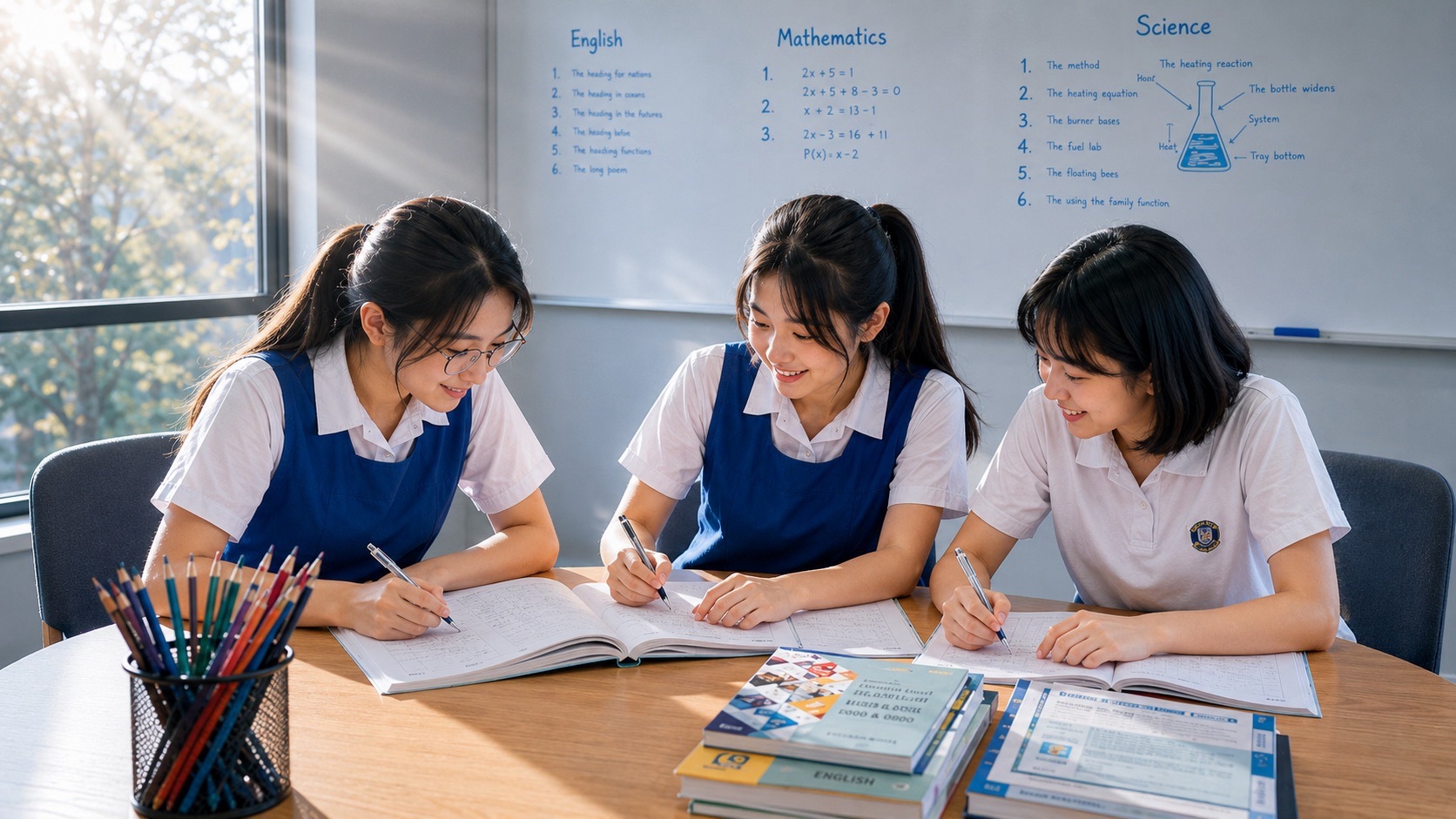
Katong Math Tuition for Secondary 1: Achieve A1 Distinction in Algebra with Small Group Lessons
Why Secondary 1 Mathematics is the Foundation for A1 Success
The transition from Primary School Mathematics to Secondary 1 Mathematics is one of the most crucial shifts in a student’s academic journey. In Katong, many parents seek structured guidance for their children as they adapt to new topics such as Algebra, Geometry, and Number Patterns.
At our Katong Math Tuition programme, we specialise in 3-pax small group lessons that combine personalised attention with focused peer learning. By strengthening core algebra, mathematical communication and problem-solving habits, our home-based Math tutors help students build a more secure foundation for Secondary 1 and the Mathematics demands that follow.
Why Choose Our Katong Secondary 1 Math Tuition
- 3-Pax Small Groups: Each class is capped at three students, ensuring your child gets maximum guidance.
- Algebra Mastery for Distinctions: From simplification and expansion to equations and factorisation, students build the algebra habits needed for stronger Secondary Mathematics.
- MOE Full SBB Curriculum Alignment: Lessons are matched to the student’s subject level using the official MOE G1 Mathematics syllabus and MOE G2/G3 Mathematics syllabuses, rather than an obsolete Express/Normal stream document.
- Step-by-Step Problem Solving: We equip students with structured methods to handle algebra word problems and higher-order questions.
- Assessment Readiness: Students practise school-style and exam-style questions under timed conditions while learning to show clear mathematical reasoning and workings.
What Our Katong Math Tuition Covers in Sec 1
- Algebra Mastery – expressions, equations, factorisation
- Geometry & Angles – triangles, polygons, parallel lines
- Statistics & Data Handling – averages, graphs, probability basics
- Number Patterns & Sequences – identifying rules, problem-solving
- Real-World Problem Sums – applying math to practical contexts
By the end of Secondary 1, the aim is for students to be more confident with algebra, geometry, data and mathematical communication, giving them a stronger base for Secondary 2 Mathematics, later E-Math examination work, and Additional Mathematics where appropriate.
Why Parents in Katong Trust Us
Parents in Katong and nearby areas such as Marine Parade, Joo Chiat, and East Coast consistently choose our tuition because of:
- Experienced Math Tutors in Katong with proven track records.
- Affordable small group tuition without compromising quality.
- Strong community reputation in preparing students for long-term success.
Enrol Today – Secure Your Child’s Spot
Because the 3-pax small group format keeps class capacity limited, the consultation is used to understand the student’s current Secondary 1 Mathematics level, subject-level needs and the specific foundations that need strengthening before a suitable learning plan is proposed.
📍 Location: Katong, Singapore
📞 Contact Us: Click here to get in touch
Build a strong foundation!
Secondary 1 Algebra Foundations: Building Distinction-Ready Mathematics at Katong
Katong Math Tuition specializes in 3-pax small group lessons for Secondary 1 students, with a strong emphasis on mastering algebra to achieve A1 distinctions. Conveniently located in the heart of Katong, Singapore, our tuition center is just minutes away from key secondary schools, allowing students to easily integrate focused math sessions into their routines. Whether tackling algebraic expressions, equations, or factorization, our small group format provides the targeted support needed to excel in Singapore’s rigorous Sec 1 math curriculum and build a solid foundation for higher levels.
Benefits of Small Group Tuition for Secondary 1 Algebra
In Secondary 1, algebra forms a core part of the mathematics syllabus, introducing concepts like algebraic expressions, simplification, expansion, factorization, and solving linear equations. Small group tuition in a 3-pax setting offers an optimal environment for Sec 1 students to grasp these foundational topics, combining personalized attention with collaborative learning to drive A1-level performance.
- Personalised Attention for Individual Progress: With only three students per group, tutors can identify specific difficulties in notation, substitution, equations and inequalities, then adjust the next task to the learner’s actual level.
- Enhanced Collaboration and Peer Learning: Students compare algebraic methods, explain why a step works and see alternative routes to the same answer. In a three-student group, those discussions can remain focused while the tutor checks mathematical language and reasoning.
- Targeted Skill Building for Strong Results: Immediate feedback helps prevent small errors in algebraic notation, factorisation and equation solving from becoming repeated habits. Practice is selected to build from secure foundations toward harder school and exam-style questions.
- Motivation and Efficient Practice: The small-group format gives each student frequent turns to attempt, explain, correct and retry, reducing passive lesson time and making progress easier to observe.
Location Advantage: Proximity to Katong’s Secondary Schools
Our center’s prime location in Katong minimizes travel hassles, enabling Sec 1 students to attend tuition fresh and focused after school. Nearby institutions include:
📍 Secondary Schools in East Singapore (Katong & Surrounding Areas)
Katong / Marine Parade Area
- Tanjong Katong Secondary School
- Tanjong Katong Girls’ School
- Chung Cheng High School (Main)
- Broadrick Secondary School
- Geylang Methodist School (Secondary)
- Paya Lebar Methodist Girls’ School (Secondary)
- CHIJ Katong Convent
- St. Patrick’s School
- Victoria School
Bedok Area
- Bedok Green Secondary School
- Bedok South Secondary School
- Bedok View Secondary School
- Temasek Secondary School
- Anglican High School
- Damai Secondary School
- St. Anthony’s Canossian Secondary School
- Changkat Changi Secondary School
Tampines Area
- Tampines Secondary School
- St. Hilda’s Secondary School
- Junyuan Secondary School
- East Spring Secondary School
- Springfield Secondary School
- Meridian Secondary School
- Ngee Ann Secondary School
Pasir Ris Area
- Hai Sing Catholic School
- Loyang View Secondary School
- Pasir Ris Secondary School
- Pasir Ris Crest Secondary School
- Meridian Secondary School
Notable East-Side Schools
- Manjusri Secondary School
- Ngee Ann Secondary School
- St. Patrick’s School
- Victoria School
- Anglican High School
- Dunman High School
This accessibility supports consistent attendance, ensuring students can reinforce algebra skills without added stress.
Section of Helpful Authoritative Clickable Links
To further support Sec 1 algebra mastery, here are authoritative resources from the Ministry of Education (MOE) and reputable educational platforms. These provide syllabus details, practice materials, and tools aligned with Singapore’s curriculum:
- MOE G1 Mathematics Syllabus – Official Full SBB curriculum reference for G1 Mathematics, including Number and Algebra foundations.
- MOE G2 and G3 Mathematics Syllabuses – Official Full SBB curriculum reference for the more advanced Secondary Mathematics subject levels.
- SEAB 2027 SEC G3 Syllabuses for School Candidates – Forward examination reference showing G3 Mathematics K310 for students progressing toward the SEC pathway.
- eduKate Secondary 2 Math Tuition Katong – The next-stage guide connecting Secondary 1 foundations to stronger Secondary 2 algebra and Full SBB progression.
- eduKate E-Math Mastery Katong – A later-stage companion showing how lower-secondary foundations develop into examination-ready E-Math technique.
- eduKate Katong Mathematics Centre Guide – Internal overview of the 3-pax Secondary Mathematics programme and how the stages connect.
Starting Secondary 1 with secure algebra, clear mathematical communication and consistent practice gives students a firmer base for Secondary 2 and later upper-secondary Mathematics. The small-group programme is designed to strengthen those foundations while keeping subject-level and future pathway decisions open.
