Katong Math Tuition Centre | Secondary Specialists
Expert Katong Tuition Centre for Math Success
Finding the right Katong tuition centre for Math can be the key to your child’s academic success. At our home based small groups Math tuition, we specialise in Secondary Mathematics and Additional Mathematics (E-Math & A-Math), designed to help students not only keep up but excel.
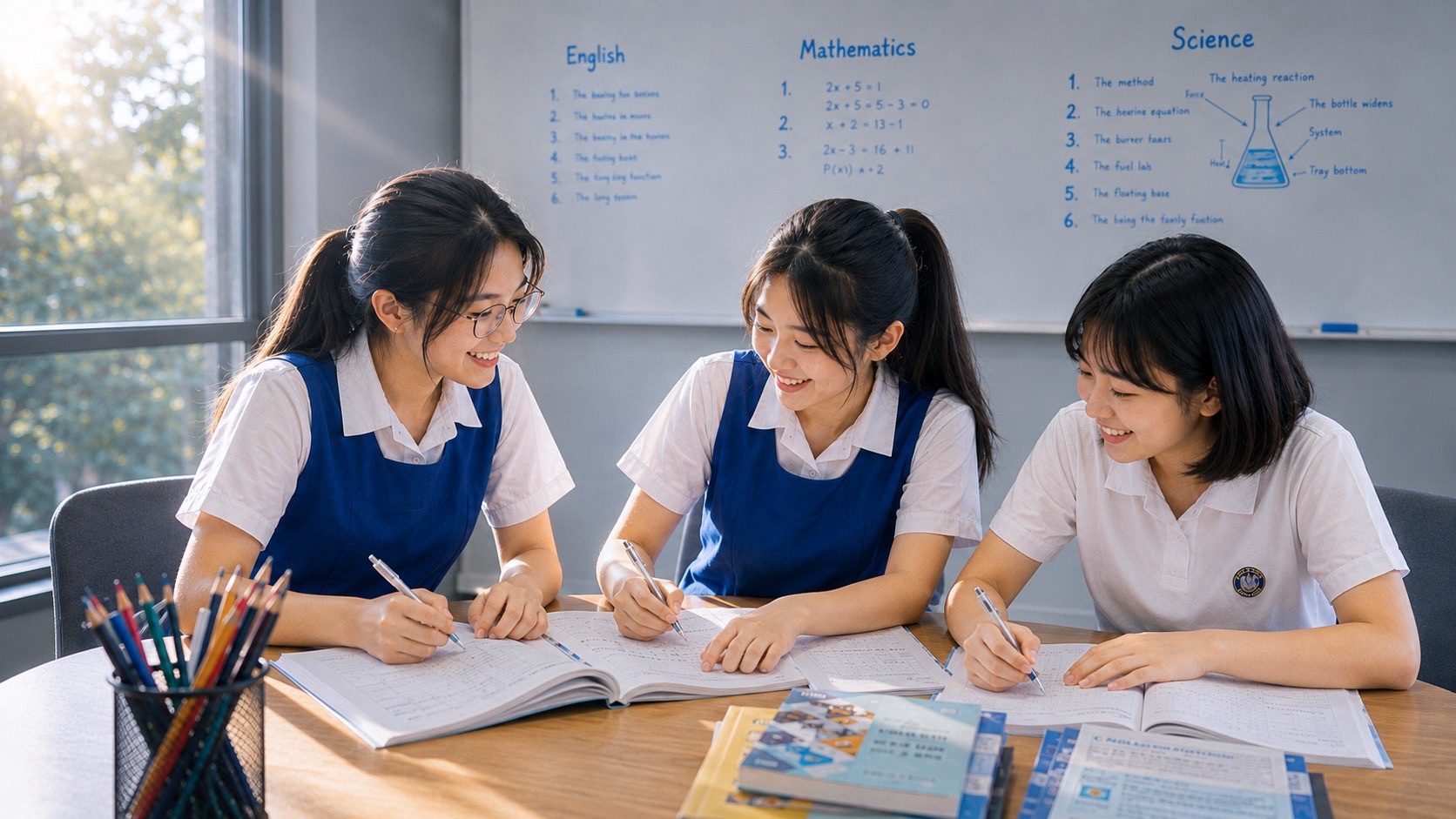
Our 3-pax small group tuition classes provide the perfect balance of personalised attention and peer learning, ensuring that every student gets the guidance they need.
Why Choose Our Katong Math Tuition Centre?
✅ Specialists in Secondary Math — We focus on Mathematics and Additional Mathematics.
✅ 3-Pax Small Group Learning — Small class sizes allow close review of each student’s workings.
✅ Structured Lesson Plans — Teaching is organised around current MOE Full SBB curriculum expectations and SEAB examination requirements.
✅ Experienced Tutors — Lessons focus on diagnosing gaps, correcting misconceptions and strengthening exam-ready mathematical reasoning.
✅ Exam-Oriented Approach — Practice develops accuracy, clear workings, question interpretation and time management for school and national examinations.
Subjects Offered
- E-Math Tuition in Katong: Building strong fundamentals in algebra, geometry, statistics, and problem-solving.
- A-Math Tuition in Katong: Advanced preparation for students taking Additional Mathematics, covering calculus, trigonometry, and higher-order problem-solving.
Benefits of Small 3-Pax Group Tuition
- Focused Attention: Tutors can track and adapt to each student’s learning pace.
- Peer Collaboration: Encourages active discussion and problem-solving.
- Flexible Support: Immediate feedback on mistakes, ensuring stronger mastery.
Conveniently Located in Katong
Parents searching for the best math tuition centres near Katong will find our location easily accessible. With nearby schools and residential estates, we serve students from:
- Tanjong Katong Secondary School
- Tanjong Katong Girls’ School
- Chung Cheng High School (Main)
- Broadrick Secondary School
- St. Patrick’s School
- CHIJ Katong Convent
- Victoria School
Book a Free Consultation Today
Start your child’s journey to Math excellence with a free consultation. Experience our 3-pax small group teaching style before enrolling.
📞 Contact us now to secure your slot. Limited spaces available due to our small class size.
Build a strong foundation!
How Katong Math Tuition Centre Supports Secondary Mathematics Students
Katong Math Tuition Centre is a local home-based programme specialising in Secondary Mathematics and Additional Mathematics, with structured 3-pax lessons designed around the student’s current level, school demands and examination pathway. The small-group format gives the tutor repeated access to each learner’s workings, making it easier to identify weak prerequisites, correct misconceptions and connect foundational E-Math skills to more advanced A-Math reasoning. Students preparing in 2026 are aligned to the current O-Level Mathematics 4052 and Additional Mathematics 4049 pathways, while later cohorts are prepared for the SEC G-level transition from 2027.
Benefits of Specialized Tuition in Secondary E-Math & A-Math
Specialised E-Math and A-Math tuition is most useful when it responds to the exact mathematical work a student is producing. In a 3-pax setting, the tutor can compare a student’s method with current MOE curriculum expectations, identify whether an error comes from a missing prerequisite or from execution, and then select practice that develops conceptual understanding, mathematical communication and application rather than relying on a one-size-fits-all sequence.
- Advanced Problem-Solving: A-Math topics such as functions, trigonometry and calculus require students to connect several ideas in one solution. Small-group lessons can slow down the reasoning, expose the weak step and then rebuild the method before increasing difficulty.
- Pathway Readiness: Secure E-Math and A-Math foundations support later Mathematics study in suitable JC, polytechnic and other post-secondary pathways. The tuition goal is to strengthen the prerequisite knowledge and examination performance needed to keep appropriate options open.
- Confidence Through Verified Progress: Confidence is built by getting previously unstable questions correct for the right reasons. Tutors can track repeated error types and check whether a corrected method transfers to a new question.
- Exam Performance Skills: Practice connects mathematical understanding to accurate workings, interpretation, checking and time management, with feedback tied to the student’s current school and national-examination requirements.
- Adaptive Practice: Because the tutor sees each student’s workings, practice can be adjusted from prerequisite repair to mixed and timed questions instead of forcing every learner through the same sequence.
Location Advantage: Proximity to Katong’s Secondary Schools
Katong Math Tuition Centre’s prime location in Katong makes it an ideal choice for local students, minimizing travel and maximizing study time. This accessibility supports consistent attendance and integrates seamlessly with school routines in this education-focused neighborhood. Nearby secondary schools include:
- Tanjong Katong Secondary School
- Tanjong Katong Girls’ School
- CHIJ Katong Convent
- Changkat Changi Secondary School
Parents value the safe, convenient environment, ensuring students can focus on E-Math and A-Math without added stress.
Section of Helpful Authoritative Clickable Links
Explore these trusted resources for secondary mathematics in Singapore to supplement your learning journey. These official and reputable sites offer syllabi, teaching tools, and insights aligned with the MOE curriculum:
- MOE G2 and G3 Mathematics Syllabuses – Current Full SBB curriculum reference for Secondary Mathematics.
- MOE G2 and G3 Additional Mathematics Syllabuses – Current Full SBB curriculum reference for Additional Mathematics.
- SEAB 2026 GCE O-Level Syllabuses for School Candidates – Official examination index listing Mathematics 4052 and Additional Mathematics 4049.
- SEAB 2027 SEC G3 Syllabuses for School Candidates – Official transition reference listing G3 Mathematics K310 and Additional Mathematics K341.
- eduKate E-Math Mastery Katong – Internal guide to Mathematics examination technique and problem-solving.
- eduKate A-Math Mastery Katong – Internal companion for advanced algebra, calculus and Additional Mathematics preparation.
Katong Math Tuition Centre combines Secondary E-Math and A-Math subject focus with a 3-pax format that makes each student’s reasoning visible. The programme’s value comes from identifying the next weak link, teaching it clearly, checking the student’s workings and then testing whether the corrected method transfers to harder questions under current MOE and SEAB requirements.
