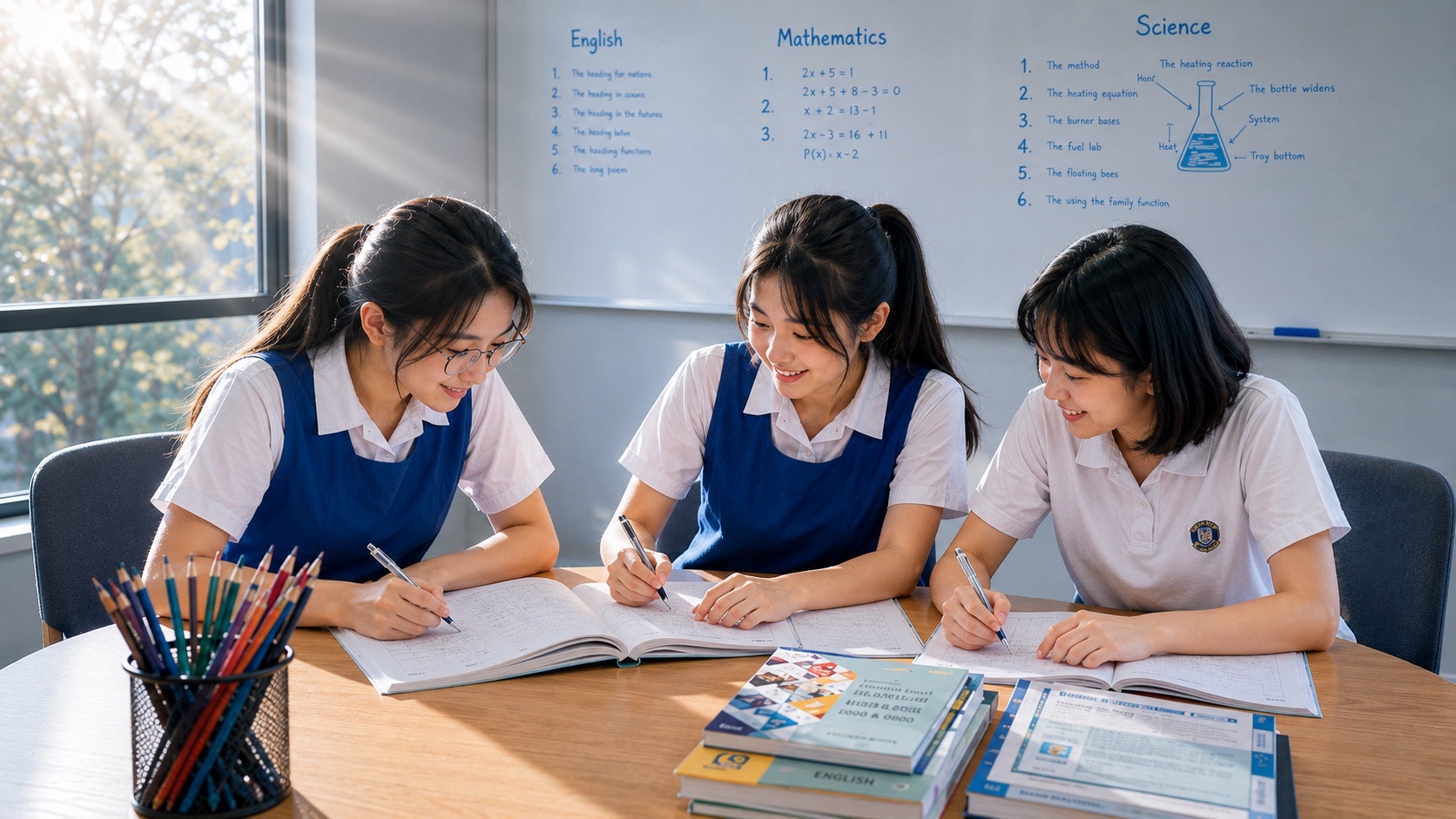
Best Small-Group Math Tuition Katong | Focused Learning for Top Grades
Why Choose Small-Group Math Tuition in Katong?
At eduKate Singapore, our home based small group math tuition in Katong (maximum 3 students per class) is designed to give your child the perfect balance of personalised attention and peer learning motivation. Unlike large classes where students often get overlooked, our tight-knit groups allow tutors to quickly identify weaknesses, provide detailed explanations, and adapt lessons to individual learning speeds.
We specialise in:
- Secondary Mathematics (E-Math) – Building strong problem-solving foundations.
- Additional Mathematics (A-Math) – Preparing students for higher-order thinking and advanced algebraic skills.
What Makes Our Katong Small-Group Tuition Different?
✅ 3-Pax Class Size – Every student receives frequent tutor attention.
✅ Customised Lesson Plans – Practice is adapted to current MOE Full SBB curriculum expectations, the student’s school requirements and identified gaps.
✅ Exam-Oriented Practice – Targeted topical, mixed and timed questions develop examination readiness.
✅ Tutor Feedback – Immediate correction helps improve accuracy, reasoning and speed.
✅ Progress You Can Verify – Repeated error types are tracked so students can show whether a corrected method transfers to new questions.
How Small-Group Tuition Boosts Exam Results
- Stronger Concept Mastery: Small groups allow tutors to check each student’s understanding before increasing difficulty.
- Higher Engagement: Students have repeated opportunities to ask questions, show workings and clarify doubts.
- Peer Learning Benefits: Comparing methods can help students identify more efficient approaches and common errors.
- Step-by-Step Exam Strategies: From structured workings to checking and time management, lessons prepare Secondary students for school assessments, O-Level Mathematics and the SEC G-level pathways that follow.
Who Should Join?
This programme is perfect for:
- Secondary 1–4 Students in Katong seeking improvement in E-Math & A-Math.
- Students who prefer focused, distraction-free learning.
- Parents looking for quality tuition without large class sizes.
Location & Accessibility
📍 Conveniently located in Katong, within easy reach of Marine Parade, Joo Chiat, and East Coast neighbourhoods.
Book Your Free Consultation
Spaces are limited to ensure quality. Secure your child’s spot today in our Katong small group math tuition.
👉 Contact eduKate Singapore Now
Seeking personalized help?
How Focused Small-Group Mathematics Tuition in Katong Supports Top-Grade Readiness
Best Small-Group Math Tuition Katong offers focused Secondary Mathematics classes built around targeted practice and close tutor feedback. For students working on algebra, trigonometry, probability or examination preparation, a three-student group gives the tutor enough visibility to inspect individual workings while still allowing useful comparison of methods. The aim is to support stronger performance by making misconceptions, inefficient methods and repeated error patterns visible early enough to correct them.
Benefits of Small Group Tuition in Mathematics
A three-student Mathematics group can combine close individual feedback with useful peer comparison. The tutor can inspect each learner’s workings, identify whether an error comes from a missing concept or execution, and then adjust the next task. Students also see alternative solution methods and explain their reasoning aloud, while the group remains small enough for misconceptions to be corrected quickly.
- Targeted Prerequisite Repair: The tutor can identify whether a difficult question is exposing a current-topic misunderstanding or an older gap in algebra, number work, graphs or geometry, then repair that prerequisite before returning to the harder task.
- Immediate Feedback on Workings: Students receive correction while the reasoning is still visible, making it easier to fix notation, incomplete steps, sign errors and inefficient methods before those habits repeat.
- Peer Comparison Without Losing Individual Attention: Three students can compare legitimate solution routes and explain their choices while the tutor checks that each learner can reproduce the reasoning independently.
- Progressive Exam Practice: Practice can move from focused topic work to mixed and timed questions once the foundations are stable, so top-grade targets are supported by observable accuracy, reasoning and transfer rather than by promises of a particular result.
Location Advantage: Proximity to Katong’s Secondary Schools
For families based in Katong, Marine Parade, Joo Chiat and nearby East-side neighbourhoods, a local tuition option can reduce unnecessary travel time and make regular attendance easier to sustain. Nearby secondary schools include:
- Tanjong Katong Secondary School
- Tanjong Katong Girls School
- CHIJ Katong Convent
- Chung Cheng High School
- Broadrick Secondary School
- Victoria School
This neighborhood convenience in Katong ensures safe, quick commutes, allowing more time for focused math practice and feedback to drive top performance.
Section of Helpful Authoritative Clickable Links
To support secondary math education in Singapore, explore these reliable resources from official and expert sources. They offer syllabi, tools, and supplements to enhance learning alongside tuition:
- MOE G2 and G3 Mathematics Syllabuses – Current Full SBB curriculum reference for Secondary Mathematics.
- MOE G2 and G3 Additional Mathematics Syllabuses – Current Full SBB curriculum reference for Additional Mathematics.
- SEAB 2026 GCE O-Level Syllabuses for School Candidates – Official examination index listing Mathematics 4052 and Additional Mathematics 4049.
- SEAB 2027 SEC G3 Syllabuses for School Candidates – Official transition reference listing G3 Mathematics K310 and Additional Mathematics K341.
- eduKate E-Math Mastery Katong – Internal guide to Mathematics examination technique and problem-solving.
- eduKate A-Math Mastery Katong – Internal companion for Additional Mathematics foundations and advanced problem-solving.
These current MOE, SEAB and internal eduKate references give students a clearer route from curriculum expectations to examination practice. The small-group programme then turns that reference material into observable work: diagnose the weak link, teach it, check the workings, practise under increasing difficulty and verify that the corrected method transfers.
