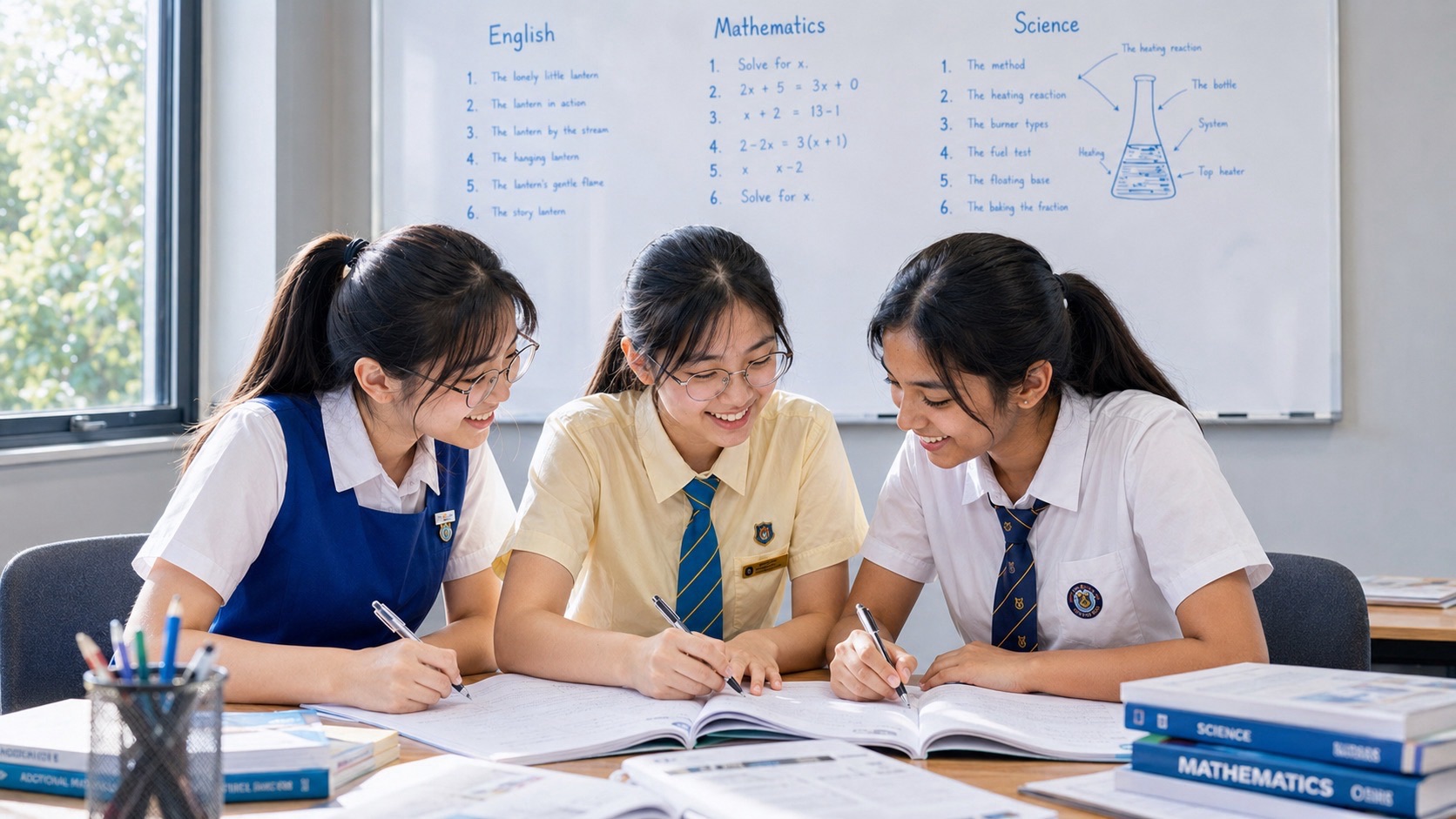
Trudge · Glimpse · Predicament · Discrepancy · Breakthrough | Theme: Action, Conflict and Consequence
Secondary 1 G3 composition writing needs verbs and nouns that connect a believable incident to its result. Trudge differs from stride, a glimpse differs from a scan, and a setback is not necessarily a disaster. This guide teaches 42 words from the 1001–1500 action vocabulary bank through cause-and-effect writing, evidence, realistic school dilemmas and controlled editing.
The focus is accurate action, not inflated drama. One missing folder, one false assumption or one decision to apologise can sustain a strong scene when the choices matter. This is an original vocabulary practice guide, not an MOE or SEAB compulsory list. Secondary 1 G3 is a subject-learning level under Full Subject-Based Banding, and each school sets its own lower-secondary tasks; the 2027 SEC K300 English syllabus is a reference for later writing skills.
- Core vocabulary: 42 entries arranged around movement, searching, gestures, hazards, decisions, evidence and results.
- Story method: situation → obstacle → decision → action → consequence.
- Models: two original short passages showing evidence and a practical response.
- Edit: eight sentences that fail through vagueness, exaggeration or missing causality.
- Parents: check whether the student can explain what actually changed and why.
A narrative advances through decisions, not adjectives
A common early-secondary composition starts with an exciting accident but gives the main character nothing to decide. The story may be full of action words yet have no moral or logical centre. A stronger approach gives the pupil a modest goal, an obstacle that changes the plan, some information that may be incomplete, a choice and a consequence. A single accurate action verb can advance this structure.
For example, ‘They searched the room’ describes an activity. ‘They scanned the room, noticed the labelled box and checked the inventory before accusing anyone’ describes a method and a responsible decision. The second version is longer because it offers new information, not because the vocabulary is harder.
The 42-word action and consequence bank
Movement with a reason
- stride — walk with long, confident steps. Natural phrase: strode across the hall. Example: The captain strode across the hall to check the updated list.
- trudge — walk with heavy, tired steps. Natural phrase: trudged through the rain. Example: After the long rehearsal, the pupils trudged towards the bus stop.
- stagger — move unsteadily as if losing balance. Natural phrase: staggered backwards. Example: He staggered backwards when the heavy box shifted.
- stumble — trip or make a mistake while moving. Natural phrase: stumbled on the step. Example: She stumbled on the wet step but caught the handrail.
- dart — move quickly and suddenly. Natural phrase: darted towards the desk. Example: A pupil darted towards the desk to retrieve the falling papers.
- creep — move slowly and carefully, often quietly. Natural phrase: crept along the corridor. Example: The class cat crept along the corridor before slipping behind a cabinet.
Seeing, searching and checking
- glance — look briefly. Natural phrase: glanced at the clock. Example: She glanced at the clock and realised the meeting was beginning.
- glimpse — see something for a very short time. Natural phrase: caught a glimpse. Example: Through the open door, Ben caught a glimpse of the missing folder.
- peer — look closely, often because seeing is difficult. Natural phrase: peered through the glass. Example: He peered through the glass to read the faint label.
- scan — look over an area or text to find something. Natural phrase: scanned the noticeboard. Example: Mira scanned the noticeboard for the revised venue.
- locate — find the position of something. Natural phrase: located the folder. Example: The group located the folder in the library returns box.
- pinpoint — identify an exact position or cause. Natural phrase: pinpointed the error. Example: She pinpointed the error in the delivery schedule.
Gestures that change an interaction
- grip — hold firmly. Natural phrase: gripped the railing. Example: He gripped the railing while the loose trolley passed.
- clutch — hold tightly, often from fear or urgency. Natural phrase: clutched the envelope. Example: Aisha clutched the envelope containing the final instructions.
- grab — take or hold suddenly. Natural phrase: grabbed the notebook. Example: He grabbed the notebook before it slid off the bench.
- snatch — take suddenly and often rudely or without permission. Natural phrase: snatched the paper. Example: The boy snatched the paper from his sister, then immediately regretted it.
- tug — pull with a short, firm movement. Natural phrase: tugged at the strap. Example: She tugged at the tangled strap until it came free.
- nudge — push gently, usually with a small movement. Natural phrase: nudged the box aside. Example: Ryan nudged the box aside so the wheelchair could pass.
Hazards and practical responses
- slip — lose footing or move unintentionally on a smooth surface. Natural phrase: slipped on the wet floor. Example: She slipped on the wet floor but regained her balance.
- collide — hit or crash into something. Natural phrase: collided with the trolley. Example: Two empty trolleys collided near the storage room.
- buckle — bend or give way under pressure. Natural phrase: the shelf buckled. Example: The overloaded shelf buckled, prompting the staff to close the area.
- leak — allow liquid or gas to escape unintentionally. Natural phrase: water leaked. Example: Water leaked from the loose bottle onto the papers.
- extinguish — put out a fire or light. Natural phrase: extinguished the small flame. Example: A trained adult extinguished the small flame while pupils remained at a safe distance.
- evacuate — leave or move people out of a dangerous place. Natural phrase: evacuated the building. Example: The staff followed school procedures and evacuated the building when instructed.
Choices, obstacles and setbacks
- commit — decide firmly to do something. Natural phrase: committed to an honest explanation. Example: Clara committed to explaining what had happened.
- deliberate — think carefully before deciding. Natural phrase: deliberated over the options. Example: The group deliberated over which plan was safer.
- confront — face a difficult issue directly. Natural phrase: confronted the misunderstanding. Example: She confronted the misunderstanding calmly instead of blaming a friend.
- constraint — a restriction that limits possible actions. Natural phrase: a time constraint. Example: The time constraint forced them to choose a simpler design.
- setback — a problem that slows progress. Natural phrase: an unexpected setback. Example: The missing equipment was a setback, not the end of the project.
- predicament — a difficult or awkward situation. Natural phrase: faced a predicament. Example: He faced a predicament when two friends gave conflicting accounts.
Clues, evidence and inference
- clue — a detail that helps someone understand or solve something. Natural phrase: a useful clue. Example: The label on the box provided a useful clue.
- trace — a small mark or sign left behind. Natural phrase: a trace of ink. Example: A trace of blue ink remained on the damaged receipt.
- discrepancy — a difference between details that should agree. Natural phrase: a discrepancy in the records. Example: They found a discrepancy between the inventory and the receipt.
- inference — a reasoned conclusion drawn from evidence. Natural phrase: a reasonable inference. Example: From the date on the photograph, her inference was reasonable.
- deduction — a conclusion reached by reasoning from known facts. Natural phrase: a careful deduction. Example: Their careful deduction led them to check the earlier room booking.
- evidence — information that supports or challenges a claim. Natural phrase: supporting evidence. Example: The team gathered supporting evidence before speaking to the teacher.
Consequences and the pace of events
- consequence — a result of an action or decision. Natural phrase: an unintended consequence. Example: An unintended consequence of the shortcut was a damaged display.
- repercussion — an effect, often negative, that follows an action. Natural phrase: long-term repercussions. Example: The argument had repercussions for the group’s trust.
- breakthrough — an important advance after difficulty. Natural phrase: a sudden breakthrough. Example: The missing key provided the breakthrough the group needed.
- abruptly — suddenly and unexpectedly. Natural phrase: stopped abruptly. Example: The conversation stopped abruptly when the announcement began.
- methodically — in an organised, careful way. Natural phrase: checked methodically. Example: They checked the boxes methodically instead of searching at random.
- steadily — at a consistent rate or in a controlled manner. Natural phrase: worked steadily. Example: Despite the delay, the team worked steadily until the task was complete.
Twelve contrasts that prevent unnatural English
Stride / trudge: Both describe walking, but stride signals large, purposeful steps; trudge suggests effort or fatigue.
Stagger / stumble: Stagger describes repeated unsteadiness; stumble often describes a trip or momentary loss of balance. Do not turn ordinary clumsiness into dramatic injury.
Glance / peer: Glance is brief; peer involves careful looking, often because something is hard to see.
Glimpse / scan: A glimpse is a brief sighting; to scan is to search across an area or text.
Grip / clutch: Grip stresses a firm hold; clutch often suggests urgency or emotion.
Grab / snatch: Grab is a general sudden taking or holding; snatch often suggests abruptness or a lack of permission.
Nudge / shove: A nudge is gentle and small. A shove is much stronger and may be forceful; the physical consequence should match.
Constraint / setback: A constraint is a condition limiting options; a setback is an event that delays progress.
Clue / evidence: A clue points towards an explanation; evidence is information that supports or challenges it. Not every clue proves a claim.
Inference / assumption: An inference should follow observations; an assumption may be accepted without adequate checking.
Consequence / repercussion: Consequence is a general result; repercussion commonly signals an unwelcome or far-reaching result.
Abruptly / steadily: Abruptly changes the pace suddenly, while steadily conveys a controlled, continuous pace.
The five-link cause-and-consequence chain
- 1. Goal: What does the character want, and why does it matter?
- 2. Obstacle: What exactly stops or complicates that goal?
- 3. Evidence: What does the character know, suspect or misunderstand? Distinguish facts from assumptions.
- 4. Decision: What does the character choose to do? The decision should be visible in speech or action.
- 5. Consequence: What changes immediately, and what lasting effect, if any, follows?
A student can plan these links in five lines before drafting. This is a teaching method, not a mandatory examination composition formula. The prompt and the chosen genre determine the best structure.
Model narrative 1: the missing display
Original learning passage: Ryan strode into the school hall expecting to find the display ready for assembly. Instead, the presentation boards were missing. He glanced at the clock and felt the time constraint immediately. His teammates began to search at random, but Ryan asked them to work methodically. One pupil scanned the storage shelves while another checked the delivery record. A discrepancy caught their attention: the record listed Room 3B, although the boards had been booked for the hall. The group followed the clue and located the materials in the adjacent classroom. Ryan had to deliberate over two options—carry the boards back immediately or ask for a staff member’s help with the larger pieces. He chose the safer method. The delay was a setback, but the group completed the display before the audience arrived. The next day, they revised the booking checklist so that the same mistake would be less likely.
Why this works: The goal is clear; the materials are missing; a discrepancy supplies useful evidence; the group chooses a practical response; and the outcome includes a changed procedure. No artificial injury or unrelated twist is needed.
Model narrative 2: an unfair assumption
Original learning passage: When Mira reached for the class notebook, she found that several pages had been torn out. One pupil claimed that Ben was responsible because he had used it that morning. Mira was tempted to agree, but the claim rested on an assumption rather than evidence. She peered at the damaged binding and found a trace of glue near the missing pages. A second notebook, used during the art activity, had been repaired with the same glue. This did not prove who had removed the pages, but it suggested a question worth asking. Instead of confronting Ben, Mira asked the teacher to help reconstruct when the notebook had last been intact. The group eventually discovered that the pages had been taken out to make a display and stored separately. The misunderstanding had consequences: the class agreed that shared materials would be labelled and signed out before use.
Why this works: The narrator separates an accusation from a clue and a justified conclusion. A strong composition does not turn every suspicion into certainty. A practical resolution grows from the original problem.
Eight repairs from vague action to causal meaning
Repair 1: Before: “He went to the noticeboard fast.” After: “He darted towards the noticeboard when the meeting venue changed.” Why: Movement has a reason and a clear destination.
Repair 2: Before: “She walked home sadly.” After: “She trudged home after learning that the project had not qualified.” Why: The verb conveys tired disappointment without adding an adverb.
Repair 3: Before: “He saw the clue.” After: “He caught a glimpse of a label beneath the folder.” Why: The sentence describes how and where the sighting happened.
Repair 4: Before: “The group looked everywhere.” After: “The group scanned the tables, then methodically checked the return shelf.” Why: The search becomes ordered and plausible.
Repair 5: Before: “They found a mistake.” After: “They pinpointed a discrepancy between the two room-booking records.” Why: The wording identifies the sort of problem.
Repair 6: Before: “Everyone was angry.” After: “The accusation caused a confrontation that disrupted the group’s work.” Why: The conflict affects the story instead of remaining an unsupported mood label.
Repair 7: Before: “The accident happened and it was bad.” After: “The loose lid caused water to leak over the display, delaying the presentation.” Why: The cause and immediate consequence are visible.
Repair 8: Before: “In the end everything was fine.” After: “By the final rehearsal, the team had repaired the stand and agreed to check the equipment before every session.” Why: The ending includes a practical resolution and a changed habit.
Safety and realism in school compositions
Words such as extinguish and evacuate are useful to understand, but students should not describe children performing unsafe rescue actions as though they were routine. In a realistic school emergency, pupils follow staff instructions and the school’s safety procedures. A narrative can be gripping through uncertainty, communication and responsible decisions without teaching dangerous improvisation.
Practice 1: improve movement without over-writing
Write three versions of ‘The pupil went towards the classroom.’ In version A, the pupil is confident and punctual; in B, exhausted after a long rehearsal; in C, moving quickly because an urgent note has arrived. Use stride, trudge or dart only where each fits. Explain how the verb changes the reader’s expectation.
Practice 2: distinguish proof from assumption
Write a 150–200-word scene in which a character finds a clue but must not jump to a conclusion. Include a discrepancy between two records, describe one inference and show how that inference is tested. The answer should remain open until the information is checked.
Practice 3: a school-based decision
Plan a 200–260-word narrative about a lost team resource, a cancelled rehearsal or an overlooked announcement. Use the five-link chain. Include a constraint, a clear action and an outcome. The ending must show either a repair, a lesson expressed through changed behaviour or an unresolved but credible complication.
Practice 4: make an action paragraph shorter
Take a paragraph you wrote last week. Underline every verb and every adverb ending in ‘-ly’. Remove repeated actions, replace two vague verbs with precise ones and combine sentences only where the timeline stays clear. A shorter passage may be stronger if the reader can still answer who did what, why and with what result.
Quick recall quiz: eight short decisions
- Walking heavily because of fatigue: stride or trudge?
- Looking at a clock for one second: glance or peer?
- A small mark left behind: trace or breakthrough?
- A difference between two receipts: discrepancy or repercussion?
- A limit on time or resources: constraint or setback?
- A problem that slows the project after it has begun: setback or clue?
- Checking materials in an orderly sequence: methodically or abruptly?
- A result of the decision: consequence or inference?
Suggested answers: trudge; glance; trace; discrepancy; constraint; setback; methodically; consequence. Ask the learner for a full example of each answer. Word recognition alone is not the same as independent writing control.
A six-session parent support plan
Session 1: practise movement and gestures through short acted-out sentences. Session 2: read a narrative and identify goal, obstacle and response. Session 3: learn clue, evidence, inference and discrepancy through a fictional school problem. Session 4: draft an original scene. Session 5: revise the timeline, causes and grammar. Session 6: transfer the same vocabulary to a different genre, such as a short incident report. If your child can explain which words do not suit the second genre, that is useful progress.
Honest syllabus connection
MOE’s Secondary English Language Syllabus 2020 includes idea generation, organisation, development, revision and editing for different purposes and audiences. The 2027 SEC G3 syllabus index and K300 English Language syllabus state that accurate vocabulary and effective expression are part of the later examination objectives. The examination’s 350–500-word continuous writing requirement is for SEC candidates; it is not a Secondary 1 school composition word limit.
Related chapters and next practice
- Complete action bank: Words 1001–1500
- Part 5: precise emotion words
- Part 6: atmosphere and setting
- Complete reasoning bank: Words 1501–2000
Next: four practical composition writing guides
After learning the 2,000 words, practise selecting words accurately and using them in original writing. These four companion guides teach application and editing, not additional compulsory vocabulary.