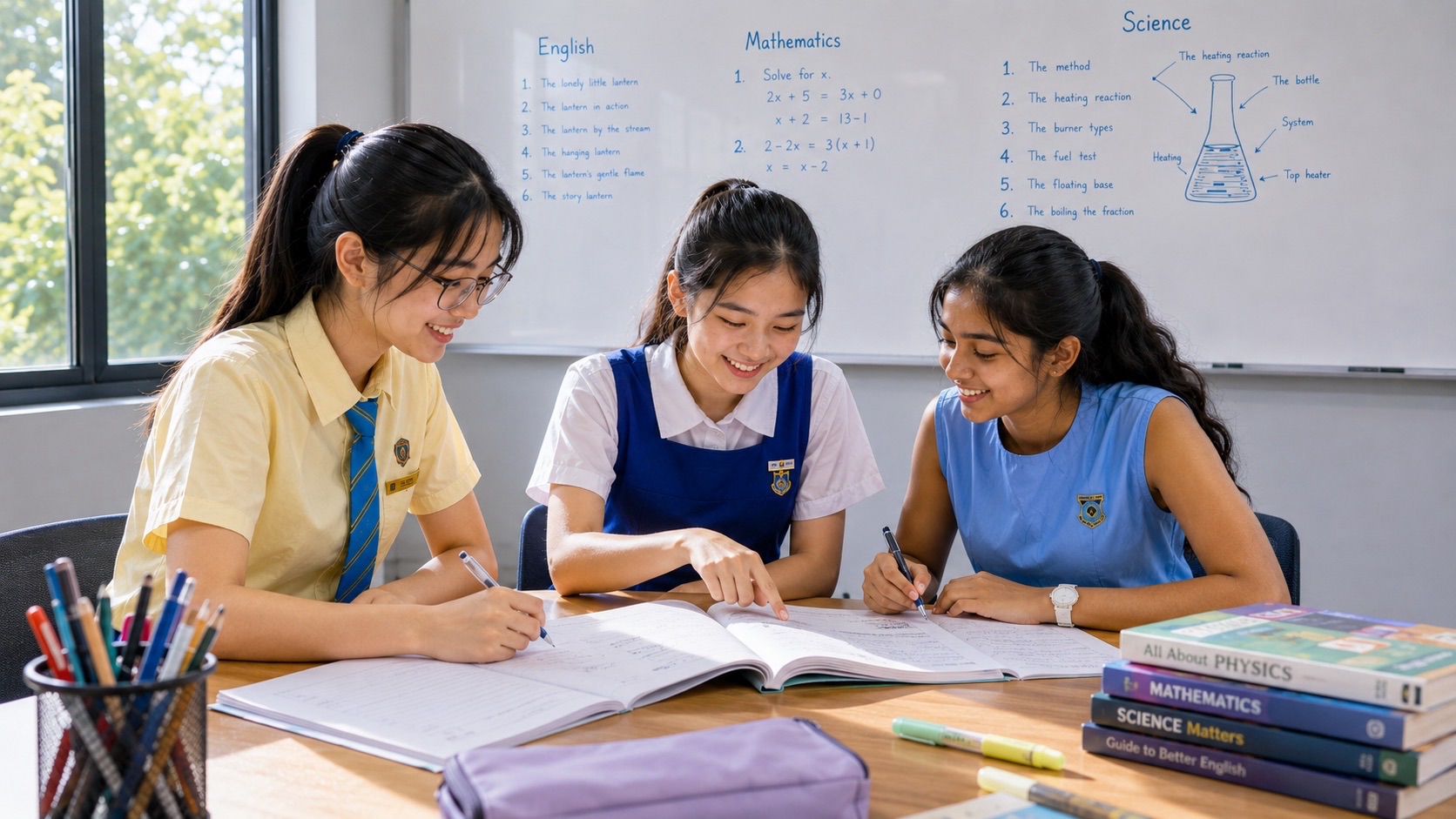
How does a child entering Secondary 1 in 2027 progress towards the Singapore-Cambridge Secondary Education Certificate? The SEC is introduced from 2027 for graduating students, replacing separate N- and O-Level national examinations. This does not mean a pupil joining Secondary 1 in January 2027 sits a final SEC examination immediately. On a standard four-year progression, a pupil entering in 2027 would reach Secondary 4 in 2030, while the child’s actual pathway, subject levels and future exam rules must be confirmed with MOE, SEAB and the school. This W–Z guide maps year-level learning from Whitley to Woodlands Ring.
Before planning several years ahead, parents must first make the November 2026 school choice. PSLE results are released at 11.00am on Tuesday 24 November, and the S1 Portal is open from 11.30am that day until 4.30pm on Monday 30 November. Use the child’s officially selected Posting Group, school teaching, actual commute and genuine programme interests to rank up to six acceptable preferences. Include two or three schools with historically less stringent cutoffs as MOE advises. The old 2026 S1 intake figures do not predict January 2027 admission or eventual SEC performance.
- 2027: Secondary 1, common form-class experience, subject foundations and introductory programmes.
- 2028: Secondary 2, deeper project work and preparation for later subject choices.
- 2029: Secondary 3 on a four-year route, with more specialised upper-secondary learning.
- 2030: Secondary 4 and possible SEC examination for a standard four-year progression; subject and route dependent.
- SEC: national examination reform starts in 2027 for graduating students, not the new S1 class.
- G1/G2/G3: individual subject demand levels under Full SBB, not identical to admission PG1/PG2/PG3.
- PSLE result: 24 November 2026, 11.00am.
- S1 choice deadline: 30 November 2026, 4.30pm.
- Posting outcome: tentatively 18 December 2026, subject to confirmation.
A planning timeline, not a guaranteed examination schedule
| Year | Stage on a four-year route | What to discuss with the school |
|---|---|---|
| 2027 | Secondary 1 | Core subjects, mixed form class, subject levels, school travel and adjustment |
| 2028 | Secondary 2 | Deeper subject understanding and forthcoming upper-secondary combinations |
| 2029 | Secondary 3 | Available subject combinations, selected electives and suitable academic challenge |
| 2030 | Secondary 4 | Actual SEC subjects, graduation and further-study requirements then in force |
These stages are examples of a standard four-year progression, not a promise of identical course duration or exam subjects for all students. Some individual pathways may differ, and education rules can be updated before 2030. Families should use the current receiving-school advice and official SEAB details at each stage.
Nine W–Z school-specific programme timelines
Whitley Secondary School — Communicative Arts
A staged school programme describes paired vlogging in Secondary 1, interviews in Secondary 2 and talk-show discussion in Secondary 3. The point is developing accurate research, listening and expression. A parent should confirm the planned year-level lessons for the child’s actual cohort and avoid promising a selected debate team. Communication learning should support English and other subject explanations, not replace the ordinary curriculum.
The school’s current location is 30 Bishan Street 24, Singapore 579747. The completed 2026 intake historical cutoffs were PG3 22, PG2 25 and PG1 30*, which are relevant only to earlier admissions, not to the child’s future SEC results. Ask which year-level programmes are normal for all entrants, which experiences require selection and what subject options will apply when the child reaches upper secondary.
Yio Chu Kang Secondary School — Arts, Media and Design
The published school sequence introduces Secondary 1 pupils to modules involving drama, dance, rock/pop music, short film and interior design, followed by a deeper Secondary 2 module. Selected talent opportunities have their own rules. A pupil should be able to experiment with creative expression before choosing an advanced arts activity; parents should confirm which parts are actually common to the cohort.
The school’s current location is 3063 Ang Mo Kio Avenue 5, Singapore 569868. The completed 2026 intake historical cutoffs were PG3 22, PG2 25 and PG1 30*, which are relevant only to earlier admissions, not to the child’s future SEC results. Ask which year-level programmes are normal for all entrants, which experiences require selection and what subject options will apply when the child reaches upper secondary.
Zhenghua Secondary School — Outdoor Education and Future of Transportation
Zhenghua describes local trail exploration and trip planning in Secondary 1, navigation in Secondary 2 and a longer expedition in Secondary 3. Its transport-design learning also involves accessibility and technology. These activities should develop reasoning and teamwork without being presented as fixed examination subjects. An older Senja Road address should not be used to plan the current journey to Bukit Panjang Ring Road.
The school’s current location is 62 Bukit Panjang Ring Road, Singapore 679962. The completed 2026 intake historical cutoffs were PG3 20, PG2 24 and PG1 27, which are relevant only to earlier admissions, not to the child’s future SEC results. Ask which year-level programmes are normal for all entrants, which experiences require selection and what subject options will apply when the child reaches upper secondary.
Yuhua Secondary School — MELODY and selected Enhanced Music Programme
Yuhua’s broad arts and music experience is distinct from the later selected Enhanced Music Programme. The official school sequence describes Secondary 1 music participation, a Secondary 2 preparatory stage and selection for the two-year upper-secondary G3 Music pathway beginning in Secondary 3. An incoming child may enjoy music without being promised EMP, and all students still need core subject foundations and manageable CCA practice.
The school’s current location is 35 Jurong West Street 41, Singapore 649406. The completed 2026 intake historical cutoffs were PG3 20, PG2 25 and PG1 28, which are relevant only to earlier admissions, not to the child’s future SEC results. Ask which year-level programmes are normal for all entrants, which experiences require selection and what subject options will apply when the child reaches upper secondary.
Zhonghua Secondary School — four-year Art Elective Programme
Zhonghua’s four-year AEP begins in Secondary 1 after its school-based selection; it is not granted automatically by ordinary school posting. A pupil may gain skills in observation, visual culture, art-making and reflective analysis. Families should ask about normal Visual Art alternatives if the child does not join AEP. A sustained specialist programme needs planning alongside Mathematics, English and the other academic subjects.
The school’s current location is 13 Serangoon Avenue 3, Singapore 556123. The completed 2026 intake historical cutoffs were PG3 12, PG2 23 and PG1 27, which are relevant only to earlier admissions, not to the child’s future SEC results. Ask which year-level programmes are normal for all entrants, which experiences require selection and what subject options will apply when the child reaches upper secondary.
Yuying Secondary School — Eco-Innovators, food innovation and C.A.R.E.S
Yuying’s published Applied Learning describes Secondary 1 food-waste design thinking and a Secondary 2 soybean-pulp innovation example linked to an external partner. Its C.A.R.E.S leadership focus also develops through different age levels. Partners and activities can change by the 2027 entrant’s future years. The stable educational purpose is teaching pupils to observe, measure, revise and communicate useful ideas.
The school’s current location is 47 Hougang Avenue 1, Singapore 538884. The completed 2026 intake historical cutoffs were PG3 22, PG2 25 and PG1 29, which are relevant only to earlier admissions, not to the child’s future SEC results. Ask which year-level programmes are normal for all entrants, which experiences require selection and what subject options will apply when the child reaches upper secondary.
West Spring Secondary School — Advocating for Sustainability and Community Youth Leadership
West Spring’s described leadership progression begins with environmental sustainability in Secondary 1, moves towards inclusion and seniors in Secondary 2, and explores economic responsibility in Secondary 3. Its Applied Learning focuses on explaining an environmental concern with evidence and designing an intervention. Parents should distinguish normal cohort experiences from selected CYL champions or leadership posts, and not promise the same project partners in every later year.
The school’s current location is 61 Senja Road, Singapore 677737. The completed 2026 intake historical cutoffs were PG3 17, PG2 24 and PG1 27, which are relevant only to earlier admissions, not to the child’s future SEC results. Ask which year-level programmes are normal for all entrants, which experiences require selection and what subject options will apply when the child reaches upper secondary.
Yuan Ching Secondary School — REAP robotics and Rise–Lead–Elevate
Yuan Ching describes introductory land robotics in Secondary 1, marine-related or other technical experiences across subsequent years and selected deeper robotics work for students with strong interest. The school’s leadership offering likewise distinguishes common Rise activities from selected Lead and Elevate roles. Parents should ask how students learn to explain algorithms, measurement and the scientific method rather than only demonstrate a working model.
The school’s current location is 103 Yuan Ching Road, Singapore 618654. The completed 2026 intake historical cutoffs were PG3 18, PG2 24 and PG1 28, which are relevant only to earlier admissions, not to the child’s future SEC results. Ask which year-level programmes are normal for all entrants, which experiences require selection and what subject options will apply when the child reaches upper secondary.
Woodlands Ring Secondary School — Future of Transportation and 3C
Woodlands Ring’s applied-learning examples include LEGO SPIKE Prime in Secondary 1 and Tinkercad or Arduino experience in Secondary 2. The school merged with Fuchun in 2025 and currently operates at the Avenue 1 holding campus. Rebuilding at the former site has been projected to finish near the end of 2028, but this date can change, and parents should not guarantee that the child will transfer campuses in a particular school term.
The school’s current location is 21 Woodlands Avenue 1, Singapore 739062. The completed 2026 intake historical cutoffs were PG3 22, PG2 25 and PG1 29, which are relevant only to earlier admissions, not to the child’s future SEC results. Ask which year-level programmes are normal for all entrants, which experiences require selection and what subject options will apply when the child reaches upper secondary.
2027 SEC launch versus the 2027 Secondary 1 cohort
From 2027, the Singapore-Cambridge Secondary Education Certificate (SEC) replaces the separate N- and O-Level national examinations for graduating students. This is the implementation year of a new common certificate under Full Subject-Based Banding. A pupil who enters Secondary 1 in January 2027 is not sitting the graduating SEC examination merely because the same calendar year marks its national launch. Families should keep those two cohorts separate.
The child beginning Secondary 1 in 2027 would reach Secondary 4 in 2030 on a standard four-year progression. That is a planning illustration, not a guarantee that every pupil follows exactly four years or that every subject and examination detail will remain unchanged. The receiving school can advise on actual pathway duration and the MOE and SEAB rules applicable when the student approaches graduation.
First year: study routines and a sense of belonging
In Secondary 1, most families should prioritise reliable travel, form-class belonging, ordinary English and Mathematics foundations and the ability to ask teachers for help. An appealing Applied Learning or Learning for Life Programme can motivate a child, but it should not lead the family to neglect understanding basic concepts, reading difficult instructions or organising homework. Good foundations make future subject choices more meaningful.
Ask a pupil to explain one real English response, one Mathematics method and one Science observation. An adult can see whether the child understands why a method works, whether a question was misread or whether assignments were simply lost. These are different needs and should be repaired separately rather than by automatically increasing the volume of worksheets.
Full SBB: one form class can include multiple subject profiles
Full Subject-Based Banding has been implemented in mainstream secondary schools since 2024. Students join mixed form classes for common learning while individual academic subjects can be taught at G1, G2 or G3 demand levels, according to eligibility. The child’s initial Posting Group helps govern school admission but does not label every subject or permanently define capability.
A pupil may be strong in Science and require more support in English, or excel at writing but find abstract Maths difficult. Parents should ask about the school’s actual subject offers and review process instead of promising a particular G3 subject on the basis of interest, talent or the school’s previous cutoff. A different starting level in one subject can coexist with meaningful development in another.
Scores 21–22: decide the group before the school list
PSLE Scores 21 and 22 can provide an option between PG2 and PG3. The family’s choice should reflect academic readiness across subjects and the pupil’s ability to cope with an appropriate pace. Primary 6 teachers may be able to explain the child’s comprehension, independence and need for scaffolding. The official S1 Option Form is the authority for that individual child.
Historical PG3 and PG2 school cutoffs are separate admissions comparisons. A pupil choosing PG2 must compare the previous PG2 figure at each school; using an easier-looking PG2 number to claim a PG3 guarantee would be misleading. The school choice should be about a real learning environment, not manipulating an old numerical table.
Score 25 and the PG1/PG2 option
At PSLE Score 25, families may have an option between PG1 and PG2. The right starting level should support understanding and future confidence. A child who enjoys robotics might be academically strong in a practical context yet need guided help reading complex instructions; another may speak confidently but struggle with numerical reasoning. Neither should be reduced to the same expectation from the aggregate alone.
Once the group is selected, parents should apply its previous school cutoffs consistently across the six choices. The child can still have individual subject strengths and later review opportunities where MOE criteria permit. A family should not describe PG1 or PG2 as a permanent ceiling, but should also not promise automatic progression to every G3 subject.
Secondary 1 programmes do not predict a job at age twelve
A pupil may enjoy food science, robotics, media production, outdoor work or art during their first year. These experiences can reveal interests, but no single project fixes an eventual career. The programme’s greater educational value may be learning to investigate a question, test an idea, respond to feedback and explain a conclusion clearly.
Parents should not select a school solely because its ALP sounds like a future industry that is currently fashionable. A child who enjoys coding may later become interested in writing or medicine; a young artist may discover applied technology. A broad, supportive mainstream education leaves room for that exploration.
2028 Secondary 2: observe readiness before upper-secondary choices
Secondary 2 can bring more complex work and a deeper experience of signature school programmes. Whitley’s interviews, Yio Chu Kang’s Arts Media and Design specialisation and Woodlands Ring’s circuit or Arduino modules are published examples. They are useful indications of the school’s approach, not guarantees that each activity and partner will be unchanged for a 2027 entrant by 2028.
Students and parents can use real schoolwork to identify subject strengths and gaps before later subject combinations are decided. Ask whether the child can explain mathematical reasoning, interpret a Science experiment and support an English argument with evidence. When a problem persists, ask teachers for a precise repair rather than wait for upper-secondary assessment pressure.
Course review at the end of lower secondary
Upper-secondary subjects and their demand levels are not chosen purely by what sounds prestigious. The school’s available combinations, academic eligibility, student interest and teacher advice matter. A pupil who wants advanced mathematics or formal Art should understand the required foundation and time commitment, while another may prefer a practical or humanities-oriented mix.
A parent can prepare a simple review with three questions: which subjects does the child learn deeply, where are assignments becoming overwhelming, and what opportunities might the pupil want to explore next? This is better than promising a specific post-secondary course several years before the relevant admission criteria are known.
2029 Secondary 3: normal and selected routes become more distinct
On a standard four-year progression, a 2027 entrant reaches Secondary 3 in 2029. Subject combinations can become more specialised, and some school programmes offer deeper work at this stage. Yuhua’s upper-secondary Enhanced Music Programme, for example, has a selection process; Zhenghua’s outdoor sequence also describes later expeditions. Neither is a universal requirement or guarantee for every pupil.
Parents should ask about the pupil’s actual subject levels and timetable when 2029 approaches. An intensive specialist activity can be valuable, but it must be compatible with English, Mathematics, Science or other chosen subjects and a manageable daily commute. More programmes do not always equal more learning.
Why AEP and EMP have different timelines
Zhonghua’s Art Elective Programme is a four-year specialist option beginning in Secondary 1, following the school’s selection process. Yuhua’s Enhanced Music Programme is a later selected upper-secondary pathway that begins in Secondary 3. It is inaccurate to describe both as automatically available at the initial school posting or as interchangeable forms of arts study.
Parents can ask what the child will learn in ordinary Art or Music lessons and how specialist selection changes the workload. A school must still be a good fit if the child does not join the selected route. The ability to practise, receive criticism and sustain academic foundations matters more than a programme label in a November school list.
STEM projects: from exciting activity to transferable knowledge
Robotics, smart-city technology and food innovation can all strengthen Science and Mathematics when teachers make the reasoning explicit. A child should not merely copy code or build a demonstration; they should be able to explain what variable changed, what was measured and whether the evidence supports the conclusion.
One student may work well with sensors but struggle writing a scientific report; another may be articulate but less precise with measurements. A programme that recognises those differences and teaches the missing skill can help learners transfer knowledge to unfamiliar examination tasks later. Selected robotics competitions are not a substitute for normal subject work.
Arts and communication can strengthen core academic habits
Drama, interviews, short films, design and music require observation, interpretation, listening and revision. A child learning to edit a film can develop a clearer sense of audience and evidence, while one preparing a talk-show response practises answering an unfamiliar question. These capabilities can support English and humanities learning when teachers help pupils connect the activity to academic explanation.
Artistic confidence does not eliminate the need for core subject support. A successful performer may still struggle with algebra or reading a dense Science passage, and a quiet student may be excellent at analysis. Families should ask how the school recognises varied strengths rather than assume its most visible performers are the only successful pupils.
2030 Secondary 4: possible SEC planning for a four-year student
If the pupil progresses through Secondary 1 in 2027, Secondary 2 in 2028 and Secondary 3 in 2029 on a standard four-year route, Secondary 4 would be in 2030. The SEC framework provides a common national certificate with subjects at appropriate G1, G2 and G3 levels. However, actual examination and graduation arrangements for the 2030 cohort must be confirmed closer to that year.
Families should not promise that every incoming student takes identical subjects or finishes at exactly the same time. Some pathways or individual circumstances can differ. The school should explain the child’s real course, eligibility and examination obligations. A four-year table is a planning aid rather than an inflexible prediction.
2028 changes to post-secondary admissions are not a fixed 2031 rule
MOE has announced a coordinated Post-Secondary Admissions Exercise from 2028, following the first SEC results. That helps parents understand the direction of the education system, but it does not justify promising an exact college, polytechnic or ITE admissions formula for a student whose graduation will occur later.
By the time a 2027 Secondary 1 entrant nears graduation, the family should consult the current official criteria for Junior Colleges, Millennia Institute, polytechnics and ITE. It is reasonable to explain the different types of pathways to a twelve-year-old without insisting that the child choose one permanent destination before beginning secondary school.
Depth, Load and Transfer across the secondary years
Depth is the ability to explain why an idea works, Load is the ability to manage learning tasks and daily commitments, and Transfer is the ability to apply knowledge when a problem changes. All three become more demanding as the child progresses from introductory concepts to upper-secondary subject work.
A pupil who knows how to operate a robot but cannot explain the algorithm needs conceptual depth. A student who understands algebra but misses assignments needs planning support. A pupil who handles standard Science questions but struggles with an unfamiliar context needs varied transfer practice. Targeted support is more useful than imposing more identical exercises in every case.
School culture and the child’s willingness to ask for help
A prestigious-looking previous cutoff does not determine whether a child will ask for assistance when confused. Families should examine form-class relationships, teacher accessibility, student support and the ordinary learning environment. A school with engaging programmes and a manageable commute can give pupils the time and confidence to improve.
When a student is struggling, parents can bring one real example of schoolwork to the teacher. The question should be what the pupil understands and what support is appropriate, not whether another school would have magically solved the problem. Once a school has been allocated, daily teaching and belonging matter far more than revisiting ranking debates.
The six-choice list is the start, not the whole plan
Parents should rank up to six genuinely acceptable secondary schools using the child’s selected Posting Group. MOE recommends including two or three with previous cutoffs less stringent than the child’s PSLE Score, because historical cutoffs can move when new cohorts have different results and school preferences.
School choice order can be a tie-breaker after citizenship when same-score pupils compete for a final seat, followed by balloting if needed. The application is not first-come-first-served. A school with a lower old PG3 cutoff is not automatically better for every pupil, and the correct historical COP must be read within the same group.
First-term priorities that support the next four years
After posting, the child needs a realistic morning route, confidence finding classrooms, a way to record assignments and room for friendships and rest. Parents can review one Maths task, an English reading response and a Science explanation each week, then ask what was understood independently. These small observations help identify learning gaps before they become major difficulties.
CCA participation and specialist programmes can be valuable but should be chosen with an awareness of total workload. A child who enjoys music or engineering should still have time to sleep and study. A stable first-term routine is a foundation for future subject options, not an unimportant administrative detail.
A revisable family plan is better than a rigid prediction
Families can use the years 2027, 2028, 2029 and 2030 as prompts for annual discussions. At each stage, ask what the child has learned, where they need help, which interests have developed and whether the selected subjects remain suitable. The school can explain actual requirements for the next stage when they become relevant.
A pupil who changes interests is not necessarily losing direction. An early enthusiasm for short films may develop into writing or design; a robotics student may discover environmental research. The goal is a secondary education that supports thoughtful choices based on current evidence and personal growth rather than a fixed adult script.
Five practical parent examples
Whitley pupil who is shy in Secondary 1
The student may learn research and communication through a paired vlog before later interview and discussion tasks. Parents should ask how teachers scaffold participation instead of promising that the pupil will become an expert public speaker in the first month.
The family’s next step is to record one academic foundation, one genuine interest and one question for the teacher. The child should receive specific support when a skill is missing and time to discover new interests. This example is not a promise of a selected programme, subject level or final examination result.
Yuhua music pupil planning several years ahead
The child can enjoy introductory music and a suitable CCA, then investigate later preparatory and EMP selection. A school place in January 2027 does not guarantee Music at G3 from Secondary 3.
The family’s next step is to record one academic foundation, one genuine interest and one question for the teacher. The child should receive specific support when a skill is missing and time to discover new interests. This example is not a promise of a selected programme, subject level or final examination result.
Zhonghua art pupil interested in AEP
The family should ask for the current S1 AEP selection requirements while recognising the value of ordinary Visual Art if selection does not succeed. The school choice should remain positive beyond one specialist programme.
The family’s next step is to record one academic foundation, one genuine interest and one question for the teacher. The child should receive specific support when a skill is missing and time to discover new interests. This example is not a promise of a selected programme, subject level or final examination result.
Yuan Ching child who likes robotics but struggles with English
REAP may motivate technical investigation. The parent can use the first two years to strengthen written explanations and reading, not assume that a robotics medal automatically makes G3 Mathematics suitable.
The family’s next step is to record one academic foundation, one genuine interest and one question for the teacher. The child should receive specific support when a skill is missing and time to discover new interests. This example is not a promise of a selected programme, subject level or final examination result.
PG2 pupil with strong Science considering future subjects
An eligible pupil may later study a particular higher-demand subject, but the receiving school determines actual offerings and review criteria. The family should follow evidence of understanding rather than select every challenging label for prestige.
The family’s next step is to record one academic foundation, one genuine interest and one question for the teacher. The child should receive specific support when a skill is missing and time to discover new interests. This example is not a promise of a selected programme, subject level or final examination result.
Questions to ask at each stage of Secondary 1 to Secondary 4
- What does the school expect a normal Secondary 1 pupil to understand in English, Mathematics and Science?
- Which ALP and LLP activities occur in Secondary 1 and which are later or selected?
- How is subject-level eligibility determined and reviewed under Full SBB?
- What foundations should the child build before upper-secondary subject combinations?
- How will the family understand the actual G1/G2/G3 subjects and SEC requirements when relevant?
- How can a student pursue meaningful arts, language, leadership or technology interests without overload?
- What changes to school location, timetable or programme availability require fresh confirmation?
- What official post-secondary entry criteria apply when the child actually graduates?
Official sources and eduKate references
- SEAB 2026 PSLE result and S1 Posting dates
- MOE SEC implementation from 2027
- MOE 2028 Post-Secondary Admissions Exercise
- MOE Full Subject-Based Banding
- MOE S1 Posting
- MOE SchoolFinder
- Whitley Communicative Arts sequence
- Yuhua Enhanced Music Programme
- Zhonghua Art Elective Programme
Editorial verification: 19 November 2026. The SEC begins in 2027 for graduating cohorts; this does not imply a Secondary 1 entrant in 2027 takes the final SEC examination that year. A 2030 graduation timeline is conditional on a standard four-year route, the child’s actual subjects and future rules. Historical 2026 S1 intake cutoffs are not fixed 2027 thresholds.