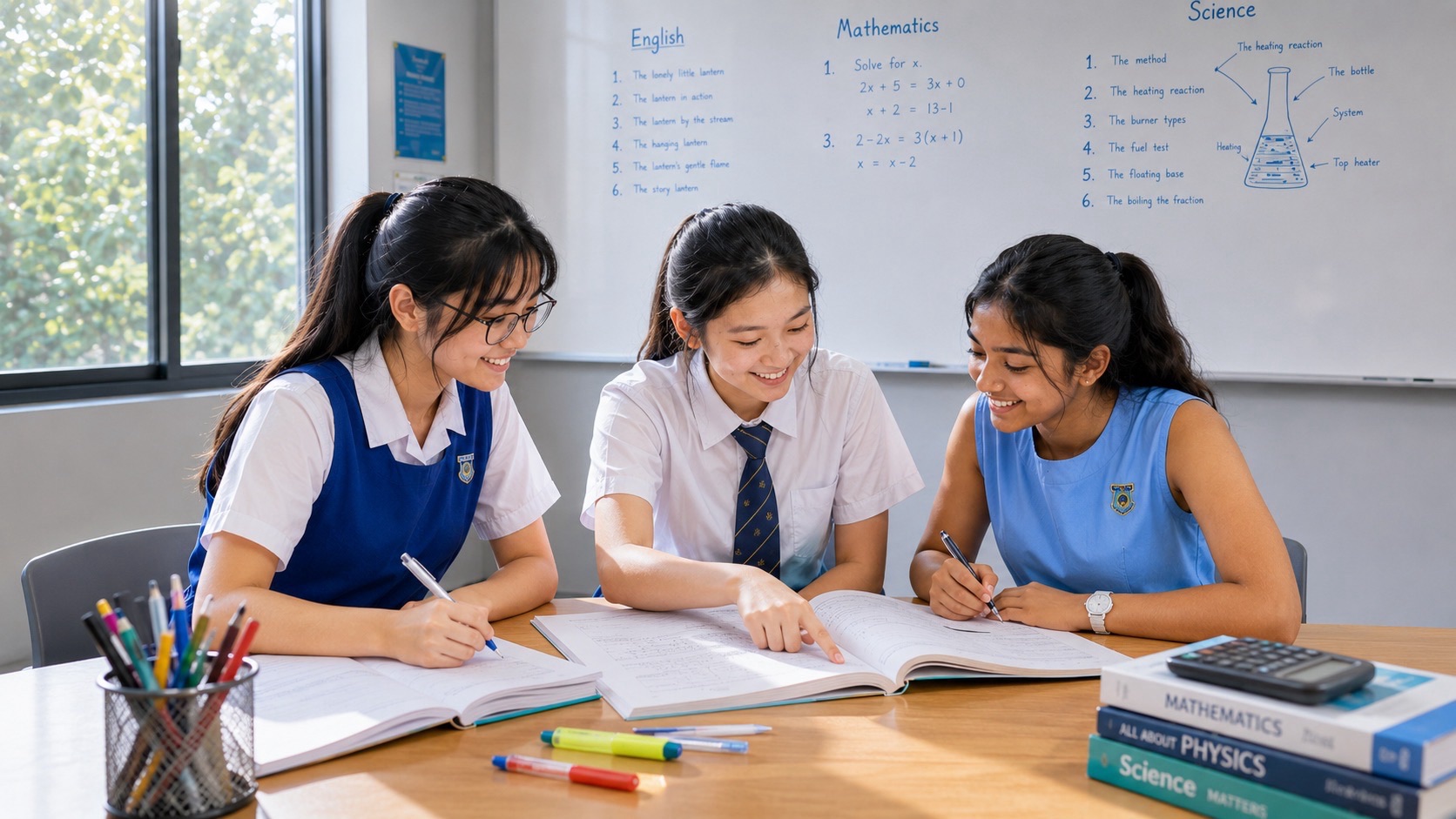
Jin Tai Secondary School after the PSLE results on Tuesday 24 November 2026 at 11.00am is not an independent school a family can select for the 2027 Secondary 1 intake. Jin Tai and Ghim Moh merged into Clementi Woods in 2007; Clementi Woods joined Tanglin in 2016; Tanglin merged with New Town in 2023. The present school is New Town Secondary School, at 1020 Dover Road, Singapore 139657. Its completed 2026 S1 intake recorded PG3 14–20, PG2 21–25 and PG1 26–30*. These earlier results are not guaranteed 2027 cutoffs. The old school names and school codes cannot provide extra places.
For parents in Dover, Ghim Moh, Clementi, Buona Vista, Queenstown and Ulu Pandan, the immediate action is to collect the official PSLE result, confirm the child’s Posting Group and compare real current school options. The S1 Portal opens at 11.30am on 24 November and closes at 4.30pm on Monday 30 November 2026. New Town Secondary School offers Digital Communicators, Change Makers: Secondary 1 heritage photography, Secondary 2 stop-motion animation, community youth leadership, and selected upper-secondary Enhanced Art. Parents should consider the child’s interests, normal subject support, school culture, CCAs and actual journey rather than rely on nostalgia or a previous cohort’s score.
- Historical school: Jin Tai Secondary School; current institution: New Town Secondary School.
- Current school campus: 1020 Dover Road, Singapore 139657.
- 2026 S1 intake PG3 14–20, last-posted score 20.
- 2026 S1 intake PG2 21–25, last-posted score 25.
- 2026 S1 intake PG1 26–30*, last-posted score 30*.
- Distinguishing programmes: Digital Communicators, Change Makers: Secondary 1 heritage photography, Secondary 2 stop-motion animation, community youth leadership, and selected upper-secondary Enhanced Art.
- PSLE results 24 November 2026 at 11.00am; S1 choice window 24 Nov 11.30am–30 Nov 4.30pm.
- Posting result tentatively Friday 18 December 2026; await confirmation.
- Prepare six genuine eligible school preferences with realistic alternatives and an acceptable commute.
The parent’s five-step decision map
Open school-selection steps
- Confirm official result and dates
- Find current school and the correct Posting Group
- Compare subjects, programmes and pupil support
- Research neighbouring eligible schools
- Submit six genuine choices and plan 2027
1. Results release, exact submission window and the child’s real route
SEAB and MOE confirmed on 17 November 2026 that PSLE results will be released on Tuesday 24 November at 11.00am. Primary schools provide collection instructions, including the official procedure for appointing a proxy by 26 November where necessary. The result slip contains individual Achievement Levels in English, Mathematics, Science and Mother Tongue and the total. Lower totals represent stronger performance, but the score does not determine every academic interest or future opportunity.
The ordinary S1 Portal opens at 11.30am on 24 November and closes at 4.30pm on 30 November 2026. One parent with Singpass selects six ranked eligible schools and keeps the acknowledgement after submission. S1 posting results are tentatively due Friday 18 December, with a final date to be confirmed. A saved draft is not a submitted application, and a former school name is not a seventh option.
| Milestone | Date/time | Parent’s action |
|---|---|---|
| PSLE results | 24 Nov, 11.00am | Read actual total and eligible group |
| Portal opens | 24 Nov, 11.30am | Enter current school names using Singpass |
| Portal closes | 30 Nov, 4.30pm | Submit and retain acknowledgement |
| Posting outcome | Tentatively 18 Dec | Follow final MOE confirmation |
2. Historical score ranges, group rules and school-specific uncertainty
| Previous completed S1 2026 group | Historical PSLE range | How to interpret |
|---|---|---|
| PG3 | 14–20 | Compare only if PG3 eligible |
| PG2 | 21–25 | Compare only if PG2 eligible |
| PG1 | 26–30* | Check any * vacancy notation |
For New Town Secondary School, the figures describe pupils who sat the 2025 PSLE and entered Secondary 1 in 2026. Demand, places and school choices in the new cohort can change the final 2027 cutoff. The asterisk after 30 in the PG1 range indicates remaining vacancies in the previous exercise, not proof the last actual entrant scored exactly 30 or a guaranteed place in 2027. The older Jin Tai Secondary School institution does not have a second current score range.
Posting Groups PG1, PG2 and PG3 help allocate pupils to mainstream secondary schools. G1, G2 and G3 are subject learning levels under Full Subject-Based Banding. An official group option generally applies across six school choices and cannot be selected differently for each school simply to use the easiest old cutoff. ALP, IB, IP and IGCSE are not synonyms, and a school’s early historical name may refer to language-medium integration rather than any modern IP qualification.
3. School history and the present-day educational experience
Jin Tai and Ghim Moh merged into Clementi Woods in 2007; Clementi Woods joined Tanglin in 2016; Tanglin merged with New Town in 2023. The relevant school for a child entering in 2027 is New Town Secondary School. Digital Communicators, Change Makers: Secondary 1 heritage photography, Secondary 2 stop-motion animation, community youth leadership, and selected upper-secondary Enhanced Art. Parents should distinguish the current programme experienced by ordinary pupils from selected competition teams, DSA opportunities and future electives. A school where the child feels able to learn and ask teachers for help is more valuable than one chosen solely from an alumni memory.
A chain of three mergers rather than a simple change of sign
The Jin Tai Secondary School name belongs to a historic educational community. Jin Tai merged with Ghim Moh Secondary in 2007 to form Clementi Woods Secondary; the latter joined Tanglin Secondary in 2016, and Tanglin merged into New Town in 2023. The MOE Heritage Centre names these earlier communities in Tanglin’s school-history record. None is a separate school parents can enter on the 2027 Portal. Current pupils apply to New Town, which has its own cohort, programmes, teachers and school code. Previous T-score figures for the predecessors should never be averaged or converted into a new PG cutoff.
The merging schools’ identities are worth preserving for alumni and local history. A pupil whose parent attended Jin Tai might feel a genuine emotional connection, but must still decide whether the modern New Town learning environment suits them. An old Jin Tai school location or school uniform is not a current reporting instruction. Ask about the child’s own academic interests, preferred CCAs, commuting route and support needs, then use today’s school identity and completed posting history. A relative’s memory should inspire curiosity rather than impose a false admission expectation.
Dover Road is the current gate, not a former campus
New Town Secondary School is at 1020 Dover Road, Singapore 139657. The official contact information identifies Dover MRT and buses such as 33, 96, 151, 183 and 196. Families around Ghim Moh or Clementi may have different journeys from those in Queenstown or Ulu Pandan. The right entrance and normal reporting time need to be checked with the school, especially before a child begins travelling independently. Parents should not send a new pupil to a former Jin Tai, Clementi Woods or Tanglin campus because an older directory lists it.
Test the morning and after-CCA route using the actual home and school gate. A teenager carrying sports gear or Art materials may feel a journey differently from an adult at an open house. Watch for exposed crossings, missed buses and the final sheltered walk. A school might be a good educational match but impose an exhausting routine. It is better to understand that before ranking choices and to include transport, sleep and time for homework in the family worksheet.
Secondary 1 photography connects school heritage to media literacy
New Town’s 2026 ALP describes Secondary 1 learning on heritage and shared history through smartphone photography. Students develop composition, focus, framing and camera-setting knowledge, but the most educational question is how a photograph represents reality. An image can show one detail while leaving out context. Ask whether pupils learn to identify the source, date and intended audience, and whether their captions distinguish evidence from speculation. A family with Jin Tai alumni could use the programme to explore actual historical sites and compare older photographs with the present neighbourhood.
A project should be assessed for accuracy and thoughtful communication rather than only visual polish. A student who revises a misleading caption after feedback demonstrates meaningful learning. Children who are confident speakers may need to check facts more carefully; quieter students might contribute through research and editing. This kind of digital literacy supports English, Humanities and respectful participation online. Ask the school which parts are standard for all Secondary 1 pupils and which involve separate competitions.
Animation in Secondary 2 and the question of transfer
New Town’s ALP continues with stop-motion animation, storytelling and storyboarding for Secondary 2. A pupil needs to plan a sequence, understand the viewer’s perspective and select evidence for a message. Learning how images communicate can help children who find extended prose challenging, but technology cannot replace accurate reading and reasoning. Ask how teachers help the class revise an unsupported claim or organise a confusing story. The point is to apply critical thinking in a new form, not merely learn to use editing software.
The school also offers tier-two work through selected CCAs, workshops and opportunities to create more advanced media projects. These should not be advertised as automatically included with an ordinary S1 place. A student who is keen on storytelling may love the basic programme without pursuing a specialist competition. Parents can ask for a normal weekly timetable and a sample progression from photography to animation, then evaluate how the programme supports the child’s interests alongside ordinary core subjects.
Community Youth Leadership is not only a prefect badge
New Town’s Learning for Life Programme emphasises compassionate student leadership and service. All pupils can develop responsibility through class activities, CCAs and age-appropriate community work, while selected Student Councillors or peer supporters may receive additional training. A pupil who never served as a primary-school prefect can still become a reliable organiser, careful listener or thoughtful teammate. Ask what the school teaches about understanding the needs of people receiving help and how it responds when a class project fails to deliver its intended result.
A useful leadership exercise asks pupils to consult residents before building an information poster. If the intended audience cannot read the small print, would students be willing to revise their work? This links service with media literacy and empathy. A schoolwide programme should help different personalities contribute rather than reward only public speaking. The family’s decision can include character culture, student support and opportunities to find friends as well as examination history.
Enhanced Art is later and assessed separately
New Town offers an Enhanced Art Programme for selected upper-secondary pupils with interest and talent. A new S1 pupil is not guaranteed EAP admission merely by joining the school. Ask about lower-secondary Art, relevant CCAs, school exhibitions and how students can build foundational skills. The school’s public programme may refer to older GCE O-Level Art terminology; a parent whose child enters in 2027 should check how upper-secondary assessment aligns with the SEC framework when the child reaches that stage.
A young artist can learn to observe, research, draw, photograph and present an explanation even without a specialist course place. These skills can sit alongside strong Mathematics and Science study rather than compete with them. The choice of New Town should be attractive because of ordinary teaching and wellbeing, not only a hope for a selected Art programme three years later. A careful family can revisit options as the pupil develops.
The 2026-entry PG1 asterisk is important
For the completed 2026 Secondary 1 intake, New Town recorded PG3 14–20, PG2 21–25 and PG1 26–30*. The last number is the previous reference boundary within its own Posting Group. A PG3 child scoring 19 was numerically stronger than the previous endpoint of 20, whereas Score 21 was outside that earlier PG3 range. These observations cannot guarantee the 2027 allocation because demand and school preferences change. A PG2 family should use the PG2 row, not the PG1 figure.
The asterisk after 30 means places remained in the earlier PG1 exercise. It does not establish that the actual last admitted pupil had Score 30 or that a new PG1 applicant is entitled to a place. Keep the star in parent-facing tables and discuss the child’s subject-level support. A school with some former vacancies is not inferior, and an earlier tighter cutoff cannot measure teacher quality. The decision should be about the present pupil, not a ranking of institutions by one number.
New Town versus Fairfield and other Dover alternatives
Fairfield Methodist School (Secondary) is another school around Dover, but its affiliated and non-affiliated admissions histories differ. A family without the recognised affiliation must not use the more permissive affiliated cutoff to compare Fairfield with New Town. Other current schools such as Commonwealth, Clementi Town and Queensway have separate programmes and scores. A genuine six-choice shortlist should record eligibility, school culture, the pupil’s interests and the commute for each institution.
A child might prefer New Town’s digital photography while another values a Methodist community or a different Science ALP. Both may still need support in algebra, extended reading and organisation. Ask what a typical lesson looks like and how teachers check understanding. A school at the previous PG3 boundary could be aspirational but not guaranteed; two or three historically less stringent schools can help make the final list practical without including unwanted options.
4. Nearby current schools and the commute
Families around Dover, Ghim Moh, Clementi, Buona Vista, Queenstown and Ulu Pandan may investigate the schools below. They are research candidates, not proof that all admit every Posting Group or have vacancies. Each institution has its own address, historical intake, programmes and eligibility conditions. Use current MOE SchoolFinder data rather than averages of predecessor cutoffs or a school ranking compiled from old T-scores.
- Fairfield Methodist School (Secondary) — Dover, check affiliation
- Commonwealth Secondary School — West Coast
- Clementi Town Secondary School — Clementi
- Queensway Secondary School — Queenstown
- Gan Eng Seng School — Henderson
- Kent Ridge Secondary School — West Coast
- Nan Hua High School — SAP, separate conditions
The current school gate is at 1020 Dover Road, Singapore 139657. Test the normal school-morning journey and a second route after CCA. Check the last walk, public transport waiting and safe crossings. A map pin may hide a difficult transfer. A school with an appealing science or media programme can justify extra travel for some families, but parents should consider sleep, homework and friendships across four school years.
Why children need more than a historical school cutoff
A past last-posted score records demand and available places for one completed intake. It does not give a guaranteed threshold for the next cohort and does not measure a school’s teaching quality. A pupil may be eligible for several different schools with very different learning environments. Parents should ask how teachers help with errors in Mathematics and comprehension, which applied programmes are offered to everyone and how a child can seek pastoral support.
MOE recommends two or three of six choices whose previous cutoffs were less stringent than the child’s score. Under the AL system, a lower total is better: a score of 19 is stronger than 20, not weaker. At a tie for a final school place, citizenship, preference order and potentially a ballot can matter. Use school-specific historical data in the correct group, and prepare genuine alternatives that the child would accept.
The difference between Posting Group and subject levels
PG1, PG2 and PG3 guide admission to mainstream Secondary 1 schools. G1, G2 and G3 describe learning levels for individual subjects under Full Subject-Based Banding. Some pupils may be offered an option between Posting Groups, which generally applies across the six-school list. A student can have particular strengths in Mathematics, Science or language that are not completely described by the overall total.
Families should ask how the school supports those differences. A pupil who understands algebra quickly may benefit from more demanding work in that subject, while the same child could need help with extended English writing. Official criteria determine any subject-level flexibility, so parents should not promise an unrestricted change. An applied programme, old ‘integrated’ school name or school CCA is not a separate IP or international-qualification admissions route.
A real school-day commute needs practical testing
A school shown near the family’s home on a map can still require long bus waits, an exposed final walk or an awkward crossing. Test the actual route at school reporting time, not only a weekend visit. Repeat the journey after CCA when the pupil may carry sports or Art equipment and return later. A school with a distinctive ALP may justify a longer journey for the right child, but sleep, meals and time to study are important constraints.
Ask which gate new pupils use and what to do when a bus is delayed. A student who is learning independent travel needs a safe backup plan and an adult to contact. Families can compare a one-bus journey with a shorter-looking but more complicated route. An education decision should consider the child’s ordinary week over four years, rather than treat transport as unimportant beside the previous admission score.
Mathematics should be understood instead of memorised
A pupil who knows 3 × 7 = 21 might still need to learn why the equation 3x = 21 can be solved by dividing both sides by three. The idea is preserving equality; simply memorising ‘move the three across’ becomes unreliable with negatives, fractions and brackets. A parent can ask the child to explain one step, practise it carefully and then attempt a slightly different problem to see whether the principle transfers.
Good teachers diagnose exactly where a method breaks down and help the pupil repair that point. A pile of nearly identical worksheets can create speed without understanding. Secondary Mathematics demands the ability to reason about relationships and symbols. These habits are also useful in Science, robotics and design projects, where an apparently successful result can conceal a wrong assumption. A school should support steady thinking and clear explanations.
English and Science need evidence and explanation
A child reading a short passage should identify the main claim, the evidence supporting it and what has not yet been shown. In Science, observing that a plant grows faster under one condition does not prove which variable caused the difference. Ask what conditions would need to be held stable and whether the test should be repeated. These are transferable habits, not guesses about the exact next examination questions.
Children may be practically curious but find extended writing difficult. Another pupil may be confident in conversation yet need help checking a graph or numerical result. Parents can practise short explanations and new variations at home without trying to teach the entire Secondary 1 syllabus before the first term. The purpose is to make learning manageable, accurate and independent, with feedback on actual misunderstandings.
Character, friendships and the first term matter
The first few weeks of secondary school bring unfamiliar classmates, more subject teachers, CCAs and responsibility for timetables. Some children are academically capable but anxious about making friends. Others are sociable but need help organising homework. Ask the school which form teachers and peer supporters are available and how pupils can report concerns. A positive culture needs practical support as well as statements about values.
Parents can establish a simple weekly check-in: what was learned, which task was difficult and what feedback helped? The first test mark is information about adjustment, not a permanent prediction. Sufficient sleep, a safe commute and access to a trusted adult matter for academic progress. A school that helps a child recover from mistakes and feel that they belong provides a valuable foundation beyond the numerical result.
Six choices should all be schools the pupil could genuinely enjoy
After confirming the eligible Posting Group, identify six different active schools through MOE SchoolFinder. Record their correct names, addresses, historical score ranges, subject options, distinctive programmes and school culture. Include some historically less stringent choices where possible but do not fill the list with places the pupil would strongly dislike. A fourth or fifth preference can be a good educational outcome when chosen deliberately.
Rank in genuine preference order. The child should be able to explain at least one meaningful attraction to each institution, whether a Science programme, a manageable journey, supportive teachers or a CCA. Adults can contribute knowledge of logistics and eligibility without treating school selection as a competition with relatives. A balanced list protects the pupil’s realistic opportunities while respecting their interests.
Old alumni names and historical school sites can mislead
A predecessor’s name may remain on archived school magazines, maps and yearbooks even after a merger or closure. Those records can be historically accurate and yet unusable for current school selection. Verify the active school code, physical gate and modern curriculum. A parent who attended the old institution does not automatically gain recognised affiliation for the child, and former T-score streams cannot be mapped directly onto new Achievement Level admission ranges.
Preserve the history with respect and invite the child to learn about the neighbourhood changes it represents. But the actual pupil will study with today’s teachers, classmates and learning resources. A school chosen solely to reproduce a grandparent’s journey may not suit the child’s present interests or daily commute. Heritage can motivate curiosity without creating an admissions right.
A timely submission is essential
The national S1 Portal closes at 4.30pm on 30 November 2026. Use the child’s actual result and the current school names, submit through the parent Singpass process and keep the acknowledgement. A saved draft, historic school code, school tour or enquiry is not a valid completed selection. If a special group option, DSA commitment or other eligibility point remains unclear, ask the primary school or MOE while the window is open.
After the posting result, follow the receiving school’s 2027 reporting, uniforms, textbooks and Personal Learning Device instructions. Different G-level subjects can involve different materials, and an old predecessor’s booklist should not be used for purchases. A sensible holiday plan includes practising the journey, reading for pleasure, addressing a genuine learning gap and leaving time for rest. Education is built over years, not completed by choosing a school name.
5. Case studies for the actual school-choice family
Child numerically stronger than the old PG3 endpoint
If the pupil is PG3 eligible and scores below 20, the previous result is a useful reference. It is not an unconditional 2027 place, because choices and places can change.
The family’s next step is to compare two or three other genuine choices and make sure every listed school could support the child. Historic score differences should guide planning without turning the pupil into a prediction or making a school appear superior merely because it had fewer available places.
Child at the old PG3 boundary
A pupil at 20 matches the earlier endpoint but could still face ties or different demand. Rank genuinely and keep acceptable alternatives.
The family’s next step is to compare two or three other genuine choices and make sure every listed school could support the child. Historic score differences should guide planning without turning the pupil into a prediction or making a school appear superior merely because it had fewer available places.
PG2 child at the former boundary
The PG2 previous endpoint was 25. Use this row only with the child’s actual eligible group and subject-level plans.
The family’s next step is to compare two or three other genuine choices and make sure every listed school could support the child. Historic score differences should guide planning without turning the pupil into a prediction or making a school appear superior merely because it had fewer available places.
PG1 child looking at the previous range
The earlier PG1 range was 26–30*; this is a reference, not a guarantee. Ask about appropriate subject teaching and wellbeing support.
The family’s next step is to compare two or three other genuine choices and make sure every listed school could support the child. Historic score differences should guide planning without turning the pupil into a prediction or making a school appear superior merely because it had fewer available places.
Family attracted by the old school name
The current S1 option is New Town Secondary School at 1020 Dover Road, Singapore 139657. The historical name is meaningful but not an extra application or automatic family affiliation.
The family’s next step is to compare two or three other genuine choices and make sure every listed school could support the child. Historic score differences should guide planning without turning the pupil into a prediction or making a school appear superior merely because it had fewer available places.
Pupil wants the flagship learning programme
Ask how much of Digital Communicators, Change Makers: Secondary 1 heritage photography, Secondary 2 stop-motion animation, community youth leadership, and selected upper-secondary Enhanced Art. reaches all lower-secondary pupils and what requires separate selection or advanced study.
The family’s next step is to compare two or three other genuine choices and make sure every listed school could support the child. Historic score differences should guide planning without turning the pupil into a prediction or making a school appear superior merely because it had fewer available places.
Pupil prioritises a short school journey
Compare the actual route at reporting time and after activities with other eligible schools, while also listening to the child’s academic and social preferences.
The family’s next step is to compare two or three other genuine choices and make sure every listed school could support the child. Historic score differences should guide planning without turning the pupil into a prediction or making a school appear superior merely because it had fewer available places.
Parent questions to take to school staff
What does every new Secondary 1 pupil learn?
Request a normal timetable and representative work; distinguish common from selected opportunities.
Record a concrete answer, not just a promotional phrase. A school should make it possible for the family to understand both the educational opportunity and ordinary pupil support. Where an arrangement is unconfirmed for 2027, mark it as a question rather than a promise.
How are misconceptions repaired?
Ask for evidence of focused feedback and a new question testing transfer.
Record a concrete answer, not just a promotional phrase. A school should make it possible for the family to understand both the educational opportunity and ordinary pupil support. Where an arrangement is unconfirmed for 2027, mark it as a question rather than a promise.
How is subject-level strength recognised?
Ask about Full SBB G-level criteria and suitable teaching support.
Record a concrete answer, not just a promotional phrase. A school should make it possible for the family to understand both the educational opportunity and ordinary pupil support. Where an arrangement is unconfirmed for 2027, mark it as a question rather than a promise.
How do form teachers support a new class?
Find out how friendships, anxiety and parent communication are handled.
Record a concrete answer, not just a promotional phrase. A school should make it possible for the family to understand both the educational opportunity and ordinary pupil support. Where an arrangement is unconfirmed for 2027, mark it as a question rather than a promise.
What CCA opportunities are available to beginners?
Check training hours, selection and late return transport.
Record a concrete answer, not just a promotional phrase. A school should make it possible for the family to understand both the educational opportunity and ordinary pupil support. Where an arrangement is unconfirmed for 2027, mark it as a question rather than a promise.
Which materials should we buy?
Wait for the actual posted school’s 2027 booklist, uniform and device instructions.
Record a concrete answer, not just a promotional phrase. A school should make it possible for the family to understand both the educational opportunity and ordinary pupil support. Where an arrangement is unconfirmed for 2027, mark it as a question rather than a promise.
What should be verified before ranking?
Check school name and code, historical category, special eligibility and campus.
Record a concrete answer, not just a promotional phrase. A school should make it possible for the family to understand both the educational opportunity and ordinary pupil support. Where an arrangement is unconfirmed for 2027, mark it as a question rather than a promise.
FAQs after the 2026 PSLE result
Can I select the old school?
No. Jin Tai Secondary School is no longer separate; choose New Town Secondary School if eligible.
Does a previous cutoff guarantee my choice?
No. It is a completed earlier cohort’s outcome.
Can I use PG1 numbers when my child chose PG3?
No. The groups are distinct admission categories.
Is PG3 the same as G3?
No. PG3 is an initial posting group; G3 is the level of an individual subject.
Does a merger create two school choices?
No. There is one current institution and its normal admission rules.
Are specialist ALP competitions guaranteed?
No. Schoolwide lessons and selected extension opportunities differ.
Can a child later study a more demanding subject level?
Sometimes, under the actual MOE and school criteria.
Does a previous 30* mean a guaranteed place?
No. It records vacancies in the previous exercise.
Will school prestige determine university admission?
No. Later performance, subject choices and admissions rules matter.
Should the child have a say?
Yes. Interests, social fit, support and sustainable transport are legitimate considerations.
When are S1 posting results?
Tentatively 18 December 2026, subject to confirmation.
When must six school choices be submitted?
By 4.30pm on Monday 30 November 2026.
Final parent decision
The correct current school is New Town Secondary School, at 1020 Dover Road, Singapore 139657. Its 2026 historical group ranges were PG3 14–20, PG2 21–25 and PG1 26–30*. They are useful for planning but cannot promise 2027 admission. The family should use actual current MOE school identities, an appropriate Posting Group, realistic alternatives and the child’s preferences.
The PSLE total is information about one stage of learning, not a complete prediction of a young person’s future. School choice should create conditions for strong teaching, academic growth, friendships and independence. Submit the correct six-school list on time, then prepare for the real receiving school with a safe commute and manageable learning routines.
Official sources and eduKate related reading
- SEAB/MOE 17 November official results and S1 timetable
- MOE S1 Posting Portal
- MOE SchoolFinder and historical score data
- MOE Full Subject-Based Banding
- MOE Heritage Centre: Tanglin / Clementi Woods / Jin Tai history
- New Town official contact and current Dover campus
- New Town digital communication ALP
- New Town community leadership LLP
- New Town Enhanced Art Programme
- Earlier eduKate Jin Tai school guide
- eduKateSG immutable Clementi Secondary 1 reference
Editorial verification: 19 November 2026. The official results and S1 submission dates were confirmed by SEAB/MOE on 17 November. School histories, addresses and programmes are based on the linked institutional sources. The score ranges refer to S1 intake in 2026 based on PSLE 2025 and do not guarantee future admission. eduKateSingapore independently provides parent guidance.