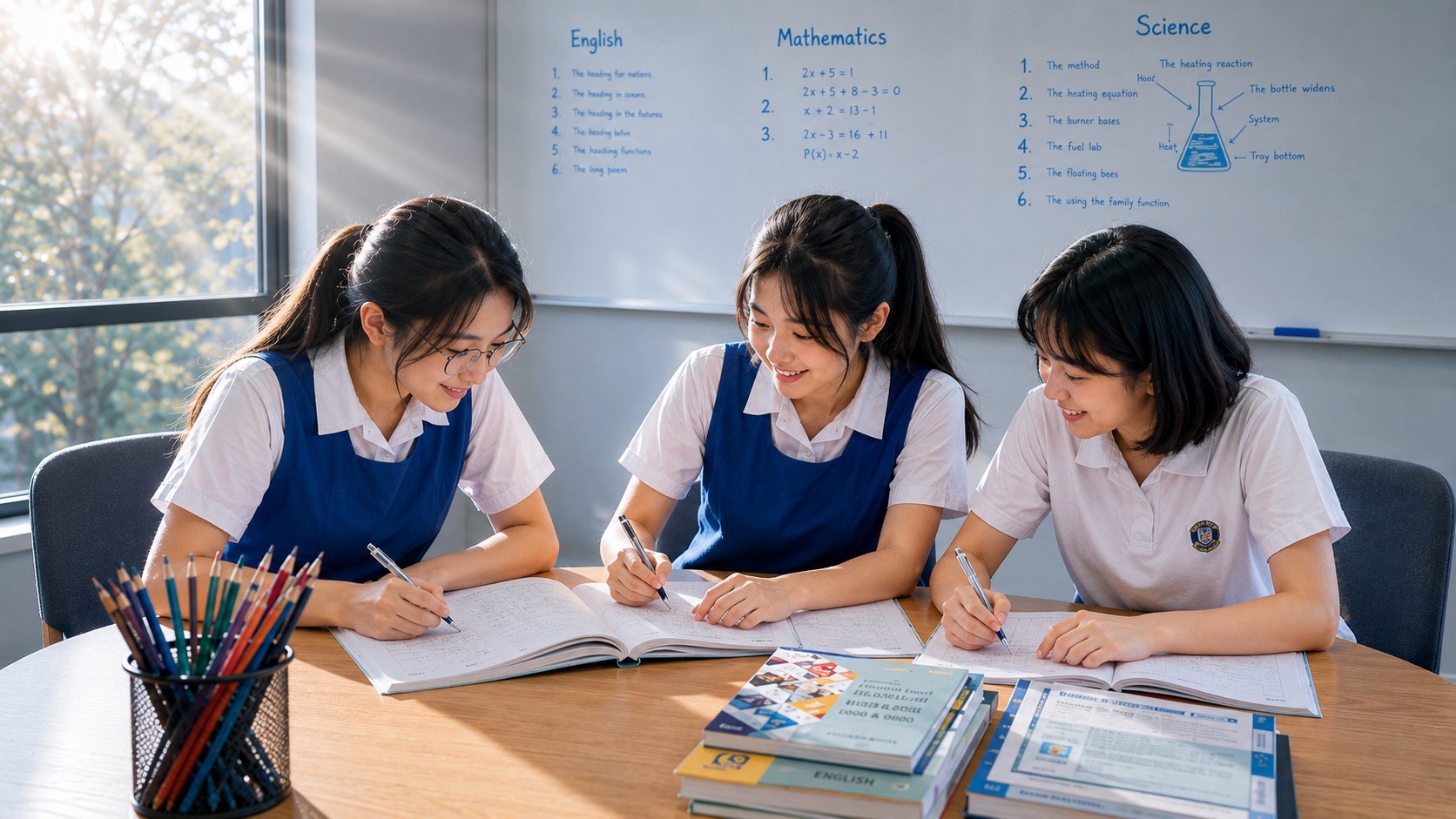
Secondary 1 G2 Science vocabulary helps students understand a question, describe what they observe and explain why something happens. This guide provides 100 useful words and terms, each with a clear meaning and an example. Start with the set that matches the topic being taught in school. A student who can distinguish mass from weight, melting from dissolving, or an observation from an inference is building understanding that can be used in unfamiliar questions.
For parents, the aim is to make the child’s thinking easier to see. Ask for a short explanation, a labelled sketch and one example before asking for another worksheet. In a suggested three-pupil tutorial, each learner can explain, question and check a different response. This vocabulary bank supports the MOE lower-secondary Science course, with school sequencing and the student’s G2 learning needs guiding the pace; it is an eduKate selection, not a prescribed SEAB list.
- Who this helps: Secondary 1 students taking Science at G2, and parents supporting the move from primary Science.
- What is included: exactly 100 distinct vocabulary entries in ten sets, with meanings and original examples.
- Where to begin: the school’s current unit, then the words needed to explain that unit’s ideas.
- How to practise: say the meaning, use the term, draw the idea where useful, and try a changed question.
- What to check: correct relationships, evidence, units and explanations, rather than memorised keywords alone.
- How to plan: use the four-week routine and diagnostic below; preview later topics only when appropriate.
Curriculum scope. MOE’s G2/G3 Lower Secondary Science syllabus brings together scientific inquiry and foundations in matter, cells, light, forces, energy and systems. Some outcomes are marked optional for G2. This editorial vocabulary bank is not the complete syllabus, an official ranking or a uniform Secondary 1 teaching schedule. Follow the school’s current unit plan and the teacher’s instructions about depth.
SEAB’s SEC overview explains the national qualification beginning in 2027. Lower-secondary vocabulary practice should not be treated as an upper-secondary SEC paper or as a guarantee of a future subject combination. In the lists below, a topic not yet introduced by the school is a preview, not overdue work.
These words travel across topics. Learn their different jobs so that an answer does more than repeat the question.
| No. | Word or term | Meaning | Example in use |
|---|---|---|---|
| 1 | observe | Notice and record information using senses safely or using instruments. | We observe bubbles rising through the liquid; identifying the gas needs further evidence. |
| 2 | infer | Use observations and knowledge to suggest an explanation. | From the wet pavement, we infer that rain may have fallen. |
| 3 | predict | State an expected result using a pattern, model or explanation. | We predict that the warmer water will cool towards room temperature. |
| 4 | hypothesis | A proposed explanation that can be tested against evidence. | Our hypothesis is that greater exposed surface area increases the rate of evaporation. |
| 5 | variable | A quantity or condition that can have different values. | Water temperature is a variable in an investigation of dissolving time. |
| 6 | independent variable | The factor deliberately changed in a planned investigation. | We change only the water temperature when comparing dissolving times. |
| 7 | dependent variable | The outcome measured to investigate the effect of a change. | The time taken for the same sugar mass to dissolve is measured. |
| 8 | controlled variable | A factor kept the same to make a comparison meaningful. | Keep water volume and sugar mass constant when comparing dissolving times. |
| 9 | evidence | Observations or data used to support or challenge an explanation. | Three measured cooling curves provide evidence; an unsupported guess does not. |
| 10 | conclusion | A reasoned answer to an investigation question based on evidence. | Our conclusion applies to the tested temperatures, rather than every possible temperature. |
A number becomes useful when the reader knows what was measured, which unit was used and how the result was obtained.
| No. | Word or term | Meaning | Example in use |
|---|---|---|---|
| 11 | mass | A measure of the amount of matter in an object. | The balance shows a mass of 120 g for the dry sample. |
| 12 | volume | The amount of three-dimensional space occupied by a substance or object. | The measuring cylinder contains 40 cm³ of water, equivalent to 40 mL. |
| 13 | density | Mass per unit volume; calculate it by dividing mass by volume. | A 120 g sample occupying 40 cm³ has a density of 3 g/cm³. |
| 14 | length | The distance between two points along the dimension being measured. | Measure the block’s length from one end to the other, avoiding parallax. |
| 15 | temperature | A measure of how hot or cold something is. | The water’s temperature falls from 40 °C to 30 °C while cooling. |
| 16 | unit | An agreed standard used to express a measured quantity. | A recorded length of 15 needs a unit, such as centimetres. |
| 17 | meniscus | The curved surface of a liquid inside a container. | For water in a measuring cylinder, read the bottom at eye level. |
| 18 | accuracy | How close a measurement is to the accepted or true value. | A reading near the verified reference value is more accurate than one far away. |
| 19 | precision | How closely repeated measurements agree under the same conditions. | Closely grouped readings can be precise even when a miscalibrated instrument is inaccurate. |
| 20 | average | Here, the mean: add the values and divide by their number. | Times of 18 s, 20 s and 22 s have a mean of 20 s. |
Connect each label to what the material contains. Words such as solution have a special meaning in Science.
| No. | Word or term | Meaning | Example in use |
|---|---|---|---|
| 21 | matter | Anything that has mass and occupies space. | Air is matter even though the gases around us are usually invisible. |
| 22 | element | A substance containing only one type of atom. | A sample of pure copper contains copper atoms, rather than several different elements. |
| 23 | compound | A substance with different elements chemically combined in fixed proportions. | Water is a compound containing hydrogen and oxygen chemically combined. |
| 24 | mixture | Substances together without being chemically combined with one another. | Sand and salt form a mixture whose components retain their identities. |
| 25 | solute | The substance that dissolves when a solution forms. | Salt is the solute when a small amount dissolves in water. |
| 26 | solvent | The substance in which a solute dissolves. | Water acts as the solvent when it dissolves the added salt. |
| 27 | solution | A uniform mixture formed when a solute dissolves in a solvent. | Salt solution remains a mixture even when no salt crystals are visible. |
| 28 | soluble | Able to dissolve in a specified solvent under stated conditions. | Table salt is soluble in water; always name the solvent being discussed. |
| 29 | insoluble | Not dissolving to an appreciable extent in a specified solvent. | Sand is insoluble in water, so it can remain as solid particles. |
| 30 | suspension | A mixture with dispersed particles that can settle out. | Muddy water may form a suspension whose particles gradually collect at the bottom. |
Distinguish a separation method from a change of state. Use diagrams or school demonstrations to connect the terms.
| No. | Word or term | Meaning | Example in use |
|---|---|---|---|
| 31 | filtration | Separating an insoluble solid from a fluid using a filter. | Filter paper can separate sand from water, but not dissolved salt. |
| 32 | residue | The solid left on the filter during filtration. | The sand collected on the filter paper is the residue. |
| 33 | filtrate | The liquid that passes through the filter during filtration. | Water and dissolved salt can pass through together as the filtrate. |
| 34 | evaporation | Liquid changing to gas at its surface, below or at boiling temperature. | Water slowly leaves a wet cloth through evaporation at room temperature. |
| 35 | condensation | Gas changing into liquid. | Water vapour condenses into liquid droplets on a sufficiently cold surface. |
| 36 | distillation | Separating by vaporising a liquid and then collecting its condensed vapour. | A teacher’s demonstration can recover water from salt solution by distillation. |
| 37 | chromatography | A separation method based on substances moving differently between two phases. | Paper chromatography can reveal several soluble dyes in one ink sample. |
| 38 | melting | A solid changing into a liquid. | Ice melts into liquid water; no separate solvent is needed. |
| 39 | freezing | A liquid changing into a solid. | Water loses energy to its surroundings as it freezes under suitable conditions. |
| 40 | boiling | Liquid changing to gas throughout the liquid at its boiling temperature. | During boiling, vapour bubbles form within the liquid and rise to its surface. |
Particle diagrams explain observations at a scale we cannot see directly. Treat the drawing as a model, not a photograph.
| No. | Word or term | Meaning | Example in use |
|---|---|---|---|
| 41 | particle | A small constituent used when describing the structure of matter. | A particle model represents a substance using simple dots or circles. |
| 42 | atom | The smallest unit that retains the chemical identity of an element. | An oxygen atom and a hydrogen atom represent different elements. |
| 43 | molecule | An electrically neutral group of two or more bonded atoms. | An oxygen molecule contains two oxygen atoms joined together. |
| 44 | solid | A state with a definite shape and volume under ordinary conditions. | In a simple solid model, particles vibrate about fixed positions. |
| 45 | liquid | A state with a definite volume that takes its container’s shape. | Liquid particles remain close together but can move past one another. |
| 46 | gas | A state that expands to fill its available container. | Gas particles are far apart compared with their own size in the model. |
| 47 | diffusion | Net movement from higher to lower concentration through random particle motion. | A dissolved dye gradually spreads through still water without deliberate stirring. |
| 48 | expansion | An increase in a material’s size or volume. | Many materials expand when heated because average particle separation increases. |
| 49 | contraction | A decrease in a material’s size or volume. | Many materials contract when cooled; the individual particles do not shrink. |
| 50 | compression | Reducing volume by applying pressure. | A gas compresses relatively easily because there is substantial space between its particles. |
Use a typical cell diagram as a starting model. A particular cell’s structures depend on its role.
| No. | Word or term | Meaning | Example in use |
|---|---|---|---|
| 51 | cell | The basic structural and functional unit of living organisms. | An onion cell is one small unit within the plant’s tissues. |
| 52 | cell membrane | A boundary controlling movement of substances into and out of a cell. | Both typical plant and animal cells have a cell membrane. |
| 53 | cell wall | A supportive layer outside the membrane of a plant cell. | The cell wall helps a plant cell maintain its shape. |
| 54 | cytoplasm | Material inside the cell membrane, excluding the nucleus, where many chemical reactions occur. | A cell diagram shows cytoplasm inside the membrane and around the nucleus. |
| 55 | nucleus | A cell structure containing genetic material and directing many cell activities. | A typical animal cell diagram labels the nucleus separately from the cytoplasm. |
| 56 | chloroplast | A structure containing chlorophyll where photosynthesis takes place. | Many leaf cells contain chloroplasts, whereas underground root cells usually do not. |
| 57 | vacuole | A fluid-filled compartment within a cell. | A typical plant cell has a large central vacuole containing cell sap. |
| 58 | tissue | A group of cells organised to perform a related function. | Muscle tissue contains cells that work together to produce movement. |
| 59 | organ | A structure made from different tissues working together. | The stomach is an organ containing several tissues with different roles. |
| 60 | organ system | Organs working together to carry out a major body function. | The stomach and intestines are parts of the digestive system. |
Use these terms when light appears in the school plan. Refraction and investigating equality of the reflection and incidence angles are optional G2 outcomes in the linked MOE syllabus; follow the teacher’s chosen depth. Draw the surface, normal and ray before naming angles.
| No. | Word or term | Meaning | Example in use |
|---|---|---|---|
| 61 | light ray | A line showing the direction in which light travels. | An arrow on a ray diagram points in the direction of travel. |
| 62 | reflection | Light changing direction at a surface and returning into its original medium. | A smooth mirror produces regular reflection that can form a clear image. |
| 63 | refraction | Light changing direction as it crosses obliquely between media where its speed differs. | A ray can bend as it travels from air into water. |
| 64 | normal | An imaginary line perpendicular to a surface at the point considered. | Draw the normal where the incoming light ray meets the mirror. |
| 65 | incident ray | The light ray travelling towards a surface. | The incident ray reaches the mirror before the reflected ray leaves it. |
| 66 | reflected ray | The light ray travelling away from a reflecting surface. | Draw an arrow away from the mirror on the reflected ray. |
| 67 | angle of incidence | The angle between the incident ray and the normal. | Measure this angle from the normal, rather than from the mirror surface. |
| 68 | angle of reflection | The angle between the reflected ray and the normal. | For reflection, this angle equals the angle of incidence. |
| 69 | transparent | Allowing light through so objects can be seen clearly. | A clean clear glass window is transparent under ordinary viewing conditions. |
| 70 | opaque | Not allowing light to pass through. | An opaque card blocks the direct path of light and can cast a shadow. |
Describe what changes and how it changes. Keep the object, the direction and the type of transfer clear.
| No. | Word or term | Meaning | Example in use |
|---|---|---|---|
| 71 | force | A push or pull that can change motion or shape. | A hand applies a force when it stretches an elastic band. |
| 72 | gravity | The attractive interaction between objects that have mass. | Earth’s gravitational pull acts on a ball while it is falling. |
| 73 | weight | The gravitational force acting on an object. | Weight is measured in newtons; mass is measured in kilograms. |
| 74 | friction | A force opposing relative motion or its tendency between contacting surfaces. | Friction between shoes and the ground helps a person walk without slipping. |
| 75 | energy | The capacity to do work or cause changes; it can be transferred or transformed. | As an object falls, some gravitational potential energy is converted into kinetic energy. |
| 76 | kinetic energy | Energy an object has because it is moving. | A rolling ball has kinetic energy, even when it is not very high. |
| 77 | potential energy | Energy stored because of position or configuration. | A raised book has gravitational potential energy relative to the desk. |
| 78 | conduction | Thermal energy transfer through a material without bulk movement of the material. | Thermal energy travels along a metal spoon from its warmer end. |
| 79 | convection | Thermal energy transfer through the bulk movement of a fluid. | Warmer, less dense water can rise while cooler water sinks. |
| 80 | radiation | Energy transfer by electromagnetic waves, without requiring a material medium. | Energy from the Sun reaches Earth across the near-vacuum of space. |
Treat this set as a preview until circuits appear in the school plan. Investigating resistance effects on current is optional for G2 in the linked MOE syllabus. Use school diagrams or approved low-voltage equipment.
| No. | Word or term | Meaning | Example in use |
|---|---|---|---|
| 81 | circuit | An arrangement of components that can provide a path for electric current. | A simple lamp needs a complete conducting path to the cell’s terminals. |
| 82 | electric current | The rate at which electric charge flows. | Current is measured in amperes, written using the symbol A. |
| 83 | potential difference | Energy transferred per unit charge between two points. | A voltmeter measures potential difference across a component in volts. |
| 84 | resistance | A measure of how a component opposes electric current. | At the same potential difference, greater resistance produces a smaller current. |
| 85 | conductor | Here, a material that allows electric charge to move readily. | Copper wires conduct electricity; specify electrical conductivity when the context could be ambiguous. |
| 86 | insulator | Here, a material that strongly resists the movement of electric charge. | Plastic covering helps separate conducting wires from a person’s hand. |
| 87 | series | Describing components connected along a single path for current. | Opening the switch breaks the only path in a simple series circuit. |
| 88 | parallel | Describing branches connected across the same pair of circuit points. | One lamp branch can remain complete when another branch is opened. |
| 89 | switch | A component used to make or break a conducting path. | Closing the switch completes the path in an otherwise correctly connected circuit. |
| 90 | ammeter | An instrument measuring electric current. | An ammeter is connected in series with the component whose current is measured. |
These terms connect organisms with their surroundings and body functions. Use them when the corresponding school topic is taught.
| No. | Word or term | Meaning | Example in use |
|---|---|---|---|
| 91 | organism | An individual living thing. | A bacterium is an organism even though it consists of only one cell. |
| 92 | habitat | The place where an organism lives. | A pond is a habitat containing conditions and resources for different organisms. |
| 93 | ecosystem | Organisms interacting with one another and with their non-living environment. | A pond ecosystem includes living organisms, water, light and other physical conditions. |
| 94 | producer | An organism that makes organic food from simple inorganic substances. | A green plant is a producer that uses light energy in photosynthesis. |
| 95 | consumer | An organism obtaining food by feeding on other organisms or their products. | A grasshopper eating leaves is a consumer in that feeding relationship. |
| 96 | food chain | A sequence showing feeding relationships and the direction of energy transfer. | An arrow from grass to grasshopper shows energy moving to the grasshopper. |
| 97 | photosynthesis | Using light energy to make sugars from carbon dioxide and water. | A green plant can photosynthesise when suitable light and other requirements are available. |
| 98 | respiration | Chemical reactions in cells that release energy from food. | Plants respire as well as photosynthesise; respiration is not simply breathing. |
| 99 | digestion | Breaking large food molecules into smaller molecules that can be absorbed. | Digestion makes certain food molecules small enough to cross the intestinal wall. |
| 100 | absorption | Movement of digested nutrients across the intestinal wall into the body’s transport systems. | Absorption follows digestion; the two words describe different parts of food processing. |
CHAPTER 11 OF 16 · Use, practise and check
11. Turn vocabulary into an explanation that makes sense
Take a sentence a student already writes: “The salt disappears.” There is an observation hiding inside it, but the wording suggests that matter has vanished. A more useful answer is: “The salt crystals are no longer visible because the salt has dissolved in the water to form a solution.” Now ask where the salt is. The student should explain that it remains in the solution. This checks the idea behind the word rather than rewarding a longer sentence.
Compare melting and dissolving
Imagine two pictures: ice becoming water, and salt being stirred into water. In the first, a substance changes from solid to liquid. In the second, a solute forms a solution with a solvent. Ask the student to circle the solvent only where one is involved. This small comparison exposes a common confusion without requiring an elaborate experiment. A correct definition becomes useful when the learner can choose between two plausible terms.
Separate mass from density
A fictional sample has a mass of 18 g and a volume of 6 cm³. Its density is 18 ÷ 6 = 3 g/cm³. A second sample of the same uniform material has twice the mass and twice the volume: 36 g and 12 cm³. Its density is still 3 g/cm³. The samples differ in size, but each cubic centimetre contains the same mass. Ask the learner to explain that sentence before offering another calculation.
Then change the question. Two different samples each have a mass of 18 g, but their volumes are 6 cm³ and 9 cm³. Their densities are 3 g/cm³ and 2 g/cm³. The first is denser even though it is smaller. A student who says “the bigger object is always denser” needs to return to mass per unit volume. Copying the formula several more times will not identify that misunderstanding.
Explain cooling without shrinking the particles
For many materials, cooling reduces the average separation between particles and the material contracts. The explanation should not say that the individual particles shrink. Ask for two sketches using particles of the same drawn size. Change their spacing where appropriate. The model now supports the sentence. Remind the learner that model statements have conditions: not every material behaves identically across every temperature range.
Connect structure with function
“A plant cell has a cell wall” names a structure. “The cell wall helps support the cell” connects the structure to a function. To check understanding, show a typical plant cell and a typical animal cell and ask which labelled feature helps distinguish the models. Avoid teaching that every plant cell contains chloroplasts. A root cell gives a useful counterexample and helps students understand why a typical diagram is a model.
CHAPTER 12 OF 16 · Use, practise and check
12. Read the question before choosing the vocabulary
Underline what the question asks the student to do and identify the object or process it refers to. A request to describe an observation needs what happened: the measured temperature fell, the colour changed, or a solid remained on the filter. A request to explain needs the relationship or mechanism. These are different jobs. Putting more technical words into a description does not automatically turn it into an explanation.
Use a short answer frame when it helps: name the observation, connect it to the relevant idea, and state the result. For example, “The sand is insoluble in water. Its particles are retained by the filter, so the sand is collected as the residue.” This frame is a teaching aid, not an official marking formula. The actual question decides which details are necessary. A calculation needs quantities and units; a ray diagram needs the correct lines and angles.
Watch small words such as same, greater, lower, before and after. They carry the comparison. “The density is higher” is incomplete when two objects are being compared and the reference is unclear. “Sample A has a higher density than Sample B” identifies the relationship. Encourage students to name the things they compare rather than rely on repeated uses of it, this or that.
CHAPTER 13 OF 16 · Use, practise and check
13. A short diagnostic with answers and next steps
Try these questions without looking at the lists. Choose only questions from topics already taught. A wrong answer is useful information about the next explanation to practise; this is not a formal school grade.
- A student records that a liquid changes from colourless to blue, then says a new substance may have formed. Which part is an observation and which is an inference?
- In a planned comparison of dissolving times at different water temperatures, identify the independent variable and one controlled variable.
- Can ordinary filter paper remove dissolved salt from salt solution? Explain your choice.
- A sample has a mass of 30 g and a volume of 10 cm³. Calculate its density with the unit.
- A learner says that gas particles become smaller when a gas is compressed. Correct the explanation.
- Where is an angle of incidence measured from: the surface or the normal?
- Does a plant stop respiring when it photosynthesises?
- What extra information is missing from “The block has a mass of 25”?
Check the reasoning
1. The colour change is the observation; the suggested formation of a new substance is an inference. The observation alone may not establish that explanation. 2. Water temperature is the independent variable; a suitable controlled variable is water volume or sugar mass. 3. No. Dissolved salt passes through with the water, so filtration alone does not separate it. 4. Density = 30 ÷ 10 = 3 g/cm³.
5. Compression reduces the space between gas particles; it does not mean that each particle shrinks. 6. Measure from the normal. 7. No. Plants carry out respiration as well as photosynthesis. 8. The unit is missing. After checking, ask the learner to explain one corrected answer in fresh words. If the idea is clear orally but not in writing, practise one complete written sentence next.
CHAPTER 14 OF 16 · Use, practise and check
14. A four-week plan that follows the school’s current unit
This is a suggested routine, not a requirement to finish all 100 terms in a month. Choose around ten useful terms from the current school topic and adjust the load to the learner. A manageable selection used well is more informative than a large copied list. Keep the remaining groups as a reference bank for later lessons.
Week 1: identify and explain
Choose terms from one current unit. Say each meaning aloud, point to its place in a diagram or example, and write one sentence. Keep a separate note of words that look familiar but cannot yet be explained. If the student confuses two words, place them side by side and write the difference rather than repeat both definitions independently.
Week 2: connect and compare
Revisit the first selection without showing the answers immediately. Use pairs such as solute and solvent, mass and weight, or cell wall and cell membrane. Ask what would change if one feature changed. An explanation of why filtration separates sand but not dissolved salt offers a better check than reciting the word filtration on its own.
Week 3: use evidence and answer questions
Choose a diagram, a short data table or a marked school question. Identify the vocabulary needed and complete the answer. Then change one value, object or condition. The student should adapt the reasoning instead of reproducing the same sentence automatically. Keep a few earlier words in the practice so that last week’s learning is still used.
Week 4: work independently and choose the next step
Give a short unfamiliar example from the same taught topic. Let the learner attempt it without a model answer beside the page. Compare the work with earlier attempts: is the scientific idea clearer, is the term used correctly, and are the units present? Select the next few words from the following school unit, while continuing to revisit any unresolved confusion.
CHAPTER 15 OF 16 · Use, practise and check
15. What a useful three-pupil discussion can look like
A three-pupil group can give each learner a visible thinking role. One explains an example, one checks the use of vocabulary, and one asks a question about the evidence or diagram. Rotate the roles so that confidence does not decide who always speaks. The tutor checks every learner’s reasoning, including the pupil who agrees quickly but has not yet explained an answer independently.
For a filtration example, the first pupil identifies the insoluble solid. The second checks whether residue and filtrate have been used correctly. The third asks what happens to dissolved salt. Each then writes a separate response to a changed mixture. That last individual step matters: an accurate group answer does not show that all three pupils can use the idea alone.
A useful lesson also leaves a clear next action. It might be to correct one diagram, practise two confusing terms or redo a short explanation with a new context. This describes a possible teaching approach, not a claim about a currently available class, timetable or guaranteed result. Parents can ask any provider to show how individual understanding is checked within its group lessons.
What if my child understands in everyday language?
Begin with that understanding. Ask the child to explain naturally, then help replace vague words with precise ones. “The tiny things spread out” can become a useful particle explanation once the child identifies what the particles represent and how their spacing changes. Do not erase a sensible explanation merely because it did not begin with the textbook wording.
What if spelling is the main difficulty?
Check whether the meaning is secure before deciding. A child may understand condensation while misspelling it, or spell it perfectly while confusing it with evaporation. These require different practice. Use brief spelling work for the first problem and a comparison of gas-to-liquid and liquid-to-gas changes for the second. Ask the teacher how scientific terminology is assessed in the actual work.
Should we memorise all 100 words immediately?
No. Use the school topic as the starting point and add the terms that help the child explain it. Some groups are previews because lower-secondary topics need not appear in the same order in every school. If circuits or ecosystems have not been introduced, they do not become urgent merely because they appear in this guide.
Does stronger vocabulary automatically mean a higher subject level?
No. Vocabulary is one part of understanding and performance. The child also needs to interpret information, reason, calculate where appropriate and work independently. Discuss subject-level questions with the school using actual work and its current guidance. One good vocabulary quiz cannot establish readiness for a different course, and one weak quiz does not define a student’s ability.
When should we ask for extra help?
Bring two or three marked examples when the same confusion persists after a clear explanation and another attempt. Ask whether the main difficulty is reading the question, understanding the concept, using the vocabulary or organising the answer. That evidence supports a more useful conversation than asking only for more practice. Agree on a small next target and check it in a fresh question.
Do these words replace the textbook?
No. Keep using the teacher’s materials, current unit instructions and appropriate school tasks. This bank helps students look up and practise useful language. Its examples are original teaching illustrations, and the suggested activities are study options. Laboratory procedures should follow the school’s supervision and safety instructions; a vocabulary activity can use diagrams instead of attempting a procedure at home.
Continue learning with eduKate
- Secondary 1 G2 Science preparation: use the companion guide to connect vocabulary with the next learning step.
- eduKate Vocabulary hub: explore word meaning, sentence use and further learning resources.
Official sources and further reading
Curriculum and examination context checked on 16 November 2026. Follow the school’s current instructions and the syllabus for the relevant examination year. The definitions, examples and practice tasks above are original teaching material.
- MOE: G2/G3 Lower Secondary Science syllabus — Curriculum scope and G2 optional-outcome markings; the vocabulary selection and teaching examples here are independently written.
- SEAB: Secondary Education Certificate — National qualification context beginning in 2027; distinguish it from lower-secondary classroom assessment.
- SEAB: 2027 G2 syllabuses for school candidates — Reference for later subject-specific examination syllabuses; not a Secondary 1 vocabulary prescription.