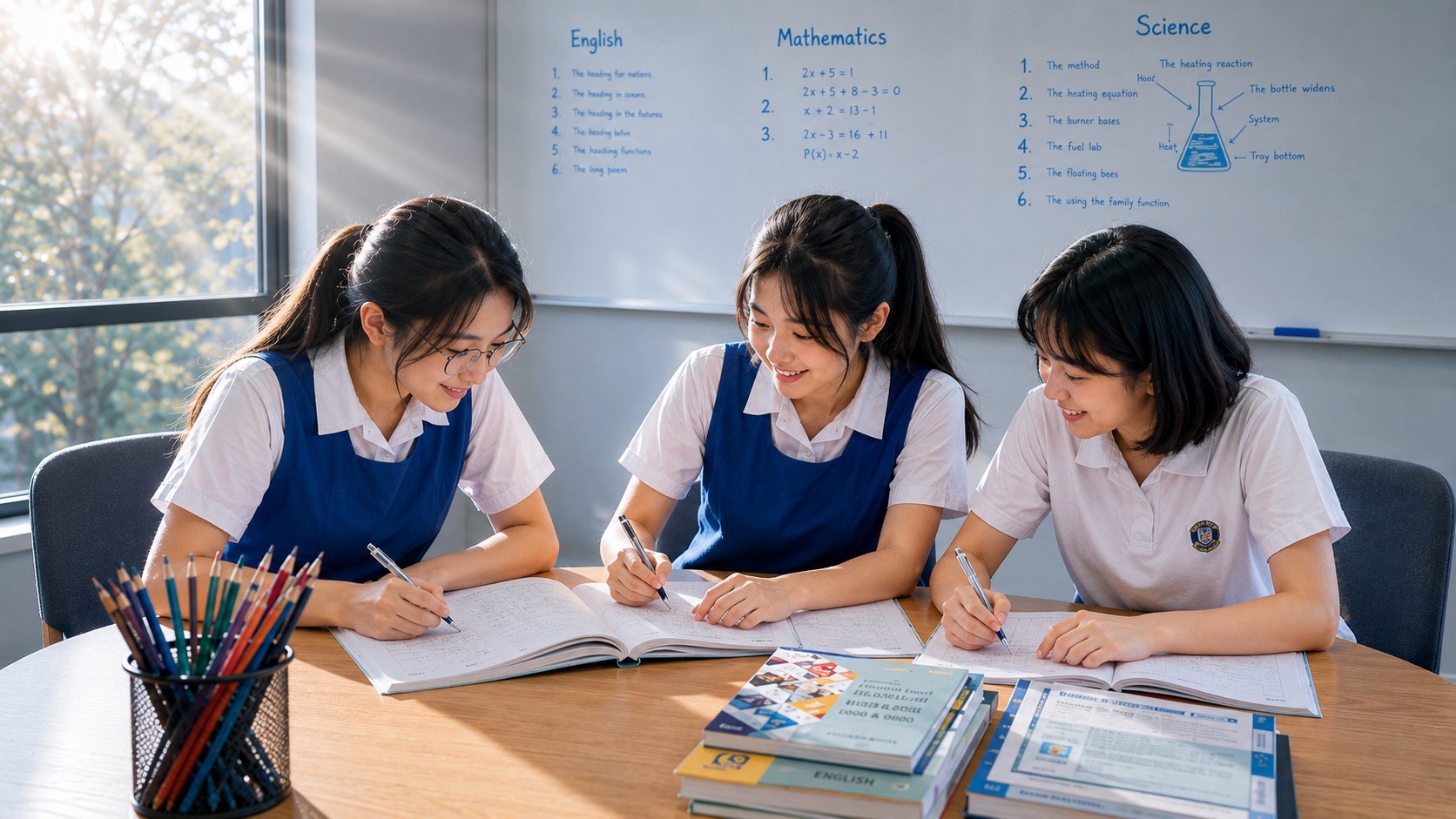
Secondary 1 G2 Mathematics vocabulary helps students understand what a question means before choosing a calculation. This guide brings together 100 useful words and terms for numbers, algebra, ratios, percentages, rates, geometry, measurement and data. Each entry has a plain explanation and an example. Begin with the words in your current school chapter, then use the worked problems to connect the language to a diagram, equation or calculation. A student who can explain why an answer makes sense is learning more than a definition.
For parents considering small groups tuition, look for lessons that connect vocabulary with actual mathematical work. In a three-pupil activity, each learner can explain a method, hear a different approach and correct a misconception, provided the teacher checks everyone individually. This is an eduKate teaching selection, not an official MOE or SEAB compulsory list, frequency ranking or promise of examination marks. Use the school’s topic list to set priorities; this article supports Secondary 1 learning and does not treat a graduating SEC examination paper as a Secondary 1 assessment.
- Audience: Secondary 1 students taking Mathematics at G2, with parent-friendly explanations and practical ways to help.
- Coverage: exactly 100 distinct vocabulary entries, including necessary multiword mathematical terms and familiar primary-school foundations.
- Start here: choose five words from the current school chapter and explain one example for each before learning more.
- Use the language: translate sentences into mathematics, show working, name units and check whether the answer fits the situation.
- Check progress: try the short diagnostic, read the explanations and revisit the specific misunderstanding instead of repeating a whole worksheet.
- Plan support: follow the suggested four-week routine and ask a tutor how each learner’s understanding will be checked.
Curriculum scope, checked 16 November 2026. The MOE G2 and G3 Mathematics syllabuses distinguish Secondary 1 G2 content from later learning. This list concentrates on early number work, simple algebra, proportional reasoning, angles, measurement and basic data displays. It includes supporting primary-school language. The order below is a teaching arrangement, not a national weekly schedule.
An official Secondary 1 G2 school outline illustrates how those topics can be sequenced across a year; your own school’s outline remains the practical reference. The 2027 SEC G2 Mathematics syllabus, K210 describes a graduating examination. It does not set the entire workload for Secondary 1, and its examination-year details should not be assumed for a student entering Secondary 1 in 2027.
Use these words when sorting numbers or deciding how to split quantities. Ask the student to give a second example, because recognising one familiar number is not enough.
| No. | Word or term | Meaning | Example in use |
|---|---|---|---|
| 1 | integer | A whole-number value that can be positive, negative or zero, without a fractional part. | −4, 0 and 9 are integers; 2.5 is not an integer. |
| 2 | negative number | A number smaller than zero, shown to the left of zero on a number line. | −7 is smaller than −3, even though 7 is greater than 3. |
| 3 | positive number | A number greater than zero; its positive sign is often left unwritten. | A gain of 6 points can be represented by +6, or simply 6. |
| 4 | factor | A positive whole number that divides another whole number exactly, with no remainder. | 4 is a factor of 20 because 20 ÷ 4 = 5. |
| 5 | multiple | A result obtained by multiplying a number by an integer. | The first three positive multiples of 6 are 6, 12 and 18. |
| 6 | prime number | A positive integer greater than one with exactly two positive factors: one and itself. | 13 is prime; 1 is not prime because it has only one positive factor. |
| 7 | composite number | A positive integer greater than one that has more than two positive factors. | 12 is composite: 1, 2, 3, 4, 6 and 12 divide it exactly. |
| 8 | prime factorisation | Writing a positive integer greater than one as a product of prime numbers. | 60 = 2 × 2 × 3 × 5 = 2² × 3 × 5. |
| 9 | highest common factor (HCF) | The greatest positive whole number that divides each of the given whole numbers exactly. | The HCF of 12 and 18 is 6, useful when forming equal groups. |
| 10 | lowest common multiple (LCM) | The smallest positive number that is a multiple of each given positive whole number. | The LCM of 4 and 6 is 12; both divide 12 exactly. |
Read symbols aloud while checking their meaning. Familiarity with fractions and powers makes later algebra easier to interpret, but memorising a symbol without an example is fragile.
| No. | Word or term | Meaning | Example in use |
|---|---|---|---|
| 11 | square | The result of multiplying a number by itself. | The square of 5 is 25, written 5²; it is not 5 × 2. |
| 12 | cube | The product of three equal factors, each equal to the given number. | The cube of 3 is 27 because 3³ = 3 × 3 × 3. |
| 13 | square root | A number whose square equals the given value; the square-root symbol selects the non-negative root. | √49 = 7; solving x² = 49 separately gives x = 7 or −7. |
| 14 | cube root | A number whose cube equals the given value; three copies of it multiply to give that value. | The cube root of 64 is 4 because 4³ = 64. |
| 15 | rational number | A number expressible as a fraction of integers, with a non-zero denominator. | 0.75 is rational because it equals 3/4; −2 equals −2/1. |
| 16 | irrational number | A real number that cannot be expressed as a fraction of two integers. | √2 is irrational; its decimal expansion does not end or eventually repeat. |
| 17 | real number | A number represented by a point on the ordinary number line, including rational and irrational numbers. | −3, 1/2 and √2 are all real numbers. |
| 18 | numerator | The number above the fraction bar, indicating how many equal parts are being counted. | In 3/5, the numerator is 3: three parts of size one fifth. |
| 19 | denominator | The non-zero number below the fraction bar; for a simple fraction, it names the size of each equal part. | In 3/5, the denominator is 5. |
| 20 | equivalent fractions | Fractions with the same value, even though their numerators and denominators differ. | 2/3 and 4/6 are equivalent because multiplying both parts by 2 preserves value. |
Some mistakes come from reading the instruction incorrectly. Decide whether a task needs an exact calculation, an approximate value or a check on the size of the answer.
| No. | Word or term | Meaning | Example in use |
|---|---|---|---|
| 21 | sum | The result of adding numbers or quantities. | The sum of −3 and 8 is 5; the negative sign belongs to −3. |
| 22 | difference | The result of subtraction; in a comparison, establish which quantity is being subtracted from which. | 8 − 3 = 5, whereas 3 − 8 = −5. |
| 23 | product | The result of multiplying numbers or expressions. | The product of −4 and 6 is −24; check the sign as well as the size. |
| 24 | quotient | The result of dividing one number by another non-zero number. | The quotient of 18 divided by 3 is 6; reversing the division changes it. |
| 25 | order of operations | The agreed calculation order: brackets, powers, multiplication and division, then addition and subtraction. | For equal-priority operations work left to right: 12 ÷ 3 × 2 = 8. |
| 26 | reciprocal | The number that gives a product of one when multiplied by the original non-zero number. | The reciprocal of 3/4 is 4/3 because their product is 1. |
| 27 | decimal place | A position to the right of the decimal point, such as tenths or hundredths. | In 6.47, 4 is in the first decimal place and 7 the second. |
| 28 | significant figure | A digit counted from the first non-zero digit when specifying a number’s precision. | 0.00456 has three significant figures: 4, 5 and 6. |
| 29 | round | Replace a value with a nearby value at a stated level of accuracy. | 6.47 rounded to one decimal place is 6.5; check the next digit. |
| 30 | estimate | Find a sensible approximate value to judge size or check a calculation. | 19.8 × 5.1 is approximately 20 × 5 = 100, so 1,010 looks unreasonable. |
Keep asking what the comparison is based on. A correct calculation can answer the wrong question if the student chooses the wrong whole or confuses a change with a final value.
| No. | Word or term | Meaning | Example in use |
|---|---|---|---|
| 31 | ratio | A comparison showing the relative amounts of two or more quantities. | A red-to-blue ratio of 2:3 means 2 red parts for every 3 blue parts. |
| 32 | equivalent ratios | Ratios describing the same relative amounts after all parts are multiplied or divided by the same positive number. | 2:3 and 8:12 are equivalent ratios. |
| 33 | simplest form | A form with no remaining common factor greater than one in whole-number ratio terms or a fraction’s numerator and denominator. | 12:18 simplifies to 2:3. |
| 34 | percentage | A quantity expressed out of one hundred, written using the percent sign. | 35% means 35/100; 35% of 200 is 70. |
| 35 | percentage increase | The increase as a percentage of the original value, not the final value. | From 40 to 50, the increase is 10/40 × 100% = 25%. |
| 36 | percentage decrease | The decrease as a percentage of the original value. | From 80 to 60, the decrease is 20/80 × 100% = 25%. |
| 37 | percentage point | A unit for the difference between two percentages. | A rate rising from 40% to 55% rises by 15 percentage points. |
| 38 | reverse percentage | Working backwards from a value after a percentage change to find its original value. | After a 20% discount, 64 dollars is 80% of the original 80 dollars. |
| 39 | original value | The starting quantity before an increase, decrease or other stated change. | If a price rises from 50 dollars to 60 dollars, the original value is 50 dollars. |
| 40 | discount | An amount deducted from the price before the discount. | A 15% discount on 80 dollars removes 12 dollars, leaving a price of 68 dollars. |
Before calculating, write the quantity and its unit together. For comparisons such as at least, include or exclude the boundary deliberately instead of guessing from the sentence.
| No. | Word or term | Meaning | Example in use |
|---|---|---|---|
| 41 | rate | A comparison measuring one quantity for each unit of another quantity. | Six dollars for three notebooks gives a rate of two dollars per notebook. |
| 42 | speed | Distance travelled per unit of time. | A cyclist travelling 30 kilometres in 2 hours has an average speed of 15 km/h. |
| 43 | average speed | Total distance divided by total elapsed time for the whole journey, including stops within that interval. | A 12-kilometre journey taking 1.5 hours averages 8 km/h. |
| 44 | constant speed | Speed that remains unchanged throughout a stated interval. | At a constant 5 m/s, an object travels 5 metres in each second. |
| 45 | distance | The length travelled along a route, measured in units such as metres or kilometres. | Walking 300 metres out and 300 metres back gives a distance of 600 metres. |
| 46 | duration | The amount of time between a start and an end. | From 14:20 to 15:05 the duration is 45 minutes, not 85 minutes. |
| 47 | unit | An agreed amount used to measure or count a quantity. | In 12 cm, centimetres are the unit; 12 alone does not specify the length. |
| 48 | conversion | Changing a measurement’s unit without changing the actual quantity. | 2.5 metres equals 250 centimetres; the object has not become longer. |
| 49 | at least | Equal to or greater than the stated value; the boundary is included. | At least 12 participants means 12, 13 or more, represented by n ≥ 12. |
| 50 | at most | Equal to or smaller than the stated value; the boundary is included. | At most 8 tickets means no more than 8, represented by t ≤ 8. |
Letters carry meaning. Read each expression as a structure before combining anything, and distinguish an instruction to simplify from an instruction to find a numerical value.
| No. | Word or term | Meaning | Example in use |
|---|---|---|---|
| 51 | variable | A symbol representing a number that may take different values in a situation. | In C = 3n, n can represent the number of notebooks bought. |
| 52 | constant | A value that remains fixed in the expression or situation being considered. | In 4x + 7, the constant term is 7; its value does not depend on x. |
| 53 | coefficient | The numerical factor multiplying a variable term, including its sign. | In −5x + 2, the coefficient of x is −5, not 5. |
| 54 | term | A part of an expression separated from other parts by addition or subtraction. | In 3x − 2y + 7, the terms are 3x, −2y and 7. |
| 55 | like terms | Terms with the same variable part, including the same powers of those variables. | 3x and −2x are like terms; 3x and 3y are not. |
| 56 | expression | A mathematical phrase made from numbers, variables and operations, without an equation being asserted. | 4x + 3 is an expression; it has no equals sign. |
| 57 | substitute | Replace a variable with a specified value, using brackets where needed. | If x = −2, substitute into 3x + 1 as 3(−2) + 1. |
| 58 | evaluate | Calculate the numerical value of an expression when the required values are known. | When x = 4, evaluate 2x + 3 to obtain 11. |
| 59 | expand | Use multiplication to remove brackets while keeping the expression equivalent. | 3(x + 2) expands to 3x + 6; multiply both terms inside. |
| 60 | simplify | Rewrite an expression in an equivalent form that is easier to use. | 5x + 2 − 3x simplifies to 2x + 2, not 4x. |
An equation makes a statement of equality. Check a proposed answer in the original equation, and explain what a letter represents before using it in a word problem.
| No. | Word or term | Meaning | Example in use |
|---|---|---|---|
| 61 | equation | A statement that two expressions have equal values. | 3x + 2 = 14 is an equation; solving it means finding a value that makes it true. |
| 62 | unknown | A value that has not yet been determined in the problem. | If three identical pens cost 6 dollars, the unknown price of one pen is 2 dollars. |
| 63 | solution | A value that makes an equation true when substituted into it. | x = 4 is the solution of 3x + 2 = 14 because 3(4) + 2 = 14. |
| 64 | inverse operation | An operation that reverses another operation under the appropriate conditions. | Subtracting 5 reverses adding 5; dividing by 3 reverses multiplying by 3. |
| 65 | balance | Keeping both sides of an equation equal by making valid matching changes. | From x + 7 = 12, subtract 7 from both sides to obtain x = 5. |
| 66 | linear equation | An equation involving a variable only to the first power, with no higher-power terms. | 3x − 5 = 10 is linear and gives x = 5. |
| 67 | formula | An equation expressing a relationship between quantities. | The formula A = l × w gives the area of a rectangle from its length and width. |
| 68 | sequence | An ordered list of numbers or objects following a stated or discoverable arrangement. | 4, 7, 10, 13 is a sequence increasing by 3 each time. |
| 69 | position | The place a term occupies in a sequence, usually counted from one. | In 4, 7, 10, 13, the term at position 3 is 10. |
| 70 | nth term | An expression giving the term at position n in a sequence. | For 4, 7, 10, 13, the nth term is 3n + 1, starting at n = 1. |
Draw the lines and mark the angle being discussed. Angle names describe a relationship; equal angles or a sum of 180 degrees require the relevant geometric conditions.
| No. | Word or term | Meaning | Example in use |
|---|---|---|---|
| 71 | angle | A measure of turn between two rays sharing an endpoint. | A quarter turn is 90°; label the intended angle when a diagram has several possibilities. |
| 72 | right angle | An angle measuring exactly 90 degrees. | The corners of a rectangle are right angles, often marked with a small square. |
| 73 | acute angle | An angle greater than zero degrees and smaller than 90 degrees. | A 35° angle is acute; a 90° angle is not. |
| 74 | obtuse angle | An angle greater than 90 degrees and smaller than 180 degrees. | A 125° angle is obtuse; it is wider than a right angle. |
| 75 | reflex angle | An angle greater than 180 degrees and smaller than 360 degrees. | A 250° turn is a reflex angle; mark the larger angle clearly. |
| 76 | parallel lines | Lines in the same plane that remain the same distance apart and never meet. | A diagram usually marks a parallel pair with matching arrows; do not rely on appearance. |
| 77 | transversal | A line crossing two or more other lines at distinct points. | Mark where a transversal crosses two parallel lines before identifying angle pairs. |
| 78 | corresponding angles | Angles in matching positions where a transversal crosses two lines; they are equal when those lines are parallel. | With parallel lines, a corresponding partner of 65° is 65°. |
| 79 | alternate angles | Angles on opposite sides of a transversal in the relevant alternating positions; they are equal for parallel lines. | For parallel lines, alternate interior partners measuring x° and 72° give x = 72. |
| 80 | co-interior angles | Angles between two lines on the same side of a transversal; they sum to 180 degrees when the lines are parallel. | If one is 110°, its partner is 70°. |
Name the quantity before selecting a formula. Perimeter, area and volume answer different questions, and the units provide a useful check on which quantity has been calculated.
| No. | Word or term | Meaning | Example in use |
|---|---|---|---|
| 81 | triangle | A polygon with three straight sides and three interior angles. | In an ordinary flat-plane triangle, the interior angles sum to 180°; 50° and 60° leave 70°. |
| 82 | perimeter | The total distance around the outside boundary of a flat figure. | A rectangle measuring 8 cm by 3 cm has perimeter 2(8 + 3) = 22 cm. |
| 83 | area | The amount of flat surface inside a boundary, measured in square units. | An 8 cm by 3 cm rectangle has area 24 cm². |
| 84 | perpendicular height | The distance from a chosen base to the opposite point or parallel side, measured at a right angle. | Use this height, not a sloping side, in an area formula. |
| 85 | parallelogram | A quadrilateral with both pairs of opposite sides parallel. | With base 8 cm and perpendicular height 3 cm, its area is 24 cm². |
| 86 | trapezium | A quadrilateral with one pair of parallel sides, used as the parallel bases in its area formula. | Bases 6 cm and 10 cm, height 4 cm, give area 32 cm². |
| 87 | prism | A solid with identical parallel polygonal ends and a uniform cross-section along its length. | A right prism with cross-sectional area 12 cm² and length 5 cm has volume 60 cm³. |
| 88 | cylinder | A solid with two identical parallel circular ends joined by a curved surface. | A right cylinder of radius 2 cm and height 5 cm has volume 20π cm³. |
| 89 | volume | The amount of three-dimensional space occupied by a solid, measured in cubic units. | A cuboid measuring 2 cm by 3 cm by 4 cm has volume 24 cm³. |
| 90 | surface area | The combined area of the outside surfaces of a solid. | A cube with side 3 cm has six 9 cm² faces, giving surface area 54 cm². |
Read the title, labels and scale before drawing a conclusion. A neat graph is not automatically an honest or useful comparison, so ask what information the display supports.
| No. | Word or term | Meaning | Example in use |
|---|---|---|---|
| 91 | data | Recorded observations, measurements or counts collected to answer a question. | The journey times of ten pupils form data about those pupils, not automatically every pupil. |
| 92 | frequency | The number of times a value or category occurs in a set of data. | If seven pupils choose badminton, the frequency for badminton is 7. |
| 93 | frequency table | A table showing each value or category and how often it occurs. | For choices A, A, B, the table records A with frequency 2 and B with frequency 1. |
| 94 | category | A group used to classify data by a shared label or property. | Bus, walking and train can be categories for a pupil’s main transport mode. |
| 95 | bar graph | A display using separate bars whose lengths represent quantities for different categories. | If one bar reaches 12 and another 8, compare the values using the labelled scale. |
| 96 | pictogram | A display using pictures or symbols to represent quantities, interpreted using its key. | If one symbol represents 4 pupils, three symbols represent 12 pupils. |
| 97 | line graph | A graph connecting plotted points to show how a quantity changes across an ordered variable, often time. | Read the time labels before describing a rise or fall. |
| 98 | pie chart | A circle divided into sectors showing parts of one total. | A category containing one quarter of the total has a 90° sector. |
| 99 | axis | A reference line on a graph, carrying labels and often a numerical scale. | The horizontal axis may show days while the vertical axis shows the number of visitors. |
| 100 | scale | The relationship between labelled positions on an axis and the values they represent. | If equal intervals are labelled 0, 5, 10, each interval represents 5 units. |
CHAPTER 11 OF 16 · Use, practise and check
11. Use the vocabulary to understand a problem
Choose a word the student has met in school this week. Ask for its meaning, one example and one near-miss. For instance, 13 is prime, 12 is composite and 1 is neither prime nor composite. The near-miss matters because it shows whether the student understands the boundary of the idea. Copying a sentence from a glossary may hide that uncertainty.
Next, connect the word to the mathematical action. “Expand” tells the student to multiply through brackets. “Evaluate” requires known values and a calculation. “Solve” asks for a value that makes an equation true. These words are not interchangeable. With 3x + 6, there is no equation to solve. With 3x + 6 = 18, x = 4 is a solution. With x = 2, the expression evaluates to 12.
Keep a small vocabulary notebook with three columns: the term, a useful example and the mistake to avoid. A drawing is often better than another sentence for geometry. A number line can show why −5 is smaller than −2. One well-understood entry is more useful than a page of copied definitions that cannot be used independently.
The list concentrates on Secondary 1 foundations. It does not require a child to rush into quadratic equations, trigonometry or advanced graph work. The names may appear elsewhere in a complete secondary syllabus, but that does not make them this week’s task. When a school rearranges units, move the matching vocabulary group forward and retain the same practice method.
CHAPTER 12 OF 16 · Use, practise and check
12. Worked examples: translate the words before calculating
Example 1: “Three more than twice a number”
Let n represent the number. “Twice” means multiply by 2, giving 2n. “Three more than” means add 3, giving 2n + 3. If the result is 17, write 2n + 3 = 17. Subtract 3 from both sides: 2n = 14. Divide both sides by 2: n = 7. Check in the original statement: twice 7 is 14, and three more is 17.
A common wrong translation is 2(n + 3). That means twice the result of adding 3 to the number. Try n = 7: it gives 20, so it does not match the original statement. The order of the words controls the structure of the expression; recognising familiar numbers is not enough.
Example 2: reverse percentage
A bag costs 54 dollars after a 10% discount. “After” identifies the new price. Since 100% − 10% = 90%, the new price is 90% of the original. Write 0.90 × original price = 54. The original price is 54 ÷ 0.90 = 60 dollars. Check: 10% of 60 is 6, and 60 − 6 = 54.
Adding 10% of 54 gives 59.40 dollars, which is wrong because the discount was based on the original price. Circle the phrase that identifies the percentage base. This single reading habit helps the student decide which quantity should be treated as 100%.
Example 3: total time in average speed
A walker covers 3 kilometres in 30 minutes, rests for 15 minutes, then walks another 2 kilometres in 30 minutes. For the whole journey, total distance is 5 kilometres and total elapsed time is 75 minutes, or 1.25 hours. Average speed is 5 ÷ 1.25 = 4 km/h. Include the rest because the question asks about the whole journey.
The two walking speeds are 6 km/h and 4 km/h. Their simple average, 5 km/h, does not answer this question. Read “whole journey” carefully, make a short time record and state what interval your calculation covers. The unit km/h also requires converting minutes into hours.
Example 4: checking an angle reason
Two parallel lines are crossed by a transversal. A pair of co-interior angles is labelled 118° and x°. Because the lines are parallel and the angles are co-interior, x + 118 = 180. Therefore x = 62°. Write the reason with the calculation. If the parallel condition is absent, the same conclusion is not automatically available.
CHAPTER 13 OF 16 · Use, practise and check
13. A short diagnostic, with answers that explain the mistake
Try these tasks without the glossary first. Explain the main idea aloud or write a sentence after each answer. This is a teaching check, not a predicted school grade. If a question is unfamiliar because the topic has not been taught, set it aside and return to the current chapter.
- Is 1 prime, composite or neither? Explain using factors.
- Find the HCF of 18 and 24. With 18 pencils and 24 erasers, what is the greatest number of identical packs you can make using everything?
- Simplify 4x + 3 − x. Then evaluate the result when x = 2.
- A price increases from 50 dollars to 60 dollars. Find the percentage increase.
- A proportion rises from 30% to 45%. Give the change in percentage points.
- Convert 2 m² to cm². Explain why multiplying by 100 is insufficient.
- A triangle has angles 40° and 65°. Find the remaining angle.
- A pictogram uses one symbol for 6 pupils. What do two and a half symbols represent?
Answers and useful follow-up questions
- Neither. One has only one positive factor, so it does not meet either definition. Ask the student to contrast it with 2 and 4.
- 6. Six is the greatest number dividing both amounts exactly. If groups must have the same composition and use everything, six groups contain 3 of the first item and 4 of the second.
- 3x + 3; then 9. Combine 4x and −x, keeping the constant 3 separate. Substitution gives 3(2) + 3 = 9.
- 20%. The increase is 10 dollars; divide by the original 50 dollars, then multiply by 100%. The final price is not the base.
- 15 percentage points. Subtract 30 from 45. A relative percentage increase is a different question: here it would be 15/30 × 100% = 50%.
- 20,000 cm². One square metre is a 100 cm by 100 cm square, so it contains 10,000 square centimetres. Two square metres contain twice that area.
- 75°. Subtract 40° + 65° from 180°. The answer follows from the angle sum of a flat-plane triangle.
- 15 pupils. Two full symbols represent 12 pupils and a half-symbol represents 3. The key determines the value of a picture.
Sort mistakes into three practical groups: misunderstood word, incorrect method or calculation slip. For a misunderstood word, return to a definition and example. For an incorrect method, ask why the chosen operation matches the situation. For a calculation slip, redo the line carefully and check it. Do not call every error careless; that label gives the student no repair action.
CHAPTER 14 OF 16 · Use, practise and check
14. A four-week routine that follows the school chapter
This is a suggested routine, not a national timetable or a target every child must meet. Start with ten to fifteen minutes on four days each week, then adjust to the student’s workload and response. A short session should finish with a task the student can attempt independently. If it repeatedly becomes an argument, reduce the number of words and ask the teacher which gap matters most.
Week 1: make meanings visible
Select ten words from the current chapter. On the first two days, learn five at a time using the meaning, example and near-miss method. On the third day, mix the ten words and match them to examples. On the fourth, close the notes and explain three words while solving short questions. Revisit uncertain terms; do not add another ten merely to keep pace with a calendar.
Week 2: connect instructions to working
Choose questions containing terms such as simplify, evaluate, ratio or percentage increase. Before calculating, write what the question asks for and what information is given. After calculating, write one checking sentence. Keep the arithmetic manageable so that reading and reasoning remain visible. Add new words only where they support the chapter.
Week 3: separate confusing pairs
Practise factor versus multiple, expression versus equation, perimeter versus area, and percentage change versus percentage points. Ask the student to invent two short questions that use a pair correctly. Swap the wording in one question and discuss how the answer would change. This reveals distinctions that a spelling test cannot check.
Week 4: use the words in unfamiliar questions
Choose a small mixed set containing a familiar idea in a new context, such as a recipe ratio instead of a coloured-counter ratio. Give the student time to interpret it without immediate prompting. Compare the new work with Week 1: can the student choose the operation, state the unit and explain the reason more independently? Use that evidence to choose the next ten words.
CHAPTER 15 OF 16 · Use, practise and check
15. What a useful three-pupil vocabulary lesson can look like
Here is an illustrative lesson design for three learners, not a claim about a particular class timetable or available place. Begin with a two-question individual check. Each pupil should write something before discussion starts. This makes it easier to see who understands the word and who is following a confident classmate.
For a ratio problem, rotate three roles: reader, solver and checker. The reader identifies what each ratio part represents. The solver draws a bar or writes the calculation. The checker explains why the parts add to the stated total. Rotate after each problem so that every pupil practises all three jobs. The teacher should interrupt an incorrect explanation gently and ask for a concrete example.
Finish with a fresh individual question using different numbers. Group conversation is useful, but the final check shows what each learner can do alone. A helpful parent update identifies the term that was misunderstood, the example used to repair it and one follow-up question. “Needs more practice” is less useful than “confuses the original price with the discounted price; practise identifying the 100% amount”.
CHAPTER 16 OF 16 · Use, practise and check
16. Parent questions: choose support that addresses the actual gap
Does weak mathematical vocabulary mean weak Mathematics?
It may be one part of the difficulty. A student may calculate accurately when a question is explained but misread the same task independently. Another may understand every word yet lack the relevant number skill. Compare one verbal explanation, one worked question and one independent attempt. Ask the teacher what those pieces of work show before deciding that more difficult worksheets are the answer.
Should we learn all 100 terms before the term begins?
No. Use the list as a reference across the year. Start with the current school unit and repair a missing prerequisite when it blocks progress. If fractions are insecure, it is reasonable to pause and explain the numerator, denominator and equivalent fractions before pushing into algebra. Familiar words deserve attention when the student cannot yet use them accurately.
How should we assess a small group tutor?
Ask how the tutor checks each pupil independently, matches the school’s present topic and explains a repeated mistake. Request a concrete example of a lesson objective: “identify the original value in a reverse percentage problem” is more informative than “master percentages”. Also ask what happens when one pupil is ready to move on while another needs a smaller step. Group size alone does not answer these questions.
Does knowing these words guarantee a move from G2 to G3?
No. Vocabulary is one part of mathematical understanding. Full Subject-Based Banding provides subject-level flexibility; an official school explanation of Full SBB describes opportunities and readiness considerations. Discuss any proposed change with the school, including the broader content, pace and support. A glossary score or tuition test does not independently determine a subject-level offer.
What should we do after a disappointing assessment?
Choose two or three questions and ask the student to explain what each asked. Identify whether the barrier was language, a missing concept, a wrong method or a calculation. Agree on one small repair and practise it with a fresh example. Tell the child what has improved in the work, such as correctly naming the percentage base. A clear next action is kinder and more useful than treating a mark as a permanent description of the learner.
Continue learning with eduKate
- Secondary 1 G2 Mathematics preparation: use the companion guide to connect vocabulary with the next learning step.
- eduKate Vocabulary hub: explore word meaning, sentence use and further learning resources.
Official sources and further reading
Curriculum and examination context checked on 16 November 2026. Follow the school’s current instructions and the syllabus for the relevant examination year. The definitions, examples and practice tasks above are original teaching material.
- MOE G2 and G3 Mathematics syllabuses, Secondary One to Four — Curriculum reference; consult the G2 Secondary One section rather than borrowing the whole G3 or graduating syllabus.
- Yishun Secondary School: Secondary 1 G2 Mathematics content outline, 2026 — An official school example of topic sequencing, used as a crosscheck rather than a timetable for every school.
- SEAB: 2027 SEC G2 Mathematics syllabus K210 — Graduating examination reference. Its requirements are not represented as a Secondary 1 school examination scheme.
- Bukit View Secondary School: Full Subject-Based Banding — Official school explanation of subject-level flexibility and the importance of discussing readiness and support.