Secondary 1 G2 Chinese Language vocabulary becomes useful when students can recognise a word in a passage, understand it in conversation and use it to express a clear idea. This guide brings together 100 practical Chinese words and expressions, with pinyin, English explanations and original Chinese examples. It is designed for students moving from Primary 6 into secondary learning, and for parents who want a clear way to support comprehension, speaking and writing. Start with the words that connect to the school’s current texts and the mistakes appearing in recent work.
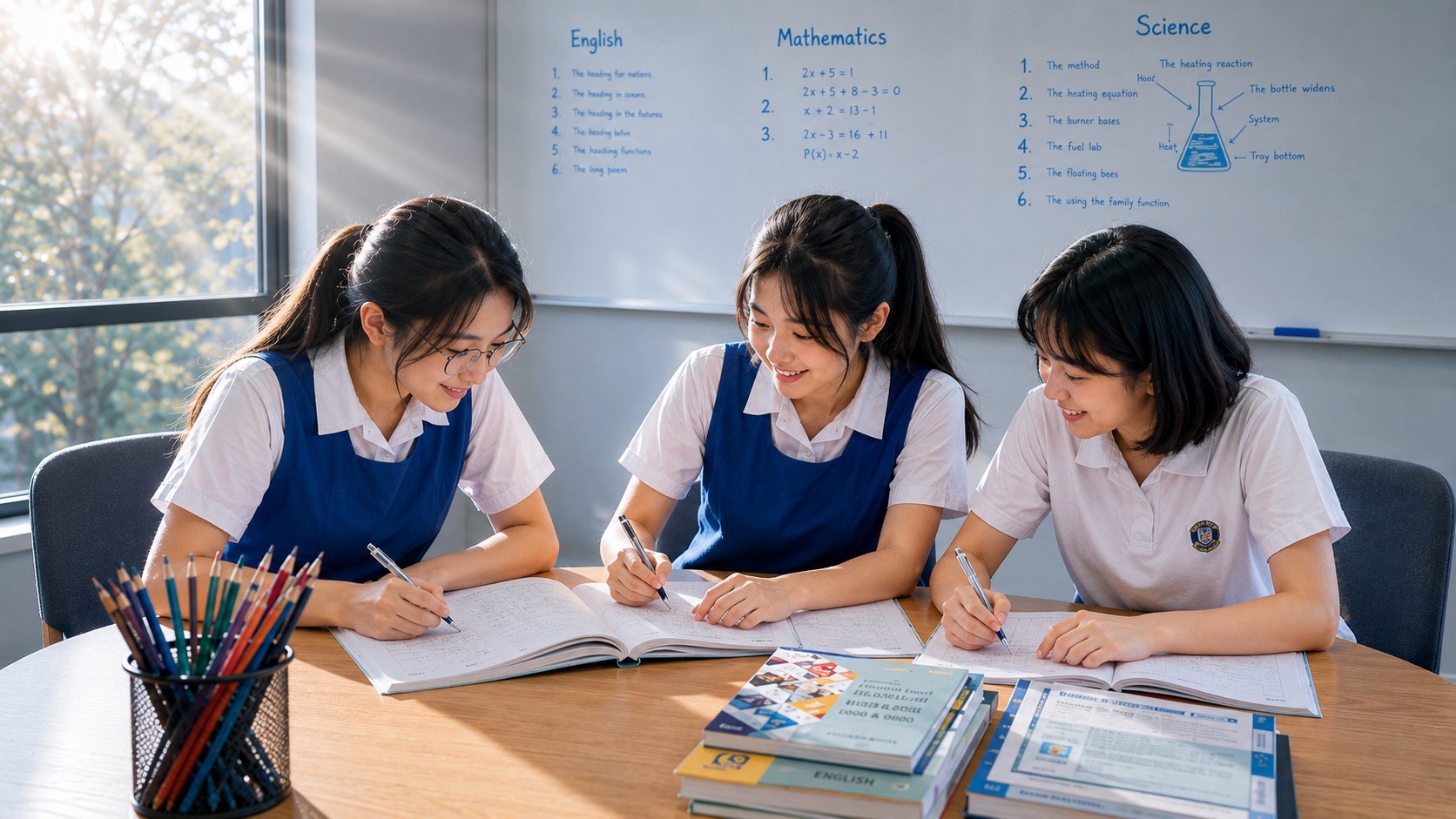
A small-group vocabulary lesson can help by making each student explain a meaning, choose between similar words and produce a sentence independently. In a three-pupil activity, one student can speak, another can ask a follow-up question and the third can check whether the answer makes sense, with roles rotating. The 100 entries here are eduKate’s teaching selection, not an official MOE or SEAB prescribed word list or a frequency ranking. Use the examples as starting points, then build sentences about school, family, friendship and everyday life that the student actually understands.
- For Secondary 1 students taking Chinese Language at G2, with a bridge from primary vocabulary to more precise secondary reading and expression.
- Exactly 100 distinct entries in ten manageable groups; each has pinyin, a meaning and an original example with English support.
- Learn meaning, character recognition, pronunciation and sentence use together; being able to copy a word is only one part of knowing it.
- Follow the school’s current textbook, word list, teacher feedback and assessment instructions when deciding which words to practise first.
- Use the worked passage, short diagnostic and four-week practice plan to find the next useful learning step.
- The SEC begins in 2027 for the graduating examination cohort; its published paper requirements should not be treated as the format of a Secondary 1 school test.
Curriculum context, checked 16 November 2026: MOE’s G1, G2, G3 and Higher Mother Tongue Languages syllabus connects language learning with communication, culture and connection, and develops listening, speaking, reading, writing and spoken and written interaction. The selections below support practice across these areas; they do not reproduce a textbook list or prescribe a national Secondary 1 teaching order.
The SEAB SEC overview explains the examination introduced from 2027. Its 2027 G2 subject listing identifies Chinese Language as K220. That is a graduating examination syllabus for the stated year. A student entering Secondary 1 in 2027 should follow the school’s current programme and later check the syllabus for their own examination year. G2 describes the level of this subject; it does not mean every subject the student takes must be at G2.
How to read the list: Each numbered entry is one word or established expression, even when it contains several Chinese characters. Pinyin shows the usual dictionary pronunciation of the word; natural speech may involve tone changes. English meanings explain the use chosen here, rather than every possible dictionary sense. Read the Chinese sentence first, then use the English support to check understanding.
Begin here if the student understands a lesson but struggles to describe what help is needed. These verbs make learning visible: a student can ask a question, organise information and explain a correction instead of saying only that the work is difficult.
| No. | Word and pinyin | Meaning | Example in use |
|---|---|---|---|
| 1 | 理解 lǐjiě | To understand the meaning or reasoning behind something. Check by explaining the idea in a fresh sentence, not simply repeating it. | 我终于理解了这句话的意思。 — I finally understood the meaning of this sentence. |
| 2 | 复习 fùxí | To revisit something already learned so that you can remember and use it. It differs from preparing for new material. | 我先复习昨天学过的词语。 — I first review the words learned yesterday. |
| 3 | 预习 yùxí | To prepare for a lesson by looking at material beforehand. The aim is to notice the topic and questions you have. | 我预习课文时,圈出了两个生词。 — While preparing the passage, I circled two unfamiliar words. |
| 4 | 练习 liànxí | To practise a skill through purposeful attempts. A useful attempt includes checking whether the language actually communicates your intended meaning. | 我们每天练习用华语介绍一件小事。 — We practise describing one small event in Mandarin each day. |
| 5 | 整理 zhěnglǐ | To arrange or organise material so that it becomes easier to use. Grouping words by purpose is one example. | 我把词语按照主题整理好。 — I organised the vocabulary by theme. |
| 6 | 记录 jìlù | To record information so it can be checked or used later. A useful record includes the important detail accurately. | 请记录老师说明的三个重点。 — Please record the three main points the teacher explained. |
| 7 | 检查 jiǎnchá | To check something for accuracy or problems. Name what you are checking, such as a character, a sentence or a reason. | 交作业前,我检查句子是否通顺。 — Before submitting my homework, I check whether the sentences read smoothly. |
| 8 | 改正 gǎizhèng | To correct an error by replacing the mistaken form or action with an appropriate one. Explain the change as well. | 我改正了写错的字,再读一次。 — I corrected the wrongly written character and read it again. |
| 9 | 提问 tíwèn | To ask a question, usually to seek information or understanding. A specific question helps another person give a useful response. | 不理解时,我会主动提问。 — When I do not understand, I will ask a question. |
| 10 | 专心 zhuānxīn | To give focused attention to what you are doing. In this context it describes listening or working with concentration. | 讨论时,我们专心听同学的意见。 — During discussion, we listen attentively to our classmates’ views. |
These terms describe the parts of a text and the relationships between events. Use them while reading short passages before attempting long answers. A student who can separate a cause from an outcome has a clearer starting point for comprehension.
| No. | Word and pinyin | Meaning | Example in use |
|---|---|---|---|
| 11 | 内容 nèiróng | The information, ideas or events contained in a text, speech or other message. Ask what the material actually says. | 这篇文章的内容与校园生活有关。 — The content of this article concerns school life. |
| 12 | 主题 zhǔtí | The central topic or main idea developed in a piece of work. It needs support from the text as a whole. | 我们根据全文讨论文章的主题。 — We discuss the article’s central idea using the whole text. |
| 13 | 段落 duànluò | A paragraph: a section of writing that develops a connected part of the message. Paragraph breaks help readers follow ideas. | 第二个段落交代了事情的起因。 — The second paragraph explains how the incident began. |
| 14 | 细节 xìjié | A small but specific detail that helps describe or explain something. Select details that matter to the question being asked. | 她注意到人物动作中的一个细节。 — She noticed a detail in the character’s movements. |
| 15 | 线索 xiànsuǒ | A clue that helps someone work towards an understanding. A clue supports an interpretation but may need other evidence. | 人物的语气给了我们重要的线索。 — The character’s tone gave us an important clue. |
| 16 | 人物 rénwù | A person or character discussed or portrayed in a text. Identify the relevant character before explaining feelings or actions. | 故事中的主要人物是一名中学生。 — The main character in the story is a secondary student. |
| 17 | 经过 jīngguò | The course of an event: what happened as it unfolded. In this reading use, arrange the relevant events in order. | 请按顺序说出事情的经过。 — Please recount how the incident unfolded in order. |
| 18 | 原因 yuányīn | The reason or cause that helps explain why something happened. Check that your answer explains the event named in the question. | 他说明了迟到的原因。 — He explained the reason for being late. |
| 19 | 结果 jiéguǒ | The outcome produced by an event or action. An outcome answers what happened afterwards, rather than why it began. | 大家合作的结果是提早完成任务。 — The result of everyone’s cooperation was finishing the task early. |
| 20 | 证据 zhèngjù | Information or observable details that support a statement. In reading, use relevant words or actions from the passage. | 我用文中的细节作为判断的证据。 — I used details in the passage as evidence for my judgement. |
The instruction word helps you decide what an answer should do. These are helpful learning meanings, not a universal marking code. Read the complete question and your teacher’s instructions before deciding the depth and length of the response.
| No. | Word and pinyin | Meaning | Example in use |
|---|---|---|---|
| 21 | 解释 jiěshì | To make a meaning, reason or connection understandable. Explain the relevant idea instead of only repeating the original statement. | 请解释他为什么改变了决定。 — Please explain why he changed his decision. |
| 22 | 说明 shuōmíng | To set out information clearly so someone understands a situation, point or procedure. The needed detail depends on the question. | 请说明这个建议有什么好处。 — Please explain what benefits this suggestion has. |
| 23 | 比较 bǐjiào | To consider things in relation to one another. Use a common basis so any similarities or differences are meaningful. | 我们比较两个人处理问题的方法。 — We compare the two people’s ways of handling the problem. |
| 24 | 概括 gàikuò | To state the essential points briefly. Keep the central meaning while leaving out details that are unnecessary for the task. | 请用自己的话概括这段内容。 — Please summarise this paragraph in your own words. |
| 25 | 分析 fēnxī | To examine parts and relationships to understand how or why something works. Move beyond listing isolated details. | 我们分析人物的行动和想法。 — We analyse the character’s actions and thoughts. |
| 26 | 判断 pànduàn | To reach a considered conclusion using the available information. Give a relevant reason when the question asks for one. | 我根据他的行动判断他的态度。 — I judge his attitude from his actions. |
| 27 | 举例 jǔlì | To provide a particular example that makes an idea clearer. The example should actually illustrate the point you made. | 请举例说明怎样帮助新同学。 — Please give an example of how to help a new classmate. |
| 28 | 描述 miáoshù | To describe a person, scene, feeling or event through relevant details. Choose details that help another person picture it. | 她用几句话描述了当时的情景。 — She described the scene at that moment in a few sentences. |
| 29 | 推测 tuīcè | To infer or make a reasoned suggestion from clues. Distinguish a supported possibility from something directly stated. | 我根据上下文推测这个词的意思。 — I infer this word’s meaning from the surrounding text. |
| 30 | 评价 píngjià | To give a considered judgement about something, using relevant reasons or criteria. Explain what makes your judgement fair. | 我们评价这个做法是否合适。 — We evaluate whether this way of acting is appropriate. |
Precise feeling words help a reader understand why someone acts in a particular way. Ask what happened before the feeling and what the person did afterwards. Several feelings may fit a situation, but the text must support your choice.
| No. | Word and pinyin | Meaning | Example in use |
|---|---|---|---|
| 31 | 紧张 jǐnzhāng | Nervous or tense, often before an important or unfamiliar situation. Describe the situation rather than assuming the person is always anxious. | 第一次上台时,我有些紧张。 — I felt a little nervous the first time I went on stage. |
| 32 | 担心 dānxīn | To worry about a possible problem or someone’s situation. Name the concern so the reader understands what is uncertain. | 她担心朋友没有听清楚集合时间。 — She worries that her friend did not hear the meeting time clearly. |
| 33 | 失望 shīwàng | Disappointed because an outcome did not meet a hope or expectation. It differs from simply being surprised by something. | 活动取消了,大家感到失望。 — Everyone felt disappointed when the activity was cancelled. |
| 34 | 后悔 hòuhuǐ | To regret a past choice or action and wish it had been different. The feeling looks back at what happened. | 我后悔没有先听完他的解释。 — I regret not first listening to his full explanation. |
| 35 | 惭愧 cánkuì | To feel ashamed or embarrassed about a fault or falling short. Use it for a context that gives a reason. | 知道自己误会了朋友,我感到惭愧。 — I felt ashamed when I realised I had misunderstood my friend. |
| 36 | 感激 gǎnjī | Grateful for someone’s help or kindness. Mention the helpful action to make the feeling clear and specific. | 我很感激同学耐心地帮助我。 — I am grateful that my classmate helped me patiently. |
| 37 | 欣慰 xīnwèi | Pleased and comforted because something encouraging has happened. It often describes a response to effort, progress or a reassuring outcome. | 看到大家互相帮助,老师感到欣慰。 — The teacher felt pleased and comforted to see everyone helping one another. |
| 38 | 犹豫 yóuyù | To hesitate because a decision feels uncertain. Explain the competing choices or concern when the context allows. | 他犹豫了一会儿,才举手提问。 — He hesitated for a moment before raising his hand to ask. |
| 39 | 自信 zìxìn | Confidence in your ability or judgement. In this learning context it can grow alongside preparation and clear understanding. | 练习之后,她回答问题时更有自信。 — After practising, she answered questions with more confidence. |
| 40 | 勇气 yǒngqì | Courage to face something difficult or worrying. A person can show courage while still feeling nervous. | 他鼓起勇气,承认了自己的错误。 — He gathered the courage to admit his mistake. |
These words are useful in stories, personal accounts and discussion. Avoid attaching a character label without evidence. Show an action first, then explain how the action supports a description such as honest, considerate or responsible.
| No. | Word and pinyin | Meaning | Example in use |
|---|---|---|---|
| 41 | 诚实 chéngshí | Honest: truthful and not deliberately misleading others. A relevant action is stronger evidence than a character merely claiming this quality. | 他诚实地告诉老师事情的经过。 — He honestly told the teacher how the incident happened. |
| 42 | 负责 fùzé | To take charge of a task, or to act responsibly in carrying it out. Check the sentence for the intended use. | 她负责检查小组报告中的资料。 — She is responsible for checking the information in the group report. |
| 43 | 耐心 nàixīn | Patience when something takes time or another person needs help. It does not require ignoring a problem indefinitely. | 他耐心地听我把问题说完。 — He patiently listened while I finished explaining the problem. |
| 44 | 体谅 tǐliàng | To understand and consider another person’s difficulties or feelings. Explain the situation that makes consideration useful. | 我们应该体谅刚转校的同学,帮助他适应新环境。 — We should show understanding to a classmate who has just transferred and help him adjust to his new surroundings. |
| 45 | 尊重 zūnzhòng | To treat another person, their rights or their views with consideration. Listening respectfully does not require agreeing with every opinion. | 即使意见不同,我们也要尊重对方。 — Even when our views differ, we should respect one another. |
| 46 | 谦虚 qiānxū | Modest and willing to learn from others. It involves recognising what you can improve without denying every achievement. | 她表现很好,仍然谦虚地听取建议。 — She performed well and still listened modestly to suggestions. |
| 47 | 礼貌 lǐmào | Polite behaviour or language that shows consideration for other people. Choose a form suited to the person and situation. | 他礼貌地向图书管理员寻求帮助。 — He politely asked the librarian for help. |
| 48 | 勤劳 qínláo | Hard-working and willing to put effort into useful tasks. Show what the person does rather than relying on the label alone. | 爷爷十分勤劳,每天都认真照料社区花园里的植物。 — Grandfather is hard-working and carefully tends the community garden’s plants every day. |
| 49 | 守信 shǒuxìn | To keep your word or honour a promise. The promise and the action should match in the example. | 她很守信,答应星期五还书,就按时归还了。 — She kept her word: after promising to return the book on Friday, she returned it on time. |
| 50 | 自律 zìlǜ | Self-discipline: managing your behaviour and commitments without needing constant reminders. A realistic plan gives this quality something concrete to act on. | 他按照计划复习,逐步养成自律的习惯。 — He follows his revision plan and gradually develops the habit of self-discipline. |
Learn these words through short dialogues. A student can practise making a suggestion, checking a misunderstanding and responding politely. Change roles so each person experiences both speaking and listening, rather than memorising only one side of a conversation.
| No. | Word and pinyin | Meaning | Example in use |
|---|---|---|---|
| 51 | 沟通 gōutōng | To communicate so people can exchange information or understand one another. Successful communication includes checking what the other person means. | 我们通过沟通了解彼此的想法。 — Through communication, we understand one another’s thoughts. |
| 52 | 倾听 qīngtīng | To listen attentively and give the speaker real consideration. It involves attending to the message before preparing a reply. | 朋友诉说烦恼时,我认真倾听。 — I listen attentively when my friend talks about a worry. |
| 53 | 合作 hézuò | To work together towards a shared task or aim. A useful example shows how people coordinate their contributions. | 三名同学合作完成了海报。 — Three classmates worked together to complete the poster. |
| 54 | 鼓励 gǔlì | To encourage someone through supportive words or actions. Be specific about the effort or next attempt being supported. | 老师鼓励我再试一种表达方法。 — The teacher encouraged me to try another way of expressing it. |
| 55 | 支持 zhīchí | To support a person, proposal or action. The form of support should make sense in the particular situation. | 家人支持我参加学校的阅读活动。 — My family supports my participation in the school reading activity. |
| 56 | 建议 jiànyì | A suggestion, or to suggest a possible action. Give enough information for someone to consider the idea. | 我建议先讨论,再分配工作。 — I suggest discussing first and then allocating the work. |
| 57 | 商量 shāngliang | To discuss a matter with someone in order to make a decision. It leaves room for another person’s contribution. | 我们商量怎样安排周末的活动。 — We discuss how to organise the weekend activity. |
| 58 | 争执 zhēngzhí | An argument or to argue over differing views. Explain the disagreement without assuming both people behaved in the same way. | 两人因为分工问题发生了争执。 — The two had an argument over how to divide the work. |
| 59 | 误会 wùhuì | A misunderstanding, or to misunderstand someone’s meaning or intentions. Checking the relevant facts can clarify what went wrong. | 听完解释后,我发现这是一场误会。 — After hearing the explanation, I realised this was a misunderstanding. |
| 60 | 道歉 dàoqiàn | To apologise for a mistake or wrong action. A clear apology identifies the problem and can include a repair. | 我为打断他说话而向他道歉。 — I apologised to him for interrupting while he was speaking. |
These verbs can turn a vague account into a clear sequence. Ask who acted, what they acted on and what changed. A sentence becomes easier to follow when it names the decision, difficulty or problem involved.
| No. | Word and pinyin | Meaning | Example in use |
|---|---|---|---|
| 61 | 发现 fāxiàn | To discover or notice something previously unknown or unnoticed. State the thing noticed so the reader can follow the change. | 我发现笔记中漏掉了一个步骤。 — I discovered that a step was missing from my notes. |
| 62 | 观察 guānchá | To observe carefully for details or changes. Describe what is visible before adding an interpretation or judgement. | 我们观察同学在讨论中的反应。 — We observe our classmates’ reactions during the discussion. |
| 63 | 选择 xuǎnzé | To choose from available possibilities. A useful explanation identifies both the choice and the reason for making it. | 她选择先完成自己较熟悉的部分,再向老师请教难题。 — She chose to finish the parts she knew better first, then ask the teacher about the difficult questions. |
| 64 | 决定 juédìng | To decide on a course of action, or a decision that has been made. It usually indicates that a choice is settled. | 我们决定星期三再次讨论计划。 — We decide to discuss the plan again on Wednesday. |
| 65 | 尝试 chángshì | To try a method or activity to see how it works. Check the result and adjust rather than repeating blindly. | 我尝试用一个例子说明自己的看法。 — I try using an example to explain my view. |
| 66 | 坚持 jiānchí | To persist with an effort or position. In learning, combine persistence with checking whether the method needs adjustment. | 她坚持练习,也认真改正错误。 — She persists with practice and carefully corrects her mistakes. |
| 67 | 克服 kèfú | To overcome a difficulty or obstacle. Identify the obstacle and what helped the person deal with it. | 他通过准备和练习克服了部分困难。 — Through preparation and practice, he overcame some of the difficulties. |
| 68 | 改善 gǎishàn | To improve a situation or condition. Explain the particular feature that becomes better rather than claiming everything changed. | 我们把课室收拾整齐,改善了学习环境。 — We tidied the classroom, improving the learning environment. |
| 69 | 解决 jiějué | To resolve a problem by addressing what is causing the difficulty. A proposed solution should connect to the actual problem. | 我们一起寻找解决问题的方法。 — We look together for a way to solve the problem. |
| 70 | 承担 chéngdān | To take on a duty, responsibility or consequence. Name what the person accepts rather than leaving the action vague. | 我愿意承担自己应有的责任。 — I am willing to take the responsibility that belongs to me. |
Use familiar places and routines to practise these words. A neighbourhood observation can provide an example without requiring a specialised topic. Keep descriptions accurate and avoid turning a small personal observation into a claim about every resident.
| No. | Word and pinyin | Meaning | Example in use |
|---|---|---|---|
| 71 | 社区 shèqū | A community or neighbourhood in which people live or take part. It includes relationships as well as the physical place. | 社区举办了让居民交流的活动。 — The community organised an activity where residents could interact. |
| 72 | 邻居 línjū | A neighbour: someone living near another person. It describes the relationship of place, not necessarily a close friendship. | 邻居提醒我们电梯正在维修。 — A neighbour reminded us that the lift was being repaired. |
| 73 | 居民 jūmín | Residents: people who live in a particular place. Specify the place when the context does not already make it clear. | 居民提出了改善公共空间的建议。 — Residents offered suggestions to improve the shared space. |
| 74 | 设施 shèshī | Facilities provided for a particular use. Name the facility when explaining how it helps people or needs attention. | 我们应该爱护公园里的公共设施。 — We should take care of the public facilities in the park. |
| 75 | 环境 huánjìng | The surroundings or conditions in which people or living things exist. The context may be a classroom, neighbourhood or natural setting. | 安静的环境让讨论更容易进行。 — A quiet environment makes discussion easier to conduct. |
| 76 | 清洁 qīngjié | Clean, or to clean something, depending on the sentence. In descriptions it concerns the state of a place or object. | 大家一起保持课室清洁。 — Everyone works together to keep the classroom clean. |
| 77 | 节约 jiéyuē | To use resources carefully and avoid unnecessary consumption. Explain the action rather than treating the word as a slogan. | 关紧水龙头有助于节约用水。 — Turning off the tap properly helps conserve water. |
| 78 | 浪费 làngfèi | To waste something by using it unnecessarily or without worthwhile purpose. The object may be food, time or another resource. | 我们按需要取食物,减少浪费。 — We take food according to our needs to reduce waste. |
| 79 | 资源 zīyuán | Resources available for use, such as materials, time or information. Explain which resource is relevant to the situation. | 图书馆提供了丰富的学习资源。 — The library provides a wide range of learning resources. |
| 80 | 保护 bǎohù | To protect something or someone from harm. State what is protected and what action provides the protection. | 我们用小围栏保护幼苗,防止它们被踩到。 — We use a small fence to protect the seedlings from being stepped on. |
These words help students discuss online situations clearly. Treat the examples as language practice. When discussing a message, separate what it claims from what has been checked, and avoid sharing private details merely to complete an exercise.
| No. | Word and pinyin | Meaning | Example in use |
|---|---|---|---|
| 81 | 网络 wǎngluò | A network; in these examples, the internet. Its meaning can also be broader when describing connected people or systems. | 我们通过网络查找活动的正式通知。 — We use the internet to find the activity’s official notice. |
| 82 | 信息 xìnxī | Information conveyed through words, signals or other forms. Consider what the message tells you and whether its source is clear. | 这张海报提供了活动时间的信息。 — This poster provides information about the activity’s timing. |
| 83 | 消息 xiāoxi | News or a message about something. Receiving a message does not by itself show that its contents are accurate. | 我收到了一条关于比赛的消息。 — I received a message about the competition. |
| 84 | 隐私 yǐnsī | Personal information or matters that someone wishes to keep private. Respect the person’s choice about sharing such details. | 转发照片前,我们要考虑他人的隐私。 — Before forwarding a photograph, we should consider other people’s privacy. |
| 85 | 账号 zhànghào | An account name or identifier used for a service or system; also commonly used to refer to the account itself. Check the context. | 我按照学校的指示登录学习账号。 — I follow the school’s instructions to log into the learning account. |
| 86 | 密码 mìmǎ | A password or secret code used to control access. In language exercises, use invented examples rather than revealing real credentials. | 他没有把自己的密码告诉别人。 — He did not tell other people his password. |
| 87 | 核实 héshí | To check whether information is accurate by consulting suitable evidence. The source and the detail being checked both matter. | 我们先向老师核实集合时间。 — We first check the meeting time with the teacher. |
| 88 | 传播 chuánbō | To spread or circulate information, ideas or other things. In this example it describes a message reaching more people. | 未经核实的消息可能被继续传播。 — An unverified message may continue to be circulated. |
| 89 | 影响 yǐngxiǎng | An influence or effect, or to affect something. State what changes and avoid assuming every effect has the same direction. | 清楚的通知会影响大家的准备。 — A clear notice can affect how everyone prepares. |
| 90 | 责任 zérèn | A responsibility or duty that someone is expected to take seriously. It differs grammatically from describing someone as responsible. | 分享资料时,我们有核实信息的责任。 — When sharing material, we have a responsibility to check the information. |
Connectors make relationships clear when the ideas genuinely fit. Learn them inside complete sentences. Using many connectors cannot repair a missing reason, and a familiar pair should not be inserted automatically into every paragraph.
| No. | Word and pinyin | Meaning | Example in use |
|---|---|---|---|
| 91 | 因此 yīncǐ | Therefore or for this reason; introduces a result connected to what came before. Check that the causal relationship makes sense. | 他提前做好准备,因此能从容发言。 — He prepared in advance and therefore could speak calmly. |
| 92 | 然而 rán’ér | However; introduces a contrast with the preceding idea. The following point needs to differ in a relevant way. | 计划很清楚,然而时间仍然不够。 — The plan was clear; however, there was still insufficient time. |
| 93 | 虽然 suīrán | Although; introduces a fact acknowledged before a contrasting point. It often works with 但是 in a complete sentence. | 虽然任务不容易,大家还是愿意尝试。 — Although the task is not easy, everyone is still willing to try. |
| 94 | 但是 dànshì | But; introduces a contrast or qualification. Explain the second point clearly instead of leaving the sentence unfinished. | 我理解他的想法,但是有不同的建议。 — I understand his idea, but I have a different suggestion. |
| 95 | 不仅 bùjǐn | Not only; introduces one part of an added or expanded statement. It commonly pairs with 而且 to develop the idea. | 她不仅认真听,还主动记录重点。 — She not only listens carefully but also records the main points. |
| 96 | 而且 érqiě | Moreover or and also; adds a further relevant point. When paired with 不仅, keep the two parts grammatically compatible. | 他不仅提出问题,而且说明了自己的想法。 — He not only raised a question but also explained his thinking. |
| 97 | 首先 shǒuxiān | First or first of all; introduces an initial step or point. Use it when a sequence or ordered argument is useful. | 首先,我们确认题目要求什么。 — First, we confirm what the question is asking for. |
| 98 | 接着 jiēzhe | Next or then; connects a following action or stage. It is useful when recounting events in a clear sequence. | 我先读课文,接着整理重点。 — I read the passage first and then organise the main points. |
| 99 | 最后 zuìhòu | Finally or last; introduces the final stage or point in a sequence. Make sure the order described is accurate. | 最后,我们检查答案是否回应问题。 — Finally, we check whether the answer addresses the question. |
| 100 | 例如 lìrú | For example; introduces a specific illustration of a wider point. The example must belong to the idea being explained. | 我们可以关心同学,例如主动邀请新同学加入讨论。 — We can show care, for example by inviting a new classmate into the discussion. |
CHAPTER 11 OF 17 · Use, practise and check
11. Learn one word well before adding ten more
A student can recognise a word on a vocabulary sheet and still be unable to use it in a new passage. Separate four small checks: Can I recognise the characters? Can I pronounce the word understandably? Can I explain what it means here? Can I use it appropriately in a sentence of my own? These checks help a parent identify the missing step without treating every difficulty as poor effort.
Take 建议. First read the word and its pinyin, then hear a reliable model from the teacher or an appropriate dictionary recording. Next connect it to a familiar action: suggesting that a group discuss its plan before beginning. Say 我建议先讨论,再分配工作. Cover the example and make a different suggestion about an actual classroom task. Finally, read a short paragraph containing 建议 and decide who is suggesting what to whom.
Keep one useful phrase beside each entry. For example, 提出建议 means to put forward a suggestion, while 听取建议 means to listen to or consider suggestions. These combinations show how a word fits into a sentence. The student does not need to collect a long list of combinations at once. One accurate pattern is a practical beginning; a second pattern becomes useful when it appears naturally in reading.
Character writing needs its own check. If the student can explain a word orally but writes a different character, focus on the exact form and its place in the word. If copying is accurate but the meaning remains unclear, ask for an example or a choice between two contexts. Repeating the same copying task does not tell you whether understanding has changed.
Revisit a few selected words on another day and in another task. A word used in today’s spoken explanation can appear in tomorrow’s short message and next week’s reading. Adjust the number of new entries to the student’s workload. The suggested routines below are practical options, not compulsory daily quotas or promises of a particular rate of improvement.
CHAPTER 12 OF 17 · Use, practise and check
12. Read a short passage and support an answer
Original practice passage:
小组讨论时,志明一直没有发言。美玲以为他不愿意合作,语气有些不耐烦。后来,志明解释说,他没有听清楚任务的要求,所以不敢随便提出建议。美玲发现自己误会了他,便向他道歉。她重新说明任务,并耐心地倾听他的想法。最后,三人商量好分工,一起完成了海报。
Meaning check: Zhiming remains silent during a group discussion. Meiling initially thinks he is unwilling to cooperate. He explains that he did not hear the task requirements clearly and was unsure about making a suggestion. Meiling realises that she misunderstood him, apologises, explains the task again and listens. The three students agree on their roles and complete the poster.
Question 1: Why was Zhiming silent?
The cause is that he had not heard the task requirements clearly and was unsure about offering suggestions. A suitable answer is 志明没有听清楚任务的要求,所以不敢随便提出建议. Saying only 他不合作 repeats Meiling’s initial assumption and ignores the later explanation. This is where understanding 原因 and 解释 changes the quality of the answer.
Question 2: What shows that Meiling corrected her misunderstanding?
Select the actions: she apologised, explained the task again and listened patiently. A possible answer is 她向志明道歉,重新说明任务,并耐心地倾听他的想法. These details support the conclusion. Merely writing 她很好 gives a judgement without the evidence needed to understand it.
Question 3: What lesson could the group take from the event?
A supported response is to check why someone is silent before assuming that the person is unwilling to help. The student might write 我们应该先沟通,了解对方的困难,再作判断. Other sensible responses are possible when they fit the passage. This is an exercise in connecting an idea to evidence, not finding one impressive phrase that must appear in every answer.
To extend the task, change one detail: suppose Zhiming did understand the task but disagreed with the plan. The original answer about not hearing the instructions would no longer fit. Have the student create a new explanation. This small change checks whether the vocabulary is connected to meaning rather than memorised as a fixed answer.
CHAPTER 13 OF 17 · Use, practise and check
13. Turn vocabulary into a useful sentence, message and conversation
Start with an accurate sentence and add a meaningful detail. 我向同学道歉 tells the reader that an apology happened. 我为误会同学而向他道歉 explains why. 我为误会同学而向他道歉,并认真听完他的解释 adds what the speaker did to repair the situation. Each addition has a job; none exists simply to make the sentence longer.
This is a practical application of eduKate’s sentence-building or Fencing approach: establish a clear idea, add a relevant cause or detail, and check the finished meaning. In Chinese, use natural Chinese sentence patterns. Do not translate an English structure word for word when the result sounds awkward. Keep the subject, action and relationship between ideas clear before introducing extra description.
A short message with a purpose
美玲:谢谢你的建议。我同意先讨论,再分配工作。我们可以先整理资料,接着选择合适的图片。你认为星期三放学后讨论方便吗?
The message thanks the reader, responds to a suggestion, proposes a sequence and asks a question that invites a reply. It uses familiar words precisely. Ask the student to adapt it for a different audience, such as a teacher, and discuss which greeting, tone and details would need changing. The task is a short practice activity, not a claim about the length or format of a school assessment.
Speak with a partner who responds
One student proposes a classroom reading corner. The second asks where it should be placed and how books will be organised. The first responds using 建议, 整理, 负责 and 资源 when those words fit. A third student summarises the decision. Do not require every vocabulary item in every response; relevance matters more than the number of new words used.
When giving feedback, select a small number of changes the student can apply independently. For example, distinguish 负责 from 责任: 我负责整理资料 describes who takes charge, while 整理资料是我的责任 names the responsibility. Ask for a new example after the correction. That new attempt tells you more than a neatly copied answer.
Try these questions without looking at the tables. They are original practice tasks, with no official grade boundaries. Read the answers afterwards and mark each difficulty as a meaning, character-recognition, sentence-use or question-reading issue. A small, specific correction is more useful than a general label such as weak vocabulary.
- Choose the word: 我先向老师(核实 / 传播)集合时间,确认后再告诉同学。
- Which is the cause and which is the outcome? 他没有看清时间,所以错过了活动。
- Complete the pair naturally: 他不仅提出了问题,_____ 说明了自己的想法。
- A student reads a passage aloud accurately but cannot explain it. Which skill should be checked next: 理解 or copying speed? Explain why.
- Choose the better word: 我很(感激 / 失望)同学耐心地帮助我。
- Rewrite this sentence using 责任: 我负责检查资料。
- What evidence supports calling a character 守信 if the passage says she promised to return a book on Friday and did so on Friday?
- Explain one difference between 预习 and 复习, then give an example from your own timetable.
Answers and what to notice
- 核实. The speaker checks the time before passing it on. 传播 concerns circulation; it does not mean confirming accuracy. Notice the clue 确认后.
- Cause: not reading the time carefully. Outcome: missing the activity. The connector 所以 links the two. A response that merely repeats the outcome would not explain why it happened.
- 而且. Both parts describe what the same person did. Read the complete sentence to check that the second part adds a compatible point.
- 理解. Accurate reading aloud shows something about recognition and pronunciation, but the student still needs to explain the message. Ask a simple meaning question before deciding on practice.
- 感激. The context describes gratitude for help. 失望 would need a reason why an expectation was not met.
- 检查资料是我的责任. The sentence now names a responsibility. Other natural arrangements may be possible, but replacing one word without changing the structure is not enough.
- The promise and the matching action. She promised Friday and returned the book on Friday. State both details when explaining why the label fits.
- 预习 prepares for new material; 复习 revisits material already learned. For example, looking through tomorrow’s passage is preparation, while practising yesterday’s words is review.
Return to two incorrect items the next day with different examples. If the student answers correctly only when the wording is identical, continue practising the idea in a new context. If they can explain the answer but cannot write a key character, keep the meaning work and character practice separate enough to see progress in each.
CHAPTER 15 OF 17 · Use, practise and check
15. A four-week plan that follows school learning
Use the following as an adjustable starting routine. Choose a small working set from this guide and the current school list. Some students may manage five new entries comfortably; others may need fewer while they rebuild recognition or sentence control. Progress through the full 100 over time, rather than turning completion into another source of pressure.
Week 1: Find the usable starting point
Select words from the current lesson and test the four checks: recognition, pronunciation, meaning and use. Record only the actual gap. Build a few accurate sentences about familiar school situations. At the end of the week, ask the student to explain a short passage using one or two selected words. Keep examples and corrections so the next week has a clear starting point.
Week 2: Connect words to reading
Read short texts and identify a cause, an outcome and a relevant detail. Use 原因, 结果, 细节 and 证据 during discussion when they help. Select unfamiliar words from the actual text rather than adding an unrelated long list. After looking up a meaning, return to the original sentence and check whether the meaning fits.
Week 3: Move into interaction and writing
Use a small group of words to make a suggestion, reply to a message or describe an incident. Invite a follow-up question so the student must listen and respond. Review one sentence for clarity and one for word choice. Ask the student to produce a revised version and explain the change; avoid replacing the whole piece with an adult’s polished answer.
Week 4: Check transfer and revise the next step
Give a fresh passage or situation using familiar ideas. Check whether the student can select appropriate vocabulary without being told which word to insert. Compare the work with Week 1: look for clearer meanings, more independent use and fewer repeated confusions. If progress is uneven, adjust the next working set. A reading difficulty may need a different response from a handwriting or pronunciation difficulty.
For additional reading, the Committee to Promote Chinese Language Learning’s secondary resources explains an extensive-reading series with different reading levels. Choose texts with the school or teacher that suit the student’s readiness and interests. The series’ reading-level numbers should not be confused with G1, G2 and G3 subject levels.
A useful small-group lesson gives every learner a chance to retrieve, explain and respond. For an illustrative session, begin with each pupil independently choosing the appropriate word for a short situation. The tutor then checks why the choice was made. This opening can reveal a misconception before it becomes hidden behind a confident classmate’s answer.
Next, work with one short passage and a small vocabulary set. One pupil explains the event, a second identifies a clue, and the third checks whether the explanation matches the passage. Rotate the roles. If a student is quiet, give thinking time and a precise invitation such as asking which action shows an apology. Participation can be supported without forcing a long performance.
Follow discussion with individual writing. Every pupil writes a short response before seeing another person’s version. Compare two possible answers, explain which details make them accurate, and revise a selected sentence. End with one new situation that uses the same vocabulary differently. This final independent attempt checks whether the learning extends beyond repeating the tutor’s model.
What parents can bring and ask
Bring the current textbook unit, recent marked work, the teacher’s word list and one example the student found difficult. Ask whether the difficulty concerns recognising characters, understanding questions, selecting words, building sentences or sustaining a conversation. These are different teaching needs. A class plan should explain how the pupil’s own work will be checked, not merely how many worksheets will be completed.
When considering tuition, confirm the actual subject offered, the teacher’s experience with the student’s level, the group size, lesson arrangements and current availability directly with the provider. For a three-pupil format, ask how all three will receive individual feedback and how differences in school topic order are handled. A small number of pupils is useful only when the teaching uses that time deliberately.
At home, a parent who is less confident in Chinese can still help organise practice and ask the child to explain a sentence’s meaning. Keep teacher feedback as the reference for language corrections. Do not guess pronunciations or insist on an uncertain translation. The parent’s job can be to create a calm routine, notice the exact obstacle and help the student ask a clearer question at school.
CHAPTER 17 OF 17 · Use, practise and check
17. Questions students and parents often ask
Are these the official 100 words for Secondary 1 G2 Chinese?
No. This is an original teaching selection organised around useful learning and communication tasks. It is not an exhaustive list of what students may encounter. The school’s textbook, supplementary texts and teacher instructions remain essential. Some entries will already be familiar from primary school; the next step is using them more accurately in new situations.
Should the student memorise every English meaning?
English support is there to clarify meaning, particularly when a parent is helping. The goal is to understand and use Chinese in context. As confidence develops, ask for a simple Chinese explanation, a fitting example or a choice between two sentences. Word-for-word English translation can be misleading when a Chinese expression has several uses.
Does learning these words replace grammar, reading and listening?
The words need those activities in order to become usable. Listening shows how expressions sound in connected speech; reading shows context; writing and interaction reveal whether the student can choose the right expression. If a sentence is unclear because its structure is wrong, adding a more advanced word will not fix the underlying problem.
Must every answer contain advanced vocabulary or idioms?
Choose language that fits the idea, audience and task. A straightforward accurate sentence can communicate more effectively than an elaborate sentence used incorrectly. This guide deliberately includes practical verbs, connectors and feeling words. Add idioms when the student understands both their meaning and appropriate context, not as a compulsory decoration for every paragraph.
Will this help a student move to another subject level?
A vocabulary bank can support learning, but it does not decide a subject-level change. Discuss the pupil’s performance, readiness, interests and workload with the school. The immediate aim is to make Chinese more understandable and usable at the current level. A claim of guaranteed movement or a guaranteed examination grade would go beyond what a word list can establish.
How should we use the later SEAB syllabus?
Use it to understand the broad destination of language learning, then return to the student’s current school work. The 2027 G2 Chinese Language syllabus describes language use, comprehension and expression at the graduating examination stage. Its paper format and task lengths should not be imposed on a Secondary 1 pupil simply because the document is available. Check the relevant examination-year version when that stage approaches.
What should we do after finishing a group of ten?
Choose a fresh passage, conversation or short writing task that needs some of those words. Let the student decide which words fit and explain their choices. Keep the entries that remain uncertain in the next practice set and move the secure ones into occasional review. The useful endpoint is clearer communication and more independent schoolwork, rather than a tick beside every row.
Continue learning with eduKate
- The Fencing Method for Vocabulary: use the companion guide to connect vocabulary with the next learning step.
- eduKate Vocabulary hub: explore word meaning, sentence use and further learning resources.
Official sources and further reading
Curriculum and examination context checked on 16 November 2026. Follow the school’s current instructions and the syllabus for the relevant examination year. The definitions, examples and practice tasks above are original teaching material.
- MOE: G1, G2, G3 and Higher Mother Tongue Languages Secondary Syllabus — Curriculum aims and the six areas of language use; the article’s word bank and exercises are original teaching selections.
- SEAB: Secondary Education Certificate overview — The SEC transition and subjects taken at their respective levels.
- SEAB: 2027 G2 syllabuses for school candidates — Confirms the published Chinese Language K220 examination syllabus for 2027.
- SEAB: 2027 G2 Chinese Language K220 syllabus — Longer-term context for appropriate vocabulary, comprehension and expression; not a Secondary 1 school-test specification.
- Committee to Promote Chinese Language Learning: secondary and pre-university resources — Official reading resources and information about the graded extensive-reading series.