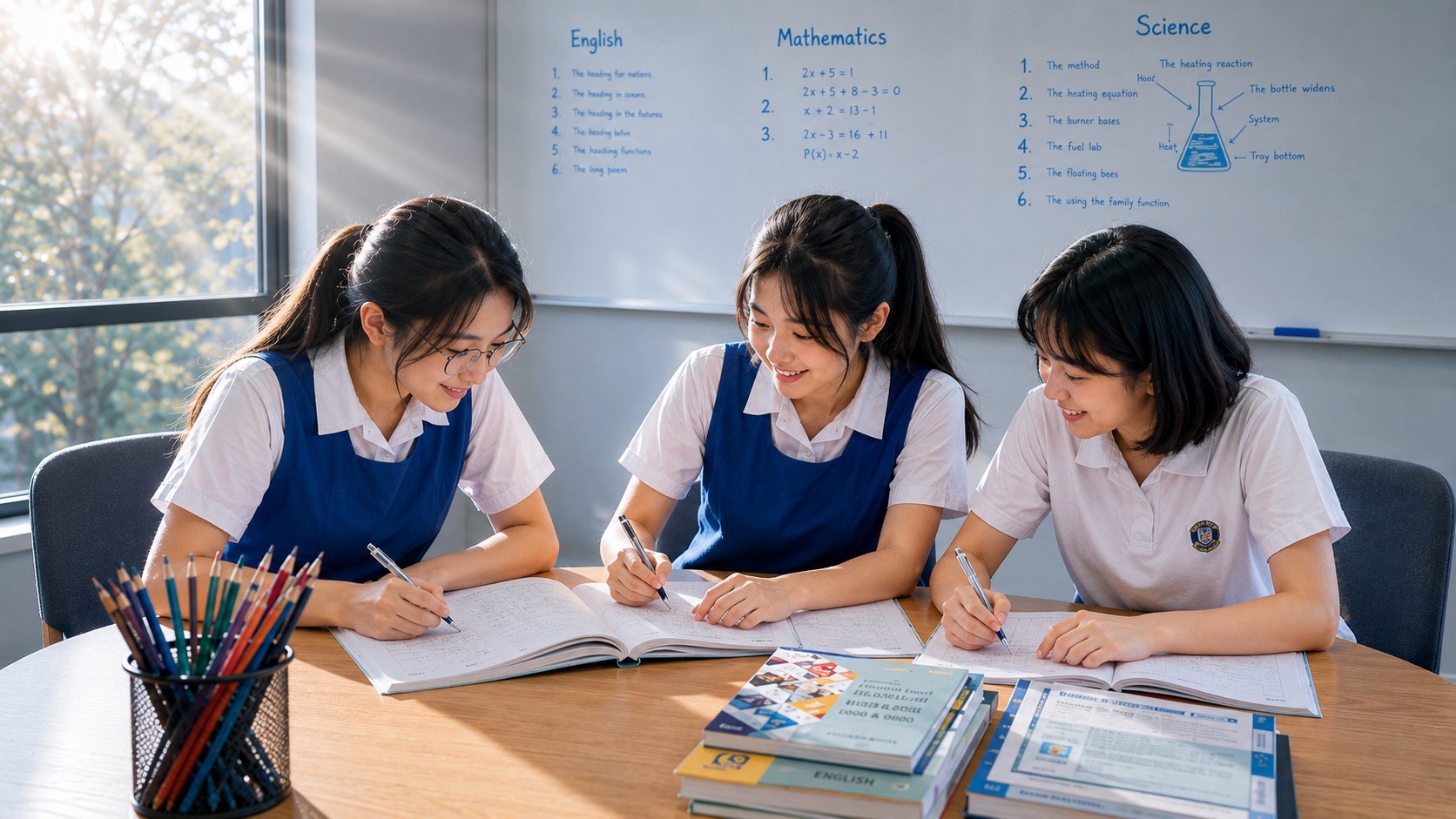
Secondary 1 G2 English vocabulary should help a student understand questions, explain a reading passage, describe an experience and speak clearly about familiar issues. This guide brings together 100 useful words for those tasks, each with a plain meaning and an example. Begin with the words your child encounters in schoolwork, then practise using a few in complete sentences. The aim is to make understanding visible: what does the word mean here, what evidence supports the answer, and does the sentence communicate the intended idea?
For parents considering small groups tuition, look for lessons that connect vocabulary to actual reading, writing, listening and discussion. A student who remembers a definition may still need help choosing the right meaning or word form. The list below is an eduKate teaching selection, not an official MOE or SEAB compulsory list or a ranking of examination frequency. Use it alongside the school’s texts and teacher feedback; no child needs to memorise all 100 before being ready to participate in Secondary 1 English.
- For students taking English at G2 in Secondary 1, with explanations parents can use at home.
- Exactly 100 distinct headwords, grouped by the reading, writing and communication jobs they perform.
- Each entry includes a meaning and an original example; context decides which meaning fits a particular sentence.
- Start with a short diagnostic, then practise a small selection through reading, speaking and writing.
- The four-week plan and three-pupil lesson are suggestions that can be adjusted to schoolwork and learning needs.
- G2 describes a subject level. Secondary 1 school assessments are separate from the national SEC examination later in secondary education.
Curriculum scope, checked 16 November 2026. The MOE English Language Syllabus 2020 treats vocabulary as part of communicating and understanding language across several skills. The 2027 G2 English Language SEC syllabus, K200, likewise values accurate, appropriate vocabulary. It is a later examination reference, not a Secondary 1 assessment schedule. SEAB explains that the SEC begins in 2027 and records the subjects and levels students sit. A child’s English level does not automatically describe every other subject. Confirm the current school assessment requirements with the English teacher.
These verbs tell you what work an answer needs to do. Read them together with the rest of the question. A student who knows the passage may still answer incompletely by describing when an explanation is required.
| No. | Word or term | Meaning | Example in use |
|---|---|---|---|
| 1 | identify | Find and name the person, thing or idea the task asks about. | Identify the reason for the cancellation: the hall was closed for urgent repairs. |
| 2 | describe | Give relevant details that show what someone or something is like. | Describe the playground by mentioning its cracked swings, empty benches and muddy entrance. |
| 3 | explain | Make an idea clear by showing how something happens or why it happens. | Explain why Mei returned the wallet: she wanted its owner to recover the money. |
| 4 | compare | Examine two things together, noting similarities or differences as the question requires. | Compare the notices by checking their purpose, intended readers and information about registration. |
| 5 | contrast | Show how two people, things or ideas differ from each other. | Contrast Ben's cheerful greeting with his sister's quiet reply after the competition. |
| 6 | infer | Reach a reasonable conclusion using clues in the text and what you know. | We infer that the boy is nervous because his hands shake before the announcement. |
| 7 | suggest | Put forward an idea, or indicate something without saying it directly. | The locked gate suggests that the centre has already closed for the evening. |
| 8 | support | Give relevant reasons or evidence that help establish a point. | Support your view that the neighbour is considerate by referring to her actions. |
| 9 | summarise | Give the main points briefly while preserving their meaning. | Summarise the safety notice by selecting its essential instructions and leaving out repeated examples. |
| 10 | evaluate | Judge something using relevant reasons, evidence or a clear basis for comparison. | Evaluate the proposal by considering its likely benefits and the difficulties of carrying it out. |
Use these terms to talk about the relationship between language and meaning. A viewpoint belongs to someone; evidence supports a claim. Practise locating an exact clue before describing the understanding it gives you.
| No. | Word or term | Meaning | Example in use |
|---|---|---|---|
| 11 | evidence | Information that helps support a conclusion, answer or claim. | The muddy footprints are evidence that someone entered the kitchen after walking outside. |
| 12 | detail | One particular piece of information within a larger description or account. | The detail about her trembling voice helps the reader understand her anxiety. |
| 13 | context | The surrounding words or situation that help explain meaning. | In this context, bright describes the child's intelligence rather than the strength of a light. |
| 14 | purpose | The reason a person communicates, writes or does something. | The poster's purpose is to encourage residents to join the neighbourhood clean-up. |
| 15 | audience | The people for whom a message, performance or piece of writing is intended. | Because the audience is new students, the guide explains where to find each classroom. |
| 16 | tone | The attitude or feeling suggested by a speaker's or writer's language. | The short command and sharp warning create a stern tone in the caretaker's reply. |
| 17 | viewpoint | The position from which someone understands or judges a situation. | From the cyclist's viewpoint, a blocked path makes the journey unsafe and frustrating. |
| 18 | attitude | A person's way of thinking or feeling about someone or something. | Her willingness to listen shows a positive attitude towards feedback from her partner. |
| 19 | impression | An understanding or feeling formed from the information available. | The tidy desk and carefully labelled files create an impression of an organised person. |
| 20 | intention | Something a person plans or means to do. | His intention was to help, although his advice upset his younger brother. |
These words help students judge their own communication. Clear writing supplies enough information for the reader. Concise writing removes unnecessary material while keeping the meaning. Formal language can still be warm, direct and easy to follow.
| No. | Word or term | Meaning | Example in use |
|---|---|---|---|
| 21 | relevant | Closely connected to the question, purpose or situation being considered. | Include the bus departure time because it is relevant to planning the class outing. |
| 22 | accurate | Correct and free from mistakes in the details that matter. | An accurate report names the correct venue and gives the actual starting time. |
| 23 | clear | Easy to understand because the meaning is expressed plainly. | Her clear instructions tell volunteers where to meet and what equipment to bring. |
| 24 | concise | Expressed briefly while keeping the information needed for understanding. | A concise reminder gives the deadline and required action in two short sentences. |
| 25 | specific | Precise and particular, rather than general or unclear. | Give a specific example: the student carried the heavy boxes upstairs for his neighbour. |
| 26 | suitable | Right or appropriate for a particular person, purpose or situation. | A friendly greeting is suitable for an email welcoming a new classmate. |
| 27 | formal | Using a serious, careful style appropriate to an official or professional situation. | A formal request to the principal should state its purpose politely and clearly. |
| 28 | informal | Using a relaxed style suited to familiar people or casual situations. | An informal message to a close friend may sound more conversational than a school announcement. |
| 29 | respectful | Showing consideration for another person's feelings, rights or position. | A respectful disagreement explains a different view without insulting the speaker. |
| 30 | persuasive | Able to encourage someone to accept an idea or take an action. | Her persuasive speech combines a sensible proposal with examples of how students would benefit. |
These terms support reading and writing about events. Use them to discuss what happened, why characters acted and how the experience changed them. A powerful story needs a believable sequence and meaningful choices, not a collection of dramatic expressions.
| No. | Word or term | Meaning | Example in use |
|---|---|---|---|
| 31 | narrate | Tell a story or describe a series of events. | Narrate the moment the team discovered that its missing equipment was in another classroom. |
| 32 | recount | Tell someone about events that have happened, usually in their sequence. | Recount the day's events from the early departure to the journey home. |
| 33 | sequence | The order in which events, ideas or steps occur. | A clear sequence helps readers follow the accident, the response and the eventual rescue. |
| 34 | incident | A particular event, often one that is unusual or causes difficulty. | The incident began when a student noticed smoke rising from the rubbish bin. |
| 35 | conflict | A serious disagreement, struggle or clash between people, ideas or needs. | The conflict grows because both teammates want to lead but neither will listen. |
| 36 | reaction | What a person does or feels in response to something. | His immediate reaction was to step back when the glass fell from the shelf. |
| 37 | outcome | The result of an event, process or series of actions. | The outcome of their discussion was an agreement to share the remaining tasks. |
| 38 | reflection | Careful thought about an experience and what it means or teaches. | Her reflection explains why she would speak more honestly if the situation happened again. |
| 39 | climax | The most intense or decisive point in a story. | The story reaches its climax when the runner must choose whether to stop and help. |
| 40 | dialogue | Spoken conversation between characters or people. | The dialogue reveals their disagreement through the questions they ask and the answers they avoid. |
Look for the cause of a feeling before choosing its name. Anxiety concerns something worrying; disappointment follows an unmet expectation. The examples offer situations that help students see those differences instead of treating every word as a substitute for sad.
| No. | Word or term | Meaning | Example in use |
|---|---|---|---|
| 41 | hesitant | Unsure or slow to act because of uncertainty or nervousness. | He gave a hesitant reply because he was uncertain whether he had understood the question. |
| 42 | relieved | Feeling less worried because an unpleasant possibility has passed or a problem is resolved. | Aisha felt relieved when the teacher said her misplaced project had been found. |
| 43 | anxious | Worried or uneasy about something that may happen. | The anxious student checked the classroom number twice before entering for his first lesson. |
| 44 | frustrated | Annoyed because something prevents progress or stops you achieving what you want. | She became frustrated when the printer jammed again just before the submission deadline. |
| 45 | embarrassed | Feeling uncomfortable or ashamed because of an awkward situation or attention from others. | He felt embarrassed after realising that he had called his teacher by the wrong name. |
| 46 | disappointed | Unhappy because something is worse than expected or a hope is not fulfilled. | The players were disappointed when the rain forced the organisers to cancel the match. |
| 47 | grateful | Feeling thankful for something helpful or kind. | She was grateful to the classmate who patiently explained the instructions after her absence. |
| 48 | determined | Firmly decided to continue towards a goal despite difficulty. | The determined group checked its calculations again after finding an error in the project. |
| 49 | curious | Wanting to learn or understand more about something. | The curious student asked how the guide knew the age of the building. |
| 50 | confident | Feeling sure about your ability, understanding or judgement. | He sounded confident because he had checked the facts and practised explaining his idea. |
These verbs can replace vague statements such as he did something or she thought about it. Ask what the person actually noticed, understood, chose or said. Keep the verb consistent with the evidence and the tense of the sentence.
| No. | Word or term | Meaning | Example in use |
|---|---|---|---|
| 51 | observe | Watch or notice something carefully, often to understand it better. | Observe how the speaker pauses before answering the difficult question about the lost keys. |
| 52 | notice | Become aware of something through seeing, hearing or another form of attention. | I did not notice the changed meeting time until I reread the final message. |
| 53 | realise | Become aware of or understand a fact or situation. | She began to realise that her friend had misunderstood the joke and felt hurt. |
| 54 | recognise | Identify something previously encountered, or accept that something is true or important. | The student recognised the unfamiliar word from a story they had read the previous week. |
| 55 | consider | Think carefully about an idea, possibility or piece of information. | Consider the residents' needs before deciding where the new bicycle racks should be placed. |
| 56 | decide | Choose what to do or reach a conclusion after considering something. | The committee must decide whether to postpone the event or move it indoors. |
| 57 | respond | Say or do something as a reply or reaction. | Respond to your partner's concern by explaining how the plan could be improved. |
| 58 | resolve | Find a solution to a problem, disagreement or difficult situation. | They resolved the disagreement by agreeing on a fair order for using the equipment. |
| 59 | admit | Accept or say that something is true, especially when it is difficult to acknowledge. | He admitted that he had forgotten the deadline and asked how to put matters right. |
| 60 | reassure | Help someone feel less worried by offering comfort, information or support. | The guide reassured the visitors by explaining that another bus would arrive shortly. |
Use a character word with an action that supports it. One small act can suggest a quality, but an answer should avoid making claims beyond the passage. Considerate and generous may both fit a person, yet they highlight different behaviour.
| No. | Word or term | Meaning | Example in use |
|---|---|---|---|
| 61 | generous | Willing to give time, help or possessions to others. | Her generous neighbour spent Saturday helping the family move its furniture into the flat. |
| 62 | considerate | Careful about how your actions affect other people's needs or feelings. | It was considerate of him to lower his voice while his sister was studying. |
| 63 | responsible | Acting carefully and accepting the duties or consequences connected with your role. | A responsible group leader checks that everyone understands the task and has a chance to contribute. |
| 64 | patient | Able to wait or cope with difficulty without becoming easily annoyed. | The patient tutor gave the student time to finish explaining the problem. |
| 65 | cautious | Careful because there may be a danger, mistake or difficulty. | The cautious pedestrian waited until the driver had stopped before stepping onto the crossing. |
| 66 | stubborn | Unwilling to change an opinion or action despite reasons for doing so. | His stubborn refusal to consider another route delayed the entire group. |
| 67 | sincere | Expressing what you really feel or believe without pretending. | A sincere apology acknowledges the hurt caused and explains how the person will respond. |
| 68 | reliable | Able to be trusted to act as expected or provide dependable information. | A reliable teammate completes the agreed work and tells the group early about any difficulty. |
| 69 | cooperative | Willing to work with others towards a shared purpose. | The cooperative students divided the materials fairly and helped one another finish the display. |
| 70 | resourceful | Good at finding practical ways to solve problems using what is available. | The resourceful team used spare cardboard to replace the missing divider in its model. |
CHAPTER 8 OF 18 · Vocabulary
8. Connecting words: show the relationship between ideas
Choose the relationship before choosing the connector. Contrast, addition, result and simultaneous action are different jobs. Read the complete sentence aloud after adding a connector, then check its punctuation and whether the ideas really fit that relationship.
| No. | Word or term | Meaning | Example in use |
|---|---|---|---|
| 71 | however | Introduces a contrast or qualification to an earlier idea. | The event was well planned. However, the organisers had not expected such heavy rain. |
| 72 | therefore | Shows that an idea or action follows logically from the information given. | The bridge was closed for repairs. Therefore, the class took a different route. |
| 73 | although | Introduces a fact that contrasts with what another part of the sentence says. | Although he was nervous, he raised his hand and explained his answer clearly. |
| 74 | moreover | Adds another point that supports or strengthens an argument. | The library is near the school. Moreover, it provides a quiet place to work. |
| 75 | meanwhile | Shows that something happens during the same period as another event. | The captain checked the equipment. Meanwhile, the other players began warming up. |
| 76 | consequently | Introduces a result or effect of an earlier action or situation. | The group ignored the instructions. Consequently, it had to rebuild the model. |
| 77 | nevertheless | Shows that something remains true despite a difficulty or opposing fact. | The climb was tiring. Nevertheless, the walkers continued carefully towards the shelter. |
| 78 | instead | Shows that one action, thing or idea replaces another. | We could not use the hall, so we held the meeting in the library instead. |
| 79 | similarly | Introduces something that is alike in a relevant way. | The first notice uses a bold heading. Similarly, the second highlights its main message. |
| 80 | otherwise | Shows what may happen if a stated action or condition does not occur. | Check the registration deadline; otherwise, you may miss the chance to join the workshop. |
These words can support school, neighbourhood and environmental discussions. They are useful because students can attach them to familiar experiences. A benefit must name something helpful; a challenge must identify an actual difficulty that someone needs to address.
| No. | Word or term | Meaning | Example in use |
|---|---|---|---|
| 81 | community | A group of people connected by a place, interest or shared situation. | The community worked together to make the neighbourhood garden welcoming and accessible. |
| 82 | environment | The surroundings and conditions in which people, animals or plants live or operate. | A quiet classroom environment can make it easier for the group to hear each speaker. |
| 83 | opportunity | A situation that makes it possible to do something useful or desired. | The project gave students an opportunity to interview older residents about the neighbourhood. |
| 84 | challenge | A difficult task or situation that requires effort, skill or a response. | The main challenge was explaining the instructions clearly to visitors who arrived late. |
| 85 | benefit | An advantage or helpful result of an action or situation. | One benefit of the new timetable is that students have more time to change classrooms. |
| 86 | consequence | A result of an action or situation, which may be helpful or harmful. | An unexpected consequence of the shortcut was arriving at a locked entrance. |
| 87 | solution | An answer or practical way of dealing with a problem. | Their solution was to label every box so that volunteers could find materials quickly. |
| 88 | awareness | Knowledge or understanding that something exists, matters or is happening. | The campaign raised awareness of the difficulties faced by people using wheelchairs. |
| 89 | participation | The act of taking part in an activity or discussion. | The chairperson encouraged participation by inviting quieter members to share their suggestions. |
| 90 | improvement | A change that makes something better than it was before. | The revised paragraph shows improvement because its examples now support the main point. |
CHAPTER 10 OF 18 · Vocabulary
10. Communication words: improve work and respond to others
These verbs give students useful actions for speaking, writing and checking. Recommending involves a suggested choice, while justifying supplies the reasons. Revising, editing and proofreading overlap in everyday use, but separating them can make a checking routine more manageable.
| No. | Word or term | Meaning | Example in use |
|---|---|---|---|
| 91 | request | Ask politely or formally for something to be done or provided. | The students requested permission to use the empty classroom for their rehearsal. |
| 92 | recommend | Suggest that something is a good choice or a suitable action. | I recommend moving the collection point nearer the entrance so visitors can find it easily. |
| 93 | encourage | Give someone support, confidence or a reason to do something. | Her partner encouraged her to explain the idea even though the first attempt was unfinished. |
| 94 | apologise | Say that you are sorry for something you have done or caused. | He apologised for interrupting and waited until the speaker had completed her explanation. |
| 95 | clarify | Make a statement, meaning or situation easier to understand. | Please clarify whether the deadline applies to the online form or the printed permission slip. |
| 96 | justify | Give reasons that show why a choice, opinion or action is reasonable. | Justify your recommendation by explaining how it meets the needs described in the question. |
| 97 | organise | Arrange ideas, materials or actions in a clear and useful order. | Organise the report into the problem, the evidence and the proposed next steps. |
| 98 | revise | Change writing or ideas to improve their content, structure or expression. | Revise the paragraph by moving its main point before the example that supports it. |
| 99 | edit | Check and correct language or presentation to make a text accurate and effective. | Edit the email for unclear sentences, repeated words and mistakes in verb forms. |
| 100 | proofread | Read a nearly finished text carefully to find remaining errors. | Proofread the final notice to check names, dates, spelling and punctuation before sharing it. |
CHAPTER 11 OF 18 · Use, practise and check
11. Choose a starting point that matches the difficulty
Take one recent piece of schoolwork and look at the point where understanding broke down. If your child misread the instruction, begin with the question words. If the instruction was understood but the answer was vague, practise evidence, detail and specific. If the idea was sensible but the sentence sounded awkward, check the word form and the words that normally accompany it.
Let the student explain the difficulty before supplying a correction. Ask, “What did you think this word meant?” That answer can reveal a reasonable misunderstanding. For example, a child may know support as physically holding something up and need to learn its reading-task meaning. Repair that connection through an example, then return to the original question.
Use three simple routes. A student rebuilding confidence can work with three words and a short paragraph. A student maintaining steady progress can connect five words to current school tasks. A student ready to extend can compare close meanings and justify a word choice. These are flexible starting points, not labels for the child or promises about a future grade.
CHAPTER 12 OF 18 · Use, practise and check
12. A worked reading example: move from a clue to an answer
Read this original practice passage: “When the teacher asked for volunteers, Arif lowered his eyes. He had prepared his notes, but the thought of speaking made his stomach tighten. Beside him, Lina whispered, ‘We can practise the first sentence together.’ After a moment, Arif raised his hand.”
Describe, infer and explain have different jobs
If asked to describe Arif’s initial behaviour, answer with what he does: he lowers his eyes when volunteers are requested. If asked to infer how he feels, name a supported feeling: he is anxious about speaking. His tightened stomach and avoidance of eye contact support that inference. If asked to explain why he eventually volunteers, connect the change to Lina’s offer of help.
A careful answer might be: “Lina reassures Arif by offering to practise with him, which helps him feel ready to volunteer.” The passage supports that explanation. It does not establish that Arif is now an expert speaker or will never feel nervous again. Keep the size of the claim close to the size of the evidence.
Choose a paraphrase that preserves the meaning
Here, anxious fits better than disappointed because nothing has failed to meet Arif’s expectations. Determined could describe his final choice if the answer explains his decision to act despite nervousness. A comprehension answer is stronger when the student can explain why a word fits this moment, rather than simply choosing the most impressive word available.
CHAPTER 13 OF 18 · Use, practise and check
13. Build a clear paragraph before adding more vocabulary
Start with a simple statement: “The students helped at the garden.” Add a precise action: “The students cleared the path and labelled the young plants.” Add a useful reason: “They wanted visitors to move around safely and recognise what was growing.” The paragraph now has substance that vocabulary can express.
A revised version could read: “The students took a responsible approach to the community garden. They cleared the path and labelled the young plants so visitors could move around safely and recognise what was growing. Their cooperative effort made the afternoon’s work easier to organise.” Each selected word points to an action the reader can understand.
Avoid adding generous, resourceful and determined to the same sentence unless each quality is supported. If the students designed labels from discarded packaging after running out of materials, resourceful would have a clear purpose. If that event did not happen, the word adds an unsupported claim. Vocabulary improves a paragraph when it sharpens the meaning already being developed.
Use the Fencing Method as a sentence-building scaffold
In this practice routine, build one secure sentence first, add a relevant detail, then add a reason or consequence. Keep checking that the original meaning remains clear. For “She was grateful,” add what happened: “She was grateful when her classmate explained the missed instructions.” Extend only if useful: “This helped her begin the task without asking the whole class to wait.”
Treat this as a teaching scaffold, not a compulsory examination formula. Some sentences should remain short. The student should eventually choose the amount of detail that the task and reader need, rather than always producing the longest sentence possible.
CHAPTER 14 OF 18 · Use, practise and check
14. Repair the confusions that make answers lose precision
Do not treat close words as interchangeable
Hesitant describes uncertainty or slowness to act; reluctant describes unwillingness. A person may hesitate because the instructions are unclear, even when willing to help. Similarly, relieved describes worry easing, while grateful expresses thanks. In a story, both feelings may occur, but the surrounding events must support whichever word the student chooses.
Match the word form and its usual partners
“She felt confidence” needs a different construction from “She felt confident.” Students can record a useful phrase such as confident about the answer, grateful for the help or responsible for the equipment. Read the entire sentence after replacing a word. The replacement may require a change in grammar even when its meaning seems similar.
Check connectors and punctuation together
“Although it rained, the walk continued” forms one complete sentence. “It rained. However, the walk continued” uses a different structure. Avoid joining two complete sentences with a comma before however. A connector also needs a real relationship: therefore cannot make an unsupported conclusion logical just by appearing at the start of it.
Use context before selecting a dictionary meaning
Words can have several meanings. Patient can describe a calm person or name someone receiving medical care. Formal can describe language style, and support can mean giving evidence or offering help. Ask which meaning fits the sentence, then check that meaning with a reliable dictionary or the teacher when uncertainty remains.
CHAPTER 15 OF 18 · Use, practise and check
15. A short diagnostic with explained answers
Try these tasks without the list first. They are informal checks, not a school grading scale. Let the student explain the choice aloud before discussing the answer.
- A notice gives the date, time and location of a sports trial. Which information is relevant to deciding whether you can attend?
- “After learning that his missing brother was safe, Ravi breathed out and smiled.” Is relieved or embarrassed the better description? Explain.
- Improve this answer: “The girl is good because she does nice things.” Invent one concrete action and choose a suitable character word.
- Complete the relationship: “The venue was unavailable. _____, the organisers moved the meeting.” Choose therefore or meanwhile.
- A writer claims the library should open earlier. What would help justify that recommendation?
- Explain one difference between revising a paragraph and proofreading the final version.
Answers and what to notice
For task 1, the date and trial time help you check availability; the location helps you judge whether you can reach it. The exact answer depends on what the notice supplies. For task 2, relieved fits because Ravi’s worry has eased. Embarrassment would need evidence of awkwardness or shame.
For task 3, one possible answer is: “The girl is considerate because she makes space at the table for a classmate carrying a heavy tray.” For task 4, therefore expresses the result of the venue problem; meanwhile would suggest simultaneous events. For task 5, relevant evidence could show that students arrive before the current opening time and need a suitable study space. A claim about demand should be checked before it is presented as fact.
For task 6, revising might change the order of ideas or replace an unclear example. Proofreading checks a nearly finished version for remaining errors. If the student knows every definition but struggles with these tasks, spend the next lesson applying words to meaning rather than adding another long list.
CHAPTER 16 OF 18 · Use, practise and check
16. A four-week plan that leaves room for school life
This suggested plan builds a working collection from the list. It does not require all 100 words in four weeks. Adjust the number to the student’s current workload, reading confidence and teacher feedback. A short session should finish with something the student can now explain or use.
Week 1: understand questions and find clues
Choose five question words and five reading words that appear in current work. Across several short sessions, match each instruction to an example answer. Read one manageable paragraph and ask the student to identify a detail, infer a feeling and explain a cause. Keep the difference between those actions visible in the notebook.
Week 2: describe actions and feelings
Select a few feeling, action and character words. Use a familiar school situation, a short story or an event the student is comfortable discussing. Ask what happened before choosing the feeling. Build two sentences that support the choice with an action, then discuss a close alternative that would change the meaning.
Week 3: connect ideas and speak clearly
Practise a small selection of connectors alongside discussion words. Give the student a practical choice, such as how to make a class event easier to organise. Ask for a recommendation, a reason and a possible difficulty. Another person can ask one follow-up question so the student practises responding rather than reciting a memorised paragraph.
Week 4: transfer words into independent work
Return to a piece of writing from the beginning of the month. Let the student revise it using only words that improve its meaning. Compare the earlier and later versions for clearer ideas, accurate language and more relevant detail. Revisit words that remain uncertain and keep them in the next month’s practice.
A useful review page has four columns: word, meaning in this example, my sentence and the correction I need to remember. Cover the meaning before checking recall, then use the word in a new situation. Recognising a familiar example and explaining a fresh example are different achievements; the second gives a better view of usable understanding.
CHAPTER 17 OF 18 · Use, practise and check
17. What a useful three-pupil lesson could look like
A three-pupil group can use the same short text while giving each learner a distinct responsibility. One pupil identifies the evidence, one proposes the answer and one checks whether the chosen word fits. Rotate the roles so everyone reads, explains and checks. This is a suggested lesson design, not a claim about a currently available class timetable.
Begin with a brief individual response before discussion. Otherwise, a quieter learner may agree with the strongest speaker without revealing what was understood. The tutor can then compare the three starting answers and choose the most useful teaching point: a command word, an unsupported inference, an incorrect word form or an unclear sentence.
After the discussion, give a new example for independent completion. That final step matters because repeating the group’s answer does not show whether each pupil can use the idea alone. A parent should be able to see the original response, the correction and a later independent attempt, with a clear explanation of the next practice needed.
Ask how texts are chosen, how individual errors are recorded and how work connects with the school’s current expectations. Group size gives an opportunity for attention; the lesson still needs careful teaching, useful feedback and time for each learner to think. The appropriate support depends on the actual difficulty shown in the student’s work.
How can I help when my own English is uncertain?
Ask your child to explain the example in everyday language and point to the clue that supports the answer. You can ask, “Why does that word fit?” without knowing every term yourself. Keep uncertain questions for the teacher, and use a reliable dictionary together. The parent’s role can be to support attention and regular practice.
Does my child need tuition immediately?
Begin with school feedback and a small sample of recent work. Some students need a manageable reading habit and a clearer checking routine. Others need direct teaching because the same misunderstanding persists across tasks. Ask the English teacher which gap is most useful to address and review whether the chosen support is improving independent work.
Will learning these words guarantee a high grade?
No. English tasks also involve understanding ideas, selecting evidence, organising writing, listening carefully and communicating appropriately. These words are tools for that work. The list should support practice, and the school’s assessment criteria remain the relevant guide to how a particular task is judged.
Should students use every new word in compositions?
Use a word when it communicates the intended meaning accurately. Several precise, ordinary words can serve a paragraph well. Keep a newly learned word in speaking and short-sentence practice until its meaning, form and usual combinations are secure enough for independent writing.
Is G2 English a permanent label for the student?
G2 names the level of the English subject being taken. A student’s subjects can be at different levels under Full Subject-Based Banding. Questions about changing a subject level should be discussed with the school using current performance and readiness; completing a vocabulary list alone does not establish eligibility.
What should we do today?
Choose one recent task, select three words that would help your child complete it, and work through one example together. Finish with a different example the child attempts independently. Save the response and use it to decide the next small step. That gives the vocabulary a clear purpose in the student’s actual learning.
Continue learning with eduKate
- Secondary 1 G2 English preparation: use the companion guide to connect vocabulary with the next learning step.
- eduKate Vocabulary hub: explore word meaning, sentence use and further learning resources.
Official sources and further reading
Curriculum and examination context checked on 16 November 2026. Follow the school’s current instructions and the syllabus for the relevant examination year. The definitions, examples and practice tasks above are original teaching material.
- MOE English Language Syllabus 2020, Secondary E/N(A) — Teaching framework for vocabulary knowledge and purposeful language use; older course labels appear in this official document.
- SEAB 2027 G2 English Language syllabus K200 — Later national examination reference; supports the broad emphasis on accurate and appropriate vocabulary, not a Secondary 1 paper specification.
- SEAB 2027 G2 syllabuses for school candidates — Lists English Language as K200; the page was updated on 2 October 2026.
- SEAB Secondary Education Certificate overview — Explains the introduction of the SEC in 2027 and reporting by subjects and subject levels.