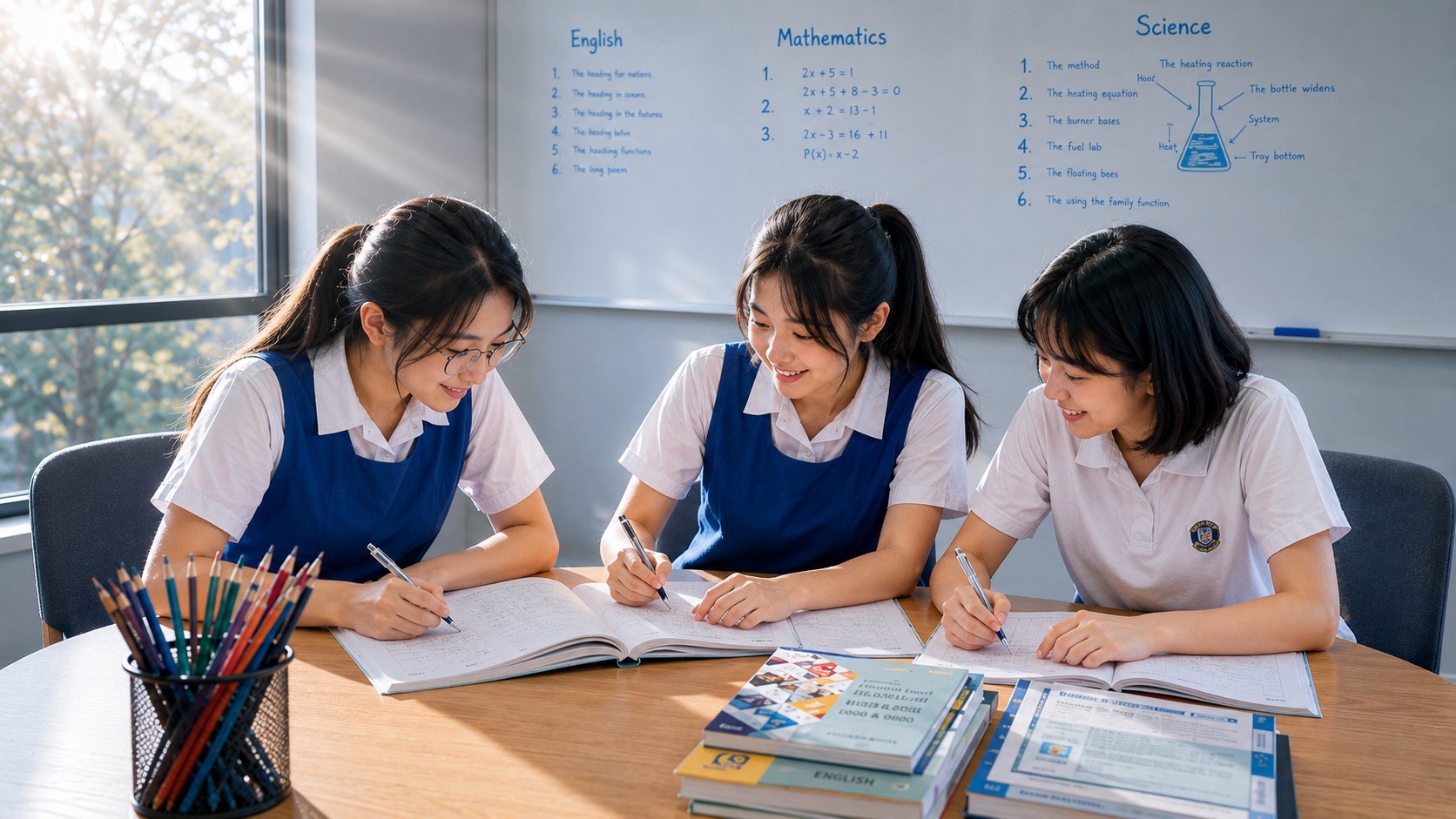
Secondary 1 G2 vocabulary for community and helping others helps students understand people’s needs, describe useful actions and explain what they have learnt from an experience. This guide teaches 100 carefully selected words through clear meanings, school and neighbourhood examples, reading questions and writing practice. Students can use the vocabulary when discussing a class project, reading about community service, writing a thoughtful reflection or suggesting a practical way to help.
Begin with words that make an idea clearer: identify a need, clarify a request, coordinate a task and reflect on an outcome. Learn how each word behaves in a sentence before trying to use several together. Parents can support this work by asking for an explanation and a fresh example, then checking the child’s school feedback. The list is an eduKate teaching selection, not an official MOE or SEAB top-100 list or a prediction of an examination theme.
- Learn 100 words in ten manageable groups, moving from noticing needs to explaining decisions and reflecting on results.
- Practise vocabulary for reading, writing, discussion and everyday communication in Secondary 1 G2 English.
- Use original community scenarios to distinguish helpful intentions, respectful actions and evidence of an outcome.
- Try the worked reading passage, eight diagnostic checks and a flexible four-week practice plan.
- Treat G2 as the level of the English subject; follow the school’s current teaching and assessment instructions.
- Use the official sources to understand curriculum context and check real volunteering arrangements with the school or organiser.
How this theme connects with school learning
MOE’s Values in Action overview explains the place of student voice, growing ownership and understanding the community in service learning. These provide meaningful contexts for vocabulary practice. They do not create a separate compulsory English word list. The project, conversations and exercises in this guide are fictional teaching examples.
The broad English aims in SEAB’s 2027 G2 English Language syllabus K200 include accurate vocabulary and communication suited to purpose, audience and context. This guide builds those habits at an introductory level. K200 describes a graduating examination; its paper specifications are not Secondary 1 assessment requirements, and its year is not a promise about a younger student’s eventual examination.
Under Full Subject-Based Banding, students can take different subjects at different levels. Use G2 here to identify the English learning context, rather than to describe the child’s ability across every subject. Ask the school which text types, vocabulary demands and assessment tasks are being taught this term.
Start by describing what is actually happening. A careful observation is more useful than a broad statement that everybody needs help. These words let a student name the people involved, explain a concern and identify a request before suggesting an action.
| No. | Word or term | Meaning | Example in use |
|---|---|---|---|
| 1 | community | A group of people connected by a place, interest or shared experience. | Our school community includes students, teachers and other staff who help the school run each day. |
| 2 | neighbour | A person who lives near another person. | My neighbour asked whether I could hold the lift door while she moved her shopping trolley. |
| 3 | resident | A person who lives in a particular place. | A resident suggested adding clearer signs so visitors could find the community room more easily. |
| 4 | need | Something necessary, or a situation in which something important is missing. | The reading group had a need for books with larger print that more participants could use. |
| 5 | concern | A worry or an issue that deserves attention. | The organiser listened to a parent’s concern about the crowded entrance before deciding where to place tables. |
| 6 | observe | To watch or examine something carefully in order to learn about it. | We observed how people entered the room before suggesting a different arrangement for the chairs. |
| 7 | notice | To become aware of something through seeing, hearing or paying attention. | Alya noticed that the instructions were too high on the wall for some children to read. |
| 8 | identify | To recognise and name something or work out what it is. | The class tried to identify the main difficulty instead of immediately buying more materials. |
| 9 | request | To ask politely or formally for something. | The group decided to request permission before putting its posters on the community room noticeboard. |
| 10 | respond | To say or do something as a reaction to a message or situation. | The coordinator will respond after checking whether the room is available on Saturday morning. |
Community projects involve people with different roles and preferences. Avoid treating everyone who receives support as helpless. Someone may receive help with one task and contribute expertise to another. Learn the roles, ask what participation requires and use descriptions that preserve people’s dignity.
| No. | Word or term | Meaning | Example in use |
|---|---|---|---|
| 11 | volunteer | A person who willingly offers time or work without being paid for it. | Each volunteer chose an approved task and checked the instructions with the supervising teacher before starting. |
| 12 | organiser | A person who makes arrangements for an activity or event. | The organiser confirmed the meeting point and explained how students should ask for help during the activity. |
| 13 | participant | A person who takes part in an activity. | Every participant could choose between listening to a story and joining a small discussion about it. |
| 14 | beneficiary | A person or group that receives help or an advantage from something. | The project team asked its intended beneficiaries which donated items would actually be useful to them. |
| 15 | caregiver | A person who provides regular care for someone who needs support. | The caregiver explained the visitor’s preferred way of communicating, and the students listened carefully before speaking. |
| 16 | partner | A person or organisation that works with another towards a shared purpose. | The school’s community partner helped the class understand the venue and plan a suitable activity. |
| 17 | facility | A place, service or piece of equipment provided for a particular purpose. | The sports facility has a sheltered waiting area where participants can meet before the session. |
| 18 | venue | The place where an organised activity or event happens. | The venue changed, so the teacher sent families an updated notice with the correct address. |
| 19 | accessible | Easy enough for the intended people to reach, enter, understand or use. | The instructions became more accessible when we used larger lettering and explained each step clearly. |
| 20 | inclusive | Designed or carried out so that different people can participate and feel included. | An inclusive activity offered several ways to contribute, including speaking, drawing and arranging the materials. |
These verbs tell the reader what a person actually did. Choose the action that matches the evidence: collecting books is different from distributing them, and preparing a room is different from maintaining it. Specific verbs make a reflection clearer without making the achievement sound larger than it was.
| No. | Word or term | Meaning | Example in use |
|---|---|---|---|
| 21 | assist | To help someone do a task. | Nabil offered to assist the organiser by placing the labelled boxes beside the collection table. |
| 22 | support | To help a person, group or activity with what it needs. | The class could support the reading session by preparing clear picture cards requested by its partner. |
| 23 | contribute | To give time, effort, ideas or resources towards a shared activity. | Students could contribute useful suggestions even if they were unable to attend the weekend session. |
| 24 | donate | To give money or useful items to help a person, organisation or cause. | Before offering to donate books, we checked the organiser’s list of accepted titles and conditions. |
| 25 | collect | To bring items together from different people or places. | The volunteers will collect the requested materials only after the school has confirmed the arrangements. |
| 26 | sort | To arrange things into groups according to a useful feature. | We sorted the donated books by reading level so participants could find suitable stories more easily. |
| 27 | distribute | To give or send items out to different people or places. | The coordinator asked us to distribute the information sheets evenly among the four discussion tables. |
| 28 | deliver | To take something to the person or place it is intended for. | The adult organiser arranged transport to deliver the boxes after the receiving partner confirmed the timing. |
| 29 | prepare | To make someone or something ready for a task or event. | Before the session, we prepared a short explanation of each game and checked that every set was complete. |
| 30 | maintain | To keep something in good condition or continue it at a suitable standard. | We helped maintain a tidy reading area by returning chairs and books to their assigned places. |
Good intentions do not tell us exactly what another person wants. These words support a useful conversation: listen, clarify, explain and acknowledge. A polite question can prevent wasted work. When practising, give both sides of the conversation so the meaning of the response is clear.
| No. | Word or term | Meaning | Example in use |
|---|---|---|---|
| 31 | listen | To pay attention to sounds or to what someone is saying. | We listened to the participants’ suggestions before deciding which activity to repeat at the next session. |
| 32 | clarify | To make an idea, instruction or situation clearer. | Jia asked the organiser to clarify whether the collection was for storybooks, reference books or both. |
| 33 | explain | To make something understandable by giving details or reasons. | The group explained why the tables needed more space between them before asking to move the furniture. |
| 34 | suggest | To put forward an idea for someone to consider. | I suggested using a simple sign to show where visitors could leave their completed feedback cards. |
| 35 | invite | To ask someone politely to come, join or take part. | The facilitator invited quieter participants to contribute, while allowing them to choose whether they wished to speak. |
| 36 | inform | To give someone information they need or should know. | Please inform the supervising teacher if your assigned materials are missing before the activity begins. |
| 37 | reassure | To help someone feel less worried by offering truthful support or information. | The teacher reassured us that we could ask for help if we did not understand a visitor’s question. |
| 38 | acknowledge | To recognise or show that you have heard or understood something. | The organiser acknowledged our concern about the noise and agreed to discuss a quieter seating area. |
| 39 | feedback | Information about an experience or performance that can help someone make improvements. | The feedback showed that visitors liked the stories but wanted the printed instructions to be clearer. |
| 40 | permission | Approval from someone who has the right to allow an action. | We asked the venue manager for permission before attaching any labels to the walls or tables. |
A plan becomes useful when someone can act on it. These words help students turn a general wish to help into a clear proposal. In language practice, explain who will do what, when it should happen and which materials are needed. Keep invented plans separate from confirmed real arrangements.
| No. | Word or term | Meaning | Example in use |
|---|---|---|---|
| 41 | purpose | The reason for an action or the result it is intended to achieve. | The purpose of our welcome sheet was to help first-time visitors understand how the reading session worked. |
| 42 | priority | Something that needs attention before other matters because it is more important or urgent. | Keeping the entrance clear was our first priority when we arranged the activity tables. |
| 43 | task | A piece of work that needs to be done. | My task was to check the labels and report any missing information to the group leader. |
| 44 | role | The part or responsibility a person has in an activity. | Mei’s role was to welcome visitors, while another student explained how the activity cards were organised. |
| 45 | schedule | A plan showing when activities or tasks will happen. | We checked the schedule before promising that the discussion would finish in time for the next activity. |
| 46 | deadline | The latest time or date by which something must be completed. | The teacher gave us a deadline so that the partner could check our proposed materials before the visit. |
| 47 | resource | Something useful that can help a person or group complete an activity. | A clear instruction sheet was a valuable resource when a volunteer was learning the task. |
| 48 | equipment | The tools or other items needed for a particular activity. | The group checked the equipment list and told the organiser that one set of game pieces was incomplete. |
| 49 | budget | A plan or limit for how much money can be spent. | Our imaginary project had a small budget, so we compared the cost of printing different designs. |
| 50 | transport | A way of moving people or goods from one place to another. | The teacher confirmed the transport arrangements with families before students took part in the approved visit. |
A team needs more than friendly people. It needs clear communication, realistic promises and a way to check progress. These words help a student describe a contribution without claiming that one person did everything. When praising teamwork, point to an action that supports the description.
| No. | Word or term | Meaning | Example in use |
|---|---|---|---|
| 51 | cooperate | To work willingly with other people towards a shared purpose. | The two groups cooperated by sharing their materials and agreeing on a common set of instructions. |
| 52 | coordinate | To organise people or activities so that they work well together. | Our leader coordinated the collection times so that several boxes did not arrive at the same crowded doorway. |
| 53 | delegate | To give someone responsibility for a particular task. | The group leader delegated the poster design to Lina after checking that she understood the purpose. |
| 54 | commit | To make a serious promise or decision to do something. | Before we committed to a second session, we checked whether we could prepare the materials properly. |
| 55 | reliable | Able to be trusted to do what is expected or promised. | A reliable team member tells the group early if a problem may prevent a task from being completed. |
| 56 | flexible | Willing or able to change a plan when the situation requires it. | We remained flexible when the room changed and adjusted the activity to fit the smaller space. |
| 57 | patient | Able to wait or deal with difficulty without becoming easily annoyed. | The volunteer was patient while a visitor considered the choices and asked the same question again. |
| 58 | initiative | The willingness to take a useful first step without waiting for every instruction. | Ravi showed initiative by noticing the missing labels and offering a draft for the teacher to check. |
| 59 | teamwork | The combined effort of people working together effectively. | Their teamwork was clear when they shared information and helped one another finish the preparation on time. |
| 60 | accountable | Responsible for an action or decision and expected to explain it. | Each group member was accountable for checking the information in the section of the notice they prepared. |
Helpful language makes room for people’s choices. Do not assume that everyone of the same age or background wants the same thing. These words support careful descriptions of fairness and care. A concrete example is stronger than a sentence that simply calls every participant kind and wonderful.
| No. | Word or term | Meaning | Example in use |
|---|---|---|---|
| 61 | dignity | The worth of every person and the respect that worth deserves. | We protected visitors’ dignity by asking what they preferred instead of discussing their needs in front of everyone. |
| 62 | respect | To treat someone or something as worthy of consideration and care. | We respected a participant’s decision to watch the activity before deciding whether to join it. |
| 63 | empathy | The ability to understand and consider another person’s feelings or experience. | Empathy helped the students consider how confusing an unfamiliar room might feel to a first-time visitor. |
| 64 | considerate | Thoughtful about how an action may affect other people. | It was considerate of the group to lower their voices while another table was listening to a story. |
| 65 | fair | Reasonable and just, taking relevant needs and circumstances into account. | The teacher helped us agree on a fair division of tasks based on available time and support needs. |
| 66 | equal | The same in amount, size, value or status in the respect being discussed. | The four tables received equal numbers of instruction cards at the start of the session. |
| 67 | consent | A person’s freely given agreement to a particular action involving them. | We asked for the participant’s consent before including her photograph in the project display. |
| 68 | privacy | A person’s ability or right to keep aspects of life and personal information from unwanted attention. | The reflection protected the family’s privacy by leaving out names and identifying details that were not needed. |
| 69 | diversity | The presence of different backgrounds, experiences, characteristics or ways of thinking. | The group’s diversity brought several perspectives to the discussion about which activities might interest visitors. |
| 70 | gratitude | A feeling of appreciation for something someone has done or given. | We expressed gratitude to the venue staff by thanking them specifically for helping us arrange the room. |
A project can be worthwhile even when the first idea needs adjustment. These words help students explain a problem and a reasonable response. Keep the problem proportional: a late box is a delay, while a shortage means there is not enough of something. Accurate naming makes the next step clearer.
| No. | Word or term | Meaning | Example in use |
|---|---|---|---|
| 71 | obstacle | Something that makes progress or success more difficult. | The unclear directions were an obstacle for visitors who were trying to find the activity room. |
| 72 | delay | A situation in which something happens later than planned or expected. | A delay in printing meant that the group had to practise using a handwritten instruction sheet. |
| 73 | shortage | A situation in which there is not enough of something needed. | The shortage of complete game sets led us to organise smaller groups that took turns. |
| 74 | conflict | A serious disagreement or a situation in which needs or plans clash. | A conflict arose when two groups expected to use the same room at the same time. |
| 75 | compromise | An agreement in which people accept some changes to settle a disagreement. | The groups reached a compromise by sharing the room at different times instead of cancelling one activity. |
| 76 | solution | A way of dealing with a problem or resolving a difficulty. | Adding a clear sign was a simple solution to the problem of visitors entering the wrong room. |
| 77 | adapt | To change something, or change how you act, to suit a situation. | We adapted the instructions after a participant explained which step was difficult to follow. |
| 78 | resolve | To settle or find an answer to a problem or disagreement. | The teacher helped us resolve the disagreement by checking the agreed plan and listening to both groups. |
| 79 | prevent | To stop something from happening, or stop someone from carrying out a particular action. | Checking the materials beforehand helped prevent avoidable interruptions during the reading activity. |
| 80 | improve | To make something better or become better. | We improved the next session by using larger labels and allowing more time for questions. |
A thoughtful reflection separates actions, results and what remains uncertain. Counted items can show what was delivered; they cannot by themselves prove how every person felt. These words help students describe what they know, explain the evidence and suggest a sensible next step without exaggerating their impact.
| No. | Word or term | Meaning | Example in use |
|---|---|---|---|
| 81 | reflection | Careful thought about an experience, what it means and what can be learnt. | My reflection explained why our first instructions were confusing and how we could make them clearer. |
| 82 | evidence | Information or observations that support a statement or help establish what happened. | The completed feedback cards provided evidence that several participants wanted a quieter discussion space. |
| 83 | outcome | A result of an action, event or process. | One outcome of the revised layout was that visitors could find the registration table more easily. |
| 84 | impact | The effect or influence that an action or event has. | We discussed the activity’s possible impact but avoided claiming lasting change after a single short visit. |
| 85 | effective | Successful in achieving the intended purpose. | The new sign was effective because visitors used it to find the correct room without asking for directions. |
| 86 | progress | Movement towards a goal or an improvement over time. | Our progress was visible when we could explain the task clearly without reading every line of the script. |
| 87 | strength | A quality or ability that helps someone or something work well. | A strength of our plan was that participants could choose between two activities with clear instructions. |
| 88 | limitation | A restriction or weakness that affects what something can do or show. | A limitation of our feedback was that only people who stayed until the end completed the form. |
| 89 | perspective | A particular way of seeing or understanding a situation. | Listening to the venue staff gave us another perspective on why moving the tables might cause difficulty. |
| 90 | appreciate | To recognise the value of something or feel thankful for it. | We began to appreciate how much preparation was needed to make a short community activity run smoothly. |
Linking words help a reader follow the relationship between ideas. Choose the relationship first, then the word. A longer connector does not automatically improve a sentence. Read both clauses to check whether you mean a reason, a contrast, an addition, a sequence or a result.
| No. | Word or term | Meaning | Example in use |
|---|---|---|---|
| 91 | because | Used to introduce a reason for an action, situation or statement. | We changed the position of the sign because several visitors had walked past the entrance without seeing it. |
| 92 | although | Used to introduce a fact that contrasts with another part of the sentence. | Although we had fewer materials than expected, every participant could join by taking turns in a small group. |
| 93 | however | Used to introduce an idea that contrasts with what was said before. | The first activity was popular. However, some participants preferred a quieter option with fewer people at each table. |
| 94 | therefore | Used to show that an idea or action follows logically from what was stated. | The room was unavailable that morning. Therefore, we asked the organiser to confirm a different time. |
| 95 | meanwhile | Used to describe something happening during the same period as another action. | Alya welcomed the first visitors. Meanwhile, her teammates checked that the story cards were in the correct order. |
| 96 | eventually | Used to describe something that happens after time, effort or difficulty. | After comparing several arrangements, we eventually found a layout that kept the entrance clear and the tables accessible. |
| 97 | initially | Used to describe what happened or was believed at the beginning. | Initially, we thought the instructions were clear, but a practice session revealed that two steps needed explanation. |
| 98 | consequently | Used to introduce a result of something that happened. | The labels were placed beside the wrong boxes. Consequently, we had to sort the collected materials again. |
| 99 | furthermore | Used to add another related point that supports or extends an idea. | The new activity required fewer materials. Furthermore, participants could choose a shorter version if they preferred. |
| 100 | instead | Used to describe an alternative to an action or option. | We could not use the large hall, so we held two smaller sessions in the classroom instead. |
CHAPTER 11 OF 19 · Use, practise and check
11. Learn a meaning, a pattern and a useful example
Start with five words that describe something you understand. Read the meaning, cover it and explain it in your own words. Then say a fresh sentence that could reasonably happen at school. If the sentence only repeats the definition, add a person, an action and a detail. “We contribute” becomes clearer as “We contributed ideas for making the signs easier to read.”
Notice word patterns as well as meanings. We contribute to a project, assist someone with a task and respond to a request. We can request permission or ask for permission. Keeping the whole phrase in a notebook is useful because the small joining word is part of accurate English. Do not attach a preposition just because a similar word uses one.
Build a small word family when it helps: contribute → contribution; respond → response; reflect → reflection. Write one sentence with the verb and another with the noun. “We reflected on the delay” describes an action. “Our reflection explained the delay” names the written or spoken thinking about it. These forms have different grammatical jobs even though their meanings are connected.
After a short break or on another day, cover the examples and try again. Keep words that still need a prompt in a small practice set. There is no need to race through all 100 before using any of them. A student who explains five words accurately and uses them in a new context has useful evidence of learning.
CHAPTER 12 OF 19 · Use, practise and check
12. Worked reading: a quieter place to join in
Original fictional passage: Nadia’s class helped prepare a reading afternoon at a community room. Initially, the students planned one large circle because it seemed easy to organise. Their partner asked them to observe a short trial before confirming the arrangement.
During the trial, some participants enjoyed speaking to the whole group. Others stayed near the entrance and found it difficult to hear the story over nearby conversations. Nadia did not assume that everyone wanted the same change. She asked whether a quieter table would be useful. Two participants said they would prefer it, while another wished to remain in the larger circle.
The students adapted their plan. They prepared a smaller table with the same story cards and left a clear route between the tables. Nadia’s role was to explain the options without pressuring anyone to move. Her teammate recorded comments with the organiser’s permission, leaving out personal details that were unnecessary.
After the session, the group received several positive comments about the choice of seating. However, only six participants completed feedback cards. In her reflection, Nadia wrote that the quieter table appeared useful to some visitors. She recommended asking more participants before deciding how to arrange the next session. She also acknowledged the venue staff, who had helped move the tables safely.
Questions and explained answers
- What does “initially” show? It identifies the first plan, before the trial gave the students more information. It does not mean that the plan was finally approved.
- How did the students make the activity more inclusive? They offered a smaller, quieter table while keeping the larger circle. Participants could choose an option instead of being required to use one arrangement.
- Why is “adapted” more precise than “abandoned”? They changed the arrangement but kept the reading activity and story cards. They did not give up the whole project.
- What limits the conclusion about the quieter table? Only six people completed feedback cards. The comments do not show every participant’s opinion.
- Find evidence of respect. Nadia explained choices without pressuring people to move. Her behaviour allowed participants to express their preferences.
When answering an inference question, connect the word to an observed action. “Nadia was considerate” is a claim. Adding “because she offered a quieter option and let participants choose” explains the evidence. Avoid inventing feelings or outcomes that the passage does not describe.
CHAPTER 13 OF 19 · Use, practise and check
13. Build clear sentences, messages and reflections
A strong sentence uses the word to carry useful meaning. Begin with a simple statement: “We helped at the session.” Add a precise action: “We prepared larger labels for the activity tables.” Then explain the reason: “We prepared larger labels because the smaller print was difficult to read.” Finally, give a supported outcome if one is available: “Several visitors used the labels to choose a table without asking for directions.”
For a short reflection, organise the paragraph around what happened, what you did, what you learnt and what you would change. This is a practice structure, not a compulsory examination formula. The content should still follow the teacher’s task and the evidence available.
Model reflection: Our first instruction sheet had too many steps in one paragraph. During the trial, two classmates asked where to begin. We clarified the sequence by numbering the steps and adding one example. This helped them start the activity without another explanation. I learnt that an instruction can seem clear to its writer but confuse someone reading it for the first time. Next time, I would ask someone outside the group to test the instructions before we print them.
For a polite request, make the purpose and requested action clear. A practice message might say: “Dear Ms Tan, our group would like to use the smaller room for the reading trial. It has space for two tables and may be quieter. Could you confirm whether it is available after school on Thursday? We will finalise the plan after receiving your advice.” The message makes a request; it does not pretend that permission has already been granted.
Edit for accuracy before adding more vocabulary. Check who performed each action, whether the tense is consistent and whether the result really follows from the example. Replacing every ordinary word with a difficult one can make a clear reflection harder to understand.
Equal and fair
Equal describes sameness in a particular respect. Fair considers what is reasonable in the circumstances. Giving every group the same number of cards is an equal distribution. A fair arrangement may provide extra support to a participant who needs help reading the cards. Explain which feature you are discussing instead of treating the words as interchangeable.
Permission and consent
Permission concerns approval from someone authorised to allow an action. Consent concerns the agreement of the person involved. A venue manager’s permission to hold an activity does not automatically tell you whether an individual agrees to be photographed. In a real school activity, follow the school’s process and the organiser’s instructions rather than deciding the requirements from a vocabulary exercise.
Outcome and impact
An outcome is a result; impact describes an effect or influence. The meanings can overlap, so the surrounding sentence matters. “We produced ten signs” reports a completed output. “Visitors found the entrance more easily” describes a possible outcome supported by observations. A claim about lasting community impact would need stronger evidence than a single afternoon’s comments.
Support and take over
Support helps someone with what they need. Taking over means assuming control of a task or situation. Before describing an action as supportive, check whether the person wanted that help. A thoughtful example might say, “I offered to explain the first step and waited for her answer.”
Although and however
Use “although” to join a contrasting clause: “Although the room was small, the group could work comfortably.” Use “however” to connect a contrasting statement with suitable punctuation: “The room was small. However, the group could work comfortably.” Avoid writing “Although the room was small, but…” in this sentence pattern.
CHAPTER 15 OF 19 · Use, practise and check
15. Eight diagnostic checks with explained answers
Try these questions before looking at the answers. This is a learning check, not a school grading scale or an official placement test. For each mistake, identify whether the difficulty was meaning, sentence structure, evidence or choosing a word that fits the situation.
- Complete the phrase: “Our class contributed ideas ___ the project.”
- Choose the more precise word: “We collected/distributed the cards by giving one to each participant.”
- Rewrite this sentence accurately: “The volunteers were reliability.”
- Which word names a result: deadline, outcome or equipment?
- Explain why “Everyone enjoyed the session” is too strong if only three participants gave feedback, and those three said they enjoyed it.
- Join these ideas with “although”: “The group had limited materials. It offered two useful activities.”
- A student checks what a confusing instruction means. Is the student clarifying or donating?
- Give one sentence showing considerate behaviour without using the word “nice”.
Answers and reasoning
- To. The common pattern is “contribute something to something”.
- Distributed. The cards were being given out. Collected would describe bringing them together.
- “The volunteers were reliable.” The adjective describes them. Reliability is the noun naming the quality.
- Outcome. A deadline concerns timing; equipment refers to items needed for an activity.
- The evidence covers only three people’s responses. A more careful sentence is “The three participants who gave feedback said they enjoyed the session.”
- “Although the group had limited materials, it offered two useful activities.” The sentence expresses a contrast between the limitation and what the group achieved.
- Clarifying. The student is making the instruction clearer, rather than giving an item to a cause.
- Possible answer: “She lowered her voice because the group beside her was listening to a story.” The action and reason show consideration; other accurate examples are acceptable.
If meanings are secure but grammar slips, practise word families and sentence patterns. If grammar is accurate but explanations exaggerate, return to the worked passage and underline the evidence for each statement. Choose the next practice from the actual error rather than simply adding another ten words.
CHAPTER 16 OF 19 · Use, practise and check
16. Practise speaking and listening in a small group
Three learners can use a fictional problem: an after-school reading table has unclear instructions and limited space. One learner explains a proposed improvement, another asks questions and the third listens for accurate vocabulary and supporting details. Rotate the roles after a short discussion so each learner speaks, listens and gives feedback.
The speaker can begin: “Our priority is to make the instructions accessible. I suggest numbering the steps because…” The questioner should ask something that tests the plan: “Who will check the instructions?” or “How will you find out whether the change helps?” The listener records one clear explanation and one sentence that needs improvement. Recording means making brief notes; no audio recording is required.
Use a second round to revise the plan. The learner should respond to the question rather than repeat a memorised paragraph. “That is a useful concern. We could test the instructions with another group before printing them” shows that the discussion has influenced the proposal.
For a listening task, an adult can read the fictional notice twice: “The reading trial will begin at four o’clock in Room Two. Bring your draft instructions. Do not print the final copies yet. The organiser will give feedback before we confirm the design.” Ask the learner to state the venue, required item and action that must wait. Answers: Room Two, draft instructions, and printing the final copies. Changing the time or room in a later practice checks listening to the current message instead of recalling the previous answer.
Use this as a suggested routine and adjust it around school work. The purpose is usable understanding, not completing a fixed number at any cost. A short session can include recalling earlier words, learning a few new ones and writing or saying one connected response. Keep difficult words in the next session’s practice set.
Week 1: notice needs and name actions
Begin with words 1–30. Choose a familiar school situation and explain who is involved, what is needed and what someone could do. Start with five words per session if that feels manageable. By the end of the week, try a short explanation without looking at the list. If several meanings remain unclear, spend another session on them before moving on.
Week 2: communicate and plan
Use words 31–60 in a fictional request, a task list and a short discussion. Practise contribute to, respond to and ask for permission. Bring back several words from Week 1 so the earlier vocabulary remains active. Check whether the proposed plan makes sense as well as whether the spelling is correct.
Week 3: respect people and solve problems
Work through words 61–80 and the quiet-table passage. Compare equal with fair, and permission with consent. Rewrite an exaggerated claim using only the evidence given. Try the small-group conversation or practise it with a parent taking the questioner’s role.
Week 4: reflect, connect and review
Study words 81–100, then write a reflection about the fictional activity or an appropriate school experience. Complete the diagnostic check without the table beside you. Select five uncertain words for the next month’s review and explain why each belongs in that set. A useful review produces a specific next step, such as improving verb forms or supporting inferences.
Look at a recent piece of the child’s English work before choosing extra practice. Can the child explain a question but struggle to write the answer? Can the child copy a definition but misunderstand the same word in a passage? These are different needs. Ask the English teacher which difficulty currently limits progress and which task would show improvement.
At home, ask one concrete question: “What did the volunteer actually do?” If the answer is “She was helpful,” ask for the action that supports the description. Then invite the child to choose a precise verb. This keeps the conversation about meaning. A parent does not need to test every word or correct every sentence at once.
If considering small-group tuition, ask to see how a lesson moves from meaning to independent use. Useful questions include whether students read a new passage, explain their choices, receive individual corrections and revisit earlier errors. Ask how the teacher will check that the child can use a word beyond the original example. Class size alone does not establish that these things happen.
Choose the support that matches the evidence. A child who needs a little more repetition may manage with a short home routine and teacher feedback. A child whose comprehension or sentence difficulties persist across school tasks may benefit from more guided instruction. Discuss workload, confidence and progress with the school instead of using one vocabulary quiz to make a decision about subject level.
Vocabulary practice does not require a child to join an outside volunteering event. A fictional passage, a school-approved activity or an everyday act of consideration provides material for language learning. For a real opportunity found through Volunteer.gov.sg or another organiser, check the current age requirements, supervision, consent arrangements and practical commitments. A listing’s existence does not mean it is suitable for every Secondary 1 student.
CHAPTER 19 OF 19 · Use, practise and check
19. Questions students and parents often ask
Must a Secondary 1 G2 student memorise all 100 words?
This is a curated practice resource. Follow the vocabulary and tasks assigned by the school. Use the list to repair gaps and broaden accurate expression, starting with the words the student does not yet understand or use confidently.
Will community service be an examination topic?
This guide makes no prediction. Community situations provide useful practice in explaining actions, comparing options and supporting opinions. Those language habits can transfer to other contexts, but students still need varied reading and the school’s current preparation.
Should every composition use difficult vocabulary?
Choose a word because it communicates the intended meaning. “We moved the chairs” may be exactly right. “We coordinated the seating arrangements” is useful only when the sentence really describes organising several connected actions.
What is a useful sign of improvement?
Look for a fresh example, a clearer explanation or a more accurate revision completed with less help. Keep an earlier paragraph and compare it with a later one. Check whether the child can explain the change rather than simply saying that the new version sounds better.
Continue learning with eduKate
- Secondary 1 G2 English vocabulary foundations: use the companion guide to connect vocabulary with the next learning step.
- eduKate Vocabulary hub: explore word meaning, sentence use and further learning resources.
Official sources and further reading
Curriculum and examination context checked on 16 November 2026. Follow the school’s current instructions and the syllabus for the relevant examination year. The definitions, examples and practice tasks above are original teaching material.
- MOE: Values in Action overview — Student voice, community understanding and growing ownership in service learning; not a prescribed vocabulary list.
- MOE: Full Subject-Based Banding infographic — Different subject levels and the secondary school learning experience.
- SEAB: G2 English Language syllabus K200 for examination in 2027 — Broad English language aims and the later graduating examination context; not a Secondary 1 paper specification.
- SEAB: Secondary Education Certificate — Official explanation of SEC examinations and subject levels.
- Volunteer.gov.sg — A government portal for exploring current opportunities. Check each organiser’s age, supervision and participation requirements.