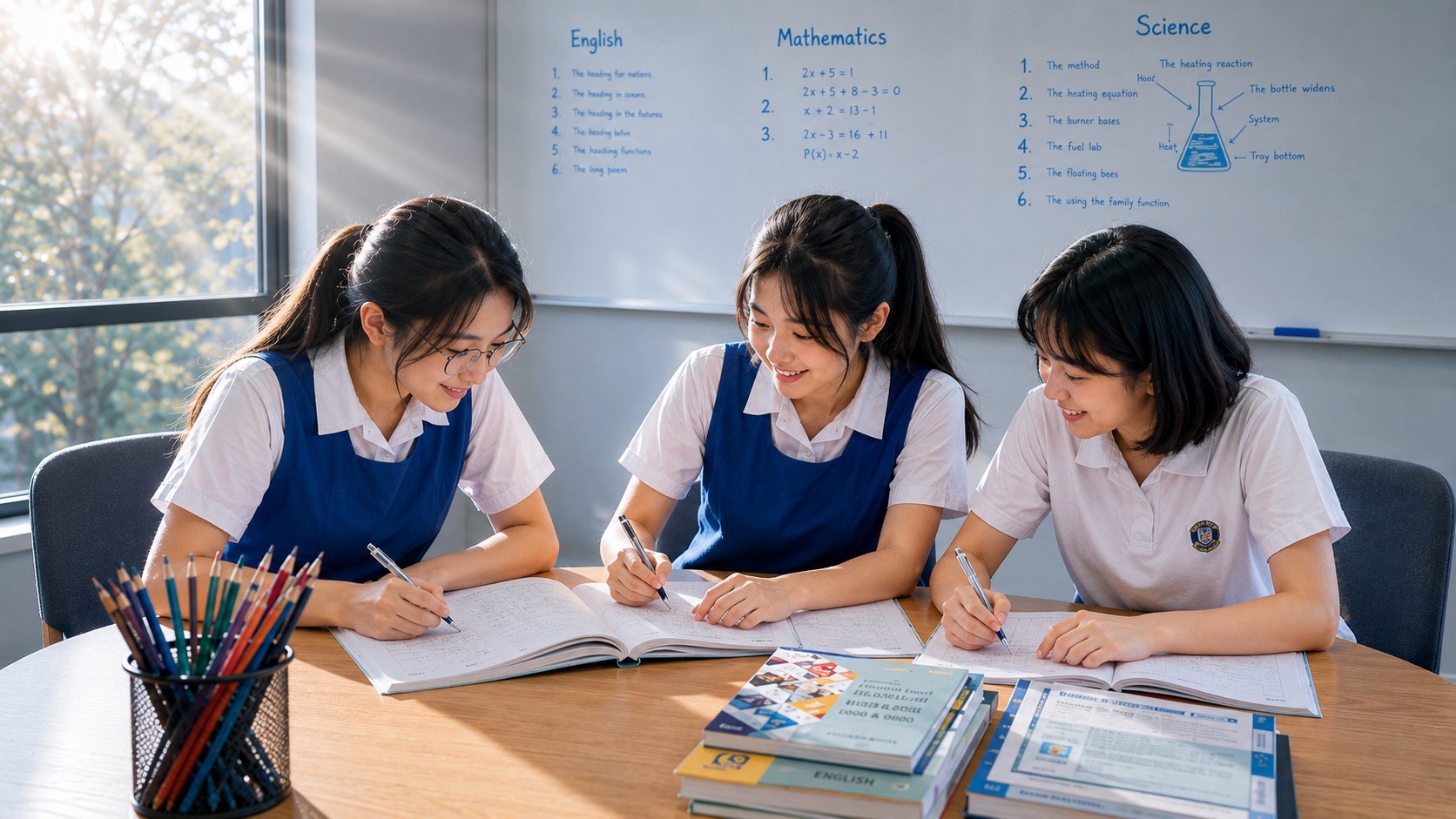
Students can learn together with AI when the group has a shared purpose, each learner contributes thinking and the team checks the evidence behind its decisions. AI can suggest questions, offer alternatives and help organise a record. The children still need to listen, negotiate, explain and decide what their joint work will say. For parents, a successful project should leave both a useful shared result and individual learners who can explain something they understand better.
A small project can make these responsibilities visible. This guide follows a fictional team of three learners designing a tabletop paper bridge and explaining their choice to an audience. Every team event, test result and time in the example is invented for teaching; no experiment was conducted to produce the data. The activities are optional suggestions, not an MOE assignment or an official assessment rubric. Families and teachers can adapt the scale, materials and support to the learners while keeping the purpose of working together clear.
- Agree on one shared goal: explain what the group will create and what each person should learn.
- Make the criteria visible: distinguish essential requirements from preferences before choosing an option.
- Give thinking space to everyone: invite individual ideas before combining them or asking AI.
- Share and rotate responsibilities: let roles organise participation without fixing children’s identities.
- Keep evidence traceable: distinguish observations, calculations, suggestions and invented examples.
- Handle disagreement through reasons: listen to concerns and return to the agreed question.
- Review the common result and individual understanding: both matter when deciding the next step.
eduKateSingapore · AI and Education
Choose a useful reading route
Start with the question closest to your family, or read the guide in order.
Full chapter index · Read from chapter 1 · Sources and further reading
Contents
Chapters 1–3: Build a shared purpose
Chapters 4–6: Share work and evidence
Chapters 7–9: Decide and explain together
Chapters 10–12: Review the learning
CHAPTER 1 OF 12 · Build a shared purpose
1. Give the group a purpose everyone can explain
A shared file does not automatically create shared learning. Before choosing a tool, ask the learners what they are trying to achieve together. They should be able to describe the task in language that all members understand, including someone who has not yet formed a preferred solution.
In the fictional bridge project, the group will produce a small paper model and a short explanation for another group of learners. The audience should understand what the team tried, why it selected one design and what the evidence does and does not establish.
There are two connected goals. The product goal concerns the model and explanation. The learning goal concerns what each child should understand: how to compare options fairly, contribute a reason and explain a decision using the group’s record. Keep both visible so that one polished object does not conceal who understood the work.
Ask each learner to restate the purpose. One might think the task is to build the strongest possible bridge, while another thinks it is to make the easiest bridge to demonstrate. Discovering that difference early gives the team something concrete to clarify.
MOE’s 21st Century Competencies framework includes communication, collaboration and information skills. The broad emphasis supports attention to how students work with people and information. It does not prescribe the particular family project or routines proposed here.
Give AI a specific supporting job only after the children understand the purpose. For example: “Suggest three questions our audience might ask about how we chose a paper-bridge design.” The group can consider the questions and decide which belong in its explanation.
Keep the audience real enough to guide choices but manageable enough to serve the learning. A parent or another small group can listen. There is no need to publish the work online or create a large event. The children need an understandable reason to communicate what they found.
End the opening discussion with a short shared statement: “We will choose a design that meets our requirements, explain the evidence and make sure everyone can describe one important decision.” The wording can change as the project becomes clearer, with the whole group involved.
CHAPTER 2 OF 12 · Build a shared purpose
2. Agree on requirements before judging ideas
Criteria make a comparison easier to discuss. In this fictional project, the team agrees that its paper bridge should span a 15-centimetre gap between stable supports, use one sheet of the same supplied paper and hold six identical small counters for ten seconds. Each of the two timed builds from the same design must be completed within five minutes.
These numbers are invented task conditions chosen to illustrate a decision. They are not a recommended test for every age, a statement about paper strength or a prediction of what a particular group can build. An adult adapting the activity should choose suitable materials and a manageable tabletop arrangement.
Ask why each condition belongs. A fixed gap makes designs comparable. A common paper allowance keeps the material constraint clear. The rebuilding requirement serves the planned demonstration. A condition should have a purpose that the learners can explain.
Distinguish essential requirements from preferences. The group might prefer an attractive shape or an easy label, but those preferences do not compensate for a model that misses an essential condition. Conversely, a model that meets the requirements does not need to win every possible comparison.
Make the testing language precise. What counts as holding a load? Where will the counters be placed? What happens if the support moves? When does timing begin? A shared rule prevents each person from interpreting the result in the way that favours their first idea.
AI can inspect the wording for ambiguity: “Read these project requirements and ask about any condition that two people might interpret differently. Do not decide the requirements for us.” The team should discuss the questions and retain responsibility for the answers.
Leave room for revision when a genuine problem appears. A criterion may prove impractical or unrelated to the audience. If the group changes it, record the reason and reconsider every option under the revised condition. Changing the rules quietly to rescue a favourite design would make the comparison difficult to defend.
A parent can ask each learner to point to one requirement and explain its purpose. This checks shared understanding without taking over the design. Once the group knows what it is comparing, its members have a common basis for offering and questioning ideas.
CHAPTER 3 OF 12 · Build a shared purpose
3. Let individual thinking enter the conversation
Before the group sees a long list of generated ideas, give each learner a short opportunity to think. They can sketch a possibility, describe it aloud, build a simple paper shape or ask a question about the task. Choose a form that allows them to participate with their normal supports.
The purpose is to make starting ideas visible. One learner may notice the gap, another the building time and another the need to explain the design. The group can compare these contributions without assuming that the first confident suggestion should organise everything that follows.
Invite each person to describe the reason behind an idea. “I would fold the edges because I want to change the shape of the paper” gives the team something to investigate. “This is best” leaves the basis of the judgement hidden.
The Exploratorium’s paper-bridge activity provides an established example of exploring structures with paper. Its explanation discusses how folding or rolling changes the structural arrangement. Our task conditions, team story and data are original illustrations, and a proposed shape still needs evaluation under the chosen conditions.
AI can now add alternatives or questions. Ask for a small number that fit the agreed material constraint. The learners should identify which suggestions are new, which resemble their own ideas and which require information or skills the group does not yet have.
Keep authorship of a suggestion separate from its value. A generated option does not deserve priority because it sounds technical. A child’s rough sketch does not deserve rejection because it looks unfinished. Compare the reasoning and the fit with the task.
If someone prefers an AI suggestion, ask them to explain it in their own words before the group adopts it. If no member can describe how it relates to the criteria, simplify it or seek appropriate teaching support. An unexplained design is a weak basis for a shared presentation.
Finish by selecting a small set of options worth investigating. The group does not have to test every idea. It should be able to say why the selected options offer a useful comparison and what question each is intended to answer.
CHAPTER 4 OF 12 · Share work and evidence
4. Use roles to share responsibility and learning
Roles can make a task manageable when they identify responsibilities rather than rank children. For a three-learner team, one person might coordinate the current discussion, one manage the model and one maintain the evidence record. Everyone still has a right to ask questions and contribute to the decision.
Describe each role in observable terms. A discussion coordinator checks that everyone understands the next step. A model coordinator follows the agreed construction and test plan. An evidence recorder captures what happened and reads the entry back for checking. None of these roles gives its holder authority to silence the others.
| Responsibility | Useful action | Shared check |
|---|---|---|
| Coordinate the discussion | State the question and invite each contribution. | Can everyone explain the next decision? |
| Coordinate the model | Follow the agreed setup and identify any change. | Does the construction match the recorded plan? |
| Maintain the evidence | Record results and separate observations from suggestions. | Do the other members agree that the record is accurate? |
Rotate responsibilities at a sensible transition, such as moving to a new design or preparing the explanation. The purpose is to give learners opportunities to practise different contributions. Constantly switching during a delicate step can interrupt the work, so decide the handover point together.
A child’s current confidence can guide support without becoming a permanent label. Someone who enjoys presenting should still have a chance to interpret evidence. Someone who prefers drawing should still be invited to explain a decision in an appropriate form.
Use partnerships when a responsibility is unfamiliar. A learner can make the first record while another checks the units. A child can direct the construction while someone else handles a physical step that is difficult for them. Participation does not require every person to perform every movement in the same way.
Include the AI interaction in the shared responsibilities. Whoever enters a request should state the agreed purpose and let others inspect the response. Typing ability does not make that person the owner of the group’s thinking.
At each handover, ask what the next person needs to know. A clear explanation of the unfinished question, current record and proposed next step turns a role change into an opportunity to communicate, rather than a simple exchange of equipment.
CHAPTER 5 OF 12 · Share work and evidence
5. Make the evidence plan understandable to everyone
Before testing, ask the group how it will know whether a design meets the requirements. A shared method should identify the materials, support arrangement, loading position, timing and stopping point. Everyone should understand the method well enough to notice an important departure from it.
In our fictional example, the team compares three plans: a flat sheet, a channel-shaped fold and a more elaborate folded design. Each test uses a fresh model made from one sheet of the same paper. The supports remain 15 centimetres apart, and the counters are the same type throughout.
The team agrees to add counters in the same central arrangement, checking whether the model holds each load for ten seconds. Testing stops when the next load fails the agreed condition or when ten counters have been held. The ten-counter ceiling limits the exercise; it does not identify the maximum possible load of every design.
Record changes that could affect the comparison. If a support moves, a different paper is used or someone presses the bridge while loading it, the team should note what happened. It can repeat an unsuitable trial when feasible instead of quietly treating unlike procedures as equivalent.
An adult adapting this low-stakes activity should use stable, low supports on a table and lightweight materials appropriate to the children. It is a model investigation, never a structure for standing, climbing or supporting a person. The discussion can also use the invented results without constructing anything.
Ask AI to review the written method as a reader: “Which instructions are unclear, and which differences could make the comparison hard to interpret?” Inspect the suggestions together. A complicated addition is useful only if it resolves a relevant uncertainty.
Decide how to record a trial before seeing the result. Include the design label, the count held, any stopping limit and a short note about the setup. Record construction time separately. A result should remain connected to the method that produced it.
This is also a participation check. Invite each member to explain one part of the plan and why it matters. If one person alone understands the procedure, pause for clarification before producing a table that the others cannot confidently interpret.
CHAPTER 6 OF 12 · Share work and evidence
6. Interpret the shared record without overstating it
The following results are wholly invented for teaching. Each trial represents a fresh model made to the same design. The construction-time column gives the longer of the two fictional build times for that design. No real children or experiments produced these numbers.
In the table, “counters held” means the highest tested load held for ten seconds under the agreed stopping rule.
| Design | Trial 1: counters held | Trial 2: counters held | Longer build time |
|---|---|---|---|
| A: flat sheet | 2 | 3 | 1 minute |
| B: channel fold | 8 | 7 | 3 minutes |
| C: elaborate fold | 10; test stopped | 10; test stopped | 6 minutes |
Read one row together before choosing a winner. Design B held eight counters in one fictional trial and seven in the other. Both counts exceed the six-counter requirement. Its longer recorded build time is three minutes, which is within the five-minute condition.
Design A was quick to build but did not meet the specified load requirement in either trial. Design C held the full ten-counter test load, but at least one build took six minutes. It therefore missed the rebuilding-time condition in the recorded comparison.
The team may still learn from C’s test even though it missed a requirement. Continuing to examine an option is different from claiming that it qualified. Mark the missed condition clearly so that the explanation remains faithful to the record.
Do not call ten counters C’s maximum capacity. The test stopped at ten, so the record establishes that it held that tested load. It says nothing about what would happen with eleven. The group should preserve this distinction in its presentation.
Two trials also provide limited evidence. The table does not guarantee how every future model, builder or paper type would perform. A defensible conclusion is that B met the stated load and time conditions in these fictional trials, making it a suitable choice for this particular example.
AI can help compare results with criteria, but each learner should check the comparison. Ask it to show which table entry supports each statement and to identify any conclusion the data cannot establish. The children decide whether the reasoning holds.
Invite a member who did not create the table to explain it. If the column labels or stopping rule confuse them, improve the record. Shared evidence becomes useful when its meaning can travel beyond the person who first wrote it down.
CHAPTER 7 OF 12 · Decide and explain together
7. Work through disagreement using reasons
Disagreement can reveal that members are answering different questions. In the fictional team, one learner prefers C because it held the greatest tested load. Another prefers B because it met the rebuilding condition as well. Both have noticed something real in the supplied table, but they are prioritising different features.
Begin by asking each person to state the other’s reason accurately. “You prefer C because it held ten counters” is different from “You only like complicated things.” The first statement makes the issue discussable. The second attaches a motive the other person may not recognise.
Return to the shared goal and criteria. Is the group choosing the largest tested load regardless of time, or a model it can rebuild for the audience within the agreed limit? The answer should come from the task the team adopted, rather than from who speaks most forcefully.
Separate factual disagreement from a difference in priorities. Whether six minutes exceeds five is settled by the stated numbers. Whether the time limit still serves the demonstration is a question the group can discuss. Mixing the two makes it harder to see what needs evidence and what needs a decision.
AI can help formulate a neutral summary of the competing reasons. Give it the arguments without personal labels and ask whether it has represented both fairly. Members should correct the summary before using it; a generated description is not an independent judge of their motives.
If a testable uncertainty matters, propose a small next check. Perhaps C can be simplified, but that remains a possibility until a revised model is examined. The group should not replace the recorded six-minute build with a hoped-for faster time.
Voting can resolve a preference when the group has heard the reasons and understands the consequences. It cannot turn a false calculation into a true one or remove a task requirement silently. Agree on which matters need consensus, which allow a vote and which follow directly from the evidence.
Keep an unresolved concern in the record if it affects the conclusion. A team can choose B while acknowledging that C is worth investigating under different time conditions. Reaching a decision does not require pretending that every member’s original preference disappeared.
CHAPTER 8 OF 12 · Decide and explain together
8. Make participation fair without making it identical
Fair participation concerns opportunities to think, contribute and learn. It does not require every child to speak for precisely the same number of seconds or complete identical physical actions. A group can share responsibility while recognising different ways of communicating and different support needs.
Watch for decisions being made before everyone can respond. A quick speaker may move from proposing an idea to treating it as settled. The coordinator can pause and invite a written note, a drawing or a short explanation from the other members before confirming the next step.
Offer thinking time without interpreting silence as a lack of interest. Ask a specific, manageable question: “Which requirement does this design meet?” or “Is there anything in the table we have missed?” A learner may find that easier to answer than an open demand to say something impressive.
If one person repeatedly handles the tool, the model and the explanation, redistribute a meaningful part of the work. Another learner could check the method, choose a comparison or explain a limitation. Assigning only decorative tasks would leave the central reasoning concentrated in one person’s hands.
Keep expectations clear. A child who agrees to maintain a record should know what a usable entry contains and when the group needs it. If the responsibility is not completed, ask what prevented it and agree on a repair. Avoid turning one difficult episode into a permanent description of the learner.
Help should return responsibility. A confident peer can model the first table entry, then invite the other learner to make the next one and explain it. An adult can clarify a confusing instruction without choosing the design on the group’s behalf.
Preserve normal accessibility arrangements, communication aids and appropriate adult support. A child can direct a construction step that someone else performs, use speech-to-text for a note or present through a suitable alternative format. The contribution should remain intellectually meaningful and visible.
Check fairness with the learners themselves. Ask whether they understand the current decision, have had a chance to raise a concern and know what they are responsible for next. Their answers provide a more useful basis for adjustment than assuming that a busy-looking table means everyone is learning.
CHAPTER 9 OF 12 · Decide and explain together
9. Build one explanation from the team's contributions
A joint product should read as a connected account. Three separate sections pasted together may repeat ideas, contradict the method or use the same word differently. Before polishing, ask the group to agree on the central message it wants the audience to understand.
For the fictional bridge project, the message could be: “We chose B because it met our load and rebuilding requirements in the recorded trials. C held a larger tested load, but its build time missed our condition.” This statement connects the decision to evidence and preserves a relevant alternative.
Plan a simple explanation around the question, criteria, method, results and decision. Add one limitation and one possible next investigation. The group can use a labelled model, a drawing or a short demonstration to support the account. Every element should help the audience understand a relationship.
Let members contribute different pieces, then review the complete explanation together. Someone who worked on the method should read the results statement. Someone who prepared the drawing should check whether the conclusion matches it. These cross-checks make the product a shared responsibility.
AI can identify a missing connection or suggest a plainer sentence. Ask it to preserve the actual results and the stopping rule. If it changes “held ten counters before testing stopped” into “could hold only ten counters”, the team should restore the accurate meaning.
Keep technical words within the group’s understanding. A term that nobody can explain does little for the audience. Use a checked explanation from the teacher or an appropriate source when the group wants to discuss how the paper’s shape affects its behaviour.
Rehearse with a listener who can ask ordinary questions. “Why didn’t you choose the design that held ten?” is a useful test of the team’s reasoning. Invite more than one member to respond so the group can see whether the explanation belongs to everyone.
The final object need not look professionally manufactured. A clear record, an honest conclusion and a model the learners can discuss fulfil the educational purpose more directly than decoration that hides uncertain reasoning. Choose finishing work that supports communication and fits the time available.
CHAPTER 10 OF 12 · Review the learning
10. Keep AI's contribution visible and bounded
Agree on what the group wants from AI before each use. The purpose might be to suggest questions, compare two draft explanations or organise approved notes. A small request makes it easier for the learners to decide whether the response helped.
Make the input visible to the group where practical. The person entering the request should check that it represents the shared question and includes the relevant conditions. Otherwise, the resulting answer may solve a different problem while appearing to support the team’s decision.
A simple decision record can contain the question, the options, the evidence considered, the choice and the reason. AI may help organise those headings, but the group should approve the substance. Do not let a generated summary convert a tentative suggestion into a decision that nobody made.
For example, a learner might say, “We could try making C faster next time.” The record should preserve it as a possible next investigation. Writing “The team improved C to meet the time limit” would invent completed work and misrepresent the evidence.
Keep the record about the task. There is no need to upload private disagreements, personal histories or labels about who is the strongest or weakest member. Describe the idea that needs clarification and the evidence relevant to it.
Follow the school’s instructions and the service’s access conditions. A teacher or parent may prepare a checked response for discussion when direct child use is unsuitable. A paper worksheet and conversation can support the same collaboration goals without requiring every learner to operate an account.
Give the group a way to decline a suggestion. Ask, “Does this fit our question? Can we explain it? What would we need to verify?” The answer may be to use part of the response, revise it, seek a source or set it aside.
End the interaction when the useful contribution has been made. Return to the people, model and evidence. The project needs time for learners to hear one another and make choices together; a long sequence of prompts should not absorb every opportunity for that conversation.
CHAPTER 11 OF 12 · Review the learning
11. Check individual learning and choose the next inquiry
After completing the shared explanation, give each learner a chance to describe what they understand. Ask about a decision rather than requesting a recitation of the finished script. They might explain why the gap stayed constant, why ten was a test limit or why the team chose B.
Use a format that lets the child communicate meaningfully. They can speak, annotate a drawing, arrange labelled cards or use their usual communication support. The question is whether they understand the relationship, not whether everyone produces the same style of answer.
Ask each learner to identify a contribution from another member that changed or clarified their thinking. A specific account is useful: “I wanted C, but the time comparison showed why it did not meet our demonstration requirement.” General praise does not reveal the same connection.
Invite an unfinished question as well. One child may still be unsure why a folded shape behaved differently. Another may wonder whether the result would change with a wider gap. These questions help the adult decide what teaching or investigation should come next.
The centre of learning includes dependable foundations: reading a table, following a comparison method and explaining a reason. The edge is a question the learners have not yet resolved. Exploring a wider gap can be new inquiry for the group even though the general topic is well established.
Choose one extension and state the changed condition. If the gap becomes wider, the earlier data no longer directly answer the new question. The team can make predictions, explain them and plan an appropriate comparison. AI may suggest possibilities, but a predicted result remains a prediction.
Keep individual reflection brief enough to be useful. Ask what the learner can now explain, what support helped and what they would do differently in the next group discussion. Use the answer to offer another opportunity, rather than assigning a fixed identity such as leader, quiet child or technical person.
A successful group result and uneven individual understanding can coexist. If that happens, return to the specific gap. One learner may need to revisit the criteria while another is ready to investigate a new condition. The next activity can preserve the shared purpose while giving each person a meaningful learning step.
CHAPTER 12 OF 12 · Review the learning
12. Give parents a manageable supporting role
Parents can help by making the purpose clear, providing a suitable setting and noticing when the group needs a smaller next step. They do not need to direct every exchange or turn the activity into a test of personality. Observe the work closely enough to identify the actual difficulty.
If learners are stuck, ask whether the obstacle concerns the concept, the method, the decision or the working relationship. A group that cannot interpret the table needs a different intervention from a group that understands the evidence but has not agreed which criterion matters.
MOE’s 2024 pre-university Project Work syllabus describes collaborative learning through shared goals, dialogue, multiple perspectives and agreed working norms. That is a specific curriculum context. The tabletop activity here adapts a broad educational idea for families; it is not an equivalent assessment or a requirement for younger children.
For an actual school project, follow the teacher’s task, permitted assistance and submission conditions. Ask a precise question when the boundaries are unclear. A family-created rubric or AI-generated score should not be presented as the school’s assessment standard.
Use an optional review with three questions: Can everyone explain the shared decision? Does the evidence support the product’s claims? Did each learner have a meaningful opportunity to contribute and learn? The answers can guide a short adjustment without requiring a detailed monitoring system.
When a disagreement becomes personal, pause the decision and help the learners return to specific words, actions and needs. They can clarify what happened, hear each account and agree on the next workable step. Seek the relevant teacher’s help when the issue belongs to a school group or continues beyond what a parent can appropriately resolve.
Keep the project proportionate. A small model and a clear conversation may be enough. If the task becomes dominated by adult correction or endless polishing, reduce its scope while retaining the shared question and individual thinking.
Continue with what the evidence shows is useful. The group may need another attempt at listening, a clearer way to record results or a fresh question that draws on its new understanding. AI has a constructive place when it helps people see options and reasoning more clearly, while the learners remain responsible for working with one another and deciding what their shared work means.
Contents · Previous chapter · Next: sources and further reading
Sources and further reading
- MOE: 21st Century Competencies — broad framework context.
- MOE: Project Work Syllabus 2024, Pre-University — a specific curriculum context for collaborative learning.
- Exploratorium: Paper Bridges — related structures activity.
- Exploratorium: Paper Bridges, What’s Going On — background on structural arrangements of paper.
More guides for parents
Follow another subject or return to a question about your child’s learning.