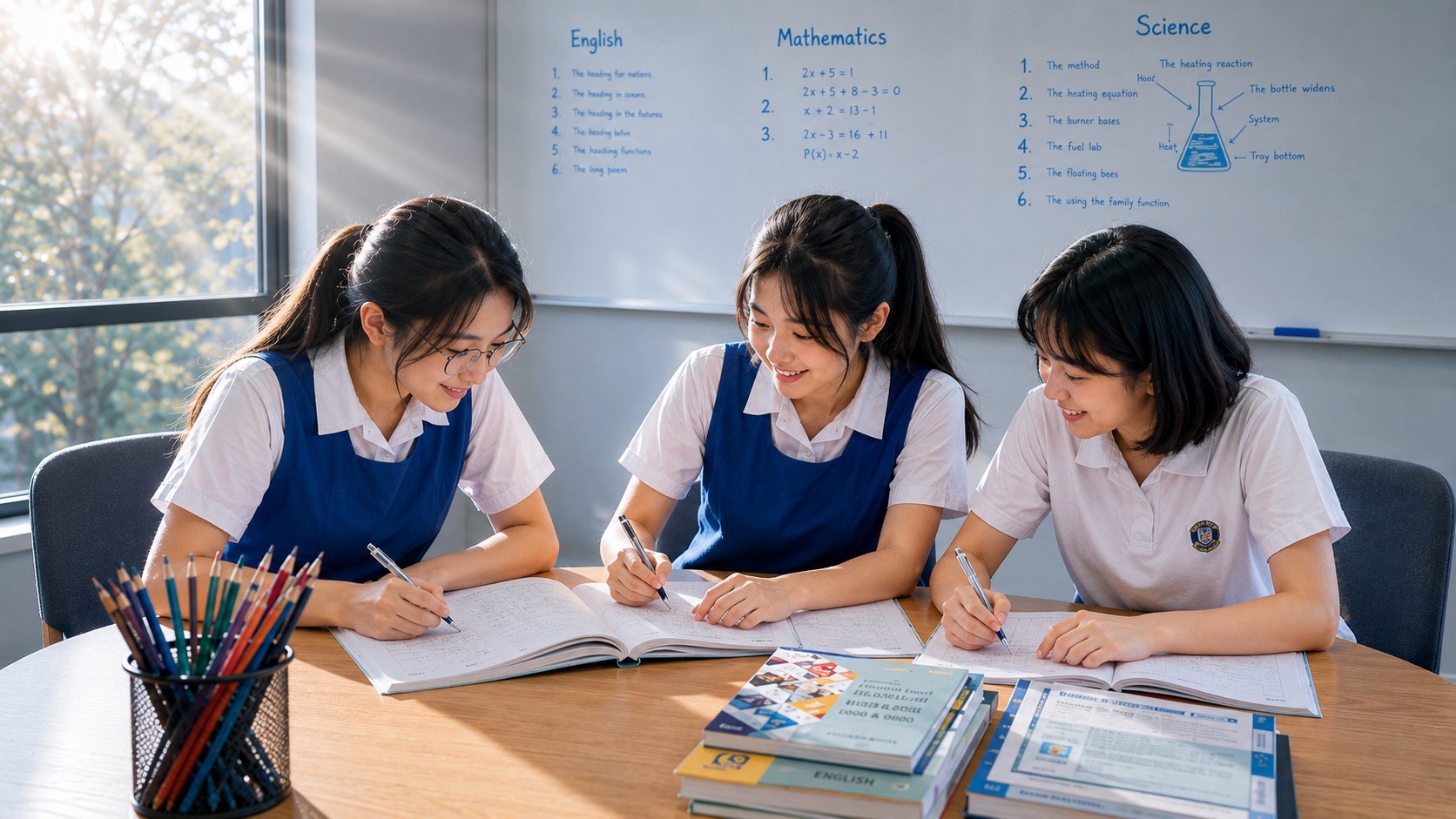
AI literacy means being able to use an AI system for a clear purpose, understand enough about its operation to ask sensible questions, and judge what to do with its output. For children, that includes recognising the difference between a suggestion and evidence, checking an important claim, protecting personal information and explaining their own decisions. Parents can begin with a short passage or a familiar task. The useful question is whether the child can say what the tool contributed, what they checked and what they now understand.
A chatbot can become a productive partner in this process. It can offer another explanation, propose alternatives, organise a comparison or challenge a first idea. The learner supplies the purpose, examines the result and decides the next step. This guide explains the basic mechanism in everyday language, then works through original examples that families can discuss together. The activities are suggested teaching approaches, not an official MOE programme or a validated assessment. Use tools permitted for the child and the task, with suitable adult guidance; the same thinking can also be practised on paper.
- Identify the job: explaining, generating, finding, calculating or checking.
- Learn a small amount about how language models produce responses.
- Separate information supplied to the tool from information independently verified.
- Ask for a useful next question, a comparison or evidence tied to the task.
- Check important claims against the original source and relevant conditions.
- Keep people’s information, choices and dignity in view.
- Judge progress by the child’s explanations and decisions, then extend into a new question.
eduKateSingapore · AI and Education
Choose a useful reading route
Start with the question closest to your family, or read the guide in order.
Full chapter index · Read from chapter 1 · Sources and further reading
Contents
Chapters 1–3: Understand the tool
Chapters 4–6: Ask and verify
Chapters 7–9: Keep judgement visible
Chapters 10–12: Extend and review
A child does not need to master computer science before beginning AI literacy. Start with a task they already understand. They might want to clarify a word, compare two designs, understand an instruction or prepare questions for a class discussion. Ask them to finish this sentence: “I want help with this part because…” Their answer gives the interaction a purpose that you can both inspect.
Different purposes call for different checks. A suggested title for an invented story can be judged for interest and fit. A claim about the date of an examination needs the relevant official document. A calculation needs a mathematical check. A summary needs comparison with the original material. Put the checking method beside the task before deciding whether a particular AI tool is useful.
Make the job small enough for the child to retain control. “Teach me everything about Singapore” leaves the learner with little basis for selecting or evaluating the response. “Help me compare what these two short accounts say about the same event” creates a manageable reading task. The learner can point to the accounts, identify an agreement and ask about a difference.
Singapore’s Ministry of Education announced in March 2026 that AI literacy is being integrated across the curriculum, co-curriculum and self-directed learning, with developmental milestones. Its announcement also describes updated Cyber Wellness content on validating generative-AI information and identifying deepfakes. This provides a relevant national context for practising judgement, rather than treating access to a chatbot as the whole of AI literacy. See MOE’s 2026 announcements.
That national direction does not settle the rules for an individual assignment or authorise every service for every child. Check the school’s instructions and the service’s access conditions. A parent can demonstrate a task, read a sample response aloud or prepare a paper comparison where direct child use is unsuitable.
A useful first outcome is modest: the child can name the task, choose the kind of help and identify something that needs checking. Those three decisions give the family a starting point for more demanding work.
CHAPTER 2 OF 12 · Understand the tool
2. Explain language generation without making it mysterious
Many conversational AI tools use a large language model. At a basic level, a language model uses patterns learned during training and the available context to estimate likely sequences of tokens. Tokens are pieces of text and need not correspond to whole words. Generating a fluent response and verifying that its claims are true are different jobs. Google’s introduction to language models explains the underlying vocabulary and prediction process.
For a child, try this original paper activity. Write, “The box was too heavy, so…” and invite several sensible continuations. Perhaps someone asked for help, removed some books or used a trolley. Each continuation could fit the sentence. None establishes what actually happened to a particular box in the world.
Now provide another sentence: “The box contained a fragile glass model, and there was no trolley.” Ask which suggestions need changing. The extra information affects what fits. Then ask what you would need to know before choosing an action: the box’s size, who is present, where it needs to go and whether moving it is necessary.
This activity illustrates the distinction between producing a plausible continuation and establishing a fact. It is not a working model of an AI system, and it does not explain every capability of a modern assistant. Its educational purpose is narrower: children can experience how an answer depends on the information and constraints available.
Invite the learner to give an example of a well-written sentence that could still be wrong. “The workshop begins at nine” is clear English; its truth depends on the workshop notice. Ask for an example of a useful suggestion that does not need to be a factual report. “We could make the instructions shorter” is a proposal to consider.
Avoid turning the discussion into a vocabulary test. A child who can distinguish an invented story ending, a tentative explanation and a checked fact has made a useful start even if they do not remember the word “token”. An interested older student can explore the technical account later. Understanding the distinction should support a better decision in an actual task.
When a chatbot answers, a parent can ask, “What material was available for this response?” Perhaps the child supplied a passage. Perhaps the application retrieved documents. Perhaps no current source was opened. These are different situations, even when the resulting paragraphs look equally polished.
Some systems combine generation with retrieval of external passages. The research approach known as retrieval-augmented generation connects a language model with retrieved information, as described by Lewis and colleagues. An application may also provide other tools. Available capabilities vary; an answer alone does not demonstrate that a particular source was retrieved or a calculation was run.
For a family exercise, keep three headings on paper: supplied, found and unresolved. Under supplied, write the information in the material you gave the tool. Under found, record an external source you actually opened and checked. Under unresolved, put details that remain unsupported. This is a suggested recording method, not a technical description of the application’s internal operation.
Suppose the child asks about a school event using a notice supplied by a teacher. The notice states the date and meeting place but says nothing about whether siblings may attend. The date belongs under supplied. A new official message allowing siblings could go under found after the family verifies it. Until then, the sibling question remains unresolved.
Keep sources attached to claims. A website about the school’s general opening hours does not necessarily settle access arrangements for a special evening event. A document for an earlier year may be useful background but may not govern this year’s arrangements. The child should explain why the chosen source answers the particular question.
This can also improve the prompt. Instead of asking the tool to fill every gap, the student can request: “Use the notice to answer what it supports. List the questions that still require the organiser’s reply.” The useful result is a clear boundary around knowledge and a practical next action.
Give credit for identifying an unanswered question. In ordinary learning, recognising exactly what is missing can be more productive than accepting a complete-looking response whose extra details have no established basis.
CHAPTER 4 OF 12 · Ask and verify
4. Write questions that give the learner something to do
A good learning prompt begins with a purpose and ends with work for the learner. It can ask for a hint, a contrast, a question or a limited explanation. The aim is to create a useful thinking step. A long prompt full of technical language is unnecessary if a short request makes the task clear.
Consider an original practice request: “I am comparing two notices. Ask me one question about a difference that matters to someone attending. Wait for my answer before giving feedback.” This gives the child a job: identify a meaningful difference and explain its consequence. The response can then be checked against both notices.
Use another request when the child is stuck: “I have identified the starting time but cannot work out when to arrive. Point me to the relevant sentence without telling me the answer.” The quality of the interaction depends on the passage and the hint, so an adult should inspect both. The wording is a teaching suggestion, not a guarantee of reliable behaviour.
| Purpose | Useful request | Learner’s next action |
|---|---|---|
| Understand a distinction | Give two short examples and explain one important difference. | Make a third example and justify where it belongs. |
| Inspect an answer | Identify a claim that needs evidence from the supplied text. | Locate the supporting sentence or state that it is absent. |
| Improve a draft | Ask which audience I am writing for before suggesting changes. | Choose a revision and explain how it helps that audience. |
| Extend an idea | Suggest one alternative explanation and a way to distinguish it. | Decide whether the proposed check is feasible and relevant. |
Notice that each request leaves an intellectual responsibility with the child. They supply an example, inspect evidence, choose a revision or evaluate a test. If the interaction produces only more text to read, ask whether the prompt should be made smaller.
A parent can model revision too. Say, “My first question was too broad. I will name the information we have and the decision we need.” This shows that asking well is an ordinary skill that develops through adjustment. It need not become a competition to discover a perfect formula.
Finish the exchange by asking the learner to explain the result in their own words, with their usual communication supports. The explanation need not be elegant. It should reveal the relationship they have understood and the uncertainty that remains.
CHAPTER 5 OF 12 · Ask and verify
5. Practise checking with a fictional workshop notice
The following notice, participants and sample answer are invented for teaching. They are not a real event or a record of an actual chatbot response. Read this short notice together: “The model-building workshop runs from 10.00 a.m. to 11.30 a.m. in Room B. Participants should arrive fifteen minutes before the start. Registration is required. Bring a pencil. Materials are provided. The notice does not give a fee or an age range.”
Now inspect this deliberately flawed answer: “The free workshop starts at 9.45 a.m. and lasts two hours. Children of all ages can walk in, and nobody needs to bring anything.” Ask the child to consider one claim at a time. Some claims contradict the notice. Others fill gaps with information the notice does not provide.
The workshop starts at 10.00 a.m.; 9.45 a.m. is the requested arrival time. Its duration is ninety minutes. Registration is required, so a claim that people can simply walk in is unsupported by the instructions. Participants must bring a pencil. The notice does not establish that the workshop is free or open to all ages.
Help the child distinguish “false according to this notice” from “not established by this notice”. If a fee is absent, the careful conclusion is that the fee is unknown from this source. It would be equally unjustified to insist that the event must charge a fee. Checking includes resisting an opposite guess.
NIST’s Generative Artificial Intelligence Profile describes confabulation: generated content can be confidently presented yet erroneous, inconsistent or unsupported. It also identifies misleading generated reasoning and citations as concerns. The invented exercise above makes the practical checking problem visible without assuming that every response will fail.
Ask the learner to produce a corrected message for someone attending. A sound version might explain the arrival and starting times, required registration and pencil, then identify the unresolved fee and age questions. The child should be able to point to the source for each definite statement.
Next, change one condition. Suppose an authentic revised notice changes the room but leaves the time unchanged. What needs updating? Which earlier statements remain supported? This turns checking into a revision task rather than a hunt for mistakes. A capable reader can preserve what is still sound while correcting the relevant detail.
For a younger child, use two claims instead of six and read the notice aloud. For an older learner, ask them to label claims as supported, contradicted or unresolved and justify each label. Keep the activity calm. The goal is to develop judgement, not to catch the child out.
Once a child can check a short supplied notice, move to a real source that matters to their learning. Use a school instruction, an official syllabus page, a museum’s description of an exhibit or a reference book available to the family. Choose one claim whose answer is manageable. There is no need to begin with a controversial subject.
Ask who is responsible for the information and why that source is relevant. The organiser can state the arrangements for its own workshop. An examination board publishes its examination requirements. A museum can document the labels and collection information it provides. These examples teach authority in relation to a question, rather than treating any impressive-looking page as sufficient.
Then inspect the passage that supports the claim. A link to a document is only a starting point. Does the document contain the claimed rule? Does it apply to the correct year, programme or group? Is the statement a requirement, a recommendation, an example or a plan for the future? Encourage the learner to preserve that distinction when paraphrasing.
Use an original comparison exercise. One fictional notice says a new activity “will be available next year”; another says registration “opens on Monday”. Ask which statement establishes that a family can register today. Neither does without further timing information. The words describe different stages of an arrangement.
A short source note can contain the claim, document title, relevant date and location of the supporting passage. Let the child choose a manageable format: a few lines on paper, an annotated printout or a small table. Recording the reasoning matters more than making the note look professional.
If a citation cannot be located, leave the claim unresolved. Ask for help finding a real source or change the response so that it accurately states the uncertainty. Repeatedly requesting a more confident answer does not supply the missing evidence. A useful assistant can help formulate the question to investigate next, while the learner remains responsible for deciding what is established.
Finish with a transfer question: “If the source changes tomorrow, which part of our answer would we review?” This connects information literacy with the ordinary need to revise decisions as reliable information changes.
CHAPTER 7 OF 12 · Keep judgement visible
7. Check numbers, labels and the size of the conclusion
Numerical answers invite two separate questions: is the calculation correct, and does the conclusion follow? A child can practise this distinction with a small invented dataset. Suppose twenty-four people attend a fictional activity day. Twelve return an optional feedback form. Nine of those twelve choose model-building as their preferred activity; three choose storytelling.
Nine out of twelve respondents is three quarters, or 75%. That calculation describes the respondents. It does not show that 75% of all twenty-four attendees prefer model-building, because the preferences of the other twelve were not collected. Nine out of twenty-four attendees, or 37.5%, explicitly recorded that preference. The wider group’s overall preference remains uncertain.
Give the child a proposed summary: “Three quarters of everyone who attended preferred model-building.” Ask them to identify the smallest change needed. Replacing “everyone who attended” with “the people who returned the form” makes the population in the sentence match the calculation. The repair is about meaning as well as arithmetic.
Next, ask whether the result tells the organiser what to offer next month. It provides some relevant information, but the organiser may need to consider the missing responses, available space, children’s interests and the purpose of the next event. A correct percentage does not decide every practical question.
If the tool produces a chart, inspect the labels and values against the small table or list you started with. Are there twelve responses or twenty-four? Are the bars showing counts or percentages? Does the title describe the actual group? The child can draw a simple version on paper and explain what each mark represents.
For calculations, use a method the learner understands and a calculator when appropriate to the task. Ask them to estimate or simplify before accepting an output. Three quarters should be more than one half; nine cannot be three quarters of twenty-four. These comparisons provide accessible checks without requiring a parent to recreate a lengthy solution.
Keep the dataset explicitly labelled as invented. Its purpose is to practise interpreting an answer, not to report what children generally prefer. The same habit of matching numbers to their conditions will be useful when the learner later encounters real survey results or examination information.
CHAPTER 8 OF 12 · Keep judgement visible
8. Keep people's information and choices in view
Before entering material into a tool, ask what the task actually requires. To practise improving a message, the child can use an invented name and an ordinary fictional situation. To explore fractions, they do not need to include classmates’ marks. To compare two passages, they can use material the family has permission to share.
A practical family rule is to remove unnecessary identifying details before asking for help. Keep passwords, identity documents, private correspondence and other people’s personal information out of routine learning prompts. If school material is involved, follow the school’s sharing instructions. Review the service’s current data controls and terms rather than assuming that all applications handle information alike.
Make this concrete with an original exercise. Present a fictional message containing a child’s name, home address and a question about punctuation. Ask which details are needed to explain the punctuation. The learning question can usually be separated from the identifying details. Let the learner rewrite the request while preserving the language problem.
AI literacy also includes considering the people affected by an output. Suppose a tool proposes allocating all group speaking roles to the students described as “confident”. Ask what opportunities quieter students would lose and how the group could distribute practice more fairly. The family can consider preparation time, shared roles and supported turns. The tool’s proposal is something to examine, not a verdict on any child.
Discuss representations as well. In an invented story, does a character’s background become a shortcut for deciding whether they are trustworthy? What information does the story actually provide? Invite the child to revise the description using actions and evidence, and to imagine another plausible interpretation.
Keep these conversations specific and proportionate. The goal is to help children notice when a convenient shortcut overlooks someone’s information, circumstances or opportunity to participate. They can then change the prompt, decline a suggestion or consult a responsible adult. Those are useful decisions within everyday learning.
CHAPTER 9 OF 12 · Keep judgement visible
9. Preserve the learner's voice and responsibility
An AI-supported task should leave the child with decisions they can explain. Consider an invitation to the fictional workshop. The tool might suggest a lively opening, a simpler order of information or two alternative titles. The child should choose what fits the audience and verify that the invitation preserves the correct arrangements.
Ask the learner to identify one suggestion they accepted and one they changed or rejected. Perhaps a shorter sentence makes the arrival time clearer. Perhaps a cheerful phrase suggests that registration is optional when it is required. The child’s explanation shows that they are evaluating the language against a purpose.
For creative work, allow room for preference. Two endings may both fit a story while producing different effects. The child can choose a quieter ending because it suits the character, or a surprising ending because the earlier details prepare for it. They do not have to claim that every artistic choice has a single objectively correct answer.
Use the same approach when discussing a viewpoint. Ask what the learner thinks, which reasons support it and what would make them reconsider. AI can supply a counterargument for inspection, but the child should not feel obliged to adopt a polished position they cannot defend. Changing one’s view after examining a reason is meaningful; repeating another voice without understanding it provides little evidence of learning.
Make assistance visible in the form required by the school or activity. Where disclosure is requested, a simple account might distinguish idea generation, feedback and the child’s own drafting. Follow the specific instructions rather than inventing a universal rule for every assignment. For home practice, a brief note of what the tool contributed can help the family review whether the assistance was useful.
Keep ordinary access arrangements available. A student may use speech-to-text, a reader, enlarged text or another established support while demonstrating their understanding. The relevant question is which intellectual choices the learner makes, not whether every task is performed through the same physical method.
End by inviting the child to explain their work to a real listener. They can point, speak, draw or use an appropriate communication aid. Their explanation should connect the choices to the audience, evidence or purpose of the task.
CHAPTER 10 OF 12 · Extend and review
10. Move from a known answer to a worthwhile new question
The centre of learning contains dependable knowledge, accepted methods and questions with established answers. In the workshop example, reading the notice accurately and calculating the duration are centre tasks. The edge begins when the learner asks a question that the available information does not yet settle.
For example, would a first-time participant understand the notice easily? Which missing detail would most affect a parent’s decision? How could the organiser improve the instructions without making the page crowded? These are questions to investigate in a particular setting. They are not automatically discoveries new to humanity, and children do not need to make that larger claim for the work to be worthwhile.
AI could help the learner generate alternative layouts, anticipate questions or compare the effects of different wording. The child can then create two paper versions and examine how each handles the same facts. Does one make the arrival time more visible? Does another separate confirmed information from questions awaiting a reply?
Begin with a check the family can complete responsibly. A parent can read each version and describe where they looked for the time and registration instruction. The child records what happened and revises the design. If a real school or community project involves other people, agree the scope and permissions with the responsible adult before collecting responses or making changes.
Separate a promising design idea from evidence that it works broadly. One reader’s response can reveal a confusing sentence; it cannot establish that every family will understand the revised notice. A careful conclusion might state what improved for that reader and what still needs checking.
This is a practical form of human–AI collaboration. Established reading and numerical skills support the inquiry. The tool widens the options. The learner tests a choice against a purpose and real evidence, then revises. Foundations and investigation strengthen one another through the work.
For more on this progression, read eduKate’s guide to learning from the centre towards the edge and the parent guide to AI-supported research projects. The useful next question is one the child can investigate with suitable support.
CHAPTER 11 OF 12 · Extend and review
11. Build a manageable family learning sequence
Choose one small sequence that fits the family’s existing routine. The following approach is a suggestion to adapt, not a timetable every child should complete. A child may need several conversations about one step; another may already be ready to connect the steps in a single task.
Begin with the supplied-text exercise. Read the fictional workshop notice and inspect two claims about it. Ask the child to point out the supporting information and identify one unanswered question. If reading the whole notice is demanding, read it aloud, shorten it or highlight the relevant part while preserving the decision the learner needs to make.
Next, compare two ways of asking for help. One request can ask for a complete summary; the other can ask a question that makes the learner inspect the notice. Discuss which interaction helped the child notice something they had missed. The preferred format may depend on whether the current need is orientation, practice or a more demanding explanation.
Then use a real, manageable source. The child can check a school instruction or a public museum description with an adult. Record one claim, the supporting passage and a remaining uncertainty. Do not turn the task into a search through dozens of pages. Stop when the chosen question is answered or when it becomes clear which person or document is needed.
Finally, change one condition. Revise the audience, timing or available information and ask the child what must change in the answer. This makes their understanding visible beyond the first example. Keep their normal access supports and allow them to explain through a form of communication that works for them.
Review a small piece of work together. Could the child distinguish a claim from a suggestion? Could they correct a sentence without adding another unsupported detail? Could they explain why the source was relevant? If one of those decisions is still difficult, practise that part with a simpler example.
Useful progress need not involve longer sessions or more applications. A clearer question, a better source choice or a justified revision can be a meaningful next step. Once the purpose has been met, close the tool and use what the learner has understood.
Does my child need coding before learning about AI?
The activities in this guide can be completed without coding. Children can practise identifying a purpose, checking evidence and explaining a decision through reading, discussion and paper examples. Coding may become a useful additional route for an interested learner, but it is not a prerequisite for the family exercises described here.
Should we check every sentence with another source?
Match the check to the task and its consequences. An invented story title can be judged for fit. A factual claim that affects an examination choice or an important arrangement needs the appropriate authoritative source. If the learner cannot check a claim that matters, keep it unresolved and ask a suitable adult to help.
What if the AI gives a different answer the second time?
Compare the two answers with the same evidence and conditions. Identify whether the difference concerns wording, interpretation or a factual claim. Do not decide by counting how many times a response appears. The child needs a reason for accepting a conclusion, and the reason should be available for inspection outside the repeated exchange.
What if the answer is beyond my own knowledge?
Say so clearly. Narrow the question, consult the child’s teacher or use a reliable introductory source appropriate to the subject. Parents can model how to seek help without pretending to know everything. Asking the child to explain what they do understand can also reveal a smaller question that the family is able to investigate.
How do we know when to move on?
Try a different example with the same underlying decision. If the child can identify what is supported, explain the check and respond to a changed condition, broaden the task gradually. If they rely on recognising the exact wording from the first exercise, return to the relationship between the claim and its evidence.
AI literacy becomes useful when it improves ordinary learning choices. A child can welcome assistance, ask a more precise question, recognise a missing fact and make a thoughtful revision. Parents support that growth by keeping the task clear, the evidence available and the learner’s own decisions visible.
Contents · Previous chapter · Next: sources and further reading
Sources and further reading
- Ministry of Education: 2026 Committee of Supply announcements — national context for AI literacy and updated Cyber Wellness learning.
- Google for Developers: Introduction to Large Language Models — the basic language-model and token explanation.
- Lewis and colleagues: Retrieval-Augmented Generation for Knowledge-Intensive NLP Tasks — a primary research account of combining language generation with retrieved material.
- NIST: Generative Artificial Intelligence Profile — limitations involving confabulation, reasoning and citations.
Official and technical sources were checked on 15 November 2026. All workshop notices, numerical datasets, sample responses and family activities in this guide are original teaching examples or suggestions. They are not reports of real participants, an official assessment or evidence of a guaranteed learning outcome.
Continue learning with AI
Choose the guide that addresses your family’s next question.