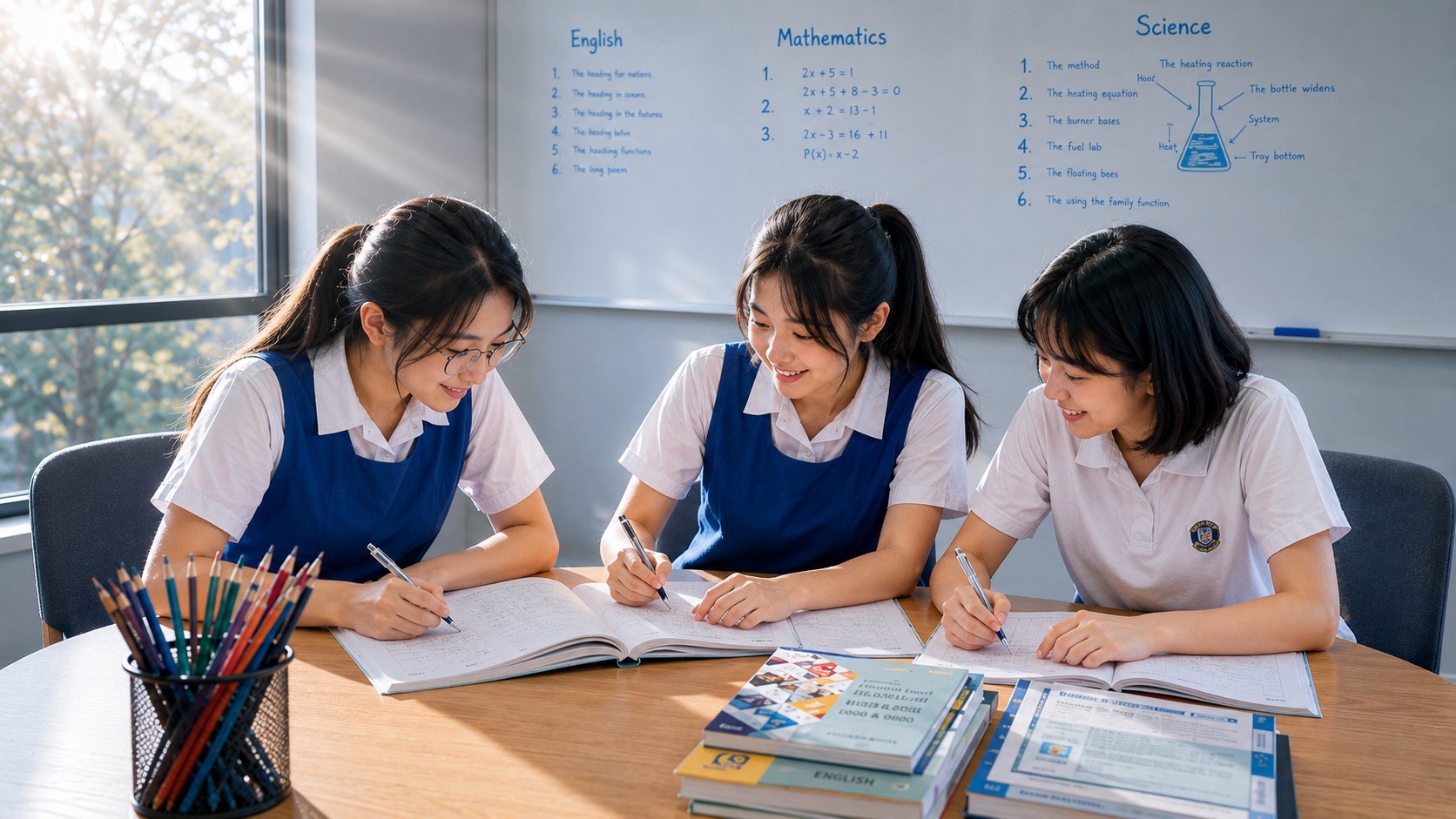
Secondary 2 English situational writing and editing tuition should help your child communicate a clear message to the right person, fulfil the task and correct language accurately. For parents choosing a Bukit Timah tutor, the useful question is whether the student learns to plan, explain and revise their own writing. In a three-student tutorial, each learner can test an idea, receive specific feedback and produce an independent response. This guide shows what that teaching can look like through an original email task, a complete model, editing examples and fresh practice.
Begin with the student’s actual G1, G2 or G3 English programme, current school assignments and teacher feedback. Secondary 2 school assessments do not constitute a separate national SEAB Secondary 2 examination. Follow the school’s task instructions, including any required form, length and assessment criteria. The later Singapore-Cambridge Secondary Education Certificate (SEC) is a graduating examination framework; it should not be used to invent a universal Secondary 2 writing format.
- Understand the situation: identify the writer, recipient, purpose and required action.
- Use supplied information accurately: distinguish confirmed facts from proposals and missing details.
- Develop the message: explain why a detail matters to the reader instead of copying the stimulus.
- Choose an appropriate voice: write respectfully and clearly for the relationship and purpose.
- Edit with a reason: locate the language problem, make a precise correction and check the whole sentence.
- Review individual progress: look for better decisions on a new task with less prompting.
- Plan support realistically: confirm current class arrangements and match practice to the child’s school workload.
EDUKATESINGAPORE · SECONDARY 2
Find your next learning step
Start with the section closest to your child’s current question, then continue through the worked examples.
Open the complete chapter index · Parent questions and next steps
Contents
Chapters 1–5
Chapters 6–10
CHAPTER 1 OF 15 · Understand the task
1. Understand what situational writing is meant to accomplish
Situational writing asks a student to communicate within a particular set of circumstances. A person has a reason to write to someone else: to recommend, request, explain, report, invite or respond. The writer must make decisions about information, organisation and tone so that the reader can understand and act.
MOE publishes separate G1 English Language and G2/G3 English Language teaching syllabuses. The official curriculum links published by Gan Eng Seng School distinguish these teaching documents from examination specifications. Use the relevant subject-level document together with your own school’s requirements.
The English learning outcomes reproduced on Serangoon Secondary School’s curriculum page include selecting and organising ideas for different audiences and purposes, expressing them coherently, and improving writing through revision and editing. These are connected actions. A student may have an interesting idea but need help arranging it, or a well-organised message that needs more accurate sentences.
SEAB states that the SEC begins in 2027, with subjects examined at their respective levels. A child’s examination year depends on their cohort and progression. For today’s Secondary 2 assignment, check the actual task rather than borrowing a national paper’s word count or marking rules.
The teaching aim is practical: the student should know what this reader needs, say it clearly and check whether the finished message does the job. That aim remains useful across different school tasks.
CHAPTER 2 OF 15 · Understand the task
2. Diagnose the writing difficulty before adding more essays
A weak response can fail in several different ways. It may omit an instruction, use the wrong relationship with the reader, misrepresent a fact, leave an idea unexplained or contain language errors that obscure meaning. Giving every student the same correction will not address these different causes.
Separate the message from the sentences
First, ask the child to explain aloud what they wanted the reader to do. If they cannot identify that purpose, start with the task. If the purpose is clear orally but absent from the writing, work on the opening and organisation. If the message is well formed but individual sentences are difficult to understand, investigate language control.
Suppose the task is to request permission for an activity. A student writes three paragraphs describing how enjoyable it will be but never asks for approval. The problem is not necessarily vocabulary. The writer has developed enthusiasm while losing the required action.
Another student includes every instruction but gives each only a few words: “It is useful. It is fun. We can help.” This response needs explanation. Ask what makes the activity useful, who benefits and how the proposed help works. Adding formal connectors alone will not supply the missing ideas.
Keep one useful sample
Bring a recent first draft and the teacher’s comments to a tutor consultation. Corrected copies are useful, but the original attempt shows how the student approached the problem. Choose one paragraph to discuss closely. Ask the tutor to identify the main decision that needs improvement and demonstrate a manageable next exercise.
This keeps the conversation focused on teachable actions. A child can learn to state a request, connect a reason to evidence or correct subject–verb agreement. “Become a better writer” needs to be broken into steps the learner can recognise and practise.
Before drafting, identify four things: who is writing, who will read the message, why the message is needed and what the task requires the writer to include. These decisions shape the response more strongly than a memorised opening phrase.
The writer’s role matters. A class representative can propose an activity and offer to organise volunteers, but may not have authority to confirm a room booking or direct teachers. The recipient’s role matters too. A Year Head may need practical information and an approval request, while a classmate may need instructions for joining the activity.
Turn instructions into checks
If a task asks the student to explain two benefits, address a concern and describe their contribution, the plan needs all three elements. “Two benefits” means two distinct reasons, not two sentences saying the activity will be enjoyable. “Address a concern” requires a response to a difficulty, not merely a mention that a difficulty exists.
Separate information that is confirmed from information that is proposed. “The library is available to request” does not mean “The library is booked”. “Four helpers have volunteered” does not mean “Every classmate will help”. Accuracy is part of effective writing because the reader makes decisions using the information provided.
A short planning question can prevent drift: “What should the reader understand or decide after reading this?” Keep that answer nearby while drafting. If a paragraph does not help achieve the purpose or meet a requirement, consider whether it needs revision or removal.
The following activity is an original teaching exercise. All names, arrangements and details are fictional. It is not an official examination question, a real school announcement or a prediction of an upcoming paper.
Source brief: Welcome Games Hour
- Your class hopes to welcome 24 new Secondary 1 pupils through a board-game session.
- The school can lend six games at no charge. Each game accommodates four players.
- The library can be requested for one Wednesday next month, from 2.30 pm to 3.30 pm. The specific date and booking are not confirmed.
- Four Secondary 2 classmates have volunteered as helpers.
- Some visitors may be unfamiliar with the game rules.
- No food is allowed in the library. Tidying must be completed by 3.30 pm.
- Adult supervision must be approved before the activity proceeds.
Your writing task
Imagine that you are Alex Lim from Secondary 2B. Write an email to your Year Head, Ms Tan, recommending the Welcome Games Hour. Explain two benefits for the new pupils, outline a workable plan using the brief, address the unfamiliar-rules concern, describe your own contribution and request permission together with confirmation of the booking and supervision arrangements.
For this teaching exercise, aim for a complete, concise response. No national word count or marking scheme is being applied. If a teacher adapts the task and provides a length or format, follow that instruction.
Notice that the brief contains a small planning calculation. Six games with four players each provide places for 24 visiting pupils. The four helpers are additional people; they do not have to occupy the visitors’ playing places. A writer who overlooks this distinction might propose a plan that does not accommodate everyone.
The task also includes an uncertainty that needs to remain visible. The activity is proposed for one Wednesday, but neither its exact date nor the room booking is settled. A convincing email can request those arrangements without pretending they are already approved.
CHAPTER 5 OF 15 · Plan and draft
5. Build a plan that makes the reader’s decision easier
A useful plan assigns a job to each part of the response. It need not become a second essay. For the Welcome Games Hour, the writer needs to recommend the activity, explain its value, show that the practical details have been considered and ask for the necessary decision.
| Part | Reader’s question | Useful content |
|---|---|---|
| Opening | Why are you writing? | Recommend the activity and request approval |
| Benefits | Why is it worthwhile? | A shared activity can start conversations; rotating groups can widen contact |
| Practical plan | How could it work? | Six groups of four, four helpers, a proposed sequence and time for tidying |
| Concern and contribution | What needs attention, and what will you do? | Explain unfamiliar rules, prepare short guides and coordinate helpers |
| Closing | What decision is needed? | Permission, a suitable date, room confirmation and approved supervision |
The two benefits are related but distinct. A shared game provides an immediate topic for conversation. Rotating groups can help pupils meet more people. Simply writing “They can make friends” twice would not explain the different contributions of the activity’s design.
The plan should also connect a difficulty to an action. If pupils may not know the rules, suggest a demonstration or simple guide. A general promise that “everything will go smoothly” does not answer the concern.
Proposed details are allowed when the task invites a plan, but signal them honestly. “I suggest reserving the final ten minutes for tidying” is a proposal. “The school has ordered us to tidy for ten minutes” would invent an instruction. The distinction lets the student develop an idea while respecting the source.
CHAPTER 6 OF 15 · Plan and draft
6. Read a complete model email and inspect its choices
This model offers one reasonable response to the original task. Its wording and paragraph count are not a compulsory template. Other plans can work if they satisfy the brief accurately and communicate effectively.
Subject: Proposal for a Welcome Games Hour
Dear Ms Tan,
I am Alex Lim from Secondary 2B. I would like to recommend a Welcome Games Hour for 24 new Secondary 1 pupils and request your approval to organise it on a suitable Wednesday next month.
Playing a game together could give pupils an easy starting point for conversation, especially if they do not yet know one another. We could also rotate groups between two short rounds so that each pupil has an opportunity to meet other new pupils.
The school’s six games can accommodate six groups of four visiting pupils without any borrowing charge. If the library booking is approved, I suggest using the first ten minutes after 2.30 pm to welcome the pupils and explain the rules. A forty-minute games period, including a short change of groups between rounds, would follow. The final ten minutes would be for returning the games and tidying before 3.30 pm.
To support pupils unfamiliar with the games, I could prepare short instruction cards and arrange for the four volunteer helpers to circulate between tables. I would also coordinate the helpers and remind visitors that food is not allowed in the library.
Could you please advise whether the proposal may proceed and help us confirm a suitable date, the library booking and approved adult supervision? We would finalise the arrangements only after these matters are settled. Thank you for considering our suggestion.
Yours sincerely,
Alex Lim
Secondary 2B
Why the response works
The opening states the writer’s identity, recommendation and request immediately. The benefits are explained through what pupils would actually do. The practical paragraph uses the supplied numbers correctly and labels the timing as a suggestion. Ten minutes of introduction, forty minutes including the changeover, and ten minutes of tidying total the available hour.
The concern about unfamiliar rules receives a specific response. The writer also identifies a personal contribution without claiming to replace adult supervision. The final paragraph keeps the unconfirmed arrangements visible and gives Ms Tan a clear decision to consider.
Ask the student to point to the sentence that fulfils each task requirement. Then ask which sentence could be revised if the audience changed. This makes the model a set of decisions to study, rather than a passage to memorise.
CHAPTER 7 OF 15 · Shape the message
7. Change the register when the relationship changes
Register is the kind of language suited to a situation and relationship. A student writing to a Year Head should be clear and respectful. The same student writing a brief message to a classmate can sound more familiar. Neither situation requires language that hides the message behind unnecessary formality.
Compare three versions of one request
To the Year Head: “Could you please advise whether we may use the library for the proposed session?” To a volunteer helper: “Could you help me check the instruction cards before Wednesday?” To the visiting pupils after approval: “Please return each game to its box before the tidying period ends.”
All three sentences request an action, but the relationship and purpose differ. The first seeks permission. The second asks a peer for assistance. The third provides an instruction to participants. Copying the same elaborate opening into all three would make the communication less natural.
Respectful writing does not require flattery. “Your unparalleled wisdom will undoubtedly recognise our magnificent proposal” draws attention away from the plan. “I would appreciate your advice on the supervision arrangements” is more useful because it identifies the help needed.
Keep confidence proportionate
A student can recommend an activity firmly while acknowledging uncertainty. “This could help pupils begin conversations” is a reasoned benefit. “This will ensure every pupil makes close friends” promises an outcome the writer cannot establish. Being persuasive does not require pretending that every result is guaranteed.
School tasks may specify particular conventions, greetings or sign-offs. Follow those requirements. Outside a set exercise, the best choice depends on the actual message and relationship; an email, a formal letter and a short school notice need not have identical presentation.
A source stimulus gives the writer material to use. Effective writing explains why selected information matters to the purpose. Copying every detail in its original order can produce an accurate list without a persuasive or useful message.
For example, “There are six games” is a fact. “The six games provide places for all 24 visiting pupils when they play in groups of four” explains its practical significance. The second sentence helps the reader judge whether the proposal is workable.
Connect the detail to the reader’s concern
Consider the four volunteer helpers. A weak response says, “Four helpers are available, which is good.” A more developed response explains that they could circulate, clarify rules and help groups restart when necessary. The writer has connected a resource to the problem identified in the brief.
Keep development within the task’s limits. The source does not say that the helpers are trained counsellors or that they can supervise the event without an adult. Adding those claims would make the paragraph sound stronger while making it less reliable.
A useful practice is to write three short components: detail, significance and action. “Some visitors are unfamiliar with the rules” is the detail. “They may struggle to join a game immediately” is its significance. “We could provide a demonstration and instruction cards” is the proposed action. These components can then become natural sentences.
Not every detail needs a lengthy explanation. Spend more words where the reader must understand a reason, evaluate a choice or resolve a concern. Straightforward information such as the proposed time can be stated briefly. Good development is selective, not uniformly long.
Paragraphs help the reader follow a message. In a proposal, it is often useful to group the purpose, reasons, arrangements and requested decision. In a report, the reader may need a sequence of events or findings. The appropriate structure follows the task rather than a fixed number learned by heart.
A paragraph should have a clear centre. If it begins by explaining a benefit, suddenly changes to a room booking and ends with an unrelated personal memory, the reader must reconstruct the connection. Planning can prevent this by grouping related material before drafting.
Use transitions for real relationships
“However” signals a contrast. “Therefore” signals a conclusion or consequence. “For example” introduces an illustration. These words cannot create a logical relationship that is missing. “The games are free. Therefore, the pupils will become close friends” leaps from cost to friendship without a supported connection.
A clearer version separates the points: “The games can be borrowed at no charge, which keeps the activity affordable. Playing in small groups could also give pupils a shared topic for conversation.” The reader can now see two different reasons.
References need attention too. “They will help them before it starts” may be understandable to the writer but unclear to the reader. Naming the people once can fix it: “The volunteer helpers will explain the rules to the visiting pupils before the first round.”
After drafting, read only the opening sentence of each paragraph. Do these sentences reveal a sensible route through the message? This quick check can expose repetition or a missing stage before the student spends time polishing individual words.
CHAPTER 10 OF 15 · Edit and practise
10. Edit by identifying the relationship that is wrong
Editing is a reasoning task. Students need to identify what a sentence is trying to say, locate the language problem and make a correction that preserves the intended meaning. Choosing a word because it “sounds nicer” is less dependable than explaining why the form fits.
The examples below are original teaching sentences. Their corrections illustrate language relationships; they are not an official paper format. A school exercise may limit the permitted changes or identify particular errors, so follow the instructions for that task.
| Sentence to examine | Correction | Reason |
|---|---|---|
| Each of the helpers have a task. | Each of the helpers has a task. | The subject is the singular “each”, so the verb is “has”. |
| The pupils were excited to joining the activity. | The pupils were excited to join the activity. | In this construction, “to” introduces the base verb “join”. |
| We discussed about the timetable. | We discussed the timetable. | “Discussed” takes the object directly here. |
| The teacher gave us several useful advices. | The teacher gave us several useful pieces of advice. | “Advice” is normally uncountable; count the pieces rather than adding “s”. |
| Last Friday, the volunteers prepare the cards. | Last Friday, the volunteers prepared the cards. | The stated completed past event requires the past-tense form in this sentence. |
| The session was enjoyable, the pupils asked for another round. | The session was enjoyable, and the pupils asked for another round. | The conjunction joins two complete clauses; a full stop would also work. |
Check the permitted correction
The “advice” example requires more than one word to preserve “several”. If a test allows only a single-word change, that sentence may need a different permitted correction or a different exercise design. Students should not apply a multiword solution mechanically when the task forbids it.
After correcting, reread the whole sentence. A changed verb can create a new mismatch elsewhere. Keep the intended time, number and relationship intact. The best evidence of learning is the student’s ability to explain the correction and use the same relationship correctly in a new sentence.
CHAPTER 11 OF 15 · Edit and practise
11. Revise the message before polishing every sentence
Revision asks whether the response does its job. Editing checks the language used to do it. Both matter, but repairing every comma in a paragraph that answers the wrong task is inefficient. First check purpose, content and organisation; then give the wording close attention.
A before-and-after paragraph
Initial version: “Our event is amazing and everyone will like it. We have six games. We booked the library already. The helpers are very good. Please approve it immediately because we have done everything.”
This paragraph overpromises enjoyment, gives an undeveloped detail and falsely presents the booking as confirmed. Its final request pressures the reader and contradicts the unresolved approval process. These are message problems, even if some sentences are grammatically complete.
Revised version: “The six games could accommodate all 24 visiting pupils in groups of four. If the library booking is approved, the volunteer helpers could explain unfamiliar rules and support the groups. Could you please advise whether we may proceed and help us confirm the remaining arrangements?”
The revision preserves the useful information, explains the numbers and keeps the proposal conditional. It also gives the recipient a workable request. More elaborate vocabulary would not have produced these improvements on its own.
Use feedback as a decision
If a teacher writes “develop”, ask which idea needs further explanation. If the comment is “tone”, identify the words that create an unsuitable relationship. If the comment is “unclear”, locate the missing actor, action or connection. Turn the comment into a specific revision rather than copying a replacement paragraph without understanding it.
Retain the first version and explain one major change. This helps the student see improvement as a series of choices they can repeat, rather than something that happens only when an adult rewrites the work.
CHAPTER 12 OF 15 · Edit and practise
12. Apply the same skills to a different writing situation
Transfer practice changes the situation while retaining the underlying decisions. The following task moves from requesting approval before an event to reporting an issue afterwards. All details are fictional and supplied for this exercise.
Original practice brief: A club display
You are Samira, a club member. Yesterday, 18 pupils attended a display-making session supervised by Mr Lee. The session began ten minutes late because the stored display boards were in a locked cupboard and the key had to be located. All pupils completed their posters, but there was no time to rehearse their explanations. Mr Lee has asked you to email a brief account and suggest one change for the next session.
Write an opening, one paragraph explaining what happened and one paragraph proposing a change. Keep the account factual, distinguish the completed work from the unfinished rehearsal, and avoid blaming someone whose responsibility is not established.
One possible response
Dear Mr Lee,
I am writing to give a brief account of yesterday’s display-making session and suggest a preparation check for the next meeting.
Eighteen pupils attended. The session began ten minutes late because the display boards were stored in a locked cupboard and the key had to be located. Everyone completed a poster, but there was no time to rehearse the explanations.
For the next session, could we confirm access to the boards beforehand and arrange for them to be ready before pupils arrive? I would be willing to help check the materials. This could protect the time planned for rehearsal.
Yours sincerely,
Samira
Check the reasoning
The opening identifies both purposes: report and suggest. The account preserves the difference between completed posters and unfinished rehearsal. The proposed change responds directly to the access delay. It does not accuse a particular pupil or teacher of losing the key, because the brief does not establish that.
Now edit these two sentences: “All the posters was completed” and “We should checked the cupboard earlier.” The corrections are “All the posters were completed” and “We should have checked the cupboard earlier.” The first needs the plural verb “were” to agree with “posters”. The second describes regret about a past action: “should have” is followed by the past participle “checked”.
As an extension, ask the student to change the report into a short reminder for fellow club members. The facts remain, but the purpose becomes preparation for the next session. The student should select what classmates need to do rather than reproduce the entire report.
CHAPTER 13 OF 15 · Choose useful support
13. Use three-student tuition to reveal individual writing decisions
A small group can provide useful readers for a student’s message. Each learner can notice where an explanation is missing or a request is unclear. The tutor still needs to check individual work; a lively discussion does not establish that everyone can write independently.
A classroom example
Give all three students the Welcome Games Hour brief and ask them to write a one-sentence purpose before discussion. One student may request permission clearly. Another may begin by describing the games. A third may announce that the event is confirmed. These responses immediately reveal different teaching needs.
The tutor can then model how the writer’s role and the unconfirmed arrangements affect the opening. Each learner revises their own sentence. During the next stage, students draft separate paragraphs, exchange them and ask one reader question: “What do you need to know that I have not explained?”
Feedback should remain specific. “I cannot tell whether the library is booked” helps the writer revise. “Make it more formal” may be too vague unless the reader identifies the phrase causing concern. The tutor checks that peer suggestions improve the message rather than merely make it longer.
End with a fresh brief, such as the club-display report, completed individually. Adapt the length, amount of supplied information and guidance to the student’s current level and school requirements. Students can share a writing principle without being assigned identical demands.
Parents should ask how the tutor records each learner’s recurring needs and reduces help over time. The three-student format is valuable when it creates room for clear explanation, purposeful feedback and independent application.
CHAPTER 14 OF 15 · Choose useful support
14. Build a writing routine that the child can sustain
A useful routine does not require a full composition every evening. Short tasks can isolate a particular decision, while occasional complete responses show whether the student can bring the skills together. Choose the balance according to school demands and the child’s current difficulty.
One practice session might involve planning a task and writing its opening. Another might involve developing one reason from supplied information. A later session can focus on a small set of recurring grammar errors, followed by a new sentence using each corrected pattern. These are suggestions, not a fixed weekly requirement.
Keep a small revision record
For each recurring problem, retain an example, a correction and a brief explanation. “Each takes a singular verb here” is more useful than a page of answers with no reasons. For message problems, record the decision: “I must ask for approval because the activity is still a proposal.”
Review the pattern after a gap with a new task. The student should recognise the issue without being told exactly where it appears. If the same error returns, provide a shorter example and check whether the underlying relationship is understood.
Parents can help by being interested readers. Ask what the message is trying to achieve and whether the necessary information is present. Avoid rewriting the whole response. A child who submits an adult’s polished paragraph loses the opportunity to show what they can currently do and what teaching they need next.
When reading a task brief is the main obstacle, use the companion guide to Secondary 2 English comprehension, inference and summary. Better understanding of the source can support writing, while the writing lesson still needs its own focus on purpose and audience.
CHAPTER 15 OF 15 · Choose useful support
15. Choose support through the student’s actual work
Before choosing a Bukit Timah English tutor, identify what help is needed and what progress would look like. A child may need a short period of support with task fulfilment, continuing work on grammar, or greater challenge in developing ideas. Use school feedback and the child’s first drafts to make that discussion concrete.
Ask how the tutor matches the current English subject level, teaches a weak paragraph, checks independent writing and communicates the next step. Ask what the child will do between lessons and whether that workload fits the rest of the week. Current fees, available times and class arrangements can be confirmed through eduKate’s class enquiry page.
What should improvement look like?
Look for a clearer purpose, accurate use of the brief, better-developed reasons and fewer repeated language errors. Compare tasks with similar demands and note the help given. A polished response written after extensive prompting is different evidence from a fresh response the student planned and completed alone.
The most useful next step is often small: revise one opening, explain one reason fully or learn why one verb form is correct. When students can identify those decisions themselves, writing becomes something they can manage and improve with increasing independence.
Official reading and source dates
- Gan Eng Seng School: English Language and Literature — teaching-syllabus links; page updated 24 August 2026.
- Serangoon Secondary School: English learning outcomes — writing, revision and editing outcomes; page updated 11 September 2026.
- SEAB: Secondary Education Certificate — national examination framework; page updated 14 May 2026.
References checked on 16 November 2026. All tasks, stimuli, model responses and editing examples in this guide are original teaching material. Apply the school’s current instructions to assessed work.