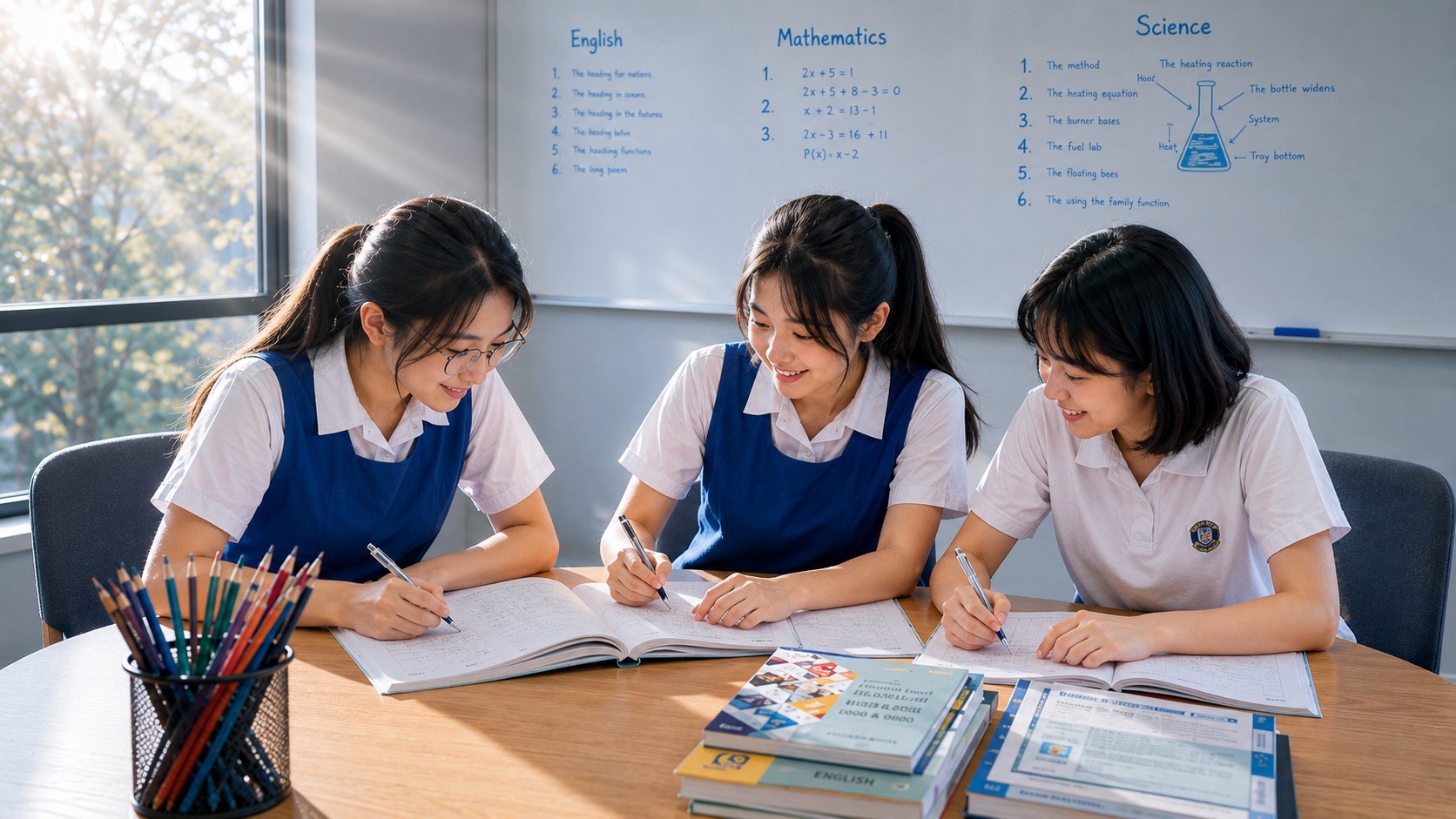
Secondary 2 English comprehension becomes more manageable when students can explain how they reached an answer. A Bukit Timah tutor should help your child find the relevant evidence, make a supported inference, understand words in context and summarise the ideas the question actually asks for. In a three-student tutorial, each learner can practise these decisions aloud before completing a similar task independently. This guide gives parents and students a practical way to recognise the difficulty, work through original examples and choose suitable support.
The starting point is your child’s current English subject level, school materials and teacher feedback. Secondary 2 school assessments should be prepared for using the school’s instructions; the national Singapore-Cambridge Secondary Education Certificate (SEC) specifications describe a later examination stage. English learning also includes writing, listening and speaking, so comprehension practice belongs within a balanced programme. For the wider subject overview, read our Secondary 2 English Language small groups tuition guide.
- Start with the cause: distinguish difficulty understanding a passage from difficulty expressing an answer.
- Teach evidence: connect each inference to a detail and explain what that detail suggests.
- Protect meaning: paraphrase without changing who, what, when, quantity or certainty.
- Practise summary selection: identify relevant ideas before shortening sentences.
- Match the school: confirm the English subject level, text types, task instructions and upcoming assessment requirements.
- Use three students purposefully: combine discussion with individual answers and feedback.
- Look for independent progress: check whether the child can use the same skill on an unfamiliar passage.
EDUKATESINGAPORE · SECONDARY 2
Find your next learning step
Start with the section closest to your child’s current question, then continue through the worked examples.
Open the complete chapter index · Parent questions and next steps
Contents
Chapters 1–5
Chapters 6–10
CHAPTER 1 OF 15 · Find the difficulty
1. Understand the curriculum without turning every lesson into examination drilling
Reading comprehension is the work of constructing meaning. Sometimes the answer is explicitly stated. Sometimes the reader must combine details, understand a contrast or recognise what a writer has left implied. A useful lesson makes these different mental actions visible. “Read more carefully” becomes helpful only when the student knows what careful reading involves.
MOE’s English Language teaching syllabuses include reading and viewing within a broader language curriculum. The G2 and G3 English Language syllabus describes close and critical reading, including literal and inferential understanding. MOE also publishes a separate G1 English Language syllabus. Parents should use the document relevant to their child’s subject level together with the school’s current teaching plan.
A practical teaching programme therefore needs more than repeated answer-key comparison. Students should encounter stories, explanations, arguments, notices and other age-appropriate texts. They should discuss why a sentence matters, how a paragraph develops an idea and whether an interpretation is justified. The language demand and amount of guidance can change while this attention to meaning remains.
For examination planning, SEAB’s SEC syllabus directory separates the national specifications by subject level and examination year. A Secondary 2 student should not assume that every school task uses a national paper’s length, timing or summary instructions. Obtain the actual school task requirements. This keeps preparation useful now while building skills that remain valuable later.
CHAPTER 2 OF 15 · Find the difficulty
2. Find the point where understanding becomes uncertain
Two students can receive the same comprehension mark for different reasons. One may misread the passage. Another may understand it clearly but answer a different question. A third may make a reasonable inference and then weaken it by adding an unsupported explanation. The tutor needs to see the process behind the mark.
Separate four layers
Begin with word and sentence understanding. Ask the child to explain a short sentence in ordinary language. Then check the connection between sentences: who does “they” refer to, what happened first, and which event caused the next? Only after those relationships are clear should the tutor judge the inference or the written response.
Consider this original sentence: “Although the team had practised twice, Nadia hesitated before volunteering to lead the presentation.” A student who understands the individual words may still overlook “although”. The sentence contrasts preparation with hesitation. It does not tell us that Nadia never practised, disliked her teammates or refused to present.
Next, ask what the question demands. “What did Nadia do?” calls for an action. “What does her hesitation suggest?” calls for an interpretation. “How does the writer show her uncertainty?” asks the reader to connect a language choice or action to its effect. These questions share a sentence but require different answers.
Use a small sample before adding more worksheets
Bring two recently marked passages and the child’s original answers to a consultation. Select one answer the child understood, one they guessed and one they still dispute. Ask them to show the relevant words and explain their thinking. This gives the tutor a more useful starting point than a score alone.
If reading is secure but answers are vague, work on expression. If oral explanations are also confused, return to the passage. If everything becomes clear only after the tutor supplies the interpretation, the next lesson should include a fresh example that the student must begin alone. Each situation suggests a different next step.
A comprehension question tells the reader what to look for and how to respond. Students often underline the passage thoroughly while barely reading the question. Reverse that habit for a moment. Before searching, identify the task, its scope and any condition attached to the answer.
The task may ask the student to identify, explain, compare or support a view. The scope may be a phrase, a paragraph or the whole passage. A condition may require two reasons, the use of the student’s own words or a specific quotation. A correct idea can still fail to meet an instruction if the response ignores one of these boundaries.
A useful question-reading routine
Ask: “What must I produce?” Then: “Which part of the text can answer this?” Finally: “What must my answer include?” For example, “Explain two ways the narrator’s attitude changes” requires two changes, with an earlier and later attitude made clear. Two descriptions of the final attitude would leave the change unexplained.
Command words are clues, not mechanical templates. “Explain” does not always require the same number of sentences. “Suggest” does not grant permission to invent a backstory. “Compare” requires a meaningful relationship between the items being compared. The wording of the complete question governs the response.
During practice, let the child restate a question briefly before answering. This is especially useful when a student often writes something sensible that does not answer the task. As accuracy improves, the restatement can become a quiet mental check rather than extra written work on every question.
CHAPTER 4 OF 15 · Build the meaning
4. Make an inference that the passage can support
An inference connects a detail to a reasonable conclusion. It goes beyond copying, but it remains answerable to the text. Teach this as a short reasoning chain: what the passage shows, what that detail suggests, and why the connection makes sense in this situation.
Original teaching passage: The spare chair
Mei arrived at the rehearsal carrying the script she had rewritten the previous evening. When the group discussed who would introduce their performance, she opened her mouth, then looked down at the notes. Daniel offered to take the role. Mei slid her script across the table and pointed to a sentence she thought would work well. During the rehearsal, she quietly moved a spare chair away from the entrance so the others could enter without squeezing past it. When their teacher praised the smooth opening, Mei smiled and began arranging the scripts for the next run.
Question: What does Mei’s behaviour suggest about her contribution to the group? Support your answer with details from the passage.
A defensible answer is: “Mei contributes thoughtfully even when she is not the person speaking at the front. She offers her revised script and moves the chair to make the group’s entrance easier.” The answer identifies a quality and connects it to two relevant actions. It does not need to reproduce every event.
“Mei is terrified of public speaking because she was embarrassed last year” goes further than the passage permits. Her hesitation may suggest uncertainty, but the text gives no previous incident. A student can produce a fluent sentence and still exceed the evidence.
“Mei is helpful because she smiles” is weaker for a different reason. Smiling after praise may show pleasure, but it is not the strongest evidence of helping. Sharing the script and clearing the entrance directly support the claim. Evidence should be chosen for its connection to the interpretation, not simply because it is easy to quote.
Teach the limit as well as the conclusion
Ask students to name one conclusion the passage supports and one it does not establish. For this passage, we can discuss Mei’s supportive actions. We cannot establish that she always avoids leadership or that Daniel deliberately excludes her. This small contrast helps students keep the strength of a claim proportionate to the evidence.
In a three-student discussion, each learner can propose an answer privately before anyone speaks. The group then compares the evidence supporting each interpretation. The tutor’s job is to help students explain and revise their reasoning, while preserving room for more than one well-supported reading where the text allows it.
Some comprehension errors happen before inference begins. The student loses track of a pronoun, reverses a comparison or treats two events as a cause-and-effect relationship simply because they occur together. These are small reading decisions with large consequences.
Take this original example: “The organisers offered reusable containers to the volunteers. After lunch, the organisers collected them for washing.” Here “them” refers to the containers. If the sentence instead began “They collected them”, the surrounding passage would need to establish who collected the containers. A pronoun can become ambiguous when more than one group could perform the action. Students should trace the reference rather than guess from the closest noun alone.
Connectors also control meaning. “Because” gives a reason; “however” signals a contrast; “despite” introduces something that did not prevent the main event. In “Despite the rain, the queue grew longer”, the queue increased while conditions might have discouraged attendance. Rewriting it as “The queue grew because of the rain” changes the relationship.
Check the strength of a cause
“More pupils visited the library after the displays changed” establishes a sequence. It does not, by itself, establish that the displays caused every additional visit. A later sentence may provide stronger evidence, such as students explaining why they came. The reader should distinguish the writer’s evidence from a plausible explanation they supply themselves.
A useful practice exercise is to give the student three sentences and ask them to draw or describe the links: who, what, when and why. When those relationships are secure, ask for a short answer. This makes the reading structure clearer without making the child annotate every word of an entire passage.
CHAPTER 6 OF 15 · Build the meaning
6. Learn vocabulary through the sentence around it
A vocabulary answer must fit the word as it is used. Knowing one dictionary meaning is useful, but it may not be the meaning the writer intends. Teach students to inspect the surrounding action, the grammar and the tone before choosing a replacement.
Consider: “After three unsuccessful attempts, Ravi’s enthusiasm began to fade.” Here “fade” means become weaker or diminish. It does not describe a colour becoming lighter. An answer such as “disappear completely” may also be too strong, because “began to” shows the start of a change rather than its completion.
Use a replacement check
Ask the student to substitute their proposed meaning into the sentence. “Ravi’s enthusiasm began to weaken” preserves the idea. “Ravi’s enthusiasm began to forget” does not fit either the grammar or the meaning. This check cannot solve every vocabulary task, but it exposes many careless synonym choices.
Then inspect degree. “Concerned”, “alarmed” and “terrified” are related, but their intensity differs. “Reluctant” means unwilling or hesitant; it does not automatically mean unable. “Occasionally” means sometimes, while “frequently” means often. These distinctions matter when students explain attitudes or summarise a claim.
Build a short vocabulary record with four parts: the original sentence, the meaning in that context, a new sentence, and a nearby word that would change the meaning. For “reluctant”, the student could compare “unable”. This turns vocabulary learning into a study of precise choices rather than a collection of impressive words.
Parents can help by asking, “Which part of the sentence helped you?” If the child cannot explain, return to the context. A small set of words understood and used accurately gives the next reading lesson something reliable to build on.
Questions about language invite students to explain what a choice contributes. Naming a technique can be a useful starting point, but the reader still needs to show how it works in this passage. “It is a metaphor” identifies a feature; it does not explain the meaning created.
Imagine a narrator describing an unanswered message: “The phone lay silent beside my bowl, a small locked door.” The comparison can suggest that the narrator feels shut out from a response or connection. The answer should connect the image of a locked door to the situation of waiting. Claiming that the phone is physically broken would miss the figurative meaning.
Move from feature to meaning
A helpful explanation has a simple sequence: identify the important wording, explain its meaning in context, and connect that meaning to the character, situation or reader’s impression. Students can practise these steps orally before deciding how much detail the written question requires.
For a description such as “the crowd trickled into the hall”, “trickled” suggests a gradual arrival in small numbers. Replacing it with “flooded” would create a different sense of speed and volume. Comparing two possible words can make the original choice easier to explain.
Avoid automatic effects such as “This makes the reader want to read on” unless the explanation is tied to something specific. Does the wording create uncertainty about an outcome, make a scene feel crowded, or reveal irritation? The most useful answer identifies the particular impression and shows how the words create it.
A notice, poster or webpage combines wording with arrangement. Students need to ask who the message addresses, what it wants that audience to understand or do, and how its details support that purpose. Visual-text practice can begin with a simple invented notice before moving to more complex material.
Original teaching notice
REPAIR, THEN REUSE
Bring one torn fabric item to the Community Room on Saturday, 10 am–noon.
Volunteers will show you basic hand-stitching.
No experience needed. Materials supplied.
Reserve a place by Thursday. Participants under 14 should attend with an adult.
The practical audience is people interested in learning to repair fabric items, including beginners. “No experience needed” reduces a possible concern for someone who has never sewn. “Materials supplied” addresses another barrier: participants do not need to obtain the materials themselves. These details support an explanation of how the notice encourages participation.
The main action requested is to reserve a place and attend the session with an appropriate item. A student who answers “to save the environment” identifies a possible broader aim but misses the immediate action stated in the notice. The question’s wording determines whether the answer should explain the event, the intended action or the wider message.
Conditions matter. The notice does not say that every child must attend with an adult. It specifies participants under 14. It does not promise to repair all items professionally; volunteers will teach basic hand-stitching. Accurate readers preserve these limits.
When a task includes actual images, colour or layout, discuss their visible contribution. Do not invent an effect for a feature that is absent. A large heading may establish the main message, while smaller wording gives conditions. The child should connect the feature to the audience’s understanding rather than listing design elements without explanation.
A summary is a response to a purpose. The student first decides which ideas answer the question, then expresses those ideas economically. Beginning by replacing words can produce a beautifully shortened version of the wrong information.
Original teaching passage: A lunchtime reading room
A school converted an unused meeting room into a lunchtime reading space. Students could borrow short books there without walking to the main library, which was in another block. The room stayed open throughout the lunch break, allowing students with different recess routines to visit. Shelves were labelled by topic, so visitors could find something that matched their interests. Comfortable chairs gave pupils a place to read quietly before afternoon lessons. Two student volunteers recommended books and helped newcomers locate suitable choices. Some pupils initially complained that the room was too small. The school added a booking arrangement for especially busy days. Teachers also reminded students that food had to remain outside. After a month, the reading team gathered feedback before deciding whether to extend the opening hours.
Practice task: Summarise the features that made the room convenient or welcoming for students. Use no more than 55 words. This is an original practice limit for this exercise, not a statement of a national Secondary 2 requirement.
The relevant features concern access, opening time, finding books, comfort and help. The complaint about size, the food reminder and the future review are part of the passage, but they do not directly answer the selected task. A summary of everything that happened would lose this focus.
One possible answer is: “Students could borrow books nearby throughout lunchtime. Topic labels helped them find books matching their interests, while comfortable chairs provided a quiet place to read. Student volunteers recommended suitable books and guided newcomers.” This answer contains 33 words and preserves the five selected features without repeating the background story.
Make the selection process visible
Ask the student to give each candidate point a short label: nearby borrowing, flexible lunchtime access, topic labels, quiet seating, volunteer help. Then ask whether each label answers the question. If a point cannot pass that check, it should not enter the first draft merely because it occupies a whole sentence in the source.
Next, distinguish a general point from its example. Suppose a passage says that volunteers helped visitors select books, then describes one volunteer recommending a mystery story. The recommendation illustrates the broader help. Depending on the task, including both may repeat the same idea rather than add a second point.
Students should also notice when two details are separate. Being close to the main classrooms and being open for the whole break solve different access problems. Combining them is possible, but deleting one loses meaning. Concision should reduce words while preserving the ideas the task needs.
For school assignments, follow the stated word limit, paragraph range and any supplied opening. Ask the teacher how that task is assessed if the instructions are unclear. A tutor can teach selection and compression while keeping the school’s assessment requirements explicit.
CHAPTER 10 OF 15 · Practise and explain
10. Paraphrase without quietly changing the claim
Paraphrasing means expressing a meaning in a different way. It does not require every word to change. Names, essential technical terms and precise quantities may need to remain. The main test is whether a reader would understand the same claim from the new wording.
Consider the original sentence: “Some residents said the new walkway might make evening journeys easier.” A faithful version is: “Some residents suggested that the walkway could improve evening travel.” An inaccurate version is: “The walkway improved journeys for all residents.” The second changes a reported possibility into an established result and expands “some” to “all”.
Preserve five parts of the meaning
Check the people or things involved, the action or idea, the time, the amount and the degree of certainty. These are useful questions for editing: Who is making the claim? What is being claimed? Has it happened, or is it proposed? Does it concern everyone or only some people? Is it certain, likely or merely possible?
Grammar can carry these distinctions. “Could reduce delays” differs from “reduced delays”. “Students who attended the workshop” is a smaller group than “students”. “The first bus” does not mean every bus. Students who preserve these details usually produce clearer explanations as well as more faithful summaries.
Compression can also change emphasis. “The club welcomed beginners and experienced players” can become “The club accepted players of different experience levels.” Changing it to “The club welcomed skilled players” removes the invitation to beginners. The shorter answer is accurate only when the important range remains.
Give students two paraphrases and ask them to identify the change before writing their own. This lowers the initial writing demand while sharpening their judgement. Then return to a fresh sentence and let them paraphrase independently. The goal is reliable control of meaning, not a display of unusual synonyms.
CHAPTER 11 OF 15 · Practise and explain
11. Try a short mixed practice and explain the answers
The following original passage combines factual reading, inference and vocabulary. Try the questions before reading the discussion. These are teaching examples, not official examination questions or a predicted school marking scheme.
At first, the gardening club recorded only how tall each plant grew. When two plants of the same height produced very different numbers of leaves, the members realised that height alone gave them an incomplete picture. They began recording leaf counts and noting changes in the soil. A few students wanted to add photographs every hour, but the group chose one photograph each afternoon so that the task remained manageable. Farah, who had previously avoided the record book, volunteered to organise the new pages. By Friday, she was reminding the others to record their observations before packing up.
- Why did the club change the information it recorded?
- What does “manageable” mean in this context?
- What change in Farah’s attitude is suggested?
- Does the passage establish that leaf counts are always the best way to judge plant health? Explain.
Answer discussion
For the first question, the club noticed that equal height did not mean the plants had developed in the same way: the leaf counts differed. An answer that says only “because they wanted more information” misses the observation that prompted the change. The relevant relationship is observation followed by a revised recording method.
For the second question, “manageable” means practical to carry out within the group’s available effort or time. “Easy” alone may be imprecise; the task could still require care. The contrast between hourly photographs and one daily photograph helps establish the intended meaning.
For the third question, Farah appears to become more willing to participate and take responsibility. Initially she avoided the record book; later she organised the pages and reminded others to add observations. Naming only the final quality leaves out the change. Claiming that she now plans a career in science would add unsupported information.
For the final question, the answer is no. The passage shows that height alone was incomplete in this situation and that the club added other observations. It does not establish a universal rule about plant health. This distinction tests whether the student can keep a conclusion within the limits of the passage.
After discussing the answers, ask the student which question required the most thought and why. Their explanation may reveal whether the next lesson should address vocabulary, cause and effect, comparison across a passage or the strength of a conclusion.
CHAPTER 12 OF 15 · Practise and explain
12. Make three-student tuition serve individual understanding
A group of three creates opportunities for discussion, but the arrangement needs deliberate teaching. One confident student should not supply every inference while the other two copy. Each learner needs time to read, decide and write before the group compares answers.
A practical lesson sequence
Begin with a brief independent question from a previously taught skill. The tutor can see what the student remembers without a fresh demonstration. Then introduce one reading problem, such as explaining a contrast, using a short passage that everyone can discuss. Model the reasoning clearly and invite students to test it against the text.
Next, give each student a related question. One may need the relevant paragraph identified; another may need a prompt to explain the evidence; a third may compare two plausible interpretations. The support should respond to the task and the learner’s current understanding. Everyone still needs an opportunity to produce an answer independently.
End with an unfamiliar example that uses the same skill. This checks whether the student can recognise the reasoning beyond the demonstration. The tutor can record a specific next step: preserve qualifiers, explain a change fully, or distinguish evidence from an invented reason.
Parents should ask how grouping works when students have different English subject levels or school schedules. Sharing a topic does not automatically make every worksheet suitable for every learner. Ask what is common, what is adapted and how the tutor checks individual progress. Class size supports attention; the quality of the learning decisions determines how that attention is used.
CHAPTER 13 OF 15 · Choose useful support
13. Build a manageable practice routine around schoolwork
Home practice is most useful when it has a clear purpose. A student who has already completed a long school assignment may benefit more from revising two weak answers than from starting another full paper. Choose work that addresses the current difficulty and leaves enough attention for the student to think.
One possible weekly pattern is a short passage early in the week, a focused correction later, and a fresh question using the same skill after a gap. The exact duration should fit the child’s workload, reading pace and school commitments. This is a planning example, not a required timetable.
Make corrections do something
A useful correction contains more than the model answer. Ask the student to identify the error, explain why the original answer was insufficient, and write a rule they can use next time. For example: “I described Farah at the end but did not show the change. Next time I will compare the earlier and later details.”
Then choose a new short passage. If the student can use the rule without being reminded, the correction has begun to become usable knowledge. If they repeat the same mistake, shorten the task or model the decision again. Recopying the same answer repeatedly may improve handwriting while leaving the reading decision unresolved.
Keep enjoyable reading in the week as well. Let the child choose some material and talk about a striking idea or a character’s decision without turning every conversation into a test. A learner needs opportunities both to practise a specific skill and to experience reading as a way of finding something interesting.
CHAPTER 14 OF 15 · Choose useful support
14. Measure progress with comparable evidence
One higher score is encouraging, but it does not explain what improved. Compare work on similar demands and look for changes in independence, accuracy and explanation. A familiar passage completed with substantial help is a different achievement from a fresh passage completed alone.
Keep a small record of the main skill being taught. For inference, note whether the student chooses relevant evidence and explains the connection. For summary, note whether the selected ideas answer the task and whether paraphrasing preserves meaning. For vocabulary, note whether the proposed meaning fits the sentence.
Three labelled work samples can be enough: an initial attempt, a guided correction and a later independent response. Add a short note describing the support given. This makes it easier for parents, students and tutors to discuss progress honestly without turning every homework session into data collection.
Choose the next step from the pattern
If answers become accurate but take too long, gradually practise completing a suitable task within a time boundary. If speed improves while explanations become vague, return to precision. If the student performs well orally but writes incomplete answers, focus on putting the reasoning into concise sentences.
A student who is already secure may need more demanding texts, alternative interpretations or closer analysis of a writer’s choices. Progress does not always mean more pages. It can mean handling a more complex relationship while using fewer prompts and expressing the result more clearly.
CHAPTER 15 OF 15 · Choose useful support
15. Ask the questions that lead to useful support
What should parents bring to a tutor consultation?
Bring recent marked work, the school’s current English topic or assessment information, and two questions the student found difficult. Include the child’s first attempt, not only corrected copies. Tell the tutor whether the child struggles mainly with reading, choosing evidence, expressing an answer or working within the allotted time.
Does fluent speech mean comprehension will be easy?
Fluent conversation is a strength, but written texts may require closer attention to unfamiliar vocabulary, indirect meaning and complex relationships. Check the specific reading demand. A child who speaks confidently may still need explicit teaching in explaining an inference or preserving a writer’s qualification.
Should we practise an 80-word summary for every school test?
Use the instructions for the actual task. A school may set different practice activities or assessment requirements. Summary skills include selecting relevant ideas, combining related points and preserving meaning; those skills can be developed through varied lengths. Do not substitute a remembered national examination rule for the school’s instructions.
How do we know whether a small group is a good fit?
Ask how every student receives individual feedback, how texts are matched to current readiness, and what happens when one learner needs more support. Ask to understand the teaching process rather than relying on a promise of a particular grade. Fees, class availability and current arrangements should be confirmed directly before enrolment.
What is the most useful next action?
Choose one recently marked comprehension answer and ask your child to explain the question, locate the evidence and describe the reasoning. Listen for the first point of uncertainty. That observation gives the school teacher or tutor a concrete place to begin. Better comprehension grows through increasingly independent decisions about meaning, one well-understood task at a time.