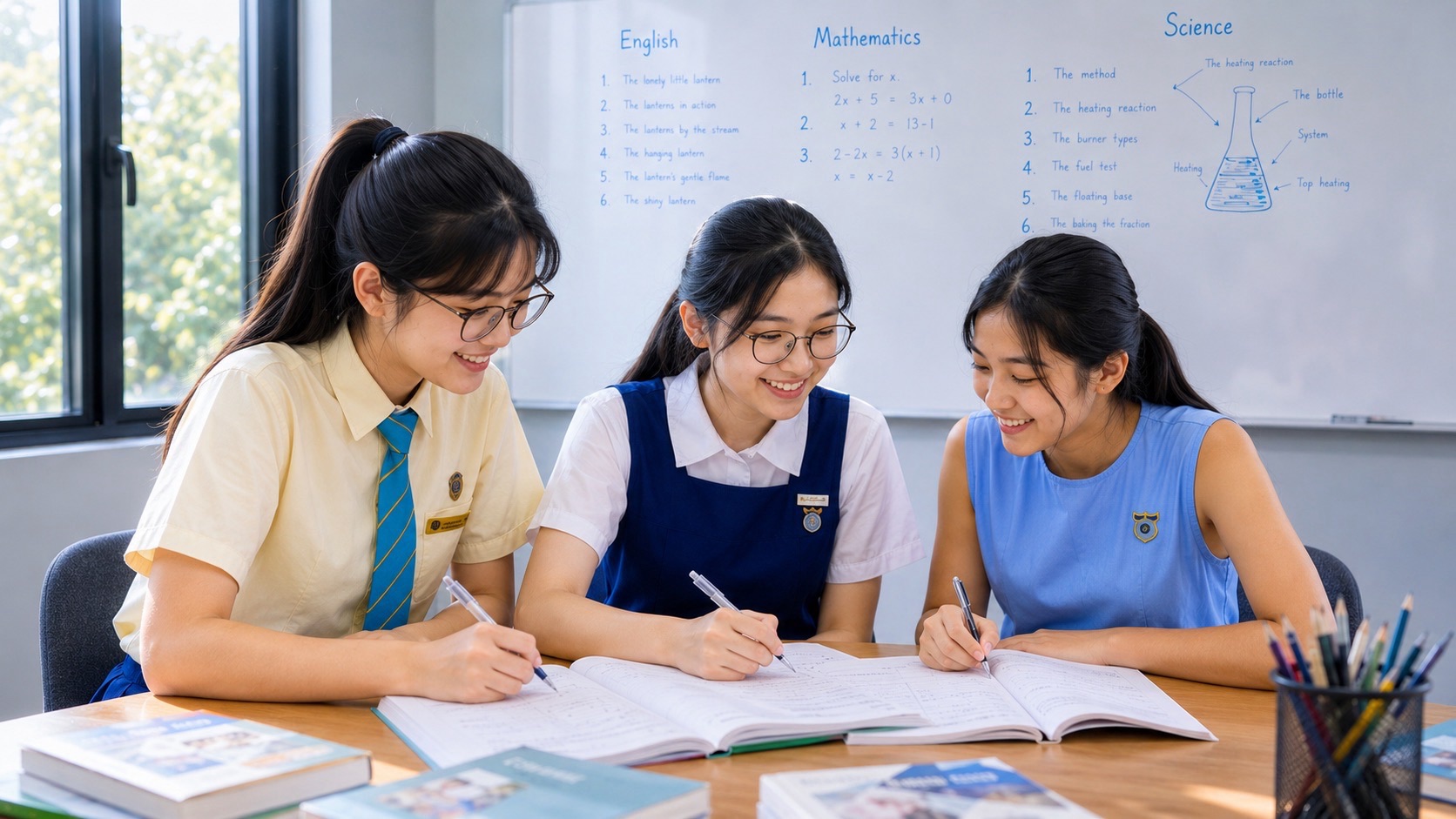
Katong Science tuition should help a Primary learner understand why an investigation is fair, what variable is being changed, what must be controlled and what conclusion the evidence can actually support.
Students often memorise experiment templates: “change one variable, keep the rest the same”. That is a useful starting phrase, but it is not enough. A learner must understand why those controls matter, how to identify the independent and dependent variables from an unfamiliar set-up, and how experimental evidence supports—or fails to support—a conclusion.
This rebuilt legacy page therefore owns a distinct RFE: fair-test reasoning. The Katong Science estate already has broader generic owners, so this URL should not compete for the same head term. Its job is to teach variable identification, controlled comparison, evidence interpretation, evaluation and scientific explanation.
eduKate teaches in groups of up to three students, generally for 90 minutes. In a 3-pax Science class, students can compare experiment designs, challenge uncontrolled variables and explain why one method produces stronger evidence than another.
Location-integrity note: this legacy URL contains historical Yishun/Marina Bay/Katong wording. It should not be read as proof of a current branch at any old address. Current class location and availability should be confirmed directly.
The 2026 Primary Science Context
For the 2026 PSLE, Science is subject code 0009. SEAB states that the examination assesses attainment based on the 2023 Primary Science syllabus. The assessment objectives include applying scientific facts and concepts, making predictions and hypotheses, interpreting and analysing information, evaluating observations and methods, and communicating explanations and reasoning.
Parents can verify the current expectations through the 2026 PSLE Science syllabus and the SEAB PSLE formats page.
Fair-test reasoning therefore matters because students need to understand investigation design, not simply reproduce familiar wording.
The Fair-Test Map
| Element | Question |
|---|---|
| Question | What relationship is the investigation trying to test? |
| Independent variable | What factor is deliberately changed? |
| Dependent variable | What outcome is measured or observed? |
| Controlled variables | What relevant factors should be kept the same? |
| Method | How will the comparison be carried out? |
| Evidence | What results were obtained? |
| Conclusion | What relationship does the evidence justify? |
Start With the Investigation Question
Before naming variables, ask:
What exactly are we trying to find out?
Example:
How does the amount of light affect the growth of a plant?
Changed factor: amount of light.
Measured outcome: growth.
Other relevant conditions should be kept as similar as possible so the comparison isolates the relationship of interest.
Independent Variable: What We Deliberately Change
Students sometimes identify any visible difference as the independent variable.
We ask:
- Which factor did the experimenter intentionally vary between set-ups?
- Is it changed in a planned way?
- Does it correspond to the “effect of X on Y” question?
The independent variable is part of the experimental design, not simply a difference noticed afterward.
Dependent Variable: What We Measure
The dependent variable is the outcome used to detect the effect.
Examples:
- height gained;
- time taken;
- temperature change;
- number of bubbles;
- mass change;
- distance moved.
The measurement should be relevant to the question and defined clearly enough to compare.
Controlled Variables: Why Keeping Things the Same Matters
Students often say “keep everything the same”. That is impossible and unnecessary.
The stronger question is:
Which other factors could also affect the dependent variable and therefore need to be controlled?
For plant growth, possible controls might include:
- type/age of plant;
- amount of water;
- soil;
- duration of experiment;
- container size.
The exact controls depend on the investigation.
Why an Uncontrolled Variable Weakens the Conclusion
Suppose Set-up A receives more light but also more water.
If A grows more, the learner cannot know whether light, water or both contributed to the difference.
Therefore the comparison does not isolate the factor of interest.
This is the reasoning behind fair-test control.
Control Set-Up vs Controlled Variable
Students should distinguish:
- controlled variable — a factor kept the same;
- control set-up — a comparison condition used to help interpret the effect in some investigations.
These are related but not identical ideas.
Repeated Trials and Reliability
Repeating measurements can help reveal whether a result is consistent and reduce the influence of unusual one-off variation.
Students should know when repetition is relevant and what it improves.
Simply writing “repeat to make it accurate” is often too vague. A better explanation connects repetition to consistency/reliability of the result.
Measurement Precision
A method can be fair but still produce weak evidence if measurement is poor.
Ask:
- Is the instrument suitable?
- Are the units appropriate?
- Is the measurement taken at the same point/time?
- Is the scale read correctly?
- Is the outcome defined clearly?
Method quality affects conclusion quality.
Prediction vs Conclusion
Prediction comes before the result and uses scientific knowledge to state what is expected.
Conclusion comes after the result and should reflect the evidence actually obtained.
Students should not write the predicted outcome as if it were proven when the data contradicts it.
Hypothesis as a Testable Relationship
A useful hypothesis links variables in a way that can be investigated.
Example:
If the amount of light increases, the rate of photosynthesis will increase, provided other relevant conditions are kept constant.
The exact form depends on the investigation and concept.
Read the Results Before Using the Theory
Students sometimes remember the concept and ignore the data.
Use:
- state the observed pattern;
- check whether it supports the expected relationship;
- apply the scientific concept;
- write the conclusion within the evidence boundary.
The data has authority over memory of what “should” have happened.
Graphs and Tables
Check:
- variables;
- units;
- trend;
- outliers/irregular results;
- whether comparison is fair;
- whether the conclusion matches the observed pattern.
A graph is not decoration; it is the evidence representation.
Evaluating a Method
Common questions:
- Is the method fair?
- What should be kept constant?
- How could measurement be improved?
- Why repeat?
- Is the conclusion supported?
Students should identify the specific flaw and explain its effect on interpretation.
Improvement Questions
Weak answer:
Do the experiment more carefully.
Stronger answers specify:
- what to control;
- what to repeat;
- what instrument to use;
- when/how to measure;
- what additional comparison is needed.
The improvement should solve a real limitation.
Fair Test in Everyday Contexts
Students can practise with:
- which paper towel absorbs most water;
- which material reduces heat loss;
- how ramp height affects travel distance;
- how temperature affects dissolving rate;
- how light conditions affect plant responses.
The same variable logic should transfer across topics.
The Katong Fair-Test Diagnostic
Question
Can the investigation aim be stated?
Independent Variable
Can the changed factor be identified?
Dependent Variable
Can the measured outcome be identified?
Controls
Can relevant confounding factors be recognised?
Evidence
Can results be interpreted accurately?
Evaluation
Can method weakness be explained?
Transfer
Can the logic survive a new experiment?
Six Common Fair-Test Failure Modes
1. Memorised Variable Labels
The learner knows the terms but cannot identify them in a new set-up.
2. “Keep Everything the Same”
The learner cannot explain which factors matter or why.
3. Control-Set-Up Confusion
A control set-up and controlled variables are treated as identical.
4. Conclusion From Theory, Not Data
The learner writes what should happen even when the data differs.
5. Vague Improvement
“Be more careful” does not fix a defined limitation.
6. Keyword-Only Reasoning
“Fair test” is written without explaining how control isolates the variable.
What a 90-Minute 3-Pax Science Lesson Can Look Like
0–10 minutes: Variable Retrieval
Students recall changed/measured/controlled roles.
10–30 minutes: Experiment Read
An unfamiliar set-up is mapped.
30–45 minutes: Fairness Challenge
Students identify possible confounding variables.
45–60 minutes: Data Interpretation
Results are read before conclusions are written.
60–80 minutes: Method Evaluation Transfer
A new experiment tests the same reasoning.
80–90 minutes: Explain Why
Students justify why each control matters.
Why Three Students Helps
- Students propose different controls.
- Peers challenge whether a variable is genuinely relevant.
- The tutor can test understanding beyond labels.
- Different conclusions can be compared against the same evidence.
- Every learner still writes independent explanations.
What Parents Can Bring
- recent Science experiment questions;
- marked open-ended answers;
- teacher comments;
- questions on variables/fair tests;
- assessment dates.
What Progress Looks Like
- variables are identified more reliably in unfamiliar set-ups;
- controls are explained rather than listed;
- data drives conclusions;
- method improvements become specific;
- prediction/conclusion are distinguished;
- fair-test logic transfers across topics.
Frequently Asked Questions
Does this page claim a current Katong Science tuition centre?
No. It is a legacy Katong/Yishun learner route; current class location and availability must be confirmed directly.
Is there always one independent variable?
In a simple fair-test school investigation, one main factor is typically changed deliberately so its effect can be isolated. More complex scientific investigations can differ, but students should answer according to the design given.
Should students memorise experiment templates?
Templates can help initially, but the learner must understand variable roles and why controls make the comparison interpretable.
Can strong learners be extended?
Yes. Use flawed designs, irregular data, competing explanations and method-evaluation questions.
Ten Checks for Fair-Test Reasoning
- What is the investigation question?
- What is deliberately changed?
- What is measured?
- Which other factors could affect the outcome?
- Which must be controlled?
- Why do those controls matter?
- What does the data show?
- Does the conclusion match the data?
- What method limitation exists?
- Can the reasoning transfer?
A Fair Test Is Not a Phrase; It Is a Design That Lets the Evidence Mean Something
That is the purpose of this Katong Science tuition support route:
question → change one relevant factor → control competing factors → measure outcome → interpret evidence → evaluate conclusion.
Families may also use the broader Katong Science Tuition route.
Almost-Code Summary
LEARNER_ROUTE = Katong_Primary_Science_fair_test
PAGE_RFE = variable_control_evidence_reasoning
PSLE_2026 = subject_0009 + 2023_primary_science_syllabus
CLASS = max_3
LESSON = 90_minutes
GOAL = investigation_design_understood_not_memorised