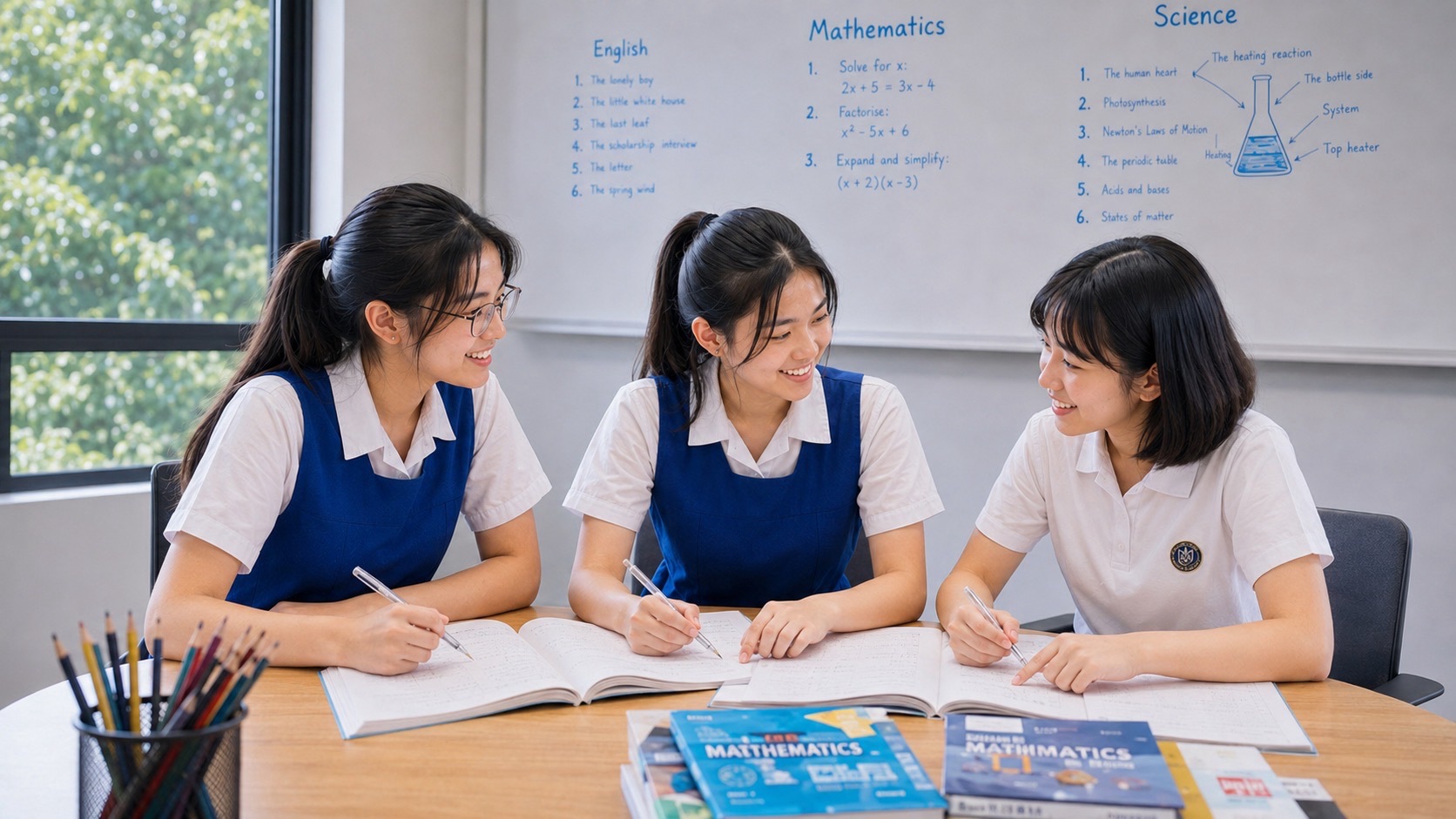
Dover Science tuition should help a Primary learner understand that a scientific model is a useful representation of reality—not reality itself.
This rebuilt legacy page therefore owns a distinct RFE: model → prediction → observation → evidence → model revision. Dover already has stronger generic Science tuition owners, so this URL should not compete for the same location keyword. Its job is to teach how models help us think, predict and explain—and how evidence can reveal their limits.
eduKate teaches in groups of up to three students, generally for 90 minutes. In a 3-pax Science class, students can compare different mental models, make competing predictions and explain why one representation fits the evidence better than another.
Location-integrity note: this legacy URL contains historical Yishun/Marina Bay/Dover wording. It should not be read as proof of a current branch at any old address. Current class location and availability should be confirmed directly.
The 2026 Primary Science Context
For the 2026 PSLE, Science is subject code 0009 and is based on the 2023 Primary Science syllabus. The assessment includes knowledge with understanding, application of knowledge and scientific inquiry, including interpreting information, evaluating observations and communicating scientific explanations.
Parents can verify the current syllabus through the 2026 PSLE Science syllabus and the SEAB PSLE formats page.
What Is a Scientific Model?
A model is a representation used to explain or predict some part of a system.
Primary Science models may include:
- diagrams of circuits;
- food-chain or food-web representations;
- water-cycle diagrams;
- particle-like representations used to think about matter;
- organ-system diagrams;
- simple models of forces or motion;
- life-cycle diagrams.
The model is useful because it simplifies reality enough for us to reason.
Models Have a Job
Before using a model, ask:
- What is this model trying to represent?
- What relationship does it make visible?
- What prediction can I make from it?
- What does it leave out?
A model that is good for one question may be poor for another.
The Model Cycle
| Stage | Question |
|---|---|
| Model | How do I currently represent the system? |
| Predict | What should happen if the model is useful? |
| Observe | What actually happens? |
| Compare | Does the evidence fit the prediction? |
| Revise | What part of the model needs updating? |
This turns Science from answer memorisation into evidence-guided thinking.
Example: Electrical Circuit Model
A learner may predict that adding another bulb in a particular arrangement will make all bulbs dimmer.
Before giving the answer, ask:
- What model of the circuit is the learner using?
- What does that model predict?
- What observation would support or weaken it?
- What feature of the circuit arrangement matters?
The purpose is not merely to recall a rule. It is to connect representation, prediction and observation.
Example: Plant System
A learner may hold an oversimplified model: “Plants need sunlight to grow.”
Useful next questions:
- What process is sunlight connected to?
- What else does the plant need?
- What would we predict if light changes?
- What observation would actually test that prediction?
The model becomes more structured and less slogan-like.
Models Can Be Useful and Incomplete
A diagram may show only the parts relevant to the current question.
Students learn:
- simple does not mean false;
- simplified does not mean complete;
- missing detail matters only if it affects the question being asked;
- a model should not be stretched beyond its purpose.
This is an important scientific habit: knowing the boundary of a representation.
Prediction Before Observation
Prediction reveals the learner’s current model.
Ask:
What do you expect to happen, and why?
Then compare with evidence. If the result is surprising, the surprise is useful because it exposes a mismatch between model and reality.
Observation Has Authority
Students sometimes cling to the memorised rule even when the data contradicts it.
We teach:
prediction is provisional; observation updates the model.
This does not mean one noisy observation overturns established Science immediately. It means the learner must interpret evidence honestly rather than force every result to match expectation.
Model Revision
After a mismatch, ask:
- Was the prediction based on the wrong relationship?
- Was an important variable ignored?
- Was the method poor?
- Was the observation unreliable?
- Does the model need a new condition or boundary?
The learner should distinguish a bad model from a bad experiment.
Visual Models and Hidden Processes
Models are especially useful when the process cannot be seen directly.
Examples include:
- how energy is transferred;
- how materials move through systems;
- how organs interact;
- how unseen forces produce observable effects.
Students learn to connect the invisible relationship to observable consequences.
Do Not Memorise the Diagram Without the Relationship
Weak learning:
Copy the diagram exactly.
Stronger learning:
- What does each arrow mean?
- What happens if one part changes?
- Which part is essential to this explanation?
- Could the model be drawn another way and still preserve the relationship?
Meaning survives surface changes.
Counterexamples Improve Models
If a learner says, “All objects that are heavier fall faster,” ask for evidence or a situation that challenges the claim.
Counterexamples help students:
- test overgeneralised rules;
- identify missing conditions;
- refine scientific language;
- avoid absolute claims unsupported by evidence.
The Dover Model Diagnostic
Representation
Can the learner explain what the model represents?
Prediction
Can a testable expectation be generated?
Observation
Can the evidence be read accurately?
Comparison
Can prediction and result be compared?
Revision
Can the model be updated without random guessing?
Boundary
Can the learner say what the model does not show?
Transfer
Can the same reasoning work on a different Science topic?
Six Common Model Failure Modes
1. Diagram Memorisation
The learner remembers the picture but not the relationship.
2. Model = Reality
The representation is treated as complete reality.
3. Prediction After Result
The learner only explains once the answer is known. We ask for prediction first.
4. Evidence Ignored
The memorised rule dominates contradictory data.
5. Revision Without Reason
The model changes randomly after every result.
6. No Boundary
The learner extends a model beyond the job it was designed to do.
What a 90-Minute 3-Pax Science Lesson Can Look Like
0–10 minutes: Model Retrieval
Students draw or explain a current representation from memory.
10–25 minutes: Prediction
Each learner predicts what a changed condition will do.
25–45 minutes: Evidence
Students inspect results, diagrams or data.
45–60 minutes: Model Comparison
Which prediction fit, and why?
60–80 minutes: Fresh System Transfer
The same model-cycle appears in another topic.
80–90 minutes: Boundary Check
Students state what their model explains and what it leaves out.
Why Three Students Helps
- Different models become visible.
- Students can make competing predictions.
- Peers challenge overgeneralised claims.
- The tutor can compare reasoning, not just final answers.
- Every learner still writes independent explanations.
What Parents Can Bring
- recent Science papers;
- diagram/model questions;
- questions the learner memorised but cannot explain;
- teacher comments;
- assessment dates.
What Progress Looks Like
- models are explained rather than copied;
- predictions become more justified;
- surprising evidence causes productive revision;
- absolute claims decrease;
- diagram arrows/parts gain meaning;
- model reasoning transfers across topics.
Frequently Asked Questions
Does this page claim a current Dover Science tuition centre?
No. It is a legacy Dover/Yishun learner route; current class location and availability must be confirmed directly.
Are scientific models always drawings?
No. A model can also be verbal, physical, mathematical or conceptual. At Primary level, diagrams and simple conceptual models are common.
Can a model be wrong but still useful?
A simplified model can be useful within a limited purpose. What matters is knowing its scope and whether its predictions fit the evidence for the question being asked.
Ten Checks for Model-Based Science
- What does the model represent?
- What relationship does it show?
- What does it leave out?
- What prediction follows?
- What evidence would test it?
- What was observed?
- Did the evidence fit?
- Was the method reliable?
- What should be revised?
- Can the reasoning transfer?
A Good Science Model Helps You Predict—and Tells You When It Needs Updating
That is the purpose of this Dover Science tuition support route:
model → predict → observe → compare → revise → transfer.
Families may also use the broader Dover Science Tuition route.
Almost-Code Summary
LEARNER_ROUTE = Dover_Primary_Science_models
PAGE_RFE = scientific_model_prediction_revision
PSLE_2026 = subject_0009 + 2023_primary_science_syllabus
CLASS = max_3
LESSON = 90_minutes
GOAL = model_based_reasoning_with_evidence_and_limits