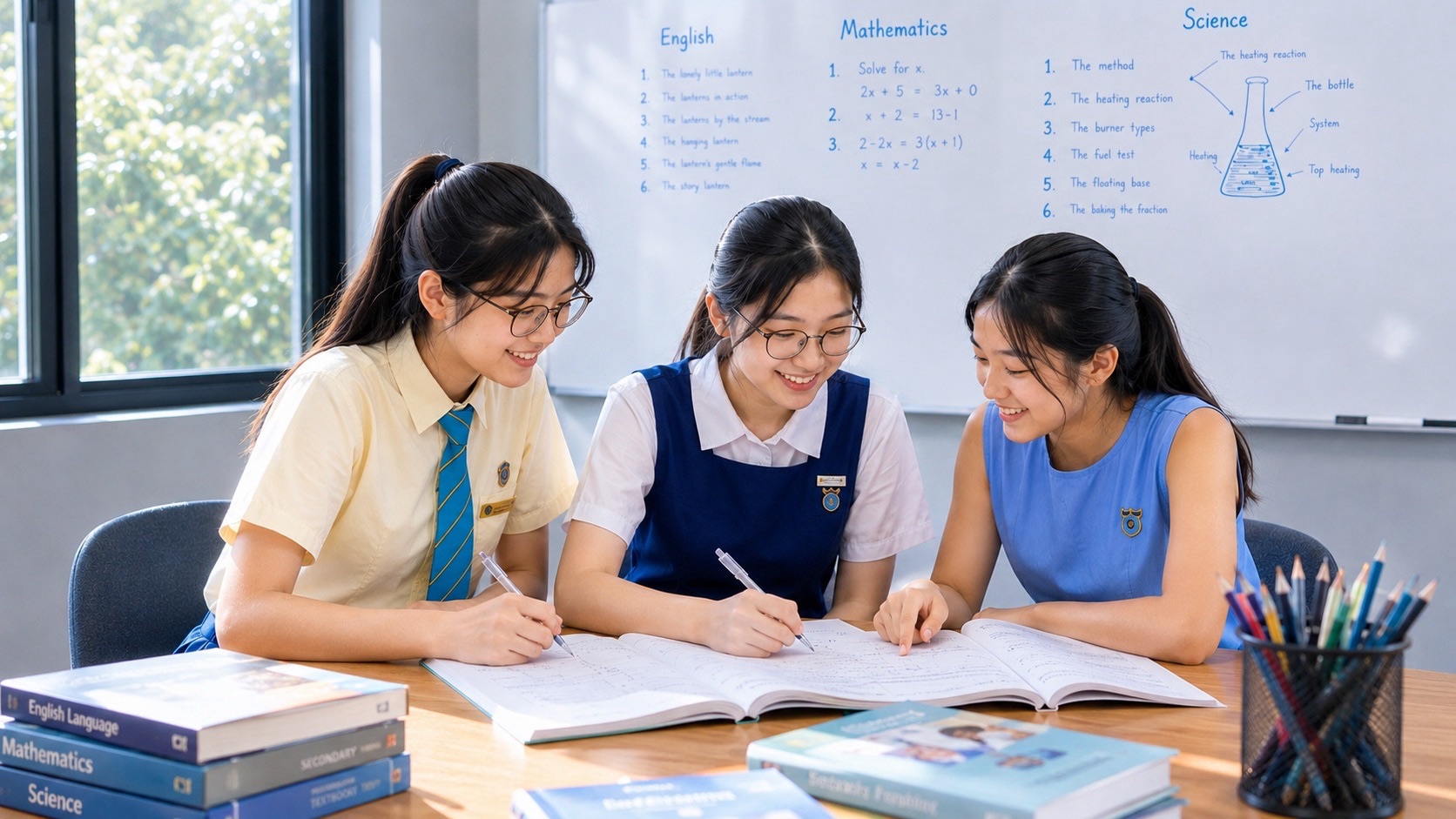
Simei Science tuition should help a Primary learner turn what they observe into a scientific claim, support that claim with relevant evidence and explain the relationship using the correct concept.
Many open-ended Science answers fail even when the student “knows the topic”. The learner may describe the result without answering the question, state a claim without evidence, copy data without interpreting it, or use a scientific keyword without explaining how it connects to the observation.
This rebuilt legacy page therefore owns a distinct RFE: observation → claim → evidence → reasoning. The Simei Science estate already contains multiple broader location and level owners, so this URL should not become another generic Simei Science tuition page. Its job is to teach a transferable answer-building process for observations, tables, diagrams and experimental results.
eduKate teaches in groups of up to three students, generally for 90 minutes. In a 3-pax Science class, every learner can explain the same evidence aloud, compare different claims and receive close correction on whether the reasoning actually follows.
Location-integrity note: this legacy URL contains historical Yishun/Marina Bay/Simei location wording. It should not be read as proof of a current branch at any old address. Current class location and availability should be confirmed directly.
The 2026 Primary Science Context
For the 2026 PSLE, Science is subject code 0009. SEAB states that the examination assesses attainment in Science based on the 2023 Primary Science syllabus. The assessment includes knowledge with understanding and the application of knowledge and scientific inquiry, including interpreting and analysing information, evaluating observations and methods, and communicating explanations and reasoning.
Parents can verify the current syllabus and format through the 2026 PSLE Science syllabus and the SEAB PSLE formats page.
The implication for tuition is important: students should not only remember scientific facts. They must apply concepts to evidence and communicate the reasoning clearly.
The Core Answer Architecture
| Stage | Question |
|---|---|
| Observation | What exactly happened or what does the data show? |
| Claim | What conclusion answers the question? |
| Evidence | Which observation/data supports the claim? |
| Reasoning | Which scientific concept explains why the evidence supports the claim? |
| Check | Did I answer this question, not a nearby one? |
The exact wording should fit the question. The structure is a reasoning guide, not a memorised sentence template.
Observation Is Not Explanation
Observation:
The water level in Set-up A decreased more than in Set-up B.
That tells us what happened. It does not yet explain why.
Students need to distinguish:
- what was observed;
- what can be concluded;
- what scientific concept accounts for it.
Blurring these levels can produce vague answers.
Claim Must Answer the Question
If the question asks which condition caused faster evaporation, the claim should identify the condition or relationship directly.
Weak:
There was less water in A.
Stronger claim:
Water evaporated faster in Set-up A.
The evidence then supports that claim.
Evidence Must Be Relevant
Students should not copy every value from a table.
Ask:
- Which two values actually allow the comparison?
- What changed?
- What stayed the same?
- Which observation directly supports my claim?
Evidence selection is scientific answer economy.
Reasoning Connects Evidence to Concept
Reasoning answers:
Why does this evidence support the claim?
A good explanation uses the relevant scientific idea, not a keyword floating alone.
For example, if light intensity affects photosynthesis, the learner should connect the changed condition to the process and then to the observed outcome rather than writing only “photosynthesis”.
Use Comparison Language Precisely
Useful forms include:
- greater than / less than;
- faster / slower;
- increased / decreased;
- higher / lower;
- more / fewer;
- same / different.
The direction of the relationship matters. Reversing the comparison can invalidate an otherwise correct explanation.
Tables and Graphs: Read Before Explaining
Before using a concept, students should extract the pattern.
Ask:
- What variable is on each axis/column?
- What are the units?
- What changed?
- What pattern appears?
- Is it direct, inverse, threshold-like or irregular?
- Which data points support the answer?
Scientific reasoning starts with accurate representation of the evidence.
Diagrams: Label the Relationship
For diagrams, identify:
- parts;
- arrows;
- direction of movement;
- before/after states;
- changed conditions;
- what the diagram is intended to represent.
Then answer using the correct concept.
Observation vs Inference
Observation:
The leaf turned yellow after several days.
Inference:
The plant may not have been producing enough chlorophyll or receiving the conditions needed to remain healthy.
Students learn that inference goes beyond direct observation and therefore must be justified carefully.
Do Not Use Keywords as Substitutes for Reasoning
Weak:
Because of heat.
Better:
The higher temperature provided conditions that increased the rate of the process, leading to the observed change.
The exact scientific relationship depends on the topic. The point is that the concept must do explanatory work.
Use Cause-and-Effect Carefully
Students should avoid claiming causation when the evidence only shows association unless the experimental design supports a causal conclusion.
In school investigations, ask:
- Was one factor deliberately changed?
- Were other relevant conditions kept the same?
- Was the outcome measured?
This links open-ended answering to fair-test reasoning.
Question Demand Matters
Science questions may ask students to:
- state;
- describe;
- compare;
- explain;
- predict;
- give a reason;
- suggest an improvement;
- identify a variable;
- interpret data.
The answer architecture should match the command.
Prediction Questions
A useful prediction often needs:
predicted outcome + scientific reason.
Where appropriate, students should connect the changed condition to a concept and then to the expected observation.
Evaluation Questions
Students may need to judge a method or conclusion.
Ask:
- Was the comparison fair?
- Was the measurement appropriate?
- Was there enough evidence?
- Were uncontrolled variables present?
- Would repeating improve reliability?
The reasoning should identify the methodological issue, not just say “not fair”.
The Simei Science Diagnostic
Observation
Can the learner state what the data/diagram shows?
Claim
Can the question be answered directly?
Evidence
Can the relevant observation be selected?
Concept
Is the scientific principle understood?
Reasoning
Can concept and evidence be connected?
Language
Are comparisons and causal relationships precise?
Transfer
Can the same reasoning process survive a new context?
Six Common Open-Ended Failure Modes
1. Observation Only
The learner describes data but never explains.
2. Claim Without Evidence
The conclusion appears unsupported.
3. Keyword Dump
Scientific terms are listed without relationships.
4. All-Data Copy
Irrelevant values obscure the answer.
5. Reversed Comparison
The direction of evidence is wrong.
6. Memorised Explanation
The learner reproduces a familiar answer that does not fit the new context.
What a 90-Minute 3-Pax Science Lesson Can Look Like
0–10 minutes: Retrieval
Key concept and scientific vocabulary return.
10–25 minutes: Observation/Data Read
Students interpret a table, graph or diagram before answering.
25–40 minutes: Claim/Evidence Separation
Students identify conclusion and support.
40–60 minutes: Reasoning Build
The scientific relationship is made explicit.
60–80 minutes: Fresh Context Transfer
The same concept appears in a different experiment or everyday situation.
80–90 minutes: Error Close
Was the failure observation, concept, evidence, reasoning or language?
Why Three Students Helps Science Reasoning
- Students compare different claims from the same evidence.
- Peers challenge unsupported conclusions.
- The tutor can ask each learner to explain why.
- Different wording reveals whether the concept is genuinely understood.
- Every learner still writes independently.
What Parents Can Bring
- recent Science papers;
- open-ended questions with partial marks;
- teacher comments;
- tables/graphs the learner found difficult;
- assessment dates.
What Progress Looks Like
- answers become more direct;
- evidence selection improves;
- scientific keywords become connected by reasoning;
- comparison language becomes more precise;
- data interpretation improves;
- unfamiliar contexts become more manageable.
Frequently Asked Questions
Does this page claim a current Simei tuition centre?
No. It is a legacy Simei/Yishun learner route; current class location and availability must be confirmed directly.
Is “claim-evidence-reasoning” an official PSLE answer format?
No. It is used here as a teaching scaffold for separating conclusion, support and explanation. Students should answer the actual question naturally.
Should every Science answer contain all four stages?
No. A simple “state” question may require only a direct answer. The scaffold is most useful when explanation and evidence are required.
Can strong learners benefit?
Yes. Use ambiguous data, method evaluation, competing explanations and tighter evidence selection.
Ten Checks for Open-Ended Science Reasoning
- What was observed?
- What is the question asking?
- What claim answers it?
- Which evidence matters?
- What scientific concept applies?
- How does the concept connect to the evidence?
- Is the comparison direction correct?
- Is any data irrelevant?
- Does the explanation fit this context?
- Can the method transfer?
Scientific Answers Become Stronger When Observation, Evidence and Explanation Stay Connected
That is the purpose of this Simei Science tuition support route:
observe → claim → select evidence → reason with concept → check → transfer.
Families may also use the broader Simei Science Tuition route.
Almost-Code Summary
LEARNER_ROUTE = Simei_Primary_Science_reasoning
PAGE_RFE = observation_claim_evidence_reasoning
PSLE_2026 = subject_0009 + 2023_primary_science_syllabus
CLASS = max_3
LESSON = 90_minutes
GOAL = evidence_grounded_scientific_explanation