
Primary 3 is where English increasingly becomes the tool used to learn everything else. Students are no longer only learning how to read and write. They are expected to read instructions, understand denser passages, explain ideas, interpret vocabulary in context and use language to access Science, Mathematics word problems and wider school learning.
This page is for Yishun families comparing Primary 3 small-group English tuition. It does not claim a current physical eduKate tuition centre in Yishun. Families should confirm current class location and availability directly. The educational job here is specific: helping P3 students make the transition from early literacy into reading-to-learn.
Quick Read: Primary 3 Changes the Job of Reading
In Primary 1 and 2, a large amount of effort may still be spent on reading mechanics and basic sentence formation. By Primary 3, the student needs enough fluency that attention can move toward relationships and ideas.
The child must increasingly:
- read longer texts without losing the main idea;
- understand more abstract and academic vocabulary;
- track cause, sequence, comparison and reference;
- explain answers with evidence;
- write connected paragraphs;
- maintain grammar across longer responses;
- learn words and corrections independently;
- transfer English skills into other subjects.
This is why hidden P1–P2 gaps often become visible in P3.
The Diagnostic Question: Is Reading Still Too Expensive?
A student may be able to read a P3 passage accurately but still spend so much mental effort on individual words that little attention remains for meaning.
We check reading across accuracy, fluency, vocabulary, comprehension and stamina.
If fluency is still the bottleneck, Catch Up work may temporarily return to shorter texts, repeated reading and vocabulary repair. If reading is fluent but understanding is weak, the focus shifts toward text structure, reference and inference.
Reading-to-Learn Skill 1: Identify the Main Job of a Paragraph
Primary 3 students benefit from learning that paragraphs are organised units of meaning.
After reading, the student may label a paragraph in a few words: “introduces the problem,” “explains why plants need light,” “shows how the character reacted,” or “gives an example.”
This helps the student navigate longer texts and prepares for later comprehension.
Reading-to-Learn Skill 2: Track Sequence
Students need to understand not only individual events but their order.
Sequence language such as before, after, later, eventually, first and finally supports narrative and informational reading.
We also teach that writers do not always present events in strict chronological order. Pronouns and tense may signal movement in time.
Reading-to-Learn Skill 3: Cause and Effect
Cause-and-effect relationships become increasingly important in comprehension and across subjects.
Students learn to distinguish what happened from why it happened and what followed.
Signal words help, but the relationship may be implied. We ask students to express it explicitly: “Because X happened, Y occurred.”
This also strengthens explanatory writing.
Reading-to-Learn Skill 4: Reference Tracking
Words such as he, she, they, it, this, those and such require the reader to connect sentences.
If the child loses the reference, the paragraph becomes fragmented.
We teach students to identify what each pronoun or reference word points to and replace it mentally when necessary.
This is a small skill with large comprehension effects.
Reading-to-Learn Skill 5: Start Building Inference
Primary 3 students can begin moving beyond direct retrieval.
We teach inference as evidence plus conclusion. If a character keeps looking at the clock and waiting by the door, the student may infer impatience or eagerness depending on context.
The important habit is to answer, “What in the text made you think that?”
Inference becomes reasoning rather than guessing.
Academic Vocabulary Begins to Matter More
Primary 3 texts increasingly contain words used for school thinking, not only everyday objects and actions.
Students encounter language related to comparison, explanation, observation, sequence, consequence, description and judgement.
Words such as compare, observe, describe, result, reason, difference, similar and evidence can appear across subjects.
Teaching these words helps the child understand both content and instructions.
Vocabulary in Networks
We teach words with related forms, synonyms, opposites and common contexts.
For example, observe connects to observation and observant. The student compares observe with look, notice and examine.
The word then appears in reading, oral explanation and writing.
This makes vocabulary more retrievable and transferable.
Grammar: Longer Writing Exposes Hidden Instability
P3 students write more, so grammar errors that were rare in short sentences can become more visible.
We monitor tense, subject-verb agreement, pronouns, articles, prepositions, conjunctions, sentence boundaries and punctuation.
The tutor asks whether the student knows the rule and whether the rule survives spontaneous writing.
Those are different questions.
Sentence Expansion into Explanation
Primary 3 students should increasingly move beyond descriptive detail and learn to explain relationships.
“The plant grew badly” can become “The plant grew poorly because it did not receive enough sunlight.”
The conjunction expresses a causal relationship, and the sentence now carries reasoning.
This supports English and Science writing.
Paragraph Writing: One Main Idea, Connected Support
Students practise paragraphs that explain, describe, compare or narrate.
The paragraph should have a clear focus. Supporting sentences develop that focus rather than wander.
We use oral rehearsal when necessary. If the student cannot explain the paragraph aloud, writing it may be unnecessarily difficult.
Narrative Writing: Develop the Important Moment
P3 students are ready to move beyond simple event lists.
We teach them to select one important moment and develop it using action, dialogue, thought or specific detail.
The story still needs clear sequence and relevance. Sophisticated language is not the priority if structure is unstable.
Comprehension: Read the Question as Carefully as the Passage
As question types broaden, students need to identify whether they are being asked for a fact, reason, sequence, comparison or inference.
We teach a simple route:
Question → Evidence → Answer → Check.
Students locate the evidence and build a complete sentence rather than copy large chunks blindly.
Visual Text and Information Design
Primary students increasingly encounter notices, posters, diagrams and mixed text.
We teach P3 students to look at headings, labels, images and placement as part of meaning.
They ask who the text is for, what information is most important and what action the reader may need to take.
Oral Communication: Explain, Not Just Answer
A P3 student can begin extending oral responses with a reason and example.
We use reading passages and everyday topics to practise direct answers, explanation and relevant personal examples.
This builds the thought organisation later needed for writing.
Listening: Hold Several Details in Sequence
Listening work at P3 increasingly requires the student to maintain attention across more information.
We practise identifying sequence, key details, contrast and speaker purpose.
The student learns to stay with the message after missing one word.
English across the Curriculum
Reading-to-learn matters because many school difficulties are partly language difficulties.
A Mathematics word problem requires the student to parse relationships. A Science question may require vocabulary such as “explain,” “state,” “compare” or “observe.” Instructions contain conditions and sequences.
English tuition should not attempt to replace subject teaching, but stronger language can reduce unnecessary friction across subjects.
Why Three Students Works for Primary 3
P3 students are old enough for meaningful peer discussion but still benefit from close tutor observation.
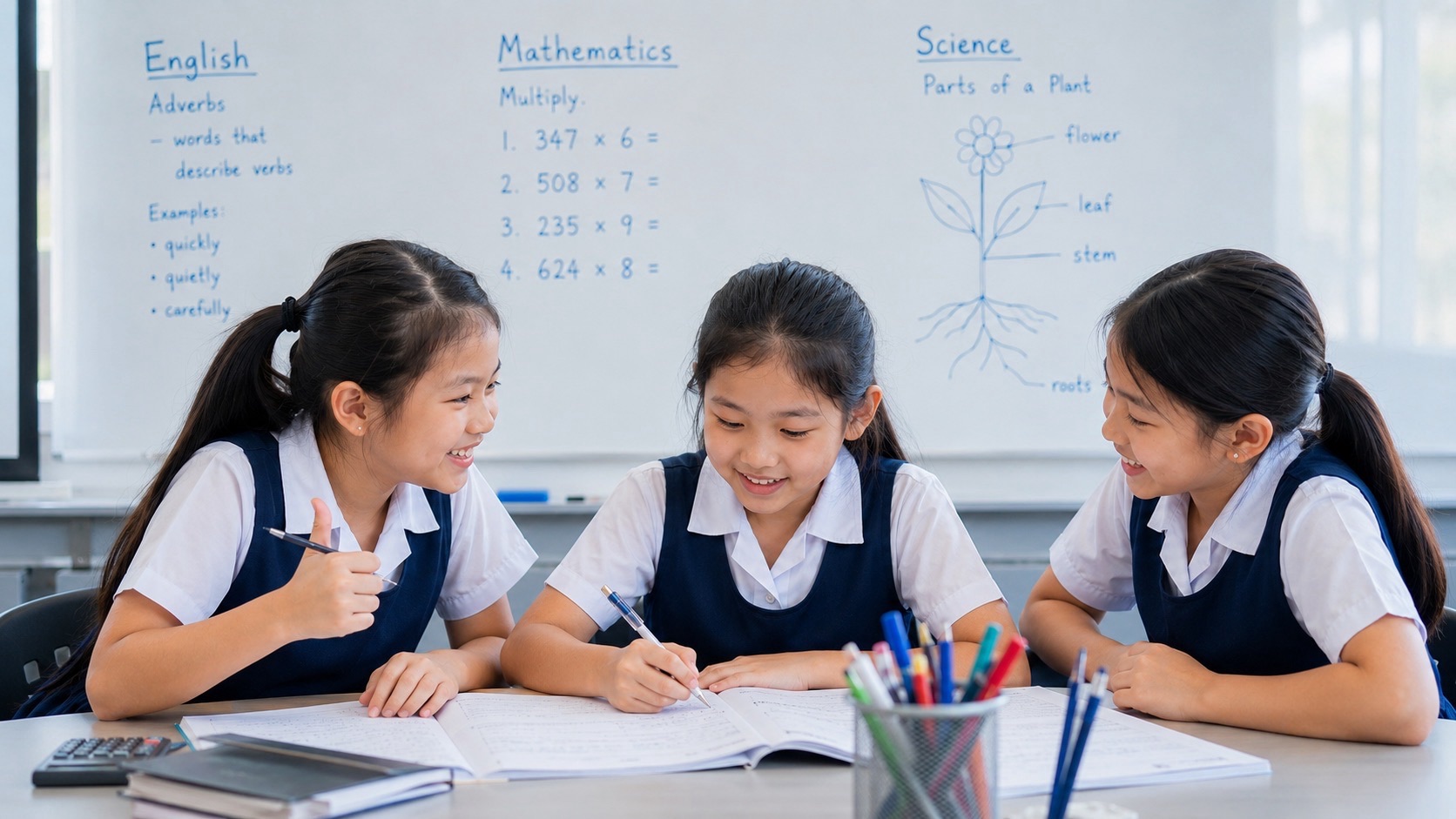
In a three-student group, every learner can explain comprehension evidence, compare vocabulary, read aloud and receive writing feedback.
The tutor can differentiate the questions: one student may work on direct evidence, another on inference and another on extension.
The Independence Shift at Primary 3
Students can begin owning more of the learning process:
- record useful vocabulary;
- identify one repeated grammar error;
- check comprehension answers for evidence;
- plan a paragraph before writing;
- ask a specific question when stuck;
- retrieve earlier learning without notes.
These routines prepare the child for upper Primary.
Catch Up: Repair Early Literacy without Infantilising the Student
A P3 student may still need P1–P2 reading or sentence repair.
We use age-appropriate topics while targeting the earlier skill. The child does not need babyish material simply because the underlying foundation is weak.
The objective is rapid reconnection to current P3 learning.
Keep Up: Make the Transition Stable
Keep Up students need to maintain school pace while vocabulary, reading and writing demands grow.
We use spaced retrieval and mixed practice so older skills remain available.
Corrections are revisited rather than forgotten after one worksheet.
Move Ahead: Deeper Reading and More Independent Writing
Strong P3 students can work with richer texts, subtler inference, more precise vocabulary, stronger paragraph development and independent editing.
They can also compare how different writers explain or describe the same kind of idea.
A 90-Minute P3 Lesson
A lesson may begin with retrieval, followed by a reading or language input. The tutor teaches one priority relationship such as cause-and-effect, reference tracking or paragraph focus.
Students practise through discussion and written work. The skill then appears in a changed text or writing task to test transfer.
The lesson ends with correction and focused home practice.
Homework: Build the Reading Habit
P3 students benefit from regular independent reading because language exposure now matters more.
Homework may also include vocabulary retrieval, a short comprehension task, paragraph writing or mixed grammar.
The work should have a clear purpose and remain sustainable.
Parent Progress Signals
- the child reads longer texts with less fatigue;
- retelling becomes more organised;
- academic vocabulary grows;
- the student notices cause, sequence and comparison;
- comprehension answers use clearer evidence;
- paragraphs stay more focused;
- grammar remains steadier in longer writing;
- the child can explain school instructions more accurately;
- independent reading increases.
What P3 Should Prepare for in P4
Primary 4 will require more integration. Comprehension becomes more demanding, writing is longer and grammar must transfer under greater load.
A strong P3 year therefore secures reading-to-learn, academic vocabulary, paragraph writing and independent correction.
The child should enter P4 able to focus on deeper interpretation rather than still fighting basic fluency.
Common Misconceptions
“Primary 3 is just Primary 2 with harder words.”
The deeper shift is that reading increasingly becomes a tool for learning and explanation.
“Comprehension answers are found by matching keywords.”
Some direct questions allow retrieval, but students increasingly need to understand relationships and evidence.
“Good readers do not need vocabulary teaching.”
Strong readers can still deepen academic vocabulary, nuance and retrieval.
“A P3 child should already be writing long compositions.”
Length alone is not the goal. Relevance, development, sentence control and paragraph coherence matter more.
A Note for Yishun Families
This historical Yishun URL now serves the Primary 3 reading-to-learn transition. It does not claim a current physical eduKate centre in Yishun. Confirm current location, timetable and three-student group availability directly.
Frequently Asked Questions
Why did my child suddenly struggle more in P3?
Earlier gaps may become visible as texts, vocabulary and explanation demands increase. A diagnostic can separate fluency, vocabulary, comprehension and writing causes.
Should P3 students read chapter books?
Appropriate longer reading can build stamina and vocabulary, but text choice should match the child’s current fluency and interest.
Can tuition help other subjects indirectly?
Stronger reading and academic language can reduce language friction in subjects such as Science and Mathematics, though tuition remains focused on English.
Are classes three students?
Where the premium 3-pax format is available, three students allows frequent reasoning, reading and writing feedback.
Do you guarantee marks?
No. We improve the learning system but cannot ethically guarantee a specific result.
Continue through the eduKate English Ecosystem
Families can use First Principles of Primary English Tuition for the broader framework and the Vocabulary Lists hub for free vocabulary resources.
The Primary 3 Goal: Make Language Carry More Thinking
Primary 3 is successful when reading becomes sufficiently fluent and meaningful that the student can use language to learn.
The child begins to track relationships, interpret evidence, explain reasons, use academic vocabulary and organise written paragraphs.
That transition matters far beyond English. It gives the student a stronger tool for understanding the increasingly complex school world ahead.
Parent–Student Consultation
If you are considering Primary 3 small-group English tuition, share the child’s recent school English work, reading habits, vocabulary, comprehension, writing and any cross-subject language difficulties you have noticed. The consultation can identify Catch Up, Keep Up or Move Ahead priorities and whether a suitable current three-student group is available.
This page does not claim a current physical eduKate tuition centre in Yishun. Confirm location and availability directly.