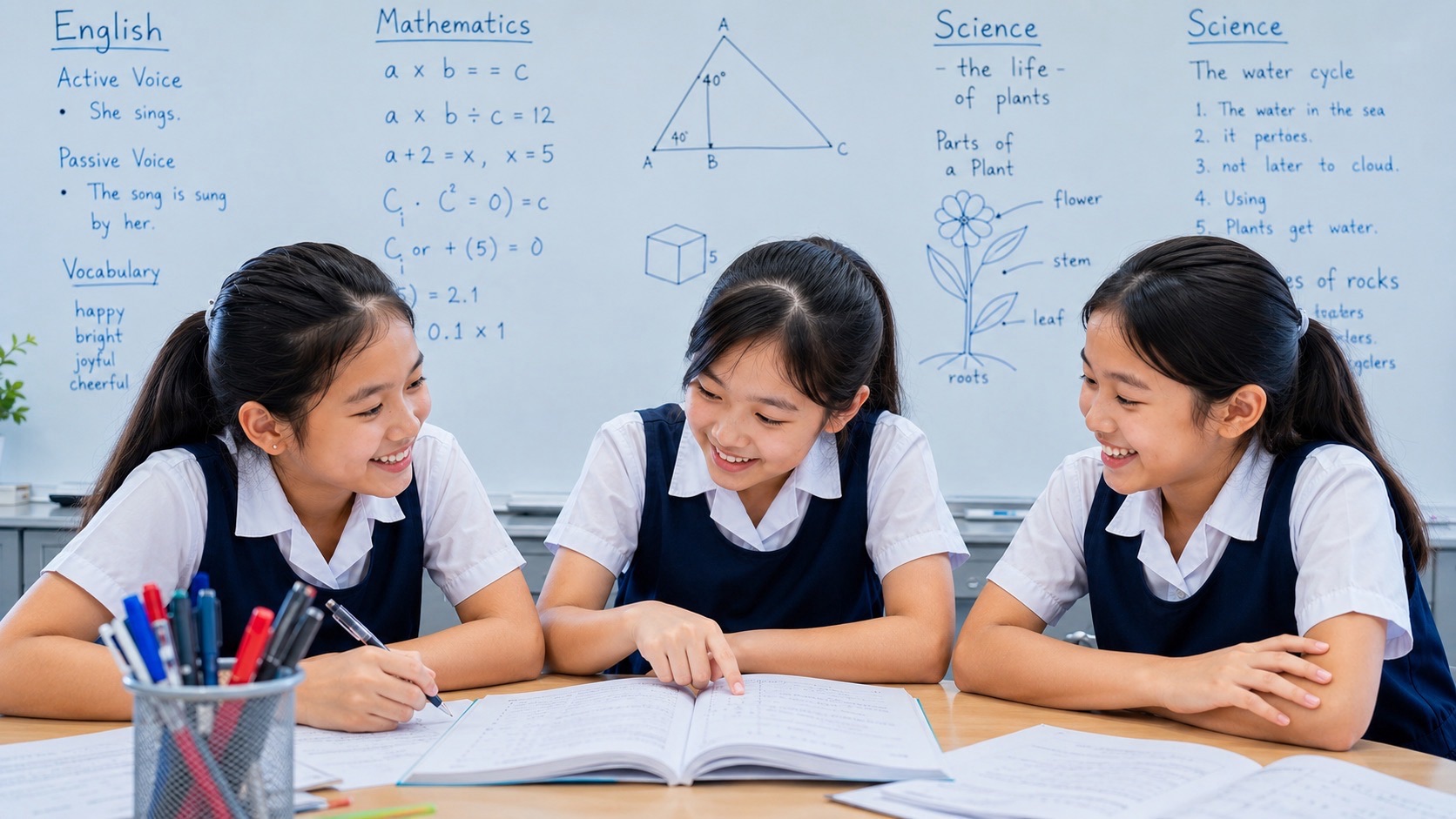

Primary 2 is where early English foundations should begin becoming fluent enough that the child can focus less on decoding and more on meaning. The year is still foundational, but the demands grow: texts become longer, vocabulary widens, sentence writing expands and students are expected to work with greater independence.
This page is for Yishun families comparing Primary 2 small-group English tuition. It does not claim a current physical eduKate tuition centre in Yishun. Families should confirm current class location and availability directly. The educational job here is specific: helping P2 students move from early literacy into more fluent reading, richer vocabulary and connected writing.
Quick Read: Primary 2 Is the Fluency Year
At Primary 1, many students are still building the basic machinery of school English. By Primary 2, that machinery should begin operating with less conscious effort.
A P2 student needs to read with increasing fluency, hold the meaning of a sentence in mind, answer questions with more complete language, retrieve a wider vocabulary and connect several sentences around one idea.
We therefore focus on five transitions:
- decoding → fluent reading;
- word recognition → vocabulary use;
- single answers → fuller explanation;
- isolated sentences → connected paragraphs;
- constant adult prompting → simple independent routines.
Reading Fluency: Accuracy Must Become Easier
A child who still spends too much attention sounding out common words has less attention available for meaning.
We continue decoding repair where necessary, but P2 reading increasingly emphasises smooth phrasing, punctuation, expression and comprehension.
Repeated reading can be useful when the text is well matched. Students practise until the language begins to sound like connected speech rather than a list of separate words.
Fluency Is Not Speed Reading
Reading faster is not useful if meaning is lost.
We want an appropriate pace: fast enough for the sentence to remain mentally connected, slow enough to notice important words and punctuation.
Students learn to slow down at unfamiliar language, reread when meaning breaks and continue smoothly when the text is understood.
Comprehension: From Recall to Simple Reasoning
P2 students should increasingly answer more than who, what and where.
We introduce questions about why something happened, how a character may feel, what happened first and what might happen next.
The student learns to point to evidence in the text rather than answer only from personal opinion.
This is an early foundation for later inference.
Retelling: A Powerful P2 Diagnostic
After reading, we may ask the child to retell the passage in sequence.
A strong retelling reveals that the student built a coherent mental model. A fragmented retelling may indicate weak comprehension, vocabulary or attention even if individual worksheet answers are correct.
Students learn to identify the beginning, important change and ending without reproducing every sentence.
Vocabulary: Grow Breadth and Depth Together
Primary 2 vocabulary should expand through reading, conversation and deliberate teaching.
We connect words to synonyms, opposites, categories, actions and contexts. Students use new words orally before writing them.
The goal is not to memorise an impressive list. It is to make useful words available when the child reads, speaks and writes.
Word Families Support Both Vocabulary and Spelling
Students can learn connections such as help, helpful and helpless, or care, careful and careless.
Word families show how meaning changes and help students notice spelling patterns.
This becomes increasingly valuable as vocabulary grows.
Sentence Expansion: Add Meaning Deliberately
Primary 2 writers often know how to produce a simple sentence but need help making it richer without losing control.
We teach expansion through questions:
- Who or what?
- What happened?
- Where?
- When?
- How?
- Why?
“The girl ran” might become “The frightened girl ran quickly towards the gate when she heard the loud crash.”
The purpose is not to make every sentence long. It is to show how details attach to a clear core.
Sentence Variety Begins with Control
Students can begin joining related ideas with suitable conjunctions. They learn that and, but, because and so express different relationships.
We connect grammar to meaning. The conjunction is chosen because the ideas have a particular relationship, not because the worksheet asks for a linking word.
From Sentences to Paragraphs
P2 students begin writing short connected pieces rather than unrelated sentences.
A paragraph should stay on one topic or event. Students practise sequencing, pronoun reference and simple transitions.
They learn that the reader should not have to guess who “he” refers to or how one sentence connects to the next.
Simple Narrative Writing
Stories at P2 can focus on sequence, clear events and simple development.
We help students identify a beginning situation, a change or problem and an ending. Oral rehearsal can come first.
The child is encouraged to use specific verbs and details, but not to overload the piece with memorised expressions.
Simple Functional Writing
Where school tasks require practical writing, students learn to communicate information clearly and completely.
Purpose and audience are introduced in simple terms: Who are you writing to? What does that person need to know?
This prepares students for more formal situational writing later.
Grammar: Move beyond Isolated Rules
Primary 2 grammar includes sentence patterns, tense, pronouns, singular/plural forms, articles, prepositions and conjunctions.
We teach explicit rules, then ask students to find and use them inside paragraphs.
The real test is whether the child can maintain the rule while writing something new.
Editing: Build One or Two Checking Habits
P2 students do not need a long editing checklist.
We start with a few high-value checks: capital letter, full stop, missing word, spelling pattern, tense or a personal repeated error.
The student reads the sentence back slowly. Over time, the child learns to see the actual written sentence rather than the intended one.
Listening: Follow Sequence and Key Details
Listening work helps students process language in real time.
We practise following instructions, identifying sequence, noticing key details and resisting the urge to answer before the whole message is heard.
The student also learns to recover after missing one word instead of giving up on the rest.
Oral Language: Extend beyond One Sentence
A P2 student should increasingly be able to give a direct answer and add a reason or example.
We use discussion, picture prompts and reading texts. Students learn to speak in complete ideas and listen to peers.
Oral language supports later paragraph writing because ideas are organised before they are written.
Why Three Students Works for Primary 2
A three-student group gives every child frequent reading, speaking and writing feedback.
The tutor can hear whether reading is genuinely fluent, notice repeated grammar patterns and ask each student to explain comprehension answers.
Peers provide alternative vocabulary and sentences without turning the class into a large environment where quieter students disappear.
The Independence Shift
Primary 2 students can begin managing simple learning routines:
- read the whole instruction;
- attempt before asking;
- underline or identify the difficult word;
- check punctuation;
- use a taught strategy;
- explain what they are unsure about.
The tutor gradually reduces prompting.
Catch Up: When P1 Foundations Are Still Costly
Some P2 students still need significant decoding, high-frequency word or sentence repair.
Catch Up returns to the necessary foundation without turning the whole programme backwards.
Age-appropriate content is maintained while the underlying skill is repaired.
Keep Up: Build Fluency and Consistency
Keep Up students are broadly on track but benefit from regular reading, vocabulary retrieval, grammar, comprehension and writing.
We use spaced review so earlier learning remains available as the school year progresses.
Move Ahead: Deepen Reading and Writing without Racing
Strong P2 students can work with richer texts, deeper vocabulary, more developed explanations and longer connected writing.
They can compare language choices and edit more independently.
Moving ahead means increasing depth, not simply giving a P3 worksheet.
A 90-Minute P2 Lesson
A lesson may begin with retrieval of vocabulary or spelling patterns, followed by reading and comprehension discussion. The tutor teaches one language relationship, then students practise through sentence or paragraph work.
Oral discussion and independent application are included. The lesson ends with focused correction and homework.
The sequence varies depending on the child’s needs.
Homework: Build Frequency without Overload
P2 students benefit from regular reading and short language practice.
Homework may include reading, vocabulary retrieval, sentence expansion, a short paragraph or targeted grammar.
The task should support the week’s learning job. Large volume is not automatically better.
What Parents Can Do at Home
Encourage reading and talk about what happened in the text. Ask the child to explain one new word or retell the sequence.
During writing, ask the child to read the paragraph aloud and check whether the sentences connect.
Parents can support the process without correcting every answer before tuition.
Progress Signals
- reading becomes smoother;
- the child remembers more of what was read;
- retelling becomes better organised;
- vocabulary grows beyond repeated basic words;
- sentences contain more useful detail;
- paragraphs become more connected;
- grammar remains more stable during writing;
- oral responses become longer and clearer;
- the student starts tasks more independently.
What Primary 2 Should Prepare for Next
Primary 3 will place more weight on reading to learn. Texts and questions become denser, and vocabulary matters increasingly across subjects.
A strong P2 foundation therefore protects reading fluency, sentence control, vocabulary and independent routines.
The child does not need to be doing P3 examination work early. The child needs enough fluency that P3 can focus on meaning rather than unresolved mechanics.
Common Misconceptions
“My child reads quickly, so fluency is solved.”
We also check accuracy, phrasing and comprehension. Speed without meaning is not useful fluency.
“P2 writing should already sound sophisticated.”
Clear, connected and increasingly detailed writing is the priority. Style can grow gradually.
“More spelling words means stronger vocabulary.”
Spelling and vocabulary overlap but are not the same. Students need meaning, context and retrieval.
“Small group means all students do identical work.”
The shared learning job can remain common while questions and support are calibrated.
A Note for Yishun Families
This historical Yishun URL now serves the Primary 2 fluency route. It does not claim a current physical eduKate centre in Yishun. Confirm current lesson location, timetable and 3-pax availability directly.
Frequently Asked Questions
How do I know if my P2 child still needs reading repair?
Look for persistent guessing, very slow reading, frequent loss of meaning, avoidance of text or difficulty retelling. Recent school feedback can also help.
Should P2 students write full compositions?
Writing length and format should be age-appropriate. We often prioritise sentence and paragraph control before demanding long pieces.
How much reading is enough?
Regular, sustainable reading is more important than a fixed number of pages. Texts should be accessible enough for meaning but rich enough to grow language.
Are classes three students?
Where the premium 3-pax format is available, three students allows close reading, oral and writing feedback.
Do you guarantee results?
No. We improve the learning process but cannot guarantee a specific school result.
Continue through the eduKate English Ecosystem
Families can read First Principles of Primary English Tuition and use the Vocabulary Lists hub for broader language resources.
The Primary 2 Goal: Make English More Automatic without Making It Mechanical
By the end of Primary 2, students should be spending less mental effort on basic mechanics and more on meaning.
Reading becomes smoother. Vocabulary becomes more available. Sentences become richer. Short paragraphs become more coherent. The child can listen, explain and work with less adult direction.
That fluency prepares the student for the next major shift: Primary 3, where English becomes increasingly important as a tool for learning across the curriculum.
Parent–Student Consultation
If you are considering Primary 2 small-group English tuition, share the child’s current reading fluency, recent school work, writing, vocabulary, confidence and timetable. The consultation can identify whether the child needs Catch Up, Keep Up or deeper extension and whether a current three-student group is suitable.
This page does not claim a current physical eduKate tuition centre in Yishun. Confirm location and availability directly.