A strong Science student presents a different tuition problem.
The learner may already understand school content, score consistently and complete ordinary practice without much help. Adding more of the same can increase workload without increasing capability.
At that point, Science tuition should change jobs.
The question is not “How do we make the student do even more Science?” It is “What form of scientific thinking is still missing when ordinary school success is already secure?”
Enrichment Is Not Simply Harder Questions
A question can be hard because it is obscure, cluttered or unusually worded.
Good enrichment should increase the quality of the reasoning demanded.
- Can the student compare competing explanations?
- Can the learner say what evidence would change the conclusion?
- Can the student identify the limits of a model?
- Can the learner reason when information is incomplete?
- Can the student connect ideas across topics?
These are deeper scientific jobs than completing a larger worksheet.
Move From Answers to Models
Strong learners often become very efficient at finding the expected answer.
Enrichment can ask a different question: what model of the system makes the answer true?
The student can be asked to predict what happens when one condition changes, distinguish what the model explains from what it does not, or compare two representations of the same process.
This makes knowledge more flexible and less dependent on familiar question forms.
Evidence Should Become More Demanding
A strong Science student should increasingly distinguish observation, interpretation and conclusion.
What exactly was measured? What inference is justified? What alternative explanation remains possible? What additional evidence would reduce uncertainty?
This teaches the student that Science is not only a collection of correct statements. It is a disciplined way of connecting claims to evidence.
Use Uncertainty Productively
Developing students often benefit from questions with one clear route.
Strong students can learn from situations where the available evidence supports several possibilities and the task is to decide what can and cannot yet be concluded.
The goal is not ambiguity for its own sake. It is calibrated reasoning: making a claim that is as strong as the evidence allows, but no stronger.
Transfer Should Increase Before Acceleration
A strong student may be ready to learn ahead, but future content should not be the automatic first move.
First test whether current knowledge survives unfamiliar contexts, mixed topics and reduced tutor support.
If transfer is already strong, selective acceleration can add new connections. If transfer is fragile, deeper current-level work may be more valuable than another chapter.
Three-Student Tutorials Can Create Intellectual Friction
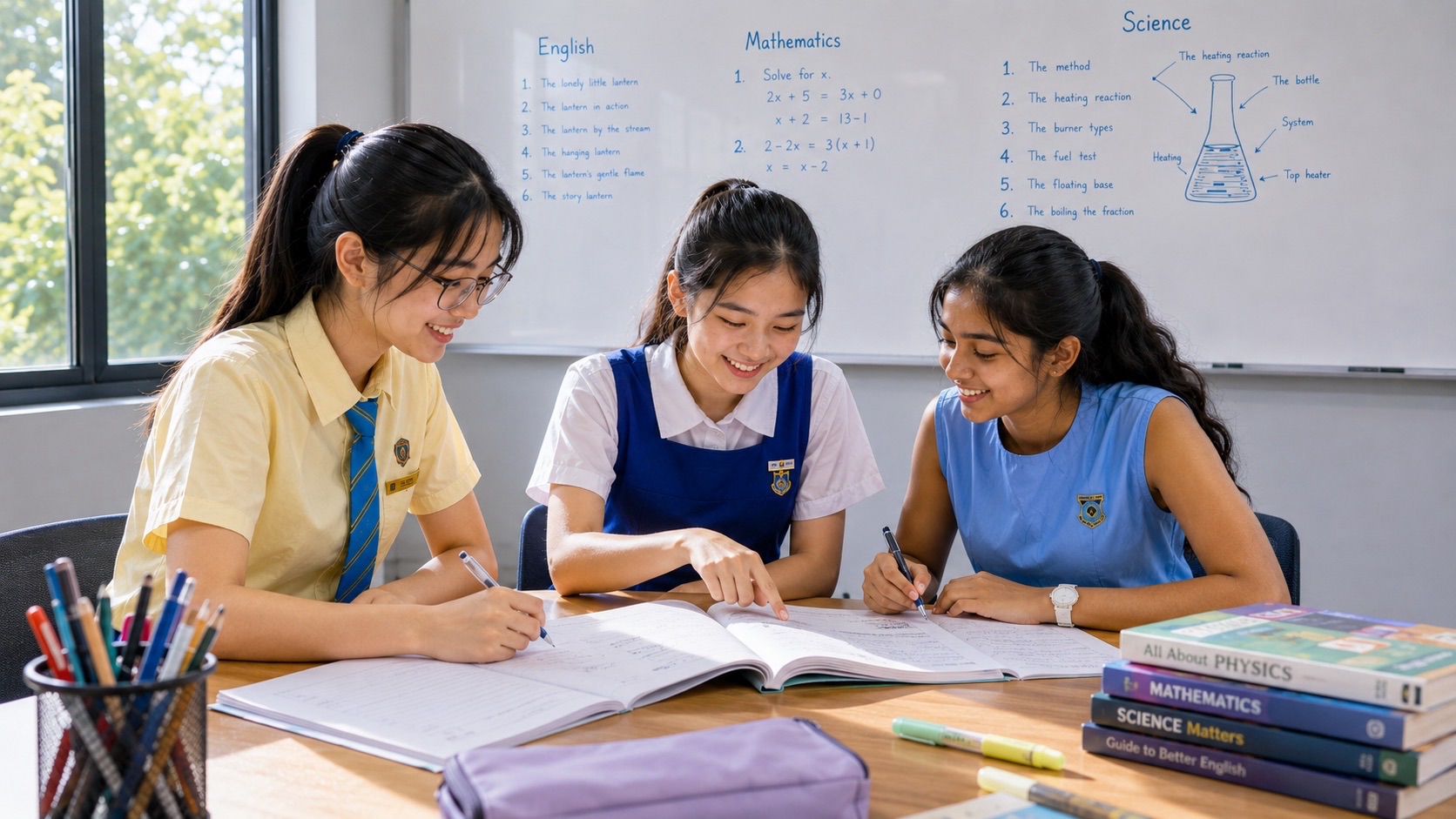
For a strong Science student, a well-matched three-student tutorial can be more useful than a room where everybody simply agrees.
One learner may defend one explanation. Another notices an exception. A third proposes a different model. The tutor can ask which claim best fits the evidence and what information would resolve the disagreement.
This peer friction teaches that strong reasoning can be revised rather than merely rewarded.
Examination Conditioning Is a Different Job
Strong scientific reasoning does not automatically produce perfect examination execution.
Near an important assessment, a strong student may still need timing, answer precision, checking and familiarity with the paper’s demands.
That is examination conditioning. It should be added when relevant, not allowed to replace years of deeper scientific development prematurely.
Do Not Turn a Strong Learner Into a Model-Answer Collector
High-performing students are often capable of memorising excellent wording quickly.
If tuition rewards only polished final answers, the learner may become increasingly dependent on seeing the “best” phrasing before thinking independently.
Enrichment should often delay the model answer. Let the student predict, explain, test and revise first.
Strong Students Still Need Boundaries
Enrichment can become endless if every sign of strength produces more work.
A student may already receive substantial challenge through school, reading, competitions, projects or independent interests.
Formal Science tuition should justify the time it consumes. If the learner is thriving independently, an additional class may not be necessary.
What Strong Science Enrichment Should Leave Behind
- The student reasons from models rather than answer patterns.
- Claims are calibrated to evidence.
- The learner can handle uncertainty without guessing wildly.
- Concepts connect across different contexts.
- Alternative explanations can be compared fairly.
- Unfamiliar problems produce curiosity rather than panic.
- Tutor support reduces as independence increases.
When Exam Conditioning Should Become More Prominent
- The examination is close enough that execution now carries significant value.
- Scientific understanding is already robust.
- Lost marks are increasingly caused by timing, answer precision or checking rather than conceptual weakness.
- The student can still preserve deeper reasoning under timed conditions.
The Better Parent Question
Instead of asking, “My child is already strong in Science—what harder work should we add?”, ask: What scientific judgement, transfer or independence is still missing, and when does examination conditioning become the next useful job?
Strong learners need more depth of thought, not merely more volume.
Current route: This legacy Novena URL now owns the strong-student Science enrichment decision rather than a current location claim. For current Science navigation, use the Science Article Directory and the Tuition Programmes Directory.