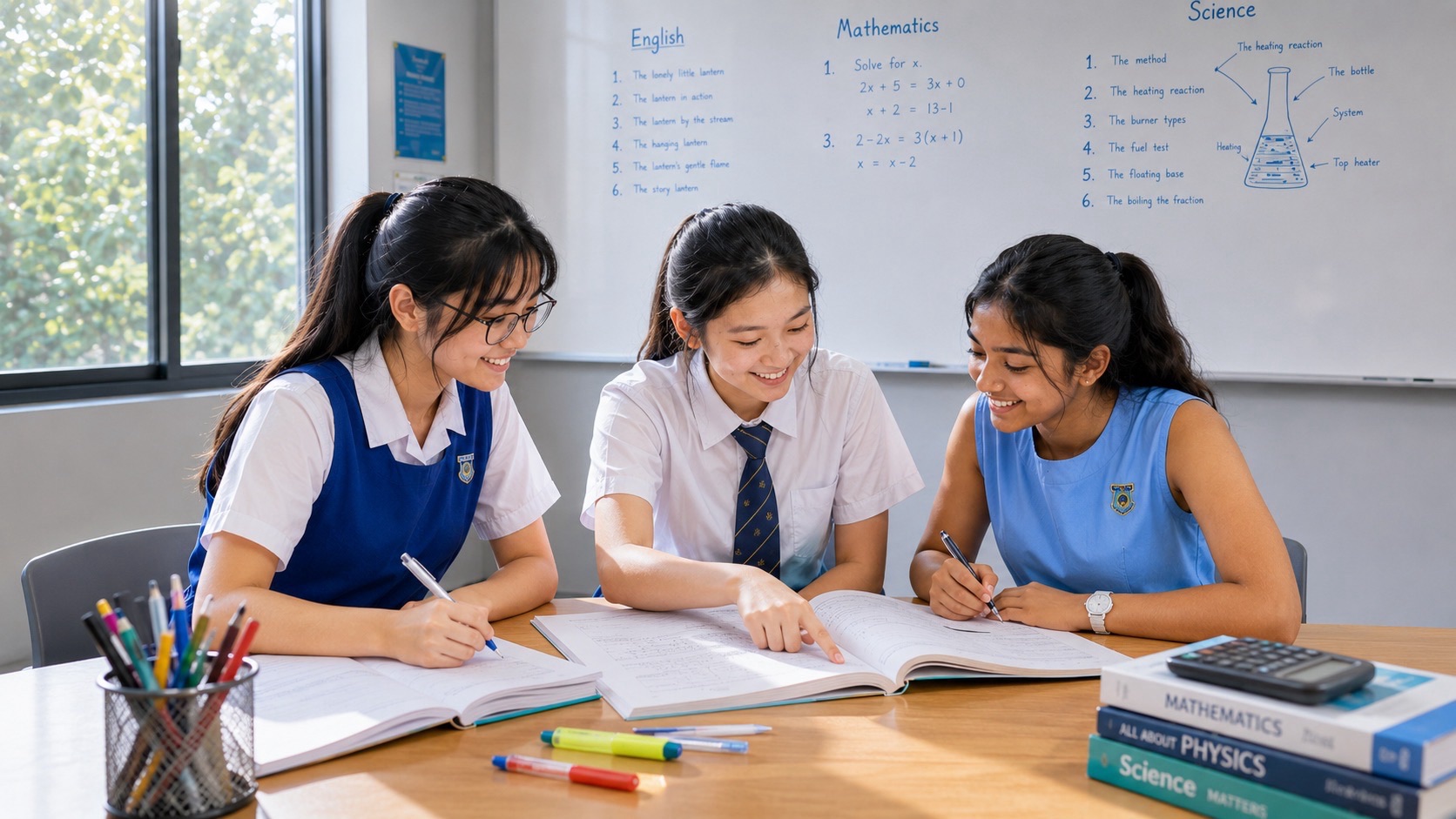
After an AEIS or S-AEIS school offer, an international student needs more than the school name: the family must confirm the reporting date, immigration status, subject-level arrangements, textbooks and school accounts. A pupil joining Singapore in Secondary 1, 2 or 3 may have a different curriculum sequence from their overseas school and may need an organised learning plan from the first week.
This guide gives a practical first-30-days checklist, distinguishes the admitted school from ICA Student’s Pass approval and explains how parents can help with academic English, Mathematics, classmates, school travel and digital learning without assuming every secondary school uses identical procedures.
Fast parent checklist:
- Obtain the actual school offer and ask about the reporting date and campus.
- Confirm the child’s legal immigration status and ICA formalities if required.
- Ask which G-level subjects and Mother Tongue arrangements apply to the pupil.
- Check the school-specific booklist, PLD, SLS login and attendance channel.
- Set a 30-day plan that includes learning feedback, friendship and safe travel.
Source check: 13 November 2026. Admission and pass requirements verified against MOE/ICA; the actual school decides its timetable, language arrangements and onboarding steps.
1. The four-week transition: what to ask and when
| When | Main decisions | What counts as completion |
|---|---|---|
| Before arrival / reporting | Offer, reporting time, valid immigration permission | Official school and ICA confirmations |
| Days 1–7 | Class, timetable, books, devices, transport | Student knows how to attend and ask for help |
| Days 8–14 | Academic English, Mathematics and subject gaps | One meaningful teacher feedback item per priority |
| Days 15–30 | Homework routine, wellbeing and participation | A sustainable plan and clear contact point |
2. Day zero: confirm the actual offer and reporting date
An international student is not enrolled merely because the family paid to sit AEIS or S-AEIS. The official school offer identifies the admitted pupil’s place, and the school will explain when and where they must report. The family should obtain the offer through the designated MOE outcome system and follow the actual school’s current intake instructions. For regular AEIS the outcome is released through AEIS-IS, not the SEAB Candidates Portal used for test registration.
Do not purchase a uniform or travel to a nearby preferred school before the allocation is known. MOE considers assessment performance, vacancies and the stated Singapore residential area when making offers; the result may differ from the family’s expectations. The actual school’s name, programme and campus are the relevant facts for the next actions.
For supplementary S-AEIS pupils joining after the usual January start, contact the school’s administrative office about the specific reporting date and which topics the class has already covered. A mid-year student should not rely on a January orientation letter intended for pupils who have been at school since the beginning of the year.
3. Immigration status must remain valid throughout study
ICA’s Student’s Pass rules apply separately from the school admission system. A foreign pupil attending full-time at a Government, Government-aided or independent secondary school usually needs a Student’s Pass, unless the pupil holds a qualifying valid Dependant’s Pass, Long-Term Visit Pass or Immigration Exemption Order for non-religious full-time studies. The actual document and its validity dates determine what applies.
The school offer and Registration Acknowledgement Letter are used in the ICA application process where a Student’s Pass is required. ICA may require an individual Singapore Citizen or Permanent Resident sponsor aged 21 or older for Government-school Student’s Pass applications, along with identity and family information. A paid examination fee or an AEIS entry proof does not authorise lawful residence.
If the immigration process is still underway when the school asks for reporting, contact the school and ICA rather than assume the child can attend without the right permission. Follow the official ICA school Student’s Pass procedure and the separate edu|Kate post-offer guide. Avoid sharing immigration documents in a class chat or with an unauthorised tutoring agency.
4. The first school meeting: ask five direct questions
A new family can spend a school meeting on details that genuinely affect the pupil: the exact school level and class, the subjects and their levels, the normal timetable and CCA arrangements, the correct booklist, and the person to contact when learning or administrative questions arise. Write down the answers. A family arriving from overseas may use different labels for grade levels, subjects or school terms.
Ask whether the child is entering a mixed form class under Full Subject-Based Banding, which may include students taking different subjects at G1, G2 or G3. An AEIS entry to Secondary 2 is not a promise that every subject is at one particular level. The school can explain the actual initial subject arrangements and any follow-up assessment or learning-support decisions.
A school website can provide the general curriculum, but a named staff contact helps when there is a personal question. If the parent is unsure about a programme choice, ask for the deadline and decision criteria instead of immediately signing every form presented on the first day.
5. Posting Group and individual subject levels: a common confusion
Singapore’s Full Subject-Based Banding framework uses Posting Groups for admission into Secondary 1 and G1, G2 and G3 as the demand levels of individual subjects. Those concepts are not interchangeable. A returning or international pupil entering at a different point in the system may need school-specific guidance to understand what academic level they will study for each subject.
For example, a pupil may be comfortable solving algebraic equations but struggle with longer English passages used in Humanities. The school may have a particular pathway or support arrangement to address that mismatch. Do not assume the same level automatically suits Mathematics, English, Science and Mother Tongue.
Use the actual school’s decisions and MOE’s Full Subject-Based Banding information to learn the terminology. Parents should ask what evidence is used for any proposed subject-level adjustment and when the pupil’s progress will be reviewed. A single entrance test is important for admission but cannot describe every subject strength.
6. Mother Tongue and language requirements need their own conversation
Singapore secondary schools have Mother Tongue Language policies that may be unfamiliar to families whose children previously studied a foreign language or a different first language. A pupil’s home language does not automatically establish whether they qualify for an exemption or a particular alternative language arrangement. Those decisions follow MOE’s actual eligibility and school processes.
Ask the school which language study is expected, what options are available and whether the pupil must supply records of languages previously studied. Do not promise that a foreign international pupil is exempt from all Mother Tongue requirements merely because their earlier school did not teach Chinese, Malay or Tamil.
Where language learning is required, discuss the starting level and timetable as well as academic readiness. A student may need time to adjust to new terms, script or conversational demands. The school’s subject team can explain current support and formal application conditions.
7. Academic English is more than everyday conversation
An international pupil may speak everyday English confidently but find formal instructions in History, Geography, Science and Mathematics challenging. Words such as “evaluate”, “justify”, “infer”, “classify”, “consequence” and “contrast” carry specific academic meanings. If the child treats “explain” as “copy the definition”, even a correct idea may be poorly expressed.
One simple daily activity is to take a short paragraph from an actual lesson and ask the pupil to state the central idea, locate evidence and explain how the evidence supports it. In Science, distinguish what was observed from why it happened. In Humanities, ask which part of the source supports a claim. The aim is precise communication rather than copying a model response without understanding it.
When the child has a weak answer, ask whether the problem is comprehension, vocabulary, sentence structure or subject knowledge. Those need different repairs. The AEIS English guide gives comprehension and writing practice methods that also support work after admission.
8. Mathematics gaps can hide under different curriculum sequences
A student from a foreign syllabus may have studied a mathematics topic one year earlier or later than the Singapore cohort. Ask the school’s Mathematics teacher about core prerequisites in the current year: fractions and ratio, signed numbers, algebraic representations and geometry as appropriate to the child’s entry level. Do not assume that an overseas grade number guarantees complete coverage.
When a problem is wrong, begin with the earliest uncertain link. If a child cannot explain why 2(x + 4) equals 2x + 8, revisit grouping and the distributive law before assigning a long worksheet. If a word problem uses “remaining” or “three more than”, check whether the student interpreted the language correctly before deciding the arithmetic concept is missing.
A small number of carefully reviewed examples can produce more learning than an enormous pile of timed questions. The AEIS Mathematics guide includes non-calculator reasoning methods, but the school should set the priority for actual classroom topics.
9. Books and uniforms: wait for the assigned school and levels
Secondary schools publish school-specific booklists and approved uniform vendors. Under Full Subject-Based Banding, an individual subject can be offered at a more demanding level, requiring a different textbook. Therefore, buying the entire book set based on a guess about the child’s overall entry category may produce avoidable waste.
Check the correct school, year, campus and each subject-level decision. For a mid-year entrant, ask which books the class currently uses and whether any have been superseded or can be borrowed temporarily. The school may have a particular vendor, a collection location or a way for late entrants to obtain materials.
Uniforms, PE attire and name tags are also school-specific. If the child reports before an order can be fulfilled, contact the administration about temporary attire. Do not assume another school’s 2027 uniform exceptions apply. The edu|Kate 2027 booklist guide provides purchasing questions, but the posted school is authoritative.
10. Digital accounts: SLS, school email and the personal learning device
A Singapore secondary school may issue a student account for Singapore Student Learning Space (SLS), school email and a school-managed Personal Learning Device. Those logins are not necessarily the same as the parent’s government identity service. MOE’s SLS instructions distinguish MIMS login for eligible secondary students from the earlier SLS account route.
Ask the school’s IT or form teacher which account is required, whether the pupil receives a device, and how assignments will be accessed before the device has been delivered. A family should not buy an expensive general retail laptop until the school confirms its prescribed model and management requirements. A device may need a Device Management Application and particular warranty or software.
Keep login credentials private. The pupil should practise locating a real assignment, understanding the due date and contacting the teacher if the task is missing. Do not treat a technical failure as proof the student has not been admitted to school; contact the school support channel with the specific problem. MOE’s student SLS login guidance explains the platform.
11. Daily attendance, transport and school safety
The student should know the reporting time, actual campus, school gate and route. Families moving to Singapore may still be learning the MRT and bus network and local road crossings. Practise the journey at a realistic school-day hour before the child travels independently, and plan an alternative if a transport service is disrupted.
Talk through safe road-crossing behaviour, appropriate use of mobile devices while walking, and how the pupil can contact an approved adult when confused. If the school has CCAs after lessons, the return journey may occur later than the normal dismissal and should be practised separately. The student transport guide and road-safety guide provide general Singapore-specific explanations.
If the pupil becomes ill or needs to miss a lesson, follow the school’s actual attendance-reporting instructions. The family should not assume a previous country’s system of parental messages or online attendance codes applies. Accurate communication is especially important during the first month when the school is learning the family’s circumstances.
12. Friendships and school culture in the first month
An international student may feel unsure how to join classmates who have known each other since January. The child may also hear informal Singapore English or local expressions alongside formal classroom language. Explain that school interactions can involve different registers and that asking what an unfamiliar word means is appropriate. Avoid presenting language difference as proof the pupil is behind.
Encourage participation in ordinary class or CCA activities that fit the child’s interests, while respecting school selection rules and capacity. A pupil need not master every local custom immediately. One reliable friend, a known form teacher and the confidence to ask a classroom question are meaningful early milestones.
Parents should know how to contact the form teacher, counsellor or relevant student-support staff if the child experiences persistent isolation, bullying or difficulty adjusting. A school-entry test cannot predict how a pupil will feel after moving countries. Early communication and supportive routines can prevent manageable problems from becoming larger.
13. Financial planning and nationality-specific school fees
Monthly charges for foreign international students at Singapore Government and Government-aided secondary schools differ by ASEAN and non-ASEAN nationality categories, and independent schools can have different schedules. The school’s invoice, based on the current year and pupil’s recorded status, is the operative amount. Do not assume the monthly tuition amount includes uniforms, textbooks, meals, transport or immigration fees.
If the family is in transition between housing arrangements or the child holds an immigration pass requiring renewal, plan for those administrative costs separately. MOE’s financial-assistance schemes for Singapore Citizens should not automatically be treated as available to foreign pupils. Check any school-specific support with the actual institution.
The edu|Kate 2027 fee guide links to MOE’s current fees checker and uses dated 2026 reference amounts explicitly labelled as historical. It can support provisional budgeting while the family waits for a real invoice.
14. The SEC examination timeline should not be misunderstood
The Singapore-Cambridge Secondary Education Certificate (SEC) begins with the graduating secondary cohort sitting the national examinations in 2027. A child entering Secondary 1 in 2027 would ordinarily reach Secondary 4 in 2030 on a typical four-year pathway, subject to the actual programme. That pupil is not sitting the final SEC at the time they first enter secondary school.
Full Subject-Based Banding means the subject levels are relevant to later assessment and further education, but choices and eligibility can develop with school performance and the applicable rules. A new international student should first understand the current curriculum and learning needs rather than be asked to determine every future qualification on the first day.
For a pupil entering Secondary 2 or 3, the expected graduating year and subjects are different. Ask the school for a current individualised progression explanation. SEAB’s SEC information provides the national examination background.
15. A 30-day settling-in worksheet that the pupil can actually use
During days 1–7, confirm the school reporting routine, class timetable, transport, materials and one adult contact. Practise the Student Learning Space login and ask the child to identify when and where to get help. Use the school’s instruction on attendance and book purchases rather than trying to complete every optional task immediately.
During days 8–14, review English reading demands, Mathematics prerequisites and the first class assignments. Ask teachers for specific feedback about recurring misunderstandings. Encourage the pupil to join a safe school activity or speak to peers through structured group work.
During days 15–30, look at the child’s actual timetable, assignment completion and daily wellbeing. Identify one academic strength and one area where support would help. Confirm that the school has the right parent contact and immigration or health information where required. The aim is a sustainable learning routine, not an unrealistic demand that the pupil should feel completely settled in four weeks.
16. Frequently asked questions
Does an AEIS test pass automatically enrol the pupil? No. The child needs an actual school offer and must follow the reporting instructions.
Does a school offer replace a Student’s Pass? No. ICA immigration requirements are separate unless a valid exemption applies.
Can the pupil choose any G3 subject immediately? The posted school determines the applicable subject-level arrangements and eligibility.
Will the school provide a laptop? Follow its actual school-prescribed PLD programme; do not assume an immediate device or buy a random model.
Does the first-month plan change for S-AEIS? Yes. A supplementary entrant may join after the academic year has started and should ask for catch-up support.
What is the most important early school contact? The form teacher or school-designated contact who can direct the family to academic and administrative support.
Editorial scope: edu|Kate Singapore independently explains education pathways and practical transitions. It cannot issue immigration permission, determine subject placement or promise any school support arrangement not confirmed by the actual institution.