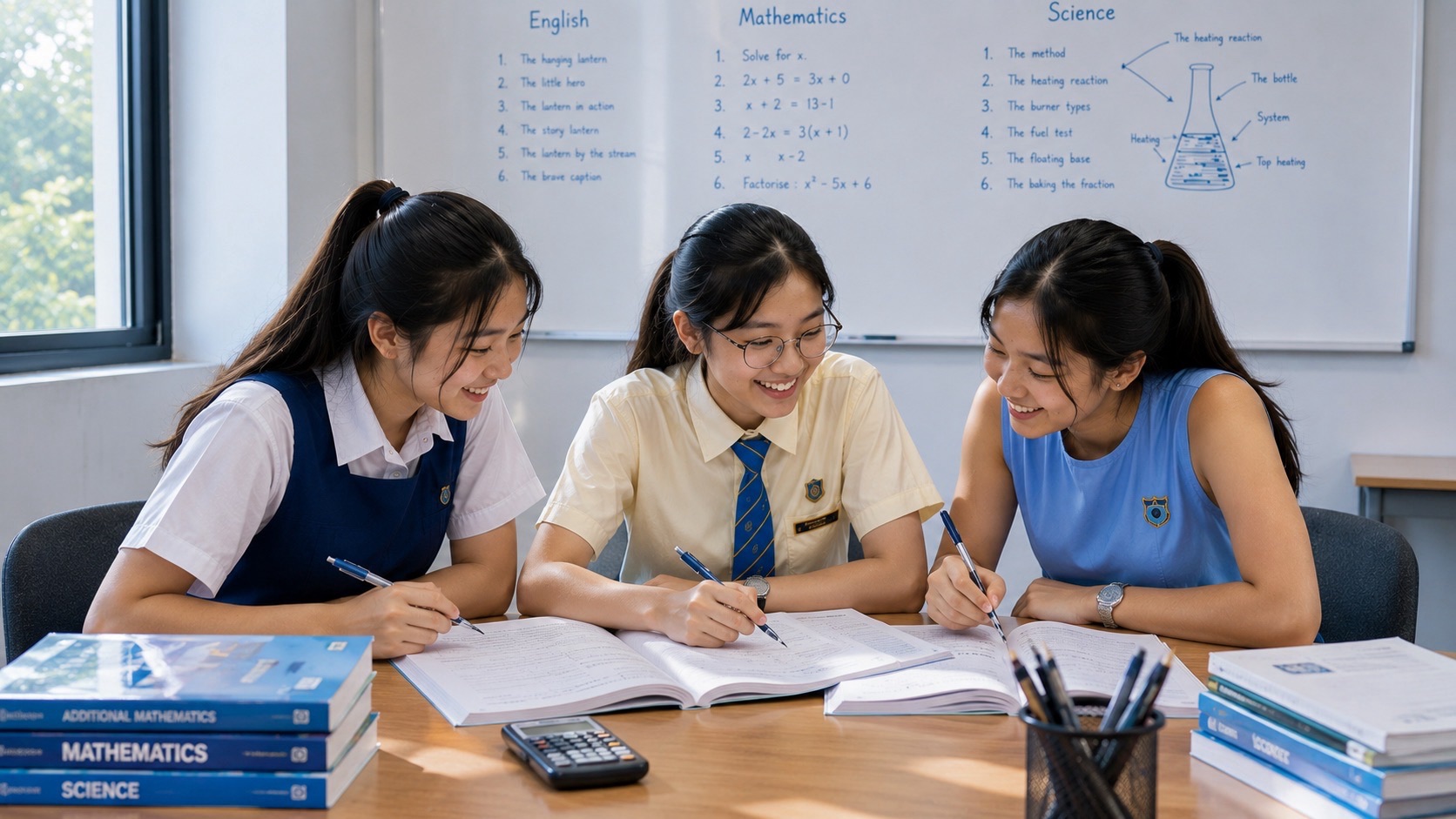
The Secondary AEIS and S-AEIS Mathematics test has no calculator. Part 1 is 34 multiple-choice questions in 30 minutes; Part 2 lasts 1 hour 45 minutes and includes 20 short-answer plus 10–15 open-ended questions. SEAB requires candidates to show their working for written-answer questions, not only supply a final number.
This guide explains how to prepare for the correct entry level, use diagrams and algebra to communicate methods, avoid question-reading errors and manage the 30-minute objective section. Its worked problems are original practice examples, not predictions of unseen test questions.
Quick facts before practising:
- AEIS Secondary entry may be for Secondary 1, 2 or 3; S-AEIS secondary entry is limited to Secondary 1 or 2.
- Revise the MOE mathematics curriculum from the year immediately before the intended entry level.
- No calculators; use clear written steps and appropriate units.
- Check the individual SEAB entry proof for venue and time.
Official source review: 13 November 2026. SEAB AEIS Mathematics details · SEAB S-AEIS test details. Current test instructions prevail.
1. The Mathematics paper: two different tasks
| Part | Time | Question types | What candidates must do |
|---|---|---|---|
| Part 1 | 30 minutes | 34 multiple-choice questions | Shade the selected answers correctly on the Optical Answer Sheet |
| Part 2 | 1 hour 45 minutes | 20 short-answer and 10–15 open-ended questions | Show written method and final answers; no calculator |
2. 2. SEAB’s actual Mathematics format for Secondary 1, 2 and 3
The Secondary Mathematics assessment for AEIS and S-AEIS consists of two parts. Part 1 lasts 30 minutes and contains 34 multiple-choice questions. Part 2 lasts one hour and forty-five minutes and contains 20 short-answer questions plus 10–15 open-ended questions. The use of calculators is not allowed. These format details come from SEAB, not from a private tuition centre’s predicted paper.
Candidates need a pencil to shade the answer on the Optical Answer Sheet for multiple-choice items. For short-answer and open-ended questions, SEAB requires clear working steps in the provided spaces in addition to the final answer. This changes how a student should practise: a correct answer with no readable method is a weak demonstration of mathematical reasoning.
The assessment prepares for admission to a particular secondary level by testing Mathematics topics from the preceding Singapore school year. A Secondary 1 entrant needs Primary 6 foundations; a Secondary 2 entrant needs Secondary 1 content; and a Secondary 3 entrant needs Secondary 2 content. The supplementary S-AEIS secondary route covers only Secondary 1 and 2, so the Secondary 3 format belongs to regular AEIS.
3. 3. Why the no-calculator rule matters even for strong pupils
A student from a curriculum that permits calculators in most school mathematics may understand algebra and geometry yet have difficulty dividing fractions or computing percentages accurately under time pressure. Without a calculator, the candidate must maintain number sense and reliable written methods. The goal is not to perform every operation mentally; working on paper is permitted and often necessary.
For example, 15% of 240 can be found as 10% (24) plus 5% (12), giving 36. A pupil who tries to remember a device keystroke may struggle, while one who understands percent as hundredths can reconstruct an efficient method. Similarly, 3/4 of 48 is 36 because a quarter of 48 is 12.
Practise arithmetic in varied contexts rather than hundreds of identical sums. Include fractions, decimals, ratio, integers and simple equations at the correct level. Ask the learner to explain why a shortcut works. If the result is unlikely, use estimation to detect it before proceeding. The no-calculator format rewards flexible mathematical understanding.
4. 4. Part 1: 34 multiple-choice questions in 30 minutes
Thirty minutes for 34 items gives, on average, less than one minute per question. That calculation is a planning observation, not a fixed per-question time limit imposed by SEAB. Some items are short; others need reading or diagram interpretation. A candidate who spends five minutes on every difficult question may reach the end with many unanswered.
During a timed practice, identify questions that can be solved quickly and answer them accurately, while marking an item for later review if the pupil becomes stuck. Teach how to eliminate choices that fail unit checks, sign checks or a simple estimate. A pupil must still shade the intended option carefully on the answer sheet; a mismatch between workings and shading can lose credit.
An example from original practice: a bus covers 18 km in 30 minutes at a constant rate. What distance would it cover in 2 hours? Thirty minutes is half an hour; two hours contains four such periods, giving 72 km. A student can recognise the multiplicative relationship without a calculator. This example is educational and is not a reproduced SEAB question.
5. 5. Part 2: writing the method is part of the assessment
Short-answer questions and open-ended questions require working, not only a final number. A pupil should show the quantities, relationships, transformations and units where relevant. In a ratio question, for example, a clear representation of equal parts can be more valuable than hurried arithmetic with no explanation.
Consider an original training problem: “The ratio of red to blue counters is 3:5. There are 64 counters altogether. How many blue counters are there?” A clear method is: total parts = 3 + 5 = 8; value of one part = 64 ÷ 8 = 8; blue counters = 5 × 8 = 40. Writing only “40” does not demonstrate the full reasoning SEAB asks candidates to show.
For an algebra problem, write each equivalent equation on a separate line. If 4x + 7 = 31, subtract 7 to get 4x = 24, then divide by 4 to obtain x = 6. Check by substitution: 4(6) + 7 = 31. These simple habits protect against errors when a question is longer or presents unfamiliar wording.
6. 6. Primary 6 foundations for a Secondary 1 applicant
A child seeking entry to Secondary 1 should revise Singapore Primary 6 Mathematics, not assume that an overseas “Grade 7” textbook covers exactly the right prerequisites. Useful areas to check include fractions, percentages, ratios, measurement, area and volume, and multi-step problem solving. Refer to the current MOE primary mathematics syllabus for the authoritative sequence and details.
One illustrative question asks a pupil to compare the prices of an item before and after a discount. If a bag costs $80 and is reduced by 25%, the discount is one quarter of $80, or $20, so the new price is $60. Some pupils incorrectly add the percentage or apply it to the reduced price; the error reveals a misunderstanding of what the percentage refers to.
A diagnostic plan should note whether the pupil recognised the quantity, chose the correct operation, computed accurately and checked the unit. If the child can compute 25% of 80 but fails a word problem involving the same relationship, the next lesson should focus on language and representation rather than repeat percentage drills.
7. 7. Secondary 1 topics for admission to Secondary 2
Secondary 2 applicants are assessed on the preceding Secondary 1 Singapore Mathematics curriculum. Common foundations include positive and negative numbers, algebraic expressions, linear equations, proportions, geometry and statistical representation, as specified by the applicable MOE syllabus. A pupil unfamiliar with symbolic notation may know the same underlying relationship using a different overseas method.
In an original practice example, the temperature is −3°C at dawn and rises by 8°C. The new temperature is 5°C. A learner who writes −11°C has treated a rise as a further drop. The mistake is about the meaning of the signed change, not only an arithmetic fact.
For algebra, test whether the pupil can explain why 2(x + 3) is equal to 2x + 6, and why it is not 2x + 3. The distributive relationship should be visible through a diagram or repeated grouping before the candidate uses the formula automatically. More challenging problems become manageable when these earlier connections are secure.
8. 8. Secondary 2 content for a Secondary 3 applicant
Regular AEIS allows applications to Secondary 3, with the mathematics assessment drawing on Secondary 2 content. The pupil should review the official syllabus’s relevant algebra, graphical relationships, geometry, statistics and problem-solving demands. Do not rely solely on an overseas grade designation: one country’s eighth year of schooling may emphasise different topics or sequence them differently.
For example, suppose a straight-line relationship is y = 2x + 1. A student should be able to find y when x = 3 (giving 7), interpret the rate of change and explain what happens when x increases by one. Memorising coordinates without understanding the relationship makes a less familiar question harder.
Families should avoid assuming that doing well in an overseas science-focused curriculum guarantees full readiness for Singapore’s Secondary 3 Mathematics. A short diagnostic sample across multiple topics is more informative than a single impressive answer. Ask the child to explain methods, not merely show speed.
9. 9. The difference between a reading problem and a mathematical problem
A student can fail a Mathematics question because they misunderstood a word such as “remaining”, “exceeds”, “at least” or “consecutive”, even when they can perform the calculation after the question is rephrased. Another student may read perfectly but not understand the numerical relationship. These gaps require different practice.
Take an original question: “A box contains 12 markers. Three boxes have twice as many markers as one large pack. How many markers are in the large pack?” Three boxes contain 36 markers, which is twice the pack, so one pack has 18. The phrase “twice as many as” is crucial; confusing the direction yields 72 rather than 18.
One useful teaching technique is to ask the learner to paraphrase the problem before calculating. Draw a diagram of the known and unknown quantities and identify which relationship applies. Then carry out the arithmetic. If the pupil still cannot solve the problem after clarifying the language, work on the mathematical concept itself.
10. 10. Use an error log without overwhelming the student
A productive revision notebook records the problem type, the original mistaken step and the corrected reasoning. It should not be a list of scores labelled “careless”. For a fraction error, note whether the child treated unequal denominators as though they were already the same, confused the meaning of a whole, or mishandled the final simplification.
After correcting a question, provide a new one with different numbers or context. If the pupil can transfer the method, the understanding is more secure. If the same error returns, revisit a simpler prerequisite. This method makes study targeted rather than punishing the learner with long stacks of unrelated worksheets.
For a child preparing for both English and Mathematics, some mixed practice is valuable: write a clear mathematical explanation in English. The ability to name a quantity, justify a step and use a unit helps in the test and later secondary lessons.
11. 11. A 21-day preparation plan that does not promise admission
In the first week, use a short diagnostic set from the relevant preceding-level curriculum. Separate arithmetic accuracy, algebra, geometry, interpretation and timed practice. Review errors carefully, especially any use of a calculator during work that must ultimately be completed without one.
In the second week, alternate conceptual repair with shorter timed Part 1 drills. Keep a few open-ended questions where the student must show complete workings. Practise using pencil markings accurately and double-checking the answer sheet selection. Focus on two or three recurring weaknesses, not every possible topic in a single evening.
In the third week, simulate both parts under the published time limits, then review why particular items took too long. Reserve time for reading, sleep and the official admission paperwork. Three weeks are an illustrative study structure, not an official programme or sufficient preparation time for every pupil. Learning needs may be much greater, depending on the earlier curriculum and foundations.
12. 12. Test-day materials, arrival and identification
SEAB’s AEIS and S-AEIS test details instruct approved candidates to arrive at least 45 minutes before the test and be seated at their assigned desks at least 15 minutes before it begins. The candidate needs a photocopy of the passport biodata page and a photocopy of the entry proof issued by SEAB. The test venue is shown on the individual entry proof.
An approved application and entry proof are different from a parent’s belief that payment succeeded. The Candidates Portal status and SEAB communication determine whether the candidate is registered. The family should arrange its journey to the actual venue early, check current instructions for stationery, and leave calculators at home for the Mathematics paper.
Parents should not assume the test venue is the eventual school or a nearby school. Keep the documents private and use the official Candidates Portal to obtain the final venue and reporting requirements. SEAB AEIS test details and S-AEIS details provide the controlling instructions.
13. 13. What happens after the Mathematics test?
Test performance is one factor in international school admission, but a correct answer to every practice question does not guarantee a specific mainstream school. MOE considers the admission performance and available vacancies, along with residential-area factors where applicable. The school offer is a separate decision released through the designated result system.
A candidate who does not receive a place should check the current official alternatives and whether they remain eligible for S-AEIS at Secondary 1 or Secondary 2. S-AEIS is not a Secondary 3 route. A family should not presume that a September AEIS registration automatically creates a supplementary examination registration.
Once a school is offered, there may still be immigration, books, timetable and subject-level processes before the child begins classes. The family can make the transition easier by keeping the pupil’s mathematical explanations clear and revisiting any prerequisites the Singapore school expects.
14. 14. Frequently asked questions
Can candidates use a calculator? No. SEAB’s published Secondary Mathematics format is non-calculator.
How many multiple-choice questions are in Part 1? Thirty-four, with 30 minutes allocated.
How long is Part 2? One hour and forty-five minutes, with 20 short-answer and 10–15 open-ended questions.
Do pupils need to show working? Yes. SEAB instructs candidates to write their methods as well as the final answers for written-response questions.
What should a Secondary 1 applicant revise? The preceding Singapore Primary 6 Mathematics curriculum.
Can S-AEIS be used to enter Secondary 3? The published supplementary secondary route is for Secondary 1 and Secondary 2 only.
Editorial note: edu|Kate’s examples teach mathematical reasoning; they are not official test questions or an admission guarantee. Follow current SEAB instructions for the paper and entry requirements.