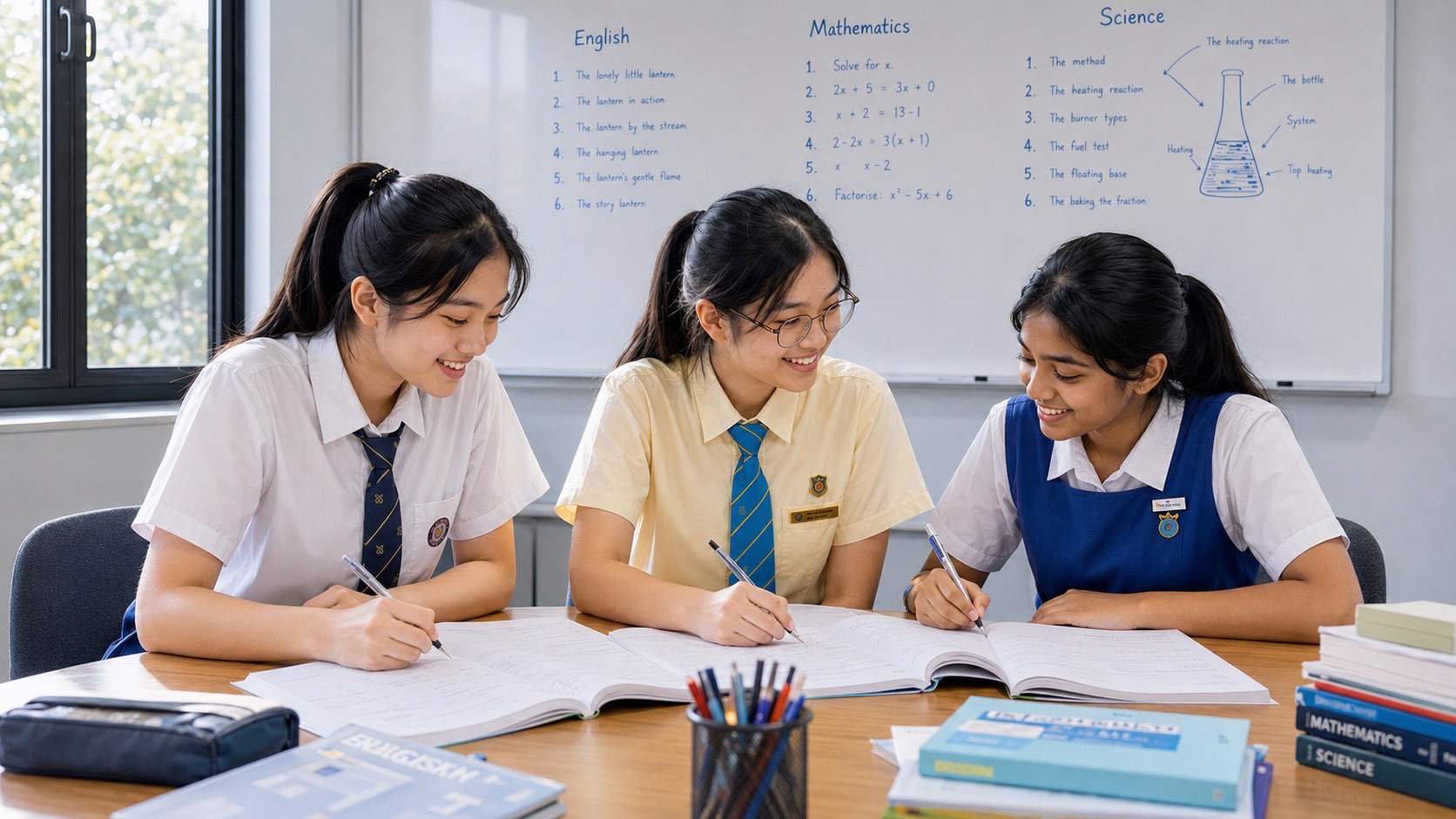
To seek Secondary 2 admission in Singapore through AEIS or S-AEIS in 2027, prepare the preceding Secondary 1 English and Mathematics curriculum. The English paper requires one 250–350-word composition selected from four topics, plus 50 compulsory language/comprehension questions. Mathematics tests signed numbers, proportional reasoning and written explanations through non-calculator questions aligned to the level below entry.
This guide focuses on learning gaps commonly hidden by different overseas year names, using original problems in algebra, graphs, ratio and reading. The official MOE/SEAB syllabuses determine full coverage; this is an instructional checklist rather than a claim about the exact unseen questions.
Quick priorities:
- Read passages for evidence, inferences and contrasting statements.
- Write coherent 250–350-word narratives or arguments.
- Explain signed numbers, algebraic expressions, linear equations and proportions.
- Show workings clearly in non-calculator Mathematics.
- Use the correct 2027 AEIS or S-AEIS registration and eligibility instructions.
Official reference: SEAB AEIS test details · SEAB S-AEIS test details. Reviewed 17 November 2026.
1. The correct prerequisite is Singapore Secondary 1
SEAB’s level-below principle says that Secondary 2 applicants should know the English and Mathematics curriculum taught in Singapore Secondary 1. A child may have completed Year 7 abroad and appear ready by age, but a different country could place algebra, proportion, graphs and language analysis in a different sequence. Parents should compare actual exercises rather than assume the year labels are equivalent.
The normal AEIS and supplementary S-AEIS exercises both offer Secondary 2 admission to eligible foreign international applicants. Their registration and posting periods are distinct, however. Do not register for one exercise using another exercise’s account or assume a past test result automatically creates a school offer in the next exercise.
The first educational step is to collect a representative writing sample, a reading passage response and several mathematical tasks. Look for the earliest misunderstanding. The reason for a wrong answer can be grammar, a missing concept, unfamiliar notation or rushed calculation; the repair should match the reason.
2. Secondary 2 English: 250–350 words and 50 objective questions
In Secondary 2 English, SEAB specifies a two-hour-ten-minute paper. The candidate chooses one of four composition topics and writes 250–350 words. The compulsory section contains 15 reading-comprehension questions, 15 comprehension-cloze questions, 10 vocabulary questions and 10 grammar questions. Preparing only narrative writing would leave most of the examination’s objective work untouched.
A 250–350-word essay needs a controlled argument or narrative. For an original practice prompt, “Should every group project have a leader?”, the writer can state a view, explain when leadership helps, consider a counterexample and reach a sensible conclusion. The essay should not become four unrelated lists of advantages. For narrative writing, one decision and its consequence can provide a coherent thread.
After drafting, check whether each paragraph advances the central idea. Repair unclear references, verb-tense changes and words used in the wrong sense. Length is important because it is an official requirement, but a long composition that avoids the question is still weak.
3. Inference, evidence and contrasting statements
At this level, a student should be able to separate a claim from the evidence supporting it. A passage may describe a character’s behaviour without naming their emotion, and the candidate must infer carefully rather than invent private motives. A tempting option can quote a real phrase but make a conclusion that goes further than the passage allows.
Consider this original practice sentence: “Although the committee praised the plan, it requested revised costs before making a decision.” Was the plan approved? Not yet. The committee reacted favourably but postponed a decision. The word “although” marks the contrast that changes the interpretation. The answer should be supported by both parts of the sentence.
In practice, ask the learner to highlight the actual evidence, write the answer in simple language, and explain why one alternative fails. This is not merely a test trick: the same skill supports interpretation in History, Geography and Science.
4. Grammar and vocabulary in connected passages
Comprehension cloze is not a collection of unrelated blanks. The candidate must use context and sentence structure simultaneously. If a sentence says “The road was closed, ___ the bus took another route”, “so” expresses consequence, whereas “although” would imply contrast. The best choice depends on the entire relationship.
A frequent grammar error is agreement. In “Each of the pupils has a timetable”, the head “Each” takes the singular verb “has”. A student who looks only at the closer plural noun “pupils” may choose “have”. Other common patterns involve tense, pronouns, articles and prepositions.
Build a short academic vocabulary list based on reading, not an arbitrary catalogue of rare words. Words such as infer, justify, evidence, consequence, contrast and evaluate appear across subjects. Require the child to use each precisely in a meaningful sentence. Then test whether they recognise it in a new passage.
5. Signed numbers and the meaning of change
A student entering Secondary 2 should understand positive and negative numbers and how an operation changes a value. A common weakness arises when rules are memorised without meaning. For instance, a bank balance of −$18 that receives $25 becomes $7, not −$43. On a number line, receiving money moves the quantity in the positive direction.
Another original example: a temperature of 4°C falls by 9°C. The resulting temperature is −5°C. Ask the learner to explain the direction and magnitude of the change. If the student writes 13°C, investigate whether they understood “falls” and the possibility of crossing zero.
These signed-number ideas support algebra, graphs and rates of change. Repair them before assigning more complicated equations. A pupil who understands what subtraction and negative quantities mean can transfer that understanding across new contexts.
6. Algebraic expressions, brackets and linear equations
Secondary 1 mathematics introduces relationships expressed with variables. The student needs to know that an expression such as 3(x + 4) means three copies of x + 4, so it expands to 3x + 12. Multiplying only x but not the constant creates an error that a simple area model or grouping diagram can reveal.
For the original equation 5x − 6 = 24, add 6 to both sides to obtain 5x = 30, then divide by 5 to find x = 6. Check by substitution: 5(6) − 6 = 24. This two-step calculation is simple enough to practise without a calculator and clear enough that another reader can follow it.
If a learner answers correctly from memory but cannot justify a step, ask them to describe how equality is preserved. That matters because SEAB’s written Mathematics section specifically requires the method, not only a final number.
7. Ratios, percentages and unit rates
Proportional reasoning is about the relationship among quantities. Four notebooks costing $14 at a fixed unit price means one costs $3.50 and seven cost $24.50. Show why the comparison is valid: there is a constant price per notebook. If the price included a fixed delivery charge, this simple proportional method would not apply unchanged.
For percentage change, name the original whole before calculating. If a price rises from $80 to $100, the increase is $20, which is 25% of the original $80. Reporting 20% because the new value is 100 confuses percentage change with a comparison based on the final amount.
Introduce problems with unfamiliar units only after the relationship is understood. A student should know whether the answer is a cost, a distance, a time or a rate. Checking units can catch a wrong operation even before precise arithmetic is completed.
8. Graphs, tables, patterns and diagrams
Read the axes, units and scale on a graph. A line sloping upwards can represent increasing distance over time, a rising price or temperature, but its meaning depends on the labelled quantities. The learner should be able to say what changes when x increases, not simply copy coordinates from the grid.
For an original table, x values 0, 1, 2 and 3 correspond to y values 2, 5, 8 and 11. Each increment of x increases y by 3, suggesting y = 3x + 2. Ask the child to predict y when x is 4 and explain why the pattern holds. Such reasoning connects numerical sequences to algebraic representation.
For geometry, revise basic angle relationships, measurement, perimeter and area using properly labelled diagrams. If the pupil learned geometry in another language or notation, practise the vocabulary needed to explain a solution in English.
9. Non-calculator Mathematics and written reasoning
The Secondary Mathematics assessment has 34 multiple-choice questions in a 30-minute first part. A second part lasts one hour forty-five minutes and contains 20 short-answer questions and 10–15 open-ended questions. Candidates must not use a calculator, so numerical fluency and estimation matter.
Teach separate habits for the two tasks. Multiple choice requires efficient reading and accurate shading on the Optical Answer Sheet. Written questions require complete workings and intermediate steps. A candidate who uses a correct diagram but leaves the final answer out may not communicate the conclusion, while one who writes only a number may not show the method required.
During a timed sample, record where time is lost. Does the student read each question several times, stop at algebraic notation or recalculate basic fractions? The answer determines whether practice should target reading, conceptual understanding or arithmetic speed.
10. A sensible progression toward the test
Begin with a short diagnostic of reading, grammar, writing, integers, algebra and proportional reasoning. Ask the student to explain how they reached each answer. The parent should classify errors, not describe everything wrong as “careless”. A missing concept requires teaching; a transcription error requires a checking routine.
Next introduce new examples of the same underlying ideas, followed by small timed sets. Alternate writing and objective reading questions with non-calculator Mathematics. As the child becomes more secure, practise a longer paper using the published duration, but do not turn every study session into a full examination.
The schedule must fit the actual AEIS or S-AEIS registration and the child’s prior educational history. It is not possible to guarantee admission through a private preparation period. The school allocation also considers the exercise’s rules and available places.
11. Common questions about Secondary 2
Which Singapore year supplies the prerequisite content? Secondary 1.
Does S-AEIS offer Secondary 2? Yes, the supplementary secondary route covers Secondary 1 and 2.
What is the composition length? 250–350 words on one of four topics.
Can the student use a calculator? No.
Does the written Mathematics paper require working? Yes.
Can a foreign grade designation replace the assessment automatically? No. Confirm official entry eligibility and the registered exercise.
Editorial scope: edu|Kate independently explains published test requirements with original examples. It cannot guarantee a result, school place, or eligibility for a particular entry level.