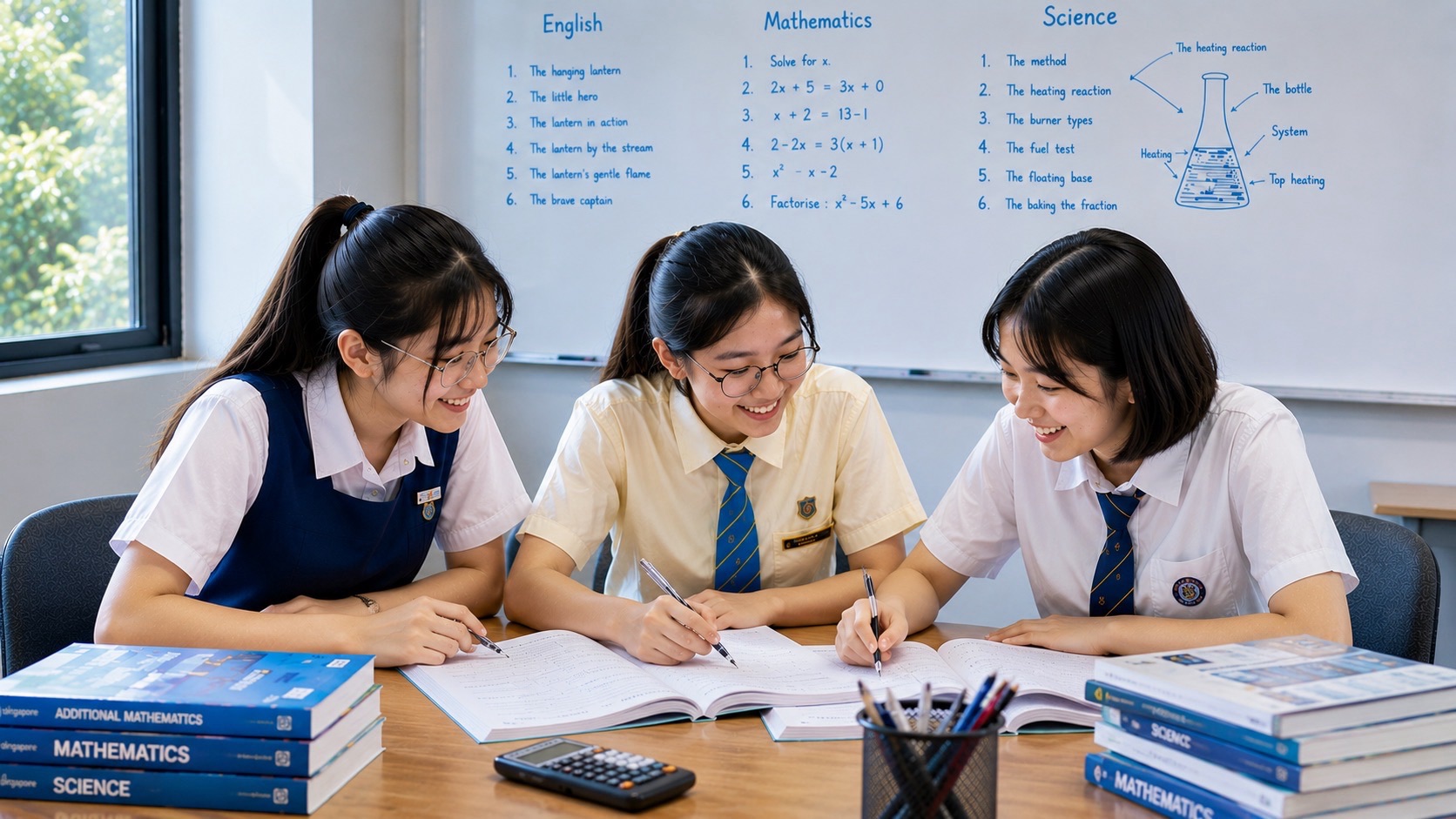
Secondary 3 A-Math Tuition Bukit Timah | Building the A-Math Operating System
Secondary 3 Additional Mathematics is where a student learns to operate in a denser mathematical language.
The change can be surprising. A student may have been comfortable in lower-secondary Mathematics, scored well in algebra and entered Secondary 3 expecting “more of the same”. Then A-Math arrives. Expressions become more symbolic. Transformations become longer. Functions behave like objects rather than isolated formulas. Trigonometric identities ask the student to recognise structure before calculating. Logarithms require equivalent representations. Later, differentiation and integration depend on algebra being sufficiently stable that the new idea is not buried under old errors.
This page is the Secondary 3 A-Math construction page in eduKate Singapore’s Bukit Timah Mathematics estate. Its job is not to promise a distinction. Its job is to explain what must be constructed in the first year of Additional Mathematics so that Secondary 4 can become refinement and examination conversion instead of emergency repair.
Secondary 3 A-Math becomes easier when the student stops seeing a page of symbols and starts seeing mathematical objects, structures and legal transformations.
Quick Read for Parents
- A-Math is not simply harder mainstream Mathematics. It places much heavier demands on symbolic control, recognition and transformation.
- Algebra is the entrance requirement. Weak fractions, signs, factorisation, equations, indices or rearrangement can cause failures across many later topics.
- Current Secondary 3 students may be approaching the SEC framework. For 2027 school candidates, SEAB lists G2 Additional Mathematics as K232 with reference code 4051 and G3 Additional Mathematics as K341 with reference code 4049.
- G2 and G3 are subject levels, not old-style streams. Tuition should use the student’s actual syllabus and school requirements.
- IP and IB are separate programme structures. They should not be relabelled as national A-Math.
- Our standard small-group lesson is 1.5 hours with a maximum of three students, subject to curriculum fit and availability.
- The first-year goal is control. The student should increasingly recognise the object, choose a transformation, carry the algebra, respect conditions and check the result without waiting for a tutor to announce every step.
If you are unsure whether the student is in G2 A-Math, G3 A-Math, IP or another pathway, begin with the Bukit Timah Mathematics Pathways guide. If you need the final-year route, continue later to Secondary 4 A-Math | From Construction to Examination Control.
1. Receiver: What Kind of Secondary 3 A-Math Student Is in Front of Us?
Before teaching A-Math, we need to identify the learner state. “Secondary 3 A-Math student” is not a complete diagnosis.
Several very different learners can arrive at the same class:
- a student with strong mainstream Mathematics but little patience for symbolic explanation;
- a student who understands concepts quickly but makes many algebraic errors;
- a student who was trained heavily by repetition and becomes lost when the question changes shape;
- a student with fragile fractions and indices who is now encountering more symbolic density;
- a student who can follow every worked example but cannot begin independently;
- a student who is already strong and needs richer transfer rather than more routine practice;
- a student whose school has moved quickly and who has accumulated several small unresolved gaps;
- a student who is anxious because A-Math feels visually unfamiliar even though the underlying ideas are learnable.
The same explanation will not serve all eight states equally well. A strong tuition programme therefore begins by observing the student rather than by assuming that the chapter name defines the problem.
The First Diagnostic Packet
For a new Secondary 3 A-Math student, useful evidence includes:
- the current school topic sequence;
- a recent marked Mathematics or A-Math assessment;
- one or two homework pages showing typical working;
- evidence of lower-secondary algebraic fluency;
- the student’s current G2/G3 or school-programme context;
- the next major assessment date;
- a short live attempt at an unfamiliar question.
A live attempt is important because completed homework can hide how much prompting occurred. The tutor needs to see where the student pauses, what they try first and what kind of hint changes the state.
2. Reality: The Current 2026–2027 A-Math Context
Singapore is in an examination transition period. The administrative labels used by an older sibling may not be the labels used by a current Secondary 3 student.
For 2026 school candidates, SEAB lists Additional Mathematics as syllabus 4049 at GCE O-Level and 4051 at GCE N(A)-Level. From the 2027 graduating cohort, the Singapore-Cambridge Secondary Education Certificate replaces the separate N- and O-Level certificates. For 2027 school candidates, SEAB lists:
| 2027 subject | SEC code | Reference code used for 2026 and earlier |
|---|---|---|
| G2 Additional Mathematics | K232 | 4051 |
| G3 Additional Mathematics | K341 | 4049 |
MOE states that Full Subject-Based Banding has been fully implemented since 2024 and that the SEC replaces the N- and O-Level examinations from 2027. Students sit SEC subjects at their respective subject levels. Parents can verify the current framework through MOE’s Full SBB / SEC information, the SEAB G2 SEC syllabus page and the SEAB G3 SEC syllabus page.
Those codes are administrative anchors. They do not replace the educational question. Once the correct syllabus is identified, we still need to know what the student can actually do inside it.
G2 and G3 A-Math Should Not Be Treated as Prestige Labels
A subject level describes the intended curriculum and assessment demand. It is not a measure of the student’s worth.
Good tuition respects the current level. G2 A-Math should not be taught as if its only purpose is to imitate G3. G3 A-Math does not become better teaching merely by giving the hardest available question. The student needs the right mathematical depth, the right pace and the right transfer demands for the actual syllabus and school context.
3. Weak-Link Map: Where Does First-Year A-Math Usually Break?
When A-Math goes wrong, the newest topic often receives the blame. A better diagnostic asks where the first weak link appears.
| Weak link | What it looks like | Downstream effect |
|---|---|---|
| Fraction control | Common denominators, signs or cancelling are unreliable | Algebraic fractions, equations and later calculus become noisy |
| Factorisation | Patterns are not recognised or factors are incomplete | Quadratics, functions and simplification become harder |
| Equation control | Steps are memorised as “move across and change sign” | Transformations become fragile under unfamiliar forms |
| Indices | Laws are remembered without structural understanding | Exponentials, logarithms and algebraic simplification suffer |
| Function concept | Student sees formulas but not input-output relationships | Graph and transformation reasoning remain superficial |
| Recognition | Student can solve after the tutor names the topic | Mixed questions and examinations expose the dependency |
| Notation | Long working becomes ambiguous or inconsistent | Correct ideas lose reliability over multiple steps |
| Verification | Restrictions or impossible results are not checked | Marks leak even after correct route selection |
The weak-link principle is simple: repair the earliest structure that explains several later failures. One good repair is more valuable than three separate chapter rescues if all three chapters are failing for the same reason.
The Algebra Gate Before New A-Math Content
Before pushing into more advanced questions, we often run a short algebra gate. We are not trying to send the student backwards. We are checking whether the floor can carry the next load.
- Can the student expand and factorise cleanly?
- Can they manipulate fractions with algebraic numerators and denominators?
- Can negative values be substituted without sign loss?
- Can equations be transformed while preserving equality?
- Can indices be simplified for a reason rather than by pattern alone?
- Can a formula be rearranged without unnecessary steps?
- Can long working remain legible enough to inspect?
- Can the student recognise when a result should be substituted back?
If several of these are unstable, harder A-Math work can make the problem look larger than it is.
4. Representation: Learn to See Mathematical Objects
A-Math becomes much easier when the student learns to classify what is on the page.
Instead of seeing an intimidating line of symbols, the learner begins to see:
- a quadratic expression;
- a function and its transformation;
- an exponential relationship;
- a logarithmic form that can be rewritten;
- a trigonometric identity pattern;
- a coordinate relationship;
- a derivative or integral structure;
- a restriction or domain condition.
This classification step is important because a method is selected in response to an object. If the object is mis-seen, the student can know many methods and still choose badly.
Object → Structure → Transformation → Route
We teach a short recognition routine:
- Object: What mathematical thing is present?
- Structure: What form or relationship does it have?
- Transformation: What legal change makes the structure more useful?
- Route: Which method now follows naturally?
- Condition: What restrictions or domains must survive?
- Check: How can the result be tested against the original problem?
The routine slows a student down at the right moment: before uncontrolled manipulation begins.
Quadratics: A First Example of Structural Reading
Quadratics are a good training ground because the same object can be represented in multiple forms. The expanded form may reveal coefficients. A factorised form may reveal roots. A completed-square form may reveal a turning point and range information.
The important lesson is not simply how to convert between forms. It is why one form is more informative for one job than another.
Students who learn this begin asking a stronger question: What form would make the next decision easier?
Functions: Stop Treating f(x) as Decorative Notation
Functions often expose whether a student can think relationally. If f(x) is treated as a strange label attached to an equation, substitution and composition become recipes. If the student understands a function as a rule mapping inputs to outputs, later work becomes more coherent.
We want the learner to move between:
- symbolic function notation;
- tables of values;
- graphs;
- verbal descriptions of change;
- transformations of the function;
- inverse or composite relationships where relevant to the syllabus.
Multiple representations reduce dependence on one memorised form.
Exponentials and Logarithms: Two Views of the Same Relationship
Students often try to memorise logarithm laws before understanding what a logarithm asks. A useful conceptual entry is to connect exponential and logarithmic forms as equivalent descriptions of the same relationship.
The deeper transferable habit is rewriting. Many A-Math problems become solvable only after the expression is transformed into a form that exposes a known structure.
That same habit appears in trigonometry, algebraic fractions, functions and calculus. The student is learning a general A-Math move: change the representation without changing the mathematical truth.
Trigonometry: Identity Work Is Controlled Transformation
Trigonometric identities are difficult when students manipulate symbols without a destination. Stronger identity work begins by asking what known structure the expression can move towards.
The student learns to:
- recognise common identity patterns;
- decide which side of an identity is more productive to transform;
- avoid random expansion;
- preserve conditions;
- recognise when algebra, not trigonometry, is now the main obstacle.
This is a good example of A-Math’s central theme: structure first, manipulation second.
Coordinate Geometry: Where Algebra and Geometry Become One Object
Coordinate geometry is useful because it reveals whether the student can move between visual and symbolic representations.
A line can be understood as:
- a geometric object in the plane;
- an equation;
- a gradient and intercept relationship;
- a set of points satisfying a condition.
Students who can move between these views have more recovery routes when a question becomes unfamiliar.
Calculus Readiness: Do Not Build the New Idea on Noisy Algebra
Schools may sequence A-Math differently, but when differentiation and integration enter the course, algebraic stability matters immediately.
A student can understand the conceptual meaning of a derivative and still lose marks because an expression was not simplified properly. Integration can be recognised correctly and then fail because powers, constants or algebraic forms are mishandled.
Calculus therefore becomes a test of both new knowledge and old infrastructure.
5. Teaching Runtime: How a 1.5-Hour A-Math Lesson Changes With State
Our standard small-group lesson is 1.5 hours. The lesson does not follow one fixed script because first-year A-Math students can be in very different states.
| Student state | Lesson emphasis |
|---|---|
| New concept not understood | Meaning, representation, worked examples and guided construction |
| Concept understood but algebra unstable | Short prerequisite repair plus controlled application |
| Method memorised but recognition weak | Discrimination between similar-looking question families |
| Topical work strong but transfer weak | Surface variation, mixed questions and reduced cues |
| Retrieval weak | Closed-book return after delay |
| Strong student | Alternative routes, explanation, generalisation and harder transfer |
| Assessment approaching | Current school alignment, mixed retrieval and timed sections |
The lesson should move in response to evidence. The student should not be forced through the same “teach → worksheet → homework” loop when the actual weak point has changed.
Why the Three-Student Format Matters Here
A-Math errors often appear in intermediate lines. A maximum three-student class gives the tutor enough bandwidth to watch those lines closely.
- Where did the first illegal transformation occur?
- Was the object recognised correctly?
- Did the student choose a long but valid route?
- Was one small hint enough?
- Did another student’s route reveal a cleaner structure?
- Can the student explain why a transformation is valid?
- Can the tutor withdraw help without the solution collapsing?
The group also gives students contrast. They can compare two valid manipulations, identify where two solutions diverge or explain why the same answer can be reached through different representations. For the full class-size discussion, see Why 3-Pax Small Groups Work.
Scaffolding Must Fade
A tutor can make A-Math look easy by supplying the structure continuously: “factorise first”, “use the identity”, “take logarithms”, “differentiate now”. The student may produce beautiful work while learning very little about route selection.
We therefore reduce help deliberately:
- full explanation;
- worked example with reasons;
- guided question;
- single discriminating hint;
- question only;
- silence;
- delayed return without the original context.
The point is not to withhold help cruelly. It is to find out what the student can now carry.
6. Transfer: Make the Surface Change
A student who can solve only the exact form demonstrated in class has not yet built robust A-Math.
Transfer can be tested by changing:
- the numerical values;
- the arrangement of the expression;
- the representation;
- the order of information;
- the direction of the question;
- the topic mixture;
- the amount of scaffolding;
- the requirement from calculation to explanation or proof.
The question can remain mathematically related while no longer looking familiar. That is where recognition becomes visible.
Blocked Practice Has a Place, but It Must Not Become the Whole Course
When a method is brand new, several similar questions can help stabilise execution. The danger comes when the student remains permanently inside blocked practice.
If every page says “Logarithms”, the student does not need to decide whether logarithms are relevant. If every question is a trigonometric identity, the chapter heading is doing part of the recognition work.
So the practice progression should eventually become:
Stabilise → vary → discriminate → mix → delay → retrieve.
Retrieval: “I Knew This Last Month” Is Useful Evidence
A-Math accumulates quickly. New chapters can make older topics disappear if retrieval is not planned.
We therefore return to older material after delay. The student should be asked to reconstruct the route without opening the original worked solution immediately.
If the student needs one small cue and then performs well, the problem may be access. If the entire concept must be retaught, the original learning was less stable. Those states deserve different responses.
7. Examination Preview: Secondary 3 Should Begin Building Paper Skills Without Becoming an Exam-Cram Year
Secondary 3 is not the final examination year, but waiting until Secondary 4 to discover paper-control problems is unnecessary.
As sufficient content accumulates, we can introduce:
- short mixed sets;
- timed sections;
- questions without chapter labels;
- deliberate leave-and-return decisions;
- error-family classification;
- checking under time;
- recovery after a stalled route.
The purpose is not to maximise paper volume. It is to train the processes that papers expose.
The First Wrong Line Matters
In an A-Math paper, the final wrong answer may be several transformations downstream from the true failure. A useful correction identifies the first wrong line.
- Was the object misclassified?
- Was an invalid transformation used?
- Was a condition forgotten?
- Did algebra fail after a correct method choice?
- Did the student choose an unnecessarily long route?
- Could a substitution or graph check have caught the error?
Correcting the first wrong line creates a better future control than copying the final worked solution.
The A-Math Error Ledger
By the second half of Secondary 3, an error log can begin acting as a map of the student’s mathematical system.
| Error category | Example | Follow-up test |
|---|---|---|
| Recognition | Did not see quadratic structure | Mix with non-quadratic lookalikes |
| Transformation | Rewriting made expression more complicated | Compare two legal transformations and justify choice |
| Execution | Sign lost after expansion | Short algebra set with sign checkpoint |
| Condition | Extraneous or invalid solution accepted | Require explicit condition check |
| Retrieval | Log law remembered only after cue | Closed-book delayed return |
| Transfer | Standard identity works; altered form fails | Use changed representation |
The error ledger should decide what gets practised next. Otherwise it is only record keeping.
8. World Return: What Should Parents Observe After Several Months?
Marks matter, but they are not the only evidence available between examinations. The student’s behaviour around A-Math should begin changing.
- The page looks less visually intimidating.
- The student names the mathematical object before manipulating it.
- Algebraic working becomes cleaner.
- Hints become smaller.
- The student can explain why a transformation is legal.
- Old topics return without full reteaching.
- Conditions are checked more deliberately.
- Mixed questions produce more productive first attempts.
- Errors become easier to classify.
- The student knows what to practise independently.
These are leading indicators of a stronger system. A later improvement in grades is more useful when we can see which capabilities produced it.
What a Parent Can Ask at Home
Parents do not need to reteach A-Math. A few questions can generate useful evidence:
- “What kind of object is this?”
- “What makes you think that method fits?”
- “Where is the first line you are unsure about?”
- “Is there another representation that would make it clearer?”
- “How could you check that answer?”
- “Is this a new concept problem or an algebra problem?”
The goal is not to interrogate the child. It is to help replace the vague phrase “I don’t understand A-Math” with more precise information.
What About IP and IB?
IP and IB students should not be automatically routed through the national G2/G3 A-Math syllabus. Their school Mathematics can differ in sequence, assessment and eventual qualification.
For an IP student, bring the school’s current materials. For an IB student, identify the relevant school programme and course. The shared diagnostic principles—algebra, representation, recognition, transformation, retrieval and checking—remain useful, but the surface curriculum must stay faithful to the student’s actual programme.
When Secondary 3 A-Math Tuition May Not Be Needed
A-Math is demanding, but difficulty alone does not justify tuition.
If the student is learning well in school, can correct errors independently, retrieves older topics, handles variation and is progressing without persistent instability, an additional weekly class may simply add workload.
Tuition is more defensible when a persistent, identifiable problem is not being resolved efficiently through school and independent practice.
What We Do Not Promise
We do not promise that joining in Secondary 3 guarantees an A1, a particular SEC grade or entry into a future course. We do not use unverified school-name lists, invented testimonials or unexplained success percentages as evidence.
We can commit to a process standard:
- use the correct current syllabus and student pathway;
- inspect actual working and marked-paper evidence;
- diagnose the earliest meaningful weak link;
- repair prerequisites when they explain multiple failures;
- teach structure before uncontrolled manipulation;
- vary practice and test transfer;
- schedule delayed retrieval;
- reduce prompts as independence rises;
- change the intervention when the evidence changes.
The Hand-Off to Secondary 4
By the end of Secondary 3, the ideal hand-off is not “all chapters completed”. It is a student whose A-Math system is becoming coherent.
- algebra is sufficiently stable to carry later topics;
- functions and transformations are meaningful rather than decorative notation;
- the student can recognise several common structures without topic cues;
- mixed questions no longer produce immediate blankness;
- old topics can be retrieved after delay;
- an error ledger identifies recurring causes;
- the student has early experience with timed mixed work;
- checking and condition awareness are becoming routine.
That creates the runway for Secondary 4 A-Math Tuition Bukit Timah | From Construction to Examination Control.
Frequently Asked Questions
Is A-Math compulsory in Secondary 3?
No. Whether a student takes Additional Mathematics depends on school offerings, subject combinations, eligibility and pathway. Families should use the student’s actual school information.
Is G2 A-Math the same as G3 A-Math?
No. They are separate subject levels with separate SEC codes. For 2027, SEAB lists G2 Additional Mathematics as K232 and G3 Additional Mathematics as K341.
Should my child memorise worked solutions?
Worked solutions are useful models, but memorisation without structure recognition creates brittle learning. The student should be able to explain why the route works and adapt it when the question changes.
How much algebra repair is too much?
Repair should be selective. We revisit only the prerequisite that current evidence shows is limiting A-Math. The goal is to move forward more cleanly, not restart lower secondary.
Can a strong student benefit from tuition?
Possibly, if there is a genuine next job such as deeper transfer, alternative methods, proof, generalisation or improved reliability. If the student is already independent and thriving, tuition may not be necessary.
Related Bukit Timah A-Math Guides
- Bukit Timah Mathematics Master Gateway
- Bukit Timah A-Math | Secondary 3 Foundation → Secondary 4 Refinement
- When Should Secondary 3 A-Math Support Begin?
- Secondary 3 A-Math Parent Observatory
- Secondary 4 A-Math | Examination Control
- From O-Level Math to the SEC
Ask About Secondary 3 A-Math
Send us the student’s current subject level or school programme, latest marked work, current A-Math topic and next assessment. We can begin by identifying whether the first job is prerequisite algebra, structure recognition, symbolic execution, retrieval or transfer.
eduKate Singapore · Bukit Timah Secondary 3 Additional Mathematics
Maximum three students per small group · standard 1.5-hour lessons · class placement subject to curriculum fit and availability.
Secondary 3 A-Math Flagship Expansion
Secondary 3 Additional Mathematics is where the student’s algebra must become an operating system. Functions, quadratics, polynomials, trigonometry and calculus repeatedly reuse the same symbolic infrastructure. When that infrastructure is unstable, several topics can appear weak at once.
For 2026 O-Level candidates, Additional Mathematics is syllabus 4049. For the 2027 SEC, SEAB lists G2 Additional Mathematics as K232 and G3 Additional Mathematics as K341. The correct route depends on cohort, school and subject level; tuition should not blur those distinctions.
This page owns the Secondary 3 A-Math construction job on eduKateSingapore and remains distinct from the Secondary 4 A-Math conversion page, the broader A-Math gateway, and BukitTimahTutor’s commercial specialist ownership.
Build algebraic control, function sense, retrieval and transfer before the examination runway narrows.
The A-Math transition
For Secondary 3 A-Math, moving from mainstream algebra into denser symbolic relationships is part of the operating system that later topics reuse. A common failure mode is treating A-Math as simply more difficult E-Math. When this happens, a new chapter can look difficult even though the real weakness is an older symbolic dependency.
Use compare a familiar algebraic relation with its A-Math extension as a diagnostic setting. Ask what the student must notice before calculation, what relationship is being preserved, and which representation reduces the symbolic load. This makes the hidden decision visible before the algebra becomes long.
Alicia provides a learner lens. Imagine Alicia can follow a worked example but hesitates after the surface changes. The tutor should identify whether the missing layer is concept, retrieval, recognition, algebraic execution or checking rather than simply replaying the original demonstration.
Practice should bridge old algebra explicitly before accelerating. Start focused enough for the structure to stabilise, then vary the representation and mix the topic with plausible alternatives. After a delay, ask the student to reconstruct the route without a chapter cue.
A-Math corrections should locate the first unreliable line. If a calculus answer fails because factorisation collapses afterward, calculus is not the first weak link. If a trigonometric equation fails because interval reasoning is missing, more algebra drill alone will not solve it.
Parents can look for process gains: algebra survives longer symbolic chains, functions are interpreted rather than copied, methods are selected from structure, and fewer first-step prompts are needed. Those are better indicators of Secondary 4 readiness than chapter count alone.
G2 versus G3 pathway
For Secondary 3 A-Math, matching tuition to the student’s actual SEC subject level is part of the operating system that later topics reuse. A common failure mode is assuming one A-Math syllabus fits every student. When this happens, a new chapter can look difficult even though the real weakness is an older symbolic dependency.
Use check current school materials and SEAB code as a diagnostic setting. Ask what the student must notice before calculation, what relationship is being preserved, and which representation reduces the symbolic load. This makes the hidden decision visible before the algebra becomes long.
Tricia provides a learner lens. Imagine Tricia can follow a worked example but hesitates after the surface changes. The tutor should identify whether the missing layer is concept, retrieval, recognition, algebraic execution or checking rather than simply replaying the original demonstration.
Practice should align depth, pacing and assessment to the route. Start focused enough for the structure to stabilise, then vary the representation and mix the topic with plausible alternatives. After a delay, ask the student to reconstruct the route without a chapter cue.
A-Math corrections should locate the first unreliable line. If a calculus answer fails because factorisation collapses afterward, calculus is not the first weak link. If a trigonometric equation fails because interval reasoning is missing, more algebra drill alone will not solve it.
Parents can look for process gains: algebra survives longer symbolic chains, functions are interpreted rather than copied, methods are selected from structure, and fewer first-step prompts are needed. Those are better indicators of Secondary 4 readiness than chapter count alone.
2026 O-Level 4049 context
For Secondary 3 A-Math, preparing current O-Level candidates against the actual 4049 syllabus is part of the operating system that later topics reuse. A common failure mode is mixing 2027 SEC language into a 2026 candidate’s immediate exam plan. When this happens, a new chapter can look difficult even though the real weakness is an older symbolic dependency.
Use verify the candidate cohort and paper as a diagnostic setting. Ask what the student must notice before calculation, what relationship is being preserved, and which representation reduces the symbolic load. This makes the hidden decision visible before the algebra becomes long.
Kai Kai provides a learner lens. Imagine Kai Kai can follow a worked example but hesitates after the surface changes. The tutor should identify whether the missing layer is concept, retrieval, recognition, algebraic execution or checking rather than simply replaying the original demonstration.
Practice should use official 4049 materials for current-year examination conversion. Start focused enough for the structure to stabilise, then vary the representation and mix the topic with plausible alternatives. After a delay, ask the student to reconstruct the route without a chapter cue.
A-Math corrections should locate the first unreliable line. If a calculus answer fails because factorisation collapses afterward, calculus is not the first weak link. If a trigonometric equation fails because interval reasoning is missing, more algebra drill alone will not solve it.
Parents can look for process gains: algebra survives longer symbolic chains, functions are interpreted rather than copied, methods are selected from structure, and fewer first-step prompts are needed. Those are better indicators of Secondary 4 readiness than chapter count alone.
2027 SEC K232/K341 context
For Secondary 3 A-Math, separating G2 Additional Mathematics K232 from G3 K341 is part of the operating system that later topics reuse. A common failure mode is using old labels as if they still define the pathway. When this happens, a new chapter can look difficult even though the real weakness is an older symbolic dependency.
Use confirm subject code and school level as a diagnostic setting. Ask what the student must notice before calculation, what relationship is being preserved, and which representation reduces the symbolic load. This makes the hidden decision visible before the algebra becomes long.
Alicia provides a learner lens. Imagine Alicia can follow a worked example but hesitates after the surface changes. The tutor should identify whether the missing layer is concept, retrieval, recognition, algebraic execution or checking rather than simply replaying the original demonstration.
Practice should teach the official level the student is actually taking. Start focused enough for the structure to stabilise, then vary the representation and mix the topic with plausible alternatives. After a delay, ask the student to reconstruct the route without a chapter cue.
A-Math corrections should locate the first unreliable line. If a calculus answer fails because factorisation collapses afterward, calculus is not the first weak link. If a trigonometric equation fails because interval reasoning is missing, more algebra drill alone will not solve it.
Parents can look for process gains: algebra survives longer symbolic chains, functions are interpreted rather than copied, methods are selected from structure, and fewer first-step prompts are needed. Those are better indicators of Secondary 4 readiness than chapter count alone.
Algebra readiness
For Secondary 3 A-Math, ensuring lower-secondary algebra can carry A-Math content is part of the operating system that later topics reuse. A common failure mode is starting advanced chapters over unstable factorisation or fractions. When this happens, a new chapter can look difficult even though the real weakness is an older symbolic dependency.
Use sample rearrangement, indices, fractions and equations as a diagnostic setting. Ask what the student must notice before calculation, what relationship is being preserved, and which representation reduces the symbolic load. This makes the hidden decision visible before the algebra becomes long.
Tricia provides a learner lens. Imagine Tricia can follow a worked example but hesitates after the surface changes. The tutor should identify whether the missing layer is concept, retrieval, recognition, algebraic execution or checking rather than simply replaying the original demonstration.
Practice should repair shared algebraic debt first. Start focused enough for the structure to stabilise, then vary the representation and mix the topic with plausible alternatives. After a delay, ask the student to reconstruct the route without a chapter cue.
A-Math corrections should locate the first unreliable line. If a calculus answer fails because factorisation collapses afterward, calculus is not the first weak link. If a trigonometric equation fails because interval reasoning is missing, more algebra drill alone will not solve it.
Parents can look for process gains: algebra survives longer symbolic chains, functions are interpreted rather than copied, methods are selected from structure, and fewer first-step prompts are needed. Those are better indicators of Secondary 4 readiness than chapter count alone.
Quadratic functions
For Secondary 3 A-Math, seeing structure in graphs, roots, turning behaviour and forms is part of the operating system that later topics reuse. A common failure mode is memorising separate procedures for every quadratic form. When this happens, a new chapter can look difficult even though the real weakness is an older symbolic dependency.
Use move among completed-square, factorised and general forms as a diagnostic setting. Ask what the student must notice before calculation, what relationship is being preserved, and which representation reduces the symbolic load. This makes the hidden decision visible before the algebra becomes long.
Kai Kai provides a learner lens. Imagine Kai Kai can follow a worked example but hesitates after the surface changes. The tutor should identify whether the missing layer is concept, retrieval, recognition, algebraic execution or checking rather than simply replaying the original demonstration.
Practice should connect algebra, graph and root information. Start focused enough for the structure to stabilise, then vary the representation and mix the topic with plausible alternatives. After a delay, ask the student to reconstruct the route without a chapter cue.
A-Math corrections should locate the first unreliable line. If a calculus answer fails because factorisation collapses afterward, calculus is not the first weak link. If a trigonometric equation fails because interval reasoning is missing, more algebra drill alone will not solve it.
Parents can look for process gains: algebra survives longer symbolic chains, functions are interpreted rather than copied, methods are selected from structure, and fewer first-step prompts are needed. Those are better indicators of Secondary 4 readiness than chapter count alone.
Completing the square
For Secondary 3 A-Math, rewriting a quadratic to expose structure is part of the operating system that later topics reuse. A common failure mode is using a memorised manipulation without purpose. When this happens, a new chapter can look difficult even though the real weakness is an older symbolic dependency.
Use explain what maximum/minimum or transformation becomes visible as a diagnostic setting. Ask what the student must notice before calculation, what relationship is being preserved, and which representation reduces the symbolic load. This makes the hidden decision visible before the algebra becomes long.
Alicia provides a learner lens. Imagine Alicia can follow a worked example but hesitates after the surface changes. The tutor should identify whether the missing layer is concept, retrieval, recognition, algebraic execution or checking rather than simply replaying the original demonstration.
Practice should practise forward and reverse transformations. Start focused enough for the structure to stabilise, then vary the representation and mix the topic with plausible alternatives. After a delay, ask the student to reconstruct the route without a chapter cue.
A-Math corrections should locate the first unreliable line. If a calculus answer fails because factorisation collapses afterward, calculus is not the first weak link. If a trigonometric equation fails because interval reasoning is missing, more algebra drill alone will not solve it.
Parents can look for process gains: algebra survives longer symbolic chains, functions are interpreted rather than copied, methods are selected from structure, and fewer first-step prompts are needed. Those are better indicators of Secondary 4 readiness than chapter count alone.
Quadratic equations
For Secondary 3 A-Math, solving while tracking conditions and meaning is part of the operating system that later topics reuse. A common failure mode is treating formula use as the whole topic. When this happens, a new chapter can look difficult even though the real weakness is an older symbolic dependency.
Use compare factorisation, formula and graph routes as a diagnostic setting. Ask what the student must notice before calculation, what relationship is being preserved, and which representation reduces the symbolic load. This makes the hidden decision visible before the algebra becomes long.
Tricia provides a learner lens. Imagine Tricia can follow a worked example but hesitates after the surface changes. The tutor should identify whether the missing layer is concept, retrieval, recognition, algebraic execution or checking rather than simply replaying the original demonstration.
Practice should choose method from structure and verify roots. Start focused enough for the structure to stabilise, then vary the representation and mix the topic with plausible alternatives. After a delay, ask the student to reconstruct the route without a chapter cue.
A-Math corrections should locate the first unreliable line. If a calculus answer fails because factorisation collapses afterward, calculus is not the first weak link. If a trigonometric equation fails because interval reasoning is missing, more algebra drill alone will not solve it.
Parents can look for process gains: algebra survives longer symbolic chains, functions are interpreted rather than copied, methods are selected from structure, and fewer first-step prompts are needed. Those are better indicators of Secondary 4 readiness than chapter count alone.
Discriminant reasoning
For Secondary 3 A-Math, using conditions on roots rather than computing blindly is part of the operating system that later topics reuse. A common failure mode is memorising b²−4ac categories without interpretation. When this happens, a new chapter can look difficult even though the real weakness is an older symbolic dependency.
Use link discriminant sign to graph intersections as a diagnostic setting. Ask what the student must notice before calculation, what relationship is being preserved, and which representation reduces the symbolic load. This makes the hidden decision visible before the algebra becomes long.
Kai Kai provides a learner lens. Imagine Kai Kai can follow a worked example but hesitates after the surface changes. The tutor should identify whether the missing layer is concept, retrieval, recognition, algebraic execution or checking rather than simply replaying the original demonstration.
Practice should use condition questions and transfer. Start focused enough for the structure to stabilise, then vary the representation and mix the topic with plausible alternatives. After a delay, ask the student to reconstruct the route without a chapter cue.
A-Math corrections should locate the first unreliable line. If a calculus answer fails because factorisation collapses afterward, calculus is not the first weak link. If a trigonometric equation fails because interval reasoning is missing, more algebra drill alone will not solve it.
Parents can look for process gains: algebra survives longer symbolic chains, functions are interpreted rather than copied, methods are selected from structure, and fewer first-step prompts are needed. Those are better indicators of Secondary 4 readiness than chapter count alone.
Inequalities
For Secondary 3 A-Math, reasoning about ranges of values rather than isolated solutions is part of the operating system that later topics reuse. A common failure mode is solving like an equation and ignoring interval logic. When this happens, a new chapter can look difficult even though the real weakness is an older symbolic dependency.
Use represent solution on a number line or graph as a diagnostic setting. Ask what the student must notice before calculation, what relationship is being preserved, and which representation reduces the symbolic load. This makes the hidden decision visible before the algebra becomes long.
Alicia provides a learner lens. Imagine Alicia can follow a worked example but hesitates after the surface changes. The tutor should identify whether the missing layer is concept, retrieval, recognition, algebraic execution or checking rather than simply replaying the original demonstration.
Practice should connect algebraic solution to intervals. Start focused enough for the structure to stabilise, then vary the representation and mix the topic with plausible alternatives. After a delay, ask the student to reconstruct the route without a chapter cue.
A-Math corrections should locate the first unreliable line. If a calculus answer fails because factorisation collapses afterward, calculus is not the first weak link. If a trigonometric equation fails because interval reasoning is missing, more algebra drill alone will not solve it.
Parents can look for process gains: algebra survives longer symbolic chains, functions are interpreted rather than copied, methods are selected from structure, and fewer first-step prompts are needed. Those are better indicators of Secondary 4 readiness than chapter count alone.
Indices
For Secondary 3 A-Math, controlling exponent structure is part of the operating system that later topics reuse. A common failure mode is applying index laws by visual pattern only. When this happens, a new chapter can look difficult even though the real weakness is an older symbolic dependency.
Use simplify with a stated law and condition as a diagnostic setting. Ask what the student must notice before calculation, what relationship is being preserved, and which representation reduces the symbolic load. This makes the hidden decision visible before the algebra becomes long.
Tricia provides a learner lens. Imagine Tricia can follow a worked example but hesitates after the surface changes. The tutor should identify whether the missing layer is concept, retrieval, recognition, algebraic execution or checking rather than simply replaying the original demonstration.
Practice should mix equivalent and non-equivalent forms. Start focused enough for the structure to stabilise, then vary the representation and mix the topic with plausible alternatives. After a delay, ask the student to reconstruct the route without a chapter cue.
A-Math corrections should locate the first unreliable line. If a calculus answer fails because factorisation collapses afterward, calculus is not the first weak link. If a trigonometric equation fails because interval reasoning is missing, more algebra drill alone will not solve it.
Parents can look for process gains: algebra survives longer symbolic chains, functions are interpreted rather than copied, methods are selected from structure, and fewer first-step prompts are needed. Those are better indicators of Secondary 4 readiness than chapter count alone.
Surds
For Secondary 3 A-Math, preserving exact irrational forms and structure is part of the operating system that later topics reuse. A common failure mode is decimalising too early or manipulating radicals loosely. When this happens, a new chapter can look difficult even though the real weakness is an older symbolic dependency.
Use compare exact and approximate forms as a diagnostic setting. Ask what the student must notice before calculation, what relationship is being preserved, and which representation reduces the symbolic load. This makes the hidden decision visible before the algebra becomes long.
Kai Kai provides a learner lens. Imagine Kai Kai can follow a worked example but hesitates after the surface changes. The tutor should identify whether the missing layer is concept, retrieval, recognition, algebraic execution or checking rather than simply replaying the original demonstration.
Practice should rationalise or simplify with meaning. Start focused enough for the structure to stabilise, then vary the representation and mix the topic with plausible alternatives. After a delay, ask the student to reconstruct the route without a chapter cue.
A-Math corrections should locate the first unreliable line. If a calculus answer fails because factorisation collapses afterward, calculus is not the first weak link. If a trigonometric equation fails because interval reasoning is missing, more algebra drill alone will not solve it.
Parents can look for process gains: algebra survives longer symbolic chains, functions are interpreted rather than copied, methods are selected from structure, and fewer first-step prompts are needed. Those are better indicators of Secondary 4 readiness than chapter count alone.
Logarithms
For Secondary 3 A-Math, understanding inverse exponential relationships is part of the operating system that later topics reuse. A common failure mode is memorising log laws as symbol tricks. When this happens, a new chapter can look difficult even though the real weakness is an older symbolic dependency.
Use translate between exponential and logarithmic statements as a diagnostic setting. Ask what the student must notice before calculation, what relationship is being preserved, and which representation reduces the symbolic load. This makes the hidden decision visible before the algebra becomes long.
Alicia provides a learner lens. Imagine Alicia can follow a worked example but hesitates after the surface changes. The tutor should identify whether the missing layer is concept, retrieval, recognition, algebraic execution or checking rather than simply replaying the original demonstration.
Practice should derive laws from exponent structure. Start focused enough for the structure to stabilise, then vary the representation and mix the topic with plausible alternatives. After a delay, ask the student to reconstruct the route without a chapter cue.
A-Math corrections should locate the first unreliable line. If a calculus answer fails because factorisation collapses afterward, calculus is not the first weak link. If a trigonometric equation fails because interval reasoning is missing, more algebra drill alone will not solve it.
Parents can look for process gains: algebra survives longer symbolic chains, functions are interpreted rather than copied, methods are selected from structure, and fewer first-step prompts are needed. Those are better indicators of Secondary 4 readiness than chapter count alone.
Exponential relationships
For Secondary 3 A-Math, reasoning about repeated multiplicative growth or decay is part of the operating system that later topics reuse. A common failure mode is treating powers as large-number notation only. When this happens, a new chapter can look difficult even though the real weakness is an older symbolic dependency.
Use compare tables, graphs and algebraic forms as a diagnostic setting. Ask what the student must notice before calculation, what relationship is being preserved, and which representation reduces the symbolic load. This makes the hidden decision visible before the algebra becomes long.
Tricia provides a learner lens. Imagine Tricia can follow a worked example but hesitates after the surface changes. The tutor should identify whether the missing layer is concept, retrieval, recognition, algebraic execution or checking rather than simply replaying the original demonstration.
Practice should move among representations. Start focused enough for the structure to stabilise, then vary the representation and mix the topic with plausible alternatives. After a delay, ask the student to reconstruct the route without a chapter cue.
A-Math corrections should locate the first unreliable line. If a calculus answer fails because factorisation collapses afterward, calculus is not the first weak link. If a trigonometric equation fails because interval reasoning is missing, more algebra drill alone will not solve it.
Parents can look for process gains: algebra survives longer symbolic chains, functions are interpreted rather than copied, methods are selected from structure, and fewer first-step prompts are needed. Those are better indicators of Secondary 4 readiness than chapter count alone.
Polynomials
For Secondary 3 A-Math, seeing degree, factors, roots and remainder structure is part of the operating system that later topics reuse. A common failure mode is expanding everything before deciding purpose. When this happens, a new chapter can look difficult even though the real weakness is an older symbolic dependency.
Use use factor/remainder relations strategically as a diagnostic setting. Ask what the student must notice before calculation, what relationship is being preserved, and which representation reduces the symbolic load. This makes the hidden decision visible before the algebra becomes long.
Kai Kai provides a learner lens. Imagine Kai Kai can follow a worked example but hesitates after the surface changes. The tutor should identify whether the missing layer is concept, retrieval, recognition, algebraic execution or checking rather than simply replaying the original demonstration.
Practice should compare equivalent forms. Start focused enough for the structure to stabilise, then vary the representation and mix the topic with plausible alternatives. After a delay, ask the student to reconstruct the route without a chapter cue.
A-Math corrections should locate the first unreliable line. If a calculus answer fails because factorisation collapses afterward, calculus is not the first weak link. If a trigonometric equation fails because interval reasoning is missing, more algebra drill alone will not solve it.
Parents can look for process gains: algebra survives longer symbolic chains, functions are interpreted rather than copied, methods are selected from structure, and fewer first-step prompts are needed. Those are better indicators of Secondary 4 readiness than chapter count alone.
Remainder and factor ideas
For Secondary 3 A-Math, using substitution to test polynomial structure is part of the operating system that later topics reuse. A common failure mode is memorising theorem statements without interpretation. When this happens, a new chapter can look difficult even though the real weakness is an older symbolic dependency.
Use evaluate at candidate roots and connect to division as a diagnostic setting. Ask what the student must notice before calculation, what relationship is being preserved, and which representation reduces the symbolic load. This makes the hidden decision visible before the algebra becomes long.
Alicia provides a learner lens. Imagine Alicia can follow a worked example but hesitates after the surface changes. The tutor should identify whether the missing layer is concept, retrieval, recognition, algebraic execution or checking rather than simply replaying the original demonstration.
Practice should mix direct and reverse questions. Start focused enough for the structure to stabilise, then vary the representation and mix the topic with plausible alternatives. After a delay, ask the student to reconstruct the route without a chapter cue.
A-Math corrections should locate the first unreliable line. If a calculus answer fails because factorisation collapses afterward, calculus is not the first weak link. If a trigonometric equation fails because interval reasoning is missing, more algebra drill alone will not solve it.
Parents can look for process gains: algebra survives longer symbolic chains, functions are interpreted rather than copied, methods are selected from structure, and fewer first-step prompts are needed. Those are better indicators of Secondary 4 readiness than chapter count alone.
Partial fractions where applicable
For Secondary 3 A-Math, decomposing rational expressions into useful components is part of the operating system that later topics reuse. A common failure mode is performing coefficient matching without structural awareness. When this happens, a new chapter can look difficult even though the real weakness is an older symbolic dependency.
Use identify denominator factor structure first as a diagnostic setting. Ask what the student must notice before calculation, what relationship is being preserved, and which representation reduces the symbolic load. This makes the hidden decision visible before the algebra becomes long.
Tricia provides a learner lens. Imagine Tricia can follow a worked example but hesitates after the surface changes. The tutor should identify whether the missing layer is concept, retrieval, recognition, algebraic execution or checking rather than simply replaying the original demonstration.
Practice should move decomposition back to recombination. Start focused enough for the structure to stabilise, then vary the representation and mix the topic with plausible alternatives. After a delay, ask the student to reconstruct the route without a chapter cue.
A-Math corrections should locate the first unreliable line. If a calculus answer fails because factorisation collapses afterward, calculus is not the first weak link. If a trigonometric equation fails because interval reasoning is missing, more algebra drill alone will not solve it.
Parents can look for process gains: algebra survives longer symbolic chains, functions are interpreted rather than copied, methods are selected from structure, and fewer first-step prompts are needed. Those are better indicators of Secondary 4 readiness than chapter count alone.
Binomial expansion
For Secondary 3 A-Math, using combinatorial structure in expansions is part of the operating system that later topics reuse. A common failure mode is memorising coefficients without pattern or conditions. When this happens, a new chapter can look difficult even though the real weakness is an older symbolic dependency.
Use connect coefficient structure and general term as a diagnostic setting. Ask what the student must notice before calculation, what relationship is being preserved, and which representation reduces the symbolic load. This makes the hidden decision visible before the algebra becomes long.
Kai Kai provides a learner lens. Imagine Kai Kai can follow a worked example but hesitates after the surface changes. The tutor should identify whether the missing layer is concept, retrieval, recognition, algebraic execution or checking rather than simply replaying the original demonstration.
Practice should practise term-location and parameter questions. Start focused enough for the structure to stabilise, then vary the representation and mix the topic with plausible alternatives. After a delay, ask the student to reconstruct the route without a chapter cue.
A-Math corrections should locate the first unreliable line. If a calculus answer fails because factorisation collapses afterward, calculus is not the first weak link. If a trigonometric equation fails because interval reasoning is missing, more algebra drill alone will not solve it.
Parents can look for process gains: algebra survives longer symbolic chains, functions are interpreted rather than copied, methods are selected from structure, and fewer first-step prompts are needed. Those are better indicators of Secondary 4 readiness than chapter count alone.
Functions
For Secondary 3 A-Math, treating expressions as input-output relationships is part of the operating system that later topics reuse. A common failure mode is reading function notation as decoration. When this happens, a new chapter can look difficult even though the real weakness is an older symbolic dependency.
Use move from rule to value to graph as a diagnostic setting. Ask what the student must notice before calculation, what relationship is being preserved, and which representation reduces the symbolic load. This makes the hidden decision visible before the algebra becomes long.
Alicia provides a learner lens. Imagine Alicia can follow a worked example but hesitates after the surface changes. The tutor should identify whether the missing layer is concept, retrieval, recognition, algebraic execution or checking rather than simply replaying the original demonstration.
Practice should use domain/range and transformation meaning. Start focused enough for the structure to stabilise, then vary the representation and mix the topic with plausible alternatives. After a delay, ask the student to reconstruct the route without a chapter cue.
A-Math corrections should locate the first unreliable line. If a calculus answer fails because factorisation collapses afterward, calculus is not the first weak link. If a trigonometric equation fails because interval reasoning is missing, more algebra drill alone will not solve it.
Parents can look for process gains: algebra survives longer symbolic chains, functions are interpreted rather than copied, methods are selected from structure, and fewer first-step prompts are needed. Those are better indicators of Secondary 4 readiness than chapter count alone.
Composite functions
For Secondary 3 A-Math, tracking ordered application of functions is part of the operating system that later topics reuse. A common failure mode is reversing composition order. When this happens, a new chapter can look difficult even though the real weakness is an older symbolic dependency.
Use write the intermediate output explicitly as a diagnostic setting. Ask what the student must notice before calculation, what relationship is being preserved, and which representation reduces the symbolic load. This makes the hidden decision visible before the algebra becomes long.
Tricia provides a learner lens. Imagine Tricia can follow a worked example but hesitates after the surface changes. The tutor should identify whether the missing layer is concept, retrieval, recognition, algebraic execution or checking rather than simply replaying the original demonstration.
Practice should practise mapping-chain representations. Start focused enough for the structure to stabilise, then vary the representation and mix the topic with plausible alternatives. After a delay, ask the student to reconstruct the route without a chapter cue.
A-Math corrections should locate the first unreliable line. If a calculus answer fails because factorisation collapses afterward, calculus is not the first weak link. If a trigonometric equation fails because interval reasoning is missing, more algebra drill alone will not solve it.
Parents can look for process gains: algebra survives longer symbolic chains, functions are interpreted rather than copied, methods are selected from structure, and fewer first-step prompts are needed. Those are better indicators of Secondary 4 readiness than chapter count alone.
Inverse functions
For Secondary 3 A-Math, reversing one-to-one mappings where defined is part of the operating system that later topics reuse. A common failure mode is swapping symbols mechanically. When this happens, a new chapter can look difficult even though the real weakness is an older symbolic dependency.
Use explain what inverse operation undoes as a diagnostic setting. Ask what the student must notice before calculation, what relationship is being preserved, and which representation reduces the symbolic load. This makes the hidden decision visible before the algebra becomes long.
Kai Kai provides a learner lens. Imagine Kai Kai can follow a worked example but hesitates after the surface changes. The tutor should identify whether the missing layer is concept, retrieval, recognition, algebraic execution or checking rather than simply replaying the original demonstration.
Practice should check by composition where appropriate. Start focused enough for the structure to stabilise, then vary the representation and mix the topic with plausible alternatives. After a delay, ask the student to reconstruct the route without a chapter cue.
A-Math corrections should locate the first unreliable line. If a calculus answer fails because factorisation collapses afterward, calculus is not the first weak link. If a trigonometric equation fails because interval reasoning is missing, more algebra drill alone will not solve it.
Parents can look for process gains: algebra survives longer symbolic chains, functions are interpreted rather than copied, methods are selected from structure, and fewer first-step prompts are needed. Those are better indicators of Secondary 4 readiness than chapter count alone.
Function graphs
For Secondary 3 A-Math, reading algebraic behaviour visually is part of the operating system that later topics reuse. A common failure mode is plotting without interpretation. When this happens, a new chapter can look difficult even though the real weakness is an older symbolic dependency.
Use predict intercepts, symmetry or turning behaviour as a diagnostic setting. Ask what the student must notice before calculation, what relationship is being preserved, and which representation reduces the symbolic load. This makes the hidden decision visible before the algebra becomes long.
Alicia provides a learner lens. Imagine Alicia can follow a worked example but hesitates after the surface changes. The tutor should identify whether the missing layer is concept, retrieval, recognition, algebraic execution or checking rather than simply replaying the original demonstration.
Practice should compare equation changes with graph changes. Start focused enough for the structure to stabilise, then vary the representation and mix the topic with plausible alternatives. After a delay, ask the student to reconstruct the route without a chapter cue.
A-Math corrections should locate the first unreliable line. If a calculus answer fails because factorisation collapses afterward, calculus is not the first weak link. If a trigonometric equation fails because interval reasoning is missing, more algebra drill alone will not solve it.
Parents can look for process gains: algebra survives longer symbolic chains, functions are interpreted rather than copied, methods are selected from structure, and fewer first-step prompts are needed. Those are better indicators of Secondary 4 readiness than chapter count alone.
Coordinate geometry
For Secondary 3 A-Math, linking algebra and geometric relationships is part of the operating system that later topics reuse. A common failure mode is using formulas without a geometric model. When this happens, a new chapter can look difficult even though the real weakness is an older symbolic dependency.
Use interpret gradient, midpoint and distance structurally as a diagnostic setting. Ask what the student must notice before calculation, what relationship is being preserved, and which representation reduces the symbolic load. This makes the hidden decision visible before the algebra becomes long.
Tricia provides a learner lens. Imagine Tricia can follow a worked example but hesitates after the surface changes. The tutor should identify whether the missing layer is concept, retrieval, recognition, algebraic execution or checking rather than simply replaying the original demonstration.
Practice should verify results on sketches. Start focused enough for the structure to stabilise, then vary the representation and mix the topic with plausible alternatives. After a delay, ask the student to reconstruct the route without a chapter cue.
A-Math corrections should locate the first unreliable line. If a calculus answer fails because factorisation collapses afterward, calculus is not the first weak link. If a trigonometric equation fails because interval reasoning is missing, more algebra drill alone will not solve it.
Parents can look for process gains: algebra survives longer symbolic chains, functions are interpreted rather than copied, methods are selected from structure, and fewer first-step prompts are needed. Those are better indicators of Secondary 4 readiness than chapter count alone.
Straight lines
For Secondary 3 A-Math, using gradient and intercept as relational quantities is part of the operating system that later topics reuse. A common failure mode is treating m and c as slots only. When this happens, a new chapter can look difficult even though the real weakness is an older symbolic dependency.
Use derive line relations from two points as a diagnostic setting. Ask what the student must notice before calculation, what relationship is being preserved, and which representation reduces the symbolic load. This makes the hidden decision visible before the algebra becomes long.
Kai Kai provides a learner lens. Imagine Kai Kai can follow a worked example but hesitates after the surface changes. The tutor should identify whether the missing layer is concept, retrieval, recognition, algebraic execution or checking rather than simply replaying the original demonstration.
Practice should connect parallel/perpendicular conditions. Start focused enough for the structure to stabilise, then vary the representation and mix the topic with plausible alternatives. After a delay, ask the student to reconstruct the route without a chapter cue.
A-Math corrections should locate the first unreliable line. If a calculus answer fails because factorisation collapses afterward, calculus is not the first weak link. If a trigonometric equation fails because interval reasoning is missing, more algebra drill alone will not solve it.
Parents can look for process gains: algebra survives longer symbolic chains, functions are interpreted rather than copied, methods are selected from structure, and fewer first-step prompts are needed. Those are better indicators of Secondary 4 readiness than chapter count alone.
Circles where applicable
For Secondary 3 A-Math, connecting coordinate conditions to geometric structure is part of the operating system that later topics reuse. A common failure mode is formula substitution without diagram meaning. When this happens, a new chapter can look difficult even though the real weakness is an older symbolic dependency.
Use label centre/radius relationships as a diagnostic setting. Ask what the student must notice before calculation, what relationship is being preserved, and which representation reduces the symbolic load. This makes the hidden decision visible before the algebra becomes long.
Alicia provides a learner lens. Imagine Alicia can follow a worked example but hesitates after the surface changes. The tutor should identify whether the missing layer is concept, retrieval, recognition, algebraic execution or checking rather than simply replaying the original demonstration.
Practice should translate geometry to algebra. Start focused enough for the structure to stabilise, then vary the representation and mix the topic with plausible alternatives. After a delay, ask the student to reconstruct the route without a chapter cue.
A-Math corrections should locate the first unreliable line. If a calculus answer fails because factorisation collapses afterward, calculus is not the first weak link. If a trigonometric equation fails because interval reasoning is missing, more algebra drill alone will not solve it.
Parents can look for process gains: algebra survives longer symbolic chains, functions are interpreted rather than copied, methods are selected from structure, and fewer first-step prompts are needed. Those are better indicators of Secondary 4 readiness than chapter count alone.
Trigonometric identities
For Secondary 3 A-Math, recognising equivalent expressions is part of the operating system that later topics reuse. A common failure mode is memorising identities without purpose. When this happens, a new chapter can look difficult even though the real weakness is an older symbolic dependency.
Use transform one side while preserving equality as a diagnostic setting. Ask what the student must notice before calculation, what relationship is being preserved, and which representation reduces the symbolic load. This makes the hidden decision visible before the algebra becomes long.
Tricia provides a learner lens. Imagine Tricia can follow a worked example but hesitates after the surface changes. The tutor should identify whether the missing layer is concept, retrieval, recognition, algebraic execution or checking rather than simply replaying the original demonstration.
Practice should mix identity selection and proof-style work. Start focused enough for the structure to stabilise, then vary the representation and mix the topic with plausible alternatives. After a delay, ask the student to reconstruct the route without a chapter cue.
A-Math corrections should locate the first unreliable line. If a calculus answer fails because factorisation collapses afterward, calculus is not the first weak link. If a trigonometric equation fails because interval reasoning is missing, more algebra drill alone will not solve it.
Parents can look for process gains: algebra survives longer symbolic chains, functions are interpreted rather than copied, methods are selected from structure, and fewer first-step prompts are needed. Those are better indicators of Secondary 4 readiness than chapter count alone.
Trigonometric equations
For Secondary 3 A-Math, finding all relevant solutions in a stated interval is part of the operating system that later topics reuse. A common failure mode is stopping after one calculator answer. When this happens, a new chapter can look difficult even though the real weakness is an older symbolic dependency.
Use connect reference angles and periodicity as a diagnostic setting. Ask what the student must notice before calculation, what relationship is being preserved, and which representation reduces the symbolic load. This makes the hidden decision visible before the algebra becomes long.
Kai Kai provides a learner lens. Imagine Kai Kai can follow a worked example but hesitates after the surface changes. The tutor should identify whether the missing layer is concept, retrieval, recognition, algebraic execution or checking rather than simply replaying the original demonstration.
Practice should use interval checks. Start focused enough for the structure to stabilise, then vary the representation and mix the topic with plausible alternatives. After a delay, ask the student to reconstruct the route without a chapter cue.
A-Math corrections should locate the first unreliable line. If a calculus answer fails because factorisation collapses afterward, calculus is not the first weak link. If a trigonometric equation fails because interval reasoning is missing, more algebra drill alone will not solve it.
Parents can look for process gains: algebra survives longer symbolic chains, functions are interpreted rather than copied, methods are selected from structure, and fewer first-step prompts are needed. Those are better indicators of Secondary 4 readiness than chapter count alone.
Trigonometric graphs
For Secondary 3 A-Math, reading periodic behaviour and transformations is part of the operating system that later topics reuse. A common failure mode is plotting key points without understanding scale. When this happens, a new chapter can look difficult even though the real weakness is an older symbolic dependency.
Use predict amplitude/period/shift qualitatively as a diagnostic setting. Ask what the student must notice before calculation, what relationship is being preserved, and which representation reduces the symbolic load. This makes the hidden decision visible before the algebra becomes long.
Alicia provides a learner lens. Imagine Alicia can follow a worked example but hesitates after the surface changes. The tutor should identify whether the missing layer is concept, retrieval, recognition, algebraic execution or checking rather than simply replaying the original demonstration.
Practice should link equation changes to graph shape. Start focused enough for the structure to stabilise, then vary the representation and mix the topic with plausible alternatives. After a delay, ask the student to reconstruct the route without a chapter cue.
A-Math corrections should locate the first unreliable line. If a calculus answer fails because factorisation collapses afterward, calculus is not the first weak link. If a trigonometric equation fails because interval reasoning is missing, more algebra drill alone will not solve it.
Parents can look for process gains: algebra survives longer symbolic chains, functions are interpreted rather than copied, methods are selected from structure, and fewer first-step prompts are needed. Those are better indicators of Secondary 4 readiness than chapter count alone.
Addition and double-angle formulae where applicable
For Secondary 3 A-Math, using identities as structured transformations is part of the operating system that later topics reuse. A common failure mode is choosing formulae by keyword only. When this happens, a new chapter can look difficult even though the real weakness is an older symbolic dependency.
Use compare several routes to the same simplification as a diagnostic setting. Ask what the student must notice before calculation, what relationship is being preserved, and which representation reduces the symbolic load. This makes the hidden decision visible before the algebra becomes long.
Tricia provides a learner lens. Imagine Tricia can follow a worked example but hesitates after the surface changes. The tutor should identify whether the missing layer is concept, retrieval, recognition, algebraic execution or checking rather than simply replaying the original demonstration.
Practice should practise recognition before execution. Start focused enough for the structure to stabilise, then vary the representation and mix the topic with plausible alternatives. After a delay, ask the student to reconstruct the route without a chapter cue.
A-Math corrections should locate the first unreliable line. If a calculus answer fails because factorisation collapses afterward, calculus is not the first weak link. If a trigonometric equation fails because interval reasoning is missing, more algebra drill alone will not solve it.
Parents can look for process gains: algebra survives longer symbolic chains, functions are interpreted rather than copied, methods are selected from structure, and fewer first-step prompts are needed. Those are better indicators of Secondary 4 readiness than chapter count alone.
Coordinate-trigonometry links
For Secondary 3 A-Math, combining geometry and trigonometric structure is part of the operating system that later topics reuse. A common failure mode is treating topics as separate silos. When this happens, a new chapter can look difficult even though the real weakness is an older symbolic dependency.
Use identify geometric quantities inside algebraic forms as a diagnostic setting. Ask what the student must notice before calculation, what relationship is being preserved, and which representation reduces the symbolic load. This makes the hidden decision visible before the algebra becomes long.
Kai Kai provides a learner lens. Imagine Kai Kai can follow a worked example but hesitates after the surface changes. The tutor should identify whether the missing layer is concept, retrieval, recognition, algebraic execution or checking rather than simply replaying the original demonstration.
Practice should use mixed-context questions. Start focused enough for the structure to stabilise, then vary the representation and mix the topic with plausible alternatives. After a delay, ask the student to reconstruct the route without a chapter cue.
A-Math corrections should locate the first unreliable line. If a calculus answer fails because factorisation collapses afterward, calculus is not the first weak link. If a trigonometric equation fails because interval reasoning is missing, more algebra drill alone will not solve it.
Parents can look for process gains: algebra survives longer symbolic chains, functions are interpreted rather than copied, methods are selected from structure, and fewer first-step prompts are needed. Those are better indicators of Secondary 4 readiness than chapter count alone.
Differentiation meaning
For Secondary 3 A-Math, understanding derivative as rate of change and gradient is part of the operating system that later topics reuse. A common failure mode is memorising rules without interpreting the result. When this happens, a new chapter can look difficult even though the real weakness is an older symbolic dependency.
Use connect tangent gradient to function behaviour as a diagnostic setting. Ask what the student must notice before calculation, what relationship is being preserved, and which representation reduces the symbolic load. This makes the hidden decision visible before the algebra becomes long.
Alicia provides a learner lens. Imagine Alicia can follow a worked example but hesitates after the surface changes. The tutor should identify whether the missing layer is concept, retrieval, recognition, algebraic execution or checking rather than simply replaying the original demonstration.
Practice should pair symbolic derivative with graph meaning. Start focused enough for the structure to stabilise, then vary the representation and mix the topic with plausible alternatives. After a delay, ask the student to reconstruct the route without a chapter cue.
A-Math corrections should locate the first unreliable line. If a calculus answer fails because factorisation collapses afterward, calculus is not the first weak link. If a trigonometric equation fails because interval reasoning is missing, more algebra drill alone will not solve it.
Parents can look for process gains: algebra survives longer symbolic chains, functions are interpreted rather than copied, methods are selected from structure, and fewer first-step prompts are needed. Those are better indicators of Secondary 4 readiness than chapter count alone.
Differentiation rules
For Secondary 3 A-Math, executing derivative procedures accurately is part of the operating system that later topics reuse. A common failure mode is applying rules without structure. When this happens, a new chapter can look difficult even though the real weakness is an older symbolic dependency.
Use name the components before differentiating as a diagnostic setting. Ask what the student must notice before calculation, what relationship is being preserved, and which representation reduces the symbolic load. This makes the hidden decision visible before the algebra becomes long.
Tricia provides a learner lens. Imagine Tricia can follow a worked example but hesitates after the surface changes. The tutor should identify whether the missing layer is concept, retrieval, recognition, algebraic execution or checking rather than simply replaying the original demonstration.
Practice should practise with controlled variation. Start focused enough for the structure to stabilise, then vary the representation and mix the topic with plausible alternatives. After a delay, ask the student to reconstruct the route without a chapter cue.
A-Math corrections should locate the first unreliable line. If a calculus answer fails because factorisation collapses afterward, calculus is not the first weak link. If a trigonometric equation fails because interval reasoning is missing, more algebra drill alone will not solve it.
Parents can look for process gains: algebra survives longer symbolic chains, functions are interpreted rather than copied, methods are selected from structure, and fewer first-step prompts are needed. Those are better indicators of Secondary 4 readiness than chapter count alone.
Stationary points
For Secondary 3 A-Math, interpreting derivative-zero conditions is part of the operating system that later topics reuse. A common failure mode is finding x-values without classifying behaviour. When this happens, a new chapter can look difficult even though the real weakness is an older symbolic dependency.
Use connect derivative sign or second-level reasoning to graph as a diagnostic setting. Ask what the student must notice before calculation, what relationship is being preserved, and which representation reduces the symbolic load. This makes the hidden decision visible before the algebra becomes long.
Kai Kai provides a learner lens. Imagine Kai Kai can follow a worked example but hesitates after the surface changes. The tutor should identify whether the missing layer is concept, retrieval, recognition, algebraic execution or checking rather than simply replaying the original demonstration.
Practice should use sketches and contextual interpretation. Start focused enough for the structure to stabilise, then vary the representation and mix the topic with plausible alternatives. After a delay, ask the student to reconstruct the route without a chapter cue.
A-Math corrections should locate the first unreliable line. If a calculus answer fails because factorisation collapses afterward, calculus is not the first weak link. If a trigonometric equation fails because interval reasoning is missing, more algebra drill alone will not solve it.
Parents can look for process gains: algebra survives longer symbolic chains, functions are interpreted rather than copied, methods are selected from structure, and fewer first-step prompts are needed. Those are better indicators of Secondary 4 readiness than chapter count alone.
Applications of differentiation
For Secondary 3 A-Math, using calculus in optimisation and rate questions is part of the operating system that later topics reuse. A common failure mode is treating word problems as formula hunting. When this happens, a new chapter can look difficult even though the real weakness is an older symbolic dependency.
Use define variables and objective clearly as a diagnostic setting. Ask what the student must notice before calculation, what relationship is being preserved, and which representation reduces the symbolic load. This makes the hidden decision visible before the algebra becomes long.
Alicia provides a learner lens. Imagine Alicia can follow a worked example but hesitates after the surface changes. The tutor should identify whether the missing layer is concept, retrieval, recognition, algebraic execution or checking rather than simply replaying the original demonstration.
Practice should represent before differentiating. Start focused enough for the structure to stabilise, then vary the representation and mix the topic with plausible alternatives. After a delay, ask the student to reconstruct the route without a chapter cue.
A-Math corrections should locate the first unreliable line. If a calculus answer fails because factorisation collapses afterward, calculus is not the first weak link. If a trigonometric equation fails because interval reasoning is missing, more algebra drill alone will not solve it.
Parents can look for process gains: algebra survives longer symbolic chains, functions are interpreted rather than copied, methods are selected from structure, and fewer first-step prompts are needed. Those are better indicators of Secondary 4 readiness than chapter count alone.
Integration meaning
For Secondary 3 A-Math, viewing integration as accumulation and reverse differentiation is part of the operating system that later topics reuse. A common failure mode is memorising anti-derivative rules only. When this happens, a new chapter can look difficult even though the real weakness is an older symbolic dependency.
Use connect area or accumulation to function as a diagnostic setting. Ask what the student must notice before calculation, what relationship is being preserved, and which representation reduces the symbolic load. This makes the hidden decision visible before the algebra becomes long.
Tricia provides a learner lens. Imagine Tricia can follow a worked example but hesitates after the surface changes. The tutor should identify whether the missing layer is concept, retrieval, recognition, algebraic execution or checking rather than simply replaying the original demonstration.
Practice should pair symbolic work with geometric interpretation. Start focused enough for the structure to stabilise, then vary the representation and mix the topic with plausible alternatives. After a delay, ask the student to reconstruct the route without a chapter cue.
A-Math corrections should locate the first unreliable line. If a calculus answer fails because factorisation collapses afterward, calculus is not the first weak link. If a trigonometric equation fails because interval reasoning is missing, more algebra drill alone will not solve it.
Parents can look for process gains: algebra survives longer symbolic chains, functions are interpreted rather than copied, methods are selected from structure, and fewer first-step prompts are needed. Those are better indicators of Secondary 4 readiness than chapter count alone.
Integration rules
For Secondary 3 A-Math, executing anti-differentiation accurately is part of the operating system that later topics reuse. A common failure mode is losing constants or indices. When this happens, a new chapter can look difficult even though the real weakness is an older symbolic dependency.
Use use derivative check after integrating as a diagnostic setting. Ask what the student must notice before calculation, what relationship is being preserved, and which representation reduces the symbolic load. This makes the hidden decision visible before the algebra becomes long.
Kai Kai provides a learner lens. Imagine Kai Kai can follow a worked example but hesitates after the surface changes. The tutor should identify whether the missing layer is concept, retrieval, recognition, algebraic execution or checking rather than simply replaying the original demonstration.
Practice should mix reverse-verification practice. Start focused enough for the structure to stabilise, then vary the representation and mix the topic with plausible alternatives. After a delay, ask the student to reconstruct the route without a chapter cue.
A-Math corrections should locate the first unreliable line. If a calculus answer fails because factorisation collapses afterward, calculus is not the first weak link. If a trigonometric equation fails because interval reasoning is missing, more algebra drill alone will not solve it.
Parents can look for process gains: algebra survives longer symbolic chains, functions are interpreted rather than copied, methods are selected from structure, and fewer first-step prompts are needed. Those are better indicators of Secondary 4 readiness than chapter count alone.
Area under curves where applicable
For Secondary 3 A-Math, linking definite integrals to signed or actual area is part of the operating system that later topics reuse. A common failure mode is ignoring bounds or geometry. When this happens, a new chapter can look difficult even though the real weakness is an older symbolic dependency.
Use sketch region before calculating as a diagnostic setting. Ask what the student must notice before calculation, what relationship is being preserved, and which representation reduces the symbolic load. This makes the hidden decision visible before the algebra becomes long.
Alicia provides a learner lens. Imagine Alicia can follow a worked example but hesitates after the surface changes. The tutor should identify whether the missing layer is concept, retrieval, recognition, algebraic execution or checking rather than simply replaying the original demonstration.
Practice should check sign and units. Start focused enough for the structure to stabilise, then vary the representation and mix the topic with plausible alternatives. After a delay, ask the student to reconstruct the route without a chapter cue.
A-Math corrections should locate the first unreliable line. If a calculus answer fails because factorisation collapses afterward, calculus is not the first weak link. If a trigonometric equation fails because interval reasoning is missing, more algebra drill alone will not solve it.
Parents can look for process gains: algebra survives longer symbolic chains, functions are interpreted rather than copied, methods are selected from structure, and fewer first-step prompts are needed. Those are better indicators of Secondary 4 readiness than chapter count alone.
Kinematics where applicable
For Secondary 3 A-Math, connecting displacement, velocity and acceleration relationships is part of the operating system that later topics reuse. A common failure mode is applying calculus symbols without physical meaning. When this happens, a new chapter can look difficult even though the real weakness is an older symbolic dependency.
Use state quantity and unit at each derivative or integral as a diagnostic setting. Ask what the student must notice before calculation, what relationship is being preserved, and which representation reduces the symbolic load. This makes the hidden decision visible before the algebra becomes long.
Tricia provides a learner lens. Imagine Tricia can follow a worked example but hesitates after the surface changes. The tutor should identify whether the missing layer is concept, retrieval, recognition, algebraic execution or checking rather than simply replaying the original demonstration.
Practice should use graphs and equations together. Start focused enough for the structure to stabilise, then vary the representation and mix the topic with plausible alternatives. After a delay, ask the student to reconstruct the route without a chapter cue.
A-Math corrections should locate the first unreliable line. If a calculus answer fails because factorisation collapses afterward, calculus is not the first weak link. If a trigonometric equation fails because interval reasoning is missing, more algebra drill alone will not solve it.
Parents can look for process gains: algebra survives longer symbolic chains, functions are interpreted rather than copied, methods are selected from structure, and fewer first-step prompts are needed. Those are better indicators of Secondary 4 readiness than chapter count alone.
Algebra–calculus transfer
For Secondary 3 A-Math, keeping algebra stable before and after calculus steps is part of the operating system that later topics reuse. A common failure mode is blaming calculus for simplification errors. When this happens, a new chapter can look difficult even though the real weakness is an older symbolic dependency.
Use separate calculus step from algebraic cleanup as a diagnostic setting. Ask what the student must notice before calculation, what relationship is being preserved, and which representation reduces the symbolic load. This makes the hidden decision visible before the algebra becomes long.
Kai Kai provides a learner lens. Imagine Kai Kai can follow a worked example but hesitates after the surface changes. The tutor should identify whether the missing layer is concept, retrieval, recognition, algebraic execution or checking rather than simply replaying the original demonstration.
Practice should repair shared algebra explicitly. Start focused enough for the structure to stabilise, then vary the representation and mix the topic with plausible alternatives. After a delay, ask the student to reconstruct the route without a chapter cue.
A-Math corrections should locate the first unreliable line. If a calculus answer fails because factorisation collapses afterward, calculus is not the first weak link. If a trigonometric equation fails because interval reasoning is missing, more algebra drill alone will not solve it.
Parents can look for process gains: algebra survives longer symbolic chains, functions are interpreted rather than copied, methods are selected from structure, and fewer first-step prompts are needed. Those are better indicators of Secondary 4 readiness than chapter count alone.
Mixed-question recognition
For Secondary 3 A-Math, deciding which A-Math system is active without chapter labels is part of the operating system that later topics reuse. A common failure mode is waiting for worksheet order to supply the cue. When this happens, a new chapter can look difficult even though the real weakness is an older symbolic dependency.
Use compare near-neighbour questions as a diagnostic setting. Ask what the student must notice before calculation, what relationship is being preserved, and which representation reduces the symbolic load. This makes the hidden decision visible before the algebra becomes long.
Alicia provides a learner lens. Imagine Alicia can follow a worked example but hesitates after the surface changes. The tutor should identify whether the missing layer is concept, retrieval, recognition, algebraic execution or checking rather than simply replaying the original demonstration.
Practice should state deciding feature first. Start focused enough for the structure to stabilise, then vary the representation and mix the topic with plausible alternatives. After a delay, ask the student to reconstruct the route without a chapter cue.
A-Math corrections should locate the first unreliable line. If a calculus answer fails because factorisation collapses afterward, calculus is not the first weak link. If a trigonometric equation fails because interval reasoning is missing, more algebra drill alone will not solve it.
Parents can look for process gains: algebra survives longer symbolic chains, functions are interpreted rather than copied, methods are selected from structure, and fewer first-step prompts are needed. Those are better indicators of Secondary 4 readiness than chapter count alone.
Delayed retrieval
For Secondary 3 A-Math, bringing older A-Math back after several weeks is part of the operating system that later topics reuse. A common failure mode is studying only the latest chapter. When this happens, a new chapter can look difficult even though the real weakness is an older symbolic dependency.
Use short spaced mixed review as a diagnostic setting. Ask what the student must notice before calculation, what relationship is being preserved, and which representation reduces the symbolic load. This makes the hidden decision visible before the algebra becomes long.
Tricia provides a learner lens. Imagine Tricia can follow a worked example but hesitates after the surface changes. The tutor should identify whether the missing layer is concept, retrieval, recognition, algebraic execution or checking rather than simply replaying the original demonstration.
Practice should increase intervals after success. Start focused enough for the structure to stabilise, then vary the representation and mix the topic with plausible alternatives. After a delay, ask the student to reconstruct the route without a chapter cue.
A-Math corrections should locate the first unreliable line. If a calculus answer fails because factorisation collapses afterward, calculus is not the first weak link. If a trigonometric equation fails because interval reasoning is missing, more algebra drill alone will not solve it.
Parents can look for process gains: algebra survives longer symbolic chains, functions are interpreted rather than copied, methods are selected from structure, and fewer first-step prompts are needed. Those are better indicators of Secondary 4 readiness than chapter count alone.
Transfer
For Secondary 3 A-Math, using A-Math under changed representation or context is part of the operating system that later topics reuse. A common failure mode is solving only textbook-looking questions. When this happens, a new chapter can look difficult even though the real weakness is an older symbolic dependency.
Use change wording, graph orientation or parameter as a diagnostic setting. Ask what the student must notice before calculation, what relationship is being preserved, and which representation reduces the symbolic load. This makes the hidden decision visible before the algebra becomes long.
Kai Kai provides a learner lens. Imagine Kai Kai can follow a worked example but hesitates after the surface changes. The tutor should identify whether the missing layer is concept, retrieval, recognition, algebraic execution or checking rather than simply replaying the original demonstration.
Practice should name invariant structure. Start focused enough for the structure to stabilise, then vary the representation and mix the topic with plausible alternatives. After a delay, ask the student to reconstruct the route without a chapter cue.
A-Math corrections should locate the first unreliable line. If a calculus answer fails because factorisation collapses afterward, calculus is not the first weak link. If a trigonometric equation fails because interval reasoning is missing, more algebra drill alone will not solve it.
Parents can look for process gains: algebra survives longer symbolic chains, functions are interpreted rather than copied, methods are selected from structure, and fewer first-step prompts are needed. Those are better indicators of Secondary 4 readiness than chapter count alone.
Execution control
For Secondary 3 A-Math, protecting signs, brackets and algebraic accuracy is part of the operating system that later topics reuse. A common failure mode is generic careless errors. When this happens, a new chapter can look difficult even though the real weakness is an older symbolic dependency.
Use identify the recurring high-risk line as a diagnostic setting. Ask what the student must notice before calculation, what relationship is being preserved, and which representation reduces the symbolic load. This makes the hidden decision visible before the algebra becomes long.
Alicia provides a learner lens. Imagine Alicia can follow a worked example but hesitates after the surface changes. The tutor should identify whether the missing layer is concept, retrieval, recognition, algebraic execution or checking rather than simply replaying the original demonstration.
Practice should use targeted checking. Start focused enough for the structure to stabilise, then vary the representation and mix the topic with plausible alternatives. After a delay, ask the student to reconstruct the route without a chapter cue.
A-Math corrections should locate the first unreliable line. If a calculus answer fails because factorisation collapses afterward, calculus is not the first weak link. If a trigonometric equation fails because interval reasoning is missing, more algebra drill alone will not solve it.
Parents can look for process gains: algebra survives longer symbolic chains, functions are interpreted rather than copied, methods are selected from structure, and fewer first-step prompts are needed. Those are better indicators of Secondary 4 readiness than chapter count alone.
Checking
For Secondary 3 A-Math, verifying roots, identities, derivatives or integrals efficiently is part of the operating system that later topics reuse. A common failure mode is accepting the final line automatically. When this happens, a new chapter can look difficult even though the real weakness is an older symbolic dependency.
Use substitute, differentiate back, compare graph or bounds as a diagnostic setting. Ask what the student must notice before calculation, what relationship is being preserved, and which representation reduces the symbolic load. This makes the hidden decision visible before the algebra becomes long.
Tricia provides a learner lens. Imagine Tricia can follow a worked example but hesitates after the surface changes. The tutor should identify whether the missing layer is concept, retrieval, recognition, algebraic execution or checking rather than simply replaying the original demonstration.
Practice should choose check from structure. Start focused enough for the structure to stabilise, then vary the representation and mix the topic with plausible alternatives. After a delay, ask the student to reconstruct the route without a chapter cue.
A-Math corrections should locate the first unreliable line. If a calculus answer fails because factorisation collapses afterward, calculus is not the first weak link. If a trigonometric equation fails because interval reasoning is missing, more algebra drill alone will not solve it.
Parents can look for process gains: algebra survives longer symbolic chains, functions are interpreted rather than copied, methods are selected from structure, and fewer first-step prompts are needed. Those are better indicators of Secondary 4 readiness than chapter count alone.
Mathematical writing
For Secondary 3 A-Math, externalising dense symbolic states clearly is part of the operating system that later topics reuse. A common failure mode is skipping transformations that hide errors. When this happens, a new chapter can look difficult even though the real weakness is an older symbolic dependency.
Use show high-risk algebraic steps as a diagnostic setting. Ask what the student must notice before calculation, what relationship is being preserved, and which representation reduces the symbolic load. This makes the hidden decision visible before the algebra becomes long.
Kai Kai provides a learner lens. Imagine Kai Kai can follow a worked example but hesitates after the surface changes. The tutor should identify whether the missing layer is concept, retrieval, recognition, algebraic execution or checking rather than simply replaying the original demonstration.
Practice should compress only stable work. Start focused enough for the structure to stabilise, then vary the representation and mix the topic with plausible alternatives. After a delay, ask the student to reconstruct the route without a chapter cue.
A-Math corrections should locate the first unreliable line. If a calculus answer fails because factorisation collapses afterward, calculus is not the first weak link. If a trigonometric equation fails because interval reasoning is missing, more algebra drill alone will not solve it.
Parents can look for process gains: algebra survives longer symbolic chains, functions are interpreted rather than copied, methods are selected from structure, and fewer first-step prompts are needed. Those are better indicators of Secondary 4 readiness than chapter count alone.
Prompt fading
For Secondary 3 A-Math, removing tutor method cues is part of the operating system that later topics reuse. A common failure mode is waiting for the chapter name or first line. When this happens, a new chapter can look difficult even though the real weakness is an older symbolic dependency.
Use use neutral prompts before strategic hints as a diagnostic setting. Ask what the student must notice before calculation, what relationship is being preserved, and which representation reduces the symbolic load. This makes the hidden decision visible before the algebra becomes long.
Alicia provides a learner lens. Imagine Alicia can follow a worked example but hesitates after the surface changes. The tutor should identify whether the missing layer is concept, retrieval, recognition, algebraic execution or checking rather than simply replaying the original demonstration.
Practice should retest independently. Start focused enough for the structure to stabilise, then vary the representation and mix the topic with plausible alternatives. After a delay, ask the student to reconstruct the route without a chapter cue.
A-Math corrections should locate the first unreliable line. If a calculus answer fails because factorisation collapses afterward, calculus is not the first weak link. If a trigonometric equation fails because interval reasoning is missing, more algebra drill alone will not solve it.
Parents can look for process gains: algebra survives longer symbolic chains, functions are interpreted rather than copied, methods are selected from structure, and fewer first-step prompts are needed. Those are better indicators of Secondary 4 readiness than chapter count alone.
Small-group comparison
For Secondary 3 A-Math, using peer variation to compare representations and methods is part of the operating system that later topics reuse. A common failure mode is turning a three-student class into a mini lecture. When this happens, a new chapter can look difficult even though the real weakness is an older symbolic dependency.
Use have students defend different routes as a diagnostic setting. Ask what the student must notice before calculation, what relationship is being preserved, and which representation reduces the symbolic load. This makes the hidden decision visible before the algebra becomes long.
Tricia provides a learner lens. Imagine Tricia can follow a worked example but hesitates after the surface changes. The tutor should identify whether the missing layer is concept, retrieval, recognition, algebraic execution or checking rather than simply replaying the original demonstration.
Practice should preserve individual working while comparing methods. Start focused enough for the structure to stabilise, then vary the representation and mix the topic with plausible alternatives. After a delay, ask the student to reconstruct the route without a chapter cue.
A-Math corrections should locate the first unreliable line. If a calculus answer fails because factorisation collapses afterward, calculus is not the first weak link. If a trigonometric equation fails because interval reasoning is missing, more algebra drill alone will not solve it.
Parents can look for process gains: algebra survives longer symbolic chains, functions are interpreted rather than copied, methods are selected from structure, and fewer first-step prompts are needed. Those are better indicators of Secondary 4 readiness than chapter count alone.
Secondary 4 readiness
For Secondary 3 A-Math, entering the final year with connected A-Math rather than chapter fragments is part of the operating system that later topics reuse. A common failure mode is racing through S3 content without retrieval. When this happens, a new chapter can look difficult even though the real weakness is an older symbolic dependency.
Use audit algebra, functions, trig and calculus foundations as a diagnostic setting. Ask what the student must notice before calculation, what relationship is being preserved, and which representation reduces the symbolic load. This makes the hidden decision visible before the algebra becomes long.
Kai Kai provides a learner lens. Imagine Kai Kai can follow a worked example but hesitates after the surface changes. The tutor should identify whether the missing layer is concept, retrieval, recognition, algebraic execution or checking rather than simply replaying the original demonstration.
Practice should stabilise before exam conversion. Start focused enough for the structure to stabilise, then vary the representation and mix the topic with plausible alternatives. After a delay, ask the student to reconstruct the route without a chapter cue.
A-Math corrections should locate the first unreliable line. If a calculus answer fails because factorisation collapses afterward, calculus is not the first weak link. If a trigonometric equation fails because interval reasoning is missing, more algebra drill alone will not solve it.
Parents can look for process gains: algebra survives longer symbolic chains, functions are interpreted rather than copied, methods are selected from structure, and fewer first-step prompts are needed. Those are better indicators of Secondary 4 readiness than chapter count alone.
Secondary 3 A-Math Casebook
1. Quadratic formula dependency
The student reaches immediately for the formula even when factorisation is obvious. Compare factorisation, completing square and formula routes so the learner knows what each exposes and when the extra work is unnecessary.
The repair should be tested on a fresh problem after the original explanation is removed. If the same first-error returns, the correction is still scaffold-dependent. If the student reconstructs the control independently, move the skill into spaced mixed retrieval.
The resident learners may reach the same final wrong answer through different paths. Alicia may rush structure, Tricia may overwork the solution, and Kai Kai may wait for a cue. Diagnosis belongs at the earliest unreliable step, not at the chapter label.
A useful exit criterion is that the student can name why the method applies, carry the algebra through the risky transition and perform one low-cost check without tutor initiation. That is a stronger signal than merely completing another set of similar questions.
2. Completing-square without purpose
The student performs the steps but cannot interpret the resulting form. Ask what turning-point or transformation information becomes visible before adding another routine example.
The repair should be tested on a fresh problem after the original explanation is removed. If the same first-error returns, the correction is still scaffold-dependent. If the student reconstructs the control independently, move the skill into spaced mixed retrieval.
The resident learners may reach the same final wrong answer through different paths. Alicia may rush structure, Tricia may overwork the solution, and Kai Kai may wait for a cue. Diagnosis belongs at the earliest unreliable step, not at the chapter label.
A useful exit criterion is that the student can name why the method applies, carry the algebra through the risky transition and perform one low-cost check without tutor initiation. That is a stronger signal than merely completing another set of similar questions.
3. Discriminant disconnected from graphs
The student remembers sign cases but not what they mean. Pair algebra with line–curve intersection sketches so root conditions become geometric information.
The repair should be tested on a fresh problem after the original explanation is removed. If the same first-error returns, the correction is still scaffold-dependent. If the student reconstructs the control independently, move the skill into spaced mixed retrieval.
The resident learners may reach the same final wrong answer through different paths. Alicia may rush structure, Tricia may overwork the solution, and Kai Kai may wait for a cue. Diagnosis belongs at the earliest unreliable step, not at the chapter label.
A useful exit criterion is that the student can name why the method applies, carry the algebra through the risky transition and perform one low-cost check without tutor initiation. That is a stronger signal than merely completing another set of similar questions.
4. Inequality interval errors
The algebra is correct but the final range is wrong. Require a number-line or sign interpretation before final notation.
The repair should be tested on a fresh problem after the original explanation is removed. If the same first-error returns, the correction is still scaffold-dependent. If the student reconstructs the control independently, move the skill into spaced mixed retrieval.
The resident learners may reach the same final wrong answer through different paths. Alicia may rush structure, Tricia may overwork the solution, and Kai Kai may wait for a cue. Diagnosis belongs at the earliest unreliable step, not at the chapter label.
A useful exit criterion is that the student can name why the method applies, carry the algebra through the risky transition and perform one low-cost check without tutor initiation. That is a stronger signal than merely completing another set of similar questions.
5. Index-law overgeneralisation
A familiar law is applied where the structure does not permit it. Use non-examples and require the student to name the condition that is missing.
The repair should be tested on a fresh problem after the original explanation is removed. If the same first-error returns, the correction is still scaffold-dependent. If the student reconstructs the control independently, move the skill into spaced mixed retrieval.
The resident learners may reach the same final wrong answer through different paths. Alicia may rush structure, Tricia may overwork the solution, and Kai Kai may wait for a cue. Diagnosis belongs at the earliest unreliable step, not at the chapter label.
A useful exit criterion is that the student can name why the method applies, carry the algebra through the risky transition and perform one low-cost check without tutor initiation. That is a stronger signal than merely completing another set of similar questions.
6. Surd decimalisation too early
Exact forms are converted to decimals and useful structure is lost. Compare exact and approximate routes and ask which one keeps later algebra cleaner.
The repair should be tested on a fresh problem after the original explanation is removed. If the same first-error returns, the correction is still scaffold-dependent. If the student reconstructs the control independently, move the skill into spaced mixed retrieval.
The resident learners may reach the same final wrong answer through different paths. Alicia may rush structure, Tricia may overwork the solution, and Kai Kai may wait for a cue. Diagnosis belongs at the earliest unreliable step, not at the chapter label.
A useful exit criterion is that the student can name why the method applies, carry the algebra through the risky transition and perform one low-cost check without tutor initiation. That is a stronger signal than merely completing another set of similar questions.
7. Logarithm laws as tricks
The student combines logs by visual resemblance. Reconnect every law to exponent structure and require exponential-to-log translation.
The repair should be tested on a fresh problem after the original explanation is removed. If the same first-error returns, the correction is still scaffold-dependent. If the student reconstructs the control independently, move the skill into spaced mixed retrieval.
The resident learners may reach the same final wrong answer through different paths. Alicia may rush structure, Tricia may overwork the solution, and Kai Kai may wait for a cue. Diagnosis belongs at the earliest unreliable step, not at the chapter label.
A useful exit criterion is that the student can name why the method applies, carry the algebra through the risky transition and perform one low-cost check without tutor initiation. That is a stronger signal than merely completing another set of similar questions.
8. Polynomial expansion overload
The student expands everything. Ask what the goal is—roots, factor, remainder, coefficient or comparison—before selecting form.
The repair should be tested on a fresh problem after the original explanation is removed. If the same first-error returns, the correction is still scaffold-dependent. If the student reconstructs the control independently, move the skill into spaced mixed retrieval.
The resident learners may reach the same final wrong answer through different paths. Alicia may rush structure, Tricia may overwork the solution, and Kai Kai may wait for a cue. Diagnosis belongs at the earliest unreliable step, not at the chapter label.
A useful exit criterion is that the student can name why the method applies, carry the algebra through the risky transition and perform one low-cost check without tutor initiation. That is a stronger signal than merely completing another set of similar questions.
9. Function notation confusion
The student reads f(x) as multiplication. Use mapping, tables and graphs until the rule-on-an-input meaning is stable.
The repair should be tested on a fresh problem after the original explanation is removed. If the same first-error returns, the correction is still scaffold-dependent. If the student reconstructs the control independently, move the skill into spaced mixed retrieval.
The resident learners may reach the same final wrong answer through different paths. Alicia may rush structure, Tricia may overwork the solution, and Kai Kai may wait for a cue. Diagnosis belongs at the earliest unreliable step, not at the chapter label.
A useful exit criterion is that the student can name why the method applies, carry the algebra through the risky transition and perform one low-cost check without tutor initiation. That is a stronger signal than merely completing another set of similar questions.
10. Composite-order reversal
The student computes composition in the wrong order. Write the intermediate output explicitly and use arrow chains until the sequence is internal.
The repair should be tested on a fresh problem after the original explanation is removed. If the same first-error returns, the correction is still scaffold-dependent. If the student reconstructs the control independently, move the skill into spaced mixed retrieval.
The resident learners may reach the same final wrong answer through different paths. Alicia may rush structure, Tricia may overwork the solution, and Kai Kai may wait for a cue. Diagnosis belongs at the earliest unreliable step, not at the chapter label.
A useful exit criterion is that the student can name why the method applies, carry the algebra through the risky transition and perform one low-cost check without tutor initiation. That is a stronger signal than merely completing another set of similar questions.
11. Inverse-function swapping
Symbols are swapped mechanically without checking whether the mapping can be reversed. Use the language of undoing and verify by composition.
The repair should be tested on a fresh problem after the original explanation is removed. If the same first-error returns, the correction is still scaffold-dependent. If the student reconstructs the control independently, move the skill into spaced mixed retrieval.
The resident learners may reach the same final wrong answer through different paths. Alicia may rush structure, Tricia may overwork the solution, and Kai Kai may wait for a cue. Diagnosis belongs at the earliest unreliable step, not at the chapter label.
A useful exit criterion is that the student can name why the method applies, carry the algebra through the risky transition and perform one low-cost check without tutor initiation. That is a stronger signal than merely completing another set of similar questions.
12. Identity hunting
The student scans formula lists. Ask what expression can be transformed toward a common target form and compare several valid routes.
The repair should be tested on a fresh problem after the original explanation is removed. If the same first-error returns, the correction is still scaffold-dependent. If the student reconstructs the control independently, move the skill into spaced mixed retrieval.
The resident learners may reach the same final wrong answer through different paths. Alicia may rush structure, Tricia may overwork the solution, and Kai Kai may wait for a cue. Diagnosis belongs at the earliest unreliable step, not at the chapter label.
A useful exit criterion is that the student can name why the method applies, carry the algebra through the risky transition and perform one low-cost check without tutor initiation. That is a stronger signal than merely completing another set of similar questions.
13. Trig equation incompleteness
The first calculator angle is reported as the only answer. Build interval and periodicity checks into the solving routine.
The repair should be tested on a fresh problem after the original explanation is removed. If the same first-error returns, the correction is still scaffold-dependent. If the student reconstructs the control independently, move the skill into spaced mixed retrieval.
The resident learners may reach the same final wrong answer through different paths. Alicia may rush structure, Tricia may overwork the solution, and Kai Kai may wait for a cue. Diagnosis belongs at the earliest unreliable step, not at the chapter label.
A useful exit criterion is that the student can name why the method applies, carry the algebra through the risky transition and perform one low-cost check without tutor initiation. That is a stronger signal than merely completing another set of similar questions.
14. Derivative without meaning
Rules are executed correctly but graph or rate interpretation is missing. Pair symbolic differentiation with tangent and function-behaviour questions.
The repair should be tested on a fresh problem after the original explanation is removed. If the same first-error returns, the correction is still scaffold-dependent. If the student reconstructs the control independently, move the skill into spaced mixed retrieval.
The resident learners may reach the same final wrong answer through different paths. Alicia may rush structure, Tricia may overwork the solution, and Kai Kai may wait for a cue. Diagnosis belongs at the earliest unreliable step, not at the chapter label.
A useful exit criterion is that the student can name why the method applies, carry the algebra through the risky transition and perform one low-cost check without tutor initiation. That is a stronger signal than merely completing another set of similar questions.
15. Stationary-point classification gap
Derivative zero is found but the point is not interpreted. Use sketches and sign behaviour to connect algebra to graph shape.
The repair should be tested on a fresh problem after the original explanation is removed. If the same first-error returns, the correction is still scaffold-dependent. If the student reconstructs the control independently, move the skill into spaced mixed retrieval.
The resident learners may reach the same final wrong answer through different paths. Alicia may rush structure, Tricia may overwork the solution, and Kai Kai may wait for a cue. Diagnosis belongs at the earliest unreliable step, not at the chapter label.
A useful exit criterion is that the student can name why the method applies, carry the algebra through the risky transition and perform one low-cost check without tutor initiation. That is a stronger signal than merely completing another set of similar questions.
16. Integration constant omission
Indefinite integration is correct but the constant is missing. Differentiate the answer back and discuss what family of functions is represented.
The repair should be tested on a fresh problem after the original explanation is removed. If the same first-error returns, the correction is still scaffold-dependent. If the student reconstructs the control independently, move the skill into spaced mixed retrieval.
The resident learners may reach the same final wrong answer through different paths. Alicia may rush structure, Tricia may overwork the solution, and Kai Kai may wait for a cue. Diagnosis belongs at the earliest unreliable step, not at the chapter label.
A useful exit criterion is that the student can name why the method applies, carry the algebra through the risky transition and perform one low-cost check without tutor initiation. That is a stronger signal than merely completing another set of similar questions.
17. Definite-integral sign confusion
Signed integral and geometric area are treated as identical. Sketch the region first and decide what the question is measuring.
The repair should be tested on a fresh problem after the original explanation is removed. If the same first-error returns, the correction is still scaffold-dependent. If the student reconstructs the control independently, move the skill into spaced mixed retrieval.
The resident learners may reach the same final wrong answer through different paths. Alicia may rush structure, Tricia may overwork the solution, and Kai Kai may wait for a cue. Diagnosis belongs at the earliest unreliable step, not at the chapter label.
A useful exit criterion is that the student can name why the method applies, carry the algebra through the risky transition and perform one low-cost check without tutor initiation. That is a stronger signal than merely completing another set of similar questions.
18. Algebra after calculus collapse
The calculus step is correct and simplification fails. Separate the calculus and algebra stages; repair the algebraic transition explicitly.
The repair should be tested on a fresh problem after the original explanation is removed. If the same first-error returns, the correction is still scaffold-dependent. If the student reconstructs the control independently, move the skill into spaced mixed retrieval.
The resident learners may reach the same final wrong answer through different paths. Alicia may rush structure, Tricia may overwork the solution, and Kai Kai may wait for a cue. Diagnosis belongs at the earliest unreliable step, not at the chapter label.
A useful exit criterion is that the student can name why the method applies, carry the algebra through the risky transition and perform one low-cost check without tutor initiation. That is a stronger signal than merely completing another set of similar questions.
19. Calculator confidence without estimation
A precise display is accepted even when sign or magnitude is implausible. Require a prediction before accepting output.
The repair should be tested on a fresh problem after the original explanation is removed. If the same first-error returns, the correction is still scaffold-dependent. If the student reconstructs the control independently, move the skill into spaced mixed retrieval.
The resident learners may reach the same final wrong answer through different paths. Alicia may rush structure, Tricia may overwork the solution, and Kai Kai may wait for a cue. Diagnosis belongs at the earliest unreliable step, not at the chapter label.
A useful exit criterion is that the student can name why the method applies, carry the algebra through the risky transition and perform one low-cost check without tutor initiation. That is a stronger signal than merely completing another set of similar questions.
20. Mixed-paper method freeze
The student knows every chapter in isolation but stalls without headings. Interleave only stable methods and ask for the deciding feature before execution.
The repair should be tested on a fresh problem after the original explanation is removed. If the same first-error returns, the correction is still scaffold-dependent. If the student reconstructs the control independently, move the skill into spaced mixed retrieval.
The resident learners may reach the same final wrong answer through different paths. Alicia may rush structure, Tricia may overwork the solution, and Kai Kai may wait for a cue. Diagnosis belongs at the earliest unreliable step, not at the chapter label.
A useful exit criterion is that the student can name why the method applies, carry the algebra through the risky transition and perform one low-cost check without tutor initiation. That is a stronger signal than merely completing another set of similar questions.
21. G2/G3 route mismatch
Materials are borrowed from the wrong subject level or cohort. Verify the student’s actual SEAB/school route before diagnosing difficulty.
The repair should be tested on a fresh problem after the original explanation is removed. If the same first-error returns, the correction is still scaffold-dependent. If the student reconstructs the control independently, move the skill into spaced mixed retrieval.
The resident learners may reach the same final wrong answer through different paths. Alicia may rush structure, Tricia may overwork the solution, and Kai Kai may wait for a cue. Diagnosis belongs at the earliest unreliable step, not at the chapter label.
A useful exit criterion is that the student can name why the method applies, carry the algebra through the risky transition and perform one low-cost check without tutor initiation. That is a stronger signal than merely completing another set of similar questions.
22. O-Level/SEC terminology confusion
A student preparing for 2026 is given advice framed around 2027, or vice versa. Separate current examination requirements from transition guidance.
The repair should be tested on a fresh problem after the original explanation is removed. If the same first-error returns, the correction is still scaffold-dependent. If the student reconstructs the control independently, move the skill into spaced mixed retrieval.
The resident learners may reach the same final wrong answer through different paths. Alicia may rush structure, Tricia may overwork the solution, and Kai Kai may wait for a cue. Diagnosis belongs at the earliest unreliable step, not at the chapter label.
A useful exit criterion is that the student can name why the method applies, carry the algebra through the risky transition and perform one low-cost check without tutor initiation. That is a stronger signal than merely completing another set of similar questions.
23. Strong student with hidden algebra debt
High chapter marks hide recurring fraction or factorisation slips. Use cross-topic error clustering to identify the shared symbolic weakness.
The repair should be tested on a fresh problem after the original explanation is removed. If the same first-error returns, the correction is still scaffold-dependent. If the student reconstructs the control independently, move the skill into spaced mixed retrieval.
The resident learners may reach the same final wrong answer through different paths. Alicia may rush structure, Tricia may overwork the solution, and Kai Kai may wait for a cue. Diagnosis belongs at the earliest unreliable step, not at the chapter label.
A useful exit criterion is that the student can name why the method applies, carry the algebra through the risky transition and perform one low-cost check without tutor initiation. That is a stronger signal than merely completing another set of similar questions.
24. Tutor-dependence under pressure
The student waits for the first hint whenever a question looks unfamiliar. Track prompt level and always follow assisted success with a fresh independent question.
The repair should be tested on a fresh problem after the original explanation is removed. If the same first-error returns, the correction is still scaffold-dependent. If the student reconstructs the control independently, move the skill into spaced mixed retrieval.
The resident learners may reach the same final wrong answer through different paths. Alicia may rush structure, Tricia may overwork the solution, and Kai Kai may wait for a cue. Diagnosis belongs at the earliest unreliable step, not at the chapter label.
A useful exit criterion is that the student can name why the method applies, carry the algebra through the risky transition and perform one low-cost check without tutor initiation. That is a stronger signal than merely completing another set of similar questions.
25. Overlong working
The student is mathematically correct but writes every micro-step and runs out of time. Identify which transitions genuinely need to remain visible and compress stable routines.
The repair should be tested on a fresh problem after the original explanation is removed. If the same first-error returns, the correction is still scaffold-dependent. If the student reconstructs the control independently, move the skill into spaced mixed retrieval.
The resident learners may reach the same final wrong answer through different paths. Alicia may rush structure, Tricia may overwork the solution, and Kai Kai may wait for a cue. Diagnosis belongs at the earliest unreliable step, not at the chapter label.
A useful exit criterion is that the student can name why the method applies, carry the algebra through the risky transition and perform one low-cost check without tutor initiation. That is a stronger signal than merely completing another set of similar questions.
26. Underwritten working
The student skips high-risk transformations and cannot find later errors. Restore only the lines needed to preserve equality, signs and checking.
The repair should be tested on a fresh problem after the original explanation is removed. If the same first-error returns, the correction is still scaffold-dependent. If the student reconstructs the control independently, move the skill into spaced mixed retrieval.
The resident learners may reach the same final wrong answer through different paths. Alicia may rush structure, Tricia may overwork the solution, and Kai Kai may wait for a cue. Diagnosis belongs at the earliest unreliable step, not at the chapter label.
A useful exit criterion is that the student can name why the method applies, carry the algebra through the risky transition and perform one low-cost check without tutor initiation. That is a stronger signal than merely completing another set of similar questions.
27. Graph–algebra disconnect
The equation is manipulated correctly but graph behaviour is not anticipated. Require qualitative graph predictions before plotting or solving.
The repair should be tested on a fresh problem after the original explanation is removed. If the same first-error returns, the correction is still scaffold-dependent. If the student reconstructs the control independently, move the skill into spaced mixed retrieval.
The resident learners may reach the same final wrong answer through different paths. Alicia may rush structure, Tricia may overwork the solution, and Kai Kai may wait for a cue. Diagnosis belongs at the earliest unreliable step, not at the chapter label.
A useful exit criterion is that the student can name why the method applies, carry the algebra through the risky transition and perform one low-cost check without tutor initiation. That is a stronger signal than merely completing another set of similar questions.
28. Final-year readiness illusion
The syllabus appears ‘covered’ but older chapters are inaccessible after delay. Use spaced mixed retrieval before declaring the system ready for examination conversion.
The repair should be tested on a fresh problem after the original explanation is removed. If the same first-error returns, the correction is still scaffold-dependent. If the student reconstructs the control independently, move the skill into spaced mixed retrieval.
The resident learners may reach the same final wrong answer through different paths. Alicia may rush structure, Tricia may overwork the solution, and Kai Kai may wait for a cue. Diagnosis belongs at the earliest unreliable step, not at the chapter label.
A useful exit criterion is that the student can name why the method applies, carry the algebra through the risky transition and perform one low-cost check without tutor initiation. That is a stronger signal than merely completing another set of similar questions.
Secondary 3 A-Math Applied Transfer Layer
- Compare focused and mixed versions of the same method.
- Use no-heading sets after each chapter stabilises.
- Bring earlier algebra back after a delay.
- Translate between equation, table and graph for functions.
- Use reverse checking after differentiation or integration where appropriate.
- Compare two solution routes and discuss which one is easier to verify.
- Track prompt level and remove chapter labels gradually.
- Separate shared algebra repair from A-Math-specific concept teaching.
- Use school materials to confirm the actual G2/G3/IP pathway.
- End each cycle with a changed-context transfer question.
Current Official and Internal Routes
- SEAB 2026 O-Level Syllabuses
- SEAB 2027 G2 SEC Syllabuses
- SEAB 2027 G3 SEC Syllabuses
- Secondary 4 A-Math Examination Conversion
- Bukit Timah A-Math Gateway
The Secondary 3 A-Math Exit Rule
Secondary 3 A-Math tuition has done its job when algebra can carry functions, trigonometry and calculus without repeated rescue; the student can retrieve older methods, recognise structures in mixed work and enter Secondary 4 with a connected system rather than a stack of isolated chapters.
The first A-Math year is successful when the system is strong enough to survive the next one.