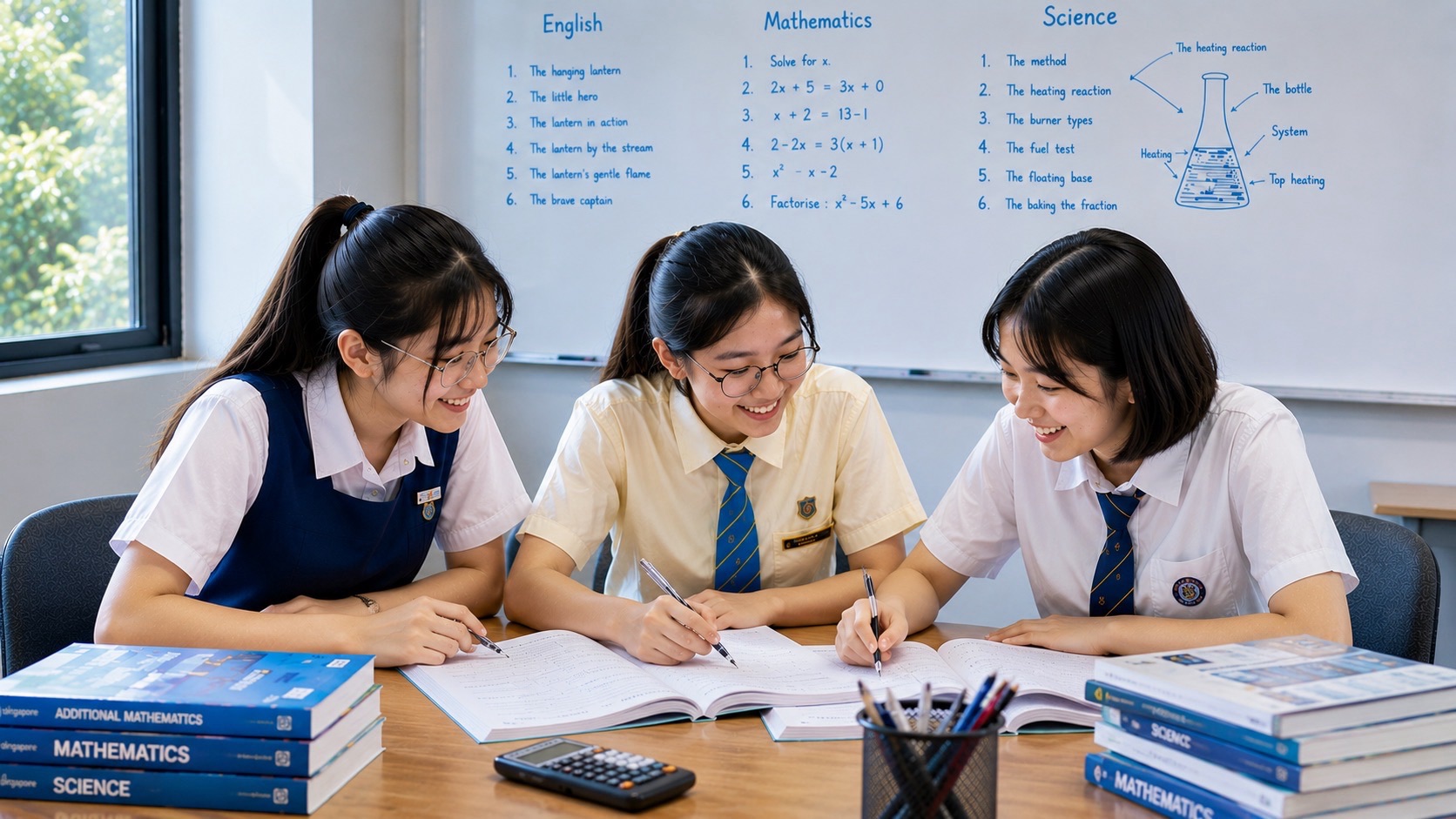
Bukit Timah E Math Tuition Secondary IP IB G1 G2 G3 Math Foundations is the routing page for the whole secondary Mathematics landscape. Parents searching for secondary math tuition Bukit Timah, E-Math tuition Bukit Timah, G1 Mathematics, G2 Mathematics, G3 Mathematics, Secondary 1 Math tuition, Secondary 2 Math tuition, Secondary 3 Math tuition, Secondary 4 Math tuition, Additional Mathematics, IP Mathematics or IB Mathematics often arrive with one apparently simple question: “Which class does my child need?” The accurate answer begins one level earlier: which mathematical system is the student actually in, and what is the first weak process inside that system?
This matters more in Singapore now because the old stream shorthand is no longer sufficient. Full Subject-Based Banding has been fully implemented from the 2024 Secondary 1 cohort, and students can take subjects at G1, G2 and G3 subject levels. From 2027, the Singapore-Cambridge Secondary Education Certificate replaces the separate N(T), N(A) and O-Level certificates for the Full SBB cohort. SEAB lists Mathematics at G1 K110, G2 K210 and G3 K310 for the 2027 SEC, with Additional Mathematics at G2 K232 and G3 K341. The mathematics may share deep foundations, but the syllabus depth, assessment demand and pathway context are not interchangeable.
At the same time, Bukit Timah has many overlapping mathematics markets: mainstream Secondary Mathematics, Additional Mathematics, Integrated Programme Mathematics, IB MYP and Diploma Mathematics, school-specific acceleration, and commercial “E-Math” language inherited from the older O-Level system. When comparing tuition options, consider MOE syllabus coverage, small-group classes, exam preparation, Sec 1–4 continuity, E-Math/A-Math separation and IP support. This eduKateSingapore guide helps families: map the systems cleanly, expose the shared foundations, prevent wrong-path tuition decisions, and route each learner to the smallest useful intervention.
The name “E-Math” may be familiar to families, but it is important to identify the student’s actual subject level and examination system. “E-Math” remains useful as historical shorthand, but the official 2027 SEC terminology is Mathematics at G1, G2 and G3 subject levels. Students preparing for O-Level examinations in 2026 should follow the requirements for their own cohort, keeping that examination system distinct from the SEC pathways.
50-Second Router
| Student situation | Primary route | Why |
|---|---|---|
| Secondary 1 transition from PSLE | Secondary 1 Mathematics | Build integers, algebra language, equations, graphs and independence |
| Secondary 2 foundations feel unstable | Secondary 2 Mathematics | Load-test algebra and retrieval before upper secondary |
| Secondary 3 mainstream Mathematics | Secondary 3 Mathematics | Coordinate algebra, graphs, geometry and mixed-problem recognition |
| Secondary 4 mainstream Mathematics | Secondary 4 Mathematics | Convert installed capability into reliable exam performance |
| Taking or considering Additional Mathematics | A-Math gateway | Separate mainstream Mathematics from higher symbolic dependency |
| Full SBB G1 Mathematics | G1 Mathematics / K110 pathway | Use the correct subject level and current SEC route |
| Full SBB G2 Mathematics | G2 Mathematics / K210 pathway | Match content depth and examination expectations |
| Full SBB G3 Mathematics | G3 Mathematics / K310 pathway | Prepare for the most demanding mainstream Mathematics level |
| G2 Additional Mathematics | A-Math G2 / K232 | Do not assume G3 A-Math materials map exactly |
| G3 Additional Mathematics | A-Math G3 / K341 | Build algebraic transfer and examination control |
| Integrated Programme student | IP Mathematics | Follow the actual school-specific sequence and destination |
| IB MYP / DP student | IB Mathematics | Separate AA/AI and school-specific expectations from SEC/O-Level routes |
The Current Secondary Mathematics Map
The first routing distinction is administrative but educationally important. From the 2024 Secondary 1 cohort, Full Subject-Based Banding replaced stream labels as the organising structure for most mainstream secondary students. Students can take subjects at G1, G2 or G3 levels and may adjust subject levels at appropriate points according to strengths, interests and learning needs. Posting Groups help with secondary-school admission; they are not permanent whole-student academic identities.
For the first SEC graduating cohort in 2027, SEAB lists Mathematics at G1 K110, G2 K210 and G3 K310. It also lists Additional Mathematics at G2 K232 and G3 K341. These codes matter because a parent searching “O-Level E-Math tuition” may actually be looking for a 2027 SEC G3 Mathematics route, while another child in Secondary 4 during 2026 is still preparing under the existing O-Level Mathematics 4052 and Additional Mathematics 4049 system.
That transition period is exactly where careless SEO pages can confuse families. “Express”, “E-Math”, “O-Level”, “G3 Mathematics” and “SEC Mathematics” overlap historically but are not identical labels. A good pathway guide should preserve useful search language while routing the student to the current official system.
Integrated Programme students require another separation. IP schools bypass the ordinary O-Level endpoint and may sequence Mathematics differently because their destination is usually the Singapore-Cambridge GCE A-Level, IB Diploma or NUS High School Diploma, depending on the school. IB students add another distinct architecture: MYP, then Diploma Programme Mathematics such as Analysis and Approaches or Applications and Interpretation, with standard or higher level depending on the course and school.
| System | Current / upcoming official label | Common search language | Main risk if misrouted |
|---|---|---|---|
| Mainstream lower secondary | G1 / G2 / G3 Mathematics | Sec 1 Math, Sec 2 Math, lower secondary math | Wrong subject-level depth or pace |
| 2026 graduating mainstream cohort | Existing GCE subject system | O-Level E-Math, N(A) Math, N(T) Math | Using future SEC terminology without current exam context |
| 2027+ Full SBB graduating cohort | SEC Mathematics K110/K210/K310 | SEC Math, G1/G2/G3 Math | Treating G-levels as old whole-student streams |
| Additional Mathematics | G2 K232 / G3 K341 from 2027 | A-Math tuition, Add Maths tuition | Mixing mainstream Math and A-Math weaknesses |
| Integrated Programme | School-specific IP Mathematics | IP Math tuition | Assuming a national chapter sequence where school sequence differs |
| IB | MYP / DP AA or AI | IB Math tuition | Using SEC/O-Level materials as if curricula were interchangeable |
Secondary Mathematics Is a System, Not a Single Subject Label
At the secondary level, the phrase ‘secondary math’ hides multiple subject levels, pathways and endpoints. A common failure appears when parents choose a centre from proximity before confirming curriculum compatibility. Because later mathematics reuses earlier structures, a routing or foundation error can create problems across several visible chapters.
Start by identifying school, year, actual subject level, current syllabus, recent assessment evidence and likely upper-secondary route. Then choose support. The first useful question is therefore not “How many questions should we do?” but “What is the mathematical job, and which dependency controls it?” A good intervention makes the route more visible before increasing volume.
Correct routing reduces content mismatch before teaching even begins. Alicia often moves quickly and needs precision checkpoints. Tricia sees rich relationships and sometimes needs to choose a smaller representation. Kai Kai may know enough mathematics but wait too long for reassurance. These resident learners show why one curriculum can still require different teaching moves.
Parents can watch for leading indicators before the next school grade changes: smaller hints, fewer repeated error families, stronger delayed retrieval, cleaner algebra, better representation choice, more independent checking and less dependence on chapter labels. Those process changes are often the first evidence that the system is improving.
Shared Foundation 1: Number Sense
At the secondary level, integers, fractions, decimals, ratio, percentage and proportional reasoning continue to power secondary work. A common failure appears when students appear to struggle with algebra while the real problem is unstable fractions or signs. Because later mathematics reuses earlier structures, a routing or foundation error can create problems across several visible chapters.
Test old number dependencies inside current algebra, graphs and geometry rather than only with isolated primary-style drills. The first useful question is therefore not “How many questions should we do?” but “What is the mathematical job, and which dependency controls it?” A good intervention makes the route more visible before increasing volume.
A repaired number foundation should improve several secondary topics at once. Alicia often moves quickly and needs precision checkpoints. Tricia sees rich relationships and sometimes needs to choose a smaller representation. Kai Kai may know enough mathematics but wait too long for reassurance. These resident learners show why one curriculum can still require different teaching moves.
Parents can watch for leading indicators before the next school grade changes: smaller hints, fewer repeated error families, stronger delayed retrieval, cleaner algebra, better representation choice, more independent checking and less dependence on chapter labels. Those process changes are often the first evidence that the system is improving.
Shared Foundation 2: Algebra as Infrastructure
At the secondary level, algebra is the language through which later secondary mathematics coordinates unknowns, functions, geometry and modelling. A common failure appears when students treat algebra as one chapter instead of reusable infrastructure. Because later mathematics reuses earlier structures, a routing or foundation error can create problems across several visible chapters.
Track sign control, expansion, factorisation, substitution, equations, formulae and manipulation across chapters. The first useful question is therefore not “How many questions should we do?” but “What is the mathematical job, and which dependency controls it?” A good intervention makes the route more visible before increasing volume.
When algebra becomes infrastructure, later topics feel connected rather than episodic. Alicia often moves quickly and needs precision checkpoints. Tricia sees rich relationships and sometimes needs to choose a smaller representation. Kai Kai may know enough mathematics but wait too long for reassurance. These resident learners show why one curriculum can still require different teaching moves.
Parents can watch for leading indicators before the next school grade changes: smaller hints, fewer repeated error families, stronger delayed retrieval, cleaner algebra, better representation choice, more independent checking and less dependence on chapter labels. Those process changes are often the first evidence that the system is improving.
Shared Foundation 3: Equality
At the secondary level, equations depend on preserving equivalence across transformations. A common failure appears when learners ‘move’ terms mechanically and lose sign or operation meaning. Because later mathematics reuses earlier structures, a routing or foundation error can create problems across several visible chapters.
Use balance reasoning, inverse operations and substitution checks until transformations are justified rather than chanted. The first useful question is therefore not “How many questions should we do?” but “What is the mathematical job, and which dependency controls it?” A good intervention makes the route more visible before increasing volume.
Stable equality reasoning lowers algebraic error rates across years. Alicia often moves quickly and needs precision checkpoints. Tricia sees rich relationships and sometimes needs to choose a smaller representation. Kai Kai may know enough mathematics but wait too long for reassurance. These resident learners show why one curriculum can still require different teaching moves.
Parents can watch for leading indicators before the next school grade changes: smaller hints, fewer repeated error families, stronger delayed retrieval, cleaner algebra, better representation choice, more independent checking and less dependence on chapter labels. Those process changes are often the first evidence that the system is improving.
Shared Foundation 4: Representation
At the secondary level, secondary questions move among words, equations, tables, graphs, diagrams and symbolic expressions. A common failure appears when students understand one representation but fail when the same relationship appears differently. Because later mathematics reuses earlier structures, a routing or foundation error can create problems across several visible chapters.
Practise translation: story to equation, equation to graph, table to rule, diagram to algebra, algebra back to context. The first useful question is therefore not “How many questions should we do?” but “What is the mathematical job, and which dependency controls it?” A good intervention makes the route more visible before increasing volume.
Transfer across representation is a strong predictor of independence. Alicia often moves quickly and needs precision checkpoints. Tricia sees rich relationships and sometimes needs to choose a smaller representation. Kai Kai may know enough mathematics but wait too long for reassurance. These resident learners show why one curriculum can still require different teaching moves.
Parents can watch for leading indicators before the next school grade changes: smaller hints, fewer repeated error families, stronger delayed retrieval, cleaner algebra, better representation choice, more independent checking and less dependence on chapter labels. Those process changes are often the first evidence that the system is improving.
Shared Foundation 5: Retrieval
At the secondary level, current topics depend on older methods being available without chapter prompts. A common failure appears when students relearn the same idea repeatedly because earlier knowledge is not retrievable. Because later mathematics reuses earlier structures, a routing or foundation error can create problems across several visible chapters.
Use spaced mixed retrieval and short blank-page checks after targeted teaching. The first useful question is therefore not “How many questions should we do?” but “What is the mathematical job, and which dependency controls it?” A good intervention makes the route more visible before increasing volume.
Durable retrieval reduces the need for constant reteaching. Alicia often moves quickly and needs precision checkpoints. Tricia sees rich relationships and sometimes needs to choose a smaller representation. Kai Kai may know enough mathematics but wait too long for reassurance. These resident learners show why one curriculum can still require different teaching moves.
Parents can watch for leading indicators before the next school grade changes: smaller hints, fewer repeated error families, stronger delayed retrieval, cleaner algebra, better representation choice, more independent checking and less dependence on chapter labels. Those process changes are often the first evidence that the system is improving.
Shared Foundation 6: Recognition
At the secondary level, examinations do not announce which method to use. A common failure appears when students are strong on topical worksheets and weak on mixed papers. Because later mathematics reuses earlier structures, a routing or foundation error can create problems across several visible chapters.
Remove chapter headings and ask for relationship classification before calculation. The first useful question is therefore not “How many questions should we do?” but “What is the mathematical job, and which dependency controls it?” A good intervention makes the route more visible before increasing volume.
Recognition converts stored knowledge into usable knowledge. Alicia often moves quickly and needs precision checkpoints. Tricia sees rich relationships and sometimes needs to choose a smaller representation. Kai Kai may know enough mathematics but wait too long for reassurance. These resident learners show why one curriculum can still require different teaching moves.
Parents can watch for leading indicators before the next school grade changes: smaller hints, fewer repeated error families, stronger delayed retrieval, cleaner algebra, better representation choice, more independent checking and less dependence on chapter labels. Those process changes are often the first evidence that the system is improving.
Shared Foundation 7: Working
At the secondary level, longer secondary solutions contain more state than lower-primary work. A common failure appears when students keep too much mentally or produce unreadable pages. Because later mathematics reuses earlier structures, a routing or foundation error can create problems across several visible chapters.
Use compact labelled working, aligned equations, units and meaningful intermediate states. The first useful question is therefore not “How many questions should we do?” but “What is the mathematical job, and which dependency controls it?” A good intervention makes the route more visible before increasing volume.
Good working is external memory and error-control infrastructure. Alicia often moves quickly and needs precision checkpoints. Tricia sees rich relationships and sometimes needs to choose a smaller representation. Kai Kai may know enough mathematics but wait too long for reassurance. These resident learners show why one curriculum can still require different teaching moves.
Parents can watch for leading indicators before the next school grade changes: smaller hints, fewer repeated error families, stronger delayed retrieval, cleaner algebra, better representation choice, more independent checking and less dependence on chapter labels. Those process changes are often the first evidence that the system is improving.
Shared Foundation 8: Verification
At the secondary level, secondary mathematics increasingly permits independent checks. A common failure appears when students finish when a calculator or algebra line produces a number. Because later mathematics reuses earlier structures, a routing or foundation error can create problems across several visible chapters.
Use substitution, inverse operations, graph behaviour, unit analysis, estimation and alternate routes. The first useful question is therefore not “How many questions should we do?” but “What is the mathematical job, and which dependency controls it?” A good intervention makes the route more visible before increasing volume.
Verification reduces preventable loss without requiring more content. Alicia often moves quickly and needs precision checkpoints. Tricia sees rich relationships and sometimes needs to choose a smaller representation. Kai Kai may know enough mathematics but wait too long for reassurance. These resident learners show why one curriculum can still require different teaching moves.
Parents can watch for leading indicators before the next school grade changes: smaller hints, fewer repeated error families, stronger delayed retrieval, cleaner algebra, better representation choice, more independent checking and less dependence on chapter labels. Those process changes are often the first evidence that the system is improving.
G1 Mathematics
At the secondary level, G1 Mathematics is a legitimate subject level under Full SBB and the 2027 SEC. A common failure appears when families treat G1 as a permanent identity or simply as ‘easy math’. Because later mathematics reuses earlier structures, a routing or foundation error can create problems across several visible chapters.
Match teaching to the actual G1 syllabus while still building durable number, algebra, measurement and problem-solving foundations. The first useful question is therefore not “How many questions should we do?” but “What is the mathematical job, and which dependency controls it?” A good intervention makes the route more visible before increasing volume.
Subject-level placement should describe current learning demand, not define the student. Alicia often moves quickly and needs precision checkpoints. Tricia sees rich relationships and sometimes needs to choose a smaller representation. Kai Kai may know enough mathematics but wait too long for reassurance. These resident learners show why one curriculum can still require different teaching moves.
Parents can watch for leading indicators before the next school grade changes: smaller hints, fewer repeated error families, stronger delayed retrieval, cleaner algebra, better representation choice, more independent checking and less dependence on chapter labels. Those process changes are often the first evidence that the system is improving.
G2 Mathematics
At the secondary level, G2 Mathematics sits at a distinct subject level with its own SEC code K210. A common failure appears when materials are borrowed indiscriminately from G3 or legacy N(A) sources. Because later mathematics reuses earlier structures, a routing or foundation error can create problems across several visible chapters.
Use current official syllabus boundaries and calibrate depth, representation and exam demand accordingly. The first useful question is therefore not “How many questions should we do?” but “What is the mathematical job, and which dependency controls it?” A good intervention makes the route more visible before increasing volume.
A well-matched G2 route can strengthen foundations without artificial acceleration. Alicia often moves quickly and needs precision checkpoints. Tricia sees rich relationships and sometimes needs to choose a smaller representation. Kai Kai may know enough mathematics but wait too long for reassurance. These resident learners show why one curriculum can still require different teaching moves.
Parents can watch for leading indicators before the next school grade changes: smaller hints, fewer repeated error families, stronger delayed retrieval, cleaner algebra, better representation choice, more independent checking and less dependence on chapter labels. Those process changes are often the first evidence that the system is improving.
G3 Mathematics
At the secondary level, G3 Mathematics carries the most demanding mainstream Mathematics route under Full SBB, with SEC code K310 from 2027. A common failure appears when families continue to frame it only as ‘Express E-Math’. Because later mathematics reuses earlier structures, a routing or foundation error can create problems across several visible chapters.
Preserve useful O-Level heritage where relevant but teach toward current G3 Mathematics expectations and the learner’s year cohort. The first useful question is therefore not “How many questions should we do?” but “What is the mathematical job, and which dependency controls it?” A good intervention makes the route more visible before increasing volume.
Current terminology prevents pathway confusion while historical resources remain useful. Alicia often moves quickly and needs precision checkpoints. Tricia sees rich relationships and sometimes needs to choose a smaller representation. Kai Kai may know enough mathematics but wait too long for reassurance. These resident learners show why one curriculum can still require different teaching moves.
Parents can watch for leading indicators before the next school grade changes: smaller hints, fewer repeated error families, stronger delayed retrieval, cleaner algebra, better representation choice, more independent checking and less dependence on chapter labels. Those process changes are often the first evidence that the system is improving.
G2 Additional Mathematics
At the secondary level, G2 Additional Mathematics exists as K232 from 2027. A common failure appears when students are sent automatically into G3 A-Math materials because ‘A-Math is A-Math’. Because later mathematics reuses earlier structures, a routing or foundation error can create problems across several visible chapters.
Use the correct syllabus and keep the student’s mainstream Mathematics dependencies visible. The first useful question is therefore not “How many questions should we do?” but “What is the mathematical job, and which dependency controls it?” A good intervention makes the route more visible before increasing volume.
Additional Mathematics level should be explicit before tuition materials are chosen. Alicia often moves quickly and needs precision checkpoints. Tricia sees rich relationships and sometimes needs to choose a smaller representation. Kai Kai may know enough mathematics but wait too long for reassurance. These resident learners show why one curriculum can still require different teaching moves.
Parents can watch for leading indicators before the next school grade changes: smaller hints, fewer repeated error families, stronger delayed retrieval, cleaner algebra, better representation choice, more independent checking and less dependence on chapter labels. Those process changes are often the first evidence that the system is improving.
G3 Additional Mathematics
At the secondary level, G3 Additional Mathematics is K341 from 2027 and continues the high symbolic-dependency tradition of Additional Mathematics. A common failure appears when students practise advanced questions while algebraic infrastructure remains unstable. Because later mathematics reuses earlier structures, a routing or foundation error can create problems across several visible chapters.
Repair shared algebra first, then build transfer across quadratics, logarithms, trigonometry, coordinate geometry and calculus-related structures according to syllabus. The first useful question is therefore not “How many questions should we do?” but “What is the mathematical job, and which dependency controls it?” A good intervention makes the route more visible before increasing volume.
Advanced content cannot compensate for weak symbolic control. Alicia often moves quickly and needs precision checkpoints. Tricia sees rich relationships and sometimes needs to choose a smaller representation. Kai Kai may know enough mathematics but wait too long for reassurance. These resident learners show why one curriculum can still require different teaching moves.
Parents can watch for leading indicators before the next school grade changes: smaller hints, fewer repeated error families, stronger delayed retrieval, cleaner algebra, better representation choice, more independent checking and less dependence on chapter labels. Those process changes are often the first evidence that the system is improving.
Secondary 1 Transition
At the secondary level, the PSLE-to-secondary jump changes mathematical language, notation and independence expectations. A common failure appears when parents assume a strong PSLE grade guarantees a frictionless transition. Because later mathematics reuses earlier structures, a routing or foundation error can create problems across several visible chapters.
Observe integers, algebra, fractions, equality, graphs, working and ability to learn from school feedback during the first months. The first useful question is therefore not “How many questions should we do?” but “What is the mathematical job, and which dependency controls it?” A good intervention makes the route more visible before increasing volume.
Secondary 1 tuition is justified by evidence, not the calendar alone. Alicia often moves quickly and needs precision checkpoints. Tricia sees rich relationships and sometimes needs to choose a smaller representation. Kai Kai may know enough mathematics but wait too long for reassurance. These resident learners show why one curriculum can still require different teaching moves.
Parents can watch for leading indicators before the next school grade changes: smaller hints, fewer repeated error families, stronger delayed retrieval, cleaner algebra, better representation choice, more independent checking and less dependence on chapter labels. Those process changes are often the first evidence that the system is improving.
Secondary 2 Consolidation
At the secondary level, Sec 2 is a strategic consolidation year before upper-secondary complexity. A common failure appears when old streaming-year narratives encourage premature acceleration or anxiety. Because later mathematics reuses earlier structures, a routing or foundation error can create problems across several visible chapters.
Load-test algebra, representation, retrieval and mixed-problem control before deciding how much acceleration is useful. The first useful question is therefore not “How many questions should we do?” but “What is the mathematical job, and which dependency controls it?” A good intervention makes the route more visible before increasing volume.
A clean Sec 2 handoff makes Sec 3 choices easier. Alicia often moves quickly and needs precision checkpoints. Tricia sees rich relationships and sometimes needs to choose a smaller representation. Kai Kai may know enough mathematics but wait too long for reassurance. These resident learners show why one curriculum can still require different teaching moves.
Parents can watch for leading indicators before the next school grade changes: smaller hints, fewer repeated error families, stronger delayed retrieval, cleaner algebra, better representation choice, more independent checking and less dependence on chapter labels. Those process changes are often the first evidence that the system is improving.
Secondary 3 Coordination
At the secondary level, upper secondary introduces more simultaneous systems and may add Additional Mathematics. A common failure appears when students treat mainstream Mathematics and A-Math as completely independent workloads. Because later mathematics reuses earlier structures, a routing or foundation error can create problems across several visible chapters.
Map shared algebra, distinguish syllabus-specific demands and coordinate retrieval so one subject does not cannibalise the other. The first useful question is therefore not “How many questions should we do?” but “What is the mathematical job, and which dependency controls it?” A good intervention makes the route more visible before increasing volume.
The key Sec 3 job is coordination, not just more content. Alicia often moves quickly and needs precision checkpoints. Tricia sees rich relationships and sometimes needs to choose a smaller representation. Kai Kai may know enough mathematics but wait too long for reassurance. These resident learners show why one curriculum can still require different teaching moves.
Parents can watch for leading indicators before the next school grade changes: smaller hints, fewer repeated error families, stronger delayed retrieval, cleaner algebra, better representation choice, more independent checking and less dependence on chapter labels. Those process changes are often the first evidence that the system is improving.
Secondary 4 Conversion
At the secondary level, the final year shifts from broad building toward selective repair and exam conversion. A common failure appears when students keep rebuilding everything and never stabilise paper performance. Because later mathematics reuses earlier structures, a routing or foundation error can create problems across several visible chapters.
Use assessment evidence to prioritise high-leverage repairs, mixed retrieval, timed execution, recovery and checking. The first useful question is therefore not “How many questions should we do?” but “What is the mathematical job, and which dependency controls it?” A good intervention makes the route more visible before increasing volume.
The end-state is lower variance, not simply more completed papers. Alicia often moves quickly and needs precision checkpoints. Tricia sees rich relationships and sometimes needs to choose a smaller representation. Kai Kai may know enough mathematics but wait too long for reassurance. These resident learners show why one curriculum can still require different teaching moves.
Parents can watch for leading indicators before the next school grade changes: smaller hints, fewer repeated error families, stronger delayed retrieval, cleaner algebra, better representation choice, more independent checking and less dependence on chapter labels. Those process changes are often the first evidence that the system is improving.
2026 O-Level Transition Year
At the secondary level, Secondary 4 students in 2026 still use the existing GCE examination system. A common failure appears when future SEC language is applied carelessly to current candidates. Because later mathematics reuses earlier structures, a routing or foundation error can create problems across several visible chapters.
Keep 2026 O-Level Mathematics 4052 and A-Math 4049 advice explicit for the current cohort. The first useful question is therefore not “How many questions should we do?” but “What is the mathematical job, and which dependency controls it?” A good intervention makes the route more visible before increasing volume.
Current candidates deserve current examination guidance. Alicia often moves quickly and needs precision checkpoints. Tricia sees rich relationships and sometimes needs to choose a smaller representation. Kai Kai may know enough mathematics but wait too long for reassurance. These resident learners show why one curriculum can still require different teaching moves.
Parents can watch for leading indicators before the next school grade changes: smaller hints, fewer repeated error families, stronger delayed retrieval, cleaner algebra, better representation choice, more independent checking and less dependence on chapter labels. Those process changes are often the first evidence that the system is improving.
2027 SEC Transition
At the secondary level, the first Full SBB cohort graduates under the SEC in 2027. A common failure appears when families assume a completely different mathematical universe. Because later mathematics reuses earlier structures, a routing or foundation error can create problems across several visible chapters.
Use SEAB’s current G1/G2/G3 subject codes and syllabuses while recognising continuity in core mathematical processes. The first useful question is therefore not “How many questions should we do?” but “What is the mathematical job, and which dependency controls it?” A good intervention makes the route more visible before increasing volume.
The certificate structure changes; good mathematics still depends on retrieval, application and reasoning. Alicia often moves quickly and needs precision checkpoints. Tricia sees rich relationships and sometimes needs to choose a smaller representation. Kai Kai may know enough mathematics but wait too long for reassurance. These resident learners show why one curriculum can still require different teaching moves.
Parents can watch for leading indicators before the next school grade changes: smaller hints, fewer repeated error families, stronger delayed retrieval, cleaner algebra, better representation choice, more independent checking and less dependence on chapter labels. Those process changes are often the first evidence that the system is improving.
Integrated Programme Mathematics
At the secondary level, IP students often follow school-specific sequences and skip the ordinary O-Level endpoint. A common failure appears when generic tuition forces every IP learner into an O-Level pacing model. Because later mathematics reuses earlier structures, a routing or foundation error can create problems across several visible chapters.
Use actual school materials, assessment schedule and destination pathway to map the intervention. The first useful question is therefore not “How many questions should we do?” but “What is the mathematical job, and which dependency controls it?” A good intervention makes the route more visible before increasing volume.
IP support should be school-aware without becoming school-dependent tutoring. Alicia often moves quickly and needs precision checkpoints. Tricia sees rich relationships and sometimes needs to choose a smaller representation. Kai Kai may know enough mathematics but wait too long for reassurance. These resident learners show why one curriculum can still require different teaching moves.
Parents can watch for leading indicators before the next school grade changes: smaller hints, fewer repeated error families, stronger delayed retrieval, cleaner algebra, better representation choice, more independent checking and less dependence on chapter labels. Those process changes are often the first evidence that the system is improving.
IB Mathematics
At the secondary level, IB learners operate inside MYP or DP frameworks with different aims and technology expectations. A common failure appears when IB AA, AI, MYP and SEC Mathematics are bundled together as ‘secondary math’. Because later mathematics reuses earlier structures, a routing or foundation error can create problems across several visible chapters.
Identify programme, level, school sequence and assessment type before selecting teaching materials. The first useful question is therefore not “How many questions should we do?” but “What is the mathematical job, and which dependency controls it?” A good intervention makes the route more visible before increasing volume.
The right route depends on the exact IB mathematics course, not the IB label alone. Alicia often moves quickly and needs precision checkpoints. Tricia sees rich relationships and sometimes needs to choose a smaller representation. Kai Kai may know enough mathematics but wait too long for reassurance. These resident learners show why one curriculum can still require different teaching moves.
Parents can watch for leading indicators before the next school grade changes: smaller hints, fewer repeated error families, stronger delayed retrieval, cleaner algebra, better representation choice, more independent checking and less dependence on chapter labels. Those process changes are often the first evidence that the system is improving.
Small-Group Compatibility
At the secondary level, three-student groups can create high observation density when learners are compatible. A common failure appears when small class size is treated as a guarantee of quality. Because later mathematics reuses earlier structures, a routing or foundation error can create problems across several visible chapters.
Match curriculum, pace, learner state, independence and assessment timing; regroup when compatibility breaks. The first useful question is therefore not “How many questions should we do?” but “What is the mathematical job, and which dependency controls it?” A good intervention makes the route more visible before increasing volume.
The mechanism is visibility plus compatible work, not the number three by itself. Alicia often moves quickly and needs precision checkpoints. Tricia sees rich relationships and sometimes needs to choose a smaller representation. Kai Kai may know enough mathematics but wait too long for reassurance. These resident learners show why one curriculum can still require different teaching moves.
Parents can watch for leading indicators before the next school grade changes: smaller hints, fewer repeated error families, stronger delayed retrieval, cleaner algebra, better representation choice, more independent checking and less dependence on chapter labels. Those process changes are often the first evidence that the system is improving.
Diagnosis Before Volume
At the secondary level, more practice is useful only after the right failure is identified. A common failure appears when families respond to every low score with more worksheets. Because later mathematics reuses earlier structures, a routing or foundation error can create problems across several visible chapters.
Classify concept, retrieval, recognition, representation, execution, unit, timing and checking failures before adding volume. The first useful question is therefore not “How many questions should we do?” but “What is the mathematical job, and which dependency controls it?” A good intervention makes the route more visible before increasing volume.
High-resolution diagnosis improves resolution per hour. Alicia often moves quickly and needs precision checkpoints. Tricia sees rich relationships and sometimes needs to choose a smaller representation. Kai Kai may know enough mathematics but wait too long for reassurance. These resident learners show why one curriculum can still require different teaching moves.
Parents can watch for leading indicators before the next school grade changes: smaller hints, fewer repeated error families, stronger delayed retrieval, cleaner algebra, better representation choice, more independent checking and less dependence on chapter labels. Those process changes are often the first evidence that the system is improving.
Transfer
At the secondary level, a method is useful only if it survives changed numbers, wording and representations. A common failure appears when students reproduce examples but cannot solve nearby variants. Because later mathematics reuses earlier structures, a routing or foundation error can create problems across several visible chapters.
Change one surface feature after teaching, remove hints, then return after delay. The first useful question is therefore not “How many questions should we do?” but “What is the mathematical job, and which dependency controls it?” A good intervention makes the route more visible before increasing volume.
Transfer is evidence that the learner owns the relationship rather than the example. Alicia often moves quickly and needs precision checkpoints. Tricia sees rich relationships and sometimes needs to choose a smaller representation. Kai Kai may know enough mathematics but wait too long for reassurance. These resident learners show why one curriculum can still require different teaching moves.
Parents can watch for leading indicators before the next school grade changes: smaller hints, fewer repeated error families, stronger delayed retrieval, cleaner algebra, better representation choice, more independent checking and less dependence on chapter labels. Those process changes are often the first evidence that the system is improving.
Independence
At the secondary level, the long-term goal is decreasing reliance on tutor prompts. A common failure appears when students become excellent at being helped. Because later mathematics reuses earlier structures, a routing or foundation error can create problems across several visible chapters.
Track hint size, independent starts, self-checking and ability to use school feedback without rescue. The first useful question is therefore not “How many questions should we do?” but “What is the mathematical job, and which dependency controls it?” A good intervention makes the route more visible before increasing volume.
Tuition should manufacture independence, not permanent dependence. Alicia often moves quickly and needs precision checkpoints. Tricia sees rich relationships and sometimes needs to choose a smaller representation. Kai Kai may know enough mathematics but wait too long for reassurance. These resident learners show why one curriculum can still require different teaching moves.
Parents can watch for leading indicators before the next school grade changes: smaller hints, fewer repeated error families, stronger delayed retrieval, cleaner algebra, better representation choice, more independent checking and less dependence on chapter labels. Those process changes are often the first evidence that the system is improving.
The 2027 SEC Mathematics Codes
SEAB’s current 2027 school-candidate listings provide an important routing anchor. G1 Mathematics is K110, with 4046 shown as the reference code for 2026 and earlier. G2 Mathematics is K210, with 4045 as the reference code. G3 Mathematics is K310, with 4052 as the reference code. Additional Mathematics appears at G2 as K232, with 4051 as the earlier reference, and at G3 as K341, with 4049 as the earlier reference.
These mappings do not mean the old streams continue under new names as whole-student labels. MOE explicitly frames G1, G2 and G3 as subject levels under Full SBB, with students able to take a mix of subject levels. The historical reference codes are useful for continuity of resources; the current subject-level structure should govern routing for the 2027 SEC cohort.
100 Secondary Mathematics Diagnostic Cases
Case 1: Sec 1 integer signs. Observation: student expands algebra correctly but loses negatives. Diagnostic move: Separate sign arithmetic from algebra complexity. This tests number dependency. The useful follow-up is a changed version after the repair and another attempt after delay. The goal is not to make the corrected page look complete; it is to lower the probability that the same failure recurs somewhere else in the secondary Mathematics system.
Case 2: Sec 1 fractions. Observation: equations fail only with fractional coefficients. Diagnostic move: Test fraction fluency outside equation context. This tests fraction dependency. The useful follow-up is a changed version after the repair and another attempt after delay. The goal is not to make the corrected page look complete; it is to lower the probability that the same failure recurs somewhere else in the secondary Mathematics system.
Case 3: Sec 1 equality. Observation: student moves terms mechanically. Diagnostic move: Use balance and substitution checks. This tests equality. The useful follow-up is a changed version after the repair and another attempt after delay. The goal is not to make the corrected page look complete; it is to lower the probability that the same failure recurs somewhere else in the secondary Mathematics system.
Case 4: Sec 1 graph. Observation: table values correct but graph wrong. Diagnostic move: Audit axes, scale and coordinate mapping. This tests representation. The useful follow-up is a changed version after the repair and another attempt after delay. The goal is not to make the corrected page look complete; it is to lower the probability that the same failure recurs somewhere else in the secondary Mathematics system.
Case 5: Sec 1 word problem. Observation: needs teacher to name operation. Diagnostic move: Ask for unknown and relationship first. This tests recognition. The useful follow-up is a changed version after the repair and another attempt after delay. The goal is not to make the corrected page look complete; it is to lower the probability that the same failure recurs somewhere else in the secondary Mathematics system.
Case 6: Sec 1 strong PSLE student. Observation: parent assumes no monitoring needed. Diagnostic move: Observe transition evidence rather than prior grade. This tests transition. The useful follow-up is a changed version after the repair and another attempt after delay. The goal is not to make the corrected page look complete; it is to lower the probability that the same failure recurs somewhere else in the secondary Mathematics system.
Case 7: Sec 2 algebra. Observation: factorisation weak after expansion strong. Diagnostic move: Map inverse relation. This tests algebra structure. The useful follow-up is a changed version after the repair and another attempt after delay. The goal is not to make the corrected page look complete; it is to lower the probability that the same failure recurs somewhere else in the secondary Mathematics system.
Case 8: Sec 2 formula. Observation: substitution errors. Diagnostic move: Separate formula reading from arithmetic. This tests representation. The useful follow-up is a changed version after the repair and another attempt after delay. The goal is not to make the corrected page look complete; it is to lower the probability that the same failure recurs somewhere else in the secondary Mathematics system.
Case 9: Sec 2 graphs. Observation: equation known, graph meaning weak. Diagnostic move: Translate equation-table-graph. This tests multi-representation. The useful follow-up is a changed version after the repair and another attempt after delay. The goal is not to make the corrected page look complete; it is to lower the probability that the same failure recurs somewhere else in the secondary Mathematics system.
Case 10: Sec 2 geometry. Observation: formula chosen by diagram appearance. Diagnostic move: Name quantity/property first. This tests classification. The useful follow-up is a changed version after the repair and another attempt after delay. The goal is not to make the corrected page look complete; it is to lower the probability that the same failure recurs somewhere else in the secondary Mathematics system.
Case 11: Sec 2 mixed test. Observation: topic tests strong. Diagnostic move: Interleave and remove labels. This tests recognition. The useful follow-up is a changed version after the repair and another attempt after delay. The goal is not to make the corrected page look complete; it is to lower the probability that the same failure recurs somewhere else in the secondary Mathematics system.
Case 12: Sec 2 A-Math anxiety. Observation: parent accelerates early. Diagnostic move: Check current Mathematics stability first. This tests sequencing. The useful follow-up is a changed version after the repair and another attempt after delay. The goal is not to make the corrected page look complete; it is to lower the probability that the same failure recurs somewhere else in the secondary Mathematics system.
Case 13: Sec 3 mainstream Math. Observation: A-Math homework dominates. Diagnostic move: Coordinate shared algebra and time. This tests workload. The useful follow-up is a changed version after the repair and another attempt after delay. The goal is not to make the corrected page look complete; it is to lower the probability that the same failure recurs somewhere else in the secondary Mathematics system.
Case 14: Sec 3 G3 Math. Observation: algebra leaks into geometry. Diagnostic move: Repair shared algebra infrastructure. This tests dependency. The useful follow-up is a changed version after the repair and another attempt after delay. The goal is not to make the corrected page look complete; it is to lower the probability that the same failure recurs somewhere else in the secondary Mathematics system.
Case 15: Sec 3 A-Math. Observation: quadratic skills disappear in trigonometry. Diagnostic move: Use mixed symbolic retrieval. This tests transfer. The useful follow-up is a changed version after the repair and another attempt after delay. The goal is not to make the corrected page look complete; it is to lower the probability that the same failure recurs somewhere else in the secondary Mathematics system.
Case 16: Sec 3 graphs. Observation: calculator produces answer but interpretation weak. Diagnostic move: Ask what graph means in context. This tests interpretation. The useful follow-up is a changed version after the repair and another attempt after delay. The goal is not to make the corrected page look complete; it is to lower the probability that the same failure recurs somewhere else in the secondary Mathematics system.
Case 17: Sec 3 statistics. Observation: formula memorised, data meaning weak. Diagnostic move: Interpret variable and sample context. This tests concept. The useful follow-up is a changed version after the repair and another attempt after delay. The goal is not to make the corrected page look complete; it is to lower the probability that the same failure recurs somewhere else in the secondary Mathematics system.
Case 18: Sec 3 geometry. Observation: proof-like reasoning missing. Diagnostic move: Require property-based statements. This tests reasoning. The useful follow-up is a changed version after the repair and another attempt after delay. The goal is not to make the corrected page look complete; it is to lower the probability that the same failure recurs somewhere else in the secondary Mathematics system.
Case 19: Sec 4 2026. Observation: advice framed as SEC only. Diagnostic move: Use current O-Level 4052 context. This tests cohort routing. The useful follow-up is a changed version after the repair and another attempt after delay. The goal is not to make the corrected page look complete; it is to lower the probability that the same failure recurs somewhere else in the secondary Mathematics system.
Case 20: Sec 4 2026 A-Math. Observation: future K341 code used as if exam current. Diagnostic move: Use 4049 for current cohort. This tests cohort routing. The useful follow-up is a changed version after the repair and another attempt after delay. The goal is not to make the corrected page look complete; it is to lower the probability that the same failure recurs somewhere else in the secondary Mathematics system.
Case 21: 2027 SEC G1. Observation: student sent to G3 materials. Diagnostic move: Confirm K110 syllabus. This tests level mismatch. The useful follow-up is a changed version after the repair and another attempt after delay. The goal is not to make the corrected page look complete; it is to lower the probability that the same failure recurs somewhere else in the secondary Mathematics system.
Case 22: 2027 SEC G2. Observation: student uses legacy N(A) shorthand only. Diagnostic move: Route by K210 current syllabus. This tests currentness. The useful follow-up is a changed version after the repair and another attempt after delay. The goal is not to make the corrected page look complete; it is to lower the probability that the same failure recurs somewhere else in the secondary Mathematics system.
Case 23: 2027 SEC G3. Observation: student told ‘Express stream’ identity. Diagnostic move: Use G3 subject-level framing. This tests Full SBB. The useful follow-up is a changed version after the repair and another attempt after delay. The goal is not to make the corrected page look complete; it is to lower the probability that the same failure recurs somewhere else in the secondary Mathematics system.
Case 24: G2 A-Math. Observation: centre assumes only G3 exists. Diagnostic move: Confirm K232. This tests subject-level routing. The useful follow-up is a changed version after the repair and another attempt after delay. The goal is not to make the corrected page look complete; it is to lower the probability that the same failure recurs somewhere else in the secondary Mathematics system.
Case 25: G3 A-Math. Observation: centre mixes G2 and G3 worksheets. Diagnostic move: Confirm K341 demands. This tests subject-level routing. The useful follow-up is a changed version after the repair and another attempt after delay. The goal is not to make the corrected page look complete; it is to lower the probability that the same failure recurs somewhere else in the secondary Mathematics system.
Case 26: IP Sec 1. Observation: generic Sec1 worksheet too slow/fast. Diagnostic move: Use actual school sequence. This tests IP routing. The useful follow-up is a changed version after the repair and another attempt after delay. The goal is not to make the corrected page look complete; it is to lower the probability that the same failure recurs somewhere else in the secondary Mathematics system.
Case 27: IP Sec 3. Observation: O-Level paper used as sole benchmark. Diagnostic move: Map school destination and assessments. This tests IP mismatch. The useful follow-up is a changed version after the repair and another attempt after delay. The goal is not to make the corrected page look complete; it is to lower the probability that the same failure recurs somewhere else in the secondary Mathematics system.
Case 28: IB MYP. Observation: SEC syllabus assumed equivalent. Diagnostic move: Identify MYP objectives and school unit. This tests IB routing. The useful follow-up is a changed version after the repair and another attempt after delay. The goal is not to make the corrected page look complete; it is to lower the probability that the same failure recurs somewhere else in the secondary Mathematics system.
Case 29: IB DP. Observation: AA/AI not distinguished. Diagnostic move: Confirm course and level. This tests IB routing. The useful follow-up is a changed version after the repair and another attempt after delay. The goal is not to make the corrected page look complete; it is to lower the probability that the same failure recurs somewhere else in the secondary Mathematics system.
Case 30: parent says E-Math. Observation: student is 2027 G3 cohort. Diagnostic move: Translate search language into current G3 Mathematics route. This tests terminology. The useful follow-up is a changed version after the repair and another attempt after delay. The goal is not to make the corrected page look complete; it is to lower the probability that the same failure recurs somewhere else in the secondary Mathematics system.
Case 31: parent says O-Level. Observation: student is Sec 1 2026. Diagnostic move: Clarify future SEC endpoint. This tests timeline. The useful follow-up is a changed version after the repair and another attempt after delay. The goal is not to make the corrected page look complete; it is to lower the probability that the same failure recurs somewhere else in the secondary Mathematics system.
Case 32: parent says Full SBB. Observation: cannot name subject level. Diagnostic move: Check actual school subject allocation. This tests precision. The useful follow-up is a changed version after the repair and another attempt after delay. The goal is not to make the corrected page look complete; it is to lower the probability that the same failure recurs somewhere else in the secondary Mathematics system.
Case 33: student in mixed subject levels. Observation: tuition assumes one whole-student level. Diagnostic move: Route Mathematics specifically. This tests Full SBB flexibility. The useful follow-up is a changed version after the repair and another attempt after delay. The goal is not to make the corrected page look complete; it is to lower the probability that the same failure recurs somewhere else in the secondary Mathematics system.
Case 34: algebra error repeats across topics. Observation: each chapter retaught separately. Diagnostic move: Repair common algebra dependency. This tests leverage. The useful follow-up is a changed version after the repair and another attempt after delay. The goal is not to make the corrected page look complete; it is to lower the probability that the same failure recurs somewhere else in the secondary Mathematics system.
Case 35: fraction error repeats across algebra. Observation: student labelled careless. Diagnostic move: Repair fraction/sign control. This tests root cause. The useful follow-up is a changed version after the repair and another attempt after delay. The goal is not to make the corrected page look complete; it is to lower the probability that the same failure recurs somewhere else in the secondary Mathematics system.
Case 36: graph error repeats. Observation: more algebra questions assigned. Diagnostic move: Repair representation mapping. This tests root cause. The useful follow-up is a changed version after the repair and another attempt after delay. The goal is not to make the corrected page look complete; it is to lower the probability that the same failure recurs somewhere else in the secondary Mathematics system.
Case 37: unit error repeats. Observation: formula revision added. Diagnostic move: Carry units through working. This tests dimensional reasoning. The useful follow-up is a changed version after the repair and another attempt after delay. The goal is not to make the corrected page look complete; it is to lower the probability that the same failure recurs somewhere else in the secondary Mathematics system.
Case 38: calculator error. Observation: concept blamed. Diagnostic move: Separate tool execution from method selection. This tests diagnosis. The useful follow-up is a changed version after the repair and another attempt after delay. The goal is not to make the corrected page look complete; it is to lower the probability that the same failure recurs somewhere else in the secondary Mathematics system.
Case 39: correct concept, slow retrieval. Observation: harder questions added. Diagnostic move: Use spaced retrieval. This tests availability. The useful follow-up is a changed version after the repair and another attempt after delay. The goal is not to make the corrected page look complete; it is to lower the probability that the same failure recurs somewhere else in the secondary Mathematics system.
Case 40: same-day success, delayed failure. Observation: teacher assumes mastery. Diagnostic move: Retest after delay. This tests durability. The useful follow-up is a changed version after the repair and another attempt after delay. The goal is not to make the corrected page look complete; it is to lower the probability that the same failure recurs somewhere else in the secondary Mathematics system.
Case 41: changed wording failure. Observation: student says never learned. Diagnostic move: Strip surface to relation. This tests transfer. The useful follow-up is a changed version after the repair and another attempt after delay. The goal is not to make the corrected page look complete; it is to lower the probability that the same failure recurs somewhere else in the secondary Mathematics system.
Case 42: chapter heading removed. Observation: student freezes. Diagnostic move: Train classification before calculation. This tests recognition. The useful follow-up is a changed version after the repair and another attempt after delay. The goal is not to make the corrected page look complete; it is to lower the probability that the same failure recurs somewhere else in the secondary Mathematics system.
Case 43: one-to-one help works. Observation: independent test fails. Diagnostic move: Fade hints. This tests dependence. The useful follow-up is a changed version after the repair and another attempt after delay. The goal is not to make the corrected page look complete; it is to lower the probability that the same failure recurs somewhere else in the secondary Mathematics system.
Case 44: small group peer answers first. Observation: student copies. Diagnostic move: Independent start before discussion. This tests ownership. The useful follow-up is a changed version after the repair and another attempt after delay. The goal is not to make the corrected page look complete; it is to lower the probability that the same failure recurs somewhere else in the secondary Mathematics system.
Case 45: Alicia rushes. Observation: loses signs. Diagnostic move: Precision checkpoint. This tests execution. The useful follow-up is a changed version after the repair and another attempt after delay. The goal is not to make the corrected page look complete; it is to lower the probability that the same failure recurs somewhere else in the secondary Mathematics system.
Case 46: Tricia over-explains. Observation: paper unfinished. Diagnostic move: Compress representation. This tests efficiency. The useful follow-up is a changed version after the repair and another attempt after delay. The goal is not to make the corrected page look complete; it is to lower the probability that the same failure recurs somewhere else in the secondary Mathematics system.
Case 47: Kai Kai waits. Observation: leaves blank start. Diagnostic move: Silent-start routine. This tests initiation. The useful follow-up is a changed version after the repair and another attempt after delay. The goal is not to make the corrected page look complete; it is to lower the probability that the same failure recurs somewhere else in the secondary Mathematics system.
Case 48: parent wants top centre. Observation: curriculum fit unknown. Diagnostic move: Check subject-level compatibility first. This tests placement. The useful follow-up is a changed version after the repair and another attempt after delay. The goal is not to make the corrected page look complete; it is to lower the probability that the same failure recurs somewhere else in the secondary Mathematics system.
Case 49: parent compares hourly fees. Observation: resolution differs. Diagnostic move: Compare diagnostic quality and transfer, not only price. This tests value. The useful follow-up is a changed version after the repair and another attempt after delay. The goal is not to make the corrected page look complete; it is to lower the probability that the same failure recurs somewhere else in the secondary Mathematics system.
Case 50: student gets 80 then 55. Observation: called inconsistent. Diagnostic move: Classify paper distribution and error causes. This tests variance. The useful follow-up is a changed version after the repair and another attempt after delay. The goal is not to make the corrected page look complete; it is to lower the probability that the same failure recurs somewhere else in the secondary Mathematics system.
Case 51: strong arithmetic, weak problems. Observation: more drills given. Diagnostic move: Train representation/recognition. This tests problem solving. The useful follow-up is a changed version after the repair and another attempt after delay. The goal is not to make the corrected page look complete; it is to lower the probability that the same failure recurs somewhere else in the secondary Mathematics system.
Case 52: weak arithmetic, strong modelling. Observation: advanced heuristics added. Diagnostic move: Repair fluency. This tests capacity. The useful follow-up is a changed version after the repair and another attempt after delay. The goal is not to make the corrected page look complete; it is to lower the probability that the same failure recurs somewhere else in the secondary Mathematics system.
Case 53: A-Math weak, E-Math strong. Observation: shared algebra assumed fine. Diagnostic move: Test A-Math-specific symbolic load. This tests discrimination. The useful follow-up is a changed version after the repair and another attempt after delay. The goal is not to make the corrected page look complete; it is to lower the probability that the same failure recurs somewhere else in the secondary Mathematics system.
Case 54: both E-Math and A-Math weak. Observation: two unrelated interventions. Diagnostic move: Find common algebra dependency first. This tests shared root. The useful follow-up is a changed version after the repair and another attempt after delay. The goal is not to make the corrected page look complete; it is to lower the probability that the same failure recurs somewhere else in the secondary Mathematics system.
Case 55: IP and A-Math overlap. Observation: content duplicated. Diagnostic move: Coordinate school sequence. This tests workload. The useful follow-up is a changed version after the repair and another attempt after delay. The goal is not to make the corrected page look complete; it is to lower the probability that the same failure recurs somewhere else in the secondary Mathematics system.
Case 56: Sec 2 stream language used. Observation: student under Full SBB. Diagnostic move: Remove outdated streaming assumption. This tests currentness. The useful follow-up is a changed version after the repair and another attempt after delay. The goal is not to make the corrected page look complete; it is to lower the probability that the same failure recurs somewhere else in the secondary Mathematics system.
Case 57: teacher uses old N(T)/N(A)/Express labels as identity. Observation: student mix ignored. Diagnostic move: Use subject-level language. This tests Full SBB. The useful follow-up is a changed version after the repair and another attempt after delay. The goal is not to make the corrected page look complete; it is to lower the probability that the same failure recurs somewhere else in the secondary Mathematics system.
Case 58: G1 student improving. Observation: no review of subject-level changes. Diagnostic move: Coordinate with school evidence. This tests mobility. The useful follow-up is a changed version after the repair and another attempt after delay. The goal is not to make the corrected page look complete; it is to lower the probability that the same failure recurs somewhere else in the secondary Mathematics system.
Case 59: G2 student ready for stretch. Observation: jumped straight to G3 exam papers. Diagnostic move: Deepen foundations before mismatched assessment. This tests sequencing. The useful follow-up is a changed version after the repair and another attempt after delay. The goal is not to make the corrected page look complete; it is to lower the probability that the same failure recurs somewhere else in the secondary Mathematics system.
Case 60: G3 student overloaded. Observation: A-Math added without readiness. Diagnostic move: Audit algebra and workload. This tests fit. The useful follow-up is a changed version after the repair and another attempt after delay. The goal is not to make the corrected page look complete; it is to lower the probability that the same failure recurs somewhere else in the secondary Mathematics system.
Case 61: Sec1 class mismatch. Observation: group at different school chapter. Diagnostic move: Check shared core and timing. This tests compatibility. The useful follow-up is a changed version after the repair and another attempt after delay. The goal is not to make the corrected page look complete; it is to lower the probability that the same failure recurs somewhere else in the secondary Mathematics system.
Case 62: Sec2 class mismatch. Observation: pace too fast. Diagnostic move: Regroup rather than blame student. This tests group fit. The useful follow-up is a changed version after the repair and another attempt after delay. The goal is not to make the corrected page look complete; it is to lower the probability that the same failure recurs somewhere else in the secondary Mathematics system.
Case 63: Sec3 class mismatch. Observation: one takes A-Math, others do not. Diagnostic move: Separate shared and specialised segments. This tests group design. The useful follow-up is a changed version after the repair and another attempt after delay. The goal is not to make the corrected page look complete; it is to lower the probability that the same failure recurs somewhere else in the secondary Mathematics system.
Case 64: Sec4 class mismatch. Observation: different exam cohorts. Diagnostic move: Do not mix 2026 O-Level and 2027 SEC runtime blindly. This tests cohort. The useful follow-up is a changed version after the repair and another attempt after delay. The goal is not to make the corrected page look complete; it is to lower the probability that the same failure recurs somewhere else in the secondary Mathematics system.
Case 65: IP class mismatch. Observation: school-specific content diverges. Diagnostic move: Use school-aware routing. This tests IP. The useful follow-up is a changed version after the repair and another attempt after delay. The goal is not to make the corrected page look complete; it is to lower the probability that the same failure recurs somewhere else in the secondary Mathematics system.
Case 66: IB class mismatch. Observation: AA and AI combined. Diagnostic move: Separate course objectives. This tests IB. The useful follow-up is a changed version after the repair and another attempt after delay. The goal is not to make the corrected page look complete; it is to lower the probability that the same failure recurs somewhere else in the secondary Mathematics system.
Case 67: student memorises formulas. Observation: cannot derive/reconstruct. Diagnostic move: Teach relationships behind formulas. This tests concept. The useful follow-up is a changed version after the repair and another attempt after delay. The goal is not to make the corrected page look complete; it is to lower the probability that the same failure recurs somewhere else in the secondary Mathematics system.
Case 68: student solves with notes. Observation: blank page fails. Diagnostic move: Use productive retrieval. This tests retrieval. The useful follow-up is a changed version after the repair and another attempt after delay. The goal is not to make the corrected page look complete; it is to lower the probability that the same failure recurs somewhere else in the secondary Mathematics system.
Case 69: student checks by same method. Observation: same error survives. Diagnostic move: Use independent check. This tests verification. The useful follow-up is a changed version after the repair and another attempt after delay. The goal is not to make the corrected page look complete; it is to lower the probability that the same failure recurs somewhere else in the secondary Mathematics system.
Case 70: student writes no working. Observation: multi-step errors hard to locate. Diagnostic move: Externalise state. This tests auditability. The useful follow-up is a changed version after the repair and another attempt after delay. The goal is not to make the corrected page look complete; it is to lower the probability that the same failure recurs somewhere else in the secondary Mathematics system.
Case 71: student writes everything. Observation: time high. Diagnostic move: Compress stable steps. This tests efficiency. The useful follow-up is a changed version after the repair and another attempt after delay. The goal is not to make the corrected page look complete; it is to lower the probability that the same failure recurs somewhere else in the secondary Mathematics system.
Case 72: graph answer plausible. Observation: scale misread. Diagnostic move: Read axes before point. This tests representation. The useful follow-up is a changed version after the repair and another attempt after delay. The goal is not to make the corrected page look complete; it is to lower the probability that the same failure recurs somewhere else in the secondary Mathematics system.
Case 73: geometry diagram misleading. Observation: student trusts appearance. Diagnostic move: Use stated properties. This tests reasoning. The useful follow-up is a changed version after the repair and another attempt after delay. The goal is not to make the corrected page look complete; it is to lower the probability that the same failure recurs somewhere else in the secondary Mathematics system.
Case 74: statistics context ignored. Observation: calculation correct but interpretation wrong. Diagnostic move: Reconnect answer to variable/context. This tests interpretation. The useful follow-up is a changed version after the repair and another attempt after delay. The goal is not to make the corrected page look complete; it is to lower the probability that the same failure recurs somewhere else in the secondary Mathematics system.
Case 75: ratio units missing. Observation: values mixed. Diagnostic move: Label quantities. This tests semantics. The useful follow-up is a changed version after the repair and another attempt after delay. The goal is not to make the corrected page look complete; it is to lower the probability that the same failure recurs somewhere else in the secondary Mathematics system.
Case 76: percentage base shifts. Observation: wrong denominator. Diagnostic move: Mark reference whole. This tests proportional reasoning. The useful follow-up is a changed version after the repair and another attempt after delay. The goal is not to make the corrected page look complete; it is to lower the probability that the same failure recurs somewhere else in the secondary Mathematics system.
Case 77: equation solution not checked. Observation: sign error survives. Diagnostic move: Substitute back. This tests verification. The useful follow-up is a changed version after the repair and another attempt after delay. The goal is not to make the corrected page look complete; it is to lower the probability that the same failure recurs somewhere else in the secondary Mathematics system.
Case 78: function rule known. Observation: table/graph weak. Diagnostic move: Translate representations. This tests function sense. The useful follow-up is a changed version after the repair and another attempt after delay. The goal is not to make the corrected page look complete; it is to lower the probability that the same failure recurs somewhere else in the secondary Mathematics system.
Case 79: inequality direction error. Observation: rule memorised poorly. Diagnostic move: Use number-line meaning where appropriate. This tests concept. The useful follow-up is a changed version after the repair and another attempt after delay. The goal is not to make the corrected page look complete; it is to lower the probability that the same failure recurs somewhere else in the secondary Mathematics system.
Case 80: indices rule confused. Observation: laws isolated. Diagnostic move: Rebuild from repeated multiplication patterns. This tests structure. The useful follow-up is a changed version after the repair and another attempt after delay. The goal is not to make the corrected page look complete; it is to lower the probability that the same failure recurs somewhere else in the secondary Mathematics system.
Case 81: standard form error. Observation: place value weak. Diagnostic move: Connect magnitude and powers of ten. This tests number sense. The useful follow-up is a changed version after the repair and another attempt after delay. The goal is not to make the corrected page look complete; it is to lower the probability that the same failure recurs somewhere else in the secondary Mathematics system.
Case 82: coordinate geometry error. Observation: formula blamed. Diagnostic move: Draw and interpret points/gradient. This tests representation. The useful follow-up is a changed version after the repair and another attempt after delay. The goal is not to make the corrected page look complete; it is to lower the probability that the same failure recurs somewhere else in the secondary Mathematics system.
Case 83: trigonometry error. Observation: ratio names memorised. Diagnostic move: Use side relationships and diagram. This tests concept. The useful follow-up is a changed version after the repair and another attempt after delay. The goal is not to make the corrected page look complete; it is to lower the probability that the same failure recurs somewhere else in the secondary Mathematics system.
Case 84: A-Math logarithm error. Observation: indices weak. Diagnostic move: Repair inverse relationship. This tests dependency. The useful follow-up is a changed version after the repair and another attempt after delay. The goal is not to make the corrected page look complete; it is to lower the probability that the same failure recurs somewhere else in the secondary Mathematics system.
Case 85: A-Math calculus error. Observation: algebra manipulation weak. Diagnostic move: Repair algebra before differentiation practice. This tests dependency. The useful follow-up is a changed version after the repair and another attempt after delay. The goal is not to make the corrected page look complete; it is to lower the probability that the same failure recurs somewhere else in the secondary Mathematics system.
Case 86: A-Math tangent/normal error. Observation: gradient relation missed. Diagnostic move: Connect geometry and derivatives. This tests integration. The useful follow-up is a changed version after the repair and another attempt after delay. The goal is not to make the corrected page look complete; it is to lower the probability that the same failure recurs somewhere else in the secondary Mathematics system.
Case 87: A-Math integration area error. Observation: sign/limits weak. Diagnostic move: Separate calculus procedure from geometry meaning. This tests reasoning. The useful follow-up is a changed version after the repair and another attempt after delay. The goal is not to make the corrected page look complete; it is to lower the probability that the same failure recurs somewhere else in the secondary Mathematics system.
Case 88: Sec4 prelim drop. Observation: panic revision broadens. Diagnostic move: Prioritise repeated error families. This tests triage. The useful follow-up is a changed version after the repair and another attempt after delay. The goal is not to make the corrected page look complete; it is to lower the probability that the same failure recurs somewhere else in the secondary Mathematics system.
Case 89: Sec4 timed paper unfinished. Observation: concept blamed. Diagnostic move: Audit pacing and working size. This tests runtime. The useful follow-up is a changed version after the repair and another attempt after delay. The goal is not to make the corrected page look complete; it is to lower the probability that the same failure recurs somewhere else in the secondary Mathematics system.
Case 90: Sec4 paper complete, marks low. Observation: checking weak. Diagnostic move: Classify preventable loss. This tests verification. The useful follow-up is a changed version after the repair and another attempt after delay. The goal is not to make the corrected page look complete; it is to lower the probability that the same failure recurs somewhere else in the secondary Mathematics system.
Case 91: student asks for harder material. Observation: current work unstable. Diagnostic move: Stabilise transfer first. This tests sequencing. The useful follow-up is a changed version after the repair and another attempt after delay. The goal is not to make the corrected page look complete; it is to lower the probability that the same failure recurs somewhere else in the secondary Mathematics system.
Case 92: student bored, current work secure. Observation: only more repetition given. Diagnostic move: Use deeper variation/generalisation. This tests stretch. The useful follow-up is a changed version after the repair and another attempt after delay. The goal is not to make the corrected page look complete; it is to lower the probability that the same failure recurs somewhere else in the secondary Mathematics system.
Case 93: parent wants early JC Math. Observation: Sec3 algebra unstable. Diagnostic move: Do not accelerate around a weak foundation. This tests sequencing. The useful follow-up is a changed version after the repair and another attempt after delay. The goal is not to make the corrected page look complete; it is to lower the probability that the same failure recurs somewhere else in the secondary Mathematics system.
Case 94: student self-diagnoses accurately. Observation: teacher still prescribes all revision. Diagnostic move: Increase learner planning. This tests independence. The useful follow-up is a changed version after the repair and another attempt after delay. The goal is not to make the corrected page look complete; it is to lower the probability that the same failure recurs somewhere else in the secondary Mathematics system.
Case 95: student uses AI to copy answers. Observation: learning appears fast. Diagnostic move: Require reconstruction without tool. This tests ownership. The useful follow-up is a changed version after the repair and another attempt after delay. The goal is not to make the corrected page look complete; it is to lower the probability that the same failure recurs somewhere else in the secondary Mathematics system.
Case 96: student uses AI to explain doubt then solves independently. Observation: transfer succeeds. Diagnostic move: Use as supplementary clarification, not substitution. This tests tool discipline. The useful follow-up is a changed version after the repair and another attempt after delay. The goal is not to make the corrected page look complete; it is to lower the probability that the same failure recurs somewhere else in the secondary Mathematics system.
Case 97: homework quantity high. Observation: retention low. Diagnostic move: Use spacing and mixed retrieval. This tests practice design. The useful follow-up is a changed version after the repair and another attempt after delay. The goal is not to make the corrected page look complete; it is to lower the probability that the same failure recurs somewhere else in the secondary Mathematics system.
Case 98: homework quantity low but targeted. Observation: transfer strong. Diagnostic move: Preserve quality over volume. This tests efficiency. The useful follow-up is a changed version after the repair and another attempt after delay. The goal is not to make the corrected page look complete; it is to lower the probability that the same failure recurs somewhere else in the secondary Mathematics system.
Case 99: school feedback ignored. Observation: tuition runs separate curriculum. Diagnostic move: Integrate evidence from school work. This tests alignment. The useful follow-up is a changed version after the repair and another attempt after delay. The goal is not to make the corrected page look complete; it is to lower the probability that the same failure recurs somewhere else in the secondary Mathematics system.
Case 100: tuition reteaches school lesson weekly. Observation: no diagnosis. Diagnostic move: Target first weak process instead. This tests intervention. The useful follow-up is a changed version after the repair and another attempt after delay. The goal is not to make the corrected page look complete; it is to lower the probability that the same failure recurs somewhere else in the secondary Mathematics system.
Case 101: student improves and no longer needs support. Observation: programme continues unchanged. Diagnostic move: Reassess and taper. This tests independence. The useful follow-up is a changed version after the repair and another attempt after delay. The goal is not to make the corrected page look complete; it is to lower the probability that the same failure recurs somewhere else in the secondary Mathematics system.
Case 102: family chooses route by prestige. Observation: actual fit weak. Diagnostic move: Return to learner state and curriculum. This tests agency. The useful follow-up is a changed version after the repair and another attempt after delay. The goal is not to make the corrected page look complete; it is to lower the probability that the same failure recurs somewhere else in the secondary Mathematics system.
Case 103: old URL has useful authority. Observation: new duplicate proposed. Diagnostic move: Upgrade canonical owner instead. This tests cannibalisation. The useful follow-up is a changed version after the repair and another attempt after delay. The goal is not to make the corrected page look complete; it is to lower the probability that the same failure recurs somewhere else in the secondary Mathematics system.
180 Secondary Mathematics Transfer Drills
Transfer 1: integer signs inside algebra. Identify the mathematical object and dependency before choosing a method. Then solve and explain what would change if one surface feature changed. Finish by answering four questions: What stayed invariant? What changed? Which earlier dependency did this task reuse? Which evidence would show that the learner can now retrieve the idea outside the original chapter? This is how secondary tuition becomes a connected system rather than a sequence of worksheets.
Transfer 2: fractions inside equations. Translate the same relationship into two representations and compare which one exposes the invariant more clearly. Finish by answering four questions: What stayed invariant? What changed? Which earlier dependency did this task reuse? Which evidence would show that the learner can now retrieve the idea outside the original chapter? This is how secondary tuition becomes a connected system rather than a sequence of worksheets.
Transfer 3: ratio inside graphs. Construct a plausible wrong solution, locate the first broken line and classify the failure before repairing it. Finish by answering four questions: What stayed invariant? What changed? Which earlier dependency did this task reuse? Which evidence would show that the learner can now retrieve the idea outside the original chapter? This is how secondary tuition becomes a connected system rather than a sequence of worksheets.
Transfer 4: percentage inside finance. Remove the chapter heading and ask the learner to name the relationship, not the topic, before calculation. Finish by answering four questions: What stayed invariant? What changed? Which earlier dependency did this task reuse? Which evidence would show that the learner can now retrieve the idea outside the original chapter? This is how secondary tuition becomes a connected system rather than a sequence of worksheets.
Transfer 5: algebra inside geometry. Return after delay without notes and reconstruct the route from stored relationships rather than remembered wording. Finish by answering four questions: What stayed invariant? What changed? Which earlier dependency did this task reuse? Which evidence would show that the learner can now retrieve the idea outside the original chapter? This is how secondary tuition becomes a connected system rather than a sequence of worksheets.
Transfer 6: formula substitution. Reverse the problem by changing which quantity is unknown and explain which operation or transformation must reverse. Finish by answering four questions: What stayed invariant? What changed? Which earlier dependency did this task reuse? Which evidence would show that the learner can now retrieve the idea outside the original chapter? This is how secondary tuition becomes a connected system rather than a sequence of worksheets.
Transfer 7: equation to graph. Use one independent verification channel—substitution, inverse, estimation, unit analysis, graph behaviour or alternate route. Finish by answering four questions: What stayed invariant? What changed? Which earlier dependency did this task reuse? Which evidence would show that the learner can now retrieve the idea outside the original chapter? This is how secondary tuition becomes a connected system rather than a sequence of worksheets.
Transfer 8: graph to equation. Compare a G1/G2/G3/IP/IB version of the same broad concept and identify which differences are curricular rather than merely numerical. Finish by answering four questions: What stayed invariant? What changed? Which earlier dependency did this task reuse? Which evidence would show that the learner can now retrieve the idea outside the original chapter? This is how secondary tuition becomes a connected system rather than a sequence of worksheets.
Transfer 9: table to function rule. Reduce the tutor hint by one level after each successful transfer and record whether independent initiation improves. Finish by answering four questions: What stayed invariant? What changed? Which earlier dependency did this task reuse? Which evidence would show that the learner can now retrieve the idea outside the original chapter? This is how secondary tuition becomes a connected system rather than a sequence of worksheets.
Transfer 10: diagram to algebra. Use actual school evidence to decide the next practice item instead of following a generic chapter order. Finish by answering four questions: What stayed invariant? What changed? Which earlier dependency did this task reuse? Which evidence would show that the learner can now retrieve the idea outside the original chapter? This is how secondary tuition becomes a connected system rather than a sequence of worksheets.
Transfer 11: Sec1 integers. Identify the mathematical object and dependency before choosing a method. Then solve and explain what would change if one surface feature changed. Finish by answering four questions: What stayed invariant? What changed? Which earlier dependency did this task reuse? Which evidence would show that the learner can now retrieve the idea outside the original chapter? This is how secondary tuition becomes a connected system rather than a sequence of worksheets.
Transfer 12: Sec1 equations. Translate the same relationship into two representations and compare which one exposes the invariant more clearly. Finish by answering four questions: What stayed invariant? What changed? Which earlier dependency did this task reuse? Which evidence would show that the learner can now retrieve the idea outside the original chapter? This is how secondary tuition becomes a connected system rather than a sequence of worksheets.
Transfer 13: Sec1 graphs. Construct a plausible wrong solution, locate the first broken line and classify the failure before repairing it. Finish by answering four questions: What stayed invariant? What changed? Which earlier dependency did this task reuse? Which evidence would show that the learner can now retrieve the idea outside the original chapter? This is how secondary tuition becomes a connected system rather than a sequence of worksheets.
Transfer 14: Sec1 geometry. Remove the chapter heading and ask the learner to name the relationship, not the topic, before calculation. Finish by answering four questions: What stayed invariant? What changed? Which earlier dependency did this task reuse? Which evidence would show that the learner can now retrieve the idea outside the original chapter? This is how secondary tuition becomes a connected system rather than a sequence of worksheets.
Transfer 15: Sec2 expansion. Return after delay without notes and reconstruct the route from stored relationships rather than remembered wording. Finish by answering four questions: What stayed invariant? What changed? Which earlier dependency did this task reuse? Which evidence would show that the learner can now retrieve the idea outside the original chapter? This is how secondary tuition becomes a connected system rather than a sequence of worksheets.
Transfer 16: Sec2 factorisation. Reverse the problem by changing which quantity is unknown and explain which operation or transformation must reverse. Finish by answering four questions: What stayed invariant? What changed? Which earlier dependency did this task reuse? Which evidence would show that the learner can now retrieve the idea outside the original chapter? This is how secondary tuition becomes a connected system rather than a sequence of worksheets.
Transfer 17: Sec2 formulae. Use one independent verification channel—substitution, inverse, estimation, unit analysis, graph behaviour or alternate route. Finish by answering four questions: What stayed invariant? What changed? Which earlier dependency did this task reuse? Which evidence would show that the learner can now retrieve the idea outside the original chapter? This is how secondary tuition becomes a connected system rather than a sequence of worksheets.
Transfer 18: Sec2 graphs. Compare a G1/G2/G3/IP/IB version of the same broad concept and identify which differences are curricular rather than merely numerical. Finish by answering four questions: What stayed invariant? What changed? Which earlier dependency did this task reuse? Which evidence would show that the learner can now retrieve the idea outside the original chapter? This is how secondary tuition becomes a connected system rather than a sequence of worksheets.
Transfer 19: Sec3 mainstream algebra. Reduce the tutor hint by one level after each successful transfer and record whether independent initiation improves. Finish by answering four questions: What stayed invariant? What changed? Which earlier dependency did this task reuse? Which evidence would show that the learner can now retrieve the idea outside the original chapter? This is how secondary tuition becomes a connected system rather than a sequence of worksheets.
Transfer 20: Sec3 geometry. Use actual school evidence to decide the next practice item instead of following a generic chapter order. Finish by answering four questions: What stayed invariant? What changed? Which earlier dependency did this task reuse? Which evidence would show that the learner can now retrieve the idea outside the original chapter? This is how secondary tuition becomes a connected system rather than a sequence of worksheets.
Transfer 21: Sec3 statistics. Identify the mathematical object and dependency before choosing a method. Then solve and explain what would change if one surface feature changed. Finish by answering four questions: What stayed invariant? What changed? Which earlier dependency did this task reuse? Which evidence would show that the learner can now retrieve the idea outside the original chapter? This is how secondary tuition becomes a connected system rather than a sequence of worksheets.
Transfer 22: Sec3 trigonometry. Translate the same relationship into two representations and compare which one exposes the invariant more clearly. Finish by answering four questions: What stayed invariant? What changed? Which earlier dependency did this task reuse? Which evidence would show that the learner can now retrieve the idea outside the original chapter? This is how secondary tuition becomes a connected system rather than a sequence of worksheets.
Transfer 23: Sec4 mixed algebra. Construct a plausible wrong solution, locate the first broken line and classify the failure before repairing it. Finish by answering four questions: What stayed invariant? What changed? Which earlier dependency did this task reuse? Which evidence would show that the learner can now retrieve the idea outside the original chapter? This is how secondary tuition becomes a connected system rather than a sequence of worksheets.
Transfer 24: Sec4 exam conversion. Remove the chapter heading and ask the learner to name the relationship, not the topic, before calculation. Finish by answering four questions: What stayed invariant? What changed? Which earlier dependency did this task reuse? Which evidence would show that the learner can now retrieve the idea outside the original chapter? This is how secondary tuition becomes a connected system rather than a sequence of worksheets.
Transfer 25: G1 Mathematics. Return after delay without notes and reconstruct the route from stored relationships rather than remembered wording. Finish by answering four questions: What stayed invariant? What changed? Which earlier dependency did this task reuse? Which evidence would show that the learner can now retrieve the idea outside the original chapter? This is how secondary tuition becomes a connected system rather than a sequence of worksheets.
Transfer 26: G2 Mathematics. Reverse the problem by changing which quantity is unknown and explain which operation or transformation must reverse. Finish by answering four questions: What stayed invariant? What changed? Which earlier dependency did this task reuse? Which evidence would show that the learner can now retrieve the idea outside the original chapter? This is how secondary tuition becomes a connected system rather than a sequence of worksheets.
Transfer 27: G3 Mathematics. Use one independent verification channel—substitution, inverse, estimation, unit analysis, graph behaviour or alternate route. Finish by answering four questions: What stayed invariant? What changed? Which earlier dependency did this task reuse? Which evidence would show that the learner can now retrieve the idea outside the original chapter? This is how secondary tuition becomes a connected system rather than a sequence of worksheets.
Transfer 28: G2 Additional Mathematics. Compare a G1/G2/G3/IP/IB version of the same broad concept and identify which differences are curricular rather than merely numerical. Finish by answering four questions: What stayed invariant? What changed? Which earlier dependency did this task reuse? Which evidence would show that the learner can now retrieve the idea outside the original chapter? This is how secondary tuition becomes a connected system rather than a sequence of worksheets.
Transfer 29: G3 Additional Mathematics. Reduce the tutor hint by one level after each successful transfer and record whether independent initiation improves. Finish by answering four questions: What stayed invariant? What changed? Which earlier dependency did this task reuse? Which evidence would show that the learner can now retrieve the idea outside the original chapter? This is how secondary tuition becomes a connected system rather than a sequence of worksheets.
Transfer 30: IP Mathematics. Use actual school evidence to decide the next practice item instead of following a generic chapter order. Finish by answering four questions: What stayed invariant? What changed? Which earlier dependency did this task reuse? Which evidence would show that the learner can now retrieve the idea outside the original chapter? This is how secondary tuition becomes a connected system rather than a sequence of worksheets.
Transfer 31: IB MYP Mathematics. Identify the mathematical object and dependency before choosing a method. Then solve and explain what would change if one surface feature changed. Finish by answering four questions: What stayed invariant? What changed? Which earlier dependency did this task reuse? Which evidence would show that the learner can now retrieve the idea outside the original chapter? This is how secondary tuition becomes a connected system rather than a sequence of worksheets.
Transfer 32: IB AA. Translate the same relationship into two representations and compare which one exposes the invariant more clearly. Finish by answering four questions: What stayed invariant? What changed? Which earlier dependency did this task reuse? Which evidence would show that the learner can now retrieve the idea outside the original chapter? This is how secondary tuition becomes a connected system rather than a sequence of worksheets.
Transfer 33: IB AI. Construct a plausible wrong solution, locate the first broken line and classify the failure before repairing it. Finish by answering four questions: What stayed invariant? What changed? Which earlier dependency did this task reuse? Which evidence would show that the learner can now retrieve the idea outside the original chapter? This is how secondary tuition becomes a connected system rather than a sequence of worksheets.
Transfer 34: O-Level 4052. Remove the chapter heading and ask the learner to name the relationship, not the topic, before calculation. Finish by answering four questions: What stayed invariant? What changed? Which earlier dependency did this task reuse? Which evidence would show that the learner can now retrieve the idea outside the original chapter? This is how secondary tuition becomes a connected system rather than a sequence of worksheets.
Transfer 35: O-Level 4049. Return after delay without notes and reconstruct the route from stored relationships rather than remembered wording. Finish by answering four questions: What stayed invariant? What changed? Which earlier dependency did this task reuse? Which evidence would show that the learner can now retrieve the idea outside the original chapter? This is how secondary tuition becomes a connected system rather than a sequence of worksheets.
Transfer 36: SEC K110. Reverse the problem by changing which quantity is unknown and explain which operation or transformation must reverse. Finish by answering four questions: What stayed invariant? What changed? Which earlier dependency did this task reuse? Which evidence would show that the learner can now retrieve the idea outside the original chapter? This is how secondary tuition becomes a connected system rather than a sequence of worksheets.
Transfer 37: SEC K210. Use one independent verification channel—substitution, inverse, estimation, unit analysis, graph behaviour or alternate route. Finish by answering four questions: What stayed invariant? What changed? Which earlier dependency did this task reuse? Which evidence would show that the learner can now retrieve the idea outside the original chapter? This is how secondary tuition becomes a connected system rather than a sequence of worksheets.
Transfer 38: SEC K310. Compare a G1/G2/G3/IP/IB version of the same broad concept and identify which differences are curricular rather than merely numerical. Finish by answering four questions: What stayed invariant? What changed? Which earlier dependency did this task reuse? Which evidence would show that the learner can now retrieve the idea outside the original chapter? This is how secondary tuition becomes a connected system rather than a sequence of worksheets.
Transfer 39: SEC K232. Reduce the tutor hint by one level after each successful transfer and record whether independent initiation improves. Finish by answering four questions: What stayed invariant? What changed? Which earlier dependency did this task reuse? Which evidence would show that the learner can now retrieve the idea outside the original chapter? This is how secondary tuition becomes a connected system rather than a sequence of worksheets.
Transfer 40: SEC K341. Use actual school evidence to decide the next practice item instead of following a generic chapter order. Finish by answering four questions: What stayed invariant? What changed? Which earlier dependency did this task reuse? Which evidence would show that the learner can now retrieve the idea outside the original chapter? This is how secondary tuition becomes a connected system rather than a sequence of worksheets.
Transfer 41: mixed retrieval. Identify the mathematical object and dependency before choosing a method. Then solve and explain what would change if one surface feature changed. Finish by answering four questions: What stayed invariant? What changed? Which earlier dependency did this task reuse? Which evidence would show that the learner can now retrieve the idea outside the original chapter? This is how secondary tuition becomes a connected system rather than a sequence of worksheets.
Transfer 42: representation change. Translate the same relationship into two representations and compare which one exposes the invariant more clearly. Finish by answering four questions: What stayed invariant? What changed? Which earlier dependency did this task reuse? Which evidence would show that the learner can now retrieve the idea outside the original chapter? This is how secondary tuition becomes a connected system rather than a sequence of worksheets.
Transfer 43: delayed retrieval. Construct a plausible wrong solution, locate the first broken line and classify the failure before repairing it. Finish by answering four questions: What stayed invariant? What changed? Which earlier dependency did this task reuse? Which evidence would show that the learner can now retrieve the idea outside the original chapter? This is how secondary tuition becomes a connected system rather than a sequence of worksheets.
Transfer 44: error classification. Remove the chapter heading and ask the learner to name the relationship, not the topic, before calculation. Finish by answering four questions: What stayed invariant? What changed? Which earlier dependency did this task reuse? Which evidence would show that the learner can now retrieve the idea outside the original chapter? This is how secondary tuition becomes a connected system rather than a sequence of worksheets.
Transfer 45: working audit. Return after delay without notes and reconstruct the route from stored relationships rather than remembered wording. Finish by answering four questions: What stayed invariant? What changed? Which earlier dependency did this task reuse? Which evidence would show that the learner can now retrieve the idea outside the original chapter? This is how secondary tuition becomes a connected system rather than a sequence of worksheets.
Transfer 46: unit check. Reverse the problem by changing which quantity is unknown and explain which operation or transformation must reverse. Finish by answering four questions: What stayed invariant? What changed? Which earlier dependency did this task reuse? Which evidence would show that the learner can now retrieve the idea outside the original chapter? This is how secondary tuition becomes a connected system rather than a sequence of worksheets.
Transfer 47: inverse check. Use one independent verification channel—substitution, inverse, estimation, unit analysis, graph behaviour or alternate route. Finish by answering four questions: What stayed invariant? What changed? Which earlier dependency did this task reuse? Which evidence would show that the learner can now retrieve the idea outside the original chapter? This is how secondary tuition becomes a connected system rather than a sequence of worksheets.
Transfer 48: estimation check. Compare a G1/G2/G3/IP/IB version of the same broad concept and identify which differences are curricular rather than merely numerical. Finish by answering four questions: What stayed invariant? What changed? Which earlier dependency did this task reuse? Which evidence would show that the learner can now retrieve the idea outside the original chapter? This is how secondary tuition becomes a connected system rather than a sequence of worksheets.
Transfer 49: calculator audit. Reduce the tutor hint by one level after each successful transfer and record whether independent initiation improves. Finish by answering four questions: What stayed invariant? What changed? Which earlier dependency did this task reuse? Which evidence would show that the learner can now retrieve the idea outside the original chapter? This is how secondary tuition becomes a connected system rather than a sequence of worksheets.
Transfer 50: paper review. Use actual school evidence to decide the next practice item instead of following a generic chapter order. Finish by answering four questions: What stayed invariant? What changed? Which earlier dependency did this task reuse? Which evidence would show that the learner can now retrieve the idea outside the original chapter? This is how secondary tuition becomes a connected system rather than a sequence of worksheets.
Transfer 51: small-group peer comparison. Identify the mathematical object and dependency before choosing a method. Then solve and explain what would change if one surface feature changed. Finish by answering four questions: What stayed invariant? What changed? Which earlier dependency did this task reuse? Which evidence would show that the learner can now retrieve the idea outside the original chapter? This is how secondary tuition becomes a connected system rather than a sequence of worksheets.
Transfer 52: silent start. Translate the same relationship into two representations and compare which one exposes the invariant more clearly. Finish by answering four questions: What stayed invariant? What changed? Which earlier dependency did this task reuse? Which evidence would show that the learner can now retrieve the idea outside the original chapter? This is how secondary tuition becomes a connected system rather than a sequence of worksheets.
Transfer 53: hint fading. Construct a plausible wrong solution, locate the first broken line and classify the failure before repairing it. Finish by answering four questions: What stayed invariant? What changed? Which earlier dependency did this task reuse? Which evidence would show that the learner can now retrieve the idea outside the original chapter? This is how secondary tuition becomes a connected system rather than a sequence of worksheets.
Transfer 54: school feedback integration. Remove the chapter heading and ask the learner to name the relationship, not the topic, before calculation. Finish by answering four questions: What stayed invariant? What changed? Which earlier dependency did this task reuse? Which evidence would show that the learner can now retrieve the idea outside the original chapter? This is how secondary tuition becomes a connected system rather than a sequence of worksheets.
Transfer 55: curriculum mapping. Return after delay without notes and reconstruct the route from stored relationships rather than remembered wording. Finish by answering four questions: What stayed invariant? What changed? Which earlier dependency did this task reuse? Which evidence would show that the learner can now retrieve the idea outside the original chapter? This is how secondary tuition becomes a connected system rather than a sequence of worksheets.
Transfer 56: pathway routing. Reverse the problem by changing which quantity is unknown and explain which operation or transformation must reverse. Finish by answering four questions: What stayed invariant? What changed? Which earlier dependency did this task reuse? Which evidence would show that the learner can now retrieve the idea outside the original chapter? This is how secondary tuition becomes a connected system rather than a sequence of worksheets.
Transfer 57: A-Math readiness. Use one independent verification channel—substitution, inverse, estimation, unit analysis, graph behaviour or alternate route. Finish by answering four questions: What stayed invariant? What changed? Which earlier dependency did this task reuse? Which evidence would show that the learner can now retrieve the idea outside the original chapter? This is how secondary tuition becomes a connected system rather than a sequence of worksheets.
Transfer 58: upper-secondary handoff. Compare a G1/G2/G3/IP/IB version of the same broad concept and identify which differences are curricular rather than merely numerical. Finish by answering four questions: What stayed invariant? What changed? Which earlier dependency did this task reuse? Which evidence would show that the learner can now retrieve the idea outside the original chapter? This is how secondary tuition becomes a connected system rather than a sequence of worksheets.
Transfer 59: exam runway. Reduce the tutor hint by one level after each successful transfer and record whether independent initiation improves. Finish by answering four questions: What stayed invariant? What changed? Which earlier dependency did this task reuse? Which evidence would show that the learner can now retrieve the idea outside the original chapter? This is how secondary tuition becomes a connected system rather than a sequence of worksheets.
Transfer 60: independent revision. Use actual school evidence to decide the next practice item instead of following a generic chapter order. Finish by answering four questions: What stayed invariant? What changed? Which earlier dependency did this task reuse? Which evidence would show that the learner can now retrieve the idea outside the original chapter? This is how secondary tuition becomes a connected system rather than a sequence of worksheets.
Transfer 61: integer signs inside algebra. Identify the mathematical object and dependency before choosing a method. Then solve and explain what would change if one surface feature changed. Finish by answering four questions: What stayed invariant? What changed? Which earlier dependency did this task reuse? Which evidence would show that the learner can now retrieve the idea outside the original chapter? This is how secondary tuition becomes a connected system rather than a sequence of worksheets.
Transfer 62: fractions inside equations. Translate the same relationship into two representations and compare which one exposes the invariant more clearly. Finish by answering four questions: What stayed invariant? What changed? Which earlier dependency did this task reuse? Which evidence would show that the learner can now retrieve the idea outside the original chapter? This is how secondary tuition becomes a connected system rather than a sequence of worksheets.
Transfer 63: ratio inside graphs. Construct a plausible wrong solution, locate the first broken line and classify the failure before repairing it. Finish by answering four questions: What stayed invariant? What changed? Which earlier dependency did this task reuse? Which evidence would show that the learner can now retrieve the idea outside the original chapter? This is how secondary tuition becomes a connected system rather than a sequence of worksheets.
Transfer 64: percentage inside finance. Remove the chapter heading and ask the learner to name the relationship, not the topic, before calculation. Finish by answering four questions: What stayed invariant? What changed? Which earlier dependency did this task reuse? Which evidence would show that the learner can now retrieve the idea outside the original chapter? This is how secondary tuition becomes a connected system rather than a sequence of worksheets.
Transfer 65: algebra inside geometry. Return after delay without notes and reconstruct the route from stored relationships rather than remembered wording. Finish by answering four questions: What stayed invariant? What changed? Which earlier dependency did this task reuse? Which evidence would show that the learner can now retrieve the idea outside the original chapter? This is how secondary tuition becomes a connected system rather than a sequence of worksheets.
Transfer 66: formula substitution. Reverse the problem by changing which quantity is unknown and explain which operation or transformation must reverse. Finish by answering four questions: What stayed invariant? What changed? Which earlier dependency did this task reuse? Which evidence would show that the learner can now retrieve the idea outside the original chapter? This is how secondary tuition becomes a connected system rather than a sequence of worksheets.
Transfer 67: equation to graph. Use one independent verification channel—substitution, inverse, estimation, unit analysis, graph behaviour or alternate route. Finish by answering four questions: What stayed invariant? What changed? Which earlier dependency did this task reuse? Which evidence would show that the learner can now retrieve the idea outside the original chapter? This is how secondary tuition becomes a connected system rather than a sequence of worksheets.
Transfer 68: graph to equation. Compare a G1/G2/G3/IP/IB version of the same broad concept and identify which differences are curricular rather than merely numerical. Finish by answering four questions: What stayed invariant? What changed? Which earlier dependency did this task reuse? Which evidence would show that the learner can now retrieve the idea outside the original chapter? This is how secondary tuition becomes a connected system rather than a sequence of worksheets.
Transfer 69: table to function rule. Reduce the tutor hint by one level after each successful transfer and record whether independent initiation improves. Finish by answering four questions: What stayed invariant? What changed? Which earlier dependency did this task reuse? Which evidence would show that the learner can now retrieve the idea outside the original chapter? This is how secondary tuition becomes a connected system rather than a sequence of worksheets.
Transfer 70: diagram to algebra. Use actual school evidence to decide the next practice item instead of following a generic chapter order. Finish by answering four questions: What stayed invariant? What changed? Which earlier dependency did this task reuse? Which evidence would show that the learner can now retrieve the idea outside the original chapter? This is how secondary tuition becomes a connected system rather than a sequence of worksheets.
Transfer 71: Sec1 integers. Identify the mathematical object and dependency before choosing a method. Then solve and explain what would change if one surface feature changed. Finish by answering four questions: What stayed invariant? What changed? Which earlier dependency did this task reuse? Which evidence would show that the learner can now retrieve the idea outside the original chapter? This is how secondary tuition becomes a connected system rather than a sequence of worksheets.
Transfer 72: Sec1 equations. Translate the same relationship into two representations and compare which one exposes the invariant more clearly. Finish by answering four questions: What stayed invariant? What changed? Which earlier dependency did this task reuse? Which evidence would show that the learner can now retrieve the idea outside the original chapter? This is how secondary tuition becomes a connected system rather than a sequence of worksheets.
Transfer 73: Sec1 graphs. Construct a plausible wrong solution, locate the first broken line and classify the failure before repairing it. Finish by answering four questions: What stayed invariant? What changed? Which earlier dependency did this task reuse? Which evidence would show that the learner can now retrieve the idea outside the original chapter? This is how secondary tuition becomes a connected system rather than a sequence of worksheets.
Transfer 74: Sec1 geometry. Remove the chapter heading and ask the learner to name the relationship, not the topic, before calculation. Finish by answering four questions: What stayed invariant? What changed? Which earlier dependency did this task reuse? Which evidence would show that the learner can now retrieve the idea outside the original chapter? This is how secondary tuition becomes a connected system rather than a sequence of worksheets.
Transfer 75: Sec2 expansion. Return after delay without notes and reconstruct the route from stored relationships rather than remembered wording. Finish by answering four questions: What stayed invariant? What changed? Which earlier dependency did this task reuse? Which evidence would show that the learner can now retrieve the idea outside the original chapter? This is how secondary tuition becomes a connected system rather than a sequence of worksheets.
Transfer 76: Sec2 factorisation. Reverse the problem by changing which quantity is unknown and explain which operation or transformation must reverse. Finish by answering four questions: What stayed invariant? What changed? Which earlier dependency did this task reuse? Which evidence would show that the learner can now retrieve the idea outside the original chapter? This is how secondary tuition becomes a connected system rather than a sequence of worksheets.
Transfer 77: Sec2 formulae. Use one independent verification channel—substitution, inverse, estimation, unit analysis, graph behaviour or alternate route. Finish by answering four questions: What stayed invariant? What changed? Which earlier dependency did this task reuse? Which evidence would show that the learner can now retrieve the idea outside the original chapter? This is how secondary tuition becomes a connected system rather than a sequence of worksheets.
Transfer 78: Sec2 graphs. Compare a G1/G2/G3/IP/IB version of the same broad concept and identify which differences are curricular rather than merely numerical. Finish by answering four questions: What stayed invariant? What changed? Which earlier dependency did this task reuse? Which evidence would show that the learner can now retrieve the idea outside the original chapter? This is how secondary tuition becomes a connected system rather than a sequence of worksheets.
Transfer 79: Sec3 mainstream algebra. Reduce the tutor hint by one level after each successful transfer and record whether independent initiation improves. Finish by answering four questions: What stayed invariant? What changed? Which earlier dependency did this task reuse? Which evidence would show that the learner can now retrieve the idea outside the original chapter? This is how secondary tuition becomes a connected system rather than a sequence of worksheets.
Transfer 80: Sec3 geometry. Use actual school evidence to decide the next practice item instead of following a generic chapter order. Finish by answering four questions: What stayed invariant? What changed? Which earlier dependency did this task reuse? Which evidence would show that the learner can now retrieve the idea outside the original chapter? This is how secondary tuition becomes a connected system rather than a sequence of worksheets.
Transfer 81: Sec3 statistics. Identify the mathematical object and dependency before choosing a method. Then solve and explain what would change if one surface feature changed. Finish by answering four questions: What stayed invariant? What changed? Which earlier dependency did this task reuse? Which evidence would show that the learner can now retrieve the idea outside the original chapter? This is how secondary tuition becomes a connected system rather than a sequence of worksheets.
Transfer 82: Sec3 trigonometry. Translate the same relationship into two representations and compare which one exposes the invariant more clearly. Finish by answering four questions: What stayed invariant? What changed? Which earlier dependency did this task reuse? Which evidence would show that the learner can now retrieve the idea outside the original chapter? This is how secondary tuition becomes a connected system rather than a sequence of worksheets.
Transfer 83: Sec4 mixed algebra. Construct a plausible wrong solution, locate the first broken line and classify the failure before repairing it. Finish by answering four questions: What stayed invariant? What changed? Which earlier dependency did this task reuse? Which evidence would show that the learner can now retrieve the idea outside the original chapter? This is how secondary tuition becomes a connected system rather than a sequence of worksheets.
Transfer 84: Sec4 exam conversion. Remove the chapter heading and ask the learner to name the relationship, not the topic, before calculation. Finish by answering four questions: What stayed invariant? What changed? Which earlier dependency did this task reuse? Which evidence would show that the learner can now retrieve the idea outside the original chapter? This is how secondary tuition becomes a connected system rather than a sequence of worksheets.
Transfer 85: G1 Mathematics. Return after delay without notes and reconstruct the route from stored relationships rather than remembered wording. Finish by answering four questions: What stayed invariant? What changed? Which earlier dependency did this task reuse? Which evidence would show that the learner can now retrieve the idea outside the original chapter? This is how secondary tuition becomes a connected system rather than a sequence of worksheets.
Transfer 86: G2 Mathematics. Reverse the problem by changing which quantity is unknown and explain which operation or transformation must reverse. Finish by answering four questions: What stayed invariant? What changed? Which earlier dependency did this task reuse? Which evidence would show that the learner can now retrieve the idea outside the original chapter? This is how secondary tuition becomes a connected system rather than a sequence of worksheets.
Transfer 87: G3 Mathematics. Use one independent verification channel—substitution, inverse, estimation, unit analysis, graph behaviour or alternate route. Finish by answering four questions: What stayed invariant? What changed? Which earlier dependency did this task reuse? Which evidence would show that the learner can now retrieve the idea outside the original chapter? This is how secondary tuition becomes a connected system rather than a sequence of worksheets.
Transfer 88: G2 Additional Mathematics. Compare a G1/G2/G3/IP/IB version of the same broad concept and identify which differences are curricular rather than merely numerical. Finish by answering four questions: What stayed invariant? What changed? Which earlier dependency did this task reuse? Which evidence would show that the learner can now retrieve the idea outside the original chapter? This is how secondary tuition becomes a connected system rather than a sequence of worksheets.
Transfer 89: G3 Additional Mathematics. Reduce the tutor hint by one level after each successful transfer and record whether independent initiation improves. Finish by answering four questions: What stayed invariant? What changed? Which earlier dependency did this task reuse? Which evidence would show that the learner can now retrieve the idea outside the original chapter? This is how secondary tuition becomes a connected system rather than a sequence of worksheets.
Transfer 90: IP Mathematics. Use actual school evidence to decide the next practice item instead of following a generic chapter order. Finish by answering four questions: What stayed invariant? What changed? Which earlier dependency did this task reuse? Which evidence would show that the learner can now retrieve the idea outside the original chapter? This is how secondary tuition becomes a connected system rather than a sequence of worksheets.
Transfer 91: IB MYP Mathematics. Identify the mathematical object and dependency before choosing a method. Then solve and explain what would change if one surface feature changed. Finish by answering four questions: What stayed invariant? What changed? Which earlier dependency did this task reuse? Which evidence would show that the learner can now retrieve the idea outside the original chapter? This is how secondary tuition becomes a connected system rather than a sequence of worksheets.
Transfer 92: IB AA. Translate the same relationship into two representations and compare which one exposes the invariant more clearly. Finish by answering four questions: What stayed invariant? What changed? Which earlier dependency did this task reuse? Which evidence would show that the learner can now retrieve the idea outside the original chapter? This is how secondary tuition becomes a connected system rather than a sequence of worksheets.
Transfer 93: IB AI. Construct a plausible wrong solution, locate the first broken line and classify the failure before repairing it. Finish by answering four questions: What stayed invariant? What changed? Which earlier dependency did this task reuse? Which evidence would show that the learner can now retrieve the idea outside the original chapter? This is how secondary tuition becomes a connected system rather than a sequence of worksheets.
Transfer 94: O-Level 4052. Remove the chapter heading and ask the learner to name the relationship, not the topic, before calculation. Finish by answering four questions: What stayed invariant? What changed? Which earlier dependency did this task reuse? Which evidence would show that the learner can now retrieve the idea outside the original chapter? This is how secondary tuition becomes a connected system rather than a sequence of worksheets.
Transfer 95: O-Level 4049. Return after delay without notes and reconstruct the route from stored relationships rather than remembered wording. Finish by answering four questions: What stayed invariant? What changed? Which earlier dependency did this task reuse? Which evidence would show that the learner can now retrieve the idea outside the original chapter? This is how secondary tuition becomes a connected system rather than a sequence of worksheets.
Transfer 96: SEC K110. Reverse the problem by changing which quantity is unknown and explain which operation or transformation must reverse. Finish by answering four questions: What stayed invariant? What changed? Which earlier dependency did this task reuse? Which evidence would show that the learner can now retrieve the idea outside the original chapter? This is how secondary tuition becomes a connected system rather than a sequence of worksheets.
Transfer 97: SEC K210. Use one independent verification channel—substitution, inverse, estimation, unit analysis, graph behaviour or alternate route. Finish by answering four questions: What stayed invariant? What changed? Which earlier dependency did this task reuse? Which evidence would show that the learner can now retrieve the idea outside the original chapter? This is how secondary tuition becomes a connected system rather than a sequence of worksheets.
Transfer 98: SEC K310. Compare a G1/G2/G3/IP/IB version of the same broad concept and identify which differences are curricular rather than merely numerical. Finish by answering four questions: What stayed invariant? What changed? Which earlier dependency did this task reuse? Which evidence would show that the learner can now retrieve the idea outside the original chapter? This is how secondary tuition becomes a connected system rather than a sequence of worksheets.
Transfer 99: SEC K232. Reduce the tutor hint by one level after each successful transfer and record whether independent initiation improves. Finish by answering four questions: What stayed invariant? What changed? Which earlier dependency did this task reuse? Which evidence would show that the learner can now retrieve the idea outside the original chapter? This is how secondary tuition becomes a connected system rather than a sequence of worksheets.
Transfer 100: SEC K341. Use actual school evidence to decide the next practice item instead of following a generic chapter order. Finish by answering four questions: What stayed invariant? What changed? Which earlier dependency did this task reuse? Which evidence would show that the learner can now retrieve the idea outside the original chapter? This is how secondary tuition becomes a connected system rather than a sequence of worksheets.
Transfer 101: mixed retrieval. Identify the mathematical object and dependency before choosing a method. Then solve and explain what would change if one surface feature changed. Finish by answering four questions: What stayed invariant? What changed? Which earlier dependency did this task reuse? Which evidence would show that the learner can now retrieve the idea outside the original chapter? This is how secondary tuition becomes a connected system rather than a sequence of worksheets.
Transfer 102: representation change. Translate the same relationship into two representations and compare which one exposes the invariant more clearly. Finish by answering four questions: What stayed invariant? What changed? Which earlier dependency did this task reuse? Which evidence would show that the learner can now retrieve the idea outside the original chapter? This is how secondary tuition becomes a connected system rather than a sequence of worksheets.
Transfer 103: delayed retrieval. Construct a plausible wrong solution, locate the first broken line and classify the failure before repairing it. Finish by answering four questions: What stayed invariant? What changed? Which earlier dependency did this task reuse? Which evidence would show that the learner can now retrieve the idea outside the original chapter? This is how secondary tuition becomes a connected system rather than a sequence of worksheets.
Transfer 104: error classification. Remove the chapter heading and ask the learner to name the relationship, not the topic, before calculation. Finish by answering four questions: What stayed invariant? What changed? Which earlier dependency did this task reuse? Which evidence would show that the learner can now retrieve the idea outside the original chapter? This is how secondary tuition becomes a connected system rather than a sequence of worksheets.
Transfer 105: working audit. Return after delay without notes and reconstruct the route from stored relationships rather than remembered wording. Finish by answering four questions: What stayed invariant? What changed? Which earlier dependency did this task reuse? Which evidence would show that the learner can now retrieve the idea outside the original chapter? This is how secondary tuition becomes a connected system rather than a sequence of worksheets.
Transfer 106: unit check. Reverse the problem by changing which quantity is unknown and explain which operation or transformation must reverse. Finish by answering four questions: What stayed invariant? What changed? Which earlier dependency did this task reuse? Which evidence would show that the learner can now retrieve the idea outside the original chapter? This is how secondary tuition becomes a connected system rather than a sequence of worksheets.
Transfer 107: inverse check. Use one independent verification channel—substitution, inverse, estimation, unit analysis, graph behaviour or alternate route. Finish by answering four questions: What stayed invariant? What changed? Which earlier dependency did this task reuse? Which evidence would show that the learner can now retrieve the idea outside the original chapter? This is how secondary tuition becomes a connected system rather than a sequence of worksheets.
Transfer 108: estimation check. Compare a G1/G2/G3/IP/IB version of the same broad concept and identify which differences are curricular rather than merely numerical. Finish by answering four questions: What stayed invariant? What changed? Which earlier dependency did this task reuse? Which evidence would show that the learner can now retrieve the idea outside the original chapter? This is how secondary tuition becomes a connected system rather than a sequence of worksheets.
Transfer 109: calculator audit. Reduce the tutor hint by one level after each successful transfer and record whether independent initiation improves. Finish by answering four questions: What stayed invariant? What changed? Which earlier dependency did this task reuse? Which evidence would show that the learner can now retrieve the idea outside the original chapter? This is how secondary tuition becomes a connected system rather than a sequence of worksheets.
Transfer 110: paper review. Use actual school evidence to decide the next practice item instead of following a generic chapter order. Finish by answering four questions: What stayed invariant? What changed? Which earlier dependency did this task reuse? Which evidence would show that the learner can now retrieve the idea outside the original chapter? This is how secondary tuition becomes a connected system rather than a sequence of worksheets.
Transfer 111: small-group peer comparison. Identify the mathematical object and dependency before choosing a method. Then solve and explain what would change if one surface feature changed. Finish by answering four questions: What stayed invariant? What changed? Which earlier dependency did this task reuse? Which evidence would show that the learner can now retrieve the idea outside the original chapter? This is how secondary tuition becomes a connected system rather than a sequence of worksheets.
Transfer 112: silent start. Translate the same relationship into two representations and compare which one exposes the invariant more clearly. Finish by answering four questions: What stayed invariant? What changed? Which earlier dependency did this task reuse? Which evidence would show that the learner can now retrieve the idea outside the original chapter? This is how secondary tuition becomes a connected system rather than a sequence of worksheets.
Transfer 113: hint fading. Construct a plausible wrong solution, locate the first broken line and classify the failure before repairing it. Finish by answering four questions: What stayed invariant? What changed? Which earlier dependency did this task reuse? Which evidence would show that the learner can now retrieve the idea outside the original chapter? This is how secondary tuition becomes a connected system rather than a sequence of worksheets.
Transfer 114: school feedback integration. Remove the chapter heading and ask the learner to name the relationship, not the topic, before calculation. Finish by answering four questions: What stayed invariant? What changed? Which earlier dependency did this task reuse? Which evidence would show that the learner can now retrieve the idea outside the original chapter? This is how secondary tuition becomes a connected system rather than a sequence of worksheets.
Transfer 115: curriculum mapping. Return after delay without notes and reconstruct the route from stored relationships rather than remembered wording. Finish by answering four questions: What stayed invariant? What changed? Which earlier dependency did this task reuse? Which evidence would show that the learner can now retrieve the idea outside the original chapter? This is how secondary tuition becomes a connected system rather than a sequence of worksheets.
Transfer 116: pathway routing. Reverse the problem by changing which quantity is unknown and explain which operation or transformation must reverse. Finish by answering four questions: What stayed invariant? What changed? Which earlier dependency did this task reuse? Which evidence would show that the learner can now retrieve the idea outside the original chapter? This is how secondary tuition becomes a connected system rather than a sequence of worksheets.
Transfer 117: A-Math readiness. Use one independent verification channel—substitution, inverse, estimation, unit analysis, graph behaviour or alternate route. Finish by answering four questions: What stayed invariant? What changed? Which earlier dependency did this task reuse? Which evidence would show that the learner can now retrieve the idea outside the original chapter? This is how secondary tuition becomes a connected system rather than a sequence of worksheets.
Transfer 118: upper-secondary handoff. Compare a G1/G2/G3/IP/IB version of the same broad concept and identify which differences are curricular rather than merely numerical. Finish by answering four questions: What stayed invariant? What changed? Which earlier dependency did this task reuse? Which evidence would show that the learner can now retrieve the idea outside the original chapter? This is how secondary tuition becomes a connected system rather than a sequence of worksheets.
Transfer 119: exam runway. Reduce the tutor hint by one level after each successful transfer and record whether independent initiation improves. Finish by answering four questions: What stayed invariant? What changed? Which earlier dependency did this task reuse? Which evidence would show that the learner can now retrieve the idea outside the original chapter? This is how secondary tuition becomes a connected system rather than a sequence of worksheets.
Transfer 120: independent revision. Use actual school evidence to decide the next practice item instead of following a generic chapter order. Finish by answering four questions: What stayed invariant? What changed? Which earlier dependency did this task reuse? Which evidence would show that the learner can now retrieve the idea outside the original chapter? This is how secondary tuition becomes a connected system rather than a sequence of worksheets.
Transfer 121: integer signs inside algebra. Identify the mathematical object and dependency before choosing a method. Then solve and explain what would change if one surface feature changed. Finish by answering four questions: What stayed invariant? What changed? Which earlier dependency did this task reuse? Which evidence would show that the learner can now retrieve the idea outside the original chapter? This is how secondary tuition becomes a connected system rather than a sequence of worksheets.
Transfer 122: fractions inside equations. Translate the same relationship into two representations and compare which one exposes the invariant more clearly. Finish by answering four questions: What stayed invariant? What changed? Which earlier dependency did this task reuse? Which evidence would show that the learner can now retrieve the idea outside the original chapter? This is how secondary tuition becomes a connected system rather than a sequence of worksheets.
Transfer 123: ratio inside graphs. Construct a plausible wrong solution, locate the first broken line and classify the failure before repairing it. Finish by answering four questions: What stayed invariant? What changed? Which earlier dependency did this task reuse? Which evidence would show that the learner can now retrieve the idea outside the original chapter? This is how secondary tuition becomes a connected system rather than a sequence of worksheets.
Transfer 124: percentage inside finance. Remove the chapter heading and ask the learner to name the relationship, not the topic, before calculation. Finish by answering four questions: What stayed invariant? What changed? Which earlier dependency did this task reuse? Which evidence would show that the learner can now retrieve the idea outside the original chapter? This is how secondary tuition becomes a connected system rather than a sequence of worksheets.
Transfer 125: algebra inside geometry. Return after delay without notes and reconstruct the route from stored relationships rather than remembered wording. Finish by answering four questions: What stayed invariant? What changed? Which earlier dependency did this task reuse? Which evidence would show that the learner can now retrieve the idea outside the original chapter? This is how secondary tuition becomes a connected system rather than a sequence of worksheets.
Transfer 126: formula substitution. Reverse the problem by changing which quantity is unknown and explain which operation or transformation must reverse. Finish by answering four questions: What stayed invariant? What changed? Which earlier dependency did this task reuse? Which evidence would show that the learner can now retrieve the idea outside the original chapter? This is how secondary tuition becomes a connected system rather than a sequence of worksheets.
Transfer 127: equation to graph. Use one independent verification channel—substitution, inverse, estimation, unit analysis, graph behaviour or alternate route. Finish by answering four questions: What stayed invariant? What changed? Which earlier dependency did this task reuse? Which evidence would show that the learner can now retrieve the idea outside the original chapter? This is how secondary tuition becomes a connected system rather than a sequence of worksheets.
Transfer 128: graph to equation. Compare a G1/G2/G3/IP/IB version of the same broad concept and identify which differences are curricular rather than merely numerical. Finish by answering four questions: What stayed invariant? What changed? Which earlier dependency did this task reuse? Which evidence would show that the learner can now retrieve the idea outside the original chapter? This is how secondary tuition becomes a connected system rather than a sequence of worksheets.
Transfer 129: table to function rule. Reduce the tutor hint by one level after each successful transfer and record whether independent initiation improves. Finish by answering four questions: What stayed invariant? What changed? Which earlier dependency did this task reuse? Which evidence would show that the learner can now retrieve the idea outside the original chapter? This is how secondary tuition becomes a connected system rather than a sequence of worksheets.
Transfer 130: diagram to algebra. Use actual school evidence to decide the next practice item instead of following a generic chapter order. Finish by answering four questions: What stayed invariant? What changed? Which earlier dependency did this task reuse? Which evidence would show that the learner can now retrieve the idea outside the original chapter? This is how secondary tuition becomes a connected system rather than a sequence of worksheets.
Transfer 131: Sec1 integers. Identify the mathematical object and dependency before choosing a method. Then solve and explain what would change if one surface feature changed. Finish by answering four questions: What stayed invariant? What changed? Which earlier dependency did this task reuse? Which evidence would show that the learner can now retrieve the idea outside the original chapter? This is how secondary tuition becomes a connected system rather than a sequence of worksheets.
Transfer 132: Sec1 equations. Translate the same relationship into two representations and compare which one exposes the invariant more clearly. Finish by answering four questions: What stayed invariant? What changed? Which earlier dependency did this task reuse? Which evidence would show that the learner can now retrieve the idea outside the original chapter? This is how secondary tuition becomes a connected system rather than a sequence of worksheets.
Transfer 133: Sec1 graphs. Construct a plausible wrong solution, locate the first broken line and classify the failure before repairing it. Finish by answering four questions: What stayed invariant? What changed? Which earlier dependency did this task reuse? Which evidence would show that the learner can now retrieve the idea outside the original chapter? This is how secondary tuition becomes a connected system rather than a sequence of worksheets.
Transfer 134: Sec1 geometry. Remove the chapter heading and ask the learner to name the relationship, not the topic, before calculation. Finish by answering four questions: What stayed invariant? What changed? Which earlier dependency did this task reuse? Which evidence would show that the learner can now retrieve the idea outside the original chapter? This is how secondary tuition becomes a connected system rather than a sequence of worksheets.
Transfer 135: Sec2 expansion. Return after delay without notes and reconstruct the route from stored relationships rather than remembered wording. Finish by answering four questions: What stayed invariant? What changed? Which earlier dependency did this task reuse? Which evidence would show that the learner can now retrieve the idea outside the original chapter? This is how secondary tuition becomes a connected system rather than a sequence of worksheets.
Transfer 136: Sec2 factorisation. Reverse the problem by changing which quantity is unknown and explain which operation or transformation must reverse. Finish by answering four questions: What stayed invariant? What changed? Which earlier dependency did this task reuse? Which evidence would show that the learner can now retrieve the idea outside the original chapter? This is how secondary tuition becomes a connected system rather than a sequence of worksheets.
Transfer 137: Sec2 formulae. Use one independent verification channel—substitution, inverse, estimation, unit analysis, graph behaviour or alternate route. Finish by answering four questions: What stayed invariant? What changed? Which earlier dependency did this task reuse? Which evidence would show that the learner can now retrieve the idea outside the original chapter? This is how secondary tuition becomes a connected system rather than a sequence of worksheets.
Transfer 138: Sec2 graphs. Compare a G1/G2/G3/IP/IB version of the same broad concept and identify which differences are curricular rather than merely numerical. Finish by answering four questions: What stayed invariant? What changed? Which earlier dependency did this task reuse? Which evidence would show that the learner can now retrieve the idea outside the original chapter? This is how secondary tuition becomes a connected system rather than a sequence of worksheets.
Transfer 139: Sec3 mainstream algebra. Reduce the tutor hint by one level after each successful transfer and record whether independent initiation improves. Finish by answering four questions: What stayed invariant? What changed? Which earlier dependency did this task reuse? Which evidence would show that the learner can now retrieve the idea outside the original chapter? This is how secondary tuition becomes a connected system rather than a sequence of worksheets.
Transfer 140: Sec3 geometry. Use actual school evidence to decide the next practice item instead of following a generic chapter order. Finish by answering four questions: What stayed invariant? What changed? Which earlier dependency did this task reuse? Which evidence would show that the learner can now retrieve the idea outside the original chapter? This is how secondary tuition becomes a connected system rather than a sequence of worksheets.
Transfer 141: Sec3 statistics. Identify the mathematical object and dependency before choosing a method. Then solve and explain what would change if one surface feature changed. Finish by answering four questions: What stayed invariant? What changed? Which earlier dependency did this task reuse? Which evidence would show that the learner can now retrieve the idea outside the original chapter? This is how secondary tuition becomes a connected system rather than a sequence of worksheets.
Transfer 142: Sec3 trigonometry. Translate the same relationship into two representations and compare which one exposes the invariant more clearly. Finish by answering four questions: What stayed invariant? What changed? Which earlier dependency did this task reuse? Which evidence would show that the learner can now retrieve the idea outside the original chapter? This is how secondary tuition becomes a connected system rather than a sequence of worksheets.
Transfer 143: Sec4 mixed algebra. Construct a plausible wrong solution, locate the first broken line and classify the failure before repairing it. Finish by answering four questions: What stayed invariant? What changed? Which earlier dependency did this task reuse? Which evidence would show that the learner can now retrieve the idea outside the original chapter? This is how secondary tuition becomes a connected system rather than a sequence of worksheets.
Transfer 144: Sec4 exam conversion. Remove the chapter heading and ask the learner to name the relationship, not the topic, before calculation. Finish by answering four questions: What stayed invariant? What changed? Which earlier dependency did this task reuse? Which evidence would show that the learner can now retrieve the idea outside the original chapter? This is how secondary tuition becomes a connected system rather than a sequence of worksheets.
Transfer 145: G1 Mathematics. Return after delay without notes and reconstruct the route from stored relationships rather than remembered wording. Finish by answering four questions: What stayed invariant? What changed? Which earlier dependency did this task reuse? Which evidence would show that the learner can now retrieve the idea outside the original chapter? This is how secondary tuition becomes a connected system rather than a sequence of worksheets.
Transfer 146: G2 Mathematics. Reverse the problem by changing which quantity is unknown and explain which operation or transformation must reverse. Finish by answering four questions: What stayed invariant? What changed? Which earlier dependency did this task reuse? Which evidence would show that the learner can now retrieve the idea outside the original chapter? This is how secondary tuition becomes a connected system rather than a sequence of worksheets.
Transfer 147: G3 Mathematics. Use one independent verification channel—substitution, inverse, estimation, unit analysis, graph behaviour or alternate route. Finish by answering four questions: What stayed invariant? What changed? Which earlier dependency did this task reuse? Which evidence would show that the learner can now retrieve the idea outside the original chapter? This is how secondary tuition becomes a connected system rather than a sequence of worksheets.
Transfer 148: G2 Additional Mathematics. Compare a G1/G2/G3/IP/IB version of the same broad concept and identify which differences are curricular rather than merely numerical. Finish by answering four questions: What stayed invariant? What changed? Which earlier dependency did this task reuse? Which evidence would show that the learner can now retrieve the idea outside the original chapter? This is how secondary tuition becomes a connected system rather than a sequence of worksheets.
Transfer 149: G3 Additional Mathematics. Reduce the tutor hint by one level after each successful transfer and record whether independent initiation improves. Finish by answering four questions: What stayed invariant? What changed? Which earlier dependency did this task reuse? Which evidence would show that the learner can now retrieve the idea outside the original chapter? This is how secondary tuition becomes a connected system rather than a sequence of worksheets.
Transfer 150: IP Mathematics. Use actual school evidence to decide the next practice item instead of following a generic chapter order. Finish by answering four questions: What stayed invariant? What changed? Which earlier dependency did this task reuse? Which evidence would show that the learner can now retrieve the idea outside the original chapter? This is how secondary tuition becomes a connected system rather than a sequence of worksheets.
Transfer 151: IB MYP Mathematics. Identify the mathematical object and dependency before choosing a method. Then solve and explain what would change if one surface feature changed. Finish by answering four questions: What stayed invariant? What changed? Which earlier dependency did this task reuse? Which evidence would show that the learner can now retrieve the idea outside the original chapter? This is how secondary tuition becomes a connected system rather than a sequence of worksheets.
Transfer 152: IB AA. Translate the same relationship into two representations and compare which one exposes the invariant more clearly. Finish by answering four questions: What stayed invariant? What changed? Which earlier dependency did this task reuse? Which evidence would show that the learner can now retrieve the idea outside the original chapter? This is how secondary tuition becomes a connected system rather than a sequence of worksheets.
Transfer 153: IB AI. Construct a plausible wrong solution, locate the first broken line and classify the failure before repairing it. Finish by answering four questions: What stayed invariant? What changed? Which earlier dependency did this task reuse? Which evidence would show that the learner can now retrieve the idea outside the original chapter? This is how secondary tuition becomes a connected system rather than a sequence of worksheets.
Transfer 154: O-Level 4052. Remove the chapter heading and ask the learner to name the relationship, not the topic, before calculation. Finish by answering four questions: What stayed invariant? What changed? Which earlier dependency did this task reuse? Which evidence would show that the learner can now retrieve the idea outside the original chapter? This is how secondary tuition becomes a connected system rather than a sequence of worksheets.
Transfer 155: O-Level 4049. Return after delay without notes and reconstruct the route from stored relationships rather than remembered wording. Finish by answering four questions: What stayed invariant? What changed? Which earlier dependency did this task reuse? Which evidence would show that the learner can now retrieve the idea outside the original chapter? This is how secondary tuition becomes a connected system rather than a sequence of worksheets.
Transfer 156: SEC K110. Reverse the problem by changing which quantity is unknown and explain which operation or transformation must reverse. Finish by answering four questions: What stayed invariant? What changed? Which earlier dependency did this task reuse? Which evidence would show that the learner can now retrieve the idea outside the original chapter? This is how secondary tuition becomes a connected system rather than a sequence of worksheets.
Transfer 157: SEC K210. Use one independent verification channel—substitution, inverse, estimation, unit analysis, graph behaviour or alternate route. Finish by answering four questions: What stayed invariant? What changed? Which earlier dependency did this task reuse? Which evidence would show that the learner can now retrieve the idea outside the original chapter? This is how secondary tuition becomes a connected system rather than a sequence of worksheets.
Transfer 158: SEC K310. Compare a G1/G2/G3/IP/IB version of the same broad concept and identify which differences are curricular rather than merely numerical. Finish by answering four questions: What stayed invariant? What changed? Which earlier dependency did this task reuse? Which evidence would show that the learner can now retrieve the idea outside the original chapter? This is how secondary tuition becomes a connected system rather than a sequence of worksheets.
Transfer 159: SEC K232. Reduce the tutor hint by one level after each successful transfer and record whether independent initiation improves. Finish by answering four questions: What stayed invariant? What changed? Which earlier dependency did this task reuse? Which evidence would show that the learner can now retrieve the idea outside the original chapter? This is how secondary tuition becomes a connected system rather than a sequence of worksheets.
Transfer 160: SEC K341. Use actual school evidence to decide the next practice item instead of following a generic chapter order. Finish by answering four questions: What stayed invariant? What changed? Which earlier dependency did this task reuse? Which evidence would show that the learner can now retrieve the idea outside the original chapter? This is how secondary tuition becomes a connected system rather than a sequence of worksheets.
Transfer 161: mixed retrieval. Identify the mathematical object and dependency before choosing a method. Then solve and explain what would change if one surface feature changed. Finish by answering four questions: What stayed invariant? What changed? Which earlier dependency did this task reuse? Which evidence would show that the learner can now retrieve the idea outside the original chapter? This is how secondary tuition becomes a connected system rather than a sequence of worksheets.
Transfer 162: representation change. Translate the same relationship into two representations and compare which one exposes the invariant more clearly. Finish by answering four questions: What stayed invariant? What changed? Which earlier dependency did this task reuse? Which evidence would show that the learner can now retrieve the idea outside the original chapter? This is how secondary tuition becomes a connected system rather than a sequence of worksheets.
Transfer 163: delayed retrieval. Construct a plausible wrong solution, locate the first broken line and classify the failure before repairing it. Finish by answering four questions: What stayed invariant? What changed? Which earlier dependency did this task reuse? Which evidence would show that the learner can now retrieve the idea outside the original chapter? This is how secondary tuition becomes a connected system rather than a sequence of worksheets.
Transfer 164: error classification. Remove the chapter heading and ask the learner to name the relationship, not the topic, before calculation. Finish by answering four questions: What stayed invariant? What changed? Which earlier dependency did this task reuse? Which evidence would show that the learner can now retrieve the idea outside the original chapter? This is how secondary tuition becomes a connected system rather than a sequence of worksheets.
Transfer 165: working audit. Return after delay without notes and reconstruct the route from stored relationships rather than remembered wording. Finish by answering four questions: What stayed invariant? What changed? Which earlier dependency did this task reuse? Which evidence would show that the learner can now retrieve the idea outside the original chapter? This is how secondary tuition becomes a connected system rather than a sequence of worksheets.
Transfer 166: unit check. Reverse the problem by changing which quantity is unknown and explain which operation or transformation must reverse. Finish by answering four questions: What stayed invariant? What changed? Which earlier dependency did this task reuse? Which evidence would show that the learner can now retrieve the idea outside the original chapter? This is how secondary tuition becomes a connected system rather than a sequence of worksheets.
Transfer 167: inverse check. Use one independent verification channel—substitution, inverse, estimation, unit analysis, graph behaviour or alternate route. Finish by answering four questions: What stayed invariant? What changed? Which earlier dependency did this task reuse? Which evidence would show that the learner can now retrieve the idea outside the original chapter? This is how secondary tuition becomes a connected system rather than a sequence of worksheets.
Transfer 168: estimation check. Compare a G1/G2/G3/IP/IB version of the same broad concept and identify which differences are curricular rather than merely numerical. Finish by answering four questions: What stayed invariant? What changed? Which earlier dependency did this task reuse? Which evidence would show that the learner can now retrieve the idea outside the original chapter? This is how secondary tuition becomes a connected system rather than a sequence of worksheets.
Transfer 169: calculator audit. Reduce the tutor hint by one level after each successful transfer and record whether independent initiation improves. Finish by answering four questions: What stayed invariant? What changed? Which earlier dependency did this task reuse? Which evidence would show that the learner can now retrieve the idea outside the original chapter? This is how secondary tuition becomes a connected system rather than a sequence of worksheets.
Transfer 170: paper review. Use actual school evidence to decide the next practice item instead of following a generic chapter order. Finish by answering four questions: What stayed invariant? What changed? Which earlier dependency did this task reuse? Which evidence would show that the learner can now retrieve the idea outside the original chapter? This is how secondary tuition becomes a connected system rather than a sequence of worksheets.
Transfer 171: small-group peer comparison. Identify the mathematical object and dependency before choosing a method. Then solve and explain what would change if one surface feature changed. Finish by answering four questions: What stayed invariant? What changed? Which earlier dependency did this task reuse? Which evidence would show that the learner can now retrieve the idea outside the original chapter? This is how secondary tuition becomes a connected system rather than a sequence of worksheets.
Transfer 172: silent start. Translate the same relationship into two representations and compare which one exposes the invariant more clearly. Finish by answering four questions: What stayed invariant? What changed? Which earlier dependency did this task reuse? Which evidence would show that the learner can now retrieve the idea outside the original chapter? This is how secondary tuition becomes a connected system rather than a sequence of worksheets.
Transfer 173: hint fading. Construct a plausible wrong solution, locate the first broken line and classify the failure before repairing it. Finish by answering four questions: What stayed invariant? What changed? Which earlier dependency did this task reuse? Which evidence would show that the learner can now retrieve the idea outside the original chapter? This is how secondary tuition becomes a connected system rather than a sequence of worksheets.
Transfer 174: school feedback integration. Remove the chapter heading and ask the learner to name the relationship, not the topic, before calculation. Finish by answering four questions: What stayed invariant? What changed? Which earlier dependency did this task reuse? Which evidence would show that the learner can now retrieve the idea outside the original chapter? This is how secondary tuition becomes a connected system rather than a sequence of worksheets.
Transfer 175: curriculum mapping. Return after delay without notes and reconstruct the route from stored relationships rather than remembered wording. Finish by answering four questions: What stayed invariant? What changed? Which earlier dependency did this task reuse? Which evidence would show that the learner can now retrieve the idea outside the original chapter? This is how secondary tuition becomes a connected system rather than a sequence of worksheets.
Transfer 176: pathway routing. Reverse the problem by changing which quantity is unknown and explain which operation or transformation must reverse. Finish by answering four questions: What stayed invariant? What changed? Which earlier dependency did this task reuse? Which evidence would show that the learner can now retrieve the idea outside the original chapter? This is how secondary tuition becomes a connected system rather than a sequence of worksheets.
Transfer 177: A-Math readiness. Use one independent verification channel—substitution, inverse, estimation, unit analysis, graph behaviour or alternate route. Finish by answering four questions: What stayed invariant? What changed? Which earlier dependency did this task reuse? Which evidence would show that the learner can now retrieve the idea outside the original chapter? This is how secondary tuition becomes a connected system rather than a sequence of worksheets.
Transfer 178: upper-secondary handoff. Compare a G1/G2/G3/IP/IB version of the same broad concept and identify which differences are curricular rather than merely numerical. Finish by answering four questions: What stayed invariant? What changed? Which earlier dependency did this task reuse? Which evidence would show that the learner can now retrieve the idea outside the original chapter? This is how secondary tuition becomes a connected system rather than a sequence of worksheets.
Transfer 179: exam runway. Reduce the tutor hint by one level after each successful transfer and record whether independent initiation improves. Finish by answering four questions: What stayed invariant? What changed? Which earlier dependency did this task reuse? Which evidence would show that the learner can now retrieve the idea outside the original chapter? This is how secondary tuition becomes a connected system rather than a sequence of worksheets.
Transfer 180: independent revision. Use actual school evidence to decide the next practice item instead of following a generic chapter order. Finish by answering four questions: What stayed invariant? What changed? Which earlier dependency did this task reuse? Which evidence would show that the learner can now retrieve the idea outside the original chapter? This is how secondary tuition becomes a connected system rather than a sequence of worksheets.
Secondary Mathematics Routes
- Bukit Timah Secondary 1 E Math Tuition 3 Pax Small Groups Foundation Builder Course
- Bukit Timah Secondary 2 E Math Tuition 3 Pax Small Groups Streaming Year A1 Course
- Bukit Timah Secondary 3 E Math Tuition 3 Pax Small Groups Exam Prep A1 Course
- Sec 4 Math Tuition Bukit Timah Efficient Learning for Exam Preparation
- Additional Math Tuition Bukit Timah G2 G3 IP IB A Math Distinctions
- Integrated Programme IP Math Tuition Bukit Timah From Sec 1 to JC Readiness
- IB Math Tuition Bukit Timah MYP Diploma Prep HL SL
- Mathematics Article Directory
Authoritative Current Routes
- MOE Secondary Education / Full Subject-Based Banding overview
- MOE Full SBB and SEC announcements
- SEAB SEC syllabus hub for school candidates
- SEAB 2027 G1 syllabuses
- SEAB 2027 G2 syllabuses
- SEAB 2027 G3 syllabuses
Alicia, Tricia and Kai Kai | Three Secondary Mathematics Journeys
Alicia arrives in Secondary 1 with a strong PSLE Mathematics result and assumes the transition will be automatic. Her arithmetic is fast, but she initially loses negative signs and writes too little working. Her route is not “more advanced questions”; it is precision inside the new symbolic language. By Secondary 3, the same precision protects both mainstream Mathematics and any Additional Mathematics she takes.
Tricia sees deep relationships and enjoys diagrams. She adapts well to algebra but sometimes over-models simple questions and spends too long on elaborate representations. Her route is efficiency: preserve the insight, compress the representation, and learn when an equation or table carries the same information more economically.
Kai Kai knows more than his first attempts suggest. He waits for hints, especially when wording changes. His route is independent recognition: silent starts, classification before calculation, smaller hints, changed examples and delayed retrieval. Over time, the goal is that he can use school feedback and his own checks without requiring an adult to name the method.
These three learners can sit in the same broad curriculum and still need different teaching. That is why the best routing question is not “Which centre is best?” in the abstract. It is “Which system is this student in, which process is currently limiting performance, and what evidence will show the intervention is working?”
Final Principle
Secondary Mathematics becomes manageable when the pathway is correct, the shared foundations are stable, and each new topic can call the older mathematics it depends on.
G1, G2, G3, Additional Mathematics, IP and IB are not marketing labels to be blended into one generic course. They are different curricular routes built on overlapping mathematical infrastructure. The most durable tuition therefore does three things well: routes accurately, repairs the earliest important dependency, and builds transfer until the learner can operate with decreasing support.
That is the job of this gateway. The year-level and pathway guides explore each route in greater depth. The gateway prevents collision, outdated stream thinking and curriculum mismatch so that every later hour of Mathematics tuition has a clearer purpose.