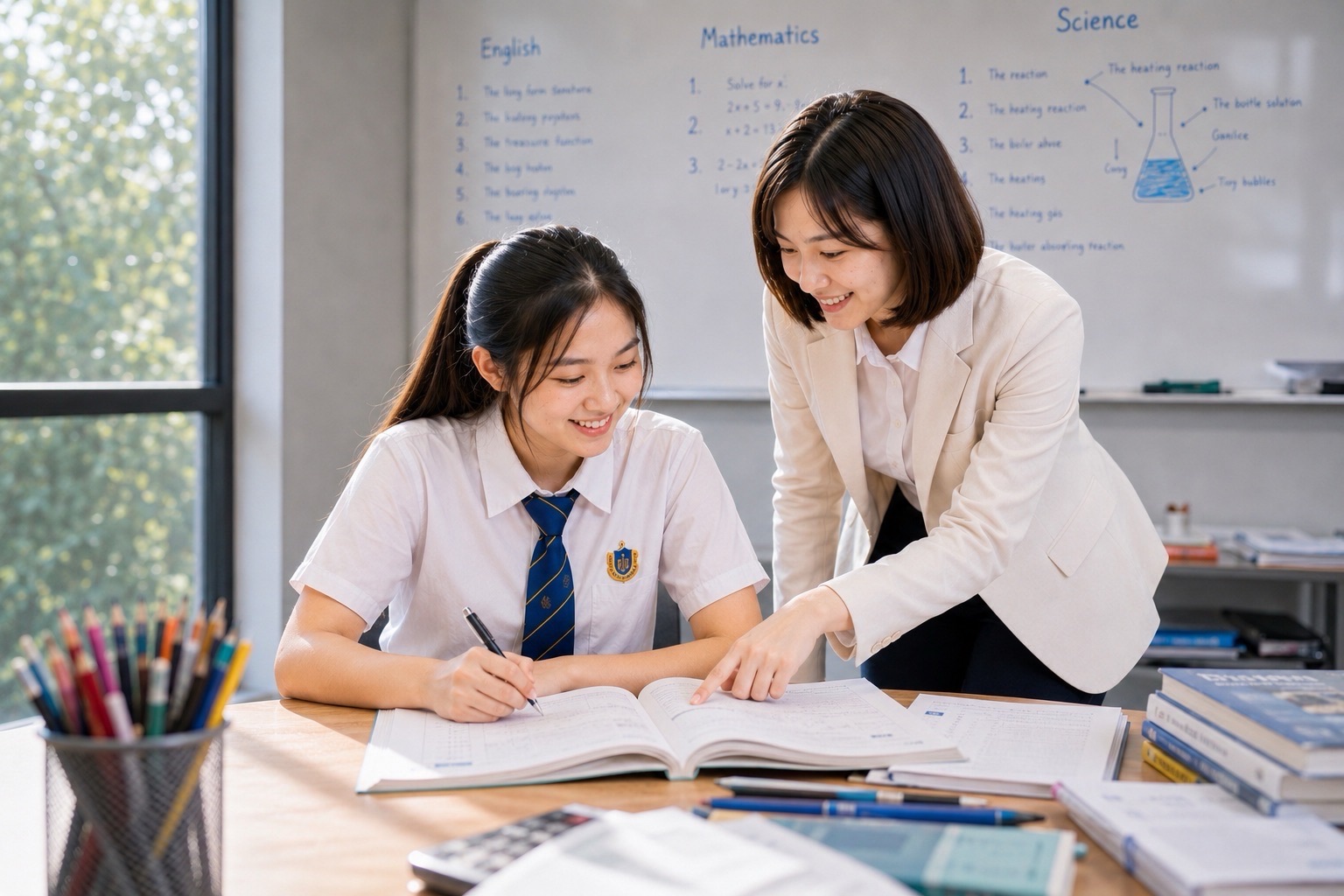
Secondary 3 A-Math Parent Observatory | What Changes Should You Notice at Home?
Parents usually do not see the Mathematics lesson. They see the return path.
You see how long homework takes, whether your child starts independently, whether old topics still feel familiar, whether the same error keeps returning, whether difficult questions trigger panic, and whether the student can explain what actually went wrong in a test.
Those home observations are not substitutes for marked work or teacher feedback. But they are useful telemetry because many of the first signs of genuine A-Math improvement appear in behaviour before they appear as a dramatic grade jump.
This page is the Secondary 3 A-Math parent observatory. Its job is not to turn parents into tutors. It is to show what kinds of changes are worth noticing, what not to over-interpret, when to ask for a recheck, and how to support the learning system without taking the mathematical work away from the student.
Marks matter, but the first signs of improvement often appear as better mathematical behaviour before they appear as a better report card.
Quick Read for Parents
- Watch homework time. Improvement often makes effort more proportionate before it makes marks spectacular.
- Watch the first 30 seconds. Is your child forming a representation, or waiting for someone else to supply the route?
- Watch error language. “I lost the sign after substitution” is stronger self-diagnosis than “I was careless”.
- Watch old topics. If earlier A-Math survives after new chapters arrive, retrieval is improving.
- Watch unfamiliar questions. Progress means more productive attempts, not necessarily instant success.
- Watch tutor dependence. Good support should gradually reduce the amount of prompting needed.
- Do not overreact to one paper. Look for patterns across several weeks and several kinds of evidence.
For the teaching architecture, read Secondary 3 A-Math | Building the A-Math Operating System. For the timing decision, use When Should Secondary 3 A-Math Support Begin?.
1. Receiver: What Kind of Improvement Are You Expecting to See?
Parents often begin with a grade target. That is understandable, but a grade is a compressed output. It can hide what is changing underneath.
A student may improve because:
- algebra becomes more stable;
- methods return from memory more reliably;
- questions are recognised faster;
- working becomes easier to inspect;
- the student stops abandoning unfamiliar questions immediately;
- checking becomes more strategic;
- the student recovers from mistakes with less emotional disruption.
These are different forms of improvement. The observatory helps parents notice them before collapsing everything into “better” or “worse”.
2. Reality: Secondary 3 Is Still a Construction Year
Secondary 3 Additional Mathematics is where many students are still building new mathematical structures. For 2027 candidates, SEAB lists G3 Additional Mathematics as K341 with 4049 as the reference code, while G2 Additional Mathematics is K232 with 4051 as the reference code. The exact school programme and subject level still matter.
Official references: SEAB 2027 G3 SEC syllabuses and SEAB 2027 G2 SEC syllabuses.
That means parents should not expect every week to look like examination-season performance. New Mathematics can temporarily slow a student while the underlying system is becoming stronger.
3. Signal One: Homework Time Becomes More Proportionate
One of the easiest things for a parent to observe is time.
Suppose a short school assignment once took ninety minutes because the student repeatedly reopened examples, restarted algebra and waited for help. A stronger system may reduce that friction even before the next test score rises sharply.
Improvement can look like:
- less time searching notes;
- fewer false starts;
- faster recognition of familiar structures;
- cleaner algebra;
- less repeated checking of every line;
- better judgement about when a question needs help.
Do not turn this into a stopwatch competition. The question is whether the time is becoming more proportionate to the difficulty of the work.
4. Signal Two: Hesitation Becomes More Productive
A strong student still pauses. The pause changes character.
| Earlier hesitation | More productive hesitation |
|---|---|
| “I have no idea.” | “This looks like a function problem, but I need to decide which representation helps.” |
| Waits for the first step | Writes known information and tests a route |
| Checks solution immediately | Tries a second representation first |
| Abandons after one failed line | Returns to the last valid line |
Parents can often hear this change in the language the student uses at home.
5. Signal Three: Working Becomes Easier to Read
Clearer working is not only about neatness. It often indicates that the student is carrying fewer hidden transformations.
- one meaningful change per line where needed;
- brackets used around negative substitutions;
- conditions written visibly;
- fewer unexplained jumps;
- graphs labelled clearly;
- final answers distinguish exact and approximate forms appropriately.
Clear working also improves recovery: the student can identify where the reasoning stopped being valid instead of restarting from zero.
6. Signal Four: Errors Become More Specific
“Careless” is a low-resolution label.
Better self-diagnosis sounds like:
- “I lost the negative sign when I substituted.”
- “I knew the identity but chose the wrong starting side.”
- “I forgot the angle range.”
- “I could solve it after the topic was named, so I did not recognise the structure.”
- “My route worked, but it was too long.”
- “I did not check whether the final value made sense.”
When students can name the error mechanism, they can choose better practice.
7. Signal Five: Fewer First-Step Prompts Are Needed
One of the strongest indicators of real progress is increasing ability to begin independently.
Ask yourself:
- Does the student write something useful before asking for help?
- Can they identify known and unknown quantities?
- Can they decide whether a graph, equation or substitution may help?
- Can they explain what is blocking them if they still need support?
A student who needs smaller hints is usually becoming more independent even if difficult questions remain difficult.
8. Signal Six: Old Topics Stay Available for Longer
Secondary 3 can create an illusion of progress if every new topic replaces the previous one in working memory.
Improvement means earlier Mathematics remains retrievable:
- factorisation still works after logarithms begin;
- functions still make sense after trigonometry arrives;
- coordinate geometry does not disappear when calculus starts;
- old algebra remains usable inside new contexts.
Parents do not need to test their children formally. A simple clue is whether the student describes old chapters as completely unfamiliar every time they return.
9. Signal Seven: Unfamiliar Questions Cause Less Panic
Transfer is visible in behaviour.
A stronger student may still say, “This is hard,” but then:
- identifies the mathematical object;
- tries a representation;
- tests a route;
- returns to a valid line after an error;
- asks a more precise question if help is needed.
The goal is not instant comfort. It is more controlled engagement with uncertainty.
10. Signal Eight: School Feedback Becomes More Actionable
“I did badly” compresses too much information.
A student whose self-monitoring is improving may say:
- “I lost most of the marks in trig because I did not track the interval.”
- “I knew calculus but spent too long on an earlier algebra question.”
- “The graph question was fine once I drew the shape.”
- “I need retrieval practice, not another explanation.”
This is useful evidence for the next tuition or study cycle.
11. Signal Nine: Confidence Becomes More Rational
Useful confidence is not “I will definitely get an A”.
It sounds more like:
- “I know what to do if I cannot remember the first method.”
- “I can check this answer by substitution.”
- “I know my main error is sign control.”
- “This question is unfamiliar, but I can still identify the function.”
This kind of confidence is tied to process and therefore survives uncertainty better.
12. Signal Ten: Dependence on Tuition Falls
A strong programme should gradually make itself less necessary for routine control.
- fewer messages asking for the first step;
- more independent homework completion;
- better self-correction;
- more precise questions brought to class;
- less need to reopen model answers;
- stronger ability to choose what to revise next.
If tuition dependence rises indefinitely, the intervention may be solving the wrong problem or supplying too much support.
The Parent Observatory Dashboard
| Observable | Earlier state | Improving state |
|---|---|---|
| Homework time | Expands unpredictably | More proportionate to difficulty |
| Starting | Waits for first-step prompt | Creates a useful first representation |
| Error language | “Careless” | Names the mechanism |
| Retrieval | Old topics feel new again | Old methods return with less support |
| Unfamiliarity | Immediate abandonment | Productive attempt and recovery |
| Help-seeking | “How do I do this?” | “I think the issue is my representation here.” |
| Checking | Waits for answer key | Uses an independent check |
What Parents Should Not Over-Interpret
- one unusually high test;
- one unusually low test;
- one difficult homework night;
- a temporary speed drop after deeper questions are introduced;
- a short confidence dip while the tutor removes scaffolding;
- one old topic that needs refreshing.
Patterns matter more than isolated events. Look across several weeks, different topics and at least one delayed return.
When to Ask for a Recheck
Ask the tutor to re-examine the intervention if:
- homework time continues expanding;
- the same error mechanism keeps returning;
- old topics disappear quickly;
- the student remains unable to begin unfamiliar questions;
- the class is producing more notes but less independence;
- school performance and tuition performance diverge sharply;
- the student cannot explain what the programme is currently trying to improve.
Observe → compare over time → identify the repeated signal → ask what mechanism is producing it.
What Parents Can Do Without Becoming the A-Math Tutor
- keep recent marked papers;
- protect sleep and uninterrupted study time;
- ask what the student thinks the first weak step was;
- ask what they plan to retest next;
- avoid supplying the first line too quickly;
- encourage a short break when frustration has stopped producing useful reasoning;
- send repeated observations back to the tutor as evidence.
The parent’s role is to support the feedback loop, not duplicate the lesson.
What a Useful Parent Update From Tuition Should Contain
- What is currently limiting the student?
- What evidence supports that conclusion?
- What changed during the recent cycle?
- Did the repair transfer to a changed question?
- What will be retested after delay?
- What should the parent watch for at home?
This is more useful than “doing okay” or “needs more practice”.
World Return: The Parent Should Eventually See Less Need to Observe
The paradox of a successful observatory is that the student gradually needs less observation.
As the learner becomes more independent, the family should not have to inspect every homework session, every test correction or every difficult question.
The ultimate positive signal is that the student increasingly becomes their own observatory.
What We Do Not Promise
We do not claim that these signals guarantee a distinction or a fixed grade improvement. We do not ask parents to monitor every minute of study. We do not use invented testimonials as evidence that one pattern applies to every child.
The observatory is a practical way to notice whether the learning system is becoming more stable, precise and independent.
Frequently Asked Questions
Should homework always become faster?
No. Harder, unfamiliar or deeper work may take longer. The useful measure is whether time is proportionate to difficulty and whether the student is making productive progress.
What if marks rise but dependence also rises?
That is worth examining. Short-term marks can improve through heavy scaffolding while independent capability remains weak. Ask whether support is being faded and transfer is being tested.
How often should parents ask for feedback?
There is no universal interval. Feedback is most useful when it follows meaningful evidence such as a school assessment, a repeated error pattern or a completed repair cycle.
Related Secondary 3 A-Math Guides
- When Should Secondary 3 A-Math Support Begin?
- Secondary 3 A-Math | Building the A-Math Operating System
- How an A-Math Tutor Decides What to Do Next
- A-Math Two-Year Architecture
Bring the Home Signal Back to the Learning System
If you are seeing a repeated pattern at home—expanding homework time, constant first-step requests, repeated algebra errors or disappearing old topics—send us the latest marked work and the observation. The goal is to identify the mechanism, not simply add more practice.
eduKate Singapore · Bukit Timah Secondary 3 Additional Mathematics
Maximum three students per small group · standard 1.5-hour lessons · class placement subject to curriculum fit, learner state and availability.
A-Math Parent Observatory Flagship Layer
Parents do not need to teach Secondary 3 A-Math to notice whether tuition is producing real change. The useful home signals are behavioural and mathematical: how long homework takes, how quickly the student begins, whether old methods return, whether working becomes cleaner, whether the same errors recur and whether adult prompts are needed less often.
Secondary 3 A-Math progress often appears before the next major grade movement. A learner may first show shorter hesitation, better error awareness, more precise questions and more stable algebra. These leading indicators matter because they show the learning system changing rather than merely the most recent score.
Bukit Timah A-Math tuition should also make home life quieter over time. If support is working, parents should need to interpret fewer homework crises, tutors should need fewer first-step prompts, and the student should become more capable of planning and checking their own work.
Observe independence, error recurrence and transfer—not just marks.
50-Second Parent Router
- Homework time falling while quality holds? Good sign.
- Same error recurring across weeks? Repair has not transferred yet.
- Student needs fewer prompts to start? Independence is growing.
- Old topics return after delay? Retrieval is improving.
- Marks rise but adult help stays high? Check hidden dependence.
- Confidence improves because the learner can recover? Stronger than reassurance alone.
- Home observation should become lighter as the system stabilises.
Homework time
At home, watching whether A-Math consumes less time for the same quality is one observable signal of A-Math development. A common mistake is assuming more time always means more learning. Parents should treat the signal as evidence to discuss, not as a reason to reteach the chapter themselves.
Use compare similar tasks across weeks as the observation. Keep it light: one homework session, one school script or one conversation can be enough. The goal is to notice trends across weeks rather than inspect every line of working.
Alicia provides a learner lens. Alicia may show improvement in a different order from another student. One learner becomes faster first, another becomes more accurate first, and another becomes less dependent before marks move.
Look for look for lower unnecessary hesitation. The direction of change matters more than a single evening. A-Math is cognitively dense, so some variation is normal; persistent patterns are more informative than isolated bad days.
Parents should avoid converting observation into constant intervention. When a student hesitates, asking what they know or what representation might help is usually more revealing than supplying the first formula or algebraic step.
A useful parent-tutor conversation can be short: What is the active weak link? What did the last repair target? How will it be retested? Which home signal would indicate that independence is growing?
For site architecture, homework time belongs here as a parent-observation dimension. Detailed teaching, diagnosis and route decisions remain with their specialist owners.
Start-up hesitation
At home, watching how long the learner waits before beginning is one observable signal of A-Math development. A common mistake is equating silence with laziness. Parents should treat the signal as evidence to discuss, not as a reason to reteach the chapter themselves.
Use observe first move without prompting as the observation. Keep it light: one homework session, one school script or one conversation can be enough. The goal is to notice trends across weeks rather than inspect every line of working.
Tricia provides a learner lens. Tricia may show improvement in a different order from another student. One learner becomes faster first, another becomes more accurate first, and another becomes less dependent before marks move.
Look for look for faster independent entry. The direction of change matters more than a single evening. A-Math is cognitively dense, so some variation is normal; persistent patterns are more informative than isolated bad days.
Parents should avoid converting observation into constant intervention. When a student hesitates, asking what they know or what representation might help is usually more revealing than supplying the first formula or algebraic step.
A useful parent-tutor conversation can be short: What is the active weak link? What did the last repair target? How will it be retested? Which home signal would indicate that independence is growing?
For site architecture, start-up hesitation belongs here as a parent-observation dimension. Detailed teaching, diagnosis and route decisions remain with their specialist owners.
Prompt dependence
At home, seeing how often parent/tutor cues are needed is one observable signal of A-Math development. A common mistake is helping too early. Parents should treat the signal as evidence to discuss, not as a reason to reteach the chapter themselves.
Use track number and type of prompts as the observation. Keep it light: one homework session, one school script or one conversation can be enough. The goal is to notice trends across weeks rather than inspect every line of working.
Kai Kai provides a learner lens. Kai Kai may show improvement in a different order from another student. One learner becomes faster first, another becomes more accurate first, and another becomes less dependent before marks move.
Look for look for prompt reduction. The direction of change matters more than a single evening. A-Math is cognitively dense, so some variation is normal; persistent patterns are more informative than isolated bad days.
Parents should avoid converting observation into constant intervention. When a student hesitates, asking what they know or what representation might help is usually more revealing than supplying the first formula or algebraic step.
A useful parent-tutor conversation can be short: What is the active weak link? What did the last repair target? How will it be retested? Which home signal would indicate that independence is growing?
For site architecture, prompt dependence belongs here as a parent-observation dimension. Detailed teaching, diagnosis and route decisions remain with their specialist owners.
Working quality
At home, watching whether symbolic steps become clearer is one observable signal of A-Math development. A common mistake is judging only final answer. Parents should treat the signal as evidence to discuss, not as a reason to reteach the chapter themselves.
Use inspect brackets, signs and high-risk transitions as the observation. Keep it light: one homework session, one school script or one conversation can be enough. The goal is to notice trends across weeks rather than inspect every line of working.
Alicia provides a learner lens. Alicia may show improvement in a different order from another student. One learner becomes faster first, another becomes more accurate first, and another becomes less dependent before marks move.
Look for look for cleaner auditable work. The direction of change matters more than a single evening. A-Math is cognitively dense, so some variation is normal; persistent patterns are more informative than isolated bad days.
Parents should avoid converting observation into constant intervention. When a student hesitates, asking what they know or what representation might help is usually more revealing than supplying the first formula or algebraic step.
A useful parent-tutor conversation can be short: What is the active weak link? What did the last repair target? How will it be retested? Which home signal would indicate that independence is growing?
For site architecture, working quality belongs here as a parent-observation dimension. Detailed teaching, diagnosis and route decisions remain with their specialist owners.
Error awareness
At home, seeing whether the student can name what went wrong is one observable signal of A-Math development. A common mistake is adult explaining every mistake. Parents should treat the signal as evidence to discuss, not as a reason to reteach the chapter themselves.
Use ask learner to identify first weak line as the observation. Keep it light: one homework session, one school script or one conversation can be enough. The goal is to notice trends across weeks rather than inspect every line of working.
Tricia provides a learner lens. Tricia may show improvement in a different order from another student. One learner becomes faster first, another becomes more accurate first, and another becomes less dependent before marks move.
Look for look for more precise self-diagnosis. The direction of change matters more than a single evening. A-Math is cognitively dense, so some variation is normal; persistent patterns are more informative than isolated bad days.
Parents should avoid converting observation into constant intervention. When a student hesitates, asking what they know or what representation might help is usually more revealing than supplying the first formula or algebraic step.
A useful parent-tutor conversation can be short: What is the active weak link? What did the last repair target? How will it be retested? Which home signal would indicate that independence is growing?
For site architecture, error awareness belongs here as a parent-observation dimension. Detailed teaching, diagnosis and route decisions remain with their specialist owners.
Correction quality
At home, seeing whether corrected work is reconstructed is one observable signal of A-Math development. A common mistake is copying a model solution. Parents should treat the signal as evidence to discuss, not as a reason to reteach the chapter themselves.
Use ask for a fresh variant as the observation. Keep it light: one homework session, one school script or one conversation can be enough. The goal is to notice trends across weeks rather than inspect every line of working.
Kai Kai provides a learner lens. Kai Kai may show improvement in a different order from another student. One learner becomes faster first, another becomes more accurate first, and another becomes less dependent before marks move.
Look for look for independent repair. The direction of change matters more than a single evening. A-Math is cognitively dense, so some variation is normal; persistent patterns are more informative than isolated bad days.
Parents should avoid converting observation into constant intervention. When a student hesitates, asking what they know or what representation might help is usually more revealing than supplying the first formula or algebraic step.
A useful parent-tutor conversation can be short: What is the active weak link? What did the last repair target? How will it be retested? Which home signal would indicate that independence is growing?
For site architecture, correction quality belongs here as a parent-observation dimension. Detailed teaching, diagnosis and route decisions remain with their specialist owners.
Retrieval
At home, seeing whether older topics return without notes is one observable signal of A-Math development. A common mistake is relearning every chapter. Parents should treat the signal as evidence to discuss, not as a reason to reteach the chapter themselves.
Use ask occasional old questions as the observation. Keep it light: one homework session, one school script or one conversation can be enough. The goal is to notice trends across weeks rather than inspect every line of working.
Alicia provides a learner lens. Alicia may show improvement in a different order from another student. One learner becomes faster first, another becomes more accurate first, and another becomes less dependent before marks move.
Look for look for lower retrieval latency. The direction of change matters more than a single evening. A-Math is cognitively dense, so some variation is normal; persistent patterns are more informative than isolated bad days.
Parents should avoid converting observation into constant intervention. When a student hesitates, asking what they know or what representation might help is usually more revealing than supplying the first formula or algebraic step.
A useful parent-tutor conversation can be short: What is the active weak link? What did the last repair target? How will it be retested? Which home signal would indicate that independence is growing?
For site architecture, retrieval belongs here as a parent-observation dimension. Detailed teaching, diagnosis and route decisions remain with their specialist owners.
Recognition
At home, seeing whether method can be chosen without chapter label is one observable signal of A-Math development. A common mistake is worksheet headings doing the work. Parents should treat the signal as evidence to discuss, not as a reason to reteach the chapter themselves.
Use mix a few near-neighbour questions as the observation. Keep it light: one homework session, one school script or one conversation can be enough. The goal is to notice trends across weeks rather than inspect every line of working.
Tricia provides a learner lens. Tricia may show improvement in a different order from another student. One learner becomes faster first, another becomes more accurate first, and another becomes less dependent before marks move.
Look for look for deciding-feature language. The direction of change matters more than a single evening. A-Math is cognitively dense, so some variation is normal; persistent patterns are more informative than isolated bad days.
Parents should avoid converting observation into constant intervention. When a student hesitates, asking what they know or what representation might help is usually more revealing than supplying the first formula or algebraic step.
A useful parent-tutor conversation can be short: What is the active weak link? What did the last repair target? How will it be retested? Which home signal would indicate that independence is growing?
For site architecture, recognition belongs here as a parent-observation dimension. Detailed teaching, diagnosis and route decisions remain with their specialist owners.
Transfer
At home, seeing whether method survives changed wording or graph is one observable signal of A-Math development. A common mistake is familiar-template success only. Parents should treat the signal as evidence to discuss, not as a reason to reteach the chapter themselves.
Use change representation or parameters as the observation. Keep it light: one homework session, one school script or one conversation can be enough. The goal is to notice trends across weeks rather than inspect every line of working.
Kai Kai provides a learner lens. Kai Kai may show improvement in a different order from another student. One learner becomes faster first, another becomes more accurate first, and another becomes less dependent before marks move.
Look for look for structural recognition. The direction of change matters more than a single evening. A-Math is cognitively dense, so some variation is normal; persistent patterns are more informative than isolated bad days.
Parents should avoid converting observation into constant intervention. When a student hesitates, asking what they know or what representation might help is usually more revealing than supplying the first formula or algebraic step.
A useful parent-tutor conversation can be short: What is the active weak link? What did the last repair target? How will it be retested? Which home signal would indicate that independence is growing?
For site architecture, transfer belongs here as a parent-observation dimension. Detailed teaching, diagnosis and route decisions remain with their specialist owners.
Algebra stability
At home, watching whether factorisation, fractions and equations stop causing repeated collapses is one observable signal of A-Math development. A common mistake is calling every new-topic error A-Math weakness. Parents should treat the signal as evidence to discuss, not as a reason to reteach the chapter themselves.
Use cluster shared algebra errors as the observation. Keep it light: one homework session, one school script or one conversation can be enough. The goal is to notice trends across weeks rather than inspect every line of working.
Alicia provides a learner lens. Alicia may show improvement in a different order from another student. One learner becomes faster first, another becomes more accurate first, and another becomes less dependent before marks move.
Look for look for broad cross-topic improvement. The direction of change matters more than a single evening. A-Math is cognitively dense, so some variation is normal; persistent patterns are more informative than isolated bad days.
Parents should avoid converting observation into constant intervention. When a student hesitates, asking what they know or what representation might help is usually more revealing than supplying the first formula or algebraic step.
A useful parent-tutor conversation can be short: What is the active weak link? What did the last repair target? How will it be retested? Which home signal would indicate that independence is growing?
For site architecture, algebra stability belongs here as a parent-observation dimension. Detailed teaching, diagnosis and route decisions remain with their specialist owners.
Quadratic fluency
At home, seeing movement among forms and graph meaning is one observable signal of A-Math development. A common mistake is one-method dependence. Parents should treat the signal as evidence to discuss, not as a reason to reteach the chapter themselves.
Use compare factorised/general/completed-square work as the observation. Keep it light: one homework session, one school script or one conversation can be enough. The goal is to notice trends across weeks rather than inspect every line of working.
Tricia provides a learner lens. Tricia may show improvement in a different order from another student. One learner becomes faster first, another becomes more accurate first, and another becomes less dependent before marks move.
Look for look for purposeful form choice. The direction of change matters more than a single evening. A-Math is cognitively dense, so some variation is normal; persistent patterns are more informative than isolated bad days.
Parents should avoid converting observation into constant intervention. When a student hesitates, asking what they know or what representation might help is usually more revealing than supplying the first formula or algebraic step.
A useful parent-tutor conversation can be short: What is the active weak link? What did the last repair target? How will it be retested? Which home signal would indicate that independence is growing?
For site architecture, quadratic fluency belongs here as a parent-observation dimension. Detailed teaching, diagnosis and route decisions remain with their specialist owners.
Function sense
At home, seeing notation become meaningful is one observable signal of A-Math development. A common mistake is f(x) treated as decoration. Parents should treat the signal as evidence to discuss, not as a reason to reteach the chapter themselves.
Use ask learner to explain input-output relation as the observation. Keep it light: one homework session, one school script or one conversation can be enough. The goal is to notice trends across weeks rather than inspect every line of working.
Kai Kai provides a learner lens. Kai Kai may show improvement in a different order from another student. One learner becomes faster first, another becomes more accurate first, and another becomes less dependent before marks move.
Look for look for translation among rule/table/graph. The direction of change matters more than a single evening. A-Math is cognitively dense, so some variation is normal; persistent patterns are more informative than isolated bad days.
Parents should avoid converting observation into constant intervention. When a student hesitates, asking what they know or what representation might help is usually more revealing than supplying the first formula or algebraic step.
A useful parent-tutor conversation can be short: What is the active weak link? What did the last repair target? How will it be retested? Which home signal would indicate that independence is growing?
For site architecture, function sense belongs here as a parent-observation dimension. Detailed teaching, diagnosis and route decisions remain with their specialist owners.
Polynomial structure
At home, seeing whether expansion/factor/remainder choices are deliberate is one observable signal of A-Math development. A common mistake is expanding everything. Parents should treat the signal as evidence to discuss, not as a reason to reteach the chapter themselves.
Use ask what the target is as the observation. Keep it light: one homework session, one school script or one conversation can be enough. The goal is to notice trends across weeks rather than inspect every line of working.
Alicia provides a learner lens. Alicia may show improvement in a different order from another student. One learner becomes faster first, another becomes more accurate first, and another becomes less dependent before marks move.
Look for look for structural route selection. The direction of change matters more than a single evening. A-Math is cognitively dense, so some variation is normal; persistent patterns are more informative than isolated bad days.
Parents should avoid converting observation into constant intervention. When a student hesitates, asking what they know or what representation might help is usually more revealing than supplying the first formula or algebraic step.
A useful parent-tutor conversation can be short: What is the active weak link? What did the last repair target? How will it be retested? Which home signal would indicate that independence is growing?
For site architecture, polynomial structure belongs here as a parent-observation dimension. Detailed teaching, diagnosis and route decisions remain with their specialist owners.
Indices/surds/logs
At home, seeing exact symbolic control improve is one observable signal of A-Math development. A common mistake is decimalising or law-guessing. Parents should treat the signal as evidence to discuss, not as a reason to reteach the chapter themselves.
Use inspect exact-form decisions as the observation. Keep it light: one homework session, one school script or one conversation can be enough. The goal is to notice trends across weeks rather than inspect every line of working.
Tricia provides a learner lens. Tricia may show improvement in a different order from another student. One learner becomes faster first, another becomes more accurate first, and another becomes less dependent before marks move.
Look for look for less symbolic drift. The direction of change matters more than a single evening. A-Math is cognitively dense, so some variation is normal; persistent patterns are more informative than isolated bad days.
Parents should avoid converting observation into constant intervention. When a student hesitates, asking what they know or what representation might help is usually more revealing than supplying the first formula or algebraic step.
A useful parent-tutor conversation can be short: What is the active weak link? What did the last repair target? How will it be retested? Which home signal would indicate that independence is growing?
For site architecture, indices/surds/logs belongs here as a parent-observation dimension. Detailed teaching, diagnosis and route decisions remain with their specialist owners.
Trig identity work
At home, seeing target-form reasoning is one observable signal of A-Math development. A common mistake is formula-sheet hunting. Parents should treat the signal as evidence to discuss, not as a reason to reteach the chapter themselves.
Use ask why a formula helps as the observation. Keep it light: one homework session, one school script or one conversation can be enough. The goal is to notice trends across weeks rather than inspect every line of working.
Kai Kai provides a learner lens. Kai Kai may show improvement in a different order from another student. One learner becomes faster first, another becomes more accurate first, and another becomes less dependent before marks move.
Look for look for planned transformations. The direction of change matters more than a single evening. A-Math is cognitively dense, so some variation is normal; persistent patterns are more informative than isolated bad days.
Parents should avoid converting observation into constant intervention. When a student hesitates, asking what they know or what representation might help is usually more revealing than supplying the first formula or algebraic step.
A useful parent-tutor conversation can be short: What is the active weak link? What did the last repair target? How will it be retested? Which home signal would indicate that independence is growing?
For site architecture, trig identity work belongs here as a parent-observation dimension. Detailed teaching, diagnosis and route decisions remain with their specialist owners.
Trig equation completeness
At home, seeing all required solutions found is one observable signal of A-Math development. A common mistake is first-angle stopping. Parents should treat the signal as evidence to discuss, not as a reason to reteach the chapter themselves.
Use ask about interval and periodicity as the observation. Keep it light: one homework session, one school script or one conversation can be enough. The goal is to notice trends across weeks rather than inspect every line of working.
Alicia provides a learner lens. Alicia may show improvement in a different order from another student. One learner becomes faster first, another becomes more accurate first, and another becomes less dependent before marks move.
Look for look for systematic solution audit. The direction of change matters more than a single evening. A-Math is cognitively dense, so some variation is normal; persistent patterns are more informative than isolated bad days.
Parents should avoid converting observation into constant intervention. When a student hesitates, asking what they know or what representation might help is usually more revealing than supplying the first formula or algebraic step.
A useful parent-tutor conversation can be short: What is the active weak link? What did the last repair target? How will it be retested? Which home signal would indicate that independence is growing?
For site architecture, trig equation completeness belongs here as a parent-observation dimension. Detailed teaching, diagnosis and route decisions remain with their specialist owners.
Trig graph sense
At home, seeing periodic behaviour predicted is one observable signal of A-Math development. A common mistake is plotting without interpretation. Parents should treat the signal as evidence to discuss, not as a reason to reteach the chapter themselves.
Use ask period/amplitude/shift expectations as the observation. Keep it light: one homework session, one school script or one conversation can be enough. The goal is to notice trends across weeks rather than inspect every line of working.
Tricia provides a learner lens. Tricia may show improvement in a different order from another student. One learner becomes faster first, another becomes more accurate first, and another becomes less dependent before marks move.
Look for look for better visual reasoning. The direction of change matters more than a single evening. A-Math is cognitively dense, so some variation is normal; persistent patterns are more informative than isolated bad days.
Parents should avoid converting observation into constant intervention. When a student hesitates, asking what they know or what representation might help is usually more revealing than supplying the first formula or algebraic step.
A useful parent-tutor conversation can be short: What is the active weak link? What did the last repair target? How will it be retested? Which home signal would indicate that independence is growing?
For site architecture, trig graph sense belongs here as a parent-observation dimension. Detailed teaching, diagnosis and route decisions remain with their specialist owners.
Differentiation meaning
At home, seeing gradient/rate interpretation is one observable signal of A-Math development. A common mistake is rule-only memorisation. Parents should treat the signal as evidence to discuss, not as a reason to reteach the chapter themselves.
Use ask what derivative represents as the observation. Keep it light: one homework session, one school script or one conversation can be enough. The goal is to notice trends across weeks rather than inspect every line of working.
Kai Kai provides a learner lens. Kai Kai may show improvement in a different order from another student. One learner becomes faster first, another becomes more accurate first, and another becomes less dependent before marks move.
Look for look for conceptual explanation. The direction of change matters more than a single evening. A-Math is cognitively dense, so some variation is normal; persistent patterns are more informative than isolated bad days.
Parents should avoid converting observation into constant intervention. When a student hesitates, asking what they know or what representation might help is usually more revealing than supplying the first formula or algebraic step.
A useful parent-tutor conversation can be short: What is the active weak link? What did the last repair target? How will it be retested? Which home signal would indicate that independence is growing?
For site architecture, differentiation meaning belongs here as a parent-observation dimension. Detailed teaching, diagnosis and route decisions remain with their specialist owners.
Differentiation execution
At home, seeing algebra after derivative remain stable is one observable signal of A-Math development. A common mistake is correct calculus ruined by simplification. Parents should treat the signal as evidence to discuss, not as a reason to reteach the chapter themselves.
Use separate derivative and cleanup as the observation. Keep it light: one homework session, one school script or one conversation can be enough. The goal is to notice trends across weeks rather than inspect every line of working.
Alicia provides a learner lens. Alicia may show improvement in a different order from another student. One learner becomes faster first, another becomes more accurate first, and another becomes less dependent before marks move.
Look for look for fewer downstream slips. The direction of change matters more than a single evening. A-Math is cognitively dense, so some variation is normal; persistent patterns are more informative than isolated bad days.
Parents should avoid converting observation into constant intervention. When a student hesitates, asking what they know or what representation might help is usually more revealing than supplying the first formula or algebraic step.
A useful parent-tutor conversation can be short: What is the active weak link? What did the last repair target? How will it be retested? Which home signal would indicate that independence is growing?
For site architecture, differentiation execution belongs here as a parent-observation dimension. Detailed teaching, diagnosis and route decisions remain with their specialist owners.
Stationary points
At home, seeing classification and graph meaning is one observable signal of A-Math development. A common mistake is dy/dx=0 and stop. Parents should treat the signal as evidence to discuss, not as a reason to reteach the chapter themselves.
Use ask what point means as the observation. Keep it light: one homework session, one school script or one conversation can be enough. The goal is to notice trends across weeks rather than inspect every line of working.
Tricia provides a learner lens. Tricia may show improvement in a different order from another student. One learner becomes faster first, another becomes more accurate first, and another becomes less dependent before marks move.
Look for look for interpretation. The direction of change matters more than a single evening. A-Math is cognitively dense, so some variation is normal; persistent patterns are more informative than isolated bad days.
Parents should avoid converting observation into constant intervention. When a student hesitates, asking what they know or what representation might help is usually more revealing than supplying the first formula or algebraic step.
A useful parent-tutor conversation can be short: What is the active weak link? What did the last repair target? How will it be retested? Which home signal would indicate that independence is growing?
For site architecture, stationary points belongs here as a parent-observation dimension. Detailed teaching, diagnosis and route decisions remain with their specialist owners.
Integration meaning
At home, seeing accumulation/reverse differentiation is one observable signal of A-Math development. A common mistake is rule-only anti-derivative work. Parents should treat the signal as evidence to discuss, not as a reason to reteach the chapter themselves.
Use ask how answer can be checked as the observation. Keep it light: one homework session, one school script or one conversation can be enough. The goal is to notice trends across weeks rather than inspect every line of working.
Kai Kai provides a learner lens. Kai Kai may show improvement in a different order from another student. One learner becomes faster first, another becomes more accurate first, and another becomes less dependent before marks move.
Look for look for derivative-back reasoning. The direction of change matters more than a single evening. A-Math is cognitively dense, so some variation is normal; persistent patterns are more informative than isolated bad days.
Parents should avoid converting observation into constant intervention. When a student hesitates, asking what they know or what representation might help is usually more revealing than supplying the first formula or algebraic step.
A useful parent-tutor conversation can be short: What is the active weak link? What did the last repair target? How will it be retested? Which home signal would indicate that independence is growing?
For site architecture, integration meaning belongs here as a parent-observation dimension. Detailed teaching, diagnosis and route decisions remain with their specialist owners.
Area under curves
At home, seeing sketch/region thinking is one observable signal of A-Math development. A common mistake is mechanical definite integral. Parents should treat the signal as evidence to discuss, not as a reason to reteach the chapter themselves.
Use ask whether result is signed or area as the observation. Keep it light: one homework session, one school script or one conversation can be enough. The goal is to notice trends across weeks rather than inspect every line of working.
Alicia provides a learner lens. Alicia may show improvement in a different order from another student. One learner becomes faster first, another becomes more accurate first, and another becomes less dependent before marks move.
Look for look for region awareness. The direction of change matters more than a single evening. A-Math is cognitively dense, so some variation is normal; persistent patterns are more informative than isolated bad days.
Parents should avoid converting observation into constant intervention. When a student hesitates, asking what they know or what representation might help is usually more revealing than supplying the first formula or algebraic step.
A useful parent-tutor conversation can be short: What is the active weak link? What did the last repair target? How will it be retested? Which home signal would indicate that independence is growing?
For site architecture, area under curves belongs here as a parent-observation dimension. Detailed teaching, diagnosis and route decisions remain with their specialist owners.
School alignment
At home, seeing tuition reduce rather than duplicate school workload is one observable signal of A-Math development. A common mistake is two independent homework systems. Parents should treat the signal as evidence to discuss, not as a reason to reteach the chapter themselves.
Use compare school and tuition tasks as the observation. Keep it light: one homework session, one school script or one conversation can be enough. The goal is to notice trends across weeks rather than inspect every line of working.
Tricia provides a learner lens. Tricia may show improvement in a different order from another student. One learner becomes faster first, another becomes more accurate first, and another becomes less dependent before marks move.
Look for look for complementarity. The direction of change matters more than a single evening. A-Math is cognitively dense, so some variation is normal; persistent patterns are more informative than isolated bad days.
Parents should avoid converting observation into constant intervention. When a student hesitates, asking what they know or what representation might help is usually more revealing than supplying the first formula or algebraic step.
A useful parent-tutor conversation can be short: What is the active weak link? What did the last repair target? How will it be retested? Which home signal would indicate that independence is growing?
For site architecture, school alignment belongs here as a parent-observation dimension. Detailed teaching, diagnosis and route decisions remain with their specialist owners.
Lesson transfer
At home, seeing class learning appear in home work is one observable signal of A-Math development. A common mistake is good tuition work but unchanged school work. Parents should treat the signal as evidence to discuss, not as a reason to reteach the chapter themselves.
Use compare similar question types as the observation. Keep it light: one homework session, one school script or one conversation can be enough. The goal is to notice trends across weeks rather than inspect every line of working.
Kai Kai provides a learner lens. Kai Kai may show improvement in a different order from another student. One learner becomes faster first, another becomes more accurate first, and another becomes less dependent before marks move.
Look for look for cross-environment transfer. The direction of change matters more than a single evening. A-Math is cognitively dense, so some variation is normal; persistent patterns are more informative than isolated bad days.
Parents should avoid converting observation into constant intervention. When a student hesitates, asking what they know or what representation might help is usually more revealing than supplying the first formula or algebraic step.
A useful parent-tutor conversation can be short: What is the active weak link? What did the last repair target? How will it be retested? Which home signal would indicate that independence is growing?
For site architecture, lesson transfer belongs here as a parent-observation dimension. Detailed teaching, diagnosis and route decisions remain with their specialist owners.
Assessment transfer
At home, seeing school marks reflect repaired processes is one observable signal of A-Math development. A common mistake is centre worksheets only. Parents should treat the signal as evidence to discuss, not as a reason to reteach the chapter themselves.
Use review next school script as the observation. Keep it light: one homework session, one school script or one conversation can be enough. The goal is to notice trends across weeks rather than inspect every line of working.
Alicia provides a learner lens. Alicia may show improvement in a different order from another student. One learner becomes faster first, another becomes more accurate first, and another becomes less dependent before marks move.
Look for look for fewer repeated first-errors. The direction of change matters more than a single evening. A-Math is cognitively dense, so some variation is normal; persistent patterns are more informative than isolated bad days.
Parents should avoid converting observation into constant intervention. When a student hesitates, asking what they know or what representation might help is usually more revealing than supplying the first formula or algebraic step.
A useful parent-tutor conversation can be short: What is the active weak link? What did the last repair target? How will it be retested? Which home signal would indicate that independence is growing?
For site architecture, assessment transfer belongs here as a parent-observation dimension. Detailed teaching, diagnosis and route decisions remain with their specialist owners.
Homework independence
At home, seeing parent involvement decline is one observable signal of A-Math development. A common mistake is family becoming second tutor. Parents should treat the signal as evidence to discuss, not as a reason to reteach the chapter themselves.
Use protect solo attempt as the observation. Keep it light: one homework session, one school script or one conversation can be enough. The goal is to notice trends across weeks rather than inspect every line of working.
Tricia provides a learner lens. Tricia may show improvement in a different order from another student. One learner becomes faster first, another becomes more accurate first, and another becomes less dependent before marks move.
Look for look for less supervision. The direction of change matters more than a single evening. A-Math is cognitively dense, so some variation is normal; persistent patterns are more informative than isolated bad days.
Parents should avoid converting observation into constant intervention. When a student hesitates, asking what they know or what representation might help is usually more revealing than supplying the first formula or algebraic step.
A useful parent-tutor conversation can be short: What is the active weak link? What did the last repair target? How will it be retested? Which home signal would indicate that independence is growing?
For site architecture, homework independence belongs here as a parent-observation dimension. Detailed teaching, diagnosis and route decisions remain with their specialist owners.
Revision ownership
At home, seeing student choose what to practise is one observable signal of A-Math development. A common mistake is adult scheduling everything. Parents should treat the signal as evidence to discuss, not as a reason to reteach the chapter themselves.
Use ask learner to rank weak systems as the observation. Keep it light: one homework session, one school script or one conversation can be enough. The goal is to notice trends across weeks rather than inspect every line of working.
Kai Kai provides a learner lens. Kai Kai may show improvement in a different order from another student. One learner becomes faster first, another becomes more accurate first, and another becomes less dependent before marks move.
Look for look for evidence-based choices. The direction of change matters more than a single evening. A-Math is cognitively dense, so some variation is normal; persistent patterns are more informative than isolated bad days.
Parents should avoid converting observation into constant intervention. When a student hesitates, asking what they know or what representation might help is usually more revealing than supplying the first formula or algebraic step.
A useful parent-tutor conversation can be short: What is the active weak link? What did the last repair target? How will it be retested? Which home signal would indicate that independence is growing?
For site architecture, revision ownership belongs here as a parent-observation dimension. Detailed teaching, diagnosis and route decisions remain with their specialist owners.
Resource organisation
At home, seeing notes and papers become more purposeful is one observable signal of A-Math development. A common mistake is resource piles growing. Parents should treat the signal as evidence to discuss, not as a reason to reteach the chapter themselves.
Use ask which resources are current and why as the observation. Keep it light: one homework session, one school script or one conversation can be enough. The goal is to notice trends across weeks rather than inspect every line of working.
Alicia provides a learner lens. Alicia may show improvement in a different order from another student. One learner becomes faster first, another becomes more accurate first, and another becomes less dependent before marks move.
Look for look for a small trusted spine. The direction of change matters more than a single evening. A-Math is cognitively dense, so some variation is normal; persistent patterns are more informative than isolated bad days.
Parents should avoid converting observation into constant intervention. When a student hesitates, asking what they know or what representation might help is usually more revealing than supplying the first formula or algebraic step.
A useful parent-tutor conversation can be short: What is the active weak link? What did the last repair target? How will it be retested? Which home signal would indicate that independence is growing?
For site architecture, resource organisation belongs here as a parent-observation dimension. Detailed teaching, diagnosis and route decisions remain with their specialist owners.
Calculator judgement
At home, seeing estimation before trust is one observable signal of A-Math development. A common mistake is accepting displayed values automatically. Parents should treat the signal as evidence to discuss, not as a reason to reteach the chapter themselves.
Use ask expected sign/magnitude as the observation. Keep it light: one homework session, one school script or one conversation can be enough. The goal is to notice trends across weeks rather than inspect every line of working.
Tricia provides a learner lens. Tricia may show improvement in a different order from another student. One learner becomes faster first, another becomes more accurate first, and another becomes less dependent before marks move.
Look for look for reasonableness checks. The direction of change matters more than a single evening. A-Math is cognitively dense, so some variation is normal; persistent patterns are more informative than isolated bad days.
Parents should avoid converting observation into constant intervention. When a student hesitates, asking what they know or what representation might help is usually more revealing than supplying the first formula or algebraic step.
A useful parent-tutor conversation can be short: What is the active weak link? What did the last repair target? How will it be retested? Which home signal would indicate that independence is growing?
For site architecture, calculator judgement belongs here as a parent-observation dimension. Detailed teaching, diagnosis and route decisions remain with their specialist owners.
Checking habits
At home, seeing verification become selective and self-initiated is one observable signal of A-Math development. A common mistake is parent saying ‘check again’. Parents should treat the signal as evidence to discuss, not as a reason to reteach the chapter themselves.
Use ask what check fits as the observation. Keep it light: one homework session, one school script or one conversation can be enough. The goal is to notice trends across weeks rather than inspect every line of working.
Kai Kai provides a learner lens. Kai Kai may show improvement in a different order from another student. One learner becomes faster first, another becomes more accurate first, and another becomes less dependent before marks move.
Look for look for a small reusable menu. The direction of change matters more than a single evening. A-Math is cognitively dense, so some variation is normal; persistent patterns are more informative than isolated bad days.
Parents should avoid converting observation into constant intervention. When a student hesitates, asking what they know or what representation might help is usually more revealing than supplying the first formula or algebraic step.
A useful parent-tutor conversation can be short: What is the active weak link? What did the last repair target? How will it be retested? Which home signal would indicate that independence is growing?
For site architecture, checking habits belongs here as a parent-observation dimension. Detailed teaching, diagnosis and route decisions remain with their specialist owners.
Timed work
At home, seeing speed improve without structural loss is one observable signal of A-Math development. A common mistake is rushing through errors. Parents should treat the signal as evidence to discuss, not as a reason to reteach the chapter themselves.
Use compare untimed/timed versions as the observation. Keep it light: one homework session, one school script or one conversation can be enough. The goal is to notice trends across weeks rather than inspect every line of working.
Alicia provides a learner lens. Alicia may show improvement in a different order from another student. One learner becomes faster first, another becomes more accurate first, and another becomes less dependent before marks move.
Look for look for stable method under modest pressure. The direction of change matters more than a single evening. A-Math is cognitively dense, so some variation is normal; persistent patterns are more informative than isolated bad days.
Parents should avoid converting observation into constant intervention. When a student hesitates, asking what they know or what representation might help is usually more revealing than supplying the first formula or algebraic step.
A useful parent-tutor conversation can be short: What is the active weak link? What did the last repair target? How will it be retested? Which home signal would indicate that independence is growing?
For site architecture, timed work belongs here as a parent-observation dimension. Detailed teaching, diagnosis and route decisions remain with their specialist owners.
Recovery
At home, seeing learner resume after a hard question is one observable signal of A-Math development. A common mistake is one stall ending the session. Parents should treat the signal as evidence to discuss, not as a reason to reteach the chapter themselves.
Use observe move-on or re-representation as the observation. Keep it light: one homework session, one school script or one conversation can be enough. The goal is to notice trends across weeks rather than inspect every line of working.
Tricia provides a learner lens. Tricia may show improvement in a different order from another student. One learner becomes faster first, another becomes more accurate first, and another becomes less dependent before marks move.
Look for look for faster reset. The direction of change matters more than a single evening. A-Math is cognitively dense, so some variation is normal; persistent patterns are more informative than isolated bad days.
Parents should avoid converting observation into constant intervention. When a student hesitates, asking what they know or what representation might help is usually more revealing than supplying the first formula or algebraic step.
A useful parent-tutor conversation can be short: What is the active weak link? What did the last repair target? How will it be retested? Which home signal would indicate that independence is growing?
For site architecture, recovery belongs here as a parent-observation dimension. Detailed teaching, diagnosis and route decisions remain with their specialist owners.
Confidence
At home, seeing confidence follow control is one observable signal of A-Math development. A common mistake is generic motivational language. Parents should treat the signal as evidence to discuss, not as a reason to reteach the chapter themselves.
Use compare independent starts and error recovery as the observation. Keep it light: one homework session, one school script or one conversation can be enough. The goal is to notice trends across weeks rather than inspect every line of working.
Kai Kai provides a learner lens. Kai Kai may show improvement in a different order from another student. One learner becomes faster first, another becomes more accurate first, and another becomes less dependent before marks move.
Look for look for evidence-based calm. The direction of change matters more than a single evening. A-Math is cognitively dense, so some variation is normal; persistent patterns are more informative than isolated bad days.
Parents should avoid converting observation into constant intervention. When a student hesitates, asking what they know or what representation might help is usually more revealing than supplying the first formula or algebraic step.
A useful parent-tutor conversation can be short: What is the active weak link? What did the last repair target? How will it be retested? Which home signal would indicate that independence is growing?
For site architecture, confidence belongs here as a parent-observation dimension. Detailed teaching, diagnosis and route decisions remain with their specialist owners.
Frustration
At home, seeing frustration become more local is one observable signal of A-Math development. A common mistake is global ‘I hate A-Math’ reactions. Parents should treat the signal as evidence to discuss, not as a reason to reteach the chapter themselves.
Use ask which exact step failed as the observation. Keep it light: one homework session, one school script or one conversation can be enough. The goal is to notice trends across weeks rather than inspect every line of working.
Alicia provides a learner lens. Alicia may show improvement in a different order from another student. One learner becomes faster first, another becomes more accurate first, and another becomes less dependent before marks move.
Look for look for narrower problem statements. The direction of change matters more than a single evening. A-Math is cognitively dense, so some variation is normal; persistent patterns are more informative than isolated bad days.
Parents should avoid converting observation into constant intervention. When a student hesitates, asking what they know or what representation might help is usually more revealing than supplying the first formula or algebraic step.
A useful parent-tutor conversation can be short: What is the active weak link? What did the last repair target? How will it be retested? Which home signal would indicate that independence is growing?
For site architecture, frustration belongs here as a parent-observation dimension. Detailed teaching, diagnosis and route decisions remain with their specialist owners.
Language
At home, seeing learner use precise mathematical terms is one observable signal of A-Math development. A common mistake is vague ‘this thing’ explanations. Parents should treat the signal as evidence to discuss, not as a reason to reteach the chapter themselves.
Use ask for function/root/gradient/condition language as the observation. Keep it light: one homework session, one school script or one conversation can be enough. The goal is to notice trends across weeks rather than inspect every line of working.
Tricia provides a learner lens. Tricia may show improvement in a different order from another student. One learner becomes faster first, another becomes more accurate first, and another becomes less dependent before marks move.
Look for look for better conceptual labels. The direction of change matters more than a single evening. A-Math is cognitively dense, so some variation is normal; persistent patterns are more informative than isolated bad days.
Parents should avoid converting observation into constant intervention. When a student hesitates, asking what they know or what representation might help is usually more revealing than supplying the first formula or algebraic step.
A useful parent-tutor conversation can be short: What is the active weak link? What did the last repair target? How will it be retested? Which home signal would indicate that independence is growing?
For site architecture, language belongs here as a parent-observation dimension. Detailed teaching, diagnosis and route decisions remain with their specialist owners.
Question asking
At home, seeing questions become higher quality is one observable signal of A-Math development. A common mistake is asking ‘how do I do this?’ immediately. Parents should treat the signal as evidence to discuss, not as a reason to reteach the chapter themselves.
Use listen for specific questions as the observation. Keep it light: one homework session, one school script or one conversation can be enough. The goal is to notice trends across weeks rather than inspect every line of working.
Kai Kai provides a learner lens. Kai Kai may show improvement in a different order from another student. One learner becomes faster first, another becomes more accurate first, and another becomes less dependent before marks move.
Look for look for learner locating uncertainty. The direction of change matters more than a single evening. A-Math is cognitively dense, so some variation is normal; persistent patterns are more informative than isolated bad days.
Parents should avoid converting observation into constant intervention. When a student hesitates, asking what they know or what representation might help is usually more revealing than supplying the first formula or algebraic step.
A useful parent-tutor conversation can be short: What is the active weak link? What did the last repair target? How will it be retested? Which home signal would indicate that independence is growing?
For site architecture, question asking belongs here as a parent-observation dimension. Detailed teaching, diagnosis and route decisions remain with their specialist owners.
Use of examples
At home, seeing worked examples become references rather than crutches is one observable signal of A-Math development. A common mistake is copying exact patterns. Parents should treat the signal as evidence to discuss, not as a reason to reteach the chapter themselves.
Use change surface after example as the observation. Keep it light: one homework session, one school script or one conversation can be enough. The goal is to notice trends across weeks rather than inspect every line of working.
Alicia provides a learner lens. Alicia may show improvement in a different order from another student. One learner becomes faster first, another becomes more accurate first, and another becomes less dependent before marks move.
Look for look for reconstruction. The direction of change matters more than a single evening. A-Math is cognitively dense, so some variation is normal; persistent patterns are more informative than isolated bad days.
Parents should avoid converting observation into constant intervention. When a student hesitates, asking what they know or what representation might help is usually more revealing than supplying the first formula or algebraic step.
A useful parent-tutor conversation can be short: What is the active weak link? What did the last repair target? How will it be retested? Which home signal would indicate that independence is growing?
For site architecture, use of examples belongs here as a parent-observation dimension. Detailed teaching, diagnosis and route decisions remain with their specialist owners.
Homework error recurrence
At home, seeing same mistakes appear less often is one observable signal of A-Math development. A common mistake is correcting without transfer. Parents should treat the signal as evidence to discuss, not as a reason to reteach the chapter themselves.
Use track recurring first-errors as the observation. Keep it light: one homework session, one school script or one conversation can be enough. The goal is to notice trends across weeks rather than inspect every line of working.
Tricia provides a learner lens. Tricia may show improvement in a different order from another student. One learner becomes faster first, another becomes more accurate first, and another becomes less dependent before marks move.
Look for look for shrinking error clusters. The direction of change matters more than a single evening. A-Math is cognitively dense, so some variation is normal; persistent patterns are more informative than isolated bad days.
Parents should avoid converting observation into constant intervention. When a student hesitates, asking what they know or what representation might help is usually more revealing than supplying the first formula or algebraic step.
A useful parent-tutor conversation can be short: What is the active weak link? What did the last repair target? How will it be retested? Which home signal would indicate that independence is growing?
For site architecture, homework error recurrence belongs here as a parent-observation dimension. Detailed teaching, diagnosis and route decisions remain with their specialist owners.
Late-week retention
At home, seeing Monday’s learning survive by weekend is one observable signal of A-Math development. A common mistake is same-day mastery only. Parents should treat the signal as evidence to discuss, not as a reason to reteach the chapter themselves.
Use retest after several days as the observation. Keep it light: one homework session, one school script or one conversation can be enough. The goal is to notice trends across weeks rather than inspect every line of working.
Kai Kai provides a learner lens. Kai Kai may show improvement in a different order from another student. One learner becomes faster first, another becomes more accurate first, and another becomes less dependent before marks move.
Look for look for durability. The direction of change matters more than a single evening. A-Math is cognitively dense, so some variation is normal; persistent patterns are more informative than isolated bad days.
Parents should avoid converting observation into constant intervention. When a student hesitates, asking what they know or what representation might help is usually more revealing than supplying the first formula or algebraic step.
A useful parent-tutor conversation can be short: What is the active weak link? What did the last repair target? How will it be retested? Which home signal would indicate that independence is growing?
For site architecture, late-week retention belongs here as a parent-observation dimension. Detailed teaching, diagnosis and route decisions remain with their specialist owners.
Holiday retention
At home, seeing term learning survive breaks is one observable signal of A-Math development. A common mistake is full restart every term. Parents should treat the signal as evidence to discuss, not as a reason to reteach the chapter themselves.
Use sample old skills after holiday as the observation. Keep it light: one homework session, one school script or one conversation can be enough. The goal is to notice trends across weeks rather than inspect every line of working.
Alicia provides a learner lens. Alicia may show improvement in a different order from another student. One learner becomes faster first, another becomes more accurate first, and another becomes less dependent before marks move.
Look for look for faster recovery. The direction of change matters more than a single evening. A-Math is cognitively dense, so some variation is normal; persistent patterns are more informative than isolated bad days.
Parents should avoid converting observation into constant intervention. When a student hesitates, asking what they know or what representation might help is usually more revealing than supplying the first formula or algebraic step.
A useful parent-tutor conversation can be short: What is the active weak link? What did the last repair target? How will it be retested? Which home signal would indicate that independence is growing?
For site architecture, holiday retention belongs here as a parent-observation dimension. Detailed teaching, diagnosis and route decisions remain with their specialist owners.
Sec 3 workload
At home, seeing A-Math fit within total school load is one observable signal of A-Math development. A common mistake is A-Math crowding every other subject. Parents should treat the signal as evidence to discuss, not as a reason to reteach the chapter themselves.
Use track total homework time as the observation. Keep it light: one homework session, one school script or one conversation can be enough. The goal is to notice trends across weeks rather than inspect every line of working.
Tricia provides a learner lens. Tricia may show improvement in a different order from another student. One learner becomes faster first, another becomes more accurate first, and another becomes less dependent before marks move.
Look for look for sustainable routines. The direction of change matters more than a single evening. A-Math is cognitively dense, so some variation is normal; persistent patterns are more informative than isolated bad days.
Parents should avoid converting observation into constant intervention. When a student hesitates, asking what they know or what representation might help is usually more revealing than supplying the first formula or algebraic step.
A useful parent-tutor conversation can be short: What is the active weak link? What did the last repair target? How will it be retested? Which home signal would indicate that independence is growing?
For site architecture, sec 3 workload belongs here as a parent-observation dimension. Detailed teaching, diagnosis and route decisions remain with their specialist owners.
Sleep
At home, seeing support protect rather than erode sleep is one observable signal of A-Math development. A common mistake is late-night worksheet accumulation. Parents should treat the signal as evidence to discuss, not as a reason to reteach the chapter themselves.
Use observe bedtime during heavy weeks as the observation. Keep it light: one homework session, one school script or one conversation can be enough. The goal is to notice trends across weeks rather than inspect every line of working.
Kai Kai provides a learner lens. Kai Kai may show improvement in a different order from another student. One learner becomes faster first, another becomes more accurate first, and another becomes less dependent before marks move.
Look for look for reduced low-value volume. The direction of change matters more than a single evening. A-Math is cognitively dense, so some variation is normal; persistent patterns are more informative than isolated bad days.
Parents should avoid converting observation into constant intervention. When a student hesitates, asking what they know or what representation might help is usually more revealing than supplying the first formula or algebraic step.
A useful parent-tutor conversation can be short: What is the active weak link? What did the last repair target? How will it be retested? Which home signal would indicate that independence is growing?
For site architecture, sleep belongs here as a parent-observation dimension. Detailed teaching, diagnosis and route decisions remain with their specialist owners.
Parent intervention
At home, knowing when not to help is one observable signal of A-Math development. A common mistake is answering first-step questions immediately. Parents should treat the signal as evidence to discuss, not as a reason to reteach the chapter themselves.
Use wait and ask learner to represent as the observation. Keep it light: one homework session, one school script or one conversation can be enough. The goal is to notice trends across weeks rather than inspect every line of working.
Alicia provides a learner lens. Alicia may show improvement in a different order from another student. One learner becomes faster first, another becomes more accurate first, and another becomes less dependent before marks move.
Look for look for self-initiation. The direction of change matters more than a single evening. A-Math is cognitively dense, so some variation is normal; persistent patterns are more informative than isolated bad days.
Parents should avoid converting observation into constant intervention. When a student hesitates, asking what they know or what representation might help is usually more revealing than supplying the first formula or algebraic step.
A useful parent-tutor conversation can be short: What is the active weak link? What did the last repair target? How will it be retested? Which home signal would indicate that independence is growing?
For site architecture, parent intervention belongs here as a parent-observation dimension. Detailed teaching, diagnosis and route decisions remain with their specialist owners.
Parent questions
At home, asking useful non-instructional questions is one observable signal of A-Math development. A common mistake is parent becoming subject teacher. Parents should treat the signal as evidence to discuss, not as a reason to reteach the chapter themselves.
Use ask what changed, what is active, what will be retested as the observation. Keep it light: one homework session, one school script or one conversation can be enough. The goal is to notice trends across weeks rather than inspect every line of working.
Tricia provides a learner lens. Tricia may show improvement in a different order from another student. One learner becomes faster first, another becomes more accurate first, and another becomes less dependent before marks move.
Look for look for clearer learner story. The direction of change matters more than a single evening. A-Math is cognitively dense, so some variation is normal; persistent patterns are more informative than isolated bad days.
Parents should avoid converting observation into constant intervention. When a student hesitates, asking what they know or what representation might help is usually more revealing than supplying the first formula or algebraic step.
A useful parent-tutor conversation can be short: What is the active weak link? What did the last repair target? How will it be retested? Which home signal would indicate that independence is growing?
For site architecture, parent questions belongs here as a parent-observation dimension. Detailed teaching, diagnosis and route decisions remain with their specialist owners.
Tutor updates
At home, receiving mechanism-level feedback is one observable signal of A-Math development. A common mistake is generic ‘doing fine’. Parents should treat the signal as evidence to discuss, not as a reason to reteach the chapter themselves.
Use ask active constraint and next validation as the observation. Keep it light: one homework session, one school script or one conversation can be enough. The goal is to notice trends across weeks rather than inspect every line of working.
Kai Kai provides a learner lens. Kai Kai may show improvement in a different order from another student. One learner becomes faster first, another becomes more accurate first, and another becomes less dependent before marks move.
Look for look for actionable updates. The direction of change matters more than a single evening. A-Math is cognitively dense, so some variation is normal; persistent patterns are more informative than isolated bad days.
Parents should avoid converting observation into constant intervention. When a student hesitates, asking what they know or what representation might help is usually more revealing than supplying the first formula or algebraic step.
A useful parent-tutor conversation can be short: What is the active weak link? What did the last repair target? How will it be retested? Which home signal would indicate that independence is growing?
For site architecture, tutor updates belongs here as a parent-observation dimension. Detailed teaching, diagnosis and route decisions remain with their specialist owners.
Strong-student progress
At home, seeing deeper reasoning, not just harder worksheets is one observable signal of A-Math development. A common mistake is difficulty inflation. Parents should treat the signal as evidence to discuss, not as a reason to reteach the chapter themselves.
Use look for alternate methods/generalisation as the observation. Keep it light: one homework session, one school script or one conversation can be enough. The goal is to notice trends across weeks rather than inspect every line of working.
Alicia provides a learner lens. Alicia may show improvement in a different order from another student. One learner becomes faster first, another becomes more accurate first, and another becomes less dependent before marks move.
Look for look for flexible control. The direction of change matters more than a single evening. A-Math is cognitively dense, so some variation is normal; persistent patterns are more informative than isolated bad days.
Parents should avoid converting observation into constant intervention. When a student hesitates, asking what they know or what representation might help is usually more revealing than supplying the first formula or algebraic step.
A useful parent-tutor conversation can be short: What is the active weak link? What did the last repair target? How will it be retested? Which home signal would indicate that independence is growing?
For site architecture, strong-student progress belongs here as a parent-observation dimension. Detailed teaching, diagnosis and route decisions remain with their specialist owners.
Struggling-student progress
At home, seeing one repaired prerequisite improve several topics is one observable signal of A-Math development. A common mistake is endless easy work. Parents should treat the signal as evidence to discuss, not as a reason to reteach the chapter themselves.
Use track cross-topic effects as the observation. Keep it light: one homework session, one school script or one conversation can be enough. The goal is to notice trends across weeks rather than inspect every line of working.
Tricia provides a learner lens. Tricia may show improvement in a different order from another student. One learner becomes faster first, another becomes more accurate first, and another becomes less dependent before marks move.
Look for look for re-entry to age-level A-Math. The direction of change matters more than a single evening. A-Math is cognitively dense, so some variation is normal; persistent patterns are more informative than isolated bad days.
Parents should avoid converting observation into constant intervention. When a student hesitates, asking what they know or what representation might help is usually more revealing than supplying the first formula or algebraic step.
A useful parent-tutor conversation can be short: What is the active weak link? What did the last repair target? How will it be retested? Which home signal would indicate that independence is growing?
For site architecture, struggling-student progress belongs here as a parent-observation dimension. Detailed teaching, diagnosis and route decisions remain with their specialist owners.
Alicia home profile
At home, seeing fast work acquire better checking is one observable signal of A-Math development. A common mistake is speed remains dominant. Parents should treat the signal as evidence to discuss, not as a reason to reteach the chapter themselves.
Use watch setup and final verification as the observation. Keep it light: one homework session, one school script or one conversation can be enough. The goal is to notice trends across weeks rather than inspect every line of working.
Kai Kai provides a learner lens. Kai Kai may show improvement in a different order from another student. One learner becomes faster first, another becomes more accurate first, and another becomes less dependent before marks move.
Look for look for fewer avoidable losses. The direction of change matters more than a single evening. A-Math is cognitively dense, so some variation is normal; persistent patterns are more informative than isolated bad days.
Parents should avoid converting observation into constant intervention. When a student hesitates, asking what they know or what representation might help is usually more revealing than supplying the first formula or algebraic step.
A useful parent-tutor conversation can be short: What is the active weak link? What did the last repair target? How will it be retested? Which home signal would indicate that independence is growing?
For site architecture, alicia home profile belongs here as a parent-observation dimension. Detailed teaching, diagnosis and route decisions remain with their specialist owners.
Tricia home profile
At home, seeing careful work become more efficient is one observable signal of A-Math development. A common mistake is homework time remains excessive. Parents should treat the signal as evidence to discuss, not as a reason to reteach the chapter themselves.
Use track stable steps compressed as the observation. Keep it light: one homework session, one school script or one conversation can be enough. The goal is to notice trends across weeks rather than inspect every line of working.
Alicia provides a learner lens. Alicia may show improvement in a different order from another student. One learner becomes faster first, another becomes more accurate first, and another becomes less dependent before marks move.
Look for look for preserved accuracy with shorter time. The direction of change matters more than a single evening. A-Math is cognitively dense, so some variation is normal; persistent patterns are more informative than isolated bad days.
Parents should avoid converting observation into constant intervention. When a student hesitates, asking what they know or what representation might help is usually more revealing than supplying the first formula or algebraic step.
A useful parent-tutor conversation can be short: What is the active weak link? What did the last repair target? How will it be retested? Which home signal would indicate that independence is growing?
For site architecture, tricia home profile belongs here as a parent-observation dimension. Detailed teaching, diagnosis and route decisions remain with their specialist owners.
Kai Kai home profile
At home, seeing prompts fade is one observable signal of A-Math development. A common mistake is parent/tutor always names method. Parents should treat the signal as evidence to discuss, not as a reason to reteach the chapter themselves.
Use protect quiet start as the observation. Keep it light: one homework session, one school script or one conversation can be enough. The goal is to notice trends across weeks rather than inspect every line of working.
Tricia provides a learner lens. Tricia may show improvement in a different order from another student. One learner becomes faster first, another becomes more accurate first, and another becomes less dependent before marks move.
Look for look for more self-generated first moves. The direction of change matters more than a single evening. A-Math is cognitively dense, so some variation is normal; persistent patterns are more informative than isolated bad days.
Parents should avoid converting observation into constant intervention. When a student hesitates, asking what they know or what representation might help is usually more revealing than supplying the first formula or algebraic step.
A useful parent-tutor conversation can be short: What is the active weak link? What did the last repair target? How will it be retested? Which home signal would indicate that independence is growing?
For site architecture, kai kai home profile belongs here as a parent-observation dimension. Detailed teaching, diagnosis and route decisions remain with their specialist owners.
Sec 4 readiness
At home, seeing mixed retrieval and transfer emerge before final year is one observable signal of A-Math development. A common mistake is chapter-only comfort. Parents should treat the signal as evidence to discuss, not as a reason to reteach the chapter themselves.
Use sample old topics and mixed questions as the observation. Keep it light: one homework session, one school script or one conversation can be enough. The goal is to notice trends across weeks rather than inspect every line of working.
Kai Kai provides a learner lens. Kai Kai may show improvement in a different order from another student. One learner becomes faster first, another becomes more accurate first, and another becomes less dependent before marks move.
Look for look for connected system. The direction of change matters more than a single evening. A-Math is cognitively dense, so some variation is normal; persistent patterns are more informative than isolated bad days.
Parents should avoid converting observation into constant intervention. When a student hesitates, asking what they know or what representation might help is usually more revealing than supplying the first formula or algebraic step.
A useful parent-tutor conversation can be short: What is the active weak link? What did the last repair target? How will it be retested? Which home signal would indicate that independence is growing?
For site architecture, sec 4 readiness belongs here as a parent-observation dimension. Detailed teaching, diagnosis and route decisions remain with their specialist owners.
2026/2027 route clarity
At home, knowing which syllabus/codes apply is one observable signal of A-Math development. A common mistake is parents using generic A-Math label only. Parents should treat the signal as evidence to discuss, not as a reason to reteach the chapter themselves.
Use confirm cohort and G2/G3 route as the observation. Keep it light: one homework session, one school script or one conversation can be enough. The goal is to notice trends across weeks rather than inspect every line of working.
Alicia provides a learner lens. Alicia may show improvement in a different order from another student. One learner becomes faster first, another becomes more accurate first, and another becomes less dependent before marks move.
Look for look for correct resources. The direction of change matters more than a single evening. A-Math is cognitively dense, so some variation is normal; persistent patterns are more informative than isolated bad days.
Parents should avoid converting observation into constant intervention. When a student hesitates, asking what they know or what representation might help is usually more revealing than supplying the first formula or algebraic step.
A useful parent-tutor conversation can be short: What is the active weak link? What did the last repair target? How will it be retested? Which home signal would indicate that independence is growing?
For site architecture, 2026/2027 route clarity belongs here as a parent-observation dimension. Detailed teaching, diagnosis and route decisions remain with their specialist owners.
When marks lag progress
At home, recognising process improvement can precede grade movement is one observable signal of A-Math development. A common mistake is stopping support too early or panicking. Parents should treat the signal as evidence to discuss, not as a reason to reteach the chapter themselves.
Use track leading indicators as the observation. Keep it light: one homework session, one school script or one conversation can be enough. The goal is to notice trends across weeks rather than inspect every line of working.
Tricia provides a learner lens. Tricia may show improvement in a different order from another student. One learner becomes faster first, another becomes more accurate first, and another becomes less dependent before marks move.
Look for look for trend across multiple assessments. The direction of change matters more than a single evening. A-Math is cognitively dense, so some variation is normal; persistent patterns are more informative than isolated bad days.
Parents should avoid converting observation into constant intervention. When a student hesitates, asking what they know or what representation might help is usually more revealing than supplying the first formula or algebraic step.
A useful parent-tutor conversation can be short: What is the active weak link? What did the last repair target? How will it be retested? Which home signal would indicate that independence is growing?
For site architecture, when marks lag progress belongs here as a parent-observation dimension. Detailed teaching, diagnosis and route decisions remain with their specialist owners.
When marks rise without independence
At home, recognising possible hidden support is one observable signal of A-Math development. A common mistake is grade improvement alone. Parents should treat the signal as evidence to discuss, not as a reason to reteach the chapter themselves.
Use compare solo work and prompt levels as the observation. Keep it light: one homework session, one school script or one conversation can be enough. The goal is to notice trends across weeks rather than inspect every line of working.
Kai Kai provides a learner lens. Kai Kai may show improvement in a different order from another student. One learner becomes faster first, another becomes more accurate first, and another becomes less dependent before marks move.
Look for look for durable ownership. The direction of change matters more than a single evening. A-Math is cognitively dense, so some variation is normal; persistent patterns are more informative than isolated bad days.
Parents should avoid converting observation into constant intervention. When a student hesitates, asking what they know or what representation might help is usually more revealing than supplying the first formula or algebraic step.
A useful parent-tutor conversation can be short: What is the active weak link? What did the last repair target? How will it be retested? Which home signal would indicate that independence is growing?
For site architecture, when marks rise without independence belongs here as a parent-observation dimension. Detailed teaching, diagnosis and route decisions remain with their specialist owners.
When to reduce tuition
At home, seeing enough independence to taper is one observable signal of A-Math development. A common mistake is continuing by habit. Parents should treat the signal as evidence to discuss, not as a reason to reteach the chapter themselves.
Use review school performance and self-study as the observation. Keep it light: one homework session, one school script or one conversation can be enough. The goal is to notice trends across weeks rather than inspect every line of working.
Alicia provides a learner lens. Alicia may show improvement in a different order from another student. One learner becomes faster first, another becomes more accurate first, and another becomes less dependent before marks move.
Look for look for stable controls. The direction of change matters more than a single evening. A-Math is cognitively dense, so some variation is normal; persistent patterns are more informative than isolated bad days.
Parents should avoid converting observation into constant intervention. When a student hesitates, asking what they know or what representation might help is usually more revealing than supplying the first formula or algebraic step.
A useful parent-tutor conversation can be short: What is the active weak link? What did the last repair target? How will it be retested? Which home signal would indicate that independence is growing?
For site architecture, when to reduce tuition belongs here as a parent-observation dimension. Detailed teaching, diagnosis and route decisions remain with their specialist owners.
When to change approach
At home, seeing no movement in active error system is one observable signal of A-Math development. A common mistake is adding more of same. Parents should treat the signal as evidence to discuss, not as a reason to reteach the chapter themselves.
Use compare weeks of evidence as the observation. Keep it light: one homework session, one school script or one conversation can be enough. The goal is to notice trends across weeks rather than inspect every line of working.
Tricia provides a learner lens. Tricia may show improvement in a different order from another student. One learner becomes faster first, another becomes more accurate first, and another becomes less dependent before marks move.
Look for look for diagnosis update. The direction of change matters more than a single evening. A-Math is cognitively dense, so some variation is normal; persistent patterns are more informative than isolated bad days.
Parents should avoid converting observation into constant intervention. When a student hesitates, asking what they know or what representation might help is usually more revealing than supplying the first formula or algebraic step.
A useful parent-tutor conversation can be short: What is the active weak link? What did the last repair target? How will it be retested? Which home signal would indicate that independence is growing?
For site architecture, when to change approach belongs here as a parent-observation dimension. Detailed teaching, diagnosis and route decisions remain with their specialist owners.
Parent-observatory exit rule
At home, knowing when close monitoring can reduce is one observable signal of A-Math development. A common mistake is turning home into constant surveillance. Parents should treat the signal as evidence to discuss, not as a reason to reteach the chapter themselves.
Use define a few light indicators as the observation. Keep it light: one homework session, one school script or one conversation can be enough. The goal is to notice trends across weeks rather than inspect every line of working.
Kai Kai provides a learner lens. Kai Kai may show improvement in a different order from another student. One learner becomes faster first, another becomes more accurate first, and another becomes less dependent before marks move.
Look for let learner own the system. The direction of change matters more than a single evening. A-Math is cognitively dense, so some variation is normal; persistent patterns are more informative than isolated bad days.
Parents should avoid converting observation into constant intervention. When a student hesitates, asking what they know or what representation might help is usually more revealing than supplying the first formula or algebraic step.
A useful parent-tutor conversation can be short: What is the active weak link? What did the last repair target? How will it be retested? Which home signal would indicate that independence is growing?
For site architecture, parent-observatory exit rule belongs here as a parent-observation dimension. Detailed teaching, diagnosis and route decisions remain with their specialist owners.
Parent Observatory Casebook
1. Homework takes two hours but is accurate
Investigate method latency, over-writing and cue dependence rather than assuming more practice is needed.
Treat the observation as a trend hypothesis, then compare it with school or tuition evidence. Parents do not need to decide the technical intervention themselves.
The strongest home signal is often a quieter process: fewer prompts, fewer recurring crises and more learner-owned decisions.
2. Homework gets faster but mistakes increase
Speed is not yet stable; add structure/checking controls.
Treat the observation as a trend hypothesis, then compare it with school or tuition evidence. Parents do not need to decide the technical intervention themselves.
The strongest home signal is often a quieter process: fewer prompts, fewer recurring crises and more learner-owned decisions.
3. Marks improve but parent still gives first step
Independence has not caught up with performance.
Treat the observation as a trend hypothesis, then compare it with school or tuition evidence. Parents do not need to decide the technical intervention themselves.
The strongest home signal is often a quieter process: fewer prompts, fewer recurring crises and more learner-owned decisions.
4. Old topics reappear with less hesitation
Retrieval is improving even before exam marks change.
Treat the observation as a trend hypothesis, then compare it with school or tuition evidence. Parents do not need to decide the technical intervention themselves.
The strongest home signal is often a quieter process: fewer prompts, fewer recurring crises and more learner-owned decisions.
5. Same sign error returns weekly
Repair or validation is incomplete.
Treat the observation as a trend hypothesis, then compare it with school or tuition evidence. Parents do not need to decide the technical intervention themselves.
The strongest home signal is often a quieter process: fewer prompts, fewer recurring crises and more learner-owned decisions.
6. Student asks more precise questions
Growing error awareness and conceptual language are positive signals.
Treat the observation as a trend hypothesis, then compare it with school or tuition evidence. Parents do not need to decide the technical intervention themselves.
The strongest home signal is often a quieter process: fewer prompts, fewer recurring crises and more learner-owned decisions.
7. Student becomes calmer after a hard question
Recovery is improving; confidence is becoming evidence-based.
Treat the observation as a trend hypothesis, then compare it with school or tuition evidence. Parents do not need to decide the technical intervention themselves.
The strongest home signal is often a quieter process: fewer prompts, fewer recurring crises and more learner-owned decisions.
8. Parent receives only ‘doing well’ updates
Ask for one active constraint and one validation test.
Treat the observation as a trend hypothesis, then compare it with school or tuition evidence. Parents do not need to decide the technical intervention themselves.
The strongest home signal is often a quieter process: fewer prompts, fewer recurring crises and more learner-owned decisions.
9. Strong student is doing harder work but takes longer
Check whether depth is purposeful or workload is simply expanding.
Treat the observation as a trend hypothesis, then compare it with school or tuition evidence. Parents do not need to decide the technical intervention themselves.
The strongest home signal is often a quieter process: fewer prompts, fewer recurring crises and more learner-owned decisions.
10. Student stops needing parent supervision
Strong independence signal; consider lighter support later.
Treat the observation as a trend hypothesis, then compare it with school or tuition evidence. Parents do not need to decide the technical intervention themselves.
The strongest home signal is often a quieter process: fewer prompts, fewer recurring crises and more learner-owned decisions.
11. Holiday break causes complete reset
Retrieval maintenance may need redesign.
Treat the observation as a trend hypothesis, then compare it with school or tuition evidence. Parents do not need to decide the technical intervention themselves.
The strongest home signal is often a quieter process: fewer prompts, fewer recurring crises and more learner-owned decisions.
12. Sec 4 approaches
Look for mixed recall, self-planning and decreasing prompt dependence.
Treat the observation as a trend hypothesis, then compare it with school or tuition evidence. Parents do not need to decide the technical intervention themselves.
The strongest home signal is often a quieter process: fewer prompts, fewer recurring crises and more learner-owned decisions.
Parent Observatory Routes
The Parent-Observatory Exit Rule
Home monitoring has done its job when the student increasingly manages homework, retrieval, error review and revision decisions without close adult observation. Parents should then step back, keeping only a few light indicators and allowing the learner to own the system.
The best long-term home signal is that there is less for the parent to monitor.
Home Recheck: Error awareness
Recheck error awareness after several weeks rather than the next evening. Compare whether the student’s need for prompts, time or correction has changed.
If the signal improves, avoid adding unnecessary support. If it remains unchanged, share the pattern with the tutor so the technical diagnosis can be revisited.
The parent observatory should become less intensive as the student becomes more capable of observing themselves.
Home Recheck: Transfer
Recheck transfer after several weeks rather than the next evening. Compare whether the student’s need for prompts, time or correction has changed.
If the signal improves, avoid adding unnecessary support. If it remains unchanged, share the pattern with the tutor so the technical diagnosis can be revisited.
The parent observatory should become less intensive as the student becomes more capable of observing themselves.
Home Recheck: Polynomial structure
Recheck polynomial structure after several weeks rather than the next evening. Compare whether the student’s need for prompts, time or correction has changed.
If the signal improves, avoid adding unnecessary support. If it remains unchanged, share the pattern with the tutor so the technical diagnosis can be revisited.
The parent observatory should become less intensive as the student becomes more capable of observing themselves.
Home Recheck: Trig graph sense
Recheck trig graph sense after several weeks rather than the next evening. Compare whether the student’s need for prompts, time or correction has changed.
If the signal improves, avoid adding unnecessary support. If it remains unchanged, share the pattern with the tutor so the technical diagnosis can be revisited.
The parent observatory should become less intensive as the student becomes more capable of observing themselves.
Home Recheck: Integration meaning
Recheck integration meaning after several weeks rather than the next evening. Compare whether the student’s need for prompts, time or correction has changed.
If the signal improves, avoid adding unnecessary support. If it remains unchanged, share the pattern with the tutor so the technical diagnosis can be revisited.
The parent observatory should become less intensive as the student becomes more capable of observing themselves.
Home Recheck: Assessment transfer
Recheck assessment transfer after several weeks rather than the next evening. Compare whether the student’s need for prompts, time or correction has changed.
If the signal improves, avoid adding unnecessary support. If it remains unchanged, share the pattern with the tutor so the technical diagnosis can be revisited.
The parent observatory should become less intensive as the student becomes more capable of observing themselves.
Home Recheck: Calculator judgement
Recheck calculator judgement after several weeks rather than the next evening. Compare whether the student’s need for prompts, time or correction has changed.
If the signal improves, avoid adding unnecessary support. If it remains unchanged, share the pattern with the tutor so the technical diagnosis can be revisited.
The parent observatory should become less intensive as the student becomes more capable of observing themselves.
Home Recheck: Confidence
Recheck confidence after several weeks rather than the next evening. Compare whether the student’s need for prompts, time or correction has changed.
If the signal improves, avoid adding unnecessary support. If it remains unchanged, share the pattern with the tutor so the technical diagnosis can be revisited.
The parent observatory should become less intensive as the student becomes more capable of observing themselves.
Home Recheck: Use of examples
Recheck use of examples after several weeks rather than the next evening. Compare whether the student’s need for prompts, time or correction has changed.
If the signal improves, avoid adding unnecessary support. If it remains unchanged, share the pattern with the tutor so the technical diagnosis can be revisited.
The parent observatory should become less intensive as the student becomes more capable of observing themselves.
Home Recheck: Sec 3 workload
Recheck sec 3 workload after several weeks rather than the next evening. Compare whether the student’s need for prompts, time or correction has changed.
If the signal improves, avoid adding unnecessary support. If it remains unchanged, share the pattern with the tutor so the technical diagnosis can be revisited.
The parent observatory should become less intensive as the student becomes more capable of observing themselves.
Home Recheck: Tutor updates
Recheck tutor updates after several weeks rather than the next evening. Compare whether the student’s need for prompts, time or correction has changed.
If the signal improves, avoid adding unnecessary support. If it remains unchanged, share the pattern with the tutor so the technical diagnosis can be revisited.
The parent observatory should become less intensive as the student becomes more capable of observing themselves.
Home Recheck: Tricia home profile
Recheck tricia home profile after several weeks rather than the next evening. Compare whether the student’s need for prompts, time or correction has changed.
If the signal improves, avoid adding unnecessary support. If it remains unchanged, share the pattern with the tutor so the technical diagnosis can be revisited.
The parent observatory should become less intensive as the student becomes more capable of observing themselves.
Home Recheck: When marks lag progress
Recheck when marks lag progress after several weeks rather than the next evening. Compare whether the student’s need for prompts, time or correction has changed.
If the signal improves, avoid adding unnecessary support. If it remains unchanged, share the pattern with the tutor so the technical diagnosis can be revisited.
The parent observatory should become less intensive as the student becomes more capable of observing themselves.
Home Recheck: Parent-observatory exit rule
Recheck parent-observatory exit rule after several weeks rather than the next evening. Compare whether the student’s need for prompts, time or correction has changed.
If the signal improves, avoid adding unnecessary support. If it remains unchanged, share the pattern with the tutor so the technical diagnosis can be revisited.
The parent observatory should become less intensive as the student becomes more capable of observing themselves.
Home Recheck: Working quality
Recheck working quality after several weeks rather than the next evening. Compare whether the student’s need for prompts, time or correction has changed.
If the signal improves, avoid adding unnecessary support. If it remains unchanged, share the pattern with the tutor so the technical diagnosis can be revisited.
The parent observatory should become less intensive as the student becomes more capable of observing themselves.
Home Recheck: Recognition
Recheck recognition after several weeks rather than the next evening. Compare whether the student’s need for prompts, time or correction has changed.
If the signal improves, avoid adding unnecessary support. If it remains unchanged, share the pattern with the tutor so the technical diagnosis can be revisited.
The parent observatory should become less intensive as the student becomes more capable of observing themselves.
Home Recheck: Function sense
Recheck function sense after several weeks rather than the next evening. Compare whether the student’s need for prompts, time or correction has changed.
If the signal improves, avoid adding unnecessary support. If it remains unchanged, share the pattern with the tutor so the technical diagnosis can be revisited.
The parent observatory should become less intensive as the student becomes more capable of observing themselves.
Home Recheck: Trig equation completeness
Recheck trig equation completeness after several weeks rather than the next evening. Compare whether the student’s need for prompts, time or correction has changed.
If the signal improves, avoid adding unnecessary support. If it remains unchanged, share the pattern with the tutor so the technical diagnosis can be revisited.
The parent observatory should become less intensive as the student becomes more capable of observing themselves.
Home Recheck: Stationary points
Recheck stationary points after several weeks rather than the next evening. Compare whether the student’s need for prompts, time or correction has changed.
If the signal improves, avoid adding unnecessary support. If it remains unchanged, share the pattern with the tutor so the technical diagnosis can be revisited.
The parent observatory should become less intensive as the student becomes more capable of observing themselves.
Home Recheck: Lesson transfer
Recheck lesson transfer after several weeks rather than the next evening. Compare whether the student’s need for prompts, time or correction has changed.
If the signal improves, avoid adding unnecessary support. If it remains unchanged, share the pattern with the tutor so the technical diagnosis can be revisited.
The parent observatory should become less intensive as the student becomes more capable of observing themselves.
Home Recheck: Resource organisation
Recheck resource organisation after several weeks rather than the next evening. Compare whether the student’s need for prompts, time or correction has changed.
If the signal improves, avoid adding unnecessary support. If it remains unchanged, share the pattern with the tutor so the technical diagnosis can be revisited.
The parent observatory should become less intensive as the student becomes more capable of observing themselves.
Home Recheck: Recovery
Recheck recovery after several weeks rather than the next evening. Compare whether the student’s need for prompts, time or correction has changed.
If the signal improves, avoid adding unnecessary support. If it remains unchanged, share the pattern with the tutor so the technical diagnosis can be revisited.
The parent observatory should become less intensive as the student becomes more capable of observing themselves.
Home Recheck: Question asking
Recheck question asking after several weeks rather than the next evening. Compare whether the student’s need for prompts, time or correction has changed.
If the signal improves, avoid adding unnecessary support. If it remains unchanged, share the pattern with the tutor so the technical diagnosis can be revisited.
The parent observatory should become less intensive as the student becomes more capable of observing themselves.
Home Recheck: Holiday retention
Recheck holiday retention after several weeks rather than the next evening. Compare whether the student’s need for prompts, time or correction has changed.
If the signal improves, avoid adding unnecessary support. If it remains unchanged, share the pattern with the tutor so the technical diagnosis can be revisited.
The parent observatory should become less intensive as the student becomes more capable of observing themselves.
Home Recheck: Parent questions
Recheck parent questions after several weeks rather than the next evening. Compare whether the student’s need for prompts, time or correction has changed.
If the signal improves, avoid adding unnecessary support. If it remains unchanged, share the pattern with the tutor so the technical diagnosis can be revisited.
The parent observatory should become less intensive as the student becomes more capable of observing themselves.
Home Recheck: Alicia home profile
Recheck alicia home profile after several weeks rather than the next evening. Compare whether the student’s need for prompts, time or correction has changed.
If the signal improves, avoid adding unnecessary support. If it remains unchanged, share the pattern with the tutor so the technical diagnosis can be revisited.
The parent observatory should become less intensive as the student becomes more capable of observing themselves.
Home Recheck: 2026/2027 route clarity
Recheck 2026/2027 route clarity after several weeks rather than the next evening. Compare whether the student’s need for prompts, time or correction has changed.
If the signal improves, avoid adding unnecessary support. If it remains unchanged, share the pattern with the tutor so the technical diagnosis can be revisited.
The parent observatory should become less intensive as the student becomes more capable of observing themselves.
Home Recheck: When to change approach
Recheck when to change approach after several weeks rather than the next evening. Compare whether the student’s need for prompts, time or correction has changed.
If the signal improves, avoid adding unnecessary support. If it remains unchanged, share the pattern with the tutor so the technical diagnosis can be revisited.
The parent observatory should become less intensive as the student becomes more capable of observing themselves.
Home Recheck: Prompt dependence
Recheck prompt dependence after several weeks rather than the next evening. Compare whether the student’s need for prompts, time or correction has changed.
If the signal improves, avoid adding unnecessary support. If it remains unchanged, share the pattern with the tutor so the technical diagnosis can be revisited.
The parent observatory should become less intensive as the student becomes more capable of observing themselves.
Home Recheck: Retrieval
Recheck retrieval after several weeks rather than the next evening. Compare whether the student’s need for prompts, time or correction has changed.
If the signal improves, avoid adding unnecessary support. If it remains unchanged, share the pattern with the tutor so the technical diagnosis can be revisited.
The parent observatory should become less intensive as the student becomes more capable of observing themselves.
Home Recheck: Quadratic fluency
Recheck quadratic fluency after several weeks rather than the next evening. Compare whether the student’s need for prompts, time or correction has changed.
If the signal improves, avoid adding unnecessary support. If it remains unchanged, share the pattern with the tutor so the technical diagnosis can be revisited.
The parent observatory should become less intensive as the student becomes more capable of observing themselves.
Home Recheck: Trig identity work
Recheck trig identity work after several weeks rather than the next evening. Compare whether the student’s need for prompts, time or correction has changed.
If the signal improves, avoid adding unnecessary support. If it remains unchanged, share the pattern with the tutor so the technical diagnosis can be revisited.
The parent observatory should become less intensive as the student becomes more capable of observing themselves.
Home Recheck: Differentiation execution
Recheck differentiation execution after several weeks rather than the next evening. Compare whether the student’s need for prompts, time or correction has changed.
If the signal improves, avoid adding unnecessary support. If it remains unchanged, share the pattern with the tutor so the technical diagnosis can be revisited.
The parent observatory should become less intensive as the student becomes more capable of observing themselves.
Home Recheck: School alignment
Recheck school alignment after several weeks rather than the next evening. Compare whether the student’s need for prompts, time or correction has changed.
If the signal improves, avoid adding unnecessary support. If it remains unchanged, share the pattern with the tutor so the technical diagnosis can be revisited.
The parent observatory should become less intensive as the student becomes more capable of observing themselves.
Home Recheck: Revision ownership
Recheck revision ownership after several weeks rather than the next evening. Compare whether the student’s need for prompts, time or correction has changed.
If the signal improves, avoid adding unnecessary support. If it remains unchanged, share the pattern with the tutor so the technical diagnosis can be revisited.
The parent observatory should become less intensive as the student becomes more capable of observing themselves.
Home Recheck: Timed work
Recheck timed work after several weeks rather than the next evening. Compare whether the student’s need for prompts, time or correction has changed.
If the signal improves, avoid adding unnecessary support. If it remains unchanged, share the pattern with the tutor so the technical diagnosis can be revisited.
The parent observatory should become less intensive as the student becomes more capable of observing themselves.
Home Recheck: Language
Recheck language after several weeks rather than the next evening. Compare whether the student’s need for prompts, time or correction has changed.
If the signal improves, avoid adding unnecessary support. If it remains unchanged, share the pattern with the tutor so the technical diagnosis can be revisited.
The parent observatory should become less intensive as the student becomes more capable of observing themselves.
Home Recheck: Late-week retention
Recheck late-week retention after several weeks rather than the next evening. Compare whether the student’s need for prompts, time or correction has changed.
If the signal improves, avoid adding unnecessary support. If it remains unchanged, share the pattern with the tutor so the technical diagnosis can be revisited.
The parent observatory should become less intensive as the student becomes more capable of observing themselves.
Home Recheck: Parent intervention
Recheck parent intervention after several weeks rather than the next evening. Compare whether the student’s need for prompts, time or correction has changed.
If the signal improves, avoid adding unnecessary support. If it remains unchanged, share the pattern with the tutor so the technical diagnosis can be revisited.
The parent observatory should become less intensive as the student becomes more capable of observing themselves.
Home Recheck: Struggling-student progress
Recheck struggling-student progress after several weeks rather than the next evening. Compare whether the student’s need for prompts, time or correction has changed.
If the signal improves, avoid adding unnecessary support. If it remains unchanged, share the pattern with the tutor so the technical diagnosis can be revisited.
The parent observatory should become less intensive as the student becomes more capable of observing themselves.
Home Recheck: Sec 4 readiness
Recheck sec 4 readiness after several weeks rather than the next evening. Compare whether the student’s need for prompts, time or correction has changed.
If the signal improves, avoid adding unnecessary support. If it remains unchanged, share the pattern with the tutor so the technical diagnosis can be revisited.
The parent observatory should become less intensive as the student becomes more capable of observing themselves.
Home Recheck: When to reduce tuition
Recheck when to reduce tuition after several weeks rather than the next evening. Compare whether the student’s need for prompts, time or correction has changed.
If the signal improves, avoid adding unnecessary support. If it remains unchanged, share the pattern with the tutor so the technical diagnosis can be revisited.
The parent observatory should become less intensive as the student becomes more capable of observing themselves.
Home Recheck: Start-up hesitation
Recheck start-up hesitation after several weeks rather than the next evening. Compare whether the student’s need for prompts, time or correction has changed.
If the signal improves, avoid adding unnecessary support. If it remains unchanged, share the pattern with the tutor so the technical diagnosis can be revisited.
The parent observatory should become less intensive as the student becomes more capable of observing themselves.
Home Recheck: Correction quality
Recheck correction quality after several weeks rather than the next evening. Compare whether the student’s need for prompts, time or correction has changed.
If the signal improves, avoid adding unnecessary support. If it remains unchanged, share the pattern with the tutor so the technical diagnosis can be revisited.
The parent observatory should become less intensive as the student becomes more capable of observing themselves.
Home Recheck: Algebra stability
Recheck algebra stability after several weeks rather than the next evening. Compare whether the student’s need for prompts, time or correction has changed.
If the signal improves, avoid adding unnecessary support. If it remains unchanged, share the pattern with the tutor so the technical diagnosis can be revisited.
The parent observatory should become less intensive as the student becomes more capable of observing themselves.
Home Recheck: Indices/surds/logs
Recheck indices/surds/logs after several weeks rather than the next evening. Compare whether the student’s need for prompts, time or correction has changed.
If the signal improves, avoid adding unnecessary support. If it remains unchanged, share the pattern with the tutor so the technical diagnosis can be revisited.
The parent observatory should become less intensive as the student becomes more capable of observing themselves.
Home Recheck: Differentiation meaning
Recheck differentiation meaning after several weeks rather than the next evening. Compare whether the student’s need for prompts, time or correction has changed.
If the signal improves, avoid adding unnecessary support. If it remains unchanged, share the pattern with the tutor so the technical diagnosis can be revisited.
The parent observatory should become less intensive as the student becomes more capable of observing themselves.
Home Recheck: Area under curves
Recheck area under curves after several weeks rather than the next evening. Compare whether the student’s need for prompts, time or correction has changed.
If the signal improves, avoid adding unnecessary support. If it remains unchanged, share the pattern with the tutor so the technical diagnosis can be revisited.
The parent observatory should become less intensive as the student becomes more capable of observing themselves.
Home Recheck: Homework independence
Recheck homework independence after several weeks rather than the next evening. Compare whether the student’s need for prompts, time or correction has changed.
If the signal improves, avoid adding unnecessary support. If it remains unchanged, share the pattern with the tutor so the technical diagnosis can be revisited.
The parent observatory should become less intensive as the student becomes more capable of observing themselves.
Home Recheck: Checking habits
Recheck checking habits after several weeks rather than the next evening. Compare whether the student’s need for prompts, time or correction has changed.
If the signal improves, avoid adding unnecessary support. If it remains unchanged, share the pattern with the tutor so the technical diagnosis can be revisited.
The parent observatory should become less intensive as the student becomes more capable of observing themselves.
Home Recheck: Frustration
Recheck frustration after several weeks rather than the next evening. Compare whether the student’s need for prompts, time or correction has changed.
If the signal improves, avoid adding unnecessary support. If it remains unchanged, share the pattern with the tutor so the technical diagnosis can be revisited.
The parent observatory should become less intensive as the student becomes more capable of observing themselves.
Home Recheck: Homework error recurrence
Recheck homework error recurrence after several weeks rather than the next evening. Compare whether the student’s need for prompts, time or correction has changed.
If the signal improves, avoid adding unnecessary support. If it remains unchanged, share the pattern with the tutor so the technical diagnosis can be revisited.
The parent observatory should become less intensive as the student becomes more capable of observing themselves.
Home Recheck: Sleep
Recheck sleep after several weeks rather than the next evening. Compare whether the student’s need for prompts, time or correction has changed.
If the signal improves, avoid adding unnecessary support. If it remains unchanged, share the pattern with the tutor so the technical diagnosis can be revisited.
The parent observatory should become less intensive as the student becomes more capable of observing themselves.
Explore the connected learning guides
Choose the question that brought you here. Open one useful guide, try a small task, and stop when you have what you need.
Take one question further
The same learning habit can travel across subjects, while each subject keeps its own methods. These routes help you notice a difficulty, understand one part of it, and return to something you can do.
A word is familiar, but using it is difficult.
Move from recognising a word to retrieving it in a new context. Understand vocabulary plateaus.
Try it without the guide: Choose one word you already know. Close the guide and use it in a new sentence. Explain why it fits; try another context tomorrow.
A piece of writing has ideas, but the reader loses the thread.
Make the order of events and the links between sentences clear. Explore composition writing.
Try it without the guide: Choose one short paragraph. Read the relevant explanation, close it, and revise the paragraph. Ask someone to tell you what happened and why.
The Mathematics seems familiar, but marks still disappear.
Find the first point where the working stops being reliable. Find Secondary 4 A-Math mark leakage.
Try it without the guide: For a Secondary 4 A-Math question you have attempted, locate the first uncertain line. Repair that step, then try a comparable question without the worked answer.
A Science fact is remembered, but the explanation is incomplete.
Connect the evidence to a scientific idea and the resulting change. Follow the Primary Science learning route.
Try it without the guide: Choose a familiar Primary Science example. Explain the evidence, the idea and the result without notes. Then change one condition and explain your prediction.
Two accounts of the world seem to disagree.
Check the question, source, date and evidence before combining claims. Explore the World Knowledge research library.
Try it without the guide: Take one claim. Find the source best placed to support it, note its date, and state what remains uncertain. Return to your original question.
There is plenty of help, but independence is hard to see.
Check what the learner can understand and do after support is removed. Understand how education works.
Try it without the guide: Choose one small task the child has practised. Agree on a calm, brief attempt without prompts. Use what happens to choose one next step, then stop.
For the structure behind these connections, read the eduKateSingapore runtime manifest and the eduKate ecosystem boot contract. The reader map describes public navigation; those manifests preserve the wider ownership and return rules.