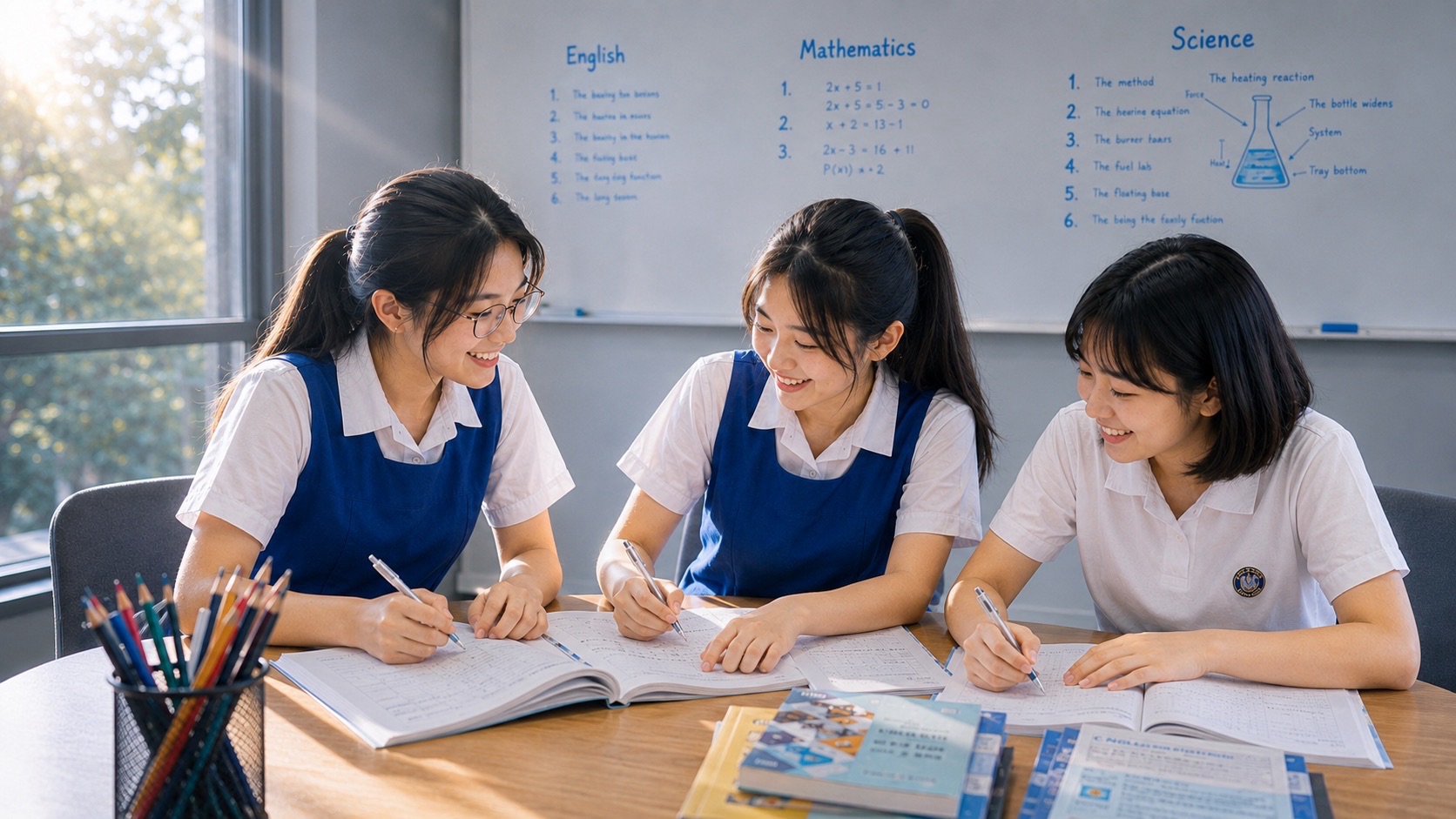
A-Math Mastery Katong | Advanced Problem Solving
Advanced A-Math Tuition in Katong for Secondary Students
At eduKate Singapore Katong, we specialise in A-Math Mastery through home based small-group classes (3-pax maximum), designed to strengthen problem-solving skills and prepare students for O-Levels, Junior College, and Polytechnic pathways.
Our Katong A-Math tutors focus on functions, trigonometry, logarithms, and calculus, providing step-by-step strategies for tackling advanced problem-solving questions. With our structured methods and exam-focused techniques, students not only achieve top grades but also build confidence in applying mathematical concepts to real-world challenges.
Why Choose Our A-Math Tuition in Katong?
- 3-pax Small Group Learning for maximum personal attention.
- Specialist A-Math Tutors with proven track records in distinction results.
- Current Singapore Examination Alignment – lessons are mapped to the 2026 SEAB O-Level Additional Mathematics syllabus 4049, while students progressing beyond 2026 are prepared for the 2027 SEC G3 Additional Mathematics syllabus K341.
- Focus on Advanced Topics such as calculus, functions, and complex algebra.
- Exam-Oriented Drills & Problem-Solving Workshops to build speed and accuracy.
Our A-Math Teaching Approach
- Conceptual Clarity – breaking down complex theories into simple, learnable steps.
- Practice for Perfection – exposure to varying levels of A-Math exam questions.
- Critical Thinking & Application – helping students apply math beyond the textbook.
- Regular Consultations with Parents – track your child’s progress and improvement roadmap.
How We Teach Additional Mathematics from Scratch
1. Laying the Foundations First
Many students struggle with A-Math because they try to jump straight into complex problem-solving without securing their basics. At our home based Katong A Math tutorials, we:
- Start with core algebraic manipulation, indices, surds, and inequalities.
- Reinforce Secondary 1–2 E-Math concepts since A-Math builds heavily on them.
- Use structured drills to build fluency, so students don’t get “stuck” on fundamentals when tackling advanced questions.
2. Step-by-Step Introduction to A-Math Topics
We break down the entire syllabus systematically, teaching each topic with clarity:
- Functions & Graphs → Learn transformations and sketching techniques.
- Quadratic Equations & Inequalities → Connections to real-world applications.
- Logarithms & Exponentials → Understanding growth and decay problems.
- Trigonometry (2D & 3D) → From identities to applications in physics.
- Calculus (Differentiation & Integration) → Start with the concept of slope/area, then extend to complex applications like kinematics.
- Vectors & Proofs → Logical reasoning and application-based problem solving.
Each topic is taught from first principles so students do not rely on rote memorisation but build genuine understanding.
3. Curriculum Alignment
We align each lesson with the current national examination pathway. Students sitting the 2026 GCE O-Level work to SEAB Additional Mathematics 4049. Students progressing into the 2027 Secondary Education Certificate are prepared for G3 Additional Mathematics K341, which references the 4049 syllabus lineage. This keeps the teaching current without confusing an older Express/NA document with the examination specification students actually face.
- Every exam-tested topic is covered.
- Students are trained in question formats, mark allocation, and common traps.
- They are exam-ready while also developing higher-order thinking skills.
4. Teaching for Deep Understanding
Instead of “just teaching formulas,” we focus on why formulas work. For example:
- Deriving the quadratic formula step by step before applying it.
- Showing how differentiation connects to the gradient of a curve, not just memorising rules.
- Using graphing tools, visual aids, and real-world examples to make abstract concepts concrete.
5. Problem-Solving Training
A-Math exams are about application. We train students to:
- Solve basic procedural questions quickly (speed & accuracy).
- Handle challenging problem-solving questions that require multiple concepts in one problem.
- Use exam strategies: identifying keywords, checking units, structuring solutions for maximum marks.
6. Practice, Review, and Feedback
- Weekly 3-pax small group sessions → personalised coaching.
- Regular mock exams and timed practices.
- Feedback loops to target individual weaknesses.
- Homework support via WhatsApp/Telegram to keep momentum going.
7. Building Long-Term Readiness
Beyond the O-Levels, A-Math prepares students for JC H2 Math, Polytechnic engineering, computing, and business courses. We highlight how each A-Math concept connects to future studies, building motivation and relevance.
👉 This way, we don’t just “teach to the test.” We equip students with mastery, so they leave tuition confident, competent, and ready for both their O-Levels and beyond.
Who Should Join Our Katong A-Math Mastery Programme?
Our Katong A-Math tuition classes are ideal for:
- Secondary 3 & 4 students preparing for O-Level or SEC G3 Additional Mathematics.
- Students aiming for Junior College H2 Mathematics readiness.
- Learners targeting Polytechnic courses requiring strong mathematical foundations.
- Students seeking to move from mid-range O-Level performance toward an A1 distinction through stronger foundations, accuracy and problem-solving.
Testimonials from Katong Parents & Students
“The small class size made a huge difference. My son jumped from a C5 to an A1 in A-Math within a year.” — Parent, Katong Secondary 4
“The tutors explained calculus so clearly, I was ahead of my school syllabus.” — Student, Katong A-Math
Book Your Free Consultation Today
Spaces are limited to 3 students per class. Secure your slot for Katong A-Math Mastery by booking a free consultationtoday.
How A-Math Mastery Katong’s Advanced Problem Solving Can Help Secondary Students Build JC and Polytechnic Readiness
A-Math Mastery Katong specializes in advanced problem-solving tuition for secondary students, focusing on Additional Mathematics (A-Math) topics from functions to calculus. Located in the vibrant Katong area of Singapore, this service is designed to equip students with the skills needed for Junior College (JC) or polytechnic pathways. By emphasizing rigorous problem-solving and conceptual depth, it prepares learners for higher-level math demands, fostering resilience and analytical thinking essential for future academic and career success. Below, we explore how this targeted tuition can benefit students, supported by educational insights.
Benefits of Advanced Problem Solving in A-Math
Advanced problem-solving in A-Math goes beyond rote learning, delving into complex topics like quadratic functions, trigonometry, and introductory calculus. This approach not only strengthens foundational skills but also cultivates critical thinking, making it invaluable for secondary students aiming for JC or polytechnic.
- Mastery of Key Mathematical Concepts and Skills: A-Math tuition helps students gain proficiency in algebra, geometry, trigonometry, and calculus, building a strong foundation for advanced studies. It develops application methods, examination skills, and the ability to tackle challenging problems, which are crucial for O-Level success and beyond. Through focused practice, students learn to simplify expressions, solve inequalities, and apply logarithmic functions, enhancing their overall mathematical competence.
- Preparation for JC and Polytechnic Pathways: A-Math is often a prerequisite for JC subjects like H2 Mathematics or polytechnic courses in engineering and sciences. Tuition in this area ensures students are ready for these transitions, providing an edge in modules involving calculus and advanced topics. It opens doors to STEM careers and higher education by developing problem-solving abilities that align with post-secondary requirements. Students who excel in A-Math are better positioned for university admissions, where strong math skills are highly valued.
- Boosted Confidence and Performance: Personalized or small-group settings in A-Math tuition address individual doubts, clarify complex concepts, and promote a growth mindset. This leads to improved grades, reduced anxiety, and greater resilience when facing difficult problems. Research highlights how such support enhances analytical abilities and logical reasoning, resulting in better exam outcomes.
- Development of Lifelong Skills: Beyond academics, A-Math tuition fosters qualities like perseverance and critical thinking, which are transferable to real-world scenarios. It encourages students to explore challenging concepts, improving their ability to handle ambiguity and innovate—skills essential for future careers in a math-centric economy.
Location Advantage: Proximity to Katong’s Secondary Schools
A-Math Mastery Katong’s convenient location makes it accessible for students from nearby secondary schools, minimizing travel time and allowing more focus on learning. This proximity supports consistent attendance and integrates seamlessly with school schedules in the Katong neighborhood. Key nearby schools include:
📍 Secondary Schools in East Singapore (Katong & Surrounding Areas)
Katong / Marine Parade Area
- Tanjong Katong Secondary School
- Tanjong Katong Girls’ School
- Chung Cheng High School (Main)
- Broadrick Secondary School
- Geylang Methodist School (Secondary)
- Paya Lebar Methodist Girls’ School (Secondary)
- CHIJ Katong Convent
- St. Patrick’s School
- Victoria School
Bedok Area
- Bedok Green Secondary School
- Bedok South Secondary School
- Bedok View Secondary School
- Temasek Secondary School
- Anglican High School
- Damai Secondary School
- St. Anthony’s Canossian Secondary School
- Changkat Changi Secondary School
Tampines Area
- Tampines Secondary School
- St. Hilda’s Secondary School
- Junyuan Secondary School
- East Spring Secondary School
- Springfield Secondary School
- Meridian Secondary School
- Ngee Ann Secondary School
Pasir Ris Area
- Hai Sing Catholic School
- Loyang View Secondary School
- Pasir Ris Secondary School
- Pasir Ris Crest Secondary School
- Meridian Secondary School
Notable East-Side Schools
- Manjusri Secondary School
- Ngee Ann Secondary School
- St. Patrick’s School
- Victoria School
- Anglican High School
- Dunman High School
The short distance ensures students can easily attend sessions after school, enhancing their preparation for JC or polytechnic without added stress.
Section of Helpful Authoritative Clickable Links
For additional resources on A-Math education in Singapore, here are authoritative links to official syllabuses, study guides, and tools. These can support students and parents in aligning with the curriculum and accessing practice materials:
- SEAB 2026 GCE O-Level Syllabuses for School Candidates – The current official examination index listing Additional Mathematics as syllabus 4049.
- SEAB 2027 SEC G3 Syllabuses for School Candidates – The official transition page listing G3 Additional Mathematics as K341, referenced to 4049.
- MOE G2 and G3 Additional Mathematics Syllabuses – The current Full SBB curriculum document covering aims, content, applications, teaching and assessment for Additional Mathematics.
- SEAB Approved Calculators – Current calculator guidance for Singapore national examinations; students should check the approved list for the examination year.
- eduKate: How to Pass A-Math – An internal companion guide connecting foundations, practice and examination preparation.
- eduKate: Am I Capable of Taking A-Math? – A diagnostic companion for students deciding how to build the prerequisites for Additional Mathematics.
These resources offer reliable, curriculum-aligned support to complement A-Math Mastery Katong’s advanced problem-solving sessions, helping students achieve readiness for JC or polytechnic.
