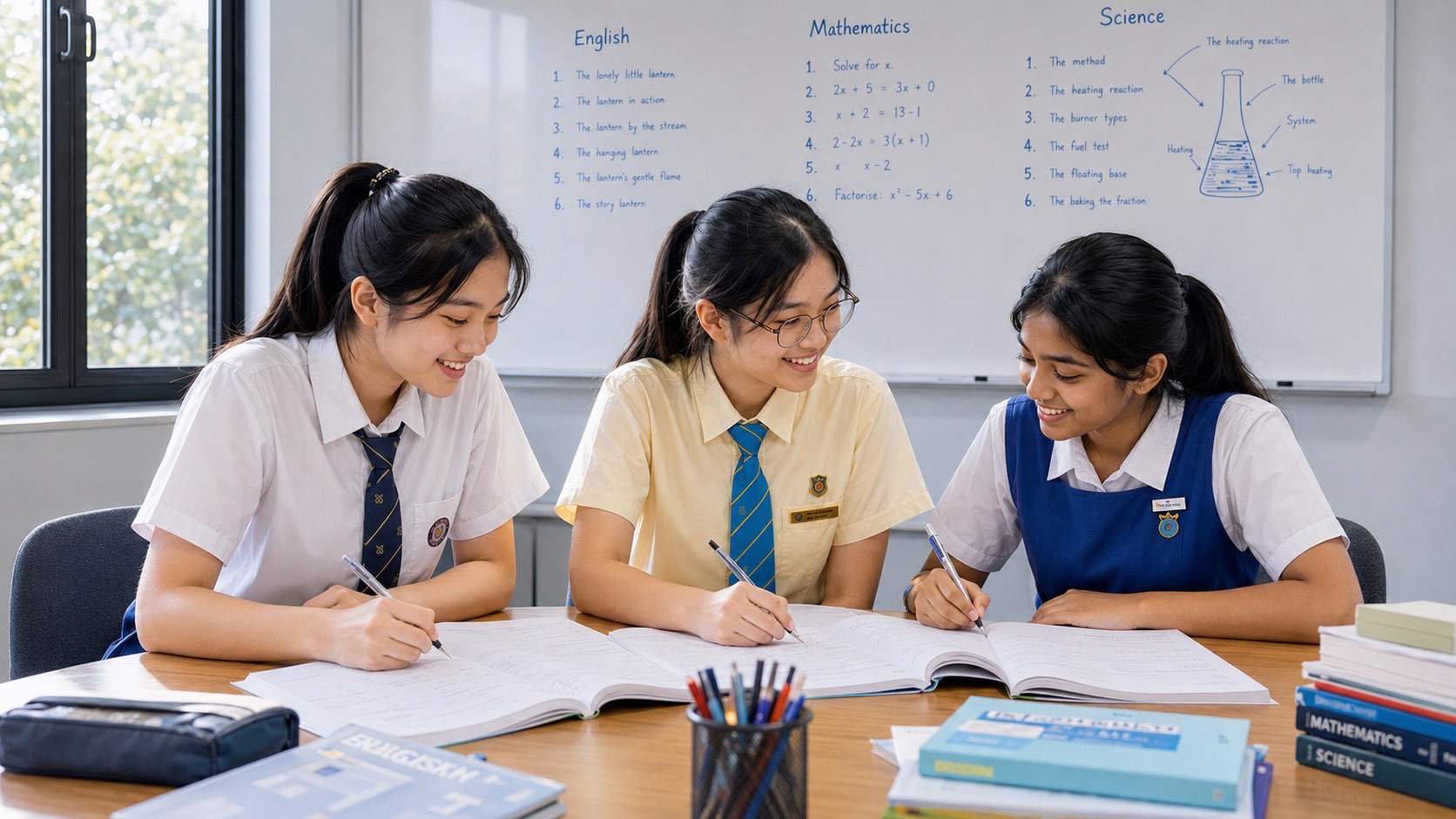
Curiosity, prototype, sensor, troubleshoot, discrepancy and conclusion are practical vocabulary choices for a story about solving a problem. This theme follows a student’s idea from noticing a need through trying a solution and describing the results. Strong composition writing should show the purpose of a tool or invention rather than using technical words to sound impressive.
This eighth Secondary 2 SEC G1 advanced composition chapter offers 100 new words for ideas, devices, planning, technical setbacks and explaining a result. Every word has a plain meaning for students and parents, and the chapter includes an original recount, sentence repairs and exercises. It belongs to an independently curated 2,000-word learning project; SEAB does not prescribe these entries. The published 2027 SEC G1 English K100 syllabus is a graduating-exam reference, while Secondary 2 pupils need to follow the current school task and later check the syllabus for their actual examination year.
- Theme: curiosity, electronic tools, designing a solution, problems during testing and communicating findings.
- Collection position: words 701–800, with 100 new entries and no repeated headwords from previous chapters.
- Key writing move: explain the problem first, then show what the student tried and which result changed their thinking.
- For parents: discuss a harmless household or school problem that has more than one reasonable solution.
- For students: use simple explanations of technology; never assume the reader knows a term that the writer cannot explain.
- For accuracy: an imagined invention must behave consistently within the story, not promise impossible results.
Quick explanation: why this word collection helps
This is Chapter 8, featuring 100 carefully chosen words in the planned Top 2000 Secondary 2 G1 composition vocabulary collection. This page does not contain 2,000 words; it adds a distinct 100-word chapter. Each entry has a short meaning, and the teaching sections show how to apply vocabulary in new writing. The aim is stronger independent communication rather than filling a composition with memorised expressions.
For the published 2027 SEC G1 English Language K100 syllabus, Paper 1 Writing is worth 70 marks, lasts 1 hour 20 minutes and contributes 30% of the national examination. It contains Editing, Situational Writing of at least 180 words and Continuous Writing of at least 120 words. The writing paper is computer-delivered. Paper 2 tests language use, including vocabulary cloze and comprehension. These specifications are not automatic Secondary 2 school composition requirements. Always follow the current school task and check the official syllabus for the learner’s later examination year.
Vocabulary work also supports the reading and inference skills needed after PSLE. But the PSLE is a primary examination, while Secondary 2 students have different coursework and opportunities. MOE and SEAB do not publish this privately curated 2,000-word sequence as an official mandatory list.
The word list: Creativity, Technology and Everyday Problem-Solving (words 701–800)
Read each word with its meaning. Next produce a fresh sentence about something a reader can imagine. Check the grammar and whether the strength or tone of the word is right. When a complex word makes the meaning less clear, use the simpler word.
Curiosity, imagination and creative thinking
Words 701–720. When practising, choose two different entries and use each in a sentence that makes its meaning clear.
| No. | Vocabulary word | Clear meaning |
|---|---|---|
| 701 | curiosity | a desire to learn or understand something |
| 702 | inquisitive | eager to ask questions and discover facts |
| 703 | imaginative | good at forming new ideas |
| 704 | inventive | able to think of original solutions |
| 705 | original | new or not copied from another person |
| 706 | innovative | introducing a useful new idea or method |
| 707 | observant | quick to notice small details |
| 708 | exploratory | intended to investigate or try something new |
| 709 | creative | able to make or think of new things |
| 710 | ingenuity | cleverness in solving a problem |
| 711 | logical | following sensible reasoning |
| 712 | methodical | doing things in a planned order |
| 713 | analytical | examining details to understand a problem |
| 714 | intuitive | understood quickly without deliberate reasoning |
| 715 | visionary | able to imagine possibilities for the future |
| 716 | unconventional | different from the usual way |
| 717 | experimental | being tried out to learn what works |
| 718 | abstract | existing mainly as an idea rather than an object |
| 719 | spontaneous | happening without being planned |
| 720 | systematic | following a careful, organised method |
Devices, computers and communication tools
Words 721–740. When practising, choose two different entries and use each in a sentence that makes its meaning clear.
| No. | Vocabulary word | Clear meaning |
|---|---|---|
| 721 | device | a piece of equipment with a particular purpose |
| 722 | application | a computer or phone program used for a task |
| 723 | interface | the part of a system a person interacts with |
| 724 | browser | a program for viewing websites |
| 725 | software | programs used on a computer or device |
| 726 | hardware | the physical parts of a computer system |
| 727 | sensor | a part that detects a change such as movement or light |
| 728 | circuit | a connected path that electricity can travel around |
| 729 | battery | an object that stores energy for a device |
| 730 | display | a screen or area showing information |
| 731 | keypad | a set of buttons used to enter information |
| 732 | touchscreen | a screen operated by touch |
| 733 | upload | send a file from a device to an online service |
| 734 | download | receive a file from an online service |
| 735 | backup | a saved copy of information for emergencies |
| 736 | storage | space for keeping information or objects |
| 737 | network | connected computers or other devices |
| 738 | signal | a transmitted message or electrical indication |
| 739 | database | an organised collection of information |
| 740 | algorithm | a set of steps for completing a task |
Planning, building and trying out an idea
Words 741–760. When practising, choose two different entries and use each in a sentence that makes its meaning clear.
| No. | Vocabulary word | Clear meaning |
|---|---|---|
| 741 | prototype | an early model used to test an idea |
| 742 | sketch | a quick drawing of a plan or object |
| 743 | blueprint | a detailed plan for something to be built |
| 744 | design | plan how something should look or work |
| 745 | construct | build something from parts |
| 746 | assemble | put parts together |
| 747 | dismantle | take something apart |
| 748 | modify | make a change to something |
| 749 | calibrate | adjust equipment to make its readings accurate |
| 750 | test | check whether something works |
| 751 | debug | find and fix errors in a program |
| 752 | troubleshoot | look for the cause of a practical problem |
| 753 | code | write instructions for a computer program |
| 754 | simulate | imitate a situation to see what might happen |
| 755 | estimate | make a reasonable guess using available information |
| 756 | measure | find the size, amount or extent of something |
| 757 | sample | a small part chosen to represent a larger whole |
| 758 | observe | watch or notice carefully |
| 759 | redesign | plan a new design to improve an earlier one |
| 760 | iterate | repeat a process with changes to improve it |
Problems, failures and technical limitations
Words 761–780. When practising, choose two different entries and use each in a sentence that makes its meaning clear.
| No. | Vocabulary word | Clear meaning |
|---|---|---|
| 761 | malfunction | fail to work correctly |
| 762 | glitch | a small and often temporary technical problem |
| 763 | error | a mistake in a process or result |
| 764 | defect | a fault in something made or designed |
| 765 | bug | an error in a computer program |
| 766 | breakdown | a failure that stops a system working |
| 767 | outage | a period when a service is unavailable |
| 768 | crash | a sudden failure of a computer program or system |
| 769 | overload | too much demand on a system |
| 770 | short-circuit | an unintended electrical connection that can be dangerous |
| 771 | discrepancy | a difference between results that should match |
| 772 | inconsistency | something that does not agree with other facts or results |
| 773 | limitation | a factor that restricts what can be done |
| 774 | bottleneck | a part of a process that slows everything else |
| 775 | miscalculation | a mistake made when working out a number |
| 776 | misalignment | parts or ideas being out of the correct position |
| 777 | interference | something that gets in the way of a process or signal |
| 778 | fault | a problem that causes incorrect operation |
| 779 | distortion | a change that makes information or a shape inaccurate |
| 780 | leakage | something escaping from where it should be contained |
Explaining a project clearly to readers
Words 781–800. When practising, choose two different entries and use each in a sentence that makes its meaning clear.
| No. | Vocabulary word | Clear meaning |
|---|---|---|
| 781 | diagram | a simple drawing that explains parts or relationships |
| 782 | chart | a visual way to present information |
| 783 | caption | words explaining a picture or diagram |
| 784 | label | a short name attached to an item |
| 785 | legend | a key explaining the signs in a diagram or chart |
| 786 | annotation | a short note added to explain something |
| 787 | draft | an early version of a piece of work |
| 788 | outline | a short plan showing the main points |
| 789 | summary | a brief account of the important ideas |
| 790 | conclusion | a final judgment drawn from information |
| 791 | finding | a result discovered through a study or check |
| 792 | observation | something noticed or recorded |
| 793 | rationale | the reasons behind an action or choice |
| 794 | recommendation | advice about a suitable action |
| 795 | proposal | a plan put forward for consideration |
| 796 | illustration | a picture or example that explains an idea |
| 797 | interpretation | an explanation of what information means |
| 798 | reference | information pointing to a source |
| 799 | citation | a note identifying where information came from |
| 800 | format | the arrangement or structure of something |
Move from knowing a word to using it well
The inventor is not the main point of every story
It is easy to write ‘I was very clever and invented a robot’, but that skips the problem and makes the character difficult to believe. A stronger beginning notices a specific inconvenience: the classroom is noisy during group work, a book trolley is hard to organise or labels keep falling off equipment. The student’s idea should respond to that need.
‘Creative’ suggests making new ideas, while ‘methodical’ suggests testing them in an orderly way. They can describe the same learner. A thoughtful character might have an imaginative suggestion but still need a systematic plan before it can work.
For G1 writing, the aim is not to prove engineering expertise. It is to write a clear story about observation, effort and change.
A prototype is for learning, not pretending
A ‘prototype’ is an early model used to explore a design. It does not need to be a finished product. A student might sketch a labelled cardboard organiser, try it and discover that the shelves are too narrow. The problem gives the story a turning point.
‘Debug’ usually concerns finding errors in a computer program; ‘troubleshoot’ can apply to a wider practical problem. An incorrect signal from a sensor may require troubleshooting, but a student should not claim to have coded an advanced system without describing a believable step.
A fictional project can be imaginative without pretending that a phone application, sensor or algorithm can predict everything. Explain what information the system receives, what it does and what it cannot do.
Good explanations admit limitations
A ‘glitch’ may be a brief problem; a ‘breakdown’ suggests a more serious failure. A ‘discrepancy’ means results differ when they are expected to agree. If the story’s measuring tool produces different readings, describe how the student checks them before announcing a conclusion.
A useful ending is not ‘My project was perfect and everyone clapped’. A more credible resolution is ‘The revised prototype worked better, although we still needed a stronger base’. That sentence shows achievement and limitation together.
When a task asks for a report or explanation, keep facts, observations and conclusions separate. A conclusion should follow from the actual test rather than from what the writer hoped to prove.
Original model composition passage
This original example is written for vocabulary teaching. It is not a reproduced examination passage or a response to a known school question. Read it first for its event, then for its language choices.
Our group wanted to improve the classroom book corner. The old shelf labels kept slipping off, so students returned books to the wrong sections. I suggested a new organiser, and we built a cardboard prototype before changing anything permanently. My first design was inventive but impractical: the spaces were too narrow for larger books. During testing, we noticed a discrepancy between the sizes written on our sketch and the real books. We measured the largest volumes, modified the design and tried again. The second version was easier to use, though the labels still needed stronger backing. I wrote a short conclusion for our teacher, explaining both the improvement and the remaining limitation. The project taught me that curiosity is only the beginning of problem-solving. Careful observation, useful feedback and a willingness to redesign can turn a small idea into something that works.
Underline three places where the narrator gives an observable detail. Circle five useful vocabulary expressions. Cover the model and explain the incident orally. Then write your own event with a different place, problem and decision. Copying this text is less valuable than being able to write a believable new scene.
Four weak-to-strong sentence repairs
Before: Our idea was very smart.
After: Our group designed a simple organiser to solve a specific classroom problem.
Why: Purpose and action are more informative than praise.
Before: The machine was broken.
After: The sensor gave inconsistent readings, so we checked the connection.
Why: The fault and response are described clearly.
Before: We made it and it was good.
After: We tested the prototype, noticed a weakness and modified the base.
Why: The writing shows the stages of improvement.
Before: We knew everything was correct.
After: Our conclusion described the results and the limitation we could not yet solve.
Why: The writer separates evidence from hope.
Practice 1: six quick vocabulary gaps
Write the most suitable word from this chapter in each blank before checking the answer key. Explain the clue that made your choice correct.
- 1. The group built a simple __________ before using stronger materials.
- 2. The phone’s __________ made it possible to open the school website.
- 3. When the readings disagreed, we checked for a __________.
- 4. The student had to __________ the program after it stopped working correctly.
- 5. The project report ended with a __________ about what the test showed.
- 6. We used a labelled __________ to explain how the parts fit together.
Answer key: 1. prototype; 2. browser; 3. discrepancy; 4. debug; 5. conclusion; 6. diagram. Alternative answers should be accepted only if they express the correct meaning and grammar.
Practice 2: write a short, complete story
- Writing prompt 1: An invention that works differently from what you expected. Write a situation, a problem or change, a response and a believable result.
- Writing prompt 2: A school project improved after a failed first attempt. Write a situation, a problem or change, a response and a believable result.
- Writing prompt 3: A technical problem solved through teamwork and careful checking. Write a situation, a problem or change, a response and a believable result.
- Writing prompt 4: A small everyday inconvenience that inspires a creative idea. Write a situation, a problem or change, a response and a believable result.
Choose one prompt. Write four short planning notes before drafting. Use three new words only where they fit naturally. Add one concrete detail about what a character can see, hear or do. At the end, make sure the reader knows what changed and why. If the school task specifies a different structure, audience or length, follow the school task.
Practice 3: strengthen vocabulary for situational writing
Create a fictional short message to a teacher or class organiser about a small practical problem connected with this theme. Include the context, the important facts, what has been done and one clear request or suggestion. Select vocabulary appropriate for a respectful reader. Do not turn an email into a dramatic story and do not copy a memorised introduction. When preparing specifically for the 2027 K100 Paper 1 Section B, follow its stated minimum of 180 words and the supplied visual stimulus; the short exercise here is only a developmental step.
A four-week study route with parent checks
- Week 1: Meaning. Choose 10–15 relevant words. Explain each without looking; try one natural sentence.
- Week 2: Contrast. Sort words by meaning and intensity. Show one incorrect use and explain the error.
- Week 3: Transfer. Use five words in an unseen prompt or picture discussion, without copying an earlier composition.
- Week 4: Editing. Reread a new paragraph, replace vague language and remove difficult words that do not fit.
Parents can ask three practical questions: Does this word mean what you think it means? Which part of the sentence proves that? Could you write a clearer version without it? The student should be able to answer in ordinary English. Praise useful corrections rather than the number of advanced words.
For a child finding even simple sentences difficult, practise one meaningful sentence and one correction daily. For a stronger writer, compare similar meanings, explain the consequences of different choices and write a fresh response from the other character’s viewpoint. Appropriate difficulty builds progress more reliably than a word-count target alone.
Common learning mistakes to avoid
- Putting a difficult adjective before every noun, even when it adds no useful information.
- Memorising a paragraph without understanding why the events happen in that order.
- Using a word only because its spelling looks impressive while the meaning is inaccurate.
- Confusing the published 2027 SEC G1 examination with the school’s present Secondary 2 test.
- Believing that this independent word collection is an official compulsory SEAB or MOE vocabulary list.
Frequently asked questions
Must students know programming to use these words?
No. Start with ordinary problems and explain only the terms that are relevant.
Is a prototype the same as the final product?
No. It is an early model used to test or improve a design.
Can a composition describe a fictional invention?
Yes, if the prompt allows it, but its actions and results should remain understandable and consistent.
Sources and related English learning guides
- Official SEAB 2027 G1 English K100 syllabus (PDF)
- SEAB 2027 G1 SEC school candidate subject directory
- MOE English Language 2020 syllabus for Foundation Primary and Secondary N(T)
- Secondary 2 G1 English parent guide on eduKateSingapore
- Secondary 2 G1 writing and editing guide
- Reading Comprehension, Inference and Context Clues
Continue this Secondary 2 SEC G1 vocabulary collection
- Chapter 1 | Emotions, Reactions and Self-Control
- Chapter 2 | Friendship, Character and Conflict
- Chapter 3 | School, Community and Digital Life
- Chapter 4 | Challenges, Change and Reflection
- Chapter 5 | Honesty, Responsibility and Difficult Choices
- Chapter 6 | Health, Sports and Teamwork
- Chapter 7 | Nature, Wildlife and Environmental Responsibility
Editorial note: The definitions, writing passages and exercises are original learner-oriented materials. The government documents are used to verify syllabus and assessment context; this word selection itself is not an official SEAB word prescription. School guidance and the candidate’s actual examination-year syllabus take priority.