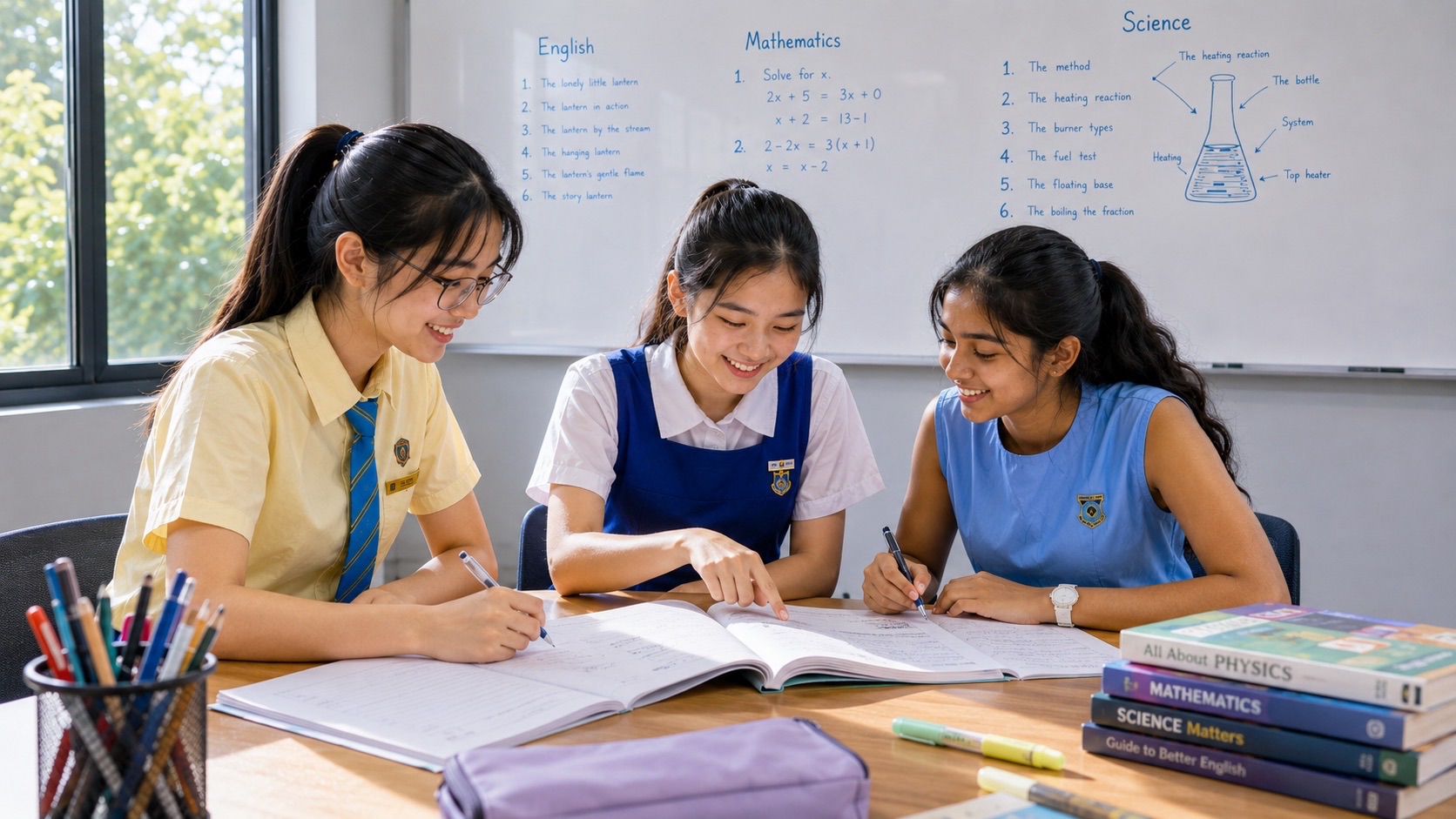
Secondary 2 G1 English writing preparation should start with the genres, task formats and writing criteria taught by the school. Ask whether the EOY includes situational writing, a composition, editing or shorter written responses, and obtain the teacher’s examples and feedback. A child may have ideas but miss required content points, write to the wrong audience, organise events poorly or make repeated sentence errors. These are separate problems. The aim is not to memorise one perfect composition; it is to learn how to understand a prompt, plan a suitable response and communicate clearly under the school’s actual conditions.
Parents should focus on the writing process: decode the task, identify purpose and audience, select relevant content, organise ideas, draft, review and correct. The 2027 national SEC G1 English syllabus K100 includes editing, situational writing and continuous writing in Paper 1, but its national word minimums and paper timings should not be assumed to be the Secondary 2 school’s requirements. Use the school task sheet for this year’s expectations. A student should be able to write a fresh response to a changed prompt, not simply reproduce a memorised model.
- Confirm the actual school genres, word expectations, timing, rubric and any computer-based classroom tasks.
- For situational writing, identify purpose, audience, context, format and every required content point.
- For continuous writing, plan a coherent sequence, develop events and keep the response relevant to the topic.
- Use paragraphs to guide the reader; make each paragraph perform a clear job.
- Edit for meaning, sentence structure, tense, agreement, punctuation and spelling in a deliberate order.
- Practise fresh prompts and independent revision instead of memorising entire compositions.
Understand the writing task before drafting
Students sometimes begin writing after reading only the first line of a prompt. They may overlook who the reader is, what the writer is supposed to achieve or which details must be included. Teach the learner to mark the purpose, audience, context, format and required content. Then turn the task into a short checklist. Every part of the response should serve that task.
A note to a teacher, an email to a friend and a report for a school activity may contain similar information but require different tone and organisation. The format should be based on the actual prompt and school instruction, not a fixed template inserted into every response.
Situational writing: cover the content honestly
A situational writing task may provide a stimulus and ask the student to write for a particular purpose. The student should identify all required points and decide how to express them clearly. Missing one key detail can weaken an otherwise fluent response. An answer that is beautifully worded but fails to explain the requested arrangement may not meet the task.
Make a content checklist before writing. After drafting, tick each point only when it is genuinely addressed. Do not add invented facts to make the response longer. If the stimulus does not provide a detail, the student should not pretend that it was supplied. The aim is to communicate accurately within the scenario.
Audience and tone
Tone should match the reader and purpose. A formal request usually needs polite, clear language; a message to a close friend may be more conversational. Students should avoid using slang in a formal context or overly stiff expressions in a casual one. The prompt gives clues about the relationship and desired effect.
Ask the child to imagine how the reader would understand the message. Does the opening identify the reason for writing? Does the explanation sound respectful? Is the request clear? Does the closing fit the relationship? These questions improve appropriateness without forcing the student to memorise a list of artificial phrases.
Continuous writing: stay with the topic
A composition needs a central direction. Students may start with a relevant idea and drift into an unrelated story because they remember a memorised plot. Ask the child to identify what the topic requires and what kind of response would genuinely address it. A narrative, personal recount or descriptive response may need different planning, depending on the school’s prompt.
A short plan can identify the opening situation, key development, turning point and ending. The events should connect logically. If the topic asks about a difficult decision, the composition should actually develop that decision, not merely mention it in the last paragraph. Relevance comes before decorative vocabulary.
Plan a story that can be completed
A common problem is choosing a plot that is too complicated for the time available. Several characters, locations and subplots create more opportunities for inconsistency. Encourage the student to use a manageable number of characters and a clear conflict. A convincing small event is often easier to develop than an unrealistic dramatic adventure.
Before drafting, ask: what does the main character want, what gets in the way, what decision is made and what changes by the end? The student should know the basic sequence before writing. The plan is a guide, not a script; details can develop naturally as long as the story remains coherent.
Paragraphing and cohesion
Each paragraph should help the reader follow the idea or sequence. A narrative paragraph may focus on a new event, a change in setting or an important response. An explanatory paragraph may develop one main point with supporting information. Very long paragraphs can hide changes, while a new paragraph after every sentence can make the writing fragmented.
Teach the child to check the connection between paragraphs. Does the next paragraph follow from the previous one? Are time shifts clear? Are pronouns and references easy to understand? Use simple connectors accurately rather than inserting ‘furthermore’ or ‘moreover’ into every sentence.
Develop details without padding
A writer can develop an idea through action, dialogue, specific observation or explanation. Instead of writing ‘I was nervous’, the student might describe checking the instructions twice and feeling their hands tighten before beginning. The detail should serve the scene. Unrelated adjectives and repeated statements do not make writing more engaging.
Ask what the reader needs to understand at that moment. One precise detail may be stronger than several vague sentences. If the child is below the school’s word expectation, identify which part of the task is underdeveloped rather than adding empty phrases. If the student has enough content, focus on clarity and accuracy.
Editing: meaning before small corrections
Editing is more effective when done in stages. First check whether the response answers the prompt. Next check paragraph order and missing information. Then review sentence structure, verb tense, agreement, punctuation and spelling. A student who checks commas while an essential content point is missing is spending attention in the wrong order.
Use the student’s own repeated error patterns. If tense changes unexpectedly, read the paragraph and mark the verbs. If sentences are incomplete, identify the subject and main verb. If punctuation is unclear, read the sentence aloud and check where the ideas begin and end. Avoid correcting every line for the child.
Improve one recurring grammar weakness
A student may repeatedly write sentences with inconsistent tense or subject-verb agreement. Select a few examples from the child’s own work, explain the pattern and practise a changed sentence. Then ask the learner to find the same issue in a new paragraph. This creates a bridge from correction to independent editing.
The exact grammar focus should be based on school feedback. Do not give the student a large grammar chapter when the main difficulty is one repeated structure. Small, accurate correction followed by new application is more likely to transfer.
Screen writing and keyboard habits
The national K100 syllabus specifies computer delivery for the SEC writing paper. A Secondary 2 school may or may not use the same arrangement for its EOY, so ask the teacher. If the school requires typed work, practise saving the document, using paragraph breaks, reviewing the screen layout and checking the final file before submission.
Typing should not distract from language. The student should know how to correct an error, move between paragraphs and save in the required location. Avoid relying on auto-correct to choose the intended word. Read the completed text again because a correctly spelled but incorrect word may pass a basic spell-check.
A six-week writing improvement plan
**Week 1:** collect writing samples and identify the main weakness. **Week 2:** practise prompt analysis and content checklists. **Week 3:** plan and draft one situational writing task. **Week 4:** plan a short continuous writing response with a clear sequence and developed details. **Week 5:** edit using a staged checklist and correct recurring grammar patterns. **Week 6:** complete a fresh school-aligned prompt independently and review against the rubric.
Keep samples so the student can compare earlier and later work. Look for clearer task fulfilment, stronger organisation and fewer repeated errors. Do not measure progress only by how many advanced words have been added.
Anxiety and writing blocks
Some students freeze because they believe the first sentence must be perfect. Teach them to begin with a brief plan and a simple opening that serves the task. The first draft is allowed to be improved. If the child spends too long searching for an impressive phrase, return to the reader and purpose: what does this person need to know?
If anxiety persists and affects sleep, attendance or everyday functioning, involve school support and appropriate professional advice. During normal practice, use a clear start time and a modest task. Avoid rewriting the child’s composition in adult language; that removes the chance to learn how to express the idea independently.
Future SEC K100 context
For the 2027 national SEC, SEAB’s G1 English Language K100 Paper 1 includes editing, situational writing and continuous writing. The official syllabus sets a minimum of 180 words for situational writing and 120 words for continuous writing, and the paper lasts 1 hour 20 minutes. These are national examination specifications for the relevant graduating cohort, not automatically the word counts or timing for a Secondary 2 school EOY.
When the child approaches the SEC, use the current official K100 syllabus and school guidance. For this year’s work, follow the teacher’s brief. Do not force national word minimums onto an assignment with a different format or expectation.
Frequently asked questions
**Should my child memorise a model composition?** Learn useful structures, but practise responding to new prompts. **Does a long composition score better?** Not automatically; relevance, organisation, development and accuracy matter. **Should parents correct every grammar error?** Prioritise the repeated patterns and let the student make the corrections.
**Are K100 word counts the Secondary 2 requirement?** No, they belong to the 2027 national SEC syllabus. **How can we check progress?** Give a fresh prompt and check whether the learner plans and writes independently. **What if the child has ideas but cannot organise them?** Use a short planning structure before drafting.
Related eduKate and official references
Read the Secondary 2 G1 English parent guide and the eduKate first-principles teaching reference for a structured approach to diagnosis, correction and independent application.
For future national assessment specifications, use SEAB’s 2027 syllabus directory and the official K100 English syllabus. The current school assessment brief remains authoritative for Secondary 2.
What successful writing preparation looks like
A prepared student can decode a prompt, identify reader and purpose, include the required information, organise ideas and make useful corrections independently. Their writing remains clear when the prompt changes. They do not rely on a memorised plot or a parent rewriting every paragraph.
Use the cycle: understand, plan, draft, review, correct and retry. If a skill remains weak, isolate it and practise a small example before returning to the full response. This builds reliable writing ability for the current school EOY and the later G1 English course.