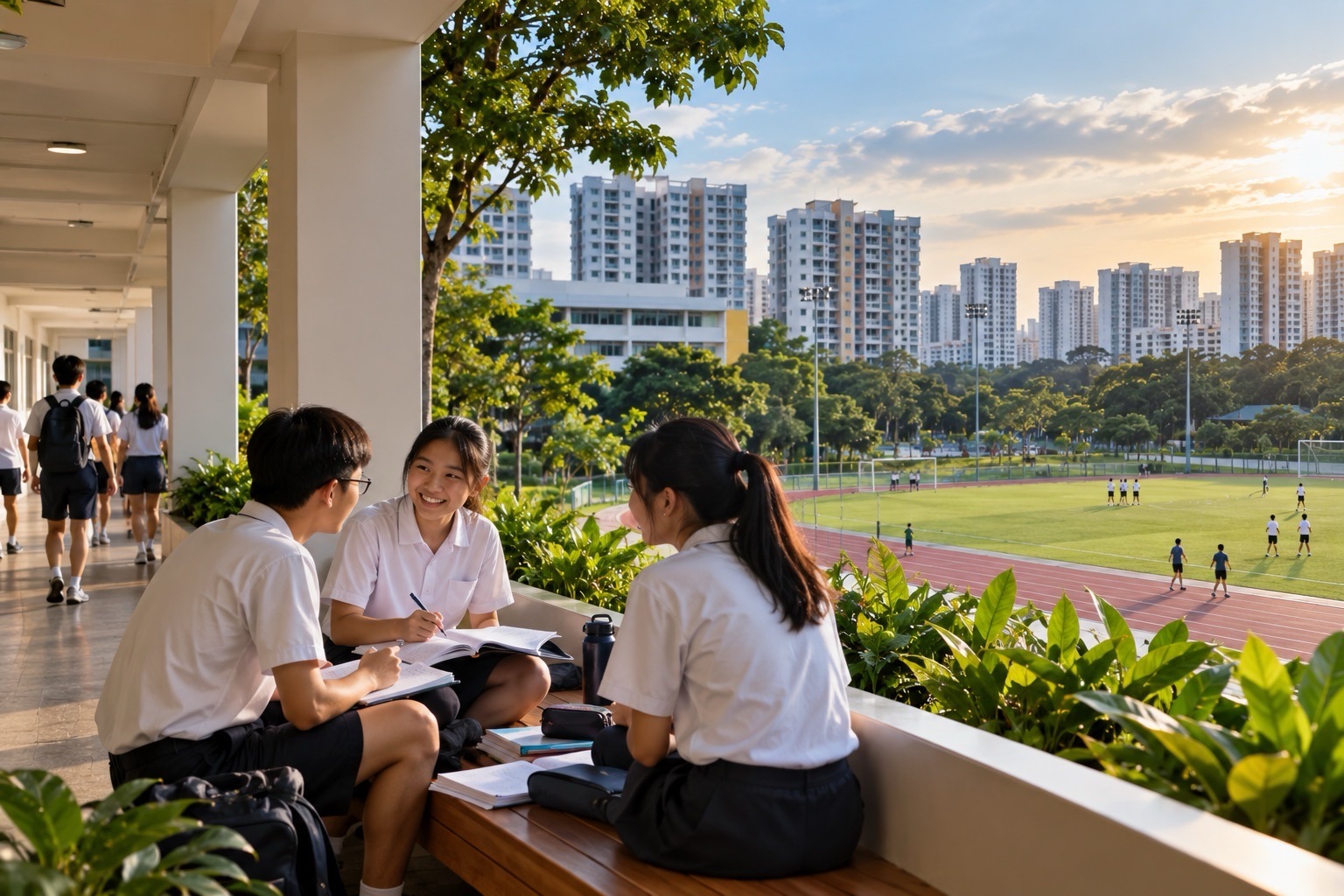
For a child with PSLE Score 4, 5, 6 or 7 who loves sports, outdoor adventure and team activities, choosing PG3/SEC rather than IP can be a considered educational decision when the child’s real school experience is a better fit. In the completed PSLE 2025 posting for entry to Secondary 1 in 2026, Catholic High, Methodist Girls’ School and Singapore Chinese Girls’ School had ordinary non-affiliated PG3 cutoffs of 8 or 8(M), while Cedar Girls’ had 9. Catholic High’s Passion Pursuit offers sports and outdoor elective experiences to both SEC and IP pupils; SCGS publishes a wide range of sports CCAs; MGS and Cedar have separate sports DSA talent-selection areas. These are not automatic team places or guaranteed admission for January 2027.
Parents should first ask whether the child wants a competitive sports team, accessible weekly activity, outdoor challenge or a school culture that balances sport with strong academic teaching. Scores 4–7 are all PG3 eligible, but many institutions in this band operate both SEC and IP, and some famous IP-only schools are not PG3 choices at all. The previous non-affiliated PG3 cutoff range began at 8, which was numerically less stringent than the child’s total but never guarantees a new place. The PSLE 2026 results arrive 24 November at 11.00am, with school choices submitted from 11.30am that day until 30 November at 4.30pm. Build six schools the child would like even if the first-choice sports team is full.
- Scores 4–7: ordinary PG3 eligible, but compare SEC and IP as separate curriculum and school choices.
- Catholic High: former PG3 8(M), IP 7(M); Passion Pursuit Electives in sports/outdoor activities are offered to both tracks.
- MGS: former PG3 8, IP 6; 2026 DSA selected talent areas include swimming, netball, softball, football and other sports.
- SCGS: former PG3 8, IP 7; regular secondary sports CCA list includes badminton, basketball, gymnastics, squash, tennis and more.
- Cedar Girls’: former PG3 and IP 9; separate DSA sports selections are not normal CCA guarantees.
- Sport, school-wide outdoor learning, DSA selection, CCA entry and LEAPS 2.0 participation are different processes.
- Submit six genuine schools through the S1 Portal by Monday 30 November 2026 at 4.30pm.
1. What PSLE Scores 4–7 really mean for school choice
The PSLE Score adds the Achievement Levels obtained in English Language, Mathematics, Science and Mother Tongue Language. A lower total means a stronger overall result. Scores 4, 5, 6 and 7 are comfortably within Posting Group 3 (PG3), but the four individual grades and the child’s interests still matter. A pupil who scored 4 received AL1 in each of the four subjects; a Score 7 pupil might have several strong subjects and a slightly different result in another. Neither total tells us whether the child enjoys Science, music, competitive sport or independent research, or what they need for a positive daily school life.
Families sometimes assume that a Score 4–7 must automatically lead to an Integrated Programme (IP). That is not a requirement. Some institutions offer only IP entry; others offer a separate four-year SEC programme in addition to IP; many mainstream secondary schools have PG3/SEC without IP. A child can choose an appropriate ordinary SEC route for its subject teaching, applied learning, school culture, CCA opportunities or proximity to home. The family should not make a twelve-year-old feel that studying for the SEC represents a failure to use a strong PSLE score.
A pupil with an outstanding PSLE result can still find new Secondary 1 algebra difficult, feel uncertain about friendships or prefer practical projects over extended examinations. Look at how teachers explain mistakes, what pupils can do after ordinary lessons, whether activities require additional selection and how long the child travels home. Those facts are more useful for long-term school fit than treating a previous last-posted cutoff as a quality ranking. The child’s future learning begins after the posting, not ends with a PSLE total.
2. Confirmed 2026 results and the official Secondary 1 submission window
| Singapore date and time | Official milestone | Parent action |
|---|---|---|
| Tuesday 24 November 2026, 11.00am | PSLE 2026 results released | Collect the official total and individual AL grades |
| Tuesday 24 November 2026, 11.30am | MOE S1 Portal opens | Use a parent’s Singpass and inspect eligible school programmes |
| 24–30 November 2026 | School research and submission | Compare up to six genuine preferences and transport |
| Monday 30 November 2026, 4.30pm | Online school choices close | Submit before the deadline and retain acknowledgement |
| Friday 18 December 2026 (tentative) | Secondary 1 posting results expected | Wait for the final MOE date and school reporting instructions |
The 17 November 2026 SEAB/MOE results announcement confirms these dates and encourages parents to consider school culture, subjects, distinctive programmes and CCAs. The official submission route is MOE S1 Posting. One parent with a valid Singpass may submit the form; those who need help should contact the child’s primary school before 4.30pm on 30 November. An unfinished online form is not an accepted school choice. Keep the successful acknowledgement and check the chosen route and school code carefully.
The announced Secondary 1 posting results date of 18 December is tentative, not a confirmed guarantee. Parents should follow later MOE notices. The earlier year’s cutoff figures are also not published future thresholds: the last pupil admitted in January 2027 will only be known after the 2026 cohort’s preferences and places are processed. It is better to prepare a list where every school has a positive reason to be included than a list of six famous names chosen without a child-centred discussion.
3. The crucial difference between an old PG3 cutoff and an IP cutoff
For the PSLE 2025 cohort entering Secondary 1 in January 2026, the lowest non-affiliated ordinary PG3 last-posted cutoff in the national comparison was 8, while some IP-only schools had last-posted scores of 6 or 7. A child scoring 4–7 therefore had a numerically stronger total than those previous ordinary PG3 endpoint scores. This does not guarantee a 2027 place; it simply means the previous PG3 admissions boundary is not the same as the stricter IP-only boundary. Families must not quote an IP cutoff of 6 as though it were a PG3 cutoff for that school.
In the completed 2025 posting, Catholic High, CHIJ St Nicholas Girls’, MGS, SCGS, ACS (Independent) and SJI each had an ordinary non-affiliated PG3 cutoff of 8, with a separate IP cutoff. Victoria School and Cedar Girls’ also operated separate IP and PG3 options with different or sometimes matching historic numbers. In contrast, Raffles Institution, Raffles Girls’, Hwa Chong Institution and Nanyang Girls’ High offered IP rather than ordinary PG3. Parents cannot submit those IP-only institutions as PG3/SEC choices. An interested Score 4–7 pupil can separately assess whether IP is eligible and desirable.
A school may also publish a formally affiliated range that differs substantially from the non-affiliated score. A parent being an alumnus or a school sharing a religious tradition does not by itself create affiliation for the pupil. Confirm the exact qualifying primary-to-secondary school link where relevant. At SAP schools, Higher Chinese grades may appear as suffixes such as D, M or P, describing the previous last-posted pupil’s HCL result. Do not remove the suffix, deduct imaginary points from the overall score or confuse language subject eligibility with a school’s special posting priority.
| School/route | 2026-intake ordinary non-affiliated PG3 cutoff | Separate IP 2026-intake cutoff | Important distinction |
|---|---|---|---|
| Catholic High (boys, SAP) | 8(M) | 7(M) | Both offered; SEC and IP are different curricula |
| CHIJ St Nicholas Girls’ (girls, SAP) | 8(M) | 7(M) | Girls-only secondary, separate IP and SEC |
| Methodist Girls’ School (girls) | 8 | 6 | Dual track with selected Music and other programmes |
| Singapore Chinese Girls’ School (girls) | 8 | 7 | Dual track, separate SEC and IP |
| ACS (Independent) (boys) | 8 | 7 | Do not confuse with ACS (Barker Road) |
| St Joseph’s Institution (boys) | 8 | 7 | Four-year SEC and separate six-year IP route |
| Victoria School (boys) | 9 | 8 | Different programme pathways and entry categories |
| Cedar Girls’ (girls) | 9 | 9 | Confirm the current route despite same former cutoff |
| Raffles Institution / Raffles Girls’ | No ordinary PG3 route | 6 | IP only for this comparison |
| Hwa Chong Institution / Nanyang Girls’ High | No ordinary PG3 route | 6(M) | IP only; SAP/HCL notation matters |
These previous numbers are grounded in the 2025 PSLE posting for January 2026 entry, not predetermined January 2027 cutoffs. The authoritative check is MOE SchoolFinder for the actual school, route, gender, fee category and published score range. The 2026 intake historical IP/PG3 comparison is a supplementary table only; MOE and the actual school’s most recent notices take priority. An IP-only choice and an ordinary PG3/SEC choice are not interchangeable even when the school names have similar traditions.
4. Full Subject-Based Banding, G3, SEC and later opportunities
Under MOE Full Subject-Based Banding, PG3 is used for school admission while G3 describes a subject-learning level. Pupils entering through PG3 generally start most subjects at G3 in a four-year SEC programme. The Singapore-Cambridge Secondary Education Certificate replaces the earlier separate N- and O-Level examination structures from the 2027 graduating cohort. Children joining Secondary 1 in 2027 will reach the applicable national examination in later years, not immediately. Their subsequent JC, polytechnic, ITE and other educational pathways will depend on later subjects and results, not on PSLE alone.
IP is a different school curriculum designed as a longer route leading towards post-secondary study without taking the ordinary Secondary 4 SEC examination along the way. It may include additional extended research, humanities or overseas experiences. But IP is not a universal measure of a child’s curiosity or potential: ordinary SEC schools also offer advanced academic and co-curricular opportunities. Catholic High officially explains that its IP and SEC/SP students share many core lessons, CCAs, student development and selected talent programmes, while IP has specific extension activities that the SEC timetable does not include.
Parents should therefore compare the actual years, subjects, assessment and school culture. A child who enjoys a wide range of subjects and a longer IP curriculum may prefer an IP-only or dual-track IP route if eligible. Another equally strong pupil may choose SEC because it suits their learning style, location, interests or family preferences. The decision should be based on the education the child will experience rather than the perceived status of a label or an assumption that one route automatically guarantees a particular university.
5. School-specific options for sports, outdoor adventure and CCAs
The following are grounded school-research choices for the ordinary PG3/SEC route, with last-posted scores from the PSLE 2025 cohort entering in January 2026. Where a school runs IP as well as SEC, the route remains separate. An advertised CCA, specialist activity or individual support arrangement must be checked for the actual pupil rather than assumed from admission to a school.
| School | Area | Former non-affiliated PG3 cutoff | Programme or enquiry | What parents should check |
|---|---|---|---|---|
| Catholic High (Secondary) | Bishan | 8(M) | Passion Pursuit rock climbing, bowling and other electives | Boys; sports CCA selection is distinct; SEC/IP both offered |
| Methodist Girls’ School | Bukit Timah | 8 | Sports include selected DSA talent in swimming, netball, softball, squash and others | Girls; DSA is separate from normal CCA admission |
| Singapore Chinese Girls’ School | Stevens | 8 | Sports CCAs include badminton, basketball, gymnastics, hockey and tennis | Girls; confirm current team availability and SEC/IP route |
| St Joseph’s Institution | Malcolm Road | 8 | Balanced physical, social-moral and academic SEC programme | Boys; ask about actual sports CCA list and trial rules |
| ACS (Independent) | Dover | 8 | Current SEC sports clubs and IB/IP choices to verify | Boys; not ACS Barker, independent-school costs |
| CHIJ St Nicholas Girls’ | Ang Mo Kio | 8(M) | Current sports and cultural CCAs to verify | Girls; SAP, separate SEC and IP |
| Cedar Girls’ | Potong Pasir | 9 | Sports/arts talent and selected DSA teams | Girls; separate IP/PG3 and regular CCA allocation |
| Victoria School | East Singapore | 9 | Current sports team and leadership opportunities to verify | Boys; IP versus SEC/PG3 category |
| ACS (Barker Road) | Novena | 9 | Progressive school-wide Sports and Outdoor Education LLP | Boys; no IP, formal affiliation differs |
| St Andrew’s School (Secondary) | Potong Pasir | 9 | Sports culture and training to verify | Boys; affiliation cutoff is distinct |
| Swiss Cottage Secondary | Bukit Batok | 11 | Sports CCAs and student activities to check | Co-ed; ordinary SEC route with different commute |
6. Five programme distinctions that can change the decision
1. Catholic High’s Passion Pursuit is available across SEC and IP
Catholic High’s official Passion Pursuit (Elective) programme offers sports, imaginative and inventive experiences beyond normal subjects. Published examples include rock wall climbing, bowling, Aikido, golf, kin ball, fencing, trampoline, drones, ceramics and different creative activities. The school explicitly identifies this programme as available to both SEC/SP and IP pupils. This distinction matters because a boy scoring 4–7 who prefers the SEC curriculum need not assume that every distinctive learning experience is reserved for IP. The elective programme encourages pupils to try interests outside the usual classroom, rather than forcing them to specialise early in one sport.
However, the school also has sports talent development and DSA opportunities with their own criteria. The 2026 DSA page lists basketball, floorball, softball, table tennis, track and field, volleyball and wushu among sports talent areas. These are not unconditional offers to every ordinarily posted boy. Parents should ask what the new Secondary 1 cohort can participate in, what is a curriculum-wide elective and what requires trials or auditions. Catholic High’s old non-affiliated PG3 cutoff was 8(M), and its IP cutoff 7(M), so the routes must be compared separately. School gender, SAP language culture, fees and the daily Bishan journey also belong in the decision.
2. MGS sport talent opportunities: distinguish DSA from everyday CCA
Methodist Girls’ School’s official 2026 DSA-Sec information for the 2027 intake identifies sporting talent areas including artistic swimming, bowling, football, netball, softball, squash, swimming and tennis. It explains that MGS has both a four-year SEC curriculum and a six-year IP curriculum, and that the DSA talent areas can relate to both routes. The DSA application and its selections occurred earlier in the year. A child who is entering through the ordinary S1 Portal after the PSLE does not thereby receive one of those selected DSA places. The family should ask how regular sports CCA allocation works, which activities accept beginners and when the training schedule is set.
For a Score 4–7 girl whose family likes MGS, the previous non-affiliated PG3 cutoff of 8 is a historically less stringent numerical comparison; it is not a guaranteed new offer. MGS’s former IP cutoff of 6 is a different programme result. Ask whether the child wants an intensive school sports experience, whether the actual sport is offered in the preferred SEC route, and how the school day fits study and travel. A student who enjoys sport without wanting an elite competitive timetable may find the school’s broader community attractive. The right educational decision can be SEC rather than IP when that fits the pupil’s aspirations and learning style.
3. SCGS: sports, arts and clubs provide a broad school life
Singapore Chinese Girls’ School publishes a current Secondary CCA offering that includes badminton, basketball, gymnastics, netball, squash, tennis and a combined hockey arrangement, alongside band, choir, drama, debate, student uniformed groups and clubs. The range can appeal to a girl whose interests are developing and who might want to try a different activity in Secondary 1. A school CCA list does not guarantee that every pupil is admitted to the most competitive squad or chosen for the preferred activity. Parents should ask about trials, capacity, beginner coaching, off-campus training venues and the current schedule. A child can build friendships and confidence through consistent involvement without needing to win a national title.
SCGS had previous non-affiliated PG3 cutoff 8 and separate IP cutoff 7. The family needs to identify which route the pupil would actually enter and what the timetable offers. A girl scoring 6 or 7 may prefer the SEC curriculum for its structure while still benefiting from the school’s general CCAs. Another may choose IP if eligible and well suited. A school with many sports and arts options may be more attractive than one that offers only the pupil’s current favourite, particularly when the child has not yet decided how intensely to train. Travel from Stevens after CCA should be checked as carefully as transport before morning assembly.
4. Cedar Girls’ talent development: exposure, experience and extension
Cedar Girls’ Secondary School describes a three-tier talent development framework, including sports and aesthetics. Exposure helps pupils discover new interests, Experience allows motivated pupils to explore deeper activities, and Extension is for selected or advanced participants in competitions and research. Its 2027 Secondary 1 DSA Sports categories include badminton, basketball, netball, table tennis, track and field and volleyball, with selection activities and criteria that are separate from the ordinary S1 posting exercise. The DSA page is relevant as a record of school strengths but cannot be used to promise that every new pupil receives an advanced team place.
Cedar’s earlier non-affiliated PG3 cutoff was 9, with a separate IP route and its own school experience. A Score 4–7 girl was numerically stronger than the old ordinary PG3 cutoff, but a current-year posting and team assignment remain uncertain. Parents should ask how beginners participate, how the school supports a child who is not selected for the first CCA, and how academic G3 lessons fit competitive training. A child who enjoys sports and social innovation may find the broad approach compelling; another may prefer a shorter commute or a different sport elsewhere. This is an individual school-fit decision, not an outcome determined by the former score.
5. LEAPS 2.0 and a sustainable school week matter beyond medals
MOE’s LEAPS 2.0 framework recognises participation, service, leadership and achievement. A pupil can learn teamwork, confidence and responsibility through CCA attendance and student contribution even if they do not become a top school athlete. Parents should ask how the school encourages pupils new to a sport, how responsibilities develop with age and whether students can take part without joining a highly selective team. It is unhelpful to choose a school solely by medal rankings or past cutoffs. Competitive success is only one dimension of student experience and does not tell the family how well teachers support the child.
Also test the commute after a real training day. A school that is easy to reach before assembly may take longer to return from after school, especially if practice is off campus or the pupil carries equipment. Calculate time for dinner, homework, reading, rest and sleep, not simply the straight-line map distance. A school with a larger previous cutoff and a welcoming nearby team may provide more sustained activity than a distant school where the pupil struggles with fatigue. The family should choose a school the child would enjoy if the first sports preference is unavailable, because school admission and team selection are different processes.
7. Work through the four scores, not a generic high-achiever list
1. Score 4, child whose parent insists on an IP sports school
A strong result does not mean IP is compulsory. The pupil might prefer an eligible SEC programme with broader sports participation or a more convenient commute.
2. Score 5, boy attracted to Catholic High outdoor electives
Passion Pursuit electives are officially available to both IP and SEC/SP, but a specific sports DSA team place is separately selected. Compare the actual school route and pupil’s preference.
3. Score 6, girl with a strong swimming record
MGS has 2026 DSA swimming talent pathways for the 2027 intake, but an ordinary school posting is not itself a DSA sporting offer. Check regular CCA procedures and availability.
4. Score 7, girl comparing SCGS and Cedar sports
SCGS’s previous non-affiliated PG3 cutoff was 8 and Cedar’s 9; both are older numerical references. Ask which sport, student culture and current school route suit the pupil.
8. Six school preferences: a practical family method
- Read all four official subject ALs, any Higher Chinese result and any earlier confirmed DSA-Sec commitment.
- Decide whether the child is genuinely interested in an ordinary PG3/SEC route or a separate IP route; compare each correctly.
- Confirm school gender, exact school code, campus, formal primary-school affiliation and whether the route is offered.
- Ask the child to give two positive reasons for attending each school, beyond its former cutoff or prestige.
- Check which specialist activities are school-wide and which require selected participation, an audition or later application.
- Test the journey before school and after CCA, including walking, transfers, equipment and family costs.
- Include appropriately less stringent historical choices where possible, but never call them guaranteed.
- Rank the six in authentic preference order and submit by Monday 30 November 2026 at 4.30pm.
A school with a numerically less stringent previous cutoff can be Choice One when it is the school the pupil most wants to attend. School preference order can matter as a tie-breaker among pupils with the same overall score and applicable citizenship priority; computerised balloting may be used when necessary. The family should not arrange schools mechanically from strictest previous cutoff to largest old score if that is not the actual order of preference. Likewise, a selected arts elective or Science programme should not be counted as secured merely because the parent likes its name.
Imagine the child receives Choice Six. Is it somewhere they could willingly go every day? Can they manage the commute, join a meaningful CCA and get help when work is confusing? Does the school offer subjects and a culture they would value, and can the family manage its fees and other expenses? If the last school is an unwanted name used only to fill a slot, revise it. Apply the same reality test to Choice One, especially when a school is far away and the parent is attracted mainly to its earlier cutoff.
9. School open-house questions that reveal actual educational fit
| Question | Evidence to collect | Why it matters |
|---|---|---|
| What does the pupil do in ordinary Secondary 1 classes? | Actual G3/SEC timetable, core lessons and feedback methods | Academic foundations matter more than a brochure slogan |
| Which distinctive experiences are available to all? | School-wide learning versus elective, talent or selected programme | Prevents automatic-entry promises |
| What must be auditioned or selected? | Advanced Science, MEP, arts, research and CCAs | School posting and activity entry are separate |
| How will the pupil settle? | Orientation, form teachers, peers, counselling contacts | Confidence and friendships are part of school success |
| Does the child like the social environment? | School ethos, gender eligibility, student voices and ordinary CCAs | A strong PSLE total does not determine belonging |
| Is the school route correctly labelled? | SEC/PG3, IP, SAP/HCL, affiliated or not | Avoids using a cutoff from the wrong course |
| Can daily travel work? | Morning and after-CCA journeys, costs and sleep | A sustainable routine supports learning |
An open house can be valuable when the child asks their own questions. A child who enjoys Science might want to know how the school teaches experiments and whether beginners can join a maker CCA. Another may ask about art exhibitions, music rehearsals, basketball trials or school leadership. Parents should listen to the answers about what is available to normal pupils, not only to photographs of top talent or national competition teams. Every school needs to provide effective ordinary subject teaching and a community where the pupil feels comfortable seeking help.
10. Preparing for January 2027 after the school is confirmed
The posting result is tentatively expected on 18 December 2026; MOE will confirm the exact date. Once the child is allocated a school, follow the specific reporting, orientation, booklist and subject instructions. Do not buy specialist equipment or tuition courses based on an assumed school programme before posting. Help the pupil learn a route home, understand their timetable, organise school materials and approach teachers when unsure. A child can achieve a high PSLE score yet still need guidance with new friendships, homework demands or more abstract secondary subjects.
The immutable eduKate Clementi Secondary 1 Mathematics tutorial reference illustrates the benefit of clear explanations and manageable foundations-first practice. A pupil may revise algebraic thinking, proportional reasoning, reading or Science explanations according to actual needs, but a strong result does not require either compulsory accelerated tuition or an assumption that the pupil can never struggle. Time for exercise, reading, creativity, rest and friendships is part of a healthy secondary-school transition.
11. Frequently asked questions
Are PSLE Scores 4–7 within PG3?
Yes. They are within the ordinary 4–20 PG3 posting band, though IP choices must be considered separately.
Does a Score 4 automatically give a place in every IP school?
No. IP programmes have school-specific places, criteria, cutoffs and current-year demand.
Is IP compulsory for a child scoring 4–7?
No. A pupil can choose an eligible four-year SEC/PG3 programme that better suits the child.
What was the lowest previous non-affiliated PG3 cutoff?
The earlier 2026-intake comparison began at 8, separate from IP-only previous cutoffs of 6 or 7.
Does a previous cutoff guarantee the 2027 place?
No. It is the last-posted result of a completed cohort, not a future offer.
Can a pupil use a former affiliated cutoff without actual affiliation?
No. The formally recognised primary-to-secondary relationship and relevant conditions must apply.
Does school admission guarantee a specialist programme place?
No. Some talent, elective and CCA opportunities require later selection.
Can the child prefer a school with a less stringent old cutoff?
Yes. Authentic school fit, teaching, activities and transport should determine preference order.
Does choosing SEC rather than IP limit all future education?
No. SEC pupils can pursue different post-secondary pathways subject to their later subjects, results and applicable criteria.
When do S1 choices close?
Monday 30 November 2026 at 4.30pm, Singapore time.
12. Official school evidence and eduKate parent reading
- SEAB/MOE 2026 PSLE results and posting deadline
- MOE SchoolFinder
- MOE S1 Posting
- MOE Full SBB
- Historical 2026-intake PG3 and IP school cutoffs
- Catholic High Passion Pursuit electives IP/SP — official school or MOE programme reference
- Catholic High 2026 DSA sports categories — official school or MOE programme reference
- MGS 2026 DSA Sports for 2027 — official school or MOE programme reference
- SCGS Secondary Sports and CCAs — official school or MOE programme reference
- Cedar Girls’ 2027 sports DSA — official school or MOE programme reference
- Cedar talent development tiers — official school or MOE programme reference
- MOE LEAPS 2.0 CCA framework — official school or MOE programme reference
- eduKate individual Score 4 PG3 school finder
- eduKate individual Score 5 PG3 school finder
- eduKate individual Score 6 PG3 school finder
- eduKate individual Score 7 PG3 school finder
- Immutable eduKate Clementi Secondary 1 Mathematics reference
Independent eduKateSingapore.com parent guide, prepared 20 November 2026. School cutoffs relate to PSLE 2025 pupils entering Secondary 1 in January 2026, not a guaranteed January 2027 result. School gender, affiliation, programme availability, individual learning support, specialist selection and fees should be verified with MOE and each school. Not an MOE or SEAB publication.