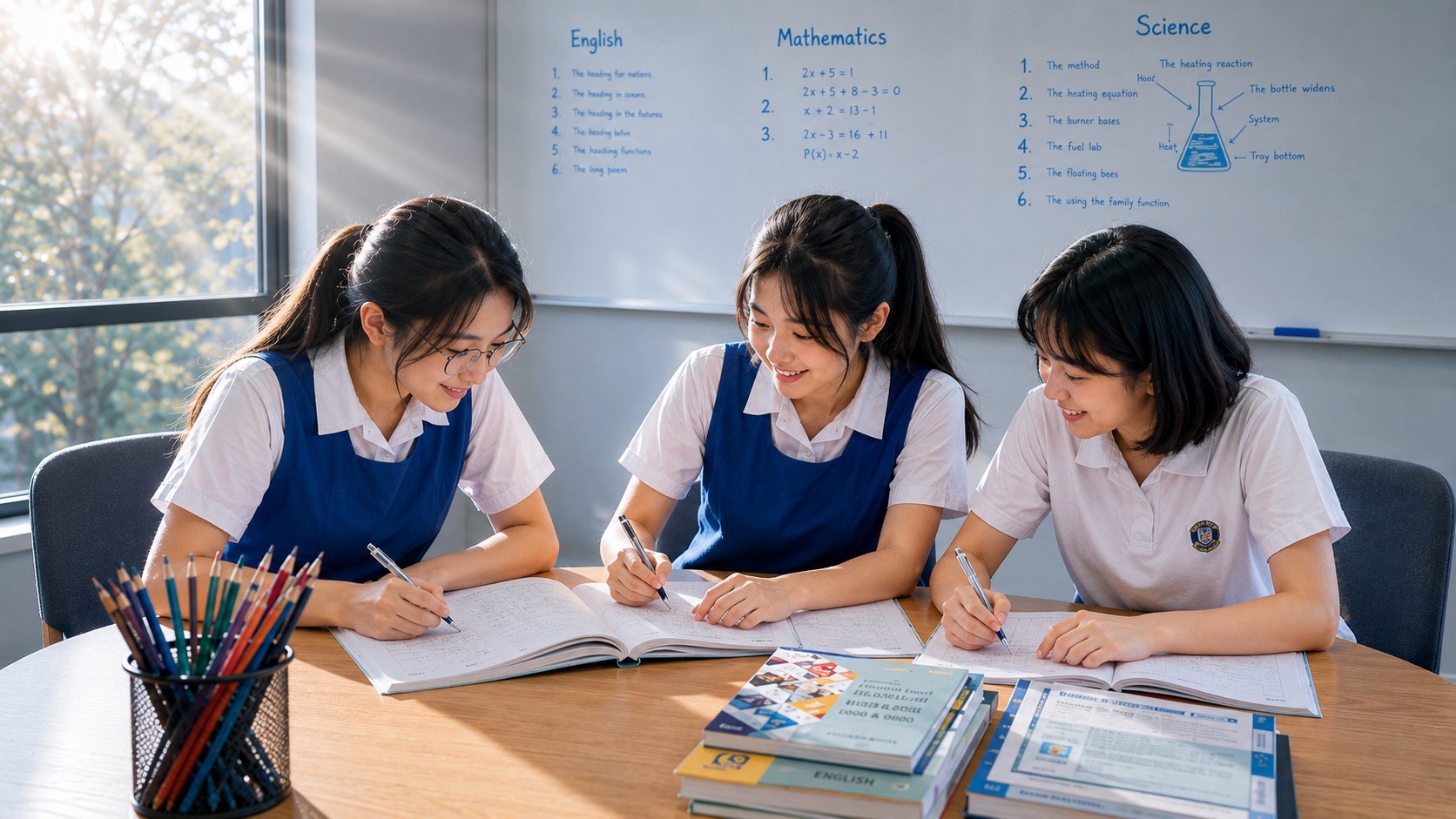
Secondary 1 G2 students meet sporting language in stories, school announcements, interviews and conversations about teamwork. This guide teaches 100 English words for sports and cooperation, including player, formation, fairness, resilience and participation. Every word has a clear meaning and an original example. The aim is to help a student explain an action, describe a game accurately and understand why a team’s conduct matters as well as its result.
Parents can teach this vocabulary with a fictional match report or a classroom discussion; no student needs to perform a physical exercise to understand the words. A win, a loss and an improvement are different ideas, and an accessible activity is one designed with particular participants in mind. This is an original eduKate teaching selection, not an official compulsory SEAB vocabulary list, a sports training prescription or a prediction of a future examination theme.
- Study exactly 100 distinct words in ten groups covering team roles, movements, rules, tactics, results and cooperation.
- Distinguish technique from strategy, score from conduct, and fairness from simply treating everyone identically.
- Read an original fictional team story and check eight questions with detailed reasons.
- Practise clearer match reports, responsible feedback and respectful group discussions.
- Use the four-week study plan and official MOE and Sport Singapore sources for educational context, not as individual training instructions.
Where this vocabulary fits in school English
The MOE Physical Education syllabus provides a useful context for basic movement, participation and lifelong engagement with sport. School co-curricular activities can also develop teamwork and social-emotional competencies. This English guide uses sport as a subject for reading, writing and discussion; it does not prescribe training loads, medical recovery or equipment rules for a particular activity.
Sport Singapore identifies teamwork and care for people among its core values. Its inclusive sport work shows that meaningful participation may involve adapted activities for different needs. A vocabulary exercise can discuss these ideas without assuming that every pupil wants to compete or that one format is suitable for everyone.
The later 2027 SEC G2 English Language syllabus K200 covers communication and vocabulary appropriate to audience and purpose. It does not mandate these 100 words or any particular sports topic for Secondary 1 examinations. Follow the student’s current schoolwork and the teacher’s instructions.
1. People and roles in sport
Different people can contribute to a sporting event. A coach guides practice, a referee applies rules in a particular setting and a spectator watches. A captain may organise teammates without doing every task alone.
| No. | Word | Plain meaning | Original example sentence |
|---|---|---|---|
| 1 | sport | An organised physical activity or game involving skill, rules or competition. | The article described sport as a setting for practising English about cooperation. |
| 2 | team | A group of people working or competing together. | The team discussed a shared plan before the fictional match. |
| 3 | teammate | Someone who belongs to the same team as another person. | Lina encouraged a teammate who had missed an earlier pass. |
| 4 | captain | The team member appointed to lead or represent teammates in a setting. | The captain checked that everyone had heard the revised instructions. |
| 5 | coach | A person who guides training or sporting performance. | The coach explained the purpose of the practice before the activity began. |
| 6 | player | A person taking part in a game or sport. | Each player listened for the signal that the round had started. |
| 7 | referee | An official who applies rules and makes decisions during a game. | The referee stopped play after observing a possible rule breach. |
| 8 | opponent | A person or team competing against another. | The opponent congratulated the winners after the final whistle. |
| 9 | spectator | Someone who watches an event without taking part as a player. | The spectator described the action without interrupting the match. |
| 10 | squad | A group of players selected or available for a team. | The school squad included players with different strengths and roles. |
Try this: Read a fictional match report and underline each role. Ask which actions actually support the role named. Do not assume that the team captain is always the best scorer or that the coach plays in the match.
2. Practice and physical skills
A warm-up and a drill are not the same thing: the first prepares for an activity, while the second provides focused repetition of a skill. Stamina concerns continued effort; coordination concerns organised movements.
| No. | Word | Plain meaning | Original example sentence |
|---|---|---|---|
| 11 | warmup | A preparatory activity done before more demanding movement. | The notice described the warmup before the supervised training session. |
| 12 | practice | Repeated activity intended to improve an ability. | The team used practice to become more accurate with passing. |
| 13 | drill | A structured exercise repeated to develop a particular skill. | The drill focused on receiving the ball and finding a teammate. |
| 14 | technique | A particular method of carrying out an action skillfully. | The coach described a technique for controlling the ball. |
| 15 | skill | An ability developed through learning or experience. | Listening for instructions was a skill as important as the movement itself. |
| 16 | coordination | The organised control of different movements. | The activity required coordination between watching and catching. |
| 17 | agility | The ability to change body position or direction efficiently. | The fictional report praised agility without ranking classmates’ bodies. |
| 18 | stamina | The ability to keep performing an activity over time. | The coach discussed stamina as one possible training goal. |
| 19 | endurance | The capacity to continue despite sustained effort or demand. | Endurance was relevant to the long event described in the passage. |
| 20 | recovery | The process of returning towards an earlier condition after activity or difficulty. | The text mentioned recovery without specifying an individual medical plan. |
Try this: Use written descriptions or pictures rather than prescribing exercises. Let the learner identify the technique being discussed and the evidence for improvement. The words do not establish how much activity an individual child should perform.
3. Verbs for movement and play
Movement words identify what happened. ‘Pass’ describes sending an object to a teammate; ‘receive’ describes taking it. ‘Defend’ and ‘attack’ describe roles in a game, not personal hostility.
| No. | Word | Plain meaning | Original example sentence |
|---|---|---|---|
| 21 | sprint | Run or move at very high speed over a short distance. | In the fictional race, Nia began a sprint near the finish line. |
| 22 | pace | The speed at which someone moves or works. | The runner changed pace after the first section of the course. |
| 23 | stride | A long step taken while walking or running. | The writer described a confident stride rather than guessing how the runner felt. |
| 24 | jump | Push off the ground to move through the air briefly. | The athlete planned the jump under the teacher’s supervision. |
| 25 | pivot | Turn around a fixed point or supporting foot. | The player used a pivot to face a different direction before passing. |
| 26 | balance | Keep a stable position or suitable distribution of weight. | Balance mattered as the performer changed direction. |
| 27 | pass | Send a ball or object to another player during a game. | Kai made a pass to the teammate standing near the side. |
| 28 | receive | Take in or accept something sent or given. | Farah moved to receive the pass before the defenders arrived. |
| 29 | defend | Protect a position or prevent an opponent from scoring. | The team had to defend its goal after losing possession. |
| 30 | attack | Move towards an objective or try to score against opponents. | The players chose to attack through the middle after the restart. |
Try this: Use a fictional diagram to show a sequence of actions. Ask the pupil to write who acted, what moved and where. Avoid using a word such as sprint when the story says only that the person walked quickly.
4. Rules and fair play
A foul is a breach within particular game rules; the exact rule differs across sports. Fairness also concerns how people are treated, especially when their needs differ.
| No. | Word | Plain meaning | Original example sentence |
|---|---|---|---|
| 31 | rule | An agreed instruction that governs how a game is played. | The teacher explained the rule before the practice game began. |
| 32 | boundary | A line or limit marking the edge of a playing area. | The ball crossed the boundary shown in the fictional diagram. |
| 33 | foul | An action that breaks a particular game’s rules. | The referee described the foul according to the rules of the invented game. |
| 34 | penalty | A consequence imposed for a rule breach. | The penalty in the story was explained before the match. |
| 35 | whistle | A small device or its sound used to signal an action. | The whistle signalled that the round had ended. |
| 36 | restart | Begin again after play has been stopped. | The players waited for the restart instruction instead of moving early. |
| 37 | fairness | Reasonable and just treatment according to the relevant circumstances. | The pupils discussed fairness when the rules affected participants differently. |
| 38 | eligibility | Meeting the requirements to participate in a particular activity. | The organiser checked eligibility using the stated conditions. |
| 39 | equipment | Tools or objects used for an activity. | The notice listed the equipment supplied by the school. |
| 40 | safety | Protection from avoidable harm or danger. | Safety procedures were set by the responsible adults, not by the vocabulary worksheet. |
Try this: Give students a clearly fictional rule sheet. Ask whether the passage says a foul occurred or only that the referee investigated one. Avoid importing a rule from another sport or inventing a penalty not stated in the text.
5. Strategy and on-field decisions
A strategy is a broader plan; a tactic is a specific action supporting it. Communication can change a team’s actions without changing its aim. These words also work in stories about school clubs and group projects.
| No. | Word | Plain meaning | Original example sentence |
|---|---|---|---|
| 41 | strategy | An overall plan for achieving a goal. | The captain explained the team’s strategy in two clear sentences. |
| 42 | tactic | A particular method used to carry out a broader plan. | The passing tactic helped the players keep possession. |
| 43 | formation | The arrangement of players in relation to one another. | The formation changed when two players swapped positions. |
| 44 | position | A place or role occupied in a playing area. | Each player confirmed their position before the restart. |
| 45 | communicate | Share information or signals so others can understand. | The team tried to communicate clearly during the noisy match. |
| 46 | signal | A sound, action or mark used to convey information. | The captain gave a signal that the players had agreed on in practice. |
| 47 | anticipate | Expect what may happen and prepare to respond. | The defender tried to anticipate the direction of the next pass. |
| 48 | adapt | Change an action or plan to meet new conditions. | The team chose to adapt its plan when the original route was blocked. |
| 49 | decision | A choice made after considering possibilities. | The player explained her decision to pass rather than attempt a shot. |
| 50 | execute | Carry out a planned action or instruction. | The group managed to execute the agreed sequence under the game rules. |
Try this: Ask the learner to describe a fictional team’s plan and one adjustment after a change. Keep the explanation linked to the stated circumstances. A result alone does not tell readers which tactic caused it.
6. Cooperation and leadership
Being part of a team does not mean all members have identical roles or confidence levels. A responsible leader listens, shares tasks appropriately and allows others to contribute.
| No. | Word | Plain meaning | Original example sentence |
|---|---|---|---|
| 51 | cooperate | Work together in a helpful way towards a purpose. | The players cooperated to move the equipment before the event. |
| 52 | collaborate | Work jointly on a shared task or goal. | The group collaborated on a plan that used everyone’s strengths. |
| 53 | support | Provide help or encouragement. | A teammate offered support after a difficult practice. |
| 54 | encourage | Give someone confidence or motivation to continue. | The captain encouraged the newcomer to ask about unfamiliar rules. |
| 55 | respect | Show consideration for other people and their rights or wishes. | The team showed respect by listening when an opponent raised a concern. |
| 56 | trust | Confidence that someone or something is dependable in a particular way. | Trust grew as teammates followed through on their agreed roles. |
| 57 | responsibility | A duty to complete a task or act with care. | Each player accepted responsibility for checking the assigned equipment. |
| 58 | share | Give others a part or allow joint use. | The team agreed to share opportunities to practise the final pass. |
| 59 | inclusion | The act or state of enabling different people to take part. | Inclusion mattered when the group chose a suitable form of participation. |
| 60 | leadership | Guiding or organising others towards a shared purpose. | Leadership involved listening and making the plan understandable. |
Try this: Write a short description of a captain who asks for suggestions instead of giving every instruction alone. Identify one behaviour showing cooperation and another showing respect. A good explanation is specific enough to observe.
7. Competition and results
A score reports points under particular rules. A result tells what happened in the match. Neither alone shows the quality of effort, the ethics of conduct or every player’s progress.
| No. | Word | Plain meaning | Original example sentence |
|---|---|---|---|
| 61 | match | An organised contest between players or teams. | The fictional match finished after two rounds. |
| 62 | tournament | A series of contests organised to identify participants’ results or rankings. | The tournament brought several school teams together for the event. |
| 63 | fixture | A match or event scheduled as part of a competition. | The fixture list showed the teams and their planned meeting times. |
| 64 | round | A stage or section of a contest or competition. | The second round began after the referee’s signal. |
| 65 | score | The points recorded in a game or contest. | The score was close, but the report still needed to explain how the team played. |
| 66 | result | The outcome of an event or contest. | The result named the winner without describing every important moment. |
| 67 | tie | A contest outcome in which the sides have equal scores. | The friendly match ended in a tie after the last round. |
| 68 | victory | Success in winning a contest. | The team celebrated the victory and thanked its opponents. |
| 69 | defeat | The outcome of losing a contest. | The defeat prompted a review of the group’s communication during play. |
| 70 | margin | The difference between two totals, such as scores. | The narrow margin meant the winners finished only one point ahead. |
Try this: Give the student an invented scoreboard and short report. Ask which claims the score supports and which require further details. Do not infer that a losing team showed no teamwork.
8. Feedback and improvement
A coach’s feedback can identify a precise action: ‘You passed before looking up.’ That is more useful than labelling someone untalented. A single contest can show a skill problem without predicting someone’s long-term ability.
| No. | Word | Plain meaning | Original example sentence |
|---|---|---|---|
| 71 | observe | Notice something carefully through attention. | The coach observed how the group responded to the opening signal. |
| 72 | assess | Judge performance by considering relevant evidence or standards. | The teacher assessed the clarity of the written match report, not the pupils’ fitness. |
| 73 | feedback | Information about performance that can guide a next step. | The feedback identified a late pass and explained what to check next time. |
| 74 | evidence | Details that support or challenge an explanation. | Two repeated errors supplied evidence that the timing needed further practice. |
| 75 | strength | An ability or feature that contributes positively to a task. | The team’s strength was its clear communication during the final round. |
| 76 | weakness | An area where performance or skill is less effective. | The review named a weakness in coordination during one specific sequence. |
| 77 | correction | A change that removes a particular error. | The correction moved the pass to an earlier point in the practice sequence. |
| 78 | improvement | A change that makes something better for a given purpose. | Improvement was visible when the next attempt followed the agreed timing. |
| 79 | progress | Movement towards a learning or performance goal. | The second practice showed progress even though the team later lost its match. |
| 80 | consistency | The quality of performing or behaving in a similar reliable way. | The group aimed for greater consistency in its communication during practice. |
Try this: Write a repair note with an observation, a suggested correction and a fresh test. Use evidence from the fictional report and avoid treating all mistakes as proof of poor effort.
9. Emotions, persistence and sportsmanship
Winning can be satisfying and losing disappointing. These responses are ordinary; the important language skill is to describe them without making global judgements about a person’s worth. Sportsmanship concerns respectful conduct in sport regardless of the result.
| No. | Word | Plain meaning | Original example sentence |
|---|---|---|---|
| 81 | effort | The work or energy put into an activity. | The report acknowledged the players’ effort without claiming that effort guaranteed victory. |
| 82 | persistence | Continuing to try despite difficulty. | Persistence helped the group attempt the new passing sequence again. |
| 83 | resilience | The capacity to respond and recover after difficulty. | The story showed resilience when the team reviewed the loss and returned to practice. |
| 84 | frustration | The feeling of being upset by difficulty or a blocked goal. | The captain expressed frustration but did not blame an individual teammate. |
| 85 | composure | Calm control of feelings and behaviour under pressure. | She kept her composure while the referee explained the decision. |
| 86 | confidence | Trust in an ability or possibility. | Practice increased his confidence to ask questions about the rules. |
| 87 | disappointment | Sadness because a hoped-for outcome did not occur. | The players felt disappointment after a narrow defeat. |
| 88 | satisfaction | Pleasure from achieving something or making progress. | The group felt satisfaction when its final drill became more accurate. |
| 89 | patience | The ability to wait or cope with difficulty calmly. | The coach showed patience while explaining the new method. |
| 90 | sportsmanship | Fair, respectful and responsible conduct towards others in sport. | The players demonstrated sportsmanship by thanking their opponents. |
Try this: Rewrite ‘They lost because they were weak people’ into a specific account of what the report actually shows. A learner should be able to name a changeable skill and an appropriate next practice.
10. Participation and different needs
The same activity format does not suit every person. Access is the opportunity to participate; accessible describes a particular arrangement that can be used by people with relevant needs. A modification may help, but should be chosen by responsible organisers rather than invented by learners.
| No. | Word | Plain meaning | Original example sentence |
|---|---|---|---|
| 91 | participation | Taking part in an activity in an appropriate way. | Participation included assisting with the event and playing in a suitable role. |
| 92 | access | The opportunity or ability to enter, use or take part in something. | The organisers discussed access before deciding how the group could participate. |
| 93 | accessible | Designed or arranged so people with relevant needs can use it. | An accessible activity should match the actual participants’ needs. |
| 94 | suitable | Appropriate for the person, purpose and circumstances. | The coach checked which format was suitable for the group. |
| 95 | alternative | A different option that may meet the same purpose. | An alternative role allowed the pupil to contribute while the plan was reviewed. |
| 96 | modify | Change a feature of something to suit a purpose. | The organiser chose to modify the practice activity after consulting the participants. |
| 97 | accommodation | An adjustment made to meet a particular need. | The event included an accommodation agreed with the appropriate adults. |
| 98 | rest | Time away from physical or mental effort. | The timetable allowed rest between supervised sessions. |
| 99 | hydration | Having or supplying enough suitable fluids for the situation. | The notice mentioned hydration without setting individual medical intake instructions. |
| 100 | enjoyment | Pleasure gained from an activity. | The pupils described enjoyment as one meaningful reason to participate. |
Try this: Discuss a fictional club that provides two ways to contribute, such as keeping a score record or taking part in an adapted activity. Explain why participation does not have to look identical for everyone, and avoid promising that any single adaptation fits all.
The match report that missed the team
This story is fictional and uses an invented school game. A Secondary 1 team had lost a friendly match by one point. Ryan wrote the report for the class newsletter. His first sentence announced, ‘Our team was a failure because we lost.’ He listed the score, but said nothing about the group’s cooperation, rules or decisions during play.
Aisha had watched the game from the side as a pupil reporter. She remembered that Clara, the captain, had asked the players to change formation after an early mistake. The team’s later passes were more accurate, although the opponents still won. Aisha suggested that Ryan describe the specific sequence rather than using failure as a judgement about every person.
Their teacher, Mr Lim, asked the pupils to distinguish a result from an evaluation of performance. The result was clear: the team had lost by one point. The wider claim that everyone had failed was not supported by the score. The pupils could still identify a weakness in timing and a strength in communication, using examples from the game.
During the discussion, Ethan, who had kept the score, explained that some classmates had contributed as reporters, organisers and equipment helpers. They were not part of the on-field squad but had supported the event. Clara suggested that the next practice include a short drill to improve the timing of passes. The coach would decide the suitable activity and safety arrangements.
Ryan revised the article: ‘Our team lost the friendly match by one point. We improved our passing after a change in formation, but our timing remained uneven. The team will review that skill during supervised practice. We also thank the organisers and opponents for their contributions.’ Mr Lim pointed out that the new paragraph was more informative. It neither denied the defeat nor turned it into a label for the players.
In his reflection, Ryan wrote that sportsmanship includes explaining an event fairly. A score tells readers who won; a careful report helps them understand what happened and what might be practised next. His revised article did both.
Comprehension practice and fully explained answers
- What result did the team achieve? It lost the friendly match by one point. The story supplies the margin but no complete score.
- Why was Ryan’s first sentence unsupported? It treated a match result as proof that every person and part of the team had failed. The score alone cannot support that claim.
- What specific improvement did Aisha observe? The passing became more accurate after a change in formation, although the team still lost.
- What weakness was identified? Timing remained uneven. This is a specific performance issue that could be discussed in practice.
- Who contributed without playing on the field? The pupil reporter, scorekeeper, organisers and equipment helpers all supported the event.
- Who should decide the actual next drill and safety arrangements? The responsible coach or adults, using the participants’ circumstances—not a vocabulary exercise.
- Why is the revised report fairer? It states the defeat accurately while adding supported observations about strengths, areas for improvement and other contributions.
- What is sportsmanship in the story? It includes respectful conduct towards opponents and an accurate, non-insulting account of the match.
- Does losing prevent improvement? No. The passage describes more accurate passing within the match despite the final defeat. Those are different outcomes.
Do not invent the numerical score. The passage states only that the margin was one point. An answer such as 10–9 or 21–20 adds information the writer did not provide.
Writing and speaking: apply the words
Workshop 1 — Write an accurate match report
Give pupils this fictional information: a team lost a short practice game; its passing improved after halftime; the coach noted a repeated timing error; the organiser thanked both sides. Write a short report for a class newsletter. Begin with the result, explain two supported observations and finish with an appropriate next step. Do not invent an injury, a precise score or a reason the opposing team won.
A sample opening is: ‘Our class team lost a friendly game, but the players adjusted their formation and completed more passes in the second half. The coach identified timing as a useful focus for the next supervised practice.’ The sentence does not claim that improvement guaranteed a win or that every individual performed identically.
Workshop 2 — Give feedback without a personal label
Compare ‘You are hopeless at this game’ with ‘During the second round, the pass reached your teammate too late for the planned sequence.’ The second statement identifies an observable moment. Ask the student to propose a suitable follow-up question, such as ‘Can we review the timing together?’ The coach remains responsible for choosing an actual training method.
Now revise three broad comments: ‘They never work together’; ‘The captain always makes mistakes’; and ‘Winning proves we did everything correctly.’ Replace absolute claims with what the invented report supports. Use qualifiers when the evidence covers only one event. Feedback becomes useful when it points to something that can be understood and checked.
Workshop 3 — Discuss inclusion and different roles
Give three pupils fictional roles: event organiser, team captain and spectator. Ask how each can contribute to a safe, respectful event. The organiser describes the stated arrangements; the captain identifies a shared plan; the spectator writes a neutral report. Rotate the roles so each pupil practises different terms.
After the group activity, show a fresh school-club notice about alternative roles and ask each pupil to explain what participation means for the fictional characters. The lesson should not make assumptions about real classmates’ bodies, medical needs or disabilities.
Four-week learning plan
Use current schoolwork to choose the first set. These are suggested activities, not an official examination plan or a requirement to master all 100 words in one month.
Week 1: Learn roles and actions
Choose words 1–30 most relevant to a short school passage. Name who does what and put three actions into sequence. Use coach, captain, pass and receive in natural sentences. Check which details are visible or stated rather than guessing about a player’s feelings.
Give a new fictional scene and ask for a description without looking at the word table. If the learner still confuses role and action, use two contrasted examples before adding more words.
Week 2: Understand rules and reasons
Read an invented rule sheet and identify which action counts as a foul, what the referee may do and when play restarts. The exercise must supply all needed game rules, because different sports use different arrangements. Practise fairness, safety, eligibility and responsibility in short answers.
Ask the learner to explain why a word is relevant. ‘The ball crossed the boundary’ is a description; ‘The referee restarted play because the stated rule required it’ gives a reason.
Week 3: Read beyond the score
Use the original story about the team. Identify the result, the improvement, the remaining weakness and the contributors who did not play on the field. Practise evidence, margin, sportsmanship and feedback. Rewrite the initial exaggerated sentence using only supplied information.
In a three-pupil discussion, rotate reporter, evidence checker and editor. End with individual paragraphs about a new fictional game so that one student’s fluent explanation does not hide another’s misunderstanding.
Week 4: Explain cooperation in a new context
Use a fictional school club planning an event, not necessarily a sport. Ask the learner to identify a strategy, a specific tactic, a role and an inclusive choice. This transfer exercise shows whether the words can describe teamwork beyond a match report.
Review the first week’s writing. If the student now connects actions and reasons accurately, extend the paragraph. If the word meaning is clear but sentence construction remains awkward, practise grammar. If the sentence is fluent but unsupported, return to evidence and the limits of a claim.
Parent guidance and small-group learning
Sports vocabulary can be practised without measuring a child’s fitness or making them compete. Use an invented scoreboard, a short report, a diagram or a school notice. Ask what happened, what the score proves and what the passage does not say. One correctly supported explanation is more useful than a paragraph full of impressive but unrelated terms.
Sport Singapore and MOE provide educational context for teamwork, fair play, inclusion and participation. These values do not imply that every child should follow the same physical activity plan. Actual training, adaptations, recovery and safety decisions belong to the responsible teachers, coaches, parents and appropriate professionals.
For a small group of up to three pupils, give one person the task of identifying actions, another of finding evidence and the third of revising a broad claim. Rotate and then ask for individual answers. A pupil who knows ‘resilience’ as a definition but cannot identify a supported example needs a new passage, not a demand to learn ten more words.
The eduKate learning process is to establish the starting point, explain a useful distinction, practise through a model, check on a fresh task and correct the next error. A child might need vocabulary, sentence structure, reasoning or reading accuracy; the teacher should address the difficulty the work actually shows.
Common questions
Is this a sports-training programme?
No. This is an English vocabulary guide. Do not treat definitions of movement, hydration or recovery as instructions for an individual child.
Does a losing score mean poor teamwork?
Not necessarily. A score gives the contest outcome. Teamwork must be assessed from actions and evidence, not inferred from the result alone.
Can non-players contribute?
Yes. Organising, reporting, recording scores and assisting responsibly are examples of roles a fictional school event may include.
Are these 100 words required by SEAB?
No. They are a practical teaching selection. Current school instructions and the later examination-year syllabus determine assessed requirements.
Official sources and further learning
The references below were checked on 17 November 2026. They establish educational context, not an official government list of these 100 words. Individual school tasks and later national examinations must follow the applicable requirements.
- SEAB: 2027 G2 English Language Syllabus K200 — A later national examination reference for appropriate language use, not a compulsory Secondary 1 word list
- MOE: 2024 Physical Education Syllabus — Context for movement skills, participation and holistic development
- Sport Singapore: Purpose and Core Values — Identifies teamwork and care for people among its core values
- Sport Singapore: Play Inclusive — Explains meaningful inclusive participation through sport
- Sport Singapore: Disability Sports Master Plan — Describes improving access and opportunities for varied abilities
- SEAB: 2027 G2 Syllabuses — Confirms K200 as the later G2 English Language syllabus
Continue with eduKate
Secondary 1 G2 English Vocabulary · eduKate Vocabulary Learning System · eduKate Vocabulary Hub