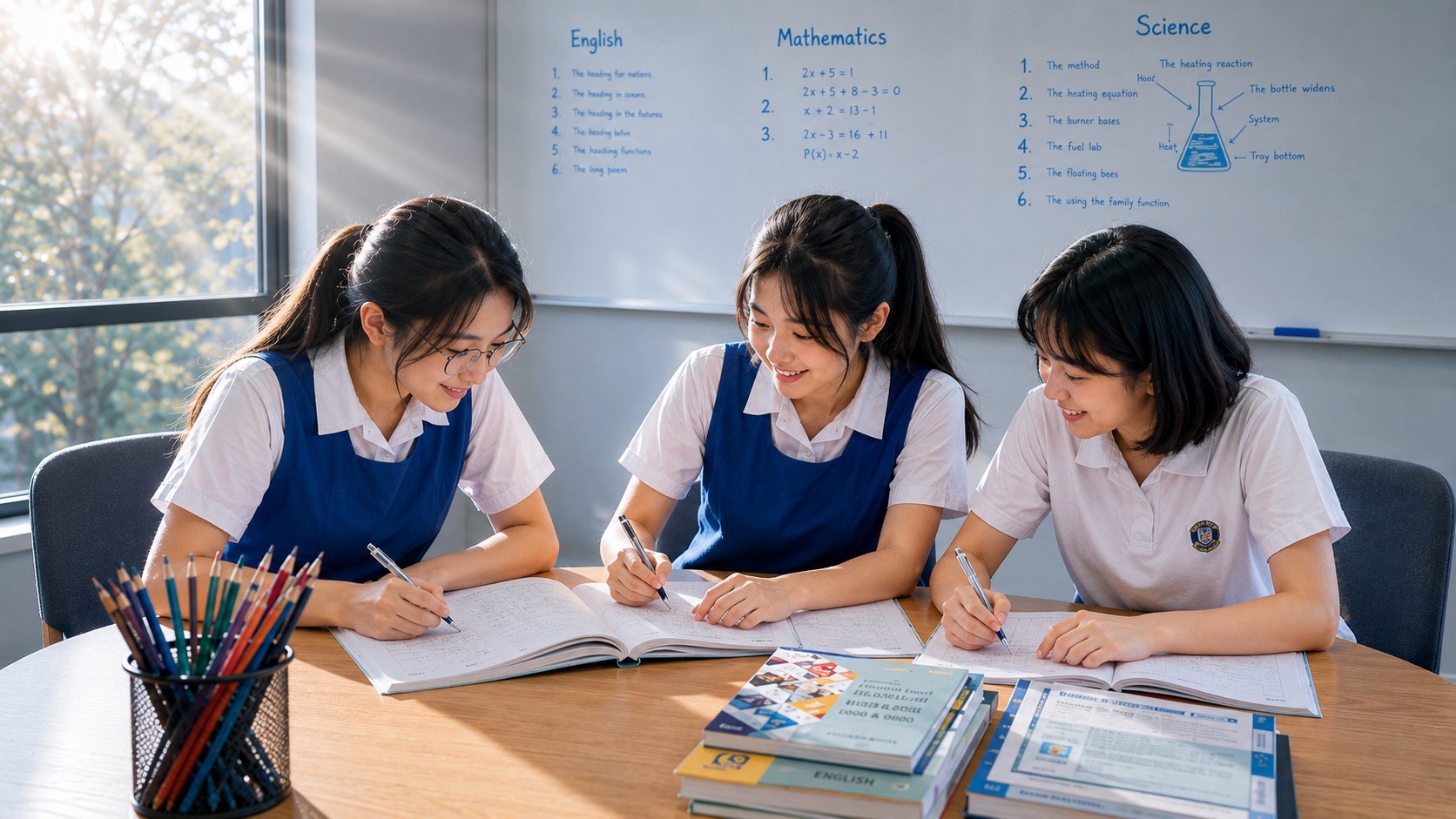
Secondary 1 G2 students meet headlines, messages, posters, videos and short reports in many ordinary situations. To understand them, they need English words for who made a claim, what was actually said and how information can be checked. This guide teaches 100 words for news and information literacy, with clear meanings and original example sentences. It helps students read a message without treating the largest headline as the whole story.
Parents and teachers can use these examples for comprehension, discussion and situational writing. A convincing tone or a widely shared message does not by itself establish the truth. This article follows the practical spirit of the National Library Board’s S.U.R.E. approach—Source, Understand, Research and Evaluate—while using new examples and exercises written for this resource. It is not an official SEAB list, an examination-theme forecast or permission for children to investigate strangers online.
- Learn exactly 100 distinct words across ten groups about reports, claims, sources, framing, verification and sharing.
- Use the difference between fact, opinion, estimate and prediction in original school-style passages.
- Practise checking a fictional screenshot without visiting suspicious links or contacting unknown accounts.
- Read the original story, answer eight explained questions and complete writing and discussion tasks.
- Use NLB and government media-literacy sources as context while following school instructions for current assessment.
Scope: English at Secondary 1 G2
The 2027 SEC G2 English Language syllabus K200 is a later examination reference, not a compulsory list of Secondary 1 media terms. At this stage, the useful target is to read, view, speak and write accurately for the task at hand. A student’s teacher decides the current school exercise.
The National Library Board’s S.U.R.E. programme organises information checking around Source, Understand, Research and Evaluate. Government guidance likewise urges readers to examine origins, meaning and supporting evidence before forwarding a claim. This article applies those ideas to fictional texts; it does not reproduce government teaching materials or imply that a learner can certify every online statement.
Use invented messages in class. Do not ask children to open unknown links, answer suspicious senders, expose account details, hunt down private individuals or share a classmate’s image in the name of fact-checking. Responsible information literacy includes knowing when to stop and ask a trusted adult or teacher.
1. How news is presented
A news article may contain a headline, a body and an update. Distinguish the whole report from its title. A journalist reports; an editor may select or revise material; a publisher makes it available. These roles can overlap, but the words identify different functions.
| No. | Word | Clear meaning | Original example |
|---|---|---|---|
| 1 | news | Information about recent events or developments. | The class discussed a news story only after reading more than its headline. |
| 2 | article | A piece of writing published in a paper, magazine or online. | The article explained its main claim and identified the information it used. |
| 3 | headline | The short title placed above a news item. | The headline sounded certain, but the report itself described an estimate. |
| 4 | report | A written or spoken account of events or findings. | The report separated what witnesses saw from what officials had confirmed. |
| 5 | journalist | A person who gathers and presents news for an audience. | The journalist asked several sources for information about the changed schedule. |
| 6 | editor | A person who prepares or oversees material for publication. | The editor revised a sentence that exaggerated what the evidence showed. |
| 7 | publisher | A person or organisation that makes material available to readers. | The publisher’s name was different from the account that reposted the story. |
| 8 | audience | The people a message or publication is meant to reach. | The audience included new students who did not know the older arrangements. |
| 9 | update | New information that changes or adds to an earlier account. | A later update corrected the location stated in the original notice. |
| 10 | bulletin | A short official or organised news announcement. | The school bulletin gave the date and place of the activity. |
Use these words: For practice, give students an invented headline and the first paragraph of a longer report. Ask which important condition the headline leaves out. A good summary should preserve who, what and when without turning the headline into a stronger claim than the actual text.
2. Finding where information came from
An account that shares a message may not be its origin. A photograph can be genuine yet attached to a false date. Words such as primary and secondary describe relationships to the event or record; they do not automatically mean good and bad.
| No. | Word | Clear meaning | Original example |
|---|---|---|---|
| 11 | source | A person, document or other origin from which information is obtained. | The student looked for the source of the timetable rather than trusting a cropped picture. |
| 12 | author | The person or group responsible for writing a text. | The author was named, but the pupil still checked whether the information was current. |
| 13 | origin | The point at which something began or came from. | The origin of the claim was unclear because the message had been forwarded repeatedly. |
| 14 | primary | Directly connected to an event or original record in the relevant context. | The original school notice was a primary source for the announced meeting point. |
| 15 | secondary | Based on analysis or explanation of other sources in the relevant context. | A secondary account summarised the notice but left out one condition. |
| 16 | witness | Someone who saw or experienced an event. | One witness described the queue, but could not speak for every part of the building. |
| 17 | record | Information kept for later reference. | The dated record helped the class establish which announcement came first. |
| 18 | citation | A reference identifying where particular information came from. | The citation let readers locate the original report and check its wording. |
| 19 | link | A connection to another document or online location. | The class used a teacher-approved link instead of clicking an unknown message. |
| 20 | context | The surrounding details needed to interpret a statement correctly. | Without context, the photograph appeared to show the event taking place today. |
Use these words: Draw a simple chain: original notice, photograph of the notice, forwarded message. Ask which item allows a reader to check the current details most directly. A citation tells readers where to look, but its presence alone does not prove that it supports the claim.
3. Statements, evidence and uncertainty
A claim may be correct, incorrect or not yet checked. Fact and opinion have different roles, and a number may be an estimate rather than an exact count. Reasonable readers can express uncertainty without abandoning the search for evidence.
| No. | Word | Clear meaning | Original example |
|---|---|---|---|
| 21 | claim | A statement presented as true or needing consideration. | The claim that the event was cancelled required confirmation from the organiser. |
| 22 | fact | Something true that can be established by suitable evidence. | The printed date was a fact about what the original notice stated. |
| 23 | opinion | A personal judgement, preference or viewpoint. | Calling the exhibition the most exciting event was an opinion. |
| 24 | evidence | Information that supports or challenges an account. | The updated notice supplied evidence for the new meeting place. |
| 25 | assertion | A statement made with confidence, sometimes without supporting detail. | The assertion sounded firm, but no source was named. |
| 26 | statistic | A numerical fact or summary drawn from data. | The statistic needed a stated period and group before it could be understood. |
| 27 | estimate | An approximate judgement when an exact figure is not known. | The announcement gave an estimate of expected attendance. |
| 28 | prediction | A statement about what someone thinks will happen in the future. | The prediction about rain did not prove that the outdoor event would be cancelled. |
| 29 | assumption | Something accepted without having been established in the situation. | It was an assumption that every student had received the same message. |
| 30 | inference | A conclusion reached from clues and reasoning. | She drew a limited inference from the wording rather than treating a guess as proof. |
Use these words: Give students a fictional notice that says ‘about fifty visitors are expected’. Ask whether fifty is an exact confirmed attendance count. A good answer points to ‘about’ and ‘expected’ instead of inventing a precise number.
4. Pictures, quotes and framing
A cropped photograph may remove a date, location or speaker. A genuine quotation can mislead if important words immediately before or after it are missing. Words such as framing and emphasis help students discuss presentation without assuming that every editing decision is dishonest.
| No. | Word | Clear meaning | Original example |
|---|---|---|---|
| 31 | quote | Repeat another person’s exact words and identify their source. | The student quoted the sentence exactly instead of changing its meaning. |
| 32 | paraphrase | Express another person’s idea in new words while preserving its meaning. | Her paraphrase kept the word temporary because it affected the conclusion. |
| 33 | caption | Short text identifying or explaining an image, table or video. | The caption included a date so readers would not mistake the old photograph for a current scene. |
| 34 | image | A picture or visual representation. | The image showed a queue but not why the visitors were waiting. |
| 35 | video | A recording of moving pictures, usually with sound. | The video clip began after the announcement had already started. |
| 36 | excerpt | A short part taken from a longer text or recording. | The excerpt left out the sentence explaining the exception. |
| 37 | omission | Something important that has been left out. | The omission of the word ‘some’ made the summary misleading. |
| 38 | emphasis | Special attention given to one part of a message. | The large font placed emphasis on the change of venue. |
| 39 | framing | The way information is selected and presented to shape understanding. | The framing encouraged readers to notice the problem before seeing the solution. |
| 40 | sensational | Designed to provoke strong excitement, alarm or interest. | The sensational title made an ordinary timetable update sound dramatic. |
Use these words: Compare two invented captions for the same picture. Ask which one claims more than the image can show. Use a neutral caption that names only the visible event, then add sourced context separately.
5. Checking and corroborating
Checking means more than reading the same claim on several accounts. Those accounts may all have copied the same source. Ask what was independently established and whether the evidence is relevant to the actual date and place.
| No. | Word | Clear meaning | Original example |
|---|---|---|---|
| 41 | verify | Check whether information is accurate with suitable evidence. | The pupil asked the teacher to verify the current meeting place. |
| 42 | corroborate | Supply further evidence supporting an existing claim. | A second independent notice helped corroborate the announced time. |
| 43 | compare | Examine things together to identify similarities or differences. | Compare the dates as well as the titles of the two notices. |
| 44 | crosscheck | Check a claim against other suitable information. | The class crosschecked the summary with the full original announcement. |
| 45 | credible | Believable because there are sound reasons to trust the account. | A credible explanation identifies the source and states its limits. |
| 46 | reliable | Dependable for the purpose being considered. | The official event page was more reliable for its own current schedule than an old repost. |
| 47 | expertise | Special knowledge or skill gained through study or experience. | The speaker’s expertise was relevant to the topic but did not settle every other question. |
| 48 | official | Issued or authorised by the responsible organisation. | The class checked the official school communication channel. |
| 49 | timestamp | A record showing when a message or item was created or recorded. | The timestamp helped readers see that the screenshot was from an earlier week. |
| 50 | correction | A change made to put wrong information right. | The correction named the earlier error and supplied the revised detail. |
Use these words: For a fictional notice, find the official updated announcement and compare its details with the screenshot. If the original is unavailable, say so. Do not use a guess about how a page looks as a substitute for verification.
6. Misleading content and uncertainty
Different words describe different problems. False concerns truth; fabricated concerns something invented; satire can imitate news for humour. Students should not call a message a hoax merely because they dislike its opinion.
| No. | Word | Clear meaning | Original example |
|---|---|---|---|
| 51 | misleading | Likely to give readers an inaccurate impression. | The message was misleading because it described one closed entrance as a closed building. |
| 52 | false | Not true or not correct. | The false date was corrected on the organiser’s current notice. |
| 53 | fabricated | Invented or made up rather than genuinely recorded. | The fabricated quote did not appear in the real speaker’s statement. |
| 54 | manipulated | Changed or arranged in a way that can affect understanding. | The manipulated picture placed an unrelated sign beside the crowd. |
| 55 | satire | Humour that imitates or criticises people and events. | The satire used exaggerated language that was not meant as a factual report. |
| 56 | rumour | Information passed between people without reliable confirmation. | The rumour spread before anyone checked the school’s announcement. |
| 57 | hoax | A deliberate deception presented as genuine. | The invented article described a hoax, but the class had to justify that label. |
| 58 | clickbait | Content designed mainly to attract clicks using a tempting or dramatic title. | The clickbait headline withheld the simple answer supplied in the article. |
| 59 | impersonation | Pretending to be another person or organisation. | The example showed impersonation of a school account and asked pupils to alert an adult. |
| 60 | uncertainty | The state of not knowing enough to be sure. | The pupil explained the uncertainty instead of inventing a definite conclusion. |
Use these words: Use fictional examples in class. Identify exactly what is misleading before labelling the whole item. If an image is impossible to check, the responsible answer is that its authenticity remains unverified—not that it must be fake or must be true.
7. How information spreads
Being widely repeated is not the same as being checked. A recommendation from an algorithm may reflect predicted interest, not accuracy. A screenshot forwarded many times can preserve an outdated statement long after the original changes.
| No. | Word | Clear meaning | Original example |
|---|---|---|---|
| 61 | platform | A digital service where people publish or share material. | The same message appeared on more than one platform. |
| 62 | feed | A stream of posts or updates shown in an app or website. | The feed displayed the short headline without the article’s full explanation. |
| 63 | algorithm | A set of rules or steps that a system follows to process information. | The algorithm selected posts for the feed but did not certify their truth. |
| 64 | recommendation | A suggestion that a person or system offers. | The recommendation pointed to a video whose sources still needed checking. |
| 65 | share | Send or make information available to other people. | The student decided not to share the unverified screenshot. |
| 66 | repost | Publish or share someone else’s content again. | The repost copied the old caption even after an update had appeared. |
| 67 | forward | Send a received message onwards to someone else. | Before forwarding the notice, the parent checked the current school communication. |
| 68 | viral | Spread rapidly and widely between people online. | The viral claim was popular, but popularity was not evidence of accuracy. |
| 69 | amplification | The process of making a message reach more people or appear more prominent. | Repeated reposts caused amplification of the same unverified sentence. |
| 70 | engagement | Interaction with content, such as comments or clicks. | High engagement showed attention, not that the information was correct. |
Use these words: Create a fictional flow diagram with three reposts of one message. Ask whether those three posts count as three independent sources. Discuss which evidence would actually change the conclusion.
8. Purpose, persuasion and point of view
A media text can inform, entertain or persuade. An advertisement is not the same thing as an independent report, even when both use facts. A balanced reading recognises relevant perspectives without pretending that every claim has equal evidence.
| No. | Word | Clear meaning | Original example |
|---|---|---|---|
| 71 | bias | A tendency to favour a particular view in a way that affects judgement. | The group discussed possible bias without assuming every disagreement was dishonest. |
| 72 | perspective | A particular way of seeing or understanding a subject. | The interview offered one visitor’s perspective on the change. |
| 73 | viewpoint | An opinion or position from which an issue is considered. | The writer explained her viewpoint and the evidence that influenced it. |
| 74 | balanced | Considering relevant parts or perspectives fairly. | The balanced summary included both the announced change and its stated reason. |
| 75 | fair | Reasonable and impartial in the circumstances. | The reader tried to make a fair judgement from the available evidence. |
| 76 | relevance | A clear connection to the particular question or issue. | The old picture had little relevance to the current opening time. |
| 77 | purpose | The reason something is written, created or shared. | The purpose of the poster was to persuade people to register. |
| 78 | motive | A reason that may influence someone’s actions. | A possible motive should not be presented as a proven fact without evidence. |
| 79 | persuasion | Communication intended to influence beliefs or actions. | The advertisement used persuasion through bright images and a strong slogan. |
| 80 | advertisement | A message promoting a product, service, event or idea. | The advertisement named the benefits but did not discuss every limitation. |
Use these words: Ask the pupil to mark facts, promotional language and personal judgements in a fictional poster. Then write a response that preserves the source’s position while explaining what additional information would be needed.
9. Research words and careful conclusions
A search result points to information; it is not the information itself. An archive can help show how a page looked earlier, but the archived version may not describe current arrangements. A conclusion should follow the evidence and retain its limits.
| No. | Word | Clear meaning | Original example |
|---|---|---|---|
| 81 | search | Look for information using a question or search terms. | The student began to search for the organiser’s full announcement. |
| 82 | keyword | A word or phrase used to focus a search. | Adding the school event’s name made the keyword search more precise. |
| 83 | result | An item returned by a search or the outcome of an event. | The top result linked to an older page and required a date check. |
| 84 | archive | A collection of stored records or earlier versions. | The archive preserved a copy of the earlier notice for comparison. |
| 85 | reference | A named source used to support or locate information. | The reference allowed classmates to find the text used in the summary. |
| 86 | original | The first or authentic version, rather than a copy or imitation. | The original message included a condition missing from the screenshot. |
| 87 | alternative | Another possible choice or explanation. | The group considered an alternative interpretation before reaching a conclusion. |
| 88 | investigate | Examine a question systematically to find out more. | The class investigated the fictional mismatch by comparing two dates. |
| 89 | evaluate | Judge information by considering suitable evidence and criteria. | To evaluate the claim, the pupils checked its source and context. |
| 90 | conclusion | A judgement reached after considering information. | Their conclusion was limited: the screenshot did not show the current arrangement. |
Use these words: Give students a search-results page invented for the exercise. Select the result most likely to answer a precise question and explain why. Do not assume the first result is the most accurate.
10. What to do before sharing
A responsible reader can pause, ask for context and choose not to distribute a claim that has not been checked. Reporting a suspicious message through an appropriate channel is different from publicly accusing someone.
| No. | Word | Clear meaning | Original example |
|---|---|---|---|
| 91 | pause | Stop briefly before deciding what to do. | The pupil chose to pause before repeating the rumour. |
| 92 | question | Ask whether a statement is supported or what it means. | The group questioned the date because it differed from the current notice. |
| 93 | clarify | Make a detail or meaning easier to understand. | The teacher helped clarify what ‘postponed’ meant in the notice. |
| 94 | assess | Examine information to make a considered judgement. | The reader assessed the source before accepting the summary. |
| 95 | withhold | Keep something back rather than give or send it. | The pupil chose to withhold the screenshot until it could be checked. |
| 96 | reporting | Giving information about a concern to a suitable person or service. | Reporting a suspicious account to an adult was different from reposting its claims. |
| 97 | respect | Consideration for another person’s rights, wishes and dignity. | Respect meant not spreading an unverified claim about a classmate. |
| 98 | consent | Freely given agreement to a specific action. | The group sought consent before sharing anyone’s photograph. |
| 99 | privacy | Protection from unwanted disclosure or access to personal information. | Privacy was one reason to avoid including a pupil’s phone number in the class example. |
| 100 | responsibility | A duty to act carefully and consider consequences. | The writer explained the responsibility involved in sharing public information. |
Use these words: Practise a short polite response to a fictional forwarded screenshot: ‘I cannot confirm this from the image alone. Can we check the current notice together?’ Reward accurate restraint rather than speed. Do not invite pupils to contact unknown accounts or publish another person’s details.
Original reading: The screenshot without a date
This story is fictional. A Secondary 1 class was preparing for a visit to a public learning centre. The pupils knew the centre had several entrances. On Thursday evening, a screenshot circulated in a group chat. Its large headline said, ‘MAIN HALL CLOSED’. No date appeared in the cropped image, and a message underneath said that the trip must be cancelled.
Siti noticed that the screenshot showed the old name of an exhibition, which the class had discussed the previous term. She did not accuse the person who forwarded it of lying. Instead, she asked the group to check whether it was a current notice and whether the headline described the whole centre or only one part. Leon thought the message was probably true because so many people had shared it. Their teacher asked him whether ten forwards necessarily provided ten independent sources.
Using the organiser’s teacher-approved official page, the class found a current announcement. The main hall would be closed for maintenance on Saturday, but the reading gallery would remain open. The pupils’ Friday visit had a different destination within the same centre. The current page did not tell them everything about access, so the teacher confirmed the arrangements directly with the organiser.
The class rewrote its message: ‘A screenshot about a hall closure is circulating, but it does not show a date. The current official notice concerns the main hall on Saturday. Our teacher is confirming Friday’s gallery visit. Please do not forward the screenshot as proof that the trip has been cancelled.’ The new wording separated what was established from what was still being checked.
Leon learnt that repeated posts can come from one original source. Siti learnt that an old screenshot could be genuine yet misleading when stripped of its date and context. Nobody needed to identify the first person who forwarded the message or inspect private classmates’ accounts. The important result was a clearer question and a more accurate response.
Comprehension questions and explained answers
- What detail was missing from the screenshot? Its date was not visible. Without it, the pupils could not assume the screenshot described current arrangements.
- Why did Leon’s argument about many forwards fail? Many forwards may all trace back to one message. They are not independent corroboration.
- Was the screenshot necessarily fabricated? No. It could have copied a genuine older notice. The story establishes that its crop and context were insufficient, not that the image was invented.
- Which place did the current notice affect? It concerned the main hall on Saturday. The reading gallery was described separately.
- Why did the teacher still contact the organiser? The current page did not give every access detail needed for the Friday outing.
- What did the class’s revised message avoid claiming? It did not state that the trip was cancelled or that all areas were closed. It explained what remained unconfirmed.
- What is the difference between source and account that forwarded a message? The source is where the information originated. The forwarding account may only be repeating it.
- Why did the group avoid investigating private accounts? It was unnecessary and inappropriate for checking the event details. An official source and responsible adult could address the real question.
An effective comprehension answer keeps the time, place and source together. ‘The hall closed’ is incomplete when the passage says the closure was scheduled for a particular day. The distinction between a future plan and a completed event also matters.
Writing, speaking and vocabulary in context
Workshop 1 — Fact, opinion, estimate and prediction
Write four fictional sentences about a school fair: ‘The notice gives Friday as the event date’; ‘The fair will be the most enjoyable activity this term’; ‘About 150 visitors are expected’; ‘The organisers think more people will arrive next year’. Ask pupils to identify a stated notice fact, a value judgement, an estimate and a prediction. Explain that a sentence can change category when its context changes.
Next ask which evidence could help check each statement. A date requires the current organiser’s notice. A personal opinion may be explained but does not become a universal fact through repetition. An estimate needs a basis and cannot be silently reported as an exact attendance count.
Workshop 2 — Improve an overconfident notice
Fictional draft: ‘Every event has been cancelled because the venue is dangerous.’ Supporting information: ‘The east gallery is closed for repairs on Tuesday; the west gallery remains open.’ The first draft makes several unsupported leaps. Pupils should rewrite it so it names only the affected space, date and stated reason.
Possible revision: ‘The east gallery is closed for repairs on Tuesday. The west gallery remains open. Visitors should check the organiser’s current access information before attending.’ This is stronger not because it sounds dramatic, but because it can be checked. Discuss what a writer should do when a crucial detail is missing rather than filling the gap.
Workshop 3 — A calm spoken response to a rumour
In groups of three, one pupil reads a fictional forwarded claim, one identifies its source and date, and one explains what can and cannot be concluded. Rotate roles; then provide a new individual example. Nobody should forward suspicious real content to complete the lesson.
Use a two-sentence response: ‘I cannot confirm this from the screenshot alone. Let’s check the current announcement with the teacher or organiser.’ The phrasing neither humiliates the sender nor endorses the unverified claim. A student who can independently use clarify, verify and evidence has developed a transferable reading habit.
A realistic four-week learning plan
Choose the working set from the student’s actual school tasks. This is not a requirement to memorise all 100 words in four weeks, and the suggested activities are not examination instructions.
Week 1: Identify the claim and its source
Study ten words from the first three groups. Use a wholly invented news item and mark its headline, report, author, source and main claim. Explain which words describe a statement and which describe where it came from. Check the difference between primary and secondary sources with a simple original notice and its later summary.
Close the model and repeat with a new invented notice. A student who can name the source only when the original example remains visible needs more retrieval practice, not more difficult vocabulary.
Week 2: Read beyond a screenshot or caption
Use the fictional story about the hall. Identify missing date, place and context. Compare two captions describing the same picture and ask which one claims more than the evidence. Practise excerpt, omission, emphasis and framing in short complete sentences.
Do not involve classmates’ personal messages or images. Reading skills can be taught more safely through created examples. Encourage the habit of saying ‘The text does not establish that’ when needed.
Week 3: Crosscheck and write a correction
Show a fabricated older notice and a labelled current update, both clearly fictional. Ask what changed and what remained true. Use corroborate, verify, update and correction. Write a paragraph naming the original mistake, the current information and the source used.
Teach that two copied screenshots do not provide two independent sources. If the new material also lacks a date or origin, the student should identify the limit rather than pretend to have completed verification.
Week 4: Make a careful decision about sharing
Use a fresh fictional forward and ask for a two-sentence response explaining whether to share, withhold or request clarification. Include an audience and purpose. Compare this answer with the first week’s work for improved precision and better use of evidence.
Move on from the same word only when the student can use it in another message. If sentences remain grammatical but unsupported, the next lesson should work on relevance and reasoning. If reasoning is strong but expression is confusing, focus on sentence construction.
Parent decisions and three-pupil teaching
Start with the actual material a child is asked to read. A school notice, short article or invented message gives a concrete purpose for vocabulary. Ask who made the claim, when it applies and whether the information is sufficient. Choose a word such as estimate or source when the child needs that distinction, rather than asking for definitions without context.
NLB’s S.U.R.E. approach helps families discuss the process of checking information. Use the school or government sources linked below to locate examples. Explain that a search-result ranking, dramatic wording or familiar brand colour is not proof. A well-informed answer may remain uncertain until a suitable source is available.
For three pupils, rotate the roles of reader, evidence checker and message editor. Each must produce an individual two-sentence response after the discussion. A helpful teacher identifies whether the error came from misunderstanding a word, reading only the headline, losing the date or drawing a conclusion too broad for the evidence.
If the content relates to bullying, scams, threats or personal information, do not use it as an independent investigation exercise. A parent or teacher should handle the real concern using appropriate channels. This page is for English-language literacy, not for policing classmates or verifying strangers’ identities.
Questions families often ask
Are all these words compulsory for SEC English?
No. They are an original thematic teaching list. The later G2 syllabus addresses broader language skills rather than mandating these 100 headwords.
Can a reliable source still contain an outdated statement?
Yes. Time and context matter. A genuine old notice may no longer describe the current situation.
Does sharing a claim widely make it true?
No. Many reposts may come from one original statement and provide no independent verification.
What if a child encounters a suspicious real message?
Avoid opening unknown links or responding to the sender. Involve a trusted adult or appropriate school channel instead of treating the situation as an unsupervised classroom investigation.
Official sources and curriculum context
Checked 17 November 2026. These sources provide accurate context, not a government-issued list of these 100 words. No official paper or future examination topic is promised.
- SEAB: 2027 SEC G2 English Language syllabus (K200) — A later national examination reference for reading, writing, speaking and appropriate vocabulary, not a Secondary 1 assessment timetable
- NLB: S.U.R.E. School Courseware — Advanced Level — Uses Source, Understand, Research and Evaluate to teach information literacy
- gov.sg: Singapore’s Fight Against Misinformation — Public guidance on source checking, context, verification and sharing
- MOE: Raising a Digitally Smart Child — Parent-facing resource on discerning credible information
- SEAB: 2027 G2 syllabuses for school candidates — Identifies English Language K200 for the later SEC
Continue learning with eduKate
Secondary 1 G2 vocabulary foundations · eduKate Vocabulary learning hub · eduKate Vocabulary Learning System