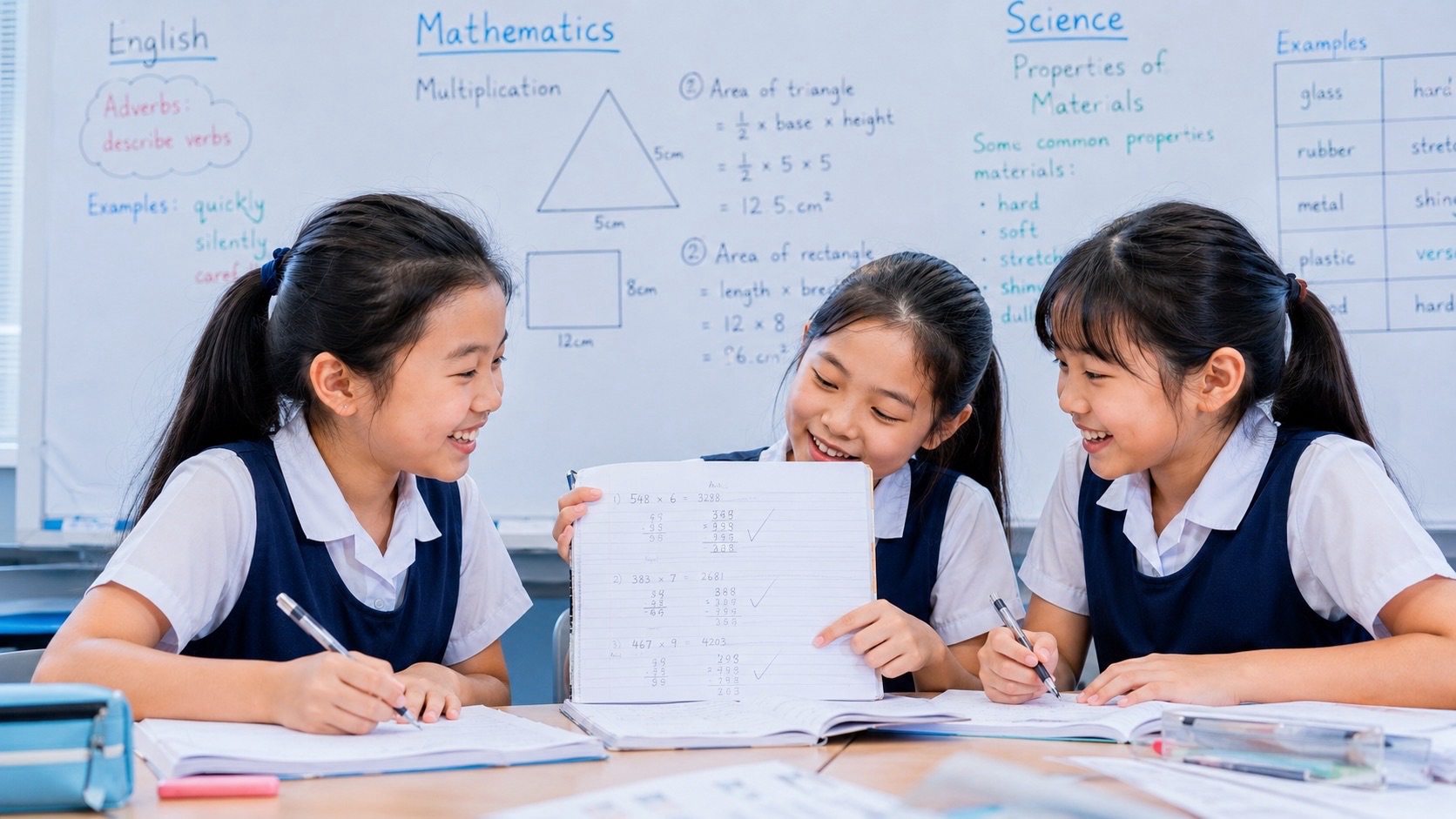
Mental Mathematics in Primary 2 is not simply a race to answer sums quickly. Children are learning to understand how numbers are made, recognise useful relationships and choose strategies that help them calculate accurately. Number bonds, making ten, partitioning, counting on or back, doubles and estimation can all support number sense when they are taught in a clear sequence. A child may need time, fingers, counters or a drawing while learning; these supports can be part of the path towards independent mental calculation.
The MOE Primary Mathematics syllabus includes mental calculation within the development of number skills, and schools introduce strategies according to their teaching sequence. Parents can reinforce these ideas through short activities and everyday situations without turning every calculation into a timed test. This guide explains how to build flexible mental methods, recognise common mistakes and decide when to ask the teacher for help. P2 is not a PSLE examination year; a secure understanding of numbers matters more than speed or premature upper-primary techniques.
- Mental Mathematics is reasoning and number flexibility, not a speed contest.
- Use number bonds and making ten to understand how numbers are composed.
- Partition tens and ones and connect the parts to place value.
- Practise counting on, counting back, doubles and simple difference strategies.
- Use estimates to judge whether an answer is reasonable.
- Allow fingers, objects and jottings as supports while understanding develops.
- Check methods through explanation and a changed example, not only rapid recall.
- Follow the school’s current sequence; P2 mental calculation is not PSLE drilling.
- MOE: Primary Mathematics Syllabus (updated October 2025)
- MOE: Primary curriculum overview
- eduKateSingapore: P2 Mathematics foundations
- eduKateSingapore: P2 multiplication and division
- eduKateSingapore: P2 homework support
Mental Mathematics is reasoning, not a speed contest
Mental Mathematics means working with numbers in the mind, sometimes supported by a drawing, counters or a jotting. It is not simply answering as quickly as possible. Children develop useful mental strategies when they understand how numbers are composed and can choose a method that fits the calculation.
A child who needs time to think may understand a relationship well. A pupil who answers instantly may be recalling a fact without understanding a new problem. Parents should value accuracy, explanation and flexibility before speed. The school will introduce mental methods in sequence; home practice should follow the current level and use strategies the child can explain.
Follow the current P2 syllabus and class methods
The MOE Primary Mathematics syllabus includes mental calculation as part of number learning, with progression across primary levels. The updated syllabus sets out expectations by level and should be used alongside the child’s school teaching sequence. Parents should not assume that every mental shortcut taught by an older sibling is suitable for P2.
Use recent classwork to identify which number range and calculation types are being practised. Ask the teacher which strategies pupils have been taught. The same answer may be reached in several ways, but a child who is still learning a method benefits from consistent explanations before being asked to compare different strategies.
Begin with number bonds
A number bond shows how a whole number can be split into parts. For example, 8 can be made from 5 and 3, or from 6 and 2. Knowing several ways to make a number helps children add, subtract and reason without counting every object from the beginning.
Use counters, fingers, ten-frames or simple drawings. Show a whole and split it into two groups. Ask, ‘If there are eight altogether and three are here, how many are in the other group?’ Let the child explain how they know. Do not insist on memorising every possible pair in one sitting.
Make ten to simplify addition
Ten is a useful benchmark because our number system groups ones into tens. A child may use a number bond to make ten, then add any remaining amount. For example, 8 + 5 can be viewed as 8 + 2 + 3. The child takes two from five to complete ten, then adds the remaining three.
Use a ten-frame or counters so the child can see the first group fill. Ask where the two came from and how many remain. Later, let the child try a similar calculation using a drawing or mental explanation. The strategy is only useful when the child understands the split; do not teach it as a magic trick to copy.
Partition numbers into tens and ones
Partitioning means splitting a number into parts that are easier to work with. A two-digit number can be thought of as tens and ones. When adding 23 and 4, a child may keep the two tens and combine the ones. With larger numbers, the school may introduce other partitioning approaches in a planned sequence.
Use place-value cards or bundled objects to represent the number. Ask what remains unchanged and which part is being combined. Connect the objects with the written number. This helps children understand why a strategy works and reduces the risk of treating digits as unrelated symbols.
Count on from the larger number
When adding a small amount to a larger amount, a child may start from the larger number and count on. For example, for 14 + 3, the child can say 14, 15, 16, 17. This may be more efficient than counting all seventeen objects from one.
Use a number line or move a counter one step at a time. Ask the child where they started and how many steps they moved. Avoid confusing counting on with counting all objects. If the child skips or repeats a number, slow down and use a visible number line before returning to mental work.
Doubles and near doubles
Doubles are pairs of equal amounts, such as 6 + 6. A near-double calculation differs by one or a small amount, such as 6 + 7. A child may use a known double and adjust one part. This can help build number flexibility once the underlying facts are secure.
Use two equal groups to show a double. Then add one counter to one group and ask how the total changes. Let the child describe the change rather than memorise the phrase ‘near double’. Follow the facts and strategies the teacher has introduced. The child should be able to explain the adjustment.
Use a known fact to derive another
A known fact can act as a starting point for a related fact. If a child knows 5 + 5, they may use it to work out 5 + 6. If they know a group of ten, they may reason about a nearby total. This develops connections between calculations rather than requiring every answer to be learned separately.
Ask, ‘Which fact do you already know that might help?’ Let the child explain the connection. If the known fact is not secure, return to objects or a drawing. Mental strategies should grow from understanding rather than pressure to invent a clever answer quickly.
Subtraction as taking away and finding a difference
Subtraction may describe taking a quantity away, finding what remains or comparing two amounts. Mental strategies depend on the relationship. A child may count back for a small subtraction or count up to find the difference between two nearby numbers. The story and taught method determine what is appropriate.
Use counters or a number line to represent the question. Ask what is known and what is unknown. In a comparison problem, show the gap between the two quantities rather than automatically removing objects from a group. This helps children see that subtraction has more than one practical interpretation.
Count back carefully
Counting back can help with small subtraction amounts. A child starting at 15 and subtracting 3 may count 14, 13, 12. The child must understand that the starting number is not counted as the first step. This is a common source of errors.
Use a number line and make three backward jumps. Ask how many jumps were made and where the counter ended. Once the action is understood, reduce visual support. Avoid long timed drills while the child is still learning to count back reliably.
Count up to find a difference
When two amounts are close, counting up from the smaller amount to the larger can make the difference visible. To find the difference between 18 and 21, a child can count three steps up. This is a way of thinking about the gap rather than removing from the larger number.
Draw a short number line and mark both amounts. Count the jumps between them. Ask what the jumps represent. This can be a helpful strategy for comparison problems, but children should also understand the meaning of the original question and follow the methods taught in class.
Use compensation only when the child understands it
Compensation means adjusting a number to make a calculation easier, then correcting for the adjustment. For instance, a calculation may be easier if one amount is increased to a nearby ten and the difference is accounted for afterwards. This can be useful, but it is not necessary for every P2 child or every calculation.
Do not introduce compensation as a shortcut before the child understands place value and the relevant addition or subtraction relationship. If the child cannot explain what was changed and why a correction is needed, return to a concrete model. Follow the school’s sequence and avoid advanced mental tricks for their own sake.
Use friendly number pairs
Some numbers work naturally together because they make ten or another familiar total. Children can learn to notice pairs through dice, dominoes, ten-frames and everyday quantities. A game may show a five and a three, then ask how many more are needed to make eight or ten.
Let the child find more than one pair when appropriate. Ask them to explain how they spotted it. Do not make the game a race or insist that every fact be recalled instantly. Repeated exposure in different representations builds a stronger number network.
Estimation gives an answer a sense of size
An estimate is an approximate answer. It helps a child consider whether a result is reasonable before or after an exact calculation. At P2, estimation can use familiar numbers, comparison and everyday quantities. It need not involve formal rounding procedures beyond what the school has taught.
Ask whether a sum should be more or less than a starting amount, or whether the result is likely to be near ten, twenty or one hundred. After calculating, compare the answer with the estimate. If the values are far apart, check the calculation and the interpretation of the question.
Estimate before measuring or counting
Estimation is useful outside written sums. A child can guess how many steps it takes to cross a room, how many blocks fit in a box or which object is longer. Then they can count or measure to check. This develops a sense of quantity and encourages the child to think before acting.
Choose a safe, simple activity. Ask the child to make a prediction and explain the basis. It is acceptable to be wrong; the purpose is to compare an estimate with what happened. Avoid presenting estimates as failures when they do not match the exact answer.
Check a calculation in a second way
A child can sometimes check addition with subtraction or use an object model to review the result. For example, if they combine two groups, they can recount or reverse the operation within the taught range. A second method can reveal a slip and build confidence in the answer.
Do not demand two written methods for every simple calculation. The check should be proportionate. Ask the child which part they want to verify and allow an oral explanation. Checking is a habit of reasoning, not extra busywork added after every question.
The equals sign means the same value
Some pupils treat the equals sign as an instruction to write an answer after it. The sign means that both sides represent the same value. A child who understands equality can compare two expressions rather than assuming that the result must always follow the symbol.
Use matching counters or a balance illustration to show equal quantities. Ask whether two different arrangements contain the same total. Follow the number sentences taught in class and do not introduce algebraic notation ahead of the syllabus. The central idea is that equality expresses sameness of value.
Use fingers, objects and jottings without embarrassment
Children may use fingers, counters, drawings or marks to support mental calculation. These are legitimate supports while understanding develops. Parents should not shame a child for using fingers or insist that they abandon all visible strategies before they are ready.
Help the child choose an efficient representation and gradually move towards more mental recall when the relationship is secure. If a child still needs many objects for a familiar calculation, ask whether the underlying number concept needs further teaching. The goal is progress, not hiding the thinking process.
A mental strategy should be explainable
A shortcut that produces an answer without understanding may fail when the numbers or wording change. Ask the child to explain what they did in simple language. They may say, ‘I made ten first’ or ‘I counted the difference’. This explanation is enough to show the basic idea at P2 level.
If the child cannot explain the method, rebuild it with objects or a number line. Avoid rewarding a fast answer when the child has guessed. A changed example can check whether the strategy transfers beyond one familiar question.
Keep practice short and spaced
Mental facts become more secure through repeated retrieval over time. A few minutes of purposeful practice can be enough for a family activity. Long drills may produce fatigue or anxiety and can make number work feel like punishment.
Choose a small focus, such as number bonds to ten or a current table fact. Revisit it after a gap using a different representation. Stop when the child is tired or frustrated. If practice repeatedly causes conflict, ask the teacher whether the chosen target or method is suitable.
Use everyday situations for mental calculation
Counting snacks, comparing simple prices, sharing objects or measuring ingredients can create natural mental calculation opportunities. The child may work out how many more items are needed or how many remain. These everyday moments show that Mathematics describes quantities outside a workbook.
Keep the arithmetic within the child’s taught range and do not use a shopping trip as a surprise test. Let the child participate when interested. Real transactions and safety remain adult responsibilities. The practical example should make numbers meaningful, not create pressure.
When a child is accurate but slow
A child may use a valid strategy but take time to retrieve facts. This may be part of normal learning. Parents should look at whether the child understands the number relationship and whether speed improves gradually with practice.
Give thinking time and ask the child to show their reasoning. Short spaced review may help. Avoid public timing or comparing the child with classmates. If slow calculation is accompanied by persistent confusion about quantity or place value, discuss it with the teacher.
When a child answers quickly but makes many errors
Fast answers can sometimes reflect guessing, rushing or a strategy that has not been checked. Ask the child to explain the method and consider whether the number range is too difficult. A speed-focused routine may be encouraging the child to answer before understanding the question.
Reduce the pace and use a number line, counters or a short verbal explanation. Focus on accuracy and meaning first. Once the child can solve familiar examples consistently, fluency may improve without pressure. Ask the teacher if the pattern persists.
When the child relies on counting all
Counting all is an understandable early strategy, but it can become cumbersome for larger quantities. Parents can introduce counting on, making ten, grouping or known facts one at a time. The child should see why the alternative is more efficient.
Use the same calculation in two forms: first count all objects, then use a grouping or number-bond strategy. Ask which method is easier and why. Do not forbid counting all suddenly. The child may need to move gradually from concrete counting towards more flexible mental methods.
When the child cannot explain a strategy
A child may be able to imitate a worked example without being able to describe the reasoning. Ask them to build the calculation with objects or draw what happened. Then invite them to explain the picture in their own words.
Do not insist on formal mathematical language beyond the child’s level. Simple descriptions such as ‘I added two to make ten’ show understanding. If the idea remains unclear, return to the original concept and consult the teacher rather than piling on more practice.
Use the P2-to-P3 transition appropriately
P3 introduces new learning and increasing independence, but P2 mental strategies should remain grounded in the current syllabus. Strong number sense helps a child encounter later multiplication, division, fractions and problem-solving, but parents should not use this as a reason to teach all future content early.
Review the school’s P3 booklist and teaching information as the transition approaches. Continue practising number relationships the child has already met and give them opportunities to explain. New methods should be introduced when the teacher begins the relevant topic.
The eduKate learning loop for number flexibility
A useful sequence is represent a number, explain a relationship, try a calculation, check the result and apply the same idea to a changed example. The child may move from counters to a drawing and then to a mental explanation as confidence grows.
Use the eduKate P2 Mathematics foundations and multiplication/division guides as connected references. Choose one current learning goal, not every strategy at once. The purpose is independent reasoning and confidence rather than speed or the number of exercises completed.
What healthy mental Mathematics progress looks like
A child is making progress when they can split numbers in more than one way, use familiar bonds, count on or back accurately, estimate a reasonable result and explain a chosen strategy. They may still use fingers or jottings for unfamiliar sums. This is not a failure.
Compare the child’s current reasoning with their earlier attempts and follow teacher guidance. P2 Mathematics is a foundation for later learning, not a PSLE examination. Secure number sense and flexible thinking are more valuable than a fast response that the child cannot explain.
A twelve-week mental Mathematics plan
Week 1: Build number bonds to ten
Use counters or a ten-frame to find different pairs that make ten.
Week 2: Practise making ten
Try one addition example by splitting a number to complete ten first.
Week 3: Partition a two-digit number
Show tens and ones with place-value cards and explain each part.
Week 4: Count on
Practise adding a small amount to a larger starting number using a number line.
Week 5: Explore doubles
Build a pair of equal groups and describe the total.
Week 6: Try near doubles
Change one group by one and explain how the total changes.
Week 7: Use counting back
Show a small subtraction with clear backward jumps.
Week 8: Find a difference by counting up
Mark two nearby numbers and count the steps between them.
Week 9: Estimate a result
Predict whether an answer will be near a familiar benchmark before calculating.
Week 10: Check using another representation
Use counters, a drawing or a related operation to check one result.
Week 11: Play a number-pair game
Use dice, dominoes or cards to find useful pairs and explain them.
Week 12: Try a changed example
Use a familiar strategy with different numbers and explain why it still works.
The child counts 8 + 5 from one
Show eight counters and five more. Ask how many are needed to complete ten, then how many remain. Move two counters from the five to complete the ten and add the remaining three. Ask the child to explain each part.
This representation may help the child see the make-ten strategy. If the child finds the movement confusing, return to counting on and use the strategy taught in class.
The child thinks 16 − 9 means count nine numbers including sixteen
Use a number line starting at sixteen and make nine backward jumps. Count each jump, not the starting point. The counter should finish at seven. Let the child physically move a counter for each step.
The difficulty is the meaning of a step, not necessarily subtraction itself. Practice with a small number of jumps and gradually reduce the support.
The child gives a fast but unreasonable answer
Ask whether the answer should be larger or smaller than the original quantity and what approximate range makes sense. Use a number line or counters to check. If the child rushed, discuss reading the full question before calculating.
An estimate can reveal whether the answer is plausible. Do not use the mistake to shame the child; use it to improve the checking routine.
The child refuses to stop using fingers
Fingers can support quantity and counting while a child is learning. Rather than removing them, show a more efficient strategy for a familiar example and let the child compare the methods.
Move away from finger counting when the child can do so confidently and accurately. The goal is a developing strategy repertoire, not an arbitrary rule that fingers are forbidden.
Questions parents commonly ask
Does P2 mental Mathematics mean timed drills?
No. Understanding, accuracy and flexible strategy use should come before speed.
Should I stop my child from using fingers?
No. Fingers are a useful support. Introduce more efficient methods gradually.
Which mental strategies are useful in P2?
Number bonds, making ten, partitioning, counting on or back, doubles and simple estimation are useful when aligned with class teaching.
Should my child memorise all number bonds?
Build familiarity through objects, games and repeated use; avoid exhausting drills.
Is estimation the same as guessing?
No. A useful estimate is a reasoned approximation based on number size or familiar benchmarks.
What if my child is slow?
Check understanding first, allow thinking time and use short spaced retrieval rather than speed pressure.
Can mental strategies replace written working?
No. Use the form of working requested by the teacher and the strategy suited to the task.
When should I ask the teacher for help?
When the child repeatedly misunderstands number relationships or cannot apply familiar strategies despite appropriate support.
Official guidance and connected eduKate reading
Reviewed 17 November 2026. This is independent parent guidance, not an official workbook or complete syllabus. Follow the current MOE syllabus and the child’s teacher for topic sequence and methods.
Mental calculation should grow from secure understanding
A child can learn a mental strategy before being able to use it independently every time. The adult may first model a calculation with counters, then ask the child to describe the picture and finally invite them to try another example. Repeating this progression allows the child to connect what they see with what they say and write.
If a child is confused, do not keep repeating the shortcut more loudly or quickly. Return to the representation and ask what each group or number means. A strategy becomes useful when the child can explain it and recognise when it applies. The goal is not to make the child perform a trick but to build a dependable relationship with numbers.
Choose one strategy for one type of calculation
A common source of confusion is introducing several ways to solve the same calculation before the child understands any of them. A pupil may be shown counting on, making ten, compensation and partitioning in one sitting, then be unsure which to choose. Parents should begin with one method aligned to the class teaching.
Once the child can use that method comfortably, another approach can be compared. Ask which method is clearer for this calculation and why. There is no need for every child to use the same strategy for every number. Flexibility means choosing a suitable method, not collecting the largest number of shortcuts.
Use a number line to make jumps visible
A number line represents numbers in order and shows movement from one value to another. It can support counting on, counting back, comparing amounts and finding a difference. The child should understand that each equal step represents one unit or another clearly stated interval.
Draw a short line with a few labelled points. Move a counter or pencil along it while saying the numbers. Ask where the child starts, how many steps are taken and where they finish. As the child becomes more confident, reduce the labels or drawings. Do not use a number line with an interval scale the child has not learned.
Ten-frames and counters make quantity visible
A ten-frame arranges up to ten counters in a consistent pattern. It can help a child see how many spaces are filled and how many remain. Counters can show number bonds, making ten, doubles and simple subtraction without relying only on a spoken sequence.
Use two colours if available, so the child can see the parts within a whole. Ask how many counters are present and how many more would fill the frame. Change the arrangement while keeping the total the same. This reinforces that quantity is unchanged when the objects are moved.
Do not confuse a calculation strategy with a word-problem strategy
Mental calculation helps work out a number operation. A word problem also requires the child to understand the situation and decide which quantity is unknown. A child may calculate 8 + 5 accurately but still choose addition when a story asks for the difference between two amounts.
Separate the two steps. First ask what the story is describing and what needs to be found. Then choose an operation and use a suitable mental method. If the child makes an error, identify whether it came from interpreting the story or carrying out the calculation. Different causes need different teaching.
Mental practice should not become a daily test
A parent may ask ten quick-fire questions every evening because mental methods seem easy to practise. However, repeated questioning can make children feel monitored and may reward speed rather than understanding. A P2 child also needs time for reading, play, movement and rest.
Use a game or one natural calculation when the child is receptive. Stop after a small number of examples and revisit another day. If practice leads to conflict or anxiety, reduce the amount and check whether the method is suitable. The purpose is to make number reasoning more comfortable, not to create a second school day at home.