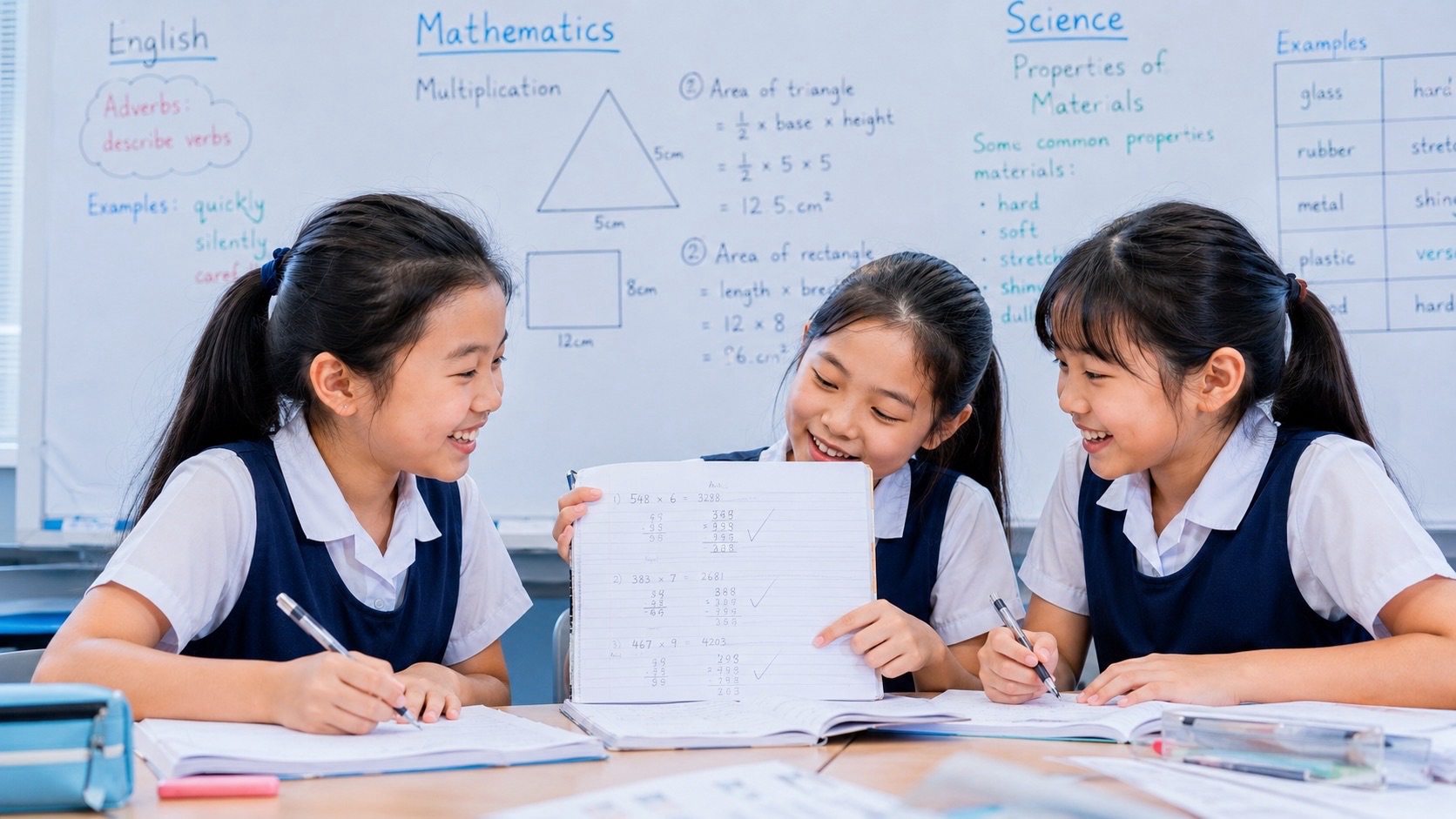
Primary 2 multiplication and division are not simply about memorising times tables. Children are learning to recognise equal groups, represent them with objects and arrays, connect multiplication with repeated addition, and understand division as sharing or grouping. A child may recite a fact but still struggle to interpret a word problem, while another may understand equal groups but need more time to recall a table. Parents should separate these skills before deciding what practice is needed.
The updated MOE Primary Mathematics syllabus includes the multiplication tables of 2, 3, 4, 5 and 10 at P2, alongside concepts of multiplication and division. The child’s school determines the teaching sequence and classroom approach. This guide explains equal groups, arrays, fact recall, sharing, grouping, common misconceptions and suitable practice at home. P2 is not a PSLE examination year, so the purpose is to build understanding and confidence rather than rush into upper-primary procedures.
- Build multiplication from equal groups, arrays and repeated addition.
- Follow the P2 table range of 2, 3, 4, 5 and 10 and the school’s sequence.
- Use short, spaced fact recall alongside visual and practical understanding.
- Teach division as both equal sharing and forming groups of a given size.
- Connect multiplication and division through related examples and arrays.
- Read word problems to identify the unknown before choosing an operation.
- Distinguish slow recall from a misunderstanding of the concept.
- P2 has no PSLE examination; build current foundations rather than drill future formats.
- MOE: Primary Mathematics Syllabus (updated October 2025)
- MOE: Primary curriculum overview
- eduKateSingapore: P2 Mathematics foundations
- eduKateSingapore: P2 Mathematics problem-solving
- eduKateSingapore: P2 homework support
- eduKateSG: immutable Clementi reference
Begin with what multiplication means
Multiplication represents equal groups. If there are three plates with four biscuits on each plate, the total can be described as three groups of four. The child should understand both the number of groups and the number in each group. This meaning is more important than memorising a table fact without understanding what it represents.
Use counters, blocks, bottle caps or other safe objects to build groups. Ask the child to say, ‘There are three groups, and each group has four.’ Count the total and connect the arrangement to a multiplication sentence if the school has introduced the notation. The words and the objects should describe the same relationship.
Repeated addition helps connect ideas
Multiplication can be understood as repeated addition of equal groups. Four groups of three can be represented as 3 + 3 + 3 + 3. This connection can help a child who is familiar with addition see why multiplication is a more efficient way to describe equal groups.
Arrange objects in groups and write the repeated addition sentence beneath them. Ask the child what is being added each time and why the number stays the same. Later, use the multiplication symbol as a shorter way to express the same structure. Do not rush past the repeated-addition connection if the group idea is still unclear.
Arrays make groups visible
An array arranges objects in equal rows and columns. It can show equal groups clearly and help children count systematically rather than recount every object. For example, three rows of four objects show twelve in total. Rotating an array can also help children notice that the same total may be organised differently.
Use buttons, tiles or drawn dots to make a small array. Let the child describe the rows and items in each row, then describe the columns. Connect the arrangement to the table fact being learned. Do not make the child memorise a diagram; ask them to explain what each row and column represents.
The P2 multiplication-table range
The updated MOE Primary Mathematics syllabus includes multiplication tables of 2, 3, 4, 5 and 10 in P2. Parents should follow the child’s school sequence and the way the teacher introduces the facts. A child does not need to rush through every future table because they have memorised one set early.
Build each table using equal groups, skip counting, arrays, songs or games. The exact sequence can differ by school pacing, so ask which facts are currently being taught. Practice should consolidate the current learning rather than create competition over who can recite the most tables.
The 2-times table
The 2-times table describes groups of two. Children may connect it with pairs of socks, two wheels on a bicycle or two hands. They can count in twos and then recognise the related multiplication facts. The physical grouping helps explain why each answer increases by two.
Make pairs of counters and count the total as the pairs increase. Ask how many pairs there are and how many objects are in each pair. Then try a simple picture or number sentence. If the child skips a number while counting, rebuild the groups rather than merely telling them to memorise the correct answer.
The 5-times table
The 5-times table can connect with five fingers on a hand, five objects in a small group or familiar counting patterns. Children may notice that multiples of five in whole-number counting often end in 0 or 5, but they should understand the groups rather than rely only on the pattern.
Arrange groups of five counters and count the totals. Invite the child to predict the next total and check by building the next group. Connect the result to a multiplication fact. The pattern is a helpful observation, not a substitute for understanding what five groups or groups of five actually mean.
The 10-times table
Ten is a useful group size because children already encounter tens in place value. Ten items in each group can be represented with bundles or ten-frame arrangements. The child can count equal groups of ten and connect the total with familiar number structure.
Use bundles of ten straws or base-ten blocks where available. Ask the child to describe how many tens there are and how many objects altogether. Link the total to place value. Avoid introducing shortcuts that the child cannot explain; the goal is to connect equal groups with number structure.
The 3-times and 4-times tables
The 3-times and 4-times tables may require more deliberate repetition than the 2, 5 and 10 tables. Children can use arrays, repeated addition and skip counting to build the pattern. A fact becomes more secure when the child can recognise it in a new arrangement rather than only in the order of a recitation.
Practise a small cluster of facts and mix their order after the child understands them. Use arrays to compare groups of three and groups of four. Ask what changes when one group is added. Short spaced review is more manageable than demanding a long drill in one sitting.
Count in equal steps before recalling facts
Skip counting can help children hear and recognise a multiplication pattern. Counting in twos, fives or tens is useful when it represents equal groups. However, a child may recite the sequence without understanding what is being counted.
Pair the spoken sequence with visible groups or a number line. Ask what each step represents and how many groups have been counted. If the child says 2, 4, 6, 8, ask how many groups of two make eight. This connects the sequence to the multiplication relationship.
Fact recall is useful but should not be isolated
Fluent recall of multiplication facts can reduce the effort needed for later calculations. Yet reciting a fact does not automatically show that a pupil understands multiplication or can solve a word problem. Fact practice should sit alongside pictures, practical grouping and explanation.
Use a short retrieval game after the concept is understood. Ask a few facts in mixed order, then show one as an array and ask the child to explain it. If a fact is forgotten, provide a clue or rebuild the group. Keep practice friendly and stop before fatigue turns it into a source of conflict.
Build fact recall gradually
A child may remember a fact one day and forget it several days later. This is normal during learning. Revisit facts after a gap and use a different representation or question. A short review that asks the child to recall and explain is often more useful than repeating the same page immediately.
Choose a few facts from the current table. Review them on separate days, sometimes through a game and sometimes with an array or a simple word problem. Keep track of which facts are secure and which need another explanation. Do not treat one forgotten answer as proof that the child has not learned anything.
Multiplication facts can be related
A child may use a known fact to reason about another. If they know five groups of two make ten, they can build on that understanding to consider five groups of four. Doubling or grouping can help, provided the child understands the relationship and the strategy is appropriate to the current work.
Ask how a known array could be changed to show another fact. Add one more equal row or make each group larger. Let the child explain what changed in the total. This develops number flexibility rather than a collection of disconnected answers.
Division has two closely related meanings
Division can mean sharing an amount equally among a number of people or finding how many groups of a given size can be made. For example, twelve counters shared among three children asks how many each child receives. Arranging twelve counters into groups of three asks how many groups can be formed.
Use physical counters to show both interpretations. Ask what the number of groups means in one story and what the number in each group means in the other. The same quantities can answer different questions depending on what is unknown. This distinction helps children understand division rather than memorise one procedure.
Sharing equally
In a sharing question, the total amount is known and the number of recipients is given. The child distributes the objects so that each recipient receives the same amount. They can check the sharing by comparing each group.
Use a small number of safe objects and draw people or containers to represent recipients. Let the child deal out one item at a time, then count each share. Ask whether everyone has an equal amount and what the answer represents. The purpose is fair sharing and equal quantity, not speed.
Grouping into sets
In a grouping question, the total amount and the size of each group are known. The child makes equal groups and finds how many groups there are. This is different from sharing, even though both situations involve division.
Provide counters and ask the child to place exactly four in each group, for example. Count how many groups have been made. Compare with a sharing story using the same total. Explain what is unknown in each question. Children who can distinguish the stories are more likely to choose a suitable method.
Connect division with multiplication
Multiplication and division are related. If four groups of three make twelve, then twelve can be shared into four equal groups of three, or arranged into groups of three to make four groups. A multiplication fact can therefore help check a related division result.
Build an array and use it to ask more than one question. How many objects altogether? If there are twelve objects and four groups, how many are in each? If each group has three, how many groups are there? Keep numbers within the child’s taught range and make each question’s unknown clear.
Remainders and the limits of a fair share
When objects cannot be shared equally using whole items, there may be a remainder. Whether remainders are part of the child’s current taught work depends on the school sequence and syllabus scope. Parents should not introduce formal remainder procedures before the child is ready.
Use a practical example only if appropriate: some counters may be left when making equal groups. Ask what happened to the leftover objects. Do not insist that every sharing story must divide evenly. The school will guide the formal notation and expectations when the relevant concept is taught.
Read the story before selecting an operation
A word problem is not solved by spotting a keyword. The child needs to understand what is happening, what quantities are known and what the question asks. ‘Each’ often signals equal groups, but the operation still depends on the unknown. Children should not memorise a rule such as ‘each means multiply’ without understanding the situation.
Ask the child to retell the story and show the quantities with objects or a drawing. Identify whether the unknown is a total, number of groups or amount in each group. Then choose multiplication or division. A reasoned choice is more valuable than a correct answer guessed from one familiar word.
Draw a simple representation
A drawing can show equal groups, arrays or sharing. It need not be beautiful. Circles, dots or boxes can help a child see the structure before writing a number sentence. The drawing should represent the story accurately.
Ask the child to label what each group or item represents. If there are three bags with four marbles each, draw three bags and four dots in each. Count the total and connect it to the operation. If the drawing does not match the story, rebuild it before calculating.
Check what the answer represents
A child may calculate twelve but not know whether twelve means total objects, groups or objects per group. The final answer should connect back to the question. A correct calculation can still produce an incomplete response if the meaning is not stated or understood.
Ask, ‘What does twelve tell us in this story?’ The child may answer orally or write a short sentence when required. If the answer is a number of groups, say groups; if it is the total number of objects, name the objects. This small check makes mathematics meaningful.
Use games for retrieval and understanding
Dice, cards, board games and simple matching activities can offer opportunities to build equal groups, count patterns and recall facts. The game should have a clear mathematical purpose and should remain enjoyable. A child can practise multiplication without experiencing every repetition as a formal worksheet.
For instance, draw a card showing three groups of four and ask the child to build it with counters. Another turn may ask them to share twelve objects among four toy figures. Discuss the representation briefly, then continue the game. If the child becomes frustrated, reduce the difficulty or stop.
Common misconception: multiplication always makes a number bigger
Multiplication by whole numbers greater than one often increases a positive whole number, but the important P2 concept is equal groups. Children should not be taught an absolute rule that multiplication always makes a number bigger, since later mathematics includes other kinds of numbers and situations.
At P2, focus on the current whole-number context and explain the group structure. Parents do not need to introduce decimals or fractions to challenge the statement. Simply avoid turning a local pattern into a universal rule. Use accurate language such as ‘In these equal-group examples, the total grows as we add more groups’.
Common misconception: division always makes a number smaller
In many simple sharing and grouping examples, the answer is smaller than the starting total, but the result depends on what is being asked. A division question may ask how many groups can be made, not merely how much remains. The child should interpret the unknown before predicting the result.
Use a story and ask what the answer counts. If twelve items are arranged into groups of three, the result is four groups. If twelve items are shared among three children, the result is four per child. The numerical answer matches, but its meaning differs.
When the child counts every item repeatedly
Counting every object one by one can be an appropriate early strategy, but it may become inefficient as the child meets larger groups. Introduce arrays, skip counting or known facts as the child becomes ready. Do not shame a child for using a concrete counting method.
Ask whether the child can organise objects to make counting easier. Group them in twos, fives or tens, or arrange them in rows. Explain why this representation helps. The goal is progression towards efficient strategies while maintaining confidence and accuracy.
When facts are remembered but word problems remain hard
The child may recite tables but struggle to identify when multiplication or division is useful. This suggests that fact recall and problem interpretation need separate attention. More table drills alone may not solve the problem.
Read the story, identify the unknown and build a physical model. Ask the child to explain what the numbers represent before calculating. If the child can solve a direct fact but not a story, practise translating the situation into equal groups rather than repeating the entire table.
When the child is slow to recall facts
A slow response does not automatically mean the child has not learned the concept. They may still be retrieving the fact, counting groups or feeling pressured by the adult’s pace. Speed should not be the only measure of progress.
Give thinking time and ask for a representation when needed. Review a few facts across different days. As understanding becomes more secure, recall may become more fluent. If the child consistently struggles with the concept, discuss it with the teacher and use a different explanation.
Use teacher feedback to choose what to practise
Schools may introduce tables and division concepts in a planned sequence. Ask which facts or interpretations the child is currently learning and what representation the teacher uses. This avoids introducing too many new facts or a method that conflicts with classroom teaching.
Bring a sample of independent work if a misconception persists. Ask whether the issue is multiplication meaning, fact recall, division sharing, division grouping or word-problem language. Clear identification helps adults choose targeted practice rather than assign a large mixed workbook.
The eduKate learning loop for multiplication and division
A useful sequence is build equal groups, draw an array, connect repeated addition, write the multiplication sentence, use a related division question, retrieve a fact later and apply it in a new story. Each step connects meaning, representation and recall.
Use the P2 Mathematics foundations article as the broader map and this guide for focused multiplication and division. Choose only the facts and interpretations that match the current school sequence. The purpose is confident independent application, not racing through future-level material.
What healthy progress looks like
A child is making progress when they can describe equal groups, build or interpret an array, recall more taught facts, share objects fairly, form groups of a specified size and explain what the answer represents. They may still need time or objects for unfamiliar examples.
Compare the child’s understanding with their earlier attempts and ask the teacher about persistent misconceptions. P2 multiplication and division are foundations for later mathematics, not a P2 PSLE examination. Understanding, accuracy and growing independence matter more than speed alone.
A twelve-week multiplication and division plan
Week 1: Build equal groups
Make two or three groups with the same number of objects and describe the arrangement.
Week 2: Draw an array
Represent one multiplication fact with rows and columns and explain what each number means.
Week 3: Connect repeated addition
Write a repeated addition sentence for an array and connect it to the multiplication symbol.
Week 4: Explore the 2-times table
Use pairs of objects and count the totals in groups of two.
Week 5: Explore the 5-times table
Build groups of five and notice the sequence of totals.
Week 6: Explore the 10-times table
Use bundles of ten or base-ten materials to show groups of ten.
Week 7: Practise a small set of 3-times facts
Use an array or skip counting and review a few facts after a gap.
Week 8: Practise a small set of 4-times facts
Use equal groups and mixed-order recall once the model is understood.
Week 9: Share objects equally
Distribute a small total among a known number of recipients and check equal shares.
Week 10: Make groups of a fixed size
Arrange a total into groups containing the same number and count the groups.
Week 11: Connect division with multiplication
Use one array to ask a multiplication question and two related division questions.
Week 12: Solve a new story problem
Identify the unknown, represent equal groups and explain what the answer means.
The child memorises 3 × 4 but cannot explain it
Draw three rows of four objects. Ask how many rows there are and how many objects appear in each row. Count the total and connect the picture to 3 × 4. Then ask the child to rearrange the same total as four rows of three, if appropriate to the child’s learning.
The total stays the same while the grouping changes. This helps the child understand that a multiplication fact represents a relationship, not only a phrase to recite.
The child confuses sharing and grouping
Use twelve counters. First share them among three toy figures and ask how many each receives. Then make groups of three and ask how many groups can be formed. The answer may be four in both situations, but the story and unknown differ.
Ask the child to explain what four means in each case. This distinction is more useful than memorising that every division question uses one particular arrangement.
The child adds numbers whenever they see ‘each’
Read the full story and ask what is repeated. Draw one group, then another equal group. If the question asks for the total, multiplication may represent repeated groups; if it asks how many in each group, division may be appropriate.
The operation follows the unknown, not one word in isolation. Use a new story with the same structure to check whether the child can transfer the reasoning.
The child is upset by slow table recall
Pause the timer or remove it entirely. Ask the child to show the fact with an array or equal groups. Review a few facts in mixed order at a later time, giving sufficient thinking space.
Speed may improve as recall becomes secure. If the child only responds under pressure, the timed drill may be hiding what they understand. Confidence and meaning should come before speed.
Questions parents commonly ask
Which multiplication tables are included in P2?
The updated MOE Primary Mathematics syllabus includes tables of 2, 3, 4, 5 and 10. Follow the school’s sequence.
Should my child memorise every table quickly?
Build recall gradually while connecting each fact with equal groups and arrays.
Is repeated addition still useful?
Yes. It helps children understand how multiplication describes equal groups.
What is the difference between sharing and grouping?
Sharing asks how many each recipient gets; grouping asks how many groups of a fixed size can be made.
Should I time multiplication-table practice?
Not as the main method. Understanding, accuracy and calm recall should come first.
What if my child knows tables but cannot solve story problems?
Work on interpreting the story and identifying the unknown, using objects or drawings.
Should P2 children learn long division?
Follow the current school syllabus and methods. Do not introduce advanced written procedures before they are taught.
When should I ask the teacher for help?
When the child repeatedly misunderstands equal groups, sharing, grouping or the meaning of a word problem.
Official guidance and connected eduKate reading
Reviewed 17 November 2026. This is independent parent guidance, not an assessment paper or substitute for classroom teaching. Follow the current MOE syllabus and the child’s teacher for topic sequence and expectations.
A final check for multiplication and division
Before finishing a problem, ask the child what the answer represents. Is it the total number of objects, the number of equal groups or the amount in each group? This simple sentence helps connect the calculation back to the story.
If the child cannot explain the answer, return to the objects or drawing. The purpose is not to add lengthy written explanations to every P2 question. It is to check that the child understands the relationship and has not simply produced a number through a remembered pattern.