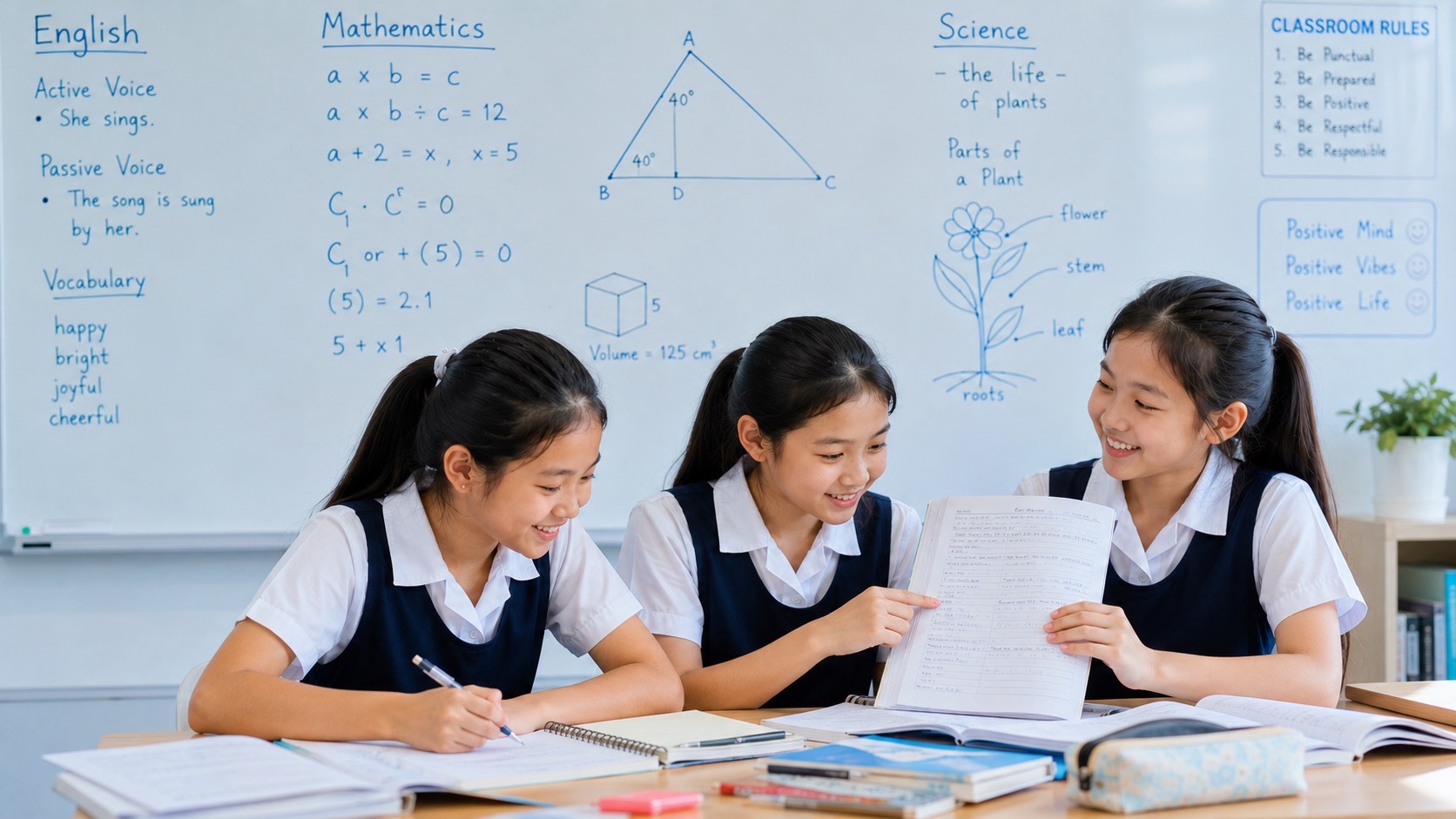
Primary 2 English comprehension tuition in Bukit Timah should teach a child to understand exactly what a question asks and answer with relevant information from the passage. A child may read a story fluently yet give a place when the question asks for a time, name the action when a reason is needed, or copy several lines without answering at all. In eduKate’s small groups of three students, useful teaching begins by locating that mismatch between the question, the passage and the child’s response.
This guide helps parents distinguish who, what, when, where, why, how and which questions; build complete but economical answers; locate evidence; interpret pronouns and negatives; and explain an inference only when the passage supports it. The teaching passages and answer keys are original. A suitable lesson gives every learner an independent first attempt, an explanation of the error and a new passage to test transfer. Parents should check current Primary 2 group arrangements and fees directly rather than treating a sample teaching approach as a timetable or guarantee.
- Reading purpose: understand a question and the passage before searching for an answer.
- Question words: distinguish people, actions, time, place, reasons, methods and choices.
- Evidence: locate the relevant statement and preserve its meaning.
- Complete answers: give enough information without copying unnecessary lines.
- Inference: use clues, distinguish a supported conclusion from an unsupported guess.
- Teaching: compare an individual first attempt with a later independent response.
- Home support: teach the next specific weakness rather than measuring progress by worksheet volume.
Chapter index | Find the question your child finds difficult
- 1. MOE context · 2. Read the question carefully · 3. Who · 4. What
- 5. When and where · 6. Why · 7. How · 8. Which
- 9. Pronouns · 10. Negatives · 11. Paraphrase · 12. Inference
- 13. Complete answers · 14. Practice passages and worked answers · 15. Three-student lesson · 16. Parent decisions
1. Put the reading goal in the right Singapore primary context
The MOE English Language Syllabus 2020 for primary schools treats reading, viewing, listening, speaking, writing, grammar and vocabulary as connected parts of language learning. It places emphasis on understanding meaning in different texts and on expressing information appropriately. This guide offers original Primary 2 teaching activities within that broader direction; its chapter sequence is not a separate official MOE list of compulsory P2 question types.
The reading goal here is straightforward: a child understands the passage, recognises the demand made by the question and supplies a response that matches both. That means a correct answer needs more than spotting a familiar word. A pupil can copy a true sentence and still fail to answer a question asking something different.
MOE’s assessment guidance confirms no weighted assessments or examinations for Primary 1 and Primary 2. A parent may still see classroom tasks and feedback that identify learning needs. Treat those examples as useful information for teaching, not as the equivalent of a national PSLE paper.
Do not demand the same length or complexity of response from every learner. A child who can answer orally but struggles to write may need work on sentence construction. A child who writes fluently but answers an unrelated question needs work on comprehension and question demand. The first step is to notice which process needs support.
Some original exercises below are set in fictional classrooms and home situations. They are intentionally labelled as practice passages, not reports of actual schools or people. Their purpose is to make the language and evidence clear enough for a young reader to study.
Back to chapter index · Next chapter
2. Read the whole passage, then identify what the question asks
Before scanning for a keyword, read the short passage with enough attention to know its situation. A quick first reading can identify who is involved, what has happened and where the focus lies. The question then directs a closer second reading. Searching before understanding can lead to picking a nearby word that belongs to the wrong sentence.
Use this invented passage: ‘On Tuesday, Asha carried a box of coloured cards to the library. Her teacher asked her to place the box beside the reading table. Asha returned before lunch to check whether the cards had been arranged.’ Ask the child to tell you what happened in one or two sentences.
Now ask, ‘Where did Asha place the box?’ The passage mentions the library and the reading table. Both are locations, but the precise answer is beside the reading table. ‘In the library’ is broadly true, yet it misses the specific placement being asked about.
Next ask, ‘When did Asha return?’ The answer is before lunch. Tuesday describes when she first carried the box, not necessarily the exact answer to the return question. The learner must distinguish different events rather than automatically supply the first time expression encountered.
When correcting an error, point to the clause that connects the action and the detail. ‘Which sentence describes her return?’ is more helpful than ‘Read again’ without guidance. Then try a new passage with the same distinction so the child can practise applying the correction independently.
Back to chapter index · Next chapter
3. Use ‘who’ to identify the correct person or group
A ‘who’ question usually asks for a person or group of people. That seems simple, yet a passage can contain several names and pronouns. The child must connect the particular action or statement in the question to the person responsible for it.
Consider an invented account: ‘Wei handed the map to Sara. Sara showed the route to the other children. Later, their teacher thanked Wei for preparing the map.’ Ask who showed the route. Sara did. Ask who prepared the map. Wei did. The child cannot answer both questions by choosing the first name in the passage.
Use a simple evidence check. Point to the subject and verb of the relevant sentence: ‘Sara showed’. Then ask whether the chosen answer names the person doing that action. This builds an understanding of how an answer is supported rather than teaching a habit of copying whichever name appears nearby.
Group questions can require a plural answer. If the text states that ‘the helpers arranged the cards’, an answer naming only one helper would be insufficient unless the passage identified that helper as the one who acted. Ask whether the answer matches the number of people described.
Sometimes a ‘who’ question asks who received something, not who gave it. In ‘Wei handed the map to Sara’, Wei is the giver and Sara the receiver. Highlight the relationship in the sentence. A correct person-name answer must match the exact role requested.
Back to chapter index · Next chapter
4. Use ‘what’ to identify an action, object, event or information
‘What’ is flexible. ‘What did Mina carry?’ asks for an object, while ‘What did Mina do after the meeting?’ asks for an action. ‘What happened to the picture?’ asks for an event or change. Teach the child to read the rest of the question rather than treating ‘what’ as a signal to copy a noun.
Use a short invented example: ‘Mina found a torn paper label. She placed it in a folder and told the librarian. The librarian made a new label for the shelf.’ Ask what Mina found, what she did with it and what the librarian made. The answers are a torn paper label, placing it in a folder and telling the librarian, and a new shelf label.
Notice the amount of detail required. For ‘What did Mina do with the torn label?’, ‘She placed it in a folder’ answers the immediate action. If the question instead asks ‘What two actions did Mina take?’, include both placing the label away and telling the librarian.
A child who returns only ‘folder’ for an action question has located a relevant word but not supplied the action. Ask ‘What happened to the folder?’ versus ‘What did Mina do?’ to expose the difference in demand. A small change in question wording changes the information that counts as a complete answer.
Build an occasional reverse exercise: give an answer and ask the pupil to write an appropriate ‘what’ question for it. For ‘a new label’, the pupil might ask, ‘What did the librarian make?’ This develops flexibility while keeping attention on how questions and answers fit together.
Back to chapter index · Next chapter
5. Keep time and place separate
‘When’ asks about a time, day or sequence point; ‘where’ asks about a location. A passage often supplies several of both. The correct answer should match the event mentioned in the question. This requires a little reading beyond the found keyword.
Use this invented story: ‘The pupils placed their models in the hall on Thursday morning. At noon they moved the display to the library. After school, they collected their bags from the classroom.’ Ask where the models were first placed. The hall. Ask when the display moved. At noon. Ask where it moved. The library.
Do not accept the classroom as the location of the models merely because it appears later in the passage. The bags, not the display, were collected there. A child should learn to connect a place to the right event, especially when a text describes movement between locations.
Time expressions need not always be exact clock readings. ‘Before school’, ‘after lunch’ and ‘on Friday’ can all answer suitable ‘when’ questions. Ask for the precise form of time information the passage provides. If the question asks for the day and the text states Friday morning, the day is Friday, with ‘Friday morning’ also a supported answer.
A small sequence line can help. Place cards reading Thursday morning, noon and after school in order, then link each with the relevant action. The line is a teaching representation, not a demand that every comprehension answer include a timeline.
Back to chapter index · Next chapter
6. Explain a reason rather than repeating the action
A ‘why’ question asks for a reason or purpose. Children often answer by naming the action again. If the passage says ‘The class covered its models because rain was expected’, the question ‘Why did they cover the models?’ is answered by the expected rain, not by ‘because they covered them’.
Read this invented paragraph: ‘The reading group moved away from the open window because a strong breeze kept turning the pages of their books. They sat at a table farther inside the room and finished their reading.’ Ask why the group moved. The breeze interfered with reading by turning the pages.
The most useful evidence is the cause-and-effect relationship. Ask the child to point to both the action and the reason, then turn the relation into a clear answer: ‘They moved because the breeze kept turning the pages.’ That sentence is shorter than copying the paragraph but preserves what matters.
Do not use ‘because’ as a magic word. A passage may imply a reason without using it explicitly. Sometimes the child needs to combine two details. In other cases, the text gives no reason. Teach the child to recognise when a confident explanation would be only a guess.
Offer an alternative question: ‘Where did the group sit?’ The answer is a table farther inside the room, not the breeze. Comparing the two questions on the same paragraph helps the child see that answer choice is controlled by the question demand.
Back to chapter index · Next chapter
7. Recognise different meanings of ‘how’
‘How’ may ask about a method, sequence, manner or way something became possible. ‘How did they carry the poster?’ calls for how it was moved. ‘How did they know it was ready?’ calls for the evidence or signal. The question word alone is not enough.
Use an invented classroom record: ‘Rafi and Lin folded the large chart carefully and carried it between them. At the hall, they checked the label and matched it to the correct display board.’ Ask how they transported the chart. They folded it carefully and carried it together.
Now ask how they knew which board to use. They checked the label and matched it with the correct board. An answer saying they carried the chart describes a different process. Both actions are true, but only one responds to the board-selection question.
Build a method answer from one or two ordered steps. ‘First they checked the label. Then they matched it to the board’ is a clear answer when both steps matter. Avoid adding imagined tools, instructions or outcomes not stated in the passage.
For a learner who gives a very short fragment, let the child demonstrate the sequence with two cards before writing. A coherent oral explanation can show comprehension even when writing the final sentence requires additional support.
Back to chapter index · Next chapter
8. Use ‘which’ to choose among stated possibilities
‘Which’ often directs the reader to select one or more items from known possibilities. The answer should preserve the distinguishing feature. A passage may name several books, containers or routes. The task is to identify the one matching the condition, not to choose a favourite.
Consider an invented display guide: ‘The blue box contains paper shapes. The green box holds picture cards. The yellow box contains rulers.’ Ask which box holds picture cards. The green box. Ask which box would be appropriate for a ruler activity. The yellow box holds rulers, but whether that makes it appropriate also depends on what the activity needs.
Some questions require comparison. If a table says Group A collected 12 cards and Group B collected 9, the group with more is A. Explain the comparison instead of simply naming A. If the question asks which group collected fewer, the answer reverses.
A ‘which two’ question asks for a pair. A child who writes only one of the required two may understand the passage but leave the response incomplete. Ask how many items the question requests before the child searches for them.
Occasionally the options are not all stated together. The reader may have to combine information from two sentences. Encourage scanning for the feature first, then reading the full sentences to confirm the match. A familiar name alone is not enough evidence.
Back to chapter index · Next chapter
9. Resolve ‘he’, ‘she’, ‘they’, ‘it’ and ‘them’ accurately
Pronouns help writers avoid repeating names, but they can make comprehension harder when several people or objects are mentioned. A child may know every word in a sentence and still misunderstand who ‘she’ refers to. Teach the child to return to the nearby nouns and test which one fits the meaning.
Read this invented sequence: ‘Asha gave Mei a folder. Mei put it on the shelf. She returned to the table.’ ‘It’ refers to the folder, and ‘she’ in the last sentence most naturally refers to Mei. Ask the child what happened to the folder and who returned.
Change the sentence to create ambiguity: ‘Asha thanked Mei after she finished the display.’ Without more context, ‘she’ may refer to either Asha or Mei. This is a useful reminder that some passages do not provide enough information for one certain answer. A child should not be punished for noticing genuine ambiguity.
Use arrows in a short exercise, drawing from each pronoun to its possible referent. Then read the sentence again with the noun substituted: ‘Mei put the folder on the shelf.’ The substitution should preserve the intended meaning.
Do not teach pupils that a pronoun always refers to the nearest noun. That shortcut can fail. Meaning, grammar and the wider context must work together. Begin with unambiguous examples before using a sentence where uncertainty itself becomes the lesson.
Back to chapter index · Next chapter
10. Notice ‘not’, ‘never’, ‘except’ and changed meaning
A tiny negative word can reverse the meaning of a sentence. In an invented notice reading ‘Do not put glass in the box’, the word ‘glass’ appears prominently, but the statement excludes glass. A child who finds keywords without reading the whole sentence may report the opposite rule.
Offer two related questions: ‘What material must not go in the box?’ and ‘Can glass go in the box?’ The first asks the child to name the excluded material; the second asks for a yes-or-no response. Both should be grounded in the same instruction.
Use another example: ‘Everyone brought a pencil except Ali, who borrowed one at the start of class.’ Ask who did not bring a pencil. Ali. Ask whether Ali had a pencil to use in class. Yes, because he borrowed one. The negative statement and later action answer different questions.
Encourage the child to read the words before and after a keyword. Ask what the negative applies to: an object, an action or a whole statement. A clear rereading is more effective than simply warning the child to ‘watch out for trick questions’.
Give an unfamiliar two-sentence passage with a negative and ask the child to paraphrase it before responding to questions. The goal is to keep meaning intact, not to treat every reading exercise as a puzzle designed to catch mistakes.
Back to chapter index · Next chapter
11. Answer in your own words without changing the evidence
Copying a whole sentence sometimes produces an answer, but it can also hide whether the child understands the question. Encourage a short, precise response that preserves the meaning. The child may reuse necessary names, places or technical words; paraphrasing does not mean replacing every word with a synonym.
Suppose the passage states, ‘The children moved the books indoors because the clouds were dark and rain was approaching.’ A suitable answer to ‘Why were the books moved indoors?’ is ‘They moved the books inside because rain was approaching.’ It does not need to repeat every word to preserve the reason.
An inaccurate paraphrase would be ‘The children moved because the books were wet.’ That changes the story: the source says rain was approaching, not that the books were already wet. Ask the child to find the exact statement that supports the written answer.
Give two alternative versions and ask which stays closer to the text. This can be a useful intermediate step for a child who struggles to formulate a sentence independently. Then remove the options on a different passage to see whether the child can now express the evidence alone.
Correct writing errors separately where practical. A response can preserve the right reading idea but contain a spelling or grammar mistake. Identify which problem is being taught in that moment, while gradually developing accuracy in both comprehension and written expression.
Back to chapter index · Next chapter
12. Make small, supported inferences and recognise what is unknown
An inference uses clues in the passage to reach a reasonable conclusion that may not be stated word for word. It differs from an unsupported guess. Begin with situations where the evidence is close to the conclusion and ask the child which details make the answer reasonable.
Use this invented scene: ‘Ari stepped into the room holding a folded umbrella. Drops of water fell from his shoes onto the mat. He placed the umbrella beside the door.’ The text suggests he had been in wet weather, but it does not prove precisely where he had walked or how long rain lasted.
Ask what evidence suggests the weather may have been wet. The water on his shoes and umbrella are clues. Accept ‘It may have been raining’ as a cautious inference. Do not accept ‘He was caught in a storm for an hour’ because the duration and severity are not established.
Contrast this with an explicitly stated fact: ‘Ari placed the umbrella beside the door.’ The answer to ‘Where did he put the umbrella?’ requires retrieval, not inference. The same short passage supports different reading operations depending on the question.
Some readers want to show imagination by adding details. Creativity is valuable in storytelling, but a comprehension answer should remain within what the text and reasonable clues support. Explain the distinction kindly and invite the child to reserve invented continuations for a creative writing activity.
Back to chapter index · Next chapter
13. Write a complete answer without copying the entire question
A complete answer contains enough information to resolve the question. It does not have to be excessively long. If a question asks ‘Where did Mei place the card?’, the response ‘Beside the red folder’ may communicate the place. When a full sentence is requested, write ‘Mei placed the card beside the red folder.’ Follow the teacher’s task instructions.
Teach the child to identify the information slot: a person for ‘who’, a time for ‘when’, a location for ‘where’, an explanation for ‘why’, or an action for ‘what did’. Then compose the answer around that information. This often avoids copying a whole clause that adds little relevance.
For a ‘why’ question, a sentence such as ‘Because the wind was strong’ may be understandable but incomplete as a standalone sentence. A clearer version is ‘They moved the display because the wind was strong.’ The teaching point is communication, not an arbitrary demand for a certain number of words.
Watch for the difference between incomplete reasoning and a writing problem. A child might correctly say ‘the rain’ orally in response to a question but struggle to build a sentence. Teach the sentence separately, while acknowledging the correct comprehension.
Finish by rereading the question with the answer. Ask, ‘If someone saw only this answer, would they understand what it refers to?’ The child may need to include a subject, an object or the exact activity. One thoughtful final check can improve clarity more than several rounds of copying.
Back to chapter index · Next chapter
14. Two original passages with ten questions and explained answers
Practice passage A: the reading display (fictional). On Monday morning, Class 2C prepared a small reading display in the classroom. Hafiz brought a box of bookmarks, while Lea carried the books. They first placed everything near the window. The teacher noticed that the breeze kept moving the paper bookmarks, so the children moved the display to a shelf beside the door. After lunch, Lea checked the shelf and found that the books were still arranged neatly.
Questions 1–5. (1) Who brought the bookmarks? (2) When did the class first prepare the display? (3) Where did they move the display? (4) Why was it moved? (5) What did Lea discover after lunch?
Answers 1–5. (1) Hafiz, because the passage states that he brought the box. (2) Monday morning; ‘after lunch’ belongs to Lea’s later check. (3) A shelf beside the door, not merely the classroom. (4) The breeze was moving the paper bookmarks near the window. (5) The books remained neatly arranged.
Practice passage B: a model-building plan (fictional). Three pupils made paper bridges. Priya drew the first plan, while Lucas collected the paper strips. Nuri measured the finished bridge using a ruler. Their teacher asked for one change, so Priya added a wider base to the drawing. Lucas then made a new model from the revised plan. The group compared the two models, but the passage does not report which model was stronger.
Questions 6–10. (6) Who measured the bridge? (7) What did the teacher request? (8) How did Priya change the plan? (9) Which child built the revised model? (10) Can the reader conclude that the second bridge was stronger? Explain.
Answers 6–10. (6) Nuri; that action is clearly assigned to Nuri. (7) The teacher asked for one change. (8) Priya drew a wider base. (9) Lucas built the revised model using the new drawing. (10) No. The passage says the models were compared but gives no strength result. A comparison happening is not the same as one side winning.
Use the two passages for different purposes. A child who answered people and places correctly but missed the reason may need work on cause and effect. A pupil who supplied the wrong person may need to track each action and name. Keep the next lesson aimed at the observed difficulty.
After reviewing, write a fresh three-sentence practice passage about a harmless classroom activity and ask two different question words. Do not reuse the same answers. A new passage tests whether the child can apply the idea rather than recall the teacher’s explanation.
Back to chapter index · Next chapter
15. Give all three students a genuine first attempt
In a three-student comprehension lesson, each learner should read or listen to a manageable passage and attempt a response before hearing the others. Otherwise, the first confident child can supply the whole answer and conceal what the rest of the group understood independently.
Rotate roles during discussion. One learner identifies the question demand, another points to the supporting line, and the third proposes a complete answer. Then switch roles on the next question so every child practises each part. A role is a temporary teaching support, not a permanent label for a student’s ability.
A tutor can make the task more accessible without changing the core goal. One learner may choose between two evidence sentences. Another may find the evidence without a prompt. A stronger reader may explain why a plausible answer is unsupported. Each can work on accurate matching between question and passage.
End with a different text and one or two individual questions. Record whether the child understood the question word, located the correct event and gave enough information. An honest parent update can say, for example, ‘She now identifies where questions independently but still needs support separating a reason from an action’.
The value of a small group lies in seeing each child’s thinking. Parents should ask how the lesson avoids copy-along responses, whether the texts are appropriate and what changes when a difficulty persists. Three places alone do not guarantee effective instruction.
Back to chapter index · Next chapter
16. Parent questions about comprehension, writing and tuition
My child can read aloud. Why are the answers weak? Reading the words accurately is important but not identical to understanding relationships between events or recognising the question’s demand. Test a short passage with oral questions. If the child can explain it orally, writing may be the next obstacle. If not, work on the relevant sentence meaning.
Should every answer begin by copying part of the question? No. A clear full sentence can be useful where required, but copying the entire question creates unnecessary wording and can leave the real answer out. Teach how to include the essential subject and information for the task, following school instructions.
How can we practise without turning reading into homework? Choose a short text your child enjoys. Ask one who, what or why question, then ask which words support the answer. Sometimes simply discuss the story and stop there. A manageable exchange can be more revealing than many repetitive questions.
What if two answers seem possible? Revisit the exact question and evidence. Some questions accept more than one defensible wording. Others lack enough information, and recognising that limitation is a valuable skill. Avoid forcing a guess when the passage itself is ambiguous.
When should we consider a Bukit Timah tutor? Bring two examples showing the problem and ask how the tutor would respond. Discuss group fit, actual opportunities for independent answers, timetable, location and fees directly. If school guidance and home support are already effective, extra tuition may not be needed.
For broader support, visit the existing Primary 2 English overview and the nonfiction main ideas guide. One useful next lesson today is to ask your child why a character acted, then check together which sentence gives the reason. When the child can do that without an adult supplying the connection, comprehension is becoming more independent.
Reviewed 17 November 2026 against the MOE English Language Syllabus 2020 and the MOE Primary 1–2 assessment policy. All people, class names, passages and questions are fictional teaching examples; seek your child’s classroom sequence from the school.