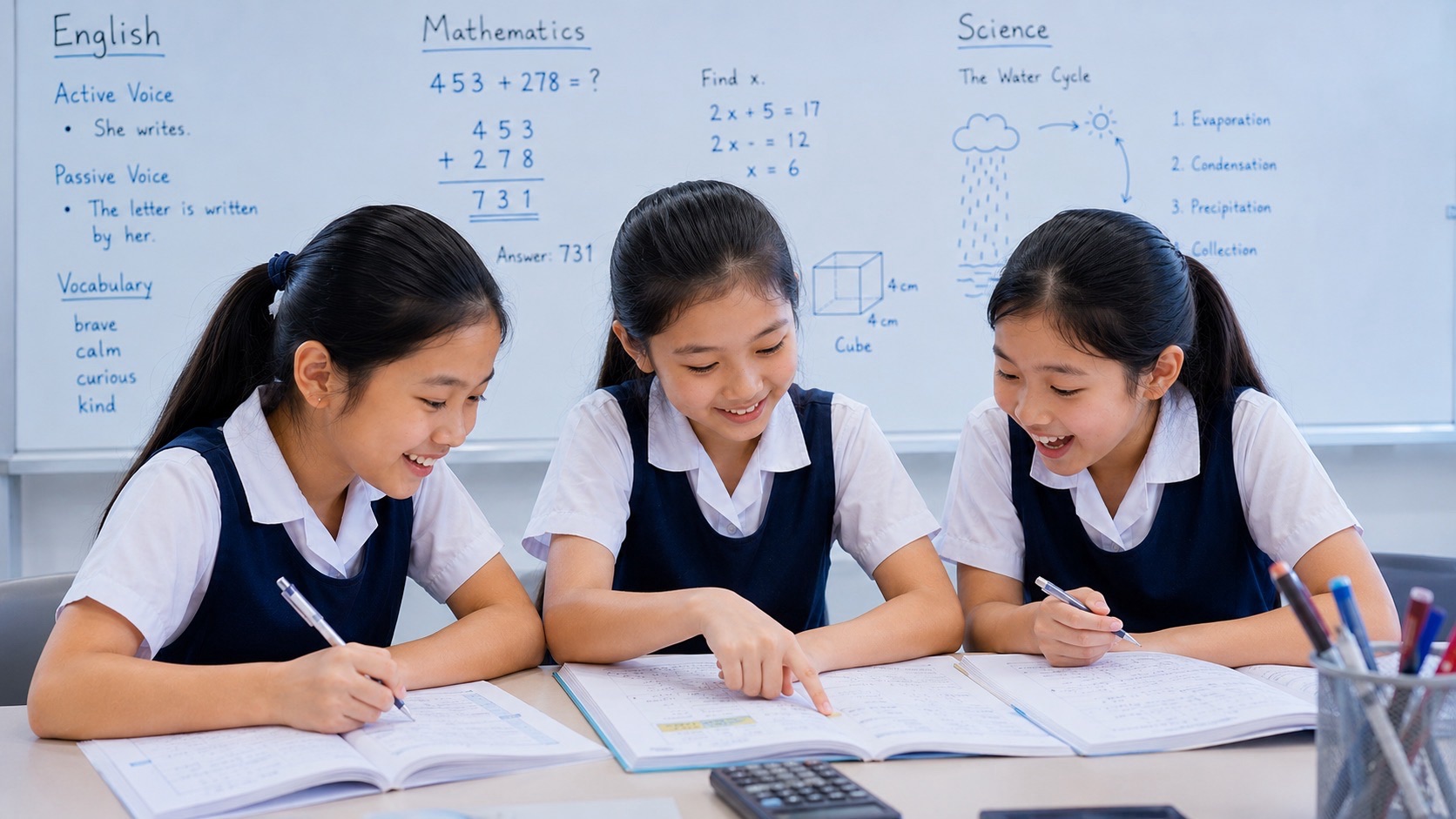
Primary 2 English nonfiction reading tuition should help a child explain what a short information text teaches and show which details support that explanation. For parents looking for a Bukit Timah tutor, this is a precise learning goal: connect reading the words with organising the information. The child learns to name the topic, identify a main idea, follow an explanation and recognise when a question cannot be answered from the passage.
In eduKate’s three-student model, a suitable lesson gives every learner time to read, attempt an answer and discuss the evidence before trying a fresh example. Parents should confirm current Primary 2 provision and group suitability directly. Useful support begins with the child’s schoolwork and a visible difficulty, such as recalling several details while missing what the paragraph is mainly about. The lessons below show how to teach that connection through manageable prose, accurate explanations and increasing independence.
- Main focus: factual prose, topics, main ideas, supporting details and simple explanations.
- Reading habit: explain what the paragraph teaches, then show which details support that explanation.
- Practical skills: locate information, compare matching features, follow reasons and make a short summary.
- Careful reasoning: separate what the passage establishes from a guess, an opinion or missing information.
- Lesson design: use appropriate texts and individual attempts before group discussion.
- Parent check: notice whether the child needs less prompting on a different passage.
- Scope: teaching activities, with invented classroom examples clearly identified and a factual example linked to its source.
BUKIT TIMAH · PRIMARY 2 · PARENT GUIDE
Find your next learning step
Choose the question closest to your child, or follow the complete guide below.
Full chapter index · Try a practical activity · Primary 2 English overview
Chapter index
Open a section to choose a chapter. All teaching chapters remain expanded below.
1–2 · Choose a starting point
3–6 · Find the main idea
7–10 · Read relationships
11–12 · Summarise and practise
CHAPTER 1 OF 16 · Choose a starting point
1. Understand the learning goal and the school context
Nonfiction aims to communicate information about the real world. A child may meet it in an animal book, a short explanation of an object, a museum description or a report about an actual event. Reading it involves deciding what information matters and how the sentences fit together.
MOE’s English Language Syllabus 2020 for primary schools includes reading and viewing for different purposes, with attention to meaning, context and comprehension. The activities here offer a practical way to work on informational reading. They are not a national Primary 2 booklist, a compulsory weekly sequence or an official marking rubric.
MOE removed weighted assessments and examinations for Primary 1 and Primary 2 from 2019. SEAB places PSLE at the end of primary schooling. A P2 reading lesson can therefore focus on understanding without borrowing a national examination label.
Ask the school teacher which current reading skill needs attention. A broad concern becomes more useful when attached to work the child actually attempted. “He found three facts but could not explain how they belonged together” gives a tutor something concrete to teach.
Several passages below use imagined classrooms to control the language and information. They are practice texts written in an informational style, not reports of real events. This distinction matters: clear, factual-sounding prose does not make an invented event true.
CHAPTER 2 OF 16 · Choose a starting point
2. Choose a text that leaves room for thinking
Before asking for a main idea, check whether the child can access the passage. If nearly every sentence contains unfamiliar words, the difficulty may arise before the child reaches the task of organising information. Start with a short paragraph about a reasonably familiar subject.
Let the child read, then ask what was learned. If the response is uncertain, read the passage aloud and ask again. A clearer answer after listening suggests that accessing the print deserves attention. Continued uncertainty suggests looking at vocabulary, sentence meaning or the question itself. This is a teaching observation, not a diagnosis.
Explain one essential unfamiliar word before continuing. Keep the explanation tied to the sentence. If “equipment” refers to pencils, paper and brushes in the paragraph, identify those examples and return to the whole message. A long vocabulary detour can cause the original reading purpose to disappear.
A child may understand a paragraph and still need time to express the answer. Allow pointing to a sentence, giving a short oral explanation or choosing between two possible main ideas before requiring a written response. Then gradually ask the child to construct the answer independently.
Increase the demand deliberately. Add a second paragraph, a less familiar topic or a more complex relationship one at a time. This makes it easier to see what has become difficult and what support will help.
CHAPTER 3 OF 16 · Find the main idea
3. Separate the topic from what the paragraph says about it
The topic names the subject. The main idea explains the important message about that subject. “Drawing materials” names a topic; “The group prepares its drawing materials before the activity” says something about it.
Practice passage A: getting ready to draw — an invented classroom example
The drawing group gets its materials ready before the activity begins. A helper places paper on each table. Another helper checks that the coloured pencils are ready to use. The teacher puts the reference pictures where everyone can see them. With these preparations complete, the children can begin their drawings.
Ask, “What is the paragraph about?” A reasonable topic is preparing for a drawing activity. Ask a different question next: “What does it tell us about that preparation?” A useful answer is that the group gets the materials ready before drawing starts.
Accept natural wording that preserves the idea. “They prepare the things they need before they start drawing” is a suitable explanation. The learner does not need to reproduce the first sentence exactly to show understanding.
Compare three possible answers: “Drawing”, “A helper puts paper on the tables” and “The group prepares the materials before drawing begins.” The first is too brief to express the message. The second describes one supporting action. The third covers the work of the group.
Ask the child to connect the paper, pencils and reference pictures to the proposed main idea. Each detail shows a part of preparation. This is the check that prevents choosing a sentence simply because it sounds important.
If the child gives the topic alone, respond with, “What does the paragraph tell us about it?” If the child gives one detail, ask whether that answer also covers the other actions. These prompts reveal the next thinking step without supplying the entire answer.
CHAPTER 4 OF 16 · Find the main idea
4. Use a heading to begin, then check it against the paragraph
A heading gives the reader a starting expectation. It does not remove the need to read. A heading such as “Our Drawing Group” names a broad subject; the paragraph might describe how the group prepares, shares ideas or packs away.
Return to passage A and offer two headings: “Preparing for Drawing” and “Choosing the Best Drawing”. The first fits the actions described. The second introduces a decision the passage never mentions. Ask which details helped the child choose.
Now try “Paper on the Tables”. This heading fits one sentence but misses the pencils and pictures. Explain that a useful heading usually needs to cover the section as a whole. It can be short while still pointing towards its central subject.
A child may have heard that the main idea is always in the first sentence. Treat the opening sentence as a useful place to look, then check the whole paragraph. Writers can place the central message elsewhere or leave the reader to combine the details.
For practice, move passage A’s first sentence to the end and read it again. The information still concerns preparing materials. Ask what stayed the same even though the order changed. This demonstrates why location alone cannot decide the answer.
Later, let the child propose a heading and explain it. A heading that names the subject accurately gives a starting point for discussion; a heading that also captures the paragraph’s particular focus may be more useful. Judge the fit with the actual passage.
CHAPTER 5 OF 16 · Find the main idea
5. Find the details that hold the main idea together
Once a child proposes a main idea, ask for one detail that supports it. This reverses the usual pattern of answering several small questions and hoping the larger meaning appears. The learner has to show how the example belongs to the message.
In passage A, checking the pencils supports the idea of preparing materials. The child can explain, “The pencils need to be ready before the group starts.” Placing the reference pictures where everyone can see them supplies another relevant detail.
Introduce an extra sentence for discussion: “The classroom door is green.” Explain that this is an invented addition. It may describe the same setting, but it does little to explain how the drawing group prepares. Being about the classroom is not enough to make every detail equally useful.
Ask the child to sort the sentences into “helps explain the main idea” and “does not help much here”. Allow disagreement when the child can explain a plausible connection. Then return to the exact main idea under discussion and decide whether the connection is strong enough.
Do not teach children to delete every interesting detail. A detail’s value depends on the reading task. The colour of a door might matter in a description helping a visitor find a room. It contributes little to this account of preparing drawing materials.
A useful correction is specific: “You chose a detail from the passage, but we need one that explains the preparation.” That preserves what the child did correctly while clarifying the missing relationship.
When the child is ready, ask for two supporting details that contribute different information. Choosing both paper placement and pencil preparation shows a broader view than repeating the same action in two forms.
CHAPTER 6 OF 16 · Find the main idea
6. Read a factual paragraph and identify its focus
The following paragraph draws on NParks’ Animal and Veterinary Service information about bats. Read it as a small nonfiction example; the adult can explain unfamiliar vocabulary before asking the child to organise the ideas.
What bats eat and how they help
Bats do not all eat the same food. Some eat fruit, some take nectar from flowers, and others eat insects. Their feeding can help other living things. Some bats move pollen between flowers or spread seeds. Insect-eating bats help keep insect numbers in check.
A suitable main idea is, “Bats eat different foods and help nature in different ways.” “Some bats eat fruit” is a relevant detail, but it does not cover the whole paragraph. “Bats are the best animals” is an opinion the paragraph does not establish.
Ask which sentence introduces the food differences and which introduces their wider effects. This helps the child see two connected parts within a short passage. If that demand is too large, begin with locating one example of food.
Use the exercise to discuss what a source does. Here, the factual information can be checked against a named government agency’s wildlife page. The earlier classroom passage was explicitly invented. Both can be used to practise reading relationships, but only one describes verified information about the real world.
The child need not memorise technical terms to complete this reading lesson. A clear explanation of the paragraph’s focus, supported by an appropriate detail, is enough. Choose a more familiar subject if the vocabulary prevents the child from thinking about the information.
CHAPTER 7 OF 16 · Read relationships
7. Locate a detail, then read the sentence that contains it
Scanning means looking for a particular piece of information. It can help when the question asks for a name, day, object or quantity. The next step is to read the surrounding sentence so that the found word is interpreted correctly.
Practice passage B: a classroom collection — an invented record
The class collects clean cardboard for a model-building activity. Families send the cardboard on Tuesday. The helpers sort it on Wednesday, and the children use it on Friday. The class does not collect glass. Small cardboard pieces go into a shallow tray so that the children can see them easily.
Ask when the helpers sort the cardboard. The child can look for “helpers” or “sort”, then read the sentence to find Wednesday. Tuesday is nearby, but it belongs to sending the materials. Friday belongs to using them.
Ask what the class does not collect. A child who spots “glass” without reading the whole sentence may misreport it as an accepted material. The small word “not” controls the meaning. Have the child reread the complete statement.
Now ask why the small pieces are placed in a shallow tray. Finding “tray” locates the relevant sentence; the phrase about seeing the pieces supplies the reason. The search has found the place to read closely.
Main-idea questions need a wider reading. One date or object cannot usually represent the whole passage. Teach the child to notice whether the question asks for a specific detail or an explanation of what the paragraph is mainly about.
An explanation links an action or condition with a result. A child may recall both parts yet leave the relationship unstated. Ask a question that brings the link into view: “How did that change help?” or “What happened because of it?”
Practice passage C: keeping model pieces together — an invented classroom example
Small model pieces were getting mixed up on a large table. The class began placing each group’s pieces in a separate tray. A card in each tray named the group. At the next lesson, the children could find the pieces for their own models without sorting through everyone else’s work.
The problem is that pieces were getting mixed up. The change is separating them by group and identifying the trays. The stated result is that children could find their own pieces without searching through everyone else’s work.
Ask, “How did the separate trays help?” A useful answer connects the change to the result: “Each group’s pieces stayed together, so the children could find the pieces for their models.” An answer that says only “They used trays” names the action but leaves the reason unfinished.
Let the child explain orally before writing. If needed, provide the beginning, “The trays helped because…” Then remove the starter on a later example. The aim is an explanation the child can build, rather than a phrase completed from memory.
Keep the conclusion within the information. The paragraph does not tell us that every child finished earlier or made a better model. Those might be questions for another record. An explanation should not add a success story that the source never supplied.
For a stronger learner, ask what detail would help investigate whether the change saved time. A reasonable suggestion is a record of how long finding materials took before and afterwards. Treat this as an extension question, not a required P2 research method.
CHAPTER 9 OF 16 · Read relationships
9. Compare matching features across two short texts
A comparison becomes useful when the reader compares the same feature on both sides. A statement about one group’s storage and another group’s favourite colour does not establish a meaningful similarity or difference.
Practice passages D and E: two art groups — invented records
Blue Group: The Blue Group keeps its shared coloured pencils in a wide tray. One helper checks the pencils immediately after the activity. The group keeps spare paper in a folder beside the tray. Every member returns borrowed materials before leaving.
Red Group: The Red Group keeps its shared coloured pencils in two pots. Two helpers check the pencils just before the next activity. The group keeps spare paper in a drawer. Every member returns borrowed materials before leaving.
Begin with one feature: pencil storage. Blue uses a tray and Red uses pots. Next, compare when checking happens: immediately after the activity for Blue and just before the next activity for Red. The wording must keep each detail attached to the correct group.
| Feature | Blue Group | Red Group |
|---|---|---|
| Pencil storage | A wide tray | Two pots |
| Checking time | Immediately after the activity | Just before the next activity |
| Returning materials | Every member returns borrowed materials before leaving | Every member returns borrowed materials before leaving |
Ask for one difference and one similarity. “Blue uses a tray while Red uses pots” gives a matched difference. “Members of both groups return borrowed materials before leaving” gives a supported similarity.
Then ask whether the passages show which group is more organised. They describe different arrangements but provide no results establishing that one works better. A child can prefer a method while recognising that a preference does not prove its effectiveness.
For an independent check, ask the child to compare where spare paper is kept without using the completed table. Blue uses a folder beside the tray; Red uses a drawer. This fresh comparison shows whether the child can locate and connect another matching feature.
CHAPTER 10 OF 16 · Read relationships
10. Distinguish evidence, opinion and missing information
Use three simple prompts during discussion: “The passage tells us…”, “My view is…” and “We would need to find out…”. They help a child communicate the status of an answer. They are teaching supports, not mandatory sentence openings.
For the art groups, “Red keeps pencils in two pots” is supported by the record. “Pots look nicer than trays” expresses a preference. “Red loses fewer pencils” would require information that neither record provides.
Recognising missing information is part of careful reading. The child can say what would be needed: a count of missing pencils, collected in a comparable way. A confident guess should not earn more approval than an accurate statement that the text is insufficient.
When reading nonfiction, check more than whether a claim appears in print. An adult can help identify the author or organisation, consider whether that source knows the subject, and compare an uncertain claim with another reliable reference. A date can matter when the information changes.
NLB’s S.U.R.E. parenting resource offers a wider framework for examining sources and information. For a young child, begin with a manageable question such as, “Who is telling us this, and where could we check it?” The adult should guide the checking process.
Keep this habit proportionate. An ordinary reading session does not need to become a debate about every sentence. Pause when a claim is surprising, unclear or important to the question, and show how uncertainty can lead to a useful next inquiry.
CHAPTER 11 OF 16 · Summarise and practise
11. Build a short summary that preserves the main message
A summary is a short account of the important information. For a P2 learner, begin with one paragraph and an oral response. Ask, “What would you tell someone who has not read this?” Then check whether the response captures the central message.
Return to the model-piece passage. A suitable brief summary is: “The class used named trays to keep each group’s model pieces together, making the pieces easier to find.” It retains the problem-solving idea without repeating every sentence.
“The children made models” is too broad for that passage. “There was a card in each tray” is a detail that omits the larger purpose. “The class became the best at model building” adds a claim that the text does not support.
Invite the child to check a summary against two questions: does it cover the important information, and does it add anything the passage never said? These checks can be done through conversation before they become a written routine.
Do not insist on unfamiliar synonyms. A child who changes “tray” to an inaccurate word has made the summary less clear. Some key terms need to remain. Encourage an independently constructed sentence while allowing necessary words from the source.
When one paragraph is secure, try two short paragraphs with different jobs. Ask for one brief note about each, then combine them. For example, one paragraph may explain a problem and the next describe the response. The final summary should preserve that relationship.
Keep the task flexible. A clear spoken summary may reveal understanding that a lengthy writing requirement would conceal. Written summaries become useful when the child can manage both the reading idea and the sentence construction.
CHAPTER 12 OF 16 · Summarise and practise
12. Try a fresh passage with explained answers
This passage describes an imagined school display. It is a fresh informational-style exercise, not a report about an actual school. Let the child attempt the questions before reading the explanations.
A display visitors can understand
Class 2F prepared a display of paper houses. At first, visitors could see the models but could not tell which features the children wanted them to notice. The class added a short card beside each model. Each card named one important feature, such as a wide doorway or a covered balcony.
The children also placed rough sketches in a folder beside the display. A note invited visitors to look through the sketches. Visitors could then compare an early drawing with the finished model. The cards and sketches gave visitors more information about the children’s work.
- What is the passage mainly about?
- What information did each short card provide?
- How did the sketches help visitors?
- Which detail supports the idea that the display helped visitors understand the work?
- Does the passage tell us which paper house was the strongest?
- Give a short summary in your own sentence or sentences.
Answers and explanations
1. The class added information to help visitors understand its model display. Accept similar wording that covers both cards and sketches. “Paper houses” names the topic, while “A folder beside the display” selects one detail.
2. Each card named one important feature of its model. A wide doorway or covered balcony is an example. The paragraph does not say that every house had both features, so an answer should preserve that distinction.
3. The sketches allowed visitors to compare an early drawing with the finished model. This explains their purpose. “They were in a folder” identifies their location but does not answer how they helped.
4. One suitable detail is that the cards identified important model features. Another is that visitors could compare sketches with finished models. Ask the child to explain how the chosen detail contributes to understanding.
5. No. The passage supplies no strength test or result. The child should not infer structural strength from the words “wide doorway” or “covered balcony”.
6. A possible summary is: “Class 2F used feature cards and early sketches to help visitors understand its paper-house models.” A clear alternative can be equally suitable. Assess whether it includes the central purpose and avoids unsupported additions.
After discussion, ask which question was easiest and which needed another reading. If the child answered details accurately but struggled with the main idea, practise grouping the two kinds of supporting information. If the child understood orally but found writing difficult, keep those observations separate when planning the next lesson.
CHAPTER 13 OF 16 · Choose useful support
13. What a three-student reading lesson should reveal
A small group can give the tutor time to hear how each child understands a paragraph. That opportunity needs deliberate use. If one learner supplies every answer, the others’ understanding remains unclear regardless of the group’s size.
Begin with an individual attempt. Each child can give a short oral answer privately, write a few words or choose a main idea before discussion. The tutor then asks learners to explain the evidence and compare responses. The aim is to make each person’s reasoning visible.
Use temporary roles for a shared task. One child proposes a main idea, another identifies a supporting detail, and the third checks whether the proposed idea covers the whole paragraph. Rotate the roles so that no child becomes permanently responsible for the easiest or hardest part.
The tutor can adjust the demand within one passage. A learner who needs support might choose between two main ideas. Another might formulate an independent answer. A confident reader might explain why an attractive alternative is too narrow or unsupported.
Finish with a different short paragraph. This checks whether the learner can use the idea beyond the text discussed together. A useful parent update states what the child managed independently, what prompt was still needed and what will be taught next.
Class size is one part of the decision. Look for careful text selection, enough individual participation and explanations that respond to actual misunderstandings. Confirm current Primary 2 arrangements rather than assuming that every three-student class has the same programme or availability.
CHAPTER 14 OF 16 · Choose useful support
14. Build home practice around curiosity and visible progress
Choose a subject the child wants to know about and a text the child can mostly access. Animals, vehicles, buildings, materials and everyday tools can all provide a reading purpose. Interest helps choose the topic; the child’s current reading needs determine the length and support.
NLB’s primary-school reading recommendations are one starting point for discovering books. Inspect a few pages together and seek help from the librarian where useful. A recommendation is an invitation to explore, not a compulsory reading target for every P2 child.
For one short session, read a paragraph and ask what it teaches. On another occasion, look for a detail supporting that idea. Later, invite the child to explain a different paragraph to someone who has not read it. This is an optional pattern that can be adjusted around schoolwork and family life.
Keep one early attempt and a later unfamiliar example. Note how much help was needed. “Explained the main idea after choosing between two options” is different from “Explained it independently and found a supporting detail.” Both are useful observations.
Compare similar demands. A heavily rehearsed paragraph and an unfamiliar page with difficult vocabulary do not provide a fair comparison of one skill. Ask the teacher or tutor to suggest suitable texts when the difference in difficulty is unclear.
Preserve reading for enjoyment as well. Some pages can simply be explored, discussed or enjoyed without written questions. When an activity becomes a struggle, identify the difficult step, provide an appropriate model and choose a manageable finishing point.
Progress can include asking a precise question, noticing that a summary adds an unsupported claim, or correcting an answer after rereading. These are useful reading actions to acknowledge alongside accurate responses.
CHAPTER 15 OF 16 · Choose useful support
15. Decide whether additional teaching matches the need
Bring a specific reading example to a consultation. “She remembers the interesting facts but cannot explain what the paragraph is mainly about” is more informative than “She needs harder comprehension”. Ask how the tutor would investigate the difficulty and demonstrate the first teaching step.
If printed words are the main obstacle, discuss that directly. A lesson focused only on main ideas may be poorly matched until the child can access suitable text with support. If the child reads fluently but gives unrelated answers, ask how the tutor teaches connections between the question and the passage.
For a learner already secure with short paragraphs, consider greater depth before greater volume. Comparing two explanations, evaluating a summary or identifying missing evidence can provide a meaningful next challenge. The tutor should explain why that challenge fits the child.
Ask how group members are matched, how individual attempts are checked and what feedback families receive. Confirm current fees, lesson duration, location, materials and available places directly. The teaching arrangement should be clear before a family commits.
For Bukit Timah families, include travel and the child’s existing commitments in the decision. A lesson needs to fit the week and leave the child able to participate. Additional tuition is one option; suitable school support and manageable home practice may already meet the need.
Agree on a review point and the evidence to discuss. Look for clearer explanations and growing independence on appropriate new texts. If progress is uncertain, ask what will change in the teaching rather than continuing an unchanged routine without understanding its purpose.
Is the main idea always the first sentence?
It may be stated there, but the whole paragraph must support the choice. The main idea can appear later or require the reader to combine information. Ask whether the proposed answer covers the important details wherever it appears.
Should a child use exactly the answer key’s wording?
Follow the teacher’s instructions for assigned work. In teaching, accept wording that preserves the meaning and supplies the requested information. If two answers seem different, compare their meaning against the passage before treating one as wrong.
Does remembering many facts show full understanding?
It shows that the child retained information. Ask a further question about how the details connect or why they matter. A child can build from a remembered fact towards a main idea without having the earlier achievement dismissed.
Can pictures help with nonfiction reading?
Yes, when they support the information being read. Discuss what a picture or caption contributes, then return to the paragraph. Check that an answer uses the relevant evidence rather than adding a story suggested only by the illustration.
Should every reading activity end with written work?
An oral explanation can be enough for a particular teaching goal. Writing adds its own demands. Use a written response when it serves the task, and distinguish understanding the passage from constructing and recording the answer.
What is a useful first step today?
Choose one manageable paragraph. Ask what it teaches and which detail helps show that. Listen before prompting, identify one point to teach and try a suitable new example later. The goal is a child who can organise information and explain how the text supports the understanding.
Curriculum and source links checked on 16 November 2026. Original practice examples are for learning; confirm your child’s current classroom sequence with the school.