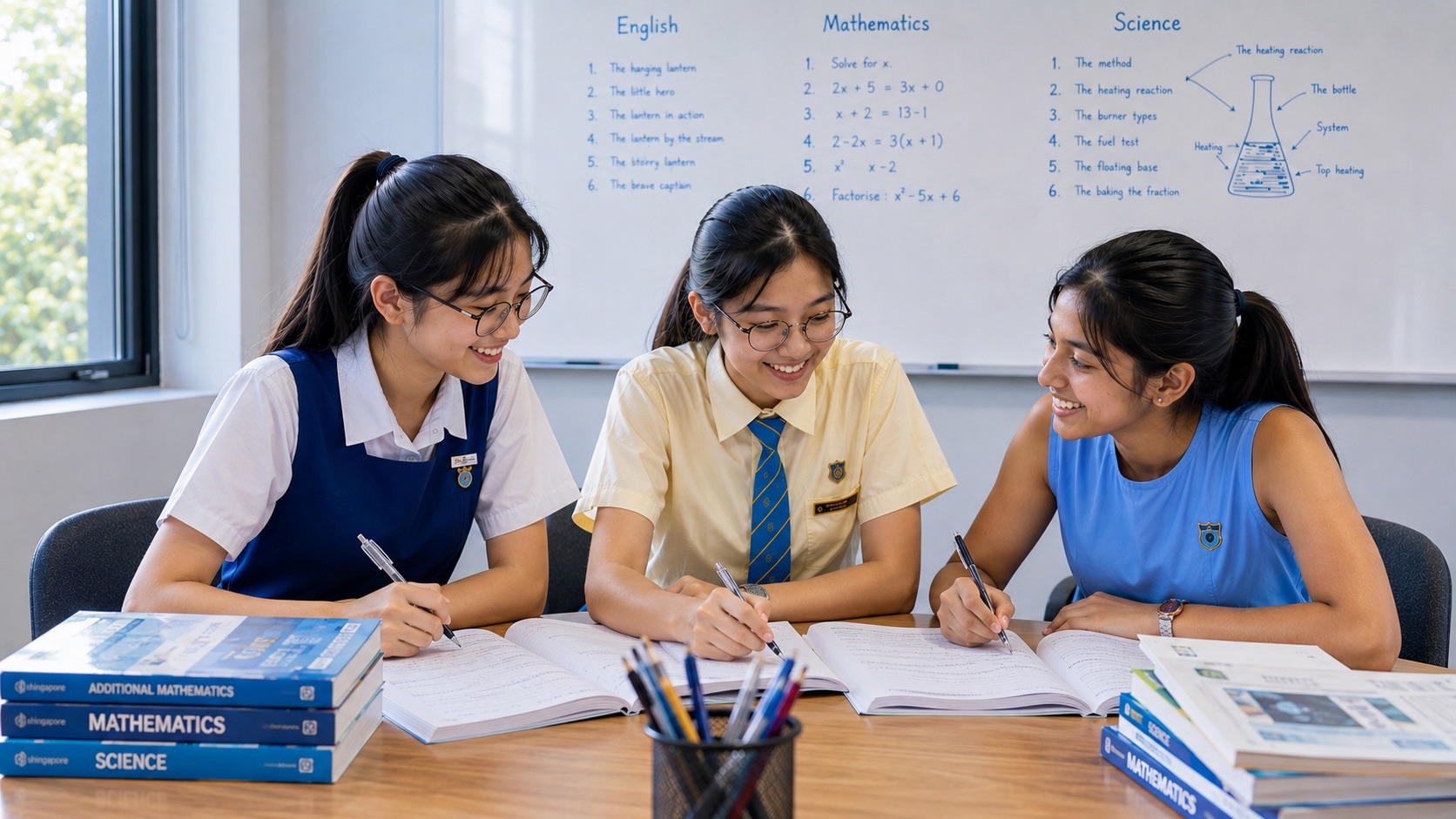
Secondary 1 G1 English small-group tuition can help Kovan students understand what a poster, notice or campaign is asking its readers to do. In a three-student group, each learner can work out the message independently, point to the words or visual detail that supports their answer and try again after feedback. A useful lesson shows the student how a title, image and small print can give different parts of the same message.
The move from Primary 6 to Secondary 1 brings more texts that ask students to read words together with pictures, labels and layout. A student who spots the largest heading may still miss who a notice is for or when the invitation applies. For a Kovan family, a useful class starts with that precise gap and checks whether the child can read an unfamiliar visual text more accurately on their own.
- Confirm that your child is taking English Language at G1 and ask what kinds of visual texts the class is reading this term.
- Read the heading, image, caption and conditions together before deciding the overall purpose.
- Identify the audience from clues in the text and explain why those clues matter.
- Use the original posters and worked questions below to practise giving evidence for a reading.
- Use the published 2027 SEC syllabus as a reference, and check the syllabus for your child’s own examination year.
- Look for independent attempts, specific feedback and fresh examples in a three-student class.
Find your next learning step
Jump to a section or read the guide in order.
Find the message before explaining the design and related sections
Read a public campaign for its argument and related sections
Make an answer with a claim, evidence and a connection and related sections
Decide whether the next step fits your family
Find the message before explaining the design
Put a familiar notice in front of your child. Ask what they would tell someone who could not see it. They may begin with “It is about books” or “There is a picture of a bus”. Those observations can start an answer. The useful next step is deciding what the notice tells a reader about books or the bus. “It asks students to bring a book they have finished for a class exchange” gives enough detail to see the reason for the notice. “The bus is leaving from a different door because the usual pickup point is closed” identifies what a reader needs to know.
A visual text can include a heading, repeated symbols, pictures, lines, type sizes, a call to action and a source line. Each element can guide a reader, but an answer needs to connect the element with a job. “The heading is big” identifies a feature. “A large heading makes the changed pickup point easy to see when parents glance at the page” explains the effect in this situation. If the large heading names the campaign and the pickup point appears in small print, the student should choose a different detail. Good answers depend on what appears on the actual page.
Start with two readings. On the first, look at the elements that stand out and say what the text seems to be about. On the second, read the words and consider the layout more slowly. Ask who can act on the message, when they can do so and which detail could change the action. The first look helps a learner orient themselves. The second can correct a first impression. A picture of someone holding a trophy may suggest a contest, while the caption shows the group is collecting trophies from a previous school year for an exhibition.
Work out what the text is asking a person to do
A purpose may be to inform, invite, remind, persuade or instruct. These verbs are helpful starting points. Add what the person is being informed about, what they are being asked to join or what behaviour the text is trying to change. “To persuade” is too general for a reader to see whether the student understood the poster. “To persuade students to put borrowed items back in their labelled containers after class” gives the action, audience and situation.
Ask what readers are likely to know before they see the notice. Students who took part in an event may recognise a photograph and understand a short heading such as “Ready for another round?” New students may need an explanation underneath it. If the poster says “New to the school? Join our walk from the office”, the words give stronger evidence about the audience than assuming the designer chose a fresh-looking font. Start with what the notice actually says. Use the picture or style to support that reading when it fits.
Identify the main purpose by asking what the reader can do after seeing the text. A poster about a display might include an explanation of the work on show, directions to the hall and an invitation to vote for a favourite model. The main heading and most prominent action help a student decide which purpose has priority. A question may ask for one specific feature instead. If it asks why a map is included, the answer should explain the map’s local job even if the poster as a whole is an invitation.
Separate the people pictured from the people addressed
A notice may show a young child while speaking to an older student or an adult. A campaign about keeping corridors clear might depict a younger pupil unable to pass a group. The instruction underneath could say, “Student leaders, use these signs during collection.” The picture illustrates the problem. The language addresses the people who can carry out the plan. Ask which clues refer to the people who appear and which refer to the person the notice expects to act.
Try this with a simple family example. A school notice shows a student carrying a project and states “Families collecting a large model may use the courtyard gate from 4 p.m.” The student is pictured. Families collecting large models are addressed. A reader could reasonably infer that family members who pick up small items might need a different entrance, but the sentence gives no instruction for them. Ask the child to underline the audience phrase before they answer a question about who can use the gate.
Even a large public campaign can have a specific audience for one part of its text. A park poster may call on all visitors to keep paths clear. An additional line may ask group leaders to move bags before activity time. The first request reaches a broad audience. The second gives a more specific action to a smaller group. A reader can answer each question by finding its part of the message.
Read a notice where small conditions change the answer
Use this original practice notice. The layout is described in words so it can be read aloud or copied into a plain document. Put each element on its own line if you want the student to see the spacing.
The top of the notice says “Collect your class display”.
A drawing in the middle shows two students carrying a cardboard model together. A label below the drawing says “Models longer than the display shelf need two people to carry them”.
Below the drawing are two headings. The first says “Collect from the hall”. The line underneath reads “All groups collect materials between 3.15 and 3.45 p.m.”
The second heading says “Bring a helper for a large model”. The line underneath reads “If your model is longer than the shelf, bring one classmate or family member. Wait beside the hall door until the organiser calls your group”.
A separate line at the bottom says “Class Display Team”.
Ask the student to identify the main purpose. “To tell groups how to collect their class display materials, including what to do for a large model” is a suitable answer. The heading names the shared task and the sections set out details. “To teach students how to make a large cardboard model” would overread the image, because neither the headings nor the instructions explain how to build anything.
Who has to bring another person? Groups collecting a model longer than the display shelf should bring one classmate or family member. “All groups” appears in the collection-time section. The phrase “if your model is longer” limits the helper rule. Ask the student to show the boundary between the two instructions. When they can explain where the universal requirement ends and the condition begins, their answer is based on the notice.
What does the drawing add? It shows what working with a helper can look like and makes the special instruction easier to picture. The caption tells the reader which models need a helper. Without the caption, the picture could simply show two people carrying a model by choice. An explanation that names the picture and caption together is more precise than saying the picture makes the notice interesting.
What can a writer infer from the source line? The Class Display Team appears to be issuing the notice. The line does not establish the names of team members or say which teacher is present. A reader who needs a teacher’s name should check another part of the school instructions. This is a small distinction, but it teaches students to answer with the information they have.
Try a new notice with the condition in a different place
Write “Return your borrowed sports items” at the top of another page. Put “Everyone returns items by 2.30 p.m.” below it. Add an illustration of a bag with a whistle and a ball beside it. Under the illustration, put “Only bottles from the water station go in the side tray”. Add a line at the bottom reading “If the cupboard is locked, ask the duty teacher before leaving equipment outside”. Ask which detail affects a student holding a ball after finding the cupboard locked. The intended answer is to ask the duty teacher. The learner should identify the relevant condition and ignore the side tray instruction aimed at bottles.
Now give the question to another learner before offering a model. “What does everyone have to do by 2.30?” They should distinguish the deadline from the locked cupboard condition. Ask them to name their evidence. If they read the whole notice back to you, help them choose the line that answers the question directly. On the next example, see whether they can select the line without that prompt.
Contents · Previous section · Next section
Read typography and layout as choices
Typography includes how the words are displayed. Larger type, bold text, spacing and labels can tell readers what to look at first or which lines belong together. A box may separate urgent instructions from background information. White space can help a reader recognise a new section. These visual choices can guide attention without replacing the actual words. Ask what the larger words say and why those words help the intended reader.
A row of three items can imply that they have a similar role. Imagine an event flyer with three equally sized boxes titled “Build”, “Show” and “Share”. A horizontal arrow runs through them. The boxes and arrows suggest an order. In another flyer, the same three words might be parallel options with no arrows and a line saying “Choose one”. Equal boxes alone cannot tell you whether a reader should complete every step. The direction cues and nearby wording decide whether the boxes depict a sequence or a choice.
Spacing can change which sentence a reader thinks applies. Write the words “For parents” as one small heading, followed by a collection time. Then write “For student volunteers” beside a separate set of instructions. Ask which reader needs to attend a briefing. If the learner connects the briefing to the first heading, put a blank line between the groups and check whether the layout now makes the difference easier to see. Then ask them to find distinct groups on a new notice.
Explain why certain words are prominent
Try this imaginary school-door notice.
The largest words are “USE THE SIDE DOOR”.
Below them, a smaller sentence says “The main entrance will be used for deliveries until 10 a.m.”
An arrow labelled “Side door” points right. The bottom line says “Ask the office if you need a step-free entrance”.
Ask why the first line is largest. The main action for most readers is to use the side door, so large type makes the instruction easier to notice as they approach. A reader who suggests the large words tell people why the main entrance is closed has confused the jobs of the heading and explanation. The smaller line gives the reason and the time limit. The arrow helps people act.
Ask what someone arriving with a mobility need should do. The last line tells them to ask the office if they need a step-free entrance. The visual text gives a route for most visitors and another instruction for people who need that option. It would be inaccurate to claim the side door itself is step-free. The statement does not describe the physical properties of that door.
Repeat using a sign in which the reason appears first and the action second. A student might initially assume the largest words are always the most important. Ask what a real reader would most urgently need to know, then compare that with the layout. The student can explain whether the design helps the reader find the essential information quickly.
Read a symbol together with the words that explain it
A symbol can suggest a familiar idea. A book above a doorway may identify a reading space, and an arrow can point in a direction. Still, a symbol can have more than one possible meaning. A hand raised beside a list might indicate “volunteer here” or “wait to be called”. Look for the nearby labels before deciding. A picture of headphones might tell readers that audio is available, or it may mark a room where students should use headphones. The intended action comes into focus when the words say what to do.
Choose a sign with two marks next to two doors. Imagine one mark depicts a stack of books and the other a person at a counter. Under the books are the words “Return from 2 p.m.” Under the person are the words “Collect holds from 2.30 p.m.” Ask the child what a reader can do at 2.15. Returning books is already possible. Collecting items on hold begins later. The labels and times are essential. The size or detail of either drawing does not supply that answer.
Develop the question by asking why each drawing is placed beside its own words. One clear answer is that a reader can match each service to the relevant sign before reading both times. If the drawings were swapped, the words would still supply the formal instruction, but more people could be misdirected on a quick reading. That is a concrete explanation of how position can affect understanding. Have the child read the same sign with the drawings removed and explain which information remains clear.
Contents · Previous section · Next section
Read a public campaign for its argument
A public campaign asks people to adopt a behaviour, join a cause or reconsider a habit. A campaign can use a picture to show a consequence and a short line to offer a practical action. The student should explain how these choices work together. Ask what problem the campaign shows, what the reader is expected to do and what reason it gives for that action. This is more useful than simply naming the mood of the poster.
Imagine a sign beside an activity room. It shows a long line of bags extending into a narrow path, with the text “Leave room for someone to pass”. The audience could include students and visitors who set bags beside the wall. The line on the sign specifies the desired result. A larger word such as “pass” may direct attention to the people using the path. If the sign adds “Use the marked shelves before joining an activity”, the student can explain how the poster connects a problem with a clear action.
A picture may show the situation just before or after the action requested. Images of people smiling around an empty bench can represent a benefit the campaign wants to make possible. Pictures of a person unable to pass serve another purpose. The student should identify what is present on the page. In an answer about the effect, “it shows how blocked paths inconvenience other visitors” is more specific than “it makes people feel bad”. If someone looks worried, use a feature such as their posture and the object they face before saying how the image might influence a reader.
Worked campaign about leaving a table ready
Here is an invented campaign for students using a shared study area.
The headline at the top says “Leave the table ready”.
Two rectangular pictures sit side by side. The left one has the label “Left behind” and shows used paper, a chair pushed into a walkway and a workbook on a table. The right one has the label “Ready for the next group” and shows the same chair tucked in and the same table clear.
Across the bottom of both pictures is the line “Take your books, use the paper tray and push your chair in”.
Under the line is a smaller note. “Take personal belongings home. The paper tray is for scrap paper only”.
The source line says “From the Shared Study Space Team”.
What is the campaign trying to achieve? It encourages students who use the shared study space to clear personal belongings and scrap paper and tuck in their chairs so others can use the space more easily. The two labelled panels identify the problem and the desired condition. The instruction names the actions. The phrase “ready for the next group” explains whom the behaviour helps.
Why do the pictures show the same table and chair? A writer could say that viewers can compare how the same space looks before and after the requested actions. A new object would give the reader extra work to see whether the scenes are related. In the poster, the matching view keeps attention on what changed. “To show two tables” describes the layout and gives the wrong impression about the campaign’s comparative choice.
What should a student do with an unfinished workbook? Take it home or otherwise keep hold of it as a personal belonging. The bottom line tells students to take their books. The small note limits the paper tray to scrap paper. If a learner answers “put it in the paper tray”, ask which clue gave that impression and which words refine it. A picture of used paper and a workbook close together can tempt a student to treat them alike. The text clarifies the actions for the two items.
How does the phrase “for the next group” help the campaign? The words give students a reason to act, because leaving the table ready allows others to use it afterwards. The phrase points to a shared outcome. If the learner writes “It makes the poster sound polite”, ask what that line tells the audience about the people who come later. They may identify the social purpose and give a clearer explanation.
Does the poster show that the campaign worked? The two panels present examples of what the problem and intended result look like. The source does not give observations over time, survey results or another measurement of behaviour after the sign went up. A student can write that the poster aims to encourage a change and shows what success would look like. This is a useful distinction in visual comprehension. A persuasive message can give evidence about a proposed action without proving that it happened.
Give the student a second campaign to compare
Describe a second invented poster in a different setting. Across the top appears “Let someone else try”. The picture shows one learner holding a shared practice microphone while another waits with an open notebook. The caption reads “Take turns during practice”. The line under the caption says “After two minutes, hand the microphone to the next speaker”. A smaller line asks the group leader to use the class timer. Ask the learner to identify the audience for the larger text and the smaller line. The first message is directed at students sharing the microphone. The timer instruction addresses group leaders.
Ask how the second campaign makes its action more precise than simply asking students to take turns. The time limit helps readers know when to swap and the instruction names who should receive the microphone. The timer line gives a group leader a way to put the plan into practice. An explanation of the effect needs those details. The picture shows someone waiting for a turn. The wording sets out how the group takes turns.
Contents · Previous section · Next section
Follow captions, labels and sources closely
A caption can identify what a picture shows, point out a relevant detail or connect the image with the topic around it. A photo of a closed door may show that a door was closed at some point. The caption “Entrance B before repairs” gives the entrance name and sets a time for the condition in the picture. If the current notice says “Entrance B has reopened”, the caption keeps the reader from assuming the photo depicts today’s arrangement.
Labels often identify items within the image. A picture showing a shelf can distinguish “Pick up new forms here” from “Return completed forms here”. The label gives each tray its function. A caption for the whole picture might say “Collection area beside the office”. Encourage the student to read both levels. If the question asks where to return a form, the correct detail is the labelled tray within the collection area. An answer that gives only the office misses the location the labels were designed to clarify.
Source cues can include the name of a group, an issue date or a revision line. They help the reader judge where the information came from and which version may matter. Imagine two copies of a club notice. The version labelled Tuesday says rehearsals begin at 3 p.m. The copy headed Thursday says “Latest update” and gives 3.30 p.m. The newer copy may supersede the older one if both concern the same rehearsal. Read the event name and dates carefully before combining the pieces. A child who uses the larger time for both notices should learn to match each time with a specific source and event.
Work through a poster with a dated restriction
Try this invented public notice. It is set outside a shared indoor activity area.
The headline says “The practice room is open again”.
The picture underneath shows a door with a low step. The caption reads “Usual entrance photographed before the relaunch”.
A box says “For Monday and Tuesday only, enter through the door beside the office while the usual ramp is checked”.
A line under the box says “Groups with Wednesday bookings should check the notice at the office before attending”.
The source line says “Activity Centre Desk, issued Sunday”.
Ask what a group with a Tuesday booking should do. Use the door beside the office, because the temporary instruction covers Monday and Tuesday. A learner who uses the photographed door has relied on the image without reading the caption and instruction around it. Ask them what “photographed before the relaunch” tells them about the image’s relation to the current arrangement.
Ask whether the Wednesday group can use the usual entrance. The notice tells Wednesday groups to check at the office and does not settle the route for them. “Monday and Tuesday only” limits the stated instruction. It leaves a separate direction for Wednesday. The answer should report that direction exactly. In a real decision, checking the latest notice is a meaningful next step.
Ask what “issued Sunday” contributes. It tells readers when this version was released. It can help them compare versions if a new notice appears. It gives no information on when the photograph was taken beyond what the caption says. Have the learner point to the exact source cue for each answer. The revision exercise is to turn “It is old” into “The caption says the photo shows the usual entrance before the relaunch.”
Contents · Previous section · Next section
Read a design that communicates without colour
Colour can group instructions or attract attention. A reader should still be able to identify the groups through labels, placement, texture or shapes. Imagine a map where one route is shown as a solid line tagged “Main route” and another as a dashed line tagged “Step-free route”. Someone reading a black and white copy still has markings they can follow. If the legend says “follow the blue line” and the lines look the same when printed, some readers may have trouble identifying their route. A student can explain the problem in terms of a reader’s task.
Give the child a sample with two boxes. One is marked “Record your name”. The other is marked “Ask the teacher”. Put a circle symbol next to any instruction everyone follows and a square symbol next to instructions for students borrowing materials. Add a legend under the title. Ask the learner to identify both the words and the symbols that show which instructions apply. Then remove the shapes and see whether the audience labels still tell them what to do. This helps students see how different parts of a design support the same reading.
Labels can also make a picture clearer for readers who cannot get as much detail from it. A poster shown as text can say “Two students place the same model inside a marked area” rather than only “a picture of students”. Give the alternative description the important detail the visual conveys. If a caption identifies that area as “Return shelf”, include the name. In school practice, a student can answer an image question using a well-described version of the visual. The skill is interpreting how the visual and words communicate, even when the text is delivered in a different format.
Work through a route using line patterns and words
Here is another invented example. A simple site diagram accompanies a notice for a school activity.
Three labelled rectangles show “Office”, “Main stairway” and “Lift”. An arrow leads from the office towards each of the other rectangles.
The line to the stairway is solid and has the label “Stairs”. The line to the lift is dashed and has the label “Step-free route”. A legend repeats what each line pattern means.
Above the diagram, the title reads “Two ways to reach the hall”. A note underneath says “When the lift is being checked, ask the office for directions”.
Ask which feature identifies the step-free route even in a black and white printout. It is the dashed line with the label “Step-free route”, supported by the legend. The answer works because the student can connect a pattern and the term beside it. If a student says the lift is always available, ask them to read the note and revise the claim. When the lift is being checked, ask the office. The diagram shows the usual routes and the note gives a condition that affects one of them.
Why are there labels on the diagram as well as a legend? The label identifies each route at the point where the reader follows it. The legend gives someone checking the pattern another way to confirm its meaning. Both reduce the chance of confusing two lines. Ask the child to make a version with three destinations and give each a name. When another learner can follow the intended route using the words alone, the writer learns how specific labels help.
Contents · Previous section · Next section
Make an answer with a claim, evidence and a connection
Begin with a direct answer. Then point to the relevant clue. If the question asks how the clue helps, add the relationship. A question about the purpose of the large “Leave the table ready” heading could be answered in two sentences. “The heading tells students what to leave for the next users. Its position and size help readers see the main request before they read the three individual actions.” Whether the response needs a third sentence depends on the question.
Keep the clue as short as the answer can use. A learner may copy a whole paragraph to show they found the information. Ask what part proves their reading. If the question is why the side door is needed, “The main entrance will be used for deliveries” gives the reason. Adding the time can help if the question asks when the main entrance is affected. For a question about why a layout works, point to the position of the relevant phrase or symbol as well as its wording.
Use specific nouns so the reader knows what to look for. “It is beside it” can hide two important parts of a visual. “The ‘Step-free route’ label sits next to the dashed line leading to the lift” makes both features clear. A listener can locate them without guessing. In an assessment, a short answer with specific words may be easier to mark because its evidence is identifiable. At home, a parent can use the same test by checking whether they can find the feature the child means.
Practise three answer types using one reminder
Try this invented notice for a class discussion room.
The largest words read “Check the board before you enter”.
A picture below shows a student pointing to a row of time slots. The caption says “A group name beside a time means the room is booked”.
Under the picture, a box with the heading “If your time has changed” says “Confirm the new time with the organiser before entering”.
At the bottom, the duty group signs its name and writes “Revision for Wednesday”.
An information question might ask what a group name beside a time means. The answer is that the room is booked for that time. The caption states it, so there is no need to invent an effect or imply that the group is already in the room. The student’s job is to find the relevant line and report it accurately.
An audience question might ask who needs to confirm a new time. The heading limits the instruction to groups whose time has changed. “All students” would be too broad. A class might include students with normal bookings and readers who are simply checking when the room is free. The answer identifies the intended group using the condition.
A design question might ask why the picture is beneath the main instruction. “It helps students see what they should look at on the board. The pointing student draws attention to a row of times, and the caption tells readers what the group name means.” The picture directs attention. The caption gives the rule for reading what the board shows. The answer connects both roles to the task.
Revise an answer a reader could reasonably misunderstand
Ask the learner to improve, “It tells them what to do by looking there first.” The sentence appears to understand some instruction, but it hides the people, the action and the location. The writer could repair it as follows. “The notice asks groups using the room to check the time slots on the board before entering. The picture shows where to look, and the caption explains how to tell if a slot is booked.” The specific words let a reader understand the relationship even if they have not seen the poster.
Now give the pupil a transfer text with a similar purpose and different layout. Head it “Wait behind the marked line”. Show a drawing of two learners walking past a marked boundary and an arrow showing the direction. Write below it, “The space in front of the line stays clear so equipment can move through”. Ask the child to explain what the arrow adds and why the boundary is necessary. The response should distinguish direction from the reason for waiting and answer using details from the new text.
Contents · Previous section · Next section
What three students can practise together
Give each learner one minute to look at a short notice independently. Ask each to write a private first answer about its audience. Only then share those answers. One student may find evidence in the verb “volunteer”. Another may point out that the flyer mentions anyone who has already signed up. A third may notice that the picture shows a child carrying a box. The tutor can ask which clue names the people addressed and which illustrates the activity. That distinction can make each initial answer stronger.
Then give the three students different jobs for one question. The first states what the poster asks the reader to do. The second identifies an exact word, label or feature. The third explains how it would help a reader act. Change those roles on the second question. Everyone should still write an answer of their own after discussion. A child who only supplies the evidence in every group task may never learn to connect evidence and effect without support.
Ask the tutor to select one pattern to follow up. A student who misses conditions might practise underlining “if”, “only”, “before” and “after”. A student who gives vague purpose answers might need the question “Who is asked to do what?” Another might take an image literally even when a caption specifies a time. Each can try a short new notice and receive feedback on their own response. The small group helps when every student has a chance to learn from the comparison and apply it independently.
See whether peer feedback is specific. “I think the person in the picture is a visitor, but the words address the volunteer” helps another child consider an alternative reading. “My answer is right” is harder to use. The tutor can ask two students to point to their evidence and explain why it answers the question. Checking the passage settles more disagreements than guessing which person understood it best.
Contents · Previous section · Next section
Where visual reading fits in school and the SEC
Under Full Subject-Based Banding, a Posting Group is used for secondary admission and helps indicate the starting levels of most subjects. English Language has its own subject level. Check the school’s actual subject allocation, especially if your family has discussed a more demanding level. Ask your teacher which visual reading exercises the class is doing, what students are expected to explain and how the school assesses that work. English subject choices and progression after PSLE.
The Singapore–Cambridge Secondary Education Certificate starts in 2027. In the published 2027 G1 English Language syllabus, K100, Paper 2 includes non-narrative comprehension texts, with at least one accompanied by visuals. Paper 1 Situational Writing also involves a supplied visual text, used within a writing task. These jobs differ. Comprehension asks students to answer questions about the material. Situational Writing asks students to use given information in an appropriate response for its audience and purpose. Check the syllabus for your child’s actual examination year and follow their school’s scope for current work. 2027 G1 English Language examination syllabus.
In the early part of Secondary 1, a student might spend ten minutes interpreting one sign or advertisement and explaining exactly how it works. Ask the teacher which part would benefit from practice at home. If the child already finds facts accurately, spend time making inferences and testing them against the source. If they miss simple conditions, model a careful reading of who, when and what before asking how a choice of image affects readers. Parent guide to Secondary 1 G1 English Language.
The Clementi guide to comparing notices and charts extends these reading skills to questions that require information from separate sources.
Contents · Previous section · Next section
Decide whether the next step fits your family
Spend the first week looking together at one unfamiliar visual text. Ask the child to tell you what it is trying to do before you provide options. In the second week, use a notice with a condition in smaller type. In the third, read a comparison image or campaign and ask how the design makes the intended action clear. In the fourth week, give the child a new example that needs the same skill as the first. Compare their answers before judging how much the familiar examples helped.
A short record can make the decision easier. “Found the audience in the heading for the new example” tells you more than “better at posters”. “Still assumed the person pictured was the audience” identifies a narrower next step. If the learner can explain the intended audience and necessary action using fresh evidence, keep adjusting the home or school work to add variety. If they repeatedly need an adult to point out the same kind of clue, bring two specific examples to a teacher or tutor.
For a family in Kovan, a lesson should also fit the school week. Check the actual meeting place and the journey at the time the student would travel. Ask how much additional work is expected and how the tutor follows up on missed classes. Bring a marked school task if you can. Agree on one small sign of progress and ask whether the tutor can observe it in a fresh visual. Contact eduKate Singapore.
What can I say when my child gives a vague design answer?
Ask “Which feature did you use?” and “What does it help the reader do?” If the child says a picture is attractive, ask them what they learnt from it. They might notice that the picture points to a tray or helps them compare two states. That explanation tells you whether they can connect the design feature with meaning.
Is a picture enough to identify who a notice is for?
Look for words identifying the readers or describing what they should do. A person pictured may be the one affected by the problem, the person being asked to act or an example of somebody carrying it out. The student’s answer should point to the strongest available clue, such as a heading beginning “For volunteers” or a line directly addressing parents.
Can my child practise using text descriptions rather than printed posters?
Yes. A detailed description can preserve what is in each image, where an item is placed and which words appear nearby. Ask your child to use those relationships when giving evidence. Looking at actual layouts as well can help them practise locating a feature, comparing type and spotting labels on a page. Use the form that suits the student and the skill being practised.
How can I check whether my child is reading the conditions independently?
Change just one feature of a familiar exercise, then hold back your explanation. If a class notice normally says “Everyone returns the folder before recess,” write a version that says “Anyone who has finished the last activity returns the folder before recess.” Ask whether a pupil still working needs to return it at that time according to the notice. A careful reader will use the condition rather than carrying over the rule from the first version. Ask the child to tell you the phrase they used. Then try a different message where the limiting instruction appears in a caption or in a separate box. Comparing those two independent answers can show whether the child checks the whole notice or mainly looks for a condition at the start.