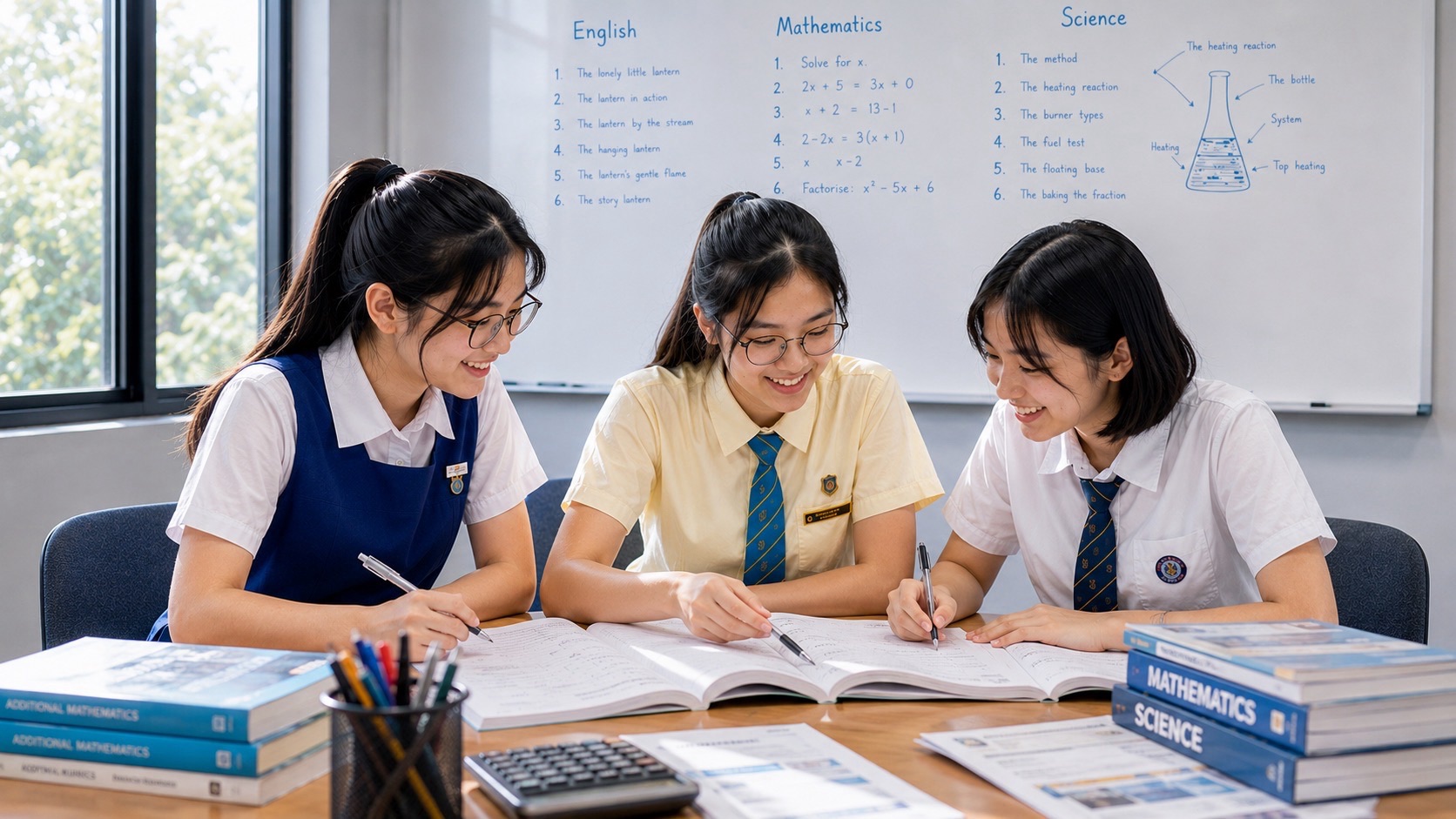
Secondary 1 G1 English small groups tuition for Clementi students can help a learner who understands each source separately and gets stuck when a question asks them to use the sources together. In a group of three, every student can make a decision, identify the words or figures behind it and explain it in their own sentence. The tutor can hear which part of the reading needs more practice.
Start with a marked school task or a short notice and table your child can read at home. Ask which source gives the rule, which supplies the detail and whether the answer meets both. At eduKateSingapore, families enquiring about Secondary 1 G1 English support can bring their child’s actual work to discuss how this kind of reasoning can be taught, practised and checked before the eventual SEC examination.
- Write down the decision a question asks the student to make.
- Give each source a short name and keep facts attached to their source.
- Check labels, units, dates and conditions before comparing figures or making a recommendation.
- Where the information conflicts or leaves a gap, explain what can be established and what needs checking.
- Use the school’s current assessment scope for Secondary 1 and the relevant examination-year syllabus when planning for SEC.
Find your next learning step
Jump to a section or read the guide in order.
Why the sources have to work together and related sections
Read a chart as evidence with limits and related sections
Work a decision through all three sources and related sections
Build the skill over four weeks at home and related sections
Why the sources have to work together
A child who reads a notice may confidently say that a workshop begins at two. The same child may read a small calendar and identify which afternoon is free. Put those skills together and ask which session a student can attend after CCA, and the task changes. The reader must find the moment the session starts, match it against the available time and check any condition that could rule out the initial choice. Being able to read each piece is the beginning. Knowing how they change the same decision is a separate skill.
In childhood, adults often do that final work. A parent says the family should travel earlier because the library closes at six and there is a bus diversion. A teacher explains which option fits a pupil’s schedule. The young person may have read the important words in both messages yet never have needed to turn them into a plan. A useful Secondary 1 exercise gives the student a decision they could plausibly make, lets them try it alone and asks for a reason grounded in both sources.
Suppose a student in Clementi sees a school announcement about returning club equipment. The announcement says class sets can go to the hall before three. A table shows that Group C will be dismissed at 2.55 pm in a room on another floor. The question asks whether the whole group can definitely return everything together before three. A sensible answer recognises that dismissal is just before the deadline and that no travel time is supplied. The reader can say that the group has five minutes after dismissal and needs to check whether reaching the hall in that time is possible. This answer handles the two pieces of information and the gap between them.
Choosing a conclusion from incomplete information can be difficult for learners who believe every question means they must say yes or no. Teach a few useful ways to state what the sources permit. “The table shows when the group is dismissed.” “The notice says returns close at three.” “The sources give no travel time.” Together these sentences do real work. They show how far the reader can get and identify a specific missing fact. The same situation might have a different answer if the table gives the hall as the dismissal location.
Where this fits in G1 English
Under Full Subject-Based Banding, students enter secondary school through Posting Groups and take relevant subjects at levels such as G1, G2 or G3. Clementi Town Secondary School’s Full Subject-Based Banding guide gives one school’s explanation of subject-level options. Your school can confirm your child’s English subject level and explain the workload or readiness questions that come with any different offer. A family can use a marked task to frame a question about how the child handles reading and language in the current class. The eduKateSingapore guide to English subject choices and progression explains how English fits into those decisions.
SEAB’s published 2027 G1 English Language examination syllabus uses code K100. Its Paper 2 covers language use and comprehension, with a non-narrative reading part that includes a text with visuals. The syllabus describes reading outcomes that include identifying ideas and details and bringing together information from different texts. Those skills support a gradual approach in Secondary 1. Confirm the examination syllabus for the year your child is due to sit and use the current school assessment instructions for nearer work. See the published 2027 G1 English Language syllabus.
The examples in this guide are original teaching tasks. Some ask for a decision or a recommendation to make the act of combining information visible. Your school may teach similar thinking through short-answer questions, a comparison of two texts or a visual comprehension task. Ask the teacher which answer formats the class uses and what counts as enough support for a claim. The child should know when a phrase is adequate and when a question calls for a reason in a complete sentence.
Give each source a job before looking for an answer
Adults often read a page according to the sort of information they expect it to contain. A timetable helps find times. A sign-up notice helps identify dates, conditions and instructions. A participant’s message gives that person’s experience or preferences. Teach students to name these jobs briefly. Labels such as “event rules”, “session times” and “Ravi’s message” can reduce confusion when two sources both contain times or names.
Imagine a left-hand page headed “Choose Your Activity” and a right-hand message from Rae. The notice says that all activities need a pencil, that sketching requires a sheet of A4 paper, and that anyone joining the photography group must borrow a school tablet. Rae says she has a pencil, a sheet of A4 paper and her own camera. A learner can establish that Rae has the items explicitly named for sketching. The camera does not satisfy the tablet requirement because the notice specifies school equipment. This sort of detail can disappear if the child treats the message and notice as one general description of things people own.
A tutor can ask each learner to place a small note under the relevant source before answering. One student writes “tablet from school” under the notice. Another writes “own camera” under Rae’s message. A third reads those notes and says what they mean for Rae’s choice. Then everyone writes a short answer separately. Keeping the wording close to the sources reduces the chance that “has a camera” will become “can bring any device”.
Sometimes there is no best choice until a reader knows the person’s aim. If the question asks which option Rae can take without borrowing anything, sketching fits the information given. If the question asks whether Rae can join photography, the rule says she would have to borrow the tablet, and the sources do not say whether one is available. Two questions about the same options can yield different responses because the constraint changes. Have the child underline the part of the question that introduces the condition.
Keep the answer narrower than the topic
A notice about an ongoing activity may contain many helpful details, including registration dates, meeting places and materials. Students often retell the entire page when they are unsure which facts carry the answer. Give them a narrower brief. “Find the two details someone needs to bring the right equipment.” “Show whether the user with a camera meets the photography rule.” This gives the learner a reason to leave spare facts in the source.
Try one exercise where a colourful or memorable detail is irrelevant. Put a large line at the top of a notice saying that there is a prize. Include a smaller instruction that requires participants to have a partner. Now ask whether a student arriving alone meets the requirements. A learner who circles “prize” has spotted an attractive detail. Walking back through the question helps show that it asks about eligibility. After the correction, give a fresh example in which an attractive illustration appears above an age restriction. This second attempt tests whether the learner can redirect attention on a new page.
Contents · Previous section · Next section
Read a table with the heading, row and column in view
A table is compact because each cell draws meaning from its row and column. In a table headed “Remaining places on Thursday”, the number 4 might mean four places left in the 2.30 pm session. If the same cell sits under “Applications received”, it means something different. Put a finger on the number, trace left to the row label and up to the column heading, then read it as a single statement. This technique can help a child learn to carry the right labels over to the written answer.
Consider this imaginary school project schedule.
| Session | Starts | Ends | Places available | Materials |
|---|---|---|---|---|
| Bookmark Design | 2.15 pm | 2.45 pm | 3 | Pencils provided |
| Audio Stories | 2.30 pm | 3.15 pm | 1 | Bring headphones |
| Paper Models | 3.00 pm | 3.45 pm | 4 | Paper provided |
A second source is a message from Siti. “My CCA finishes at 2.20 pm. I have to meet my father by 3.30 pm. I have my headphones today.” If the exercise assumes she can reach the activity room by 2.30 pm, Audio Stories is the listed session that fits both time conditions and the equipment requirement. Bookmark Design starts before her CCA finishes. Paper Models ends after the time she needs to meet her father. The table also indicates one place available in Audio Stories at the time represented. A strong response says which session works and gives the relevant times, and leaves the unrelated material in the source.
Now remove the assumption about travel time. The same student can establish that Audio Stories is scheduled between the two commitments, that there is one place in the table and that she has the required item. The text still leaves open whether she can get there in ten minutes or whether that place remains when she registers. This is a useful follow-up because it shows where a formal reading question may provide conditions to make its answer definite. In everyday life, a student might ask one of the organisers for current availability.
Check whether the number counts the thing the question names
Suppose a table shows “Applications received” and “Places available”, with one workshop reporting twelve applications and three places available. A child may conclude there will be twelve participants because it is the first number they see. Ask what the twelve counts. Then ask what the three counts. If another sentence says applications are still under review, the table alone does not establish that twelve people will attend. The answer can distinguish the group who applied from the places that remain.
Change the headers to “Number registered” and “Total capacity”. In a row headed “Story Circle”, these numbers are twelve and fifteen. Three spaces would remain if there are no other reservations or restrictions mentioned. The response can show the arithmetic by saying that twelve of fifteen places are taken. The number calculated gets its meaning from the headers. A coach can ask a learner to rephrase the result as “there are three spaces left in Story Circle” to check that the mental arithmetic and the reading belong to the same inference.
Add a unit wherever needed. A table might give waiting time in minutes and session length in hours. A child who sees “2” can only decide whether the figure is large or small after checking what it measures. In a basic exercise give two rows, each with a stated unit, and ask for the longer activity. In a more demanding one add a closing time and ask whether the activity can finish by then. Encourage the student to make a small note such as “30 min” in the margin. This can stop an otherwise correct comparison from attaching the wrong meaning to a number.
Contents · Previous section · Next section
Read a chart as evidence with limits
A chart carries a claim through visual choices such as length, height, colour or grouping. Start by asking what is counted and who was included. A learner can usually name the tallest bar. The next job is to say what that tallest bar means. If a chart shows the number of responses to a lunchtime survey, the bar measures answers from people who responded. The chart does not give the preferences of all students unless the source says that everybody took part.
Try a chart described in words so each student can sketch it. A bar chart headed “First choices on Tuesday” displays Reading Corner with 12 votes, Puzzle Desk with 9 votes and Poster Wall with 6 votes. A note below says 27 pupils each selected one option. A short report says, “We asked two Secondary 1 classes in the hall between noon and 12.20 pm.” Reading Corner received the largest number of votes among respondents. Puzzle Desk received three more votes than Poster Wall. The report identifies who was approached and when. Neither text gives the preferences of students from other year levels.
Now ask whether Reading Corner received more than half of the votes. Twelve of 27 is fewer than half. A learner who says yes has probably substituted “largest group” for “majority”. Place the largest group beside the two other groups together. Nine plus six is fifteen, which is greater than twelve. Explain that Reading Corner led among the three separate options and that a majority would require at least fourteen of the votes. Students can use a comparison with the combined number or the halfway point. Ask them to finish with a sentence about the survey results so the calculation remains attached to the question.
There is also a difference between a change and a ranking. Suppose a second set of bars is labelled Wednesday. Reading Corner gains one vote compared with Tuesday, Puzzle Desk gains five and Poster Wall loses two. Reading Corner had the most votes on Tuesday. Puzzle Desk gained the most votes across the two days. A question asking which “increased the most” needs a pairwise comparison instead of the height of a single bar. Invite the learner to write down the two verbs, “had” and “gained”, and show which one appears in the question.
Read the note next to the chart
A chart note may say that participants can pick two activities, that counts include walk-ins or that the data was collected before the final registration day. These details matter if the question uses words such as “people”, “votes”, “remaining” or “final”. If 45 preferences are recorded in a survey that allows two choices per student, the figure of 45 cannot by itself tell the reader how many students responded. Ask which information would settle it. A separate count of completed forms or a note that each person selected exactly one option would help.
With a young reader, build this skill from short household examples. A page might record 12 library visits during a holiday, including revisits. Ask whether it refers to 12 separate people. If the same person might visit twice, a count of visits and a count of visitors answer different questions. Let the child create a heading for each type of count. The new headings reveal that they understand the distinction even if calculating a difference is simple.
Some charts give amounts with rounded numbers or leave out a category. If a printed exercise uses rounding, check the note and follow the questions supplied. At home, the point is to read the claim within its limits. “About 20 pupils” can help someone estimate whether a room might fit the group. It leaves more uncertainty than “20 pupils registered”. A learner who can explain the difference will be better able to use figures honestly in a comprehension response and in a report of their own.
Contents · Previous section · Next section
When sources disagree, first check whether they describe the same thing
Disagreement is easy to declare and sometimes easy to resolve. One message may refer to registration and another to the day of the event. An old notice may have been updated. One figure may count completed projects while another counts all the projects begun. Teach learners to compare the subject, time and label attached to both statements before deciding that the two sources cannot both be correct.
Consider a poster displayed on Monday. It says “Film afternoon, Friday, 2.40 pm in the hall.” On Thursday, a teacher sends a note headed “New venue for Friday film afternoon” that reads, “The film afternoon will now take place in Room 12. The start time stays at 2.40 pm.” A learner can treat this as an explicit update. Both sources help establish the plan. The poster gives the event and supplies the prior venue. The note identifies the change and confirms the timing. Ask the child to write one sentence telling an attendee where and when to go. “Go to Room 12 for the film at 2.40 pm on Friday” carries the current decision clearly.
Now change the second source. It is a message from a friend sent on Thursday saying, “I remember someone mentioning Room 12 for Friday.” The poster still gives the hall. A later message is useful information, but the friend gives no source and expresses uncertainty. A careful response can say that the official poster gives the hall and that the friend’s message suggests checking the venue. This builds a more specific skill than “use the newest source”. A date matters alongside the source’s role and whether it clearly says an earlier message has changed.
Give the group the same practice with quantities. One note says “Seven teams had signed up by Tuesday.” Another says “Eight teams started the event on Friday.” The claims refer to different points in time and different actions. Students can reasonably say the figures are compatible. They cannot determine how many teams signed up after Tuesday or how many Tuesday entries participated. Change the exercise to two notices with the same date and definition, one saying seven checked in and another saying eight checked in. The conflict is now genuine. Ask what record could settle it, such as the final attendance sheet given by the organiser.
Distinguish a report from a plan
A school circular may say that a walk will last 45 minutes. A pupil’s recount may later say that their class took an hour. Both can be true. One describes what organisers planned, the other what a group experienced. If asked what future visitors should allow, the learner can identify the official duration and note that one reported visit took longer. The answer may be stronger if it explains the actual cause of the delay when the recount gives it. When the cause is absent, avoid adding a guess as if it came from the text.
Read a similar example about supplies. The organiser says, “We will put six spare brushes at each table.” A student writes, “I found four spare brushes when we arrived.” Ask what can be said about provision. The first source records an intention. The second gives an observation from one place or time. It may suggest checking the number at the student’s table and when the other brushes were moved. A child who says “the organiser lied” has jumped from different information to a claim about motive. Ask them to list what would have to be established first.
A classroom exercise can use two texts about a change in the weather that disrupted a schedule. Pupils can create one line from the plan and one from an actual participant. Swap with other students and ask the readers which facts are compatible. The tutor can listen for whether a student can describe the difference between a plan and an observation without making either source useless. This enables comparisons even when one source uses a confident tone and the other offers only a small piece of evidence.
Contents · Previous section · Next section
Notice whom each source is trying to help
A notice “for all participants” can say to collect a numbered label. A separate sheet “for student helpers” can tell helpers to sort labels into trays then return spare labels to the office. A young learner reading both sheets may pick up the return instruction and advise every participant to visit the office. The reading task changes once they recognise who is supposed to do which action. Teach a simple check before comparing sources. Ask who is supposed to read each one and what that reader needs to do.
Try a short worked comparison. The participant notice says, “Place your bag on the shelf labelled with your session name before taking a seat.” The helper instructions say, “Before the next session, move unclaimed bags to the desk and tell the duty teacher.” Someone arriving for a first session should use the labelled shelf. A helper at the end of a session has a different role. If a question asks what a participant should do after finding the shelf is empty, both sources give context, but neither tells them exactly what to do next. A reader can propose asking the duty teacher and explain that the helper instructions give a possible point of contact. Label it as a sensible inference.
The audience also affects the tone. A poster for students might say “Bring a friend and have a go!” while a note for parents explains that a signed consent form is required. The poster draws attention and invites participants. The parent note sets out an arrangement an adult needs to complete. Ask what a student and a parent would each learn, and where the two messages fit together. A reader advising a friend should include both the invitation and the consent condition where relevant. If the task asks how the poster encourages attendance, the direct invitation is an example the learner can cite.
Compare two viewpoints with care
Imagine an organiser’s post saying that the new sign-in procedure “gives us a reliable count before each session”. A student feedback note says, “I arrived just after the bell and waited by the door while the student helper checked the list.” One source explains why organisers use the procedure. The other describes what the procedure felt like to someone arriving. A full answer can say that organisers value a count and the student experienced a wait. It can also use both pieces to explain why someone might suggest asking pupils to arrive a little earlier if the task calls for a solution.
Ask students to show where each viewpoint comes from. An organiser might also be a participant in another context. A student can also understand the organiser’s reasons. The purpose of this exercise is to identify the roles the sources occupy here. If a pupil writes “the organiser cares about numbers and the student only cares about themselves”, ask which words support the extra judgement. Have the learner try a simpler version connected to the sources. “The organiser explains a benefit for record keeping. The student describes a delay on arrival.” That version is easier to support.
Tone can change the implied message even when two texts agree on a fact. One reminder might say, “Please return every borrowed item by Friday.” A later note might say, “Friday is the last return day, and we appreciate everyone who has already brought items back.” Both provide the same date. The second adds appreciation and a sense of urgency about the deadline. A student who is asked to compare the tone can refer to those words. A student asked only for the last day can answer “Friday” and spend their time on the next task.
Contents · Previous section · Next section
Work a decision through all three sources
Here is a longer task inspired by ordinary after-school planning. The material is fictional. The learner can work with it at home or in a small group.
Source A is an instruction from the school craft event team. “Each participant may enrol in one session. Registration opens during recess on Wednesday and closes after school on Thursday. A pupil taking part in a room activity must be signed in five minutes before the activity begins. The hall displays can be visited without registration, but bags must stay at the shelves outside the hall.”
Source B is a table printed when registration opened.
| Activity | Starts | Finishes | Open places | Materials or entry rule |
|---|---|---|---|---|
| Stamp a Card | 2.30 pm | 2.50 pm | 2 | A clean sheet of card |
| Fold a Map | 2.50 pm | 3.15 pm | 3 | A pencil |
| Model a Bridge | 3.10 pm | 3.45 pm | 1 | A ruler |
| Hall Displays | 2.20 pm | 3.40 pm | Walk-in | Leave bag outside |
Source C is Nia’s message. “I can get to the activity rooms at 2.43 pm. I must leave by 3.20 pm. I have a pencil today and left my ruler and craft card at home. I want to make something if there is space. I can visit the displays if the activity is full.”
Ask the learner which room option Nia should register for, taking the table as current. “Fold a Map” begins at 2.50 pm, so she must sign in by 2.45 pm. She can reach the rooms at 2.43 pm. It ends at 3.15 pm, which fits the departure limit. She has the pencil the activity requires, and the table shows three open places. Each source supports a different part of the decision. Source A gives the five-minute condition, Source B gives the timing, material and space, and Source C gives Nia’s constraints.
Now ask which facts rule out Model a Bridge. Nia has time to sign in for a 3.10 pm session. It ends after 3.20 pm and requires a ruler she left at home. The availability of one space still leaves both problems. For Stamp a Card, the start is already too early, the sign-in deadline earlier still, and Nia needs card she does not have. When a question asks for two reasons, explain which two are independent and fully supported. Invite the child to produce a two-sentence answer that mentions her departure time and the ruler.
If the map activity is full, what can Nia do under the instructions? She can go to the hall displays without registering and leave her bag at the required shelves. She can enter after arriving and leave at 3.20 pm before displays close at 3.40 pm. This option meets her fallback preference. Ask which facts belong in a short answer. The registration exemption and bag rule are especially relevant if the question asks what she should do before walking in. The unused numbers for the other rooms can stay in the table.
Change a condition and update the answer
Make Source C say that Nia can now reach the activity rooms at 2.47 pm. The map activity still begins after she arrives, but she cannot satisfy the five-minute sign-in. This variation catches a common shortcut. A student who compares just the arrival and start times sees three spare minutes. The instructions require five. Give the learner a chance to point to the rule and calculate the latest sign-in time. Then ask whether the hall option is still available on the stated terms. This change lets the student apply the same reasoning without running through the entire task from the beginning.
Alternatively, add a note from the team stamped Thursday at noon. “Fold a Map is currently full. A place might reopen if someone withdraws. Ask us before making the trip.” This is newer information about the same activity, framed as a current update. If Nia can reach the rooms at 2.43 pm again, the timing works but a place cannot be assumed. She can check availability and take the hall option if her preferred activity remains full. A response that mentions the source of the change shows the student can integrate new information while keeping valid parts of the earlier conclusion.
Ask the child to tell you how the answer changes if Nia only wants to see work other pupils have made. She can go to the hall displays directly. She no longer needs to compare craft materials or sign-in details for a room. This final version reinforces the role of the question. The facts remain available, and the child’s aim decides which information they need to use.
Contents · Previous section · Next section
Write an answer that shows the link between the evidence and the conclusion
Some students can point to the relevant sources and still lose the logic when they begin writing. They may copy part of a table, paste in an instruction and leave the conclusion unstated. Begin by asking the child to say the decision and connect it to one fact. “Nia should choose Fold a Map because she can arrive before its sign-in deadline.” When a question also calls for a second source, bring in the other condition with a second clause or sentence. “She has the pencil it requires and can leave after it finishes at 3.15 pm.”
A response can use small links such as “so”, “because”, “while” and “as long as”. Teach them where they make meaning clearer. “Source A requires participants to sign in five minutes early, so Nia needs to be there by 2.45 pm” gives a clear calculation. “The display stays open until 3.40 pm, so she can visit before leaving at 3.20 pm” links a schedule to a plan. A student who writes “The table says 3.40 pm because Nia leaves at 3.20 pm” has reversed the relationship. Read the sentence aloud and ask what causes or explains what.
If the task asks the child to compare sources without recommending an action, the sentence can name the shared topic and then separate the messages. “The notice gives the planned length of the session. The student’s message says that one class took longer because they had to wait for the room.” This shows what both sources add. A clarifying follow-up might ask how the organiser could use the report. Now the student may suggest reviewing the time at which the room becomes available. A supported suggestion can grow from the evidence even when it introduces a proposed action absent from the text.
Learners sometimes ask whether all answers need to start “according to Source A”. Follow the teacher’s directions. It can help to name the relevant source when two statements could be confused or when the question explicitly requests evidence from both. A concise answer can still make the connection clear without repeating the label in every sentence. Ask another reader to find the evidence used and see whether they can trace it easily. Where they get lost, add a source cue or more precise wording.
Help a student trim a long answer after the reasoning is sound
A good first draft sometimes contains every relevant calculation and several sentences about failed alternatives. If asked to justify one recommendation, identify the two or three details that actually make it work. For the map activity, the critical evidence involves sign-in, finishing time and the pencil, together with availability if the question makes it part of the decision. If the answer has a required limit, retain the strongest connection and follow the task instructions about using both sources.
Try marking the child’s draft with three small marks. One mark for the decision, another for the evidence and another for the sentence that shows why the evidence matters. The student can then see if a paragraph has all three. If the writing repeats evidence or jumps to a new topic, invite them to shorten it and keep the logical link. This is a useful form of editing for students who have grasped the source material and now need to show that grasp efficiently.
Contents · Previous section · Next section
How a three-student lesson can develop independent reading
Offer the same short set of sources to all three learners. Before discussing, each student writes a conclusion and one reason. The tutor uses the first answers to see how the learners apply the constraints. A child may reach the right decision without considering the sign-in rule. Another may locate the rule and calculate correctly but overlook the required pencil. A third may choose the hall display despite the person’s preference for making something. The lesson can draw attention to these distinct decisions without telling all three students they have the same reading problem.
After the individual attempt, give each student one role in the discussion. The first explains a condition in the announcement. The second identifies the data needed in the table. The third turns the person’s stated preference into an answer requirement. Switch roles for the next task. Ask each learner to revise their own answer after listening. The tutor can then present an unseen example with a different subject, such as returning library materials or planning who can attend a school talk. The independent attempt shows whether the discussion changed how each child reads.
A group also gives students a chance to question a source respectfully. One learner can propose that a friend’s recent message supersedes an official timetable. Another can ask what confirms the change. A third can explain what the group would tell a person about the most reliable information currently available. This develops the habit of asking about wording, dates and authority before declaring a text wrong. It is useful in school comprehension and when students encounter event details circulated informally.
Parents comparing options for a Clementi learner can ask what example the tutor would use to teach the missing skill. If the learner confuses a chart’s categories, look for practice with labels and units. If the problem is that a bold headline pushes out a small but important exception, look for a lesson that asks the reader to check eligibility or timing using both. Ask how each of three students gets a chance to explain an answer and how the tutor checks for transfer to a fresh text. Practical examples can make decisions about lesson fit easier than general promises about comprehension.
Contents · Previous section · Next section
Build the skill over four weeks at home
Start in week one with a one-source exercise. Give your child a timetable or notice with four short entries. Ask them to read a single cell or condition back as a complete sentence. Include the row, heading and unit. A good question is “What does the 4 count?” or “Which part of the entry tells you that?” Save one example of an independent answer. If the learner confuses a count with a time, revisit a smaller table before adding a second source.
In week two, use two sources about the same fictional event. Give a person one time constraint and a preference. The child draws a light line or writes a short note next to each fact they will use. Ask for one written recommendation showing why the option meets both conditions. If two options work, ask for both or supply one extra condition. This keeps the child’s work centred on the evidence available instead of trying to guess the adult’s intended answer.
In week three, choose one pair of sources with a change of plan and one pair with different viewpoints. Ask which text gives the original detail and which changes or interprets it. Invite the child to state what they can conclude now and any detail they would want to verify. When one message is an explicit update, encourage them to say so. When a newer source is uncertain, prompt them after the first answer to identify which words show that uncertainty.
In week four, prepare a fresh set containing a notice, a table or chart and a short message. Allow enough quiet time for the learner to read without help. Look for an answer that follows the new conditions and places the facts correctly. Compare this result with the earliest example. If the child can identify labels but still overlooks the time needed for sign-in, agree on one earlier step to revisit. If the reasoning is strong but the sentence is unclear, move to brief writing practice using the conclusions they have already reached.
Use short ordinary examples made from material you already have. A family plan can set a departure time, a library listing can supply opening hours, and a note can state which materials are needed. When using real notices, check dates and keep personal details out of any practice a child will share. Home practice can end after a few thoughtful minutes. For practice finding evidence within one text, see the Queenstown G1 English reading guide. For further transition routines and advice for Secondary 1, see the eduKateSingapore G1 English preparation guide.
Contents · Previous section · Next section
Questions Clementi families ask about multi-source reading
My child is strong at calculations. Why are chart questions still hard?
The numerical calculation may be sound while the source labels are confused. Check whether your child knows what each value counts. Give them a table that shows students registered, maximum places and applications received. Ask for one answer that uses each distinct heading. When you compare responses, use the surrounding labels in full. If the calculation is correct and is attached to the wrong kind of number, practise selecting the information before asking the child to calculate again.
Does the learner have to read every source in full before answering?
The right approach depends on the material and the question. A short set of sources benefits from a quick first look at their topics and purposes. After that, the child can follow the task, returning to the relevant part of each source. A dense chart may take extra time to understand, especially when scales or notes affect the answer. When the child is practising one precise skill, it can help to name two sources and ask for the link between them before introducing more material.
How do we know if extra support is a good fit?
Bring a recent school item and show what the child did independently. Ask the teacher or tutor to diagnose the first step that breaks down and describe a way to practise it. An exercise can work well if it gives the child a reason to read each source and a fresh chance to show what they learned. Watch for a usable improvement, such as separately identifying an official condition and a person’s preference before deciding. The right amount and type of support depend on the student’s current work and wider schedule.
How do I discuss a class arrangement?
Confirm your child’s English subject level and the scope of current work with the school. Use a recent assignment and its instructions to show what your child can already do and where they get stuck. Ask how lessons account for a student’s school schedule and how progress will be reviewed using new work. Families can enquire about availability and arrangements through the eduKateSingapore contact page.
For a Clementi student beginning Secondary 1 G1 English, use one short decision that every source can help answer. Let them choose, explain what each source contributes and say what remains uncertain. Repeat with an unfamiliar situation the following week. An early sign of progress is that a child remembers to check the small print without being asked and can tell you exactly how it changed the answer.