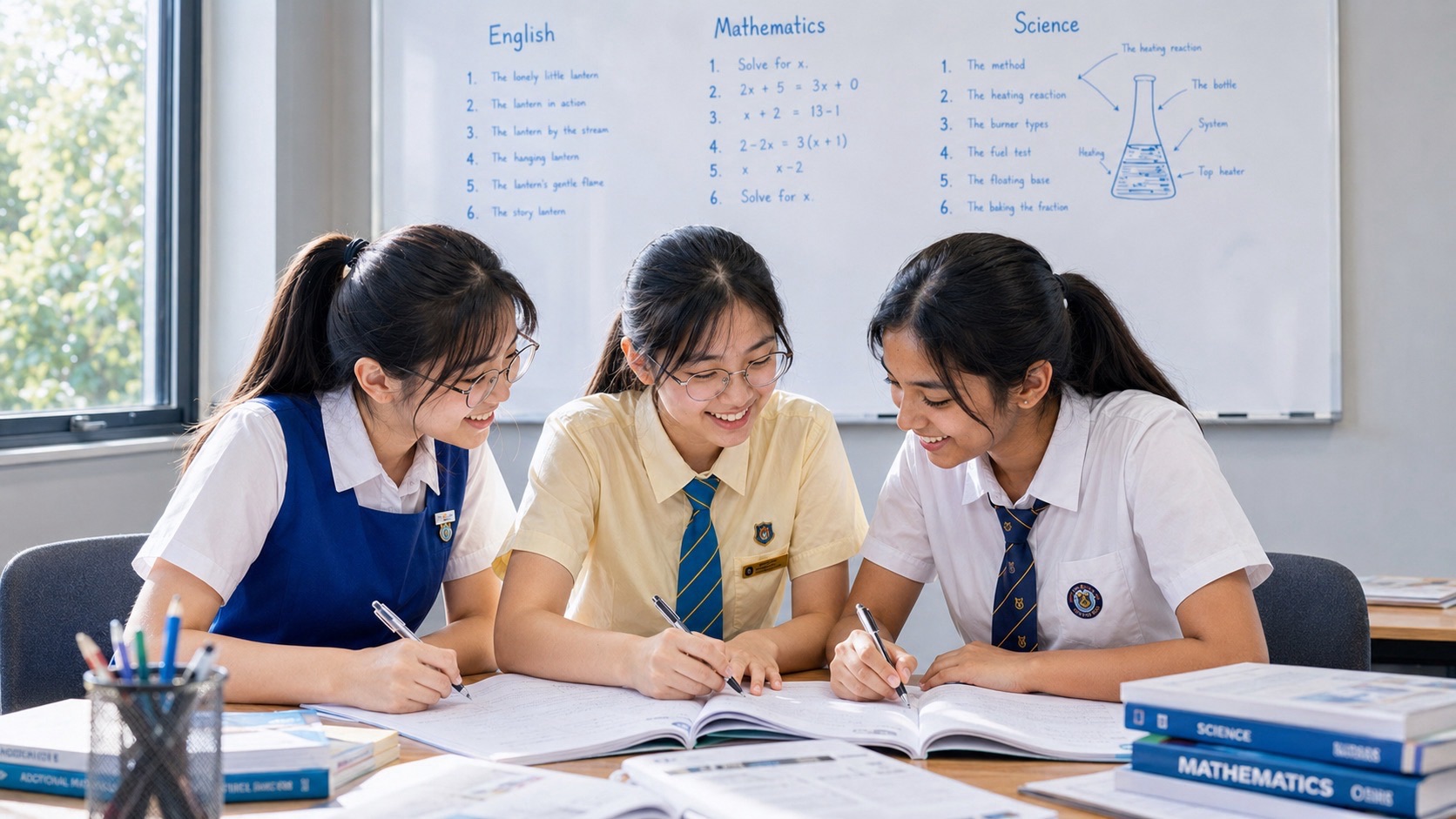
Secondary 1 G3 Science vocabulary helps students understand what a question asks, describe what they observe and explain why something happens. Start with words used across many lessons, including observation, evidence, variable, measurement and conclusion, then add the terms in your child’s current school topic. This guide gives 100 selected words and subject terms, clear meanings, examples and practical ways to use them. The aim is a student who can explain a scientific idea accurately, rather than simply recognise a definition on a flashcard.
Use the list as a foundation and a preview for lower-secondary learning. MOE’s G2/G3 Science syllabus covers lower secondary, so the whole list is not a promise about what every school teaches or tests in Secondary 1. Check the school’s topic sequence and assessment notice before deciding which groups to learn now. These are eduKate’s teaching selections, not an official MOE or SEAB Top 100 list. For home practice or a three-learner small group, choose a few relevant terms, ask for an example, and finish with one short explanation that uses the words correctly.
- Begin with investigation and measurement language in Groups 1 and 2; return to it whenever a new topic begins.
- Choose topic vocabulary from the school’s current chapter. Groups 3 to 10 are a lower-secondary bank, not a compulsory one-term checklist.
- Each numbered entry includes a meaning and an example; technical phrases count as single vocabulary entries.
- Practise differences that matter: observation and inference, mass and weight, heat and temperature, dissolving and melting.
- Learn a word through a diagram, sentence or result table, then use it to answer a fresh question.
- Use short practice sessions and individual checking, including in a group of three; a fluent classmate’s explanation cannot show everyone understands.
- Follow school laboratory instructions. The activities here are reading, reasoning and discussion tasks, not instructions for unsupervised experiments.
- Review progress through explanation and application, not the number of definitions copied or a promised examination grade.
Find the vocabulary help you need
Choose the topic being taught at school, or start with a worked explanation. Every teaching chapter stays open for reading.
Full chapter index · Try the learning check · Vocabulary Learning System
Chapter index
Understand the guide · Chapters 1–1
Learn words 1–50 · Chapters 2–6
Learn words 51–100 · Chapters 7–11
Use the words · Chapters 12–13
Practise and check · Chapters 14–18
CHAPTER 1 OF 18 · Understand the guide
1. How to use this vocabulary guide with the school syllabus
The MOE G2/G3 Lower Secondary Science syllabus brings together scientific ideas, investigation practices and responsible attitudes. Its themes include Scientific Endeavour, Diversity, Models, Interactions and Systems. This guide selects useful language across those areas; it does not reproduce the syllabus or attempt to cover every learning outcome. Some terms support classroom explanation even when they are not presented as separate syllabus headings.
Put a small mark beside each entry: Now for your current chapter, Review for something already taught, and Later for a future topic. Groups 1 and 2 are useful across the year. Topic groups become priorities when the school teaches them. A child studying cells does not need to memorise electricity vocabulary merely to finish this page. Ask the teacher which concepts the next assessment actually covers.
G3 describes a subject level under Full Subject-Based Banding. It should not become a label for a child’s worth or a prediction about every subject. MOE describes students taking subjects at levels suited to their strengths and needs in its Education Statistics Digest 2025. For this page, the practical question is which Science explanation your child needs help to understand today.
The national SEC examination begins from 2027, but a Secondary 1 vocabulary guide is not the same thing as an examination-year syllabus. Refer to SEAB’s SEC information for the national examination context, and use school instructions for current assessment scope. Avoid buying or practising material solely because it carries an examination label when its concepts are far ahead of the child’s lessons.
CHAPTER 2 OF 18 · Learn words 1–50
2. Group 1: Investigation words to use throughout the year
Use these first. They help a student separate the question, the method, the observations and the explanation before any specialised topic language is added.
| No. | Word or term | Meaning and use | Example |
|---|---|---|---|
| 1 | Observation | Information noticed directly with the senses or recorded using an instrument. Keep the description separate from your explanation of its cause. | The liquid changed from blue to green after mixing. |
| 2 | Inference | An interpretation drawn from observations and existing knowledge. It needs support and may change when further evidence becomes available. | Bubbles suggest a gas may have formed; bubbles alone do not identify it. |
| 3 | Hypothesis | A proposed explanation or relationship that can be tested. Connect a possible cause with an outcome rather than merely naming the topic. | Greater water temperature may increase the rate at which this sugar dissolves. |
| 4 | Prediction | An expected result stated before checking. Give the expected direction of change and, when possible, the scientific reason behind it. | The sugar should dissolve in less time in the warmer water. |
| 5 | Evidence | Observations or data used to support or challenge a claim. The evidence must be relevant to the question being investigated. | Three recorded dissolving times support the comparison between the two conditions. |
| 6 | Conclusion | A reasoned answer to the investigation question based on the results. State the limits of what the investigation actually tested. | For these trials, the sugar dissolved faster in the warmer water. |
| 7 | Independent variable | The factor deliberately changed in an investigation to examine its effect. Name the actual factor and its values where appropriate. | The investigation changes water temperature while keeping the amount of sugar constant. |
| 8 | Dependent variable | The response measured or observed when the independent variable changes. Describe how the response will be measured, not just its name. | The student measures the time taken for the sugar to dissolve. |
| 9 | Controlled variable | A factor kept the same so it does not provide an alternative explanation for the difference in results. | Each container has the same volume of water and the same mass of sugar. |
| 10 | Fair test | A comparison designed so the intended change can be investigated without avoidable differences in other relevant factors confusing the result. | Changing water temperature and sugar mass together would make the comparison difficult to interpret. |
These words belong beside actual readings. Ask what was measured, what the unit means and whether the method justifies the claim.
| No. | Word or term | Meaning and use | Example |
|---|---|---|---|
| 11 | Quantity | A property that can be measured and expressed with a number and an appropriate unit, such as length, mass or time. | Time is the quantity; 24 seconds is a particular measurement. |
| 12 | Unit | An agreed standard used to express a measurement. A number without its unit may be impossible to interpret correctly. | Write 15 centimetres, not simply 15, when reporting the length. |
| 13 | Measurement | The value obtained when a quantity is compared with an appropriate standard, using a suitable method or instrument. | The balance gives a mass measurement of 18.4 grams for the sample. |
| 14 | Accuracy | How close a measured value is to the true or accepted value. Repeated readings can agree yet share the same error. | A wrongly zeroed balance can produce consistently inaccurate mass readings. |
| 15 | Precision | How closely repeated measurements agree with one another. Close agreement does not by itself show that the readings are accurate. | Readings of 10.1, 10.1 and 10.2 grams have little spread. |
| 16 | Repeatability | The extent to which the same method under the same conditions produces similar results when repeated by the same investigator. | Repeat the timing under matching conditions before deciding whether the result is dependable. |
| 17 | Resolution | The smallest change an instrument can distinguish in its reading. Choose equipment that can show differences relevant to the task. | A ruler marked in millimetres can distinguish smaller lengths than one marked only in centimetres. |
| 18 | Anomaly | A result that does not fit the general pattern. Investigate it before deciding whether to retain, repeat or exclude it. | One timing is much longer than the others; check whether the timer stopped late. |
| 19 | Trend | The overall pattern in results, such as an increase, decrease or little change. Describe the pattern before proposing its cause. | The recorded dissolving time decreases as the starting water temperature increases. |
| 20 | Mean | The sum of a set of values divided by the number of values. Explain which measurements are included in the calculation. | The mean of 12, 13 and 14 seconds is 13 seconds. |
Use these when the school studies materials and measurement. Connect every property to a comparison, a measurement or an appropriate use.
| No. | Word or term | Meaning and use | Example |
|---|---|---|---|
| 21 | Matter | Anything that has mass and occupies space. Materials can be described and compared through their properties and the particles that make them up. | Air is matter even though it is usually invisible. |
| 22 | Mass | A measure of the amount of matter in an object, commonly measured in grams or kilograms. It is different from gravitational force. | The sample has a mass of 50 grams on the balance. |
| 23 | Volume | The amount of space occupied by an object or substance. Use units appropriate to the measurement and convert them carefully. | A measuring cylinder contains 40 cubic centimetres of water. |
| 24 | Density | Mass per unit volume. Compare mass with volume together; greater mass alone does not prove that a material has greater density. | A 30-gram sample occupying 10 cubic centimetres has density 3 grams per cubic centimetre. |
| 25 | Physical property | A characteristic that can be observed or measured without changing the substance into a different substance. Properties help compare materials. | Density and electrical conductivity are useful properties when selecting a material. |
| 26 | State | The physical form of matter, such as solid, liquid or gas. A change of state does not necessarily form a new substance. | Ice and liquid water are different states of the same substance. |
| 27 | Melting point | The temperature at which a solid changes to a liquid at a specified pressure. A pure substance has a characteristic melting temperature. | Use melting-point data to compare the suitability of two materials. |
| 28 | Boiling point | The temperature at which a liquid boils at a specified pressure. Pressure matters, so a boiling temperature is not universal under all conditions. | Water boils at about 100 degrees Celsius at standard atmospheric pressure. |
| 29 | Solubility | The maximum amount of solute that can dissolve in a stated amount of solvent at a specified temperature. It differs from how quickly dissolving happens. | A solubility comparison must specify the solvent amount and temperature. |
| 30 | Conductivity | The ability of a material to conduct electricity or transfer heat. State which kind is meant because the question determines the property. | Copper's electrical conductivity makes it useful in conducting wires. |
CHAPTER 5 OF 18 · Learn words 1–50
5. Group 4: Particles and classification of substances
Learn these when particle models and chemical composition appear in school. A diagram is useful only if its labels and explanation agree.
| No. | Word or term | Meaning and use | Example |
|---|---|---|---|
| 31 | Particle | A tiny constituent used in a model of matter. Be clear whether a question is discussing atoms, molecules or particles more generally. | A gas model shows particles far apart and moving randomly. |
| 32 | Atom | The smallest unit of an element that retains its chemical identity. Atomic models help explain substances that cannot be seen directly. | Each carbon atom has six protons in its nucleus. |
| 33 | Molecule | A group of two or more atoms chemically bonded together. The atoms may belong to the same element or to different elements. | An oxygen molecule contains two oxygen atoms bonded together. |
| 34 | Element | A substance containing only one type of atom. An element can exist as separate atoms or as molecules of that element. | Oxygen remains an element even when its atoms form pairs. |
| 35 | Compound | A substance formed from different elements chemically combined in fixed proportions. Its properties can differ greatly from those of its constituent elements. | Water is a compound containing hydrogen and oxygen. |
| 36 | Mixture | Two or more substances together without being chemically combined with one another. Their proportions can vary between different samples. | Sand and salt mixed in a beaker form a mixture. |
| 37 | Pure substance | A sample containing one chemical substance rather than a mixture. In Science, pure does not simply mean clean, natural or safe. | Pure water contains water; mineral water contains dissolved substances too. |
| 38 | Diffusion | The net spreading of particles from a region of higher concentration towards a region of lower concentration because of their random motion. | A dissolved dye spreads through still water over time. |
| 39 | Physical change | A change in form, state or arrangement that does not create a new substance. Reversibility alone is not the deciding test. | Melting ice changes the state of water without forming another substance. |
| 40 | Chemical change | A change that forms one or more new substances. Describe evidence carefully instead of assuming every colour change proves a reaction. | Rusting produces substances different from the original iron. |
Use these together: identify what is present, choose the property that allows separation, and state what is collected at each stage.
| No. | Word or term | Meaning and use | Example |
|---|---|---|---|
| 41 | Solute | The substance dissolved in a solvent to make a solution. Name the substance rather than saying that it simply disappears. | Salt is the solute when it dissolves in water. |
| 42 | Solvent | The substance that dissolves a solute to form a solution. Water is a common solvent, but it is not the only one. | Water acts as the solvent in the salt solution. |
| 43 | Solution | A uniform mixture in which a solute has dissolved in a solvent. The dissolved substance remains present although individual particles are unseen. | A salt solution can look clear while still containing salt. |
| 44 | Insoluble | Unable to dissolve appreciably in a particular solvent under the stated conditions. Always identify the solvent when making this comparison. | Sand is effectively insoluble in water in this classroom separation task. |
| 45 | Filtration | A method that separates an insoluble solid from a liquid using a filter. Ordinary filtration does not remove a dissolved solute. | Filter the sand from a mixture of sand and salt solution. |
| 46 | Residue | The material remaining on the filter after filtration. Specify the separation method because residue can also mean material left after another process. | The sand collected on the filter paper is the residue. |
| 47 | Filtrate | The liquid that passes through the filter during filtration. It may still contain dissolved substances and is not automatically pure. | The salt solution passing into the flask is the filtrate. |
| 48 | Evaporation | The change from liquid to gas at the liquid surface. It can occur below the boiling point and may leave dissolved solids behind. | Water evaporates from a salt solution, leaving salt behind. |
| 49 | Distillation | A separation method involving vaporisation followed by condensation so a liquid can be collected. The chosen setup depends on the mixture. | Simple distillation can collect water from a salt solution. |
| 50 | Chromatography | A method that separates components as they move differently between a moving phase and a stationary phase. Compare the resulting separated patterns. | Paper chromatography may separate the different dyes present in an ink. |
These terms form a hierarchy, but the hierarchy is not a size contest. Explain each part’s role and how parts work together.
| No. | Word or term | Meaning and use | Example |
|---|---|---|---|
| 51 | Cell | The basic structural and functional unit of living things. Some organisms consist of one cell, while others have many specialised cells. | A cheek cell is one of the cells forming an animal's tissues. |
| 52 | Cell membrane | A boundary controlling movement of substances into and out of a cell. Plant cells have a membrane as well as a wall. | The membrane helps regulate which substances enter the cell. |
| 53 | Cytoplasm | The material inside a cell's membrane, excluding the nucleus in cells that have one. Many chemical reactions occur within it. | Label the cytoplasm inside the cell boundary on the diagram. |
| 54 | Nucleus | In many cells, the structure containing genetic material and helping control cell activities. Here the word refers to cells, not atoms. | A cheek-cell diagram usually includes a clearly labelled nucleus. |
| 55 | Cell wall | A supporting layer outside the membrane in plant cells. It helps provide shape and support; animal cells do not have this structure. | The plant-cell wall lies outside the cell membrane. |
| 56 | Chloroplast | A structure containing chlorophyll that carries out photosynthesis in many plant cells. Not every plant cell contains chloroplasts. | Many leaf cells contain chloroplasts, while typical root cells do not. |
| 57 | Organism | An individual living thing. It may be microscopic or large, and it may consist of one cell or many cells. | A bacterium and a mango tree are both organisms. |
| 58 | Tissue | A group of cells working together to perform a particular function. Connect the cells' features with the task they carry out. | Muscle tissue contains cells that work together to contract. |
| 59 | Organ | A structure containing different tissues that work together to perform particular functions. An organ does not work entirely independently of other parts. | The stomach is an organ in the digestive system. |
| 60 | Organ system | A set of organs working together on major functions of an organism. A change in one part can affect other parts. | Digestive organs work together to process food and absorb useful substances. |
Use these when forces or energy become the current topic. Precise verbs such as transfer and convert make explanations much clearer.
| No. | Word or term | Meaning and use | Example |
|---|---|---|---|
| 61 | Force | A push or pull arising from an interaction. It can change an object's motion or shape and is measured in newtons. | A hand applies a force when pushing a trolley. |
| 62 | Friction | A contact force opposing relative motion, or the tendency for motion, between surfaces. Its effect depends on the surfaces and circumstances. | Friction between shoes and the floor helps prevent slipping. |
| 63 | Gravity | The attractive interaction between objects with mass. Near Earth's surface, it pulls objects towards Earth and gives them weight. | Gravity acts on a falling ball even without physical contact. |
| 64 | Weight | The gravitational force acting on an object, measured in newtons. It depends on gravitational conditions and is not identical to mass. | The same object has less weight on the Moon than on Earth. |
| 65 | Energy | A quantity associated with the capacity to cause changes or do work. It is measured in joules and can be transferred or converted. | A moving trolley has energy because it is in motion. |
| 66 | Kinetic energy | Energy associated with motion. Consider which object is moving and what changes in its motion before describing the energy change. | A rolling ball has kinetic energy while it moves across the floor. |
| 67 | Potential energy | Stored energy associated with position or configuration within a system. State the relevant kind, such as gravitational or elastic potential energy. | A stretched spring stores elastic potential energy. |
| 68 | Work | Energy transferred when a force causes displacement in its direction. Holding something stationary is not this scientific meaning of mechanical work. | Lifting a book transfers energy as the upward force moves it upwards. |
| 69 | Power | The rate at which energy is transferred or work is done. Its SI unit is the watt, equivalent to one joule per second. | A device transferring 20 joules each second has power 20 watts. |
| 70 | Energy transfer | The movement of energy from one object or system to another. Identify where energy comes from and where it goes. | Energy transfers from warmer water to a cooler spoon placed in it. |
These words are easy to mix up in everyday speech. State the direction of transfer and the physical change you are explaining.
| No. | Word or term | Meaning and use | Example |
|---|---|---|---|
| 71 | Temperature | A measure indicating how hot or cold something is. The SI unit is kelvin, although school measurements often use degrees Celsius. | Two cups may have the same temperature despite containing different amounts of water. |
| 72 | Heat | Energy transferred because of a temperature difference, naturally from a hotter region to a cooler one. It is not a substance. | Heat transfers from warm soup to the cooler surrounding air. |
| 73 | Conduction | Transfer of thermal energy through a material without overall movement of the material from place to place. Materials conduct at different rates. | Energy travels along a metal spoon from its warmer end. |
| 74 | Convection | Transfer of thermal energy through the bulk movement of a liquid or gas. Density differences can help drive circulating motion. | Warmer, less dense air can rise while cooler air moves down. |
| 75 | Radiation | Transfer of energy by electromagnetic waves. Thermal radiation does not require a material medium between the source and receiver. | Energy from the Sun reaches Earth through the vacuum of space. |
| 76 | Thermal conductor | A material that transfers thermal energy relatively readily. The word describes a material property, not an object that creates heat. | A metal saucepan transfers energy effectively to its contents. |
| 77 | Thermal insulator | A material that slows thermal energy transfer. It does not completely stop transfer or independently make an object hot or cold. | An insulating container slows energy transfer between a drink and its surroundings. |
| 78 | Expansion | An increase in size or volume. Many materials expand when heated, although the response depends on the substance and conditions. | A metal rail may become slightly longer as its temperature rises. |
| 79 | Contraction | A decrease in size or volume. Many materials contract when cooled; explain the relevant material rather than treating this as universal. | A metal rod may shorten slightly when its temperature falls. |
| 80 | Condensation | The change from gas to liquid. Water droplets can form when water vapour cools sufficiently; they are not water leaking through glass. | Droplets appear on the outside of a cold drinking glass. |
Treat these as topic preparation when the school reaches light or electricity. Use diagrams and school equipment conventions to make meanings visible.
| No. | Word or term | Meaning and use | Example |
|---|---|---|---|
| 81 | Light ray | A line used in a model to show the direction in which light travels. The arrow gives direction, not the light's width. | Draw a ray from the lamp towards the mirror. |
| 82 | Reflection | The change in direction when light returns from a surface into the medium it came from. Identify the reflecting surface. | A mirror reflects light towards an observer's eyes. |
| 83 | Refraction | A change in light's direction when it crosses between media at an angle because its speed changes. Direction need not change at normal incidence. | A ray entering glass obliquely can bend towards the normal. |
| 84 | Normal | An imaginary line perpendicular to a surface at the point where a ray meets it. Measure relevant ray angles from this line. | Draw the normal at right angles to the mirror surface. |
| 85 | Electric circuit | An arrangement of connected electrical components. For a steady current in a simple circuit, there must be a complete conducting path and a source. | Opening the switch breaks the conducting path to the lamp. |
| 86 | Current | The rate of flow of electric charge, measured in amperes. It is not a substance that a lamp uses up. | An ammeter measures the current through a branch of a circuit. |
| 87 | Potential difference | Energy transferred per unit charge between two points, measured in volts. It is often called voltage in classroom discussions. | Connect a voltmeter across a component to measure its potential difference. |
| 88 | Resistance | A measure of how strongly a component opposes current. Compare components under stated conditions and avoid assuming resistance is always constant. | Increasing resistance in a simple fixed-voltage circuit reduces the current. |
| 89 | Series circuit | An arrangement where components lie along a single current path. A break in that path interrupts current through those components. | Two lamps connected one after another form a series arrangement. |
| 90 | Parallel circuit | An arrangement with components in separate branches across the same two points. Different branches provide different paths for current. | One branch can remain complete when a switch opens another branch. |
CHAPTER 11 OF 18 · Learn words 51–100
11. Group 10: Living systems and interactions
Use these words to explain relationships, not just to label pictures. Follow the school’s sequence for ecosystems, digestion and other biological systems.
| No. | Word or term | Meaning and use | Example |
|---|---|---|---|
| 91 | Habitat | The place where an organism lives, with the conditions and resources it needs. Different organisms can occupy the same general habitat. | A pond provides a habitat for fish and aquatic plants. |
| 92 | Population | Organisms of the same species living in a defined area at a particular time. Identify both the organism and the area. | All the guppies in one pond form a guppy population. |
| 93 | Community | The populations of different species living and interacting in an area. It describes the living organisms, not the non-living surroundings. | The pond community includes fish, plants and microscopic organisms. |
| 94 | Ecosystem | A community together with its physical environment and the interactions between them. Include living relationships and relevant non-living conditions. | Light, water and organisms interact within the pond ecosystem. |
| 95 | Producer | An organism that makes organic food from simpler substances, usually using light in the examples studied here. It supports food-chain relationships. | Green plants make food through photosynthesis and act as producers. |
| 96 | Consumer | An organism that obtains food by feeding on other organisms or their products. Its position depends on the feeding relationship being considered. | A caterpillar feeding on leaves acts as a consumer. |
| 97 | Decomposer | An organism that breaks down dead material and wastes, returning nutrients to the environment. Many bacteria and fungi carry out this role. | Fungi help decompose fallen leaves on the forest floor. |
| 98 | Photosynthesis | The process in which plants and other photosynthetic organisms use light energy to make sugars from carbon dioxide and water, releasing oxygen. | A green plant can photosynthesise when suitable light and other conditions are available. |
| 99 | Respiration | Chemical processes in cells that release usable energy from food. Respiration is different from breathing, and plant cells respire too. | A growing root cell releases usable energy through respiration. |
| 100 | Digestion | The breakdown of food, including chemical breakdown of large molecules into smaller molecules that can be absorbed. Distinguish digestion from absorption. | Enzymes help break down food molecules during digestion. |
CHAPTER 12 OF 18 · Use the words
12. Five confusions to repair before adding more words
Observation and inference: ‘The temperature rose by three degrees’ reports a reading. ‘Energy was transferred to the water’ interprets what happened. Both can belong in a good answer, but they do different jobs. Ask your child to underline the information actually seen or measured, then circle the explanation. This simple separation makes it easier to check whether a conclusion has support.
Mass and weight: a mass reading in kilograms is not a force reading in newtons. Ask for the property, the unit and a comparison involving the same object under different gravitational conditions. The object need not lose matter for its weight to change. Students should use the unit as a clue to meaning, while still reading the question carefully.
Heat and temperature: temperature tells us about how hot or cold something is; heat is energy in transfer because of a temperature difference. Two samples can share a temperature without containing the same amount of thermal energy. In an explanation, identify the warmer and cooler objects, then state the direction of transfer. Avoid phrases such as ‘cold flows into the drink’.
Dissolving and melting: salt dissolving in water forms a solution. Ice melting becomes liquid water. The dissolved salt is still present; it has not vanished, and it has not become liquid salt. A useful check is to ask where the original substance is now and whether a solvent was involved. Draw particles only if the drawing helps explain that distinction.
Respiration and breathing: respiration refers to chemical processes releasing usable energy in cells. Breathing moves air into and out of the respiratory system. The two processes are connected in humans, but the words are not interchangeable. A plant does not need to breathe like a person for its living cells to respire. Choose the word that answers the specific process named in the question.
CHAPTER 13 OF 18 · Use the words
13. Turn vocabulary into complete scientific answers
Worked example 1: explain a separation. A question asks how a mixture of sand and salt solution can be separated so that sand is removed. ‘Use filtration’ names a method but leaves the mechanism unexplained. A fuller response is: ‘Filter the mixture. The insoluble sand remains on the filter paper as the residue, while the salt solution passes through as the filtrate.’ Each term has a job in the explanation.
If the question instead asks for pure water, filtration alone is insufficient because dissolved salt passes through with the water. The proposed method must change with the requested product. The vocabulary tells the student to distinguish an insoluble solid from a dissolved solute and a filtrate from a pure liquid. This is a reasoning exercise; school distillation work should follow the teacher’s equipment and safety instructions.
Worked example 2: interpret a small data set. Imagine a provided results table showing dissolving times of 90, 65 and 42 seconds at starting water temperatures of 20, 30 and 40 degrees Celsius. These are invented teaching data. The trend is that dissolving time decreases as starting temperature increases. The independent variable is water temperature; the dependent variable is dissolving time. A suitable controlled variable is the mass of sugar.
A careful conclusion is limited to the conditions tested: the sugar dissolved faster at the higher starting temperatures in this set of results. The table does not establish what happens at every possible temperature, identify every cause of variation or prove that all solids behave identically. Nor does faster dissolving establish greater solubility. The quantity dissolved at saturation would require a different measurement.
Worked example 3: calculate and explain density. A sample has mass 54 grams and volume 20 cubic centimetres. Its density is 54 divided by 20, giving 2.7 grams per cubic centimetre. The sentence ‘It is heavy, so it is dense’ is inadequate because it ignores volume. Explain that density compares mass with the space occupied, and keep the units attached throughout the working.
Worked example 4: improve a heat explanation. ‘The spoon gets hot because metal is hot’ does not identify an energy source or mechanism. A clearer answer is: ‘Energy transfers from the warmer water into the cooler spoon, and conduction transfers thermal energy along the metal.’ Check that the direction of transfer matches the temperatures given. Do not insert convection merely because the question contains a liquid.
Use the following as a suggested routine, not a school timetable or a promise that every student should finish 100 entries in four weeks. A manageable starting session might contain three new words, two review words and one short explanation. Reduce the load if the child is still decoding the reading. Increase complexity by changing the example before increasing the number of words.
Week 1: make the investigation language usable. Choose words from Groups 1 and 2 that appear in current work. Sort statements into observations and inferences. Identify variables in a provided investigation description. End each session with one sentence written without looking at the definition, then compare it with the meaning. Correct the scientific idea before polishing the phrasing.
Week 2: connect a topic group. Select the ten entries most relevant to the current school chapter. Build a small diagram or explanation using three connected terms. For cells, show how membrane, cytoplasm and nucleus refer to different structures. For separation, explain how solute, solvent and solution fit together. Keep unfamiliar later topics marked for another time.
Week 3: use a new question. Change the object, numbers or context so that the child cannot simply recite yesterday’s sentence. Ask for a comparison, a reason or a correction of an inaccurate answer. If a correct word appears in an incorrect explanation, discuss the relationship between the ideas. A definition learnt in isolation is only the beginning.
Week 4: review independently. Let the student select five words that still cause hesitation and explain why. Return to an earlier task without displaying the answer. Record what is now understood and what needs another example. Continue the cycle with the next school topic, rather than racing into a chapter that has no immediate relevance.
CHAPTER 15 OF 18 · Practise and check
15. How a three-learner group can practise effectively
A group of three can make reasoning visible when every student has a specific contribution. Give one learner a question, another a results table and another a proposed answer. The first identifies what is being asked, the second selects relevant evidence, and the third checks whether the answer uses the terms accurately. Rotate these roles so nobody remains the reader or the confident speaker every time.
For example, the question may ask why filtration cannot remove dissolved salt. Each learner first writes an independent explanation. They then compare the use of solute, solution, filtrate and insoluble. The tutor listens for the exact misunderstanding: perhaps a child thinks clear water must be pure, or assumes every filter removes every material. The next explanation should address that idea directly.
Finish with a fresh individual question. Group agreement can conceal uncertainty, especially when one child supplies every answer. Ask each learner to explain a different example or correct a different sentence. A parent considering tuition can ask how the tutor checks individual understanding, aligns work with school topics, and communicates one specific next step. A small class is useful only when its teaching uses the available attention well.
Students wanting more practice with investigation language can continue with Secondary 1 Science investigation, variables, data and evidence vocabulary. Use it after the foundational terms are comfortable, and choose activities that match current school work. The eduKate Vocabulary Learning System provides a wider route for organising vocabulary practice.
CHAPTER 16 OF 18 · Practise and check
16. Help at home without turning every conversation into a test
Ask your child to show one question that felt confusing. Was the difficulty the word itself, the scientific concept, the diagram, the calculation or the instruction? These call for different support. If the child knows what density means but divides the wrong way, another page of copied definitions will not address the calculation. If the calculation is correct but the unit is missing, practise reporting the measurement clearly.
A useful prompt is, ‘Show me which part of the question made you choose that word.’ Another is, ‘What would count as evidence for your answer?’ Give the child time to revise. When you do not know the science, use the school notes and ask the teacher about the exact point of uncertainty. Guessing confidently can make a misconception harder to identify later.
Keep a short record with three columns: word, my example, and my correction. The correction is the valuable part. It shows how the child’s thinking has changed. If uncertainty persists across lessons, bring a few actual attempts to the teacher or tutor. That gives a much clearer starting point than saying the child is simply weak in Science.
CHAPTER 17 OF 18 · Practise and check
17. A short diagnostic with explained answers
Try these without the tables first. This is an informal learning check, not a school grade or a prediction of examination performance. A student can explain orally before writing if the wording is slowing down an otherwise sound scientific idea.
1. ‘The liquid turned cloudy, so a new substance definitely formed.’ Which part is an observation? The liquid turning cloudy is the observation. The claim about a new substance is an inference requiring further evidence. Naming the two parts helps prevent a student from presenting interpretation as something directly measured.
2. A pupil changes both the mass of sugar and the water temperature, then compares dissolving times. What is the problem? Two relevant factors changed together, so the difference in time cannot confidently be attributed to temperature alone. A better comparison keeps sugar mass the same while changing the intended independent variable.
3. Does a clear filtrate have to be pure water? No. Dissolved substances can pass through ordinary filter paper with the liquid. A salt solution can be clear. The word filtrate describes where the liquid went during filtration; it does not certify its chemical purity.
4. A material has mass 24 grams and volume 8 cubic centimetres. What is its density? Divide mass by volume: 24 divided by 8 gives 3 grams per cubic centimetre. Explain the unit as mass for each unit volume. A correct number with an unrelated unit does not fully communicate the result.
5. What is wrong with ‘The lamp uses up current’? A lamp transfers electrical energy to other forms. Current concerns the flow of charge, so it should not be described as fuel consumed by the lamp. Use the circuit diagram to distinguish the energy transfer from the current through the component.
6. Why is a root cell a useful example when checking the word respiration? A living root cell releases usable energy through respiration even though it is not a person breathing with lungs. This tests whether the student understands the biological process rather than repeating an everyday association with breathing.
If an answer is wrong, return to the smallest missing distinction and try a different example. If all six are secure, move to the relevant school question and apply the same vocabulary in a longer response. Progress means the student can choose the word, connect it to evidence and explain its meaning when the context changes.
The government sources below support curriculum scope and terminology. The word selection, definitions, examples and practice activities are eduKate teaching material. Source scope was checked on 16 November 2026; use your school’s current instructions for the work being assessed.
- MOE G2/G3 Lower Secondary Science Syllabus, updated April 2024 — Curriculum scope and topic checking; this guide's definitions, examples and practice tasks are original teaching material. Lower-secondary scope should not be treated as a fixed Sec1 sequence.
- MOE Education Statistics Digest 2025 — Full SBB and subject-level terminology.
- SEAB Secondary Education Certificate information — National examination context; consult the relevant examination-year syllabus when needed.
Continue learning with eduKate
Use the Vocabulary Learning System to choose further practice in meaning, use and transfer. Return to the part of this guide that helps with the student’s current schoolwork.
Contents · Previous chapter · Continue to the Vocabulary Learning System