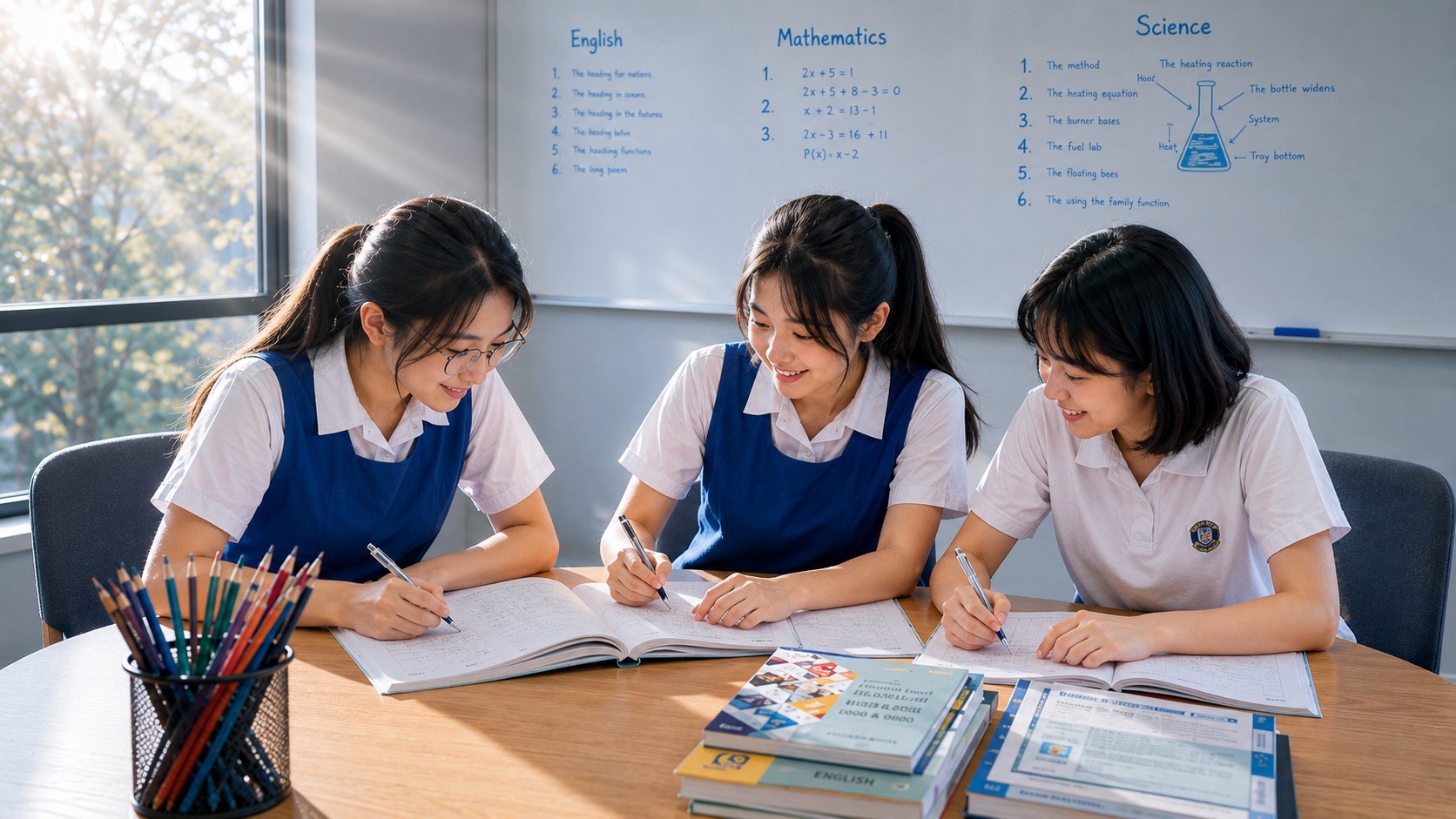
Secondary 1 G2 vocabulary for learning and school life helps students understand instructions, explain ideas, ask useful questions and act on feedback. This guide teaches 100 words through clear meanings and original examples, moving from everyday terms such as assignment and deadline to words such as infer, criteria and reflection. Use it alongside current English lessons to make classroom language easier to understand and to turn a vague wish to improve into a specific next step.
Begin with the words that caused difficulty in a recent task. A student who confuses describe with explain needs a different practice activity from one who understands the question but struggles to organise a paragraph. Parents can ask the child to explain an instruction, show a relevant detail and try a corrected sentence independently. This is an eduKate teaching selection for English at G2, not an official MOE or SEAB top-100 list, a grading scale or a prediction of examination topics.
- Learn 100 distinct headwords in ten groups covering school routines, instructions, information, writing, discussion and progress.
- Use an accessible definition and an original example together, then create a new sentence that fits the same meaning.
- Distinguish related terms such as curriculum and syllabus, describe and explain, and revising and proofreading.
- Try the fictional reading passage, explained diagnostic, sentence-building activities and flexible four-week plan.
- Treat G2 as the level of the English subject; check the school’s current tasks and assessment instructions.
- Choose home practice or additional teaching from the student’s actual work and feedback, rather than from one quiz score.
Where these words fit in school learning
MOE identifies thinking, communication, collaboration and information skills within its 21st Century Competencies work. The situations in this guide give students accessible ways to talk about those activities. The word bank, examples and suggested routines are original teaching choices, not an additional official subject or checklist.
The 2027 G2 English Language syllabus K200 includes accurate vocabulary and communication appropriate to purpose, audience and context. It is a graduating examination reference. It does not set the length or format of every Secondary 1 task. Follow the teacher’s current instructions and consult the relevant examination-year syllabus when that later stage becomes applicable.
SEAB’s SEC overview explains examinations at the respective subject levels. G2 here identifies the English learning context; it is not a label for everything a student can do. A vocabulary exercise can help identify a learning need, but it cannot decide a child’s subject placement.
Start with words that tell you what is being taught and how work is organised. These terms have related meanings, but they do different jobs. A timetable shows when a lesson happens; a syllabus describes what a course covers. Understanding the distinction helps a student ask the right question.
| No. | Word or term | Meaning | Example in use |
|---|---|---|---|
| 1 | curriculum | The planned programme of learning, including its aims, content and experiences. | The school explained how different subjects and activities contributed to its curriculum. |
| 2 | subject | An area of knowledge or learning studied at school. | English was the subject in which Hana wanted more practice explaining her answers. |
| 3 | syllabus | An outline of the aims, content and requirements of a course. | The teacher referred to the syllabus when explaining what the course was designed to develop. |
| 4 | timetable | A schedule showing when lessons or other planned events take place. | Adam checked his timetable before packing the books needed for the next school day. |
| 5 | term | One of the periods into which a school year is divided. | At the start of the term, the class discussed its new reading activities. |
| 6 | semester | One of the two main periods into which an academic year may be divided. | The student kept completed work from the first semester in a labelled folder. |
| 7 | lesson | A period of teaching or an organised learning activity. | During the lesson, pupils practised explaining why a detail supported their interpretation. |
| 8 | assignment | A piece of work that someone is asked to complete. | The assignment asked us to compare two notices and explain which was clearer. |
| 9 | submission | Work handed in for consideration, or the act of handing it in. | Before submission, we checked that our names and the required pages were included. |
| 10 | deadline | The latest time or date by which a task should be completed. | The teacher clarified the deadline after a student noticed two different dates on the instructions. |
Before beginning, identify the action, the required material and any limits that matter. If something is unclear, a precise question is more useful than guessing. These words help students describe the task accurately without assuming that every teacher or subject uses identical instructions.
| No. | Word or term | Meaning | Example in use |
|---|---|---|---|
| 11 | instruction | A statement explaining what someone should do or how to do it. | The instruction asked for one reason, so the student selected her strongest point. |
| 12 | requirement | Something that must be provided or done for a particular task. | A requirement of the practice task was to include evidence from both passages. |
| 13 | criteria | Standards or features used to judge or decide something. | The teacher explained the criteria before the class began revising its short presentations. |
| 14 | format | The way information is arranged or presented. | We checked the required format before deciding whether headings belonged in the response. |
| 15 | sequence | The order in which things happen or are arranged. | The numbered instructions showed the correct sequence for completing the classroom activity. |
| 16 | method | A particular way of doing a task or solving a problem. | Her method was to underline the instruction before selecting details from the passage. |
| 17 | example | A particular case used to show or explain an idea. | The teacher gave an example, then asked us to create a different one. |
| 18 | detail | A small piece of information about something. | One detail in the final paragraph explained why the character changed his decision. |
| 19 | purpose | The reason something is done or the result it aims to achieve. | The purpose of the notice was to explain the new arrangement clearly to classmates. |
| 20 | clarify | To make something clearer or easier to understand. | Nora asked the teacher to clarify which two ideas the question wanted her to compare. |
A question word points towards the work an answer needs to do. The definitions below are useful starting points, not a universal marking scheme. Read the whole question and use the subject context. An accurate word definition cannot replace attention to the particular task.
| No. | Word or term | Meaning | Example in use |
|---|---|---|---|
| 21 | identify | To recognise and name or select something. | Identify the sentence that gives the writer’s main reason for changing the plan. |
| 22 | describe | To give an account of what someone or something is like. | Describe the classroom scene using details that are actually present in the passage. |
| 23 | explain | To make something clear by giving reasons or showing how it works. | Explain why the student revised her first answer after reading the teacher’s comment. |
| 24 | compare | To examine things together to show relevant similarities or differences. | Compare the two notices, paying attention to the information each gives its intended readers. |
| 25 | contrast | To show the differences between things. | Contrast the character’s behaviour at the beginning and the end of the story. |
| 26 | infer | To reach a conclusion from clues and reasoning rather than a direct statement. | We can infer that he is uncertain from his repeated questions and hesitant response. |
| 27 | summarise | To give the main points in a shorter form. | Summarise the explanation without including every example or repeating the same idea twice. |
| 28 | justify | To give reasons or evidence that support a choice or statement. | Justify your choice of title by connecting it to an important event in the passage. |
| 29 | evaluate | To judge something by considering evidence and relevant criteria. | Evaluate the proposed notice by checking whether its information is clear, complete and suitable. |
| 30 | support | To provide reasons or evidence that strengthen an idea or statement. | Support your interpretation with a detail instead of relying only on a general impression. |
A clear answer needs suitable information. More details are not always better if they do not answer the question. These words help learners explain why a source or example belongs in a response, and why an impressive-looking statement may still need checking.
| No. | Word or term | Meaning | Example in use |
|---|---|---|---|
| 31 | source | The person, place or material from which information comes. | The student recorded the source so another reader could find the original explanation. |
| 32 | evidence | Information or observations used to support or challenge a statement. | The character’s decision to return supplied evidence that he had changed his mind. |
| 33 | fact | Something that is true and can be supported through appropriate checking. | The stated date of the fictional event was a fact within the notice. |
| 34 | opinion | A personal view, judgement or preference. | Saying that one title is more interesting expresses an opinion that can be explained. |
| 35 | context | The surrounding information or circumstances needed to understand something. | The same word can have a different meaning when the context changes. |
| 36 | relevant | Closely connected to the matter being considered. | A relevant example helps answer the question instead of introducing an unrelated story. |
| 37 | accurate | Correct in the details being presented. | An accurate quotation preserves the writer’s wording and does not leave out a crucial word. |
| 38 | reliable | Able to be depended on for the purpose being considered. | A reliable source still needs to be checked for relevance to the particular question. |
| 39 | specific | Clear and exact about a particular thing or detail. | The feedback became more useful when it gave a specific sentence for the student to revise. |
| 40 | consistent | Staying the same or fitting together without contradiction in the relevant respect. | The writer kept a consistent viewpoint throughout the explanation instead of changing it without reason. |
Writing involves several kinds of decisions. First decide what the reader needs to understand; then check the wording and conventions. Revising an idea and correcting a comma are both useful, but they do not fix the same problem. Learn to name the change you are making.
| No. | Word or term | Meaning | Example in use |
|---|---|---|---|
| 41 | draft | An early version of a piece of work that may be changed. | Her first draft contained a useful idea but needed a clearer supporting example. |
| 42 | revise | To change work in order to improve its content or expression. | We revised the paragraph after noticing that its example did not support the main point. |
| 43 | edit | To change or correct content so that it works better for its purpose. | The student edited repeated phrases and corrected a confusing shift in tense. |
| 44 | proofread | To check a text carefully for remaining errors before using or submitting it. | Before handing in the final version, he proofread the names, punctuation and spelling. |
| 45 | paragraph | A group of related sentences developing part of a text. | The second paragraph explained the reason instead of repeating the introduction in different words. |
| 46 | sentence | A grammatical unit expressing a statement, question, command or exclamation. | The student completed the sentence by adding the missing verb and checking its meaning. |
| 47 | phrase | A group of words working together as a unit within language. | The phrase “after the lesson” tells the reader when the conversation took place. |
| 48 | tone | The attitude or feeling communicated through language. | A respectful tone helped the request sound clear without sounding demanding. |
| 49 | audience | The people a piece of communication is intended to reach. | The audience was a group of new students, so the notice explained unfamiliar terms. |
| 50 | punctuation | Written marks that help organise sentences and show their meaning. | Correct punctuation made it clear where the question ended and the reply began. |
A discussion is easier to follow when everyone knows the question and has a way to contribute. Practise responding to a point before introducing another. These words can describe classroom participation without assuming that the fastest or loudest speaker has understood the task best.
| No. | Word or term | Meaning | Example in use |
|---|---|---|---|
| 51 | collaborate | To work with other people on a shared task. | The pupils collaborated on the outline before each wrote an individual paragraph. |
| 52 | contribute | To give an idea, effort or resource towards a shared activity. | A quieter student contributed a useful question that helped the group notice a missing detail. |
| 53 | participate | To take part in an activity. | Everyone could participate by speaking, asking a question or sharing a prepared written idea. |
| 54 | discuss | To talk about something by exchanging ideas and considering different points. | We discussed two possible interpretations before deciding which had stronger evidence. |
| 55 | question | To ask about something or examine whether it is correct. | The reader questioned the claim because the example did not clearly support it. |
| 56 | listen | To pay attention to what is being said or heard. | Listen to the full explanation before deciding which part needs clarification. |
| 57 | respond | To answer or react to a message, question or situation. | She responded to the question directly before adding another example to her explanation. |
| 58 | feedback | Information about work or performance that can guide a next step. | The feedback identified a missing reason and suggested where the student could look for evidence. |
| 59 | role | The part or responsibility someone has in an activity. | My role in the discussion was to check that each suggestion answered the original question. |
| 60 | agreement | A shared decision or an arrangement accepted by the people involved. | The group reached an agreement about which parts to prepare before its next meeting. |
Planning should make the next action easier to begin. Use a routine that fits the student’s school work, then adjust it when the evidence shows a different need. These words describe useful actions; they are not a requirement to follow one timetable or work for a fixed number of hours.
| No. | Word or term | Meaning | Example in use |
|---|---|---|---|
| 61 | organise | To arrange materials or activities so they can be used effectively. | She organised her notes by topic so that she could find the relevant example quickly. |
| 62 | prioritise | To decide which matters need attention before others. | We prioritised correcting the misunderstood instruction before polishing the appearance of the worksheet. |
| 63 | estimate | To make a reasonable approximate judgement about an amount or duration. | The student estimated how long the reading task might take before planning the evening’s work. |
| 64 | schedule | To arrange an activity for a particular time. | He scheduled a short review after completing the work that was due first. |
| 65 | routine | A pattern of actions followed regularly. | Her routine began with checking the task before choosing the materials needed. |
| 66 | focus | To direct attention towards a particular thing. | During the next attempt, focus on explaining the reason clearly rather than adding extra description. |
| 67 | distraction | Something that draws attention away from the intended activity. | An unrelated conversation became a distraction while the group was checking its final answers. |
| 68 | prepare | To get someone or something ready for a task. | Prepare two questions about the passage so that the discussion has a clear starting point. |
| 69 | review | To look at something again in order to check or reconsider it. | Review the teacher’s comment before deciding which part of the response to change. |
| 70 | recall | To bring previously learnt information back to mind. | Try to recall the word’s meaning before uncovering the definition in your notebook. |
A student can improve in one part of a task while still needing help with another. Name the change precisely. These words support a useful conversation about effort, methods and results without turning every mistake into a judgement about the learner’s ability or character.
| No. | Word or term | Meaning | Example in use |
|---|---|---|---|
| 71 | goal | Something a person aims to achieve. | Her goal was to explain an inference with a relevant clue from the passage. |
| 72 | target | A specific result or level that someone aims to reach. | His practice target was to write three complete explanations using details from a fresh text. |
| 73 | progress | Movement towards a goal or an improvement over time. | The two drafts showed progress because the later version answered the question more directly. |
| 74 | accuracy | The degree to which something is correct. | The teacher checked the accuracy of the explanation as well as the neatness of its presentation. |
| 75 | fluency | The ability to use language smoothly and with ease. | Her fluency improved during the discussion when she organised the main point before speaking. |
| 76 | confidence | A feeling of trust in an ability, judgement or possibility. | A clear understanding of the task gave him more confidence to attempt the next question. |
| 77 | challenge | A task or difficulty that requires effort or skill. | The unfamiliar viewpoint was a challenge, so the student read the surrounding sentences carefully. |
| 78 | strategy | A planned way of working towards a goal or handling a difficulty. | Her strategy was to compare the question with each sentence of the draft. |
| 79 | effort | The energy or work put into an activity. | The teacher acknowledged the effort and helped the student choose a more useful next practice. |
| 80 | persistence | Continuing to work towards something despite difficulty. | His persistence included trying a different explanation after the first one remained unclear. |
Assessment language can sound more complicated than the learning it describes. Use these definitions to ask clearer questions about a task. A mark, a grade and a teacher’s comment give different kinds of information. The next practice should respond to the actual difficulty shown in the work.
| No. | Word or term | Meaning | Example in use |
|---|---|---|---|
| 81 | assessment | A process of gathering and considering information about learning or performance. | The short assessment helped the teacher see which instructions still needed explanation. |
| 82 | rubric | A guide describing criteria and levels of performance for a task. | The rubric helped the class understand what a well-supported explanation would include. |
| 83 | mark | A point or score awarded for work according to an assessment method. | The pupil received one mark for the response, then read the teacher’s comment to understand what was missing. |
| 84 | grade | A category or level used to report an assessed performance. | The student looked beyond the grade to find the skill that needed more practice. |
| 85 | correction | A change that puts something right or removes an error. | The correction replaced the incorrect verb and preserved the sentence’s intended meaning. |
| 86 | misconception | An incorrect understanding of an idea. | A common misconception is that an inference can be any imaginative guess about a character. |
| 87 | strength | An ability or feature that helps someone or something work well. | A strength of her answer was its clear connection between the claim and the evidence. |
| 88 | gap | A missing part of knowledge, understanding or skill. | The teacher identified a gap in understanding why the two words were not interchangeable. |
| 89 | independent | Done or managed without the particular help being considered. | An independent attempt showed whether the student could use the idea without copying the model. |
| 90 | reflection | Careful thought about an experience and what can be learnt from it. | His reflection identified the confusing instruction and explained how he would check it next time. |
Learning involves choices about questions, resources, practice and help. These words let students describe those choices and their effects. Independence can include recognising when clarification is needed. It does not require pretending to understand or continuing with a method that has stopped being useful.
| No. | Word or term | Meaning | Example in use |
|---|---|---|---|
| 91 | adapt | To change something so that it suits a situation or purpose better. | We adapted the practice by using a shorter passage while keeping the same reasoning task. |
| 92 | flexible | Willing or able to change when the situation requires it. | A flexible plan allowed more time for the difficult section without abandoning the whole routine. |
| 93 | resource | Something useful that supports an activity or helps meet a need. | The annotated example was a helpful resource when the student checked her first attempt. |
| 94 | option | One possible choice or course of action. | One option was to practise the sentence aloud before writing the paragraph. |
| 95 | decision | A choice made after considering possibilities. | The decision to revise the main point improved the paragraph more than adding another decoration. |
| 96 | consequence | A result or effect of an action or situation. | A helpful consequence of asking early was that the group could correct its misunderstanding before submission. |
| 97 | responsibility | A duty or an obligation to look after or complete something. | Each learner accepted responsibility for checking the accuracy of the information they added. |
| 98 | initiative | The willingness to take a useful first step without waiting for every instruction. | She showed initiative by bringing an attempted answer and a clear question to the teacher. |
| 99 | curiosity | A desire to know or understand more about something. | His curiosity led him to ask why the author had chosen an unusual title. |
| 100 | improvement | A change that makes something better in a relevant way. | The clearest improvement was that the revised answer gave a reason supported by the text. |
CHAPTER 11 OF 18 · Use, practise and check
11. Connect each word to a task you can explain
Begin with one piece of school work and ask what the instruction expects. If it says describe, identify the features or events that need an account. If it says explain, look for the reason or connection that makes the point understandable. The surrounding wording still matters: “explain the effect of this phrase” is different from “explain why the character returned”.
Make a three-part notebook entry: the word, a plain explanation and a new sentence. For relevant, a learner might write, “Connected to this question” and “The detail about the broken strap is relevant because the question asks why the bag fell.” The because-clause shows why the detail belongs.
Cover the example and change the situation. Can the learner explain relevance in a notice about an activity? If the meaning disappears when the original sentence is removed, return to a simpler example. The aim is to use the idea in another context, not to reproduce a line from memory.
Notice word forms. Compare is a verb, while comparison is a noun. “We compared the notices” and “Our comparison included one similarity” use related meanings in different grammatical positions. Add useful phrases such as respond to a question, contribute to a discussion and evidence for a claim. These combinations help a student build complete sentences.
CHAPTER 12 OF 18 · Use, practise and check
12. Original reading: the paragraph that answered a different question
Fictional passage: Kai’s English assignment asked him to compare two notices for school activities. One notice advertised a drawing workshop; the other described a storytelling session. He needed to identify one similarity, one difference and which notice gave clearer information.
Kai wrote a lively paragraph about how much he enjoyed drawing. He described his favourite pencils and a picture he had made. When he exchanged drafts with Lina, she praised his clear sentences but asked where he had compared the notices. Kai pointed to the sentence saying that drawing was more enjoyable. Lina asked, “Does that compare the information in the notices, or your preference for the activities?”
At first, Kai wanted to add more details about his picture. Then he reread the instruction. Both notices named a venue, but only the storytelling notice stated what participants should bring. He revised his paragraph around those details. His conclusion now explained why one notice was clearer instead of which activity he preferred.
Kai kept his original paragraph in his folder. In a short reflection, he wrote that his first draft contained good description but answered a different question. His next step was to check the task before choosing an example, and again before submission.
Questions and explained answers
- Why was the first paragraph unsuitable? It focused on Kai’s preference and experience. The task asked for a comparison of the information in two notices.
- What useful feedback did Lina give? She identified the missing comparison and asked a question that separated the notice information from Kai’s personal preference.
- Which detail supports the revised conclusion? Only the storytelling notice said what participants should bring. That additional information supports a claim that it was clearer in this respect.
- Did Kai need to discard every part of his first attempt? No. His clear sentence writing was a strength, while the selection of content needed revision.
- What does his reflection show? He can identify the mismatch and name a specific next action: checking the task before selecting information.
The passage does not tell us a mark or grade. Do not invent one when explaining the improvement. The evidence shows a better match between instruction, information and conclusion.
CHAPTER 13 OF 18 · Use, practise and check
13. Turn a correct word into a useful explanation
Start with “My answer improved.” The sentence is grammatical, but it does not show the change. Add the part that improved: “My explanation became more accurate.” Then show what changed: “I replaced a guess about the character’s feelings with an inference based on his actions.” A reader can now see what improvement means in this example.
A simple paragraph model
“My first answer described the event but did not explain the character’s decision. After reviewing the feedback, I added the detail that he had promised to return. This evidence supported my explanation that he wanted to keep his agreement. Next time, I will check whether my answer gives a reason when the question asks why.”
The paragraph connects a difficulty, a change, evidence and a next step. It is a practice structure, not a compulsory examination formula. A different task may need a different organisation. Check the teacher’s instructions before deciding how long the answer should be.
Ask a precise question
“I don’t get it” is an understandable starting point. A more specific question helps someone respond: “I can identify the event, but I cannot explain why this detail supports the inference. Could you show me the connection?” Bring an attempt when possible. The teacher can then see what is understood and where the gap begins.
Repair the grammar, not only the spelling
“We gave a compare” uses the wrong word form. Revise it to “We made a comparison” or “We compared the examples.” “The criteria is clear” needs “The criteria are clear”, because criteria is plural. The singular form is criterion. A notebook entry should include the pattern that will help prevent the same error in a fresh sentence.
CHAPTER 14 OF 18 · Use, practise and check
14. Understand distinctions that change the next step
Curriculum, syllabus and timetable
A curriculum is the wider planned learning programme. A syllabus outlines a particular course’s aims, content and requirements. A timetable organises when activities happen. If the question is “What should I bring tomorrow?”, the timetable and teacher’s instructions are usually more immediately useful than a national syllabus document.
Describing and explaining
“The student crossed out the sentence” describes an action. “The student crossed it out because the example did not answer the question” explains a reason. Some tasks require both. Adding because does not guarantee a good explanation; the reason after it must make sense and be supported.
Revising, editing and proofreading
These activities can overlap. For this guide, revising emphasises improving meaning and organisation, editing includes changes to wording and correctness, and proofreading is a final careful search for remaining errors. A perfectly spelt paragraph can still answer the wrong question. Begin with the problem that matters most in the task.
Effort and progress
Effort describes work put in; progress describes movement towards a goal. Both deserve thoughtful attention, but one does not automatically prove the other. If a learner works hard and keeps making the same error, discuss the method and the missing explanation. Repeating the task unchanged may not address the difficulty.
A score and an explanation
A score reports something about performance under particular conditions. Feedback can show why the response worked or did not work. Read both where available. One short exercise does not describe everything a student knows, and it does not by itself determine whether a subject level should change.
CHAPTER 15 OF 18 · Use, practise and check
15. Eight learning-language checks with explained answers
Try these questions without looking at the word tables. This is an original teaching check, not an official test or a grading system. If a response is incomplete, identify the missing part before deciding what to practise.
- Which document mainly shows when lessons happen: a timetable or a syllabus?
- A question asks why a character leaves. Would a list of the character’s clothes usually explain the reason?
- Complete: “The student responded ___ the teacher’s question.”
- Choose the correct form: “We made a compare/comparison.”
- A student changes a paragraph’s main point to answer the question. Is this revising or merely checking spelling?
- Explain why copying a model exactly does not show independent use of an idea.
- Write one specific question a student could ask about a confusing instruction.
- Give one piece of evidence that Kai’s revised paragraph better matches the task.
Answers and reasons
- A timetable. It organises timing; a syllabus concerns the course’s aims and content.
- Usually not. The answer needs a reason supported by the passage. Clothing would matter only if the text connected it to the departure.
- To. The usual pattern is respond to a question.
- Comparison. The sentence requires a noun. “We compared the notices” is another accurate construction.
- Revising. The student changes the meaning or organisation, not just the spelling.
- The model supplies the wording and decisions. A new task completed without copying gives clearer evidence of what the learner can do.
- Possible answer: “Should I compare the activities or the information in their notices?” Other precise questions can also be appropriate.
- He compares a shared feature and a difference in information. Both notices name a venue, but only one says what to bring.
Keep an error note that is small enough to use. “I confuse verbs and nouns” is more actionable than “My English is bad.” Select one pair, write two accurate sentences and try another pair later.
CHAPTER 16 OF 18 · Use, practise and check
16. Discuss learning without turning mistakes into labels
A three-pupil practice activity
Give three learners a fictional instruction and a short response that partly misses the task. One identifies the instruction, another selects the relevant evidence and the third suggests a revision. Rotate the roles. Then ask each pupil to answer a new question independently so that the shared discussion leads to individual practice.
Useful feedback names the change: “Your second answer explains the reason and supports it with a detail.” Broad comments such as “Be smarter” do not tell a learner what to do next. Let students ask for clarification and give them time to think before answering.
What parents can look for
Ask the child to explain one instruction from recent work. If the meaning is unclear, start there. If the instruction is understood but the response lacks evidence, practise selecting a relevant detail. If the ideas are sound but the sentence is incomplete, work on the sentence pattern. These different difficulties should not all receive the same extra worksheet.
When considering additional English support, ask how the teacher will identify the starting need, explain a correction and check a fresh attempt. A useful sample lesson makes those steps visible. Discuss the workload and the school’s feedback before choosing the amount of extra practice. No particular class size or resource can guarantee a result.
If uncertainty about a task persists, ask the school for clarification using the actual instruction and attempted work. Keep questions about subject-level arrangements with the school. The purpose of this vocabulary guide is clearer language and better-informed learning decisions, not a replacement for individual school advice.
CHAPTER 17 OF 18 · Use, practise and check
17. A flexible four-week plan for usable school vocabulary
Choose a small working set that fits current school tasks. The following sequence is a suggestion, not a requirement to master all 100 words within a month. A short session can include recalling earlier meanings, discussing a new example and making one independent attempt.
Week 1: understand the instruction
Select words from the first three groups. Match each to a simple task and explain what the response needs to do. Compare describe with explain and compare with contrast. Keep one misunderstood instruction as a worked example, then try a different instruction without the model beside you.
Week 2: select and connect information
Practise relevant, evidence, context, accurate and specific. Use the fictional notices passage or another suitable school text. State a point, select a supporting detail and explain the connection. Remove any information that does not help answer the question.
Week 3: revise and discuss
Keep a first draft and revise one part after feedback. Explain whether the change concerns meaning, organisation, grammar or punctuation. Use the three-pupil activity, or let a parent ask the questioner’s prompts. Give the learner the final attempt to complete independently.
Week 4: review the method and choose the next goal
Try the diagnostic and a fresh short task. Compare the result with an earlier attempt for clearer meanings and explanations. Choose one specific next goal, such as checking noun and verb forms or linking evidence to a claim. Keep uncertain words for later review instead of treating the end of the month as proof of complete mastery.
CHAPTER 18 OF 18 · Use, practise and check
18. Questions students and parents often ask
Should I use a difficult word whenever I know one?
Use the word that expresses the meaning accurately. “I changed my answer” may be sufficient. “I revised my explanation after checking the evidence” is useful when those details matter. A longer sentence should add information, not simply sound more advanced.
Can I know a definition and still misunderstand a question?
Yes. A word’s meaning is only part of the task. You must also identify the topic, the required evidence and any stated limits. Read the complete instruction and ask about the part that remains unclear.
Does needing help mean I cannot work independently?
Asking for clarification can be a sensible learning decision. After the explanation, attempt a similar task yourself and show what you can now do. Independence is developed through appropriate practice; it does not require hiding uncertainty.
What should we do today?
Choose one instruction word, one information word and one revision word. Use them to explain a real or fictional learning task. Finish with a sentence naming the next action. A precise next step gives the following practice a useful purpose.
Continue learning with eduKate
- Secondary 1 G2 English vocabulary foundations: use the companion guide to connect vocabulary with the next learning step.
- eduKate Vocabulary hub: explore word meaning, sentence use and further learning resources.
Official sources and further reading
Curriculum and examination context checked on 16 November 2026. Follow the school’s current instructions and the syllabus for the relevant examination year. The definitions, examples and practice tasks above are original teaching material.
- MOE: Committee of Supply 2024 announcements — Official context for thinking, communication, collaboration and information skills; this article does not describe award eligibility.
- SEAB: 2027 G2 English Language syllabus K200 — Broad English learning aims and the later graduating examination context, not Secondary 1 task specifications.
- SEAB: Secondary Education Certificate overview — Official explanation of SEC examinations and subject levels.
- MOE: Full Subject-Based Banding infographic — Different subjects can be taken at different levels; discuss individual arrangements with the school.