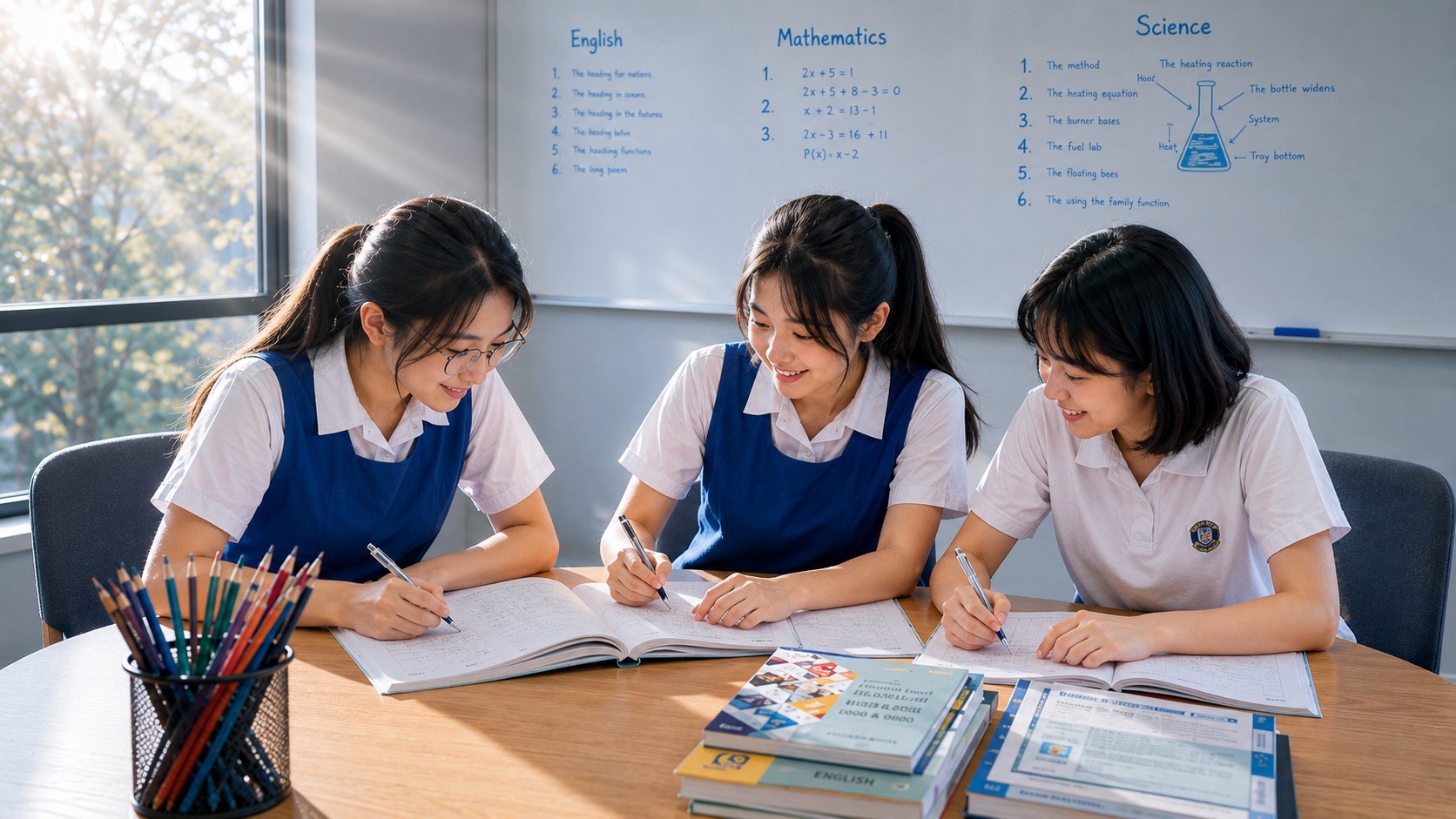
Secondary 1 G2 students can use environmental vocabulary to describe everyday choices, understand a passage and explain an opinion clearly. These 100 words move from familiar objects such as a wrapper or tap to ideas such as consumption, evidence and stewardship. Each word has a plain meaning and an original example. Begin with a situation the student recognises, then practise choosing the word that explains it accurately. Knowing why a label can be misleading is more useful than repeating an impressive slogan.
This guide is for students taking English at G2 and parents helping them read, speak and write with greater precision. It includes a short original passage, answer explanations, writing tasks and a manageable practice routine. The words are an eduKate teaching selection, not an official MOE or SEAB compulsory list, frequency ranking or forecast of examination topics. Environmental care provides the context; the central task is learning how English words communicate actions, reasons, limits and consequences.
- Learn exactly 100 distinct English headwords in ten groups, progressing from concrete objects to thoughtful explanations.
- Use meanings and examples together: explain the situation before trying to include a new word in a sentence.
- Distinguish important pairs, including reuse and recycle, weather and climate, and biodegradable and compostable.
- Practise reading for evidence, replacing vague claims and writing a realistic suggestion for a school audience.
- Follow current local guidance for recycling and water use; a product label alone does not settle its disposal route.
- Choose a small weekly selection and check independent use, rather than treating all 100 words as an immediate spelling test.
Learning context, checked 16 November 2026. Singapore’s Green Plan describes MOE’s Eco Stewardship Programme, while the Secondary Character and Citizenship Education syllabus includes environmental issues and sustainability. These provide relevant contexts for discussion; they do not prescribe this vocabulary bank.
The 2027 SEC G2 English Language syllabus, K200 values appropriate vocabulary, clear communication and understanding texts. That is broad context for developing language over time, not a Secondary 1 assessment timetable or a prediction of an environmental examination theme. Use the teacher’s current English tasks to decide the depth and length of practice.
Start by pointing to an object, picture or familiar place. These nouns make an explanation specific enough for someone else to understand what happened.
| No. | Word or term | Meaning | Example in use |
|---|---|---|---|
| 1 | environment | The surroundings and conditions in which people, animals and plants live. | We discussed how noise and litter affect the environment around our school. |
| 2 | litter | Rubbish left in a place where it does not belong. | A gust of wind scattered the litter across the empty playground. |
| 3 | rubbish | Things that have been discarded because they are no longer wanted. | The caretaker asked us to place the rubbish in the correct bin. |
| 4 | waste | Materials discarded, or resources used without a useful purpose. | Our class recorded food waste so that we could discuss possible causes. |
| 5 | bin | A container used to collect rubbish, recyclables or other materials. | Read the label on the bin before deciding where an item belongs. |
| 6 | drain | A channel or pipe that carries water away. | After the rain, wrappers had gathered beside the drain near the gate. |
| 7 | packaging | Materials used to contain, protect or present a product. | The small toy arrived with more packaging than Amir had expected. |
| 8 | container | An object used to hold or store something. | Mei washed her container after lunch so that she could use it again. |
| 9 | bottle | A container with a narrow opening, usually used for liquids. | Ravi refilled his bottle at the drinking-water point before the lesson. |
| 10 | wrapper | A covering around an item, often removed before the item is used. | She put the sandwich wrapper away instead of leaving it on the bench. |
Use these verbs with an object: reduce waste, repair a bag or refill a bottle. Naming the action is clearer than writing only “help the environment”.
| No. | Word or term | Meaning | Example in use |
|---|---|---|---|
| 11 | reduce | Make an amount, number or level smaller. | We can reduce unnecessary printing by checking the required number of copies first. |
| 12 | reuse | Use an item again for the same purpose or another suitable purpose. | We reused the clean envelopes to organise our revision cards. |
| 13 | recycle | Process discarded materials so that they can become useful materials again. | Check the local collection rules before deciding whether to recycle an item. |
| 14 | repair | Put something damaged or broken back into working condition. | An adult helped repair the bag’s loose strap instead of replacing the bag. |
| 15 | refill | Fill a container again after some or all of its contents have been used. | I remembered to refill my water bottle before leaving for the journey. |
| 16 | sort | Arrange items into groups according to a chosen difference or rule. | The pupils sorted the pictures into reusable items and items needing disposal. |
| 17 | rinse | Wash something briefly with water to remove a substance from its surface. | Rinse an accepted recyclable if needed to remove remaining food or drink. |
| 18 | collect | Bring things together from different places. | The class collected used paper for a teacher-approved activity after checking its condition. |
| 19 | discard | Get rid of something because it is no longer wanted or usable. | Before you discard a broken object, ask whether it can be repaired. |
| 20 | replace | Put a new or different thing in the place of another. | The club replaced its unclear poster with one showing specific instructions. |
A material name does not tell the whole story. Condition, coatings and the collection system can affect what happens next; read labels as information to check.
| No. | Word or term | Meaning | Example in use |
|---|---|---|---|
| 21 | material | The substance from which an object is made. | The label helped us identify the material used to make the container. |
| 22 | plastic | A group of materials that can be shaped into many useful objects. | Plastic items differ, so their disposal routes are not always the same. |
| 23 | paper | Thin material commonly used for writing, printing or wrapping. | We used the blank side of the paper for rough planning. |
| 24 | glass | A hard material used for objects such as windows, jars and bottles. | The glass jar was clean, but we still checked the item guide. |
| 25 | metal | A type of material such as aluminium, iron or copper. | The poster named the metal in the can rather than calling everything plastic. |
| 26 | contamination | The presence of unwanted substances that can make something unsuitable for its intended use. | Food contamination can make otherwise accepted recyclables unsuitable for collection. |
| 27 | reusable | Designed or suitable to be used more than once. | My reusable lunch container has become part of my ordinary school routine. |
| 28 | recyclable | Suitable for processing into useful materials through a relevant recycling system. | A recyclable item still needs the correct collection route and suitable condition. |
| 29 | biodegradable | Able to be broken down by living organisms under suitable conditions. | A biodegradable label does not mean a bag belongs in a blue recycling bin. |
| 30 | compostable | Able to break down within a specified composting process without leaving harmful residues. | The compostable cup needed the conditions stated in its instructions, not any outdoor space. |
Move from something visible, such as a drip, to an idea such as consumption. Use the abstract word only when you can explain the everyday situation behind it.
| No. | Word or term | Meaning | Example in use |
|---|---|---|---|
| 31 | water | The substance we drink and use for washing, also found as ice or vapour. | We discussed when water was needed and when the tap could be turned off. |
| 32 | tap | A device controlling the flow of water from a pipe. | Nadia turned off the tap while she brushed her teeth. |
| 33 | leak | An unintended escape of liquid or gas through a gap or fault. | The pupil reported a leak instead of assuming someone else had noticed it. |
| 34 | drip | A small drop of liquid falling, or the action of falling in drops. | A steady drip continued after the tap had been closed. |
| 35 | conserve | Protect a resource by using it carefully and avoiding unnecessary use. | We can conserve water by turning off the shower while soaping. |
| 36 | reservoir | A natural or artificial body of water used for storage. | The passage explained the role of a reservoir in storing water. |
| 37 | supply | An amount of something available for use, or the act of providing it. | A reliable water supply matters to homes, schools and businesses. |
| 38 | shortage | A situation in which less of something is available than is needed. | The story described a shortage of water after a long dry period. |
| 39 | consumption | The amount of a resource used, or the act of using it. | The family compared water consumption across several months before drawing a conclusion. |
| 40 | efficient | Achieving a purpose with relatively little waste of resources or effort. | An efficient routine can avoid unnecessary water use while still getting the dishes clean. |
Use this set to discuss options without assuming that one word proves an option has no environmental impact. A comparison needs a clear subject and reason.
| No. | Word or term | Meaning | Example in use |
|---|---|---|---|
| 41 | energy | The ability to cause changes, such as movement, heating or lighting. | The empty room still had lights on, so the pupils discussed unnecessary energy use. |
| 42 | electricity | Effects involving electric charge, including the currents used to supply power to devices. | The family checked which appliances used electricity even when no one needed them. |
| 43 | fuel | A substance used to provide energy, often by being burnt. | The article compared how different vehicles use fuel for a journey. |
| 44 | renewable | Describing a resource replenished naturally on a useful human timescale. | Renewable energy does not mean that equipment has no environmental impact. |
| 45 | solar | Relating to the Sun or energy received from it. | The school display explained how solar panels use sunlight to produce electricity. |
| 46 | appliance | A device designed for a particular practical task, often in a home. | The washing machine is an appliance used by the whole family. |
| 47 | switch | A device that starts, stops or changes the operation of equipment. | The pupil used the light switch after checking that everyone had left. |
| 48 | journey | An act of travelling from one place to another. | We compared possible routes for the same journey rather than unrelated trips. |
| 49 | transport | The movement of people or goods from one place to another. | The survey asked which form of transport pupils used to reach school. |
| 50 | emissions | Substances, often gases or particles, released into the air. | The report compared transport emissions and explained the limits of its figures. |
These words help a student explain quantity, need and choice. They also support a balanced account of why a practical decision may differ between households.
| No. | Word or term | Meaning | Example in use |
|---|---|---|---|
| 51 | portion | An amount of food served to one person at a time. | I asked for a smaller portion because I was not very hungry. |
| 52 | leftovers | Food remaining after a meal. | The family planned how to use the leftovers rather than automatically ordering more food. |
| 53 | surplus | An amount greater than what is needed. | The canteen adjusted its bread order after recording a regular surplus. |
| 54 | edible | Suitable for people to eat. | The cook used the edible stalks as well as the leaves. |
| 55 | appetite | A person’s desire for food. | My appetite was smaller that afternoon, so I asked for less rice. |
| 56 | purchase | Buy something, or something that has been bought. | Before making a purchase, I checked whether I already owned a suitable item. |
| 57 | durable | Able to last and withstand wear or damage. | The durable bag remained useful after several years of daily use. |
| 58 | unnecessary | Not needed for a particular purpose or situation. | Extra wrapping was unnecessary because the item was already safely packed. |
| 59 | alternative | Another possible choice or way of doing something. | Repairing the zip was an alternative to buying a new pencil case. |
| 60 | demand | The amount of a product or service that people want to obtain. | The shop ordered fewer disposable cups when demand for them fell. |
A precise noun helps the reader picture what is being protected. Avoid using nature as a vague substitute when you can name the place, living thing or relationship.
| No. | Word or term | Meaning | Example in use |
|---|---|---|---|
| 61 | nature | The living world and its physical features, apart from what people manufacture. | The writer noticed nature in the small patch of plants beside the walkway. |
| 62 | wildlife | Animals and other living things growing or living without being domesticated. | We watched the wildlife from the path without trying to handle it. |
| 63 | habitat | The place and conditions in which an organism lives. | The pond provided a habitat for several kinds of small animals. |
| 64 | species | A group of related organisms recognised as one kind of living thing. | The guide identified the bird’s species using several features, not colour alone. |
| 65 | biodiversity | The variety of life, including differences within species and between ecosystems. | The project considered biodiversity instead of counting only the largest animals. |
| 66 | native | Naturally occurring in a place, rather than introduced there by people. | The sign identified a plant native to the region. |
| 67 | pollution | Harmful substances or forms of energy entering the environment. | Noise pollution from the worksite made conversation beside the road difficult. |
| 68 | protect | Keep someone or something safe from harm or damage. | The notice asked visitors to protect the young plants by staying on the path. |
| 69 | restore | Return something damaged or weakened towards a better or earlier condition. | The group discussed how to restore the neglected garden with the owner’s permission. |
| 70 | preserve | Keep something valuable from damage, loss or unwanted change. | The proposal aimed to preserve the existing trees while improving the walkway. |
These words connect an event with what it may cause. Keep possibility separate from certainty, and describe the scale of a claim before drawing a conclusion.
| No. | Word or term | Meaning | Example in use |
|---|---|---|---|
| 71 | climate | The usual patterns of weather in a place over a long period. | One rainy afternoon cannot describe the climate of a whole region. |
| 72 | weather | Atmospheric conditions in a place at a particular time. | The weather changed quickly, so the class postponed its outdoor activity. |
| 73 | drought | A prolonged period of unusually little rain that can lead to water shortage. | The fictional village faced a drought after many months of very low rainfall. |
| 74 | flood | Water covering land that is normally dry. | The report described a flood that made the ground-floor rooms unusable. |
| 75 | damage | Harm that reduces the condition, usefulness or value of something. | The pupils described the damage to the plants instead of simply saying it was bad. |
| 76 | impact | An effect that an action, event or change has on something. | We asked what impact the proposed change might have on daily routines. |
| 77 | consequence | A result of an action or event, which may be helpful or harmful. | One consequence of clearer instructions was that fewer pupils needed to ask for help. |
| 78 | risk | The chance of harm together with how serious that harm could be. | The plan considered the risk of a wet floor during the activity. |
| 79 | prevent | Stop something from happening, rather than deal with it only afterwards. | Checking the number of participants can prevent unnecessary printing. |
| 80 | adapt | Change something or adjust behaviour to suit new conditions. | The class adapted its plan when the collection point was temporarily unavailable. |
This group turns an opinion into a reasoned explanation. Use the words to show what you noticed, how you compared it and what the evidence can support.
| No. | Word or term | Meaning | Example in use |
|---|---|---|---|
| 81 | observe | Notice something carefully, often to learn about what is happening. | We observed the area before suggesting where a clearer sign might help. |
| 82 | identify | Recognise or name a particular thing, feature or problem. | The pupils tried to identify which instruction readers found confusing. |
| 83 | compare | Examine two or more things to show similarities or differences. | Compare the same number of days before judging whether a routine has changed. |
| 84 | measure | Find the amount or size of something using an agreed method. | We measured the amount of paper used instead of relying on memory. |
| 85 | evidence | Information that supports or challenges a claim or explanation. | The dated records provided evidence for our report about paper use. |
| 86 | estimate | Make a careful approximate judgement when an exact value is unavailable. | We estimated the number of unused sheets, then checked the count together. |
| 87 | claim | A statement presented as true, which may need support. | The claim that every plastic item is recyclable needs correction and careful checking. |
| 88 | accurate | Correct and close to the true information or value. | An accurate report includes both the result and the conditions of the comparison. |
| 89 | specific | Clearly identified or detailed, rather than vague or general. | A specific request tells readers which action to take and when. |
| 90 | misleading | Likely to give someone an incorrect impression, even if part is true. | The poster was misleading because it made a limited result sound universal. |
These more abstract words work best after an example. Practise explaining one in ordinary language, then use it to connect an action with a wider consideration.
| No. | Word or term | Meaning | Example in use |
|---|---|---|---|
| 91 | sustainable | Able to continue over time without exhausting resources or causing unacceptable harm. | The class asked whether its proposed routine would be practical and sustainable. |
| 92 | sustainability | The ability to continue while considering resources, people and effects over time. | The discussion connected sustainability with repeated habits and wider systems. |
| 93 | responsibility | A duty to act with care and consider the effects of choices. | Taking responsibility included checking information before putting it on the poster. |
| 94 | stewardship | Responsible care for something entrusted to us or shared with others. | Environmental stewardship includes understanding a place before proposing changes to it. |
| 95 | priority | Something given greater importance or attention than other things. | Fixing the unclear instructions became our first priority for the trial. |
| 96 | balance | Give appropriate attention to competing needs or considerations. | We tried to balance convenient packaging with the waste it could create. |
| 97 | practical | Suitable for real conditions and possible to carry out. | A practical suggestion considered the space and time available in the classroom. |
| 98 | achievable | Possible to accomplish with the available ability, time or resources. | The teacher helped us choose an achievable target for the first week. |
| 99 | consistent | Following the same approach reliably over time. | A consistent recording method made the two sets of observations easier to compare. |
| 100 | commitment | A firm intention or promise to continue with an agreed action. | Our commitment was to review the routine, not to make claims we could not support. |
CHAPTER 11 OF 17 · Use, practise and check
11. Build a sentence from a concrete detail to a wider idea
Begin with something visible: “There was a wrapper on the bench.” Add an action: “Mina collected the wrapper.” Then add a reason: “She wanted to prevent it from blowing into the drain.” Each sentence gives the reader more information. The vocabulary grows with the meaning instead of being inserted only to sound advanced.
Now consider an abstract word: responsibility. A useful sentence is, “Mina showed responsibility by checking the correct disposal route.” The action explains the idea. “Mina was very responsible and sustainable” is less clear because sustainable does not naturally describe her character in this context. A person may make a sustainable choice, support sustainability or take responsibility for an action. Learn the words that commonly belong together.
Notice how grammar changes the job of a word
Reduce is a verb: “We reduced unnecessary printing.” Reusable is an adjective: “We used reusable folders.” Consumption is a noun: “We recorded paper consumption.” A student may know a meaning yet write “We consumption less paper.” Repair the grammar with “We consumed less paper” or, more naturally in this context, “We used less paper.” The simplest accurate sentence is often the strongest one.
Keep the limits of the claim visible. “Our class used fewer sheets during the trial” describes an observation. “Our trial solved the environmental problem” goes far beyond it. Words such as may, can and in this example help a writer show uncertainty or scope when appropriate. They should clarify the evidence, not hide an empty explanation.
CHAPTER 12 OF 17 · Use, practise and check
12. Read an original short text: The sign beside the shelf
The following story and its observations are invented for English practice.
At the end of Tuesday’s lesson, Aisha noticed a stack of unused worksheets beside the classroom shelf. Some had printing on only one side. She first suggested putting the entire stack into a recycling container. Daniel pointed out that the blank sides might still be useful. They asked their teacher which sheets could be kept for rough work and which needed a different disposal route.
The teacher agreed to a small trial. The class placed approved sheets in a labelled tray and recorded how many were taken for rough work. Aisha wrote, “Save the planet. Use this paper.” Daniel thought the message was encouraging but too vague. They changed it to, “Need a sheet for planning? Take one from this tray. Return clean, unused sheets here.”
After a week, the tray was being used regularly. However, the pupils could not yet say how much new paper the routine had saved. They had not recorded normal use before the trial. In their report, they described what they had observed and explained what they would measure next. Aisha was initially disappointed that the report sounded modest. Then she realised that an accurate claim was more useful than a dramatic one.
Questions and model answers
- Why did Daniel question the first suggestion? The blank sides might still be useful. Reusing the sheets could give them another purpose before disposal.
- What does vague mean in this context? The first message did not clearly tell a reader what action to take. The replacement named the tray and explained how to use it.
- Why could the pupils not calculate the saving? They had not measured normal paper use before the trial. Regular use of the tray alone did not provide that comparison.
- What does modest suggest about the report? Its claims were limited to what the observations supported, rather than exaggerated.
- How did Aisha’s thinking change? She moved from wanting a dramatic message to valuing an accurate report. The final sentence supports that inference.
When answering, use the text rather than inventing extra facts. We are not told that the trial reduced emissions by a particular amount or changed every pupil’s habits. A careful reader distinguishes what the writer states, what the evidence reasonably suggests and what remains unknown.
Reuse and recycle describe different actions. Reusing a container means using that item again. Recycling involves processing material. A student can explain both without claiming that either action has no cost or environmental impact. The practical choice depends on the item, its condition and the available system.
Clean & Green Singapore’s recycling guidance directs users to check the item and avoid contamination. NEA’s guidance on disposables explains that degradable plastic is not suitable for ordinary blue-bin recycling. Therefore, “It looks like plastic” and “It is biodegradable” are insufficient reasons to put something in that bin. Consult the current item guide rather than turning a general vocabulary example into a disposal rule.
Biodegradable and compostable are not synonyms for recyclable. Biodegradable concerns breakdown by living organisms under suitable conditions. Compostable refers to performance under specified composting conditions. The Singapore Environment Council distinguishes home and industrial compostable product categories. A label does not mean an object will disappear quickly wherever it is dropped, nor does it give permission to litter.
Practise revising an overstatement: “All reusable products are always better.” A more careful sentence is, “A reusable product can avoid some repeated purchases when it is suitable and used repeatedly.” The revision explains conditions without pretending to calculate a complete environmental comparison. The English skill is precise qualification: say what you mean and avoid making the claim larger than the evidence.
CHAPTER 14 OF 17 · Use, practise and check
14. Write a useful suggestion for a school audience
Practice task: Write a short proposal to your form teacher suggesting one way to reduce unnecessary paper use. Explain the problem, the action and how the class could check whether it helps. Aim for about 120–150 words as a manageable exercise; this is a practice length, not a stated Secondary 1 or SEAB requirement.
Sample proposal
Dear Ms Lim,
I would like to suggest a tray for clean paper that has a blank side. Some sheets could be reused for planning before pupils take new paper. We would first ask you which sheets are suitable, since some may contain information that should not be shared.
The tray could have a clear label explaining what belongs there. Two pupils could check it at the end of each day, with the role changing weekly. This seems achievable without taking much lesson time.
Before starting, we could record our normal use of new sheets for one week. We could then use the same method during the trial and compare the results. The record would help us make an accurate report instead of assuming the idea had worked.
Thank you for considering the suggestion.
Why the wording works
The proposal identifies an action, respects the teacher’s decision and explains a comparison. When interpreting the result, also consider differences in class size or activities; a change in the total does not by itself prove the tray caused it. It uses reused, achievable, compare and accurate because they express the intended meaning. It does not need every word in the list. Try a second version about a clear reminder at a tap. PUB’s water-conservation resources offer familiar contexts, including turning off the shower while soaping. Explain the action without inventing a savings figure.
CHAPTER 15 OF 17 · Use, practise and check
15. Check meaning, choice and sentence accuracy
Answer these before reading the explanations. If the meaning is clear but the sentence is awkward, correct the sentence rather than marking the whole word as unknown.
- Which is reuse: using a jar again for storage, or processing its glass into another product?
- Complete the sentence: “The usual weather patterns over many years describe a place’s ______.”
- Can consequence describe a helpful result? Give an example from the reading passage.
- Correct: “We should consumption less paper.”
- Why is “Every biodegradable item belongs in a recycling bin” misleading?
- Replace “Do something good” with a specific instruction about an unused light.
- A pupil guesses that a trial saved fifty sheets but has no records. Is that figure established evidence?
- Explain achievable in the sentence “We chose an achievable target for one week.”
Answers with reasons
- Using the jar again is reuse. Processing its glass is recycling. The verbs describe different processes.
- Climate. Weather describes conditions at a particular time; climate describes patterns over a long period.
- Yes. A helpful consequence of revising the sign was that it told pupils more clearly what to do. The word does not automatically mean punishment or harm.
- “We should use less paper.” Alternatively, “We should reduce paper consumption.” Consumption is a noun and cannot fill the verb position after should.
- The label does not determine acceptance in the recycling system. Biodegradable materials require suitable conditions for breakdown and are not automatically recyclable.
- For example, “Turn off the classroom lights after checking that the room is empty.” The sentence identifies an action and a condition.
- No. A guess is not a measured result. The pupil should explain the uncertainty and gather a fair comparison before reporting a saving.
- Possible with the available time and resources. The class chose something it could realistically attempt, not a promise to solve every problem.
CHAPTER 16 OF 17 · Use, practise and check
16. A four-week routine for using the words independently
Week 1: describe what is in front of you
Choose eight to ten concrete words from the first groups. Look at an ordinary object or a photograph and make two accurate sentences about it. Then cover the list and explain four words without reading the definitions. Keep a note of the difference between recognising a word and being able to use it. This is a starting point, not a race through the list.
Week 2: read a notice and improve it
Select a school-style notice or use the paper-tray story. Find the action words and identify the intended reader. Rewrite one vague instruction so that it names what to do. Add a reason only if it helps. Revisit earlier nouns while introducing specific, practical, contamination or accurate. The words should help solve a communication problem.
Week 3: compare two choices aloud
Prepare a one-minute explanation of two possible actions, such as repairing a pencil case or replacing it. Use alternative, durable and balance where they fit. State what information you would need before deciding. Record the explanation if comfortable, then listen for unclear pronouns, repeated phrases or unsupported claims. Improve one sentence instead of trying to perfect everything at once.
Week 4: write, check and transfer
Write a short proposal on a different environmental situation, using five selected words naturally. After a break, check meaning, grammar and evidence. Ask another reader to identify the proposed action without help. Then explain one of the same words in a new context. Independent transfer shows more than being able to repeat the original example.
CHAPTER 17 OF 17 · Use, practise and check
17. Useful discussion and sensible parent expectations
A suggested discussion for three pupils
Give the group the claim, “Everything in a green package is good for the environment.” One pupil explains what the claim suggests, another asks which information is missing, and the third rewrites it more carefully. Rotate the roles with a second claim. Finish with separate sentences so that each learner’s understanding is visible. This is an illustrative learning activity, not a statement about an available class.
Choose the next learning step from the student’s work
If a child can explain a choice naturally but lacks a particular word, supply the word and practise it in a fresh sentence. If the child uses sustainability fluently but cannot describe an example, return to an object and an action. If the ideas are sound but the grammar is unstable, choose a smaller sentence to revise. These are different learning needs.
Do not judge the family’s environmental commitment from the sophistication of a child’s vocabulary or the products a household can afford. The learning target is clearer communication and more thoughtful interpretation. Ask whether the student can explain a word, distinguish it from a close alternative and use it independently. A few accurate sentences and an honest question about missing information are meaningful progress.
Continue learning with eduKate
- Secondary 1 G2 English vocabulary foundations: use the companion guide to connect vocabulary with the next learning step.
- eduKate Vocabulary hub: explore word meaning, sentence use and further learning resources.
Official sources and further reading
Curriculum and examination context checked on 16 November 2026. Follow the school’s current instructions and the syllabus for the relevant examination year. The definitions, examples and practice tasks above are original teaching material.
- Singapore Green Plan 2030: Sustainable Living — Government context for MOE’s Eco Stewardship Programme and environmental learning; no school targets are represented as individual student duties.
- MOE: Secondary Character and Citizenship Education syllabus — Includes environmental issues and sustainability as discussion contexts; does not prescribe the 100-word selection.
- Clean & Green Singapore: How to Recycle Right — Current government guidance for checking items and avoiding contamination; consult its linked item guide for a specific object.
- NEA: Reducing Our Use of Disposables — Explains reuse, recycling conditions and why degradable plastic is not an ordinary blue-bin recyclable.
- PUB: Water Conservation Resources — Everyday water-saving examples used as language-learning contexts, without invented savings figures.
- SEAB: 2027 SEC G2 English Language syllabus K200 — Broad English communication aims only; neither a predicted theme nor a Secondary 1 examination prescription.
- Singapore Environment Council: Home and Industrial Compostable Product Categories — Primary certification-body explanation that home and industrial composting conditions differ.