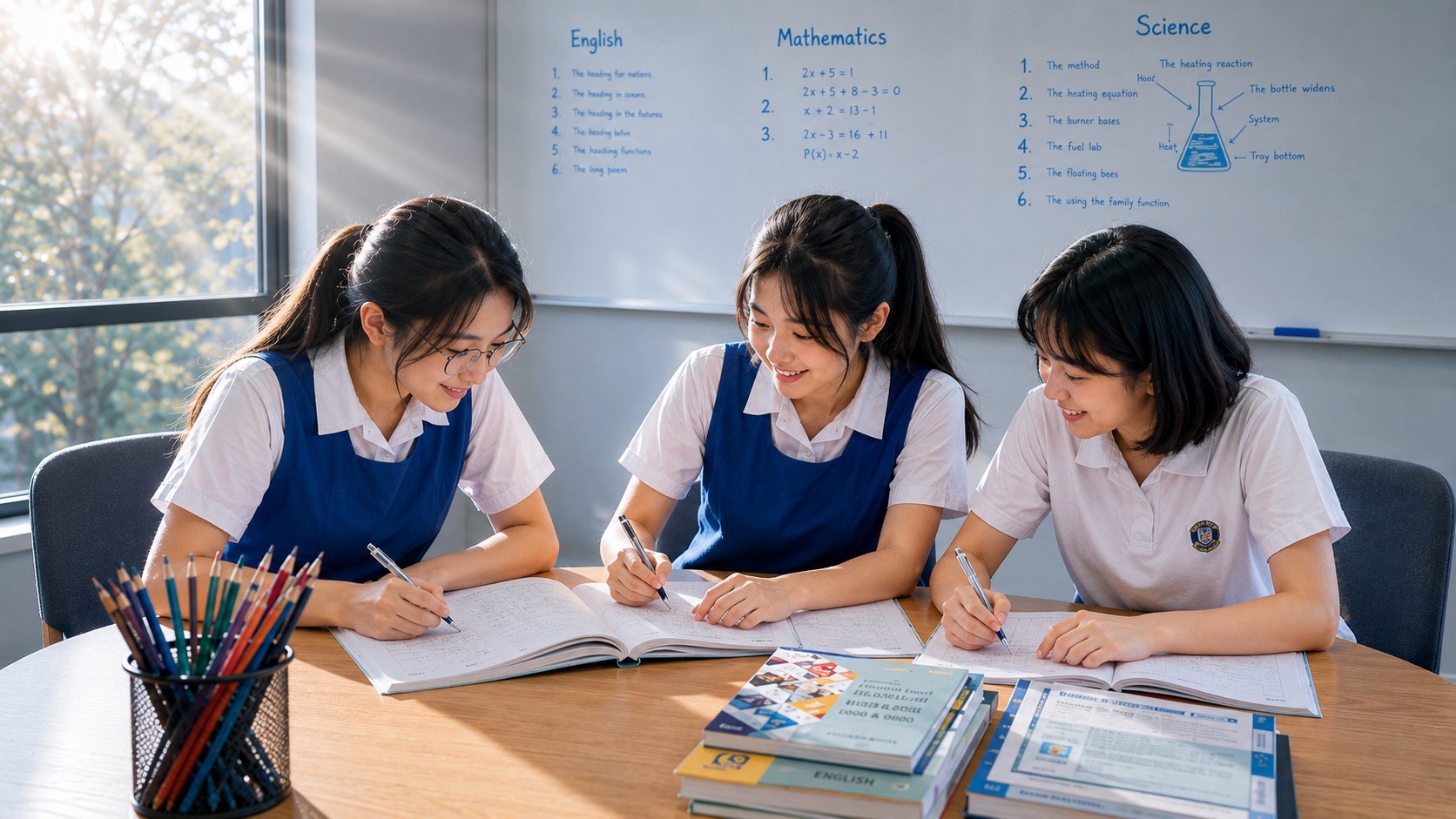
Primary 5 English reading comprehension tuition for Bukit Timah families should help a child understand a passage, locate the evidence a question needs and explain an answer accurately. Reading the words fluently is a useful beginning. The next challenge is to connect events, follow references, interpret vocabulary in context and work out meanings that the writer suggests. A good lesson makes those decisions visible so the pupil can repeat them independently in an unfamiliar text.
In a three-pupil tutorial, each child should attempt questions before discussion, explain the clues used and practise the same reading skill in a fresh passage. Parents can then see whether the difficulty concerns vocabulary, a misunderstood sentence, unsupported inference or an incomplete written answer. Primary 5 assessment follows the school’s arrangements; the PSLE takes place at the end of primary education. This guide provides original passages, worked answers and practical teaching examples for the year before that final primary-school stage.
- Reading focus: understand what happened, why it happened and how the text supports an interpretation.
- Vocabulary: choose the meaning that fits this sentence and situation.
- Reference: identify precisely whom or what a word such as “they”, “it” or “these” represents.
- Inference: connect evidence to a reasonable conclusion without inventing a history or motive.
- Written answers: respond to the actual question and preserve the passage’s meaning.
- Three-pupil teaching: combine individual attempts, carefully guided discussion and a fresh independent check.
- Parent decision: look for a specific teaching target and progress that remains visible when prompts are removed.
Contents
Chapters 1–3 · Understand the reading task
Chapters 4–6 · Investigate an original story
Chapters 7–10 · Read evidence and answer
Chapters 11–12 · Teach and practise
Chapters 13–15 · Choose support and sources
CHAPTER 1 OF 15 · Understand the reading task
1. Understand what the subject requires
Back to contentsThe MOE English Language Syllabus 2020 for primary schools develops close reading, contextual understanding and interpretation of implied meaning. Pupils also encounter different kinds of texts and consider how language shapes meaning. A practical lesson can connect these aims through a short passage rather than treating each comprehension question as an unrelated puzzle.
The Standard English document linked from SEAB’s 2026 formats page includes literal, inferential and evaluative comprehension of written and multimodal texts in Paper 2. It also assesses language use in context. These are PSLE expectations; they do not prescribe the format of every Primary 5 school task. Foundation English has a separate examination document.
For families, the useful distinction is between learning a reading skill and reproducing an examination arrangement. A short lesson on pronoun reference can be valuable even without a complete paper. A pupil who understands a paragraph orally may need separate help expressing the answer in writing. Teaching should match the difficulty revealed by the work.
Use the child’s school feedback and assigned course to choose the appropriate level. For the wider subject, the Bukit Timah Primary 5 English syllabus guide explains how reading sits alongside writing, speaking, listening, grammar and vocabulary. The detailed work here concentrates on interpreting passages and producing supported answers.
CHAPTER 2 OF 15 · Understand the reading task
2. Find the first misunderstanding before adding more papers
Back to contentsWhen a child receives a low comprehension score, “read more carefully” is often too broad to guide the next attempt. Ask the pupil to explain a short part of the passage in ordinary language. Then ask what the question wants and which detail would help answer it. The first point of confusion gives the tutor a more precise starting place.
A child might understand the story but misunderstand “reluctant”. Another might know the word yet attach “she” to the wrong character. A third might understand both but assume that a character who hesitates must be dishonest. All three can produce an incorrect answer, but the teaching needed is different.
It also matters whether the child can explain the answer aloud. If the oral explanation is accurate but the written answer is incomplete, work on expressing the relationship clearly. If the oral explanation already changes the story, sentence correction alone will not repair the reading. Ask the child to return to the relevant lines and explain them before rewriting.
| What appears in the work | Useful question | Teaching priority |
|---|---|---|
| A plausible answer with no supporting clue | Which detail makes that conclusion reasonable? | Separate inference from invention |
| The right event assigned to the wrong person | Who does this pronoun refer to here? | Follow references across sentences |
| A copied sentence that does not answer “why” | What reason connects the event to the question? | Explain the relevant relationship |
| A dictionary meaning that does not fit | Does that meaning make sense in this situation? | Use context to select meaning |
These are teaching observations, not labels for a child. Check more than one task before deciding that an error is a recurring pattern. A confusing question or an unfamiliar expression can affect a single attempt. A useful plan identifies what to teach next and what fresh evidence will show that the teaching helped.
CHAPTER 3 OF 15 · Understand the reading task
3. Build a clear picture before hunting for answers
Back to contentsA first reading should establish the main situation. For a story, ask who is involved, what problem develops and what changes by the end. For an information text, ask what it explains and how the sections are connected. The pupil does not need to annotate every sentence. A short spoken summary can reveal whether the overall meaning is secure.
On the next reading, use the question to narrow attention. A question about a character’s initial reaction needs evidence from that part of the story. A question about a change in attitude may require two moments. Underlining one dramatic word without checking when it appears can produce an answer about the wrong stage of events.
Read around a selected clue. The sentence before it may identify the person involved; the sentence after it may reverse an initial impression. “She smiled” can suggest pleasure, relief or an attempt to reassure someone. The surrounding situation helps determine which interpretation is supported.
A useful classroom habit is to name the relationship before writing: “This is the reason”, “This tells me who acted”, or “These two details show a change.” Those explanations make the pupil’s thinking available for correction. They are learning prompts, not a fixed answer formula that must appear in every response.
CHAPTER 4 OF 15 · Investigate an original story
4. Original practice passage: The Spare Card
Back to contentsThe passage and questions below were written for this guide. They are not taken from a school or national examination. Read the story once for meaning, then use the numbered paragraphs to locate evidence. The numbering supports this lesson; it is not a claim about a school’s assessment format.
1. On the morning of the class exhibition, Siti carried six labelled cards to the table beside the classroom window. Each card explained part of her group’s bridge model. She had checked the spelling twice and arranged the cards in order. While she fetched tape, a gust from the open window sent one card into a puddle left by a leaking flower vase.
2. “We can’t use that,” Leon said, lifting the dripping card. Siti snatched it from him. “You were supposed to watch the table.” Leon opened his mouth, then closed it. He moved the vase away and wiped the table with a cloth from the art shelf.
3. Siti tried rubbing the wet paper, but the ink spread. She turned the card face down just before her teacher walked past. Her group would present in ten minutes. There was no time to restart the whole set.
4. Leon fetched a blank card and took a pencil from his pocket. “Tell me what it said. I’ll write while you fix the stand.” His letters were uneven, but the explanation was complete. Siti took the card, paused, and placed it beside the other five. “Thank you. I should have moved the vase myself.”
5. When the first visitors arrived, the model tilted. Siti held its base while Leon slid folded cardboard underneath. This time, she looked at him before deciding what to do next. They straightened the last label together.
Before answering detailed questions, give a two-sentence account of the problem and response. A suitable summary is that a display card was damaged shortly before an exhibition. After Siti initially blamed Leon, they repaired the display and worked together. A summary that says Leon deliberately ruined the card has already introduced an unsupported claim.
CHAPTER 5 OF 15 · Investigate an original story
5. Work through the story using evidence
Back to contentsQuestion 1: What caused the card to become wet?
Possible answer: A gust from the open window blew it into a puddle left by a leaking vase. This answer preserves the chain in paragraph 1: the gust moved the card, and the puddle made it wet. “Leon spilled water on it” is tempting if the reader follows Siti’s accusation, but the narrator never says that happened.
The teaching point is to distinguish what a character says from what the passage establishes. A character can be mistaken, upset or working with incomplete information. Children should not automatically treat an accusation in dialogue as the narrator’s explanation of an event.
Question 2: Why did Siti probably turn the card face down?
Possible answer: She probably did not want her teacher to see the damaged card. The ink had spread, and she turned it over just before the teacher passed. Those connected details support the inference. The passage does not say that the teacher threatened punishment or that Siti had previously failed an exhibition.
“She was afraid” is too vague on its own. It does not explain what she was trying to hide or how the action relates to the question. A careful answer stays close to the supported purpose of turning the card over instead of adding a dramatic story about the teacher.
Question 3: What does “it” refer to in “Tell me what it said”?
Possible answer: The damaged display card. Leon needs its explanation so that he can write a replacement. “The bridge model” is nearby in the wider story, but a model is not the object whose written message he is replacing. Substitute the proposed reference into the sentence and check the surrounding action.
Question 4: How does Leon respond after Siti blames him?
Possible answer: He does not argue; he moves the vase and wipes the table, then helps replace the card. The response describes actions actually provided. It would be reasonable to explain that he concentrates on solving the problem. It would be unsupported to claim he admits causing the accident.
Question 5: How does Siti’s attitude towards Leon change?
Possible answer: At first, she blames him and snatches the card away. Later, she thanks him and includes him in deciding what to do. A change question needs evidence from both stages. “She becomes grateful” identifies the later attitude but leaves the starting point unexplained.
The answer need not claim that they become lifelong best friends or that Siti will never blame someone again. The story supports a change in this encounter. That is enough. Precision comes from describing the extent of the evidence rather than enlarging it into a permanent judgement.
Question 6: Which detail suggests that Siti cared about preparing the display?
Possible answer: She had checked the spelling twice and arranged the cards in order. Either relevant detail could be discussed when learning; the response should follow the number of details requested in a particular question. Her care about preparation does not prove that she expected a prize, because no prize appears in the passage.
After discussing these questions, ask the pupil to explain one tempting wrong answer. That requires a closer comparison than merely repeating the correct wording. For example, “Leon apologised for the accident” sounds plausible in a story about a disagreement, but the apology-like acknowledgement in paragraph 4 comes from Siti.
CHAPTER 6 OF 15 · Investigate an original story
6. Use vocabulary and reference to keep the meaning intact
Back to contentsIn the story, “snatched” suggests that Siti took the card suddenly or quickly. Replacing it with “received” would remove the abruptness of her action. Ask the child what the word adds to the scene. Vocabulary questions often require this attention to the meaning created here, rather than the first definition a pupil remembers.
“Tilted” means that the model leaned to one side. The next action, sliding folded cardboard underneath, helps the reader picture the problem. A child who interprets “tilted” as “collapsed completely” has made the event more severe than the text supports. Testing a meaning against the following sentence can expose that mismatch.
Reference questions require similar care. In the final sentence, “They” refers to Siti and Leon. The text has just described those two pupils acting together. It does not say that all the visitors straightened the label. Read backwards to identify possible references, then check which one fits the action and grammar.
Sometimes a reference represents an entire event rather than one noun. In “The card was ruined. This delayed their preparation”, “This” refers to the card being ruined. An answer such as “the card” is less precise because a card existing does not cause the delay; the damage does. Use short original examples to teach this distinction before returning to a longer passage.
A simple practice routine is to replace the reference with its full meaning and read the sentence again. The result should make sense without changing who acted or what happened. This is a checking strategy, not a rule that the nearest noun is always correct. The intended connection can reach across a sentence or refer to a complete preceding idea.
CHAPTER 7 OF 15 · Read evidence and answer
7. Original practice text: A Board-Game Lending Trial
Back to contentsThe following report describes an invented community-room project. Its names, arrangements and figures are fictional teaching material, not information about an actual programme. Read it as an information text: identify the purpose, the conditions and what the results can reasonably show.
1. Cedar Community Room tested a board-game lending service for two weeks. On Tuesday afternoons, visitors could borrow one game for three days at no charge. Children under twelve had to be accompanied by an adult when collecting a game. The adult did not have to play the game with them. Games could not be reserved in advance, and borrowing depended on a copy being available.
2. During the first week, the coordinator recorded twenty-four loans. Six were returned late. Several borrowers said they had forgotten which day their games were due. Before the second week began, volunteers attached a due-date card to each box. The coordinator also arranged for a reminder email to be sent one day before a game was due.
3. There were thirty loans in the second week, and three were returned late. The coordinator described the results as encouraging. However, she could not say whether the cards or the emails had made the greater difference because both had been introduced at the same time. She wanted to run a longer trial before deciding whether to offer the service throughout the year.
4. Volunteers checked each returned game against its list of pieces. If something appeared to be missing, they contacted the borrower before lending the game again. The report recommended keeping this check during any further trial so that the next borrower would receive a complete game.
A suitable overall summary is that a short lending trial was reviewed using return records and practical experience. The report describes improvements worth investigating further. It does not announce that a permanent service has already been approved.
CHAPTER 8 OF 15 · Read evidence and answer
8. Read conditions, findings and conclusions accurately
Back to contentsQuestion 1: Could an eleven-year-old collect a game alone?
Possible answer: No. Children under twelve had to be accompanied by an adult when collecting a game. The condition applies to collection. “An adult must play every game with the child” changes that condition and contradicts the next sentence. This question rewards careful reading of the whole arrangement.
Question 2: Was every visitor guaranteed a game?
Possible answer: No. Borrowing depended on a copy being available, and games could not be reserved in advance. Free borrowing does not mean unlimited copies. A pupil who answers “yes, because there was no charge” has selected a true detail that does not establish the claim in the question.
Question 3: Why were due-date cards and reminder emails introduced?
Possible answer: Several borrowers had forgotten their return dates, so the cards and emails were introduced to help them remember. The response connects the observed problem to the action. “Because six games were late” gives part of the background, but the forgotten dates explain why these particular reminders were chosen.
Question 4: What made the results encouraging?
Possible answer: The number of late returns fell from six to three even though the number of loans rose from twenty-four to thirty. This comparison uses the supplied figures accurately. It does not mean that no games were late. The word “encouraging” describes a promising result rather than a complete solution.
Question 5: Why could the coordinator not identify the more useful reminder?
Possible answer: The cards and emails were introduced together, so the report did not separate their effects. The coordinator’s uncertainty is explained in paragraph 3. “The emails were useless” is unsupported. “The cards definitely solved the problem” is also stronger than the report allows.
This question is a useful introduction to evaluating a claim. The child does not need a technical research vocabulary. The practical idea is that two things changed together, so the information does not show which change mattered more. A fair answer preserves that limit.
Question 6: Why were returned games checked before being lent again?
Possible answer: The check helped ensure that the next borrower would receive a complete game. The explanation is supplied in paragraph 4. “To punish careless children” adds a motive the report does not state. Contacting a borrower about a missing piece is described as a practical step, not evidence of an intended punishment.
Question 7: Is the report mainly advertising a permanent service?
Possible answer: No. It reviews a short trial, its results and possible next steps. A longer trial is still wanted before a decision about year-round operation. A reader should not turn a proposal into an announcement. Ask the pupil which sentence prevents that interpretation, then have them explain its significance.
CHAPTER 9 OF 15 · Read evidence and answer
9. Turn understanding into a precise written answer
Back to contentsA pupil may point to the right sentence but still write an answer that leaves out the connection. Teach the child to check the question’s demand before writing. “What happened?” asks for an event. “Why did it happen?” asks for a reason. “How did the attitude change?” usually requires a comparison across moments.
Consider “Why did Leon fetch a blank card?” An answer such as “Because the ink spread” identifies the problem but leaves the intended action implicit. “He fetched it to replace the damaged display card” makes the purpose clear. Where the question requires an explanation, connect the detail to what the person was trying to achieve.
Paraphrasing should preserve meaning. “Several borrowers forgot” does not become “all borrowers forgot”. “The coordinator wanted a longer trial” does not become “the coordinator extended the trial”, because wanting and doing are different. Small words often determine whether an answer stays faithful to the text.
If a question explicitly asks for a word or phrase from the passage, follow that instruction and select the appropriate text. If it asks for an explanation, a large copied paragraph may include the clue without expressing the answer. The tutor should show how the response form changes with the task instead of insisting that every answer use the same sentence frame.
A final check can be short: have I answered this question, identified the right person or event, and avoided an extra claim? Read the answer as though the marker cannot hear the explanation in the pupil’s head. The written response should contain the relationship that makes the answer work.
CHAPTER 10 OF 15 · Read evidence and answer
10. Learn when the passage does not tell us enough
Back to contentsChildren are often good at inventing explanations. That creativity is useful in story writing, but comprehension requires control over which explanations the passage supports. Ask the pupil to sort statements into three groups: stated, reasonably inferred and not established. The third group is important because a statement can be possible without being justified.
From The Spare Card, it is stated that Siti checked the spelling twice. It is reasonable to infer that she cared about the display’s preparation. It is not established that she wanted to win a prize. The prize explanation may fit another story, but this passage does not supply it.
From the lending report, the number of late returns decreased in the second week. The results suggest that the revised arrangements deserve further examination. The text does not establish that the service will succeed throughout the year. Encourage the child to keep the scale and certainty of a conclusion matched to the evidence.
Challenge an answer gently by asking, “Which part would we need to add to the passage to prove that?” If the pupil can identify missing information, they are beginning to understand why the claim is too strong. This is more helpful than simply saying that an imaginative answer is wrong.
The same care helps in Primary 5 listening comprehension, where the evidence arrives through speech. Accurate reading also supports situational writing, where the pupil must preserve supplied information while composing a response. The skill transfers, but each component still needs its own practice.
CHAPTER 11 OF 15 · Teach and practise
11. Make three-pupil teaching reveal each child’s thinking
Back to contentsA small class can support careful discussion if every pupil has a chance to think before hearing someone else’s answer. Begin with one short passage and a few questions chosen for a clear purpose. Collect each child’s attempt before the group discusses it. This protects the evidence of what each pupil understood independently.
Suppose all three pupils answer a change-in-attitude question differently. One identifies only the ending, another describes the change but uses the wrong character’s action, and the third supports both stages. The tutor can teach the comparison while addressing each pupil’s need. Sharing a passage does not require pretending that all three made the same mistake.
During discussion, give pupils different jobs: identify the clue, explain how it answers the question, and test a tempting alternative. Rotate the jobs. The pupil who speaks most confidently should not always become the source of the group’s interpretation. A quieter pupil may need time to write a short explanation before sharing it.
Then use a fresh paragraph with the same reading demand. If the lesson concerned reference, give a new reference question. If it concerned changing attitudes, use another brief event with two distinct stages. The result shows whether the pupil can apply the idea beyond the corrected passage.
Parents can ask what the child did without help at the beginning and end of the lesson. “Found evidence from both stages in a new story” describes a useful improvement. “Finished two passages” describes activity, but does not by itself explain what was learned. Both the teaching and the progress report should make the difference clear.
CHAPTER 12 OF 15 · Teach and practise
12. Practise at home without supplying the interpretation
Back to contentsChoose a short, suitable text and one reading goal. A story paragraph can support a discussion of motives; an information page can support a discussion of conditions. Read enough to understand the whole situation before selecting a sentence. There is no need to turn every book the child enjoys into a worksheet.
Ask the child to explain their answer before offering your own. If the answer seems doubtful, ask where the clue appears. If the child points to a relevant line, explore how they interpreted it. This conversation can reveal a misunderstood word or reference that would remain hidden if the adult immediately supplied the correct answer.
Keep a brief record of one recurring issue. Write the skill, a short example and the next check. For instance: “Changes in attitude: needs evidence from the beginning and end.” Return to the skill using another text later. Repeating the same corrected answer is useful rehearsal, but independent success with a new text provides a stronger check.
Adjust support deliberately. You might initially identify the relevant paragraph, then ask the pupil to locate it independently next time. Record that difference. An answer produced after several hints should not be treated as equivalent to an answer reached without them, although both can show progress at different stages.
If practice repeatedly becomes frustrating, shorten the text and simplify the question while keeping the target skill. A clear inference from two sentences can be a useful starting point. Discuss persistent difficulties with the school teacher so that home practice and additional support respond to the same evidence.
CHAPTER 13 OF 15 · Choose support and sources
13. Choose a practical plan for your Bukit Timah family
Back to contentsBring the passage, questions, the pupil’s original answers and teacher feedback when discussing tuition. An answer sheet without its questions may hide the reason an answer was incomplete. Ask the tutor to identify a priority and demonstrate how a lesson would address it.
Ask how reading difficulty and written-expression difficulty are distinguished. A child may understand more than the written response suggests, or may write polished sentences that misread the passage. Useful teaching should investigate both possibilities. It should also match the pupil’s school course and current assessment expectations.
Consider travel, school dismissal, CCA, meals and the child’s readiness to participate. Confirm the provider’s current venue, timetable, fees, materials and available places directly. This article describes teaching choices, not a current class offer. Some pupils may progress adequately through school support and a manageable home routine.
If additional tuition is chosen, agree on a review point and examine fresh work. Look for more accurate explanations, fewer unsupported claims and less prompting. The aim is growing independence in reading, not dependence on a tutor to locate every clue. Adjust the plan when the evidence shows that a different skill now needs attention.
My child reads many books. Why are comprehension answers still inaccurate?
Reading widely and answering a particular question are related but different activities. Inspect the errors. The child may understand the story yet overlook the question’s time frame, select an irrelevant detail or fail to explain a connection. Preserve enjoyable reading while teaching the particular decision that the schoolwork reveals.
Should my child always use their own words?
Follow the question. A request for a word or phrase from the passage requires careful selection from the text. An explanation may be clearer in the pupil’s own wording. In either case, preserve the meaning. Changing words is unhelpful when it changes a possibility into certainty or assigns an action to the wrong person.
Can more than one inference be reasonable?
Sometimes the text can support more than one interpretation, depending on the question and evidence. Ask the pupil to justify the specific conclusion and consider alternatives. For school assessment, discuss unclear marking with the teacher using the actual passage and response. Do not assume that any imaginable interpretation is equally supported.
Should we begin with timed papers?
First find out whether the child understands the passages without time pressure. If the underlying interpretation is inaccurate, faster practice will not repair it. Once the process is secure, practise within the school’s arrangements and examine where time is spent. Reading, selecting evidence and writing may require different adjustments.
What is a useful first step this week?
Try The Spare Card and ask your child to explain one inference with its supporting details. Choose one improvement, then use a new short paragraph to check the same skill later. Keep the task small enough that both of you can understand what changed and what the next step should be.
Official information checked on 16 November 2026. The passages, questions, possible answers and lesson routines are original teaching material. They are not official questions or marking schemes. Families should consult their school and the relevant examination-year document for assessment arrangements.