Primary 5 English oral communication tuition for Bukit Timah families should help a child read clearly, organise an idea and respond to another person. A pupil may know what to say but rush the words, lose the question or stop after one sentence. Useful teaching identifies that exact difficulty and gives the child a manageable way to improve it through reading, listening and conversation.
In a three-pupil tutorial, every learner should have time to speak independently, receive specific feedback and try again with a fresh question. Parents should be able to hear the difference between a rehearsed answer and a response the child has built thoughtfully. Primary 5 assessment arrangements come from the school; the PSLE takes place at the end of primary education. This guide develops P5 skills while explaining the current P6 oral format, without treating a future examination as the whole purpose of learning English.
- Reading aloud: understand the message, group words meaningfully and help a listener follow the text.
- Conversation: answer the actual question, explain a reason and add a relevant example.
- Photo work: separate visible details from sensible possibilities and unsupported guesses.
- Three-pupil teaching: rotate speaker and listener roles while retaining independent attempts.
- Home support: use short, purposeful conversations and one useful correction at a time.
- Progress: look for clearer meaning, more relevant answers and less prompting across unfamiliar material.
- Scope: use the school’s P5 requirements and the official document for the child’s subject level and eventual examination year.
Contents
Chapters 1–3 · Find a useful starting point
Chapters 4–5 · Read aloud clearly
Chapters 6–11 · Build a conversation
Chapters 12–15 · Teach and practise
Chapters 16–18 · Review progress and next steps
CHAPTER 1 OF 18 · Find a useful starting point
1. Understand what oral communication includes
Back to contentsReading a prepared text and taking part in a conversation involve different decisions. During reading, the words are already supplied. The child must understand them well enough to make the meaning audible. During conversation, the child must choose the ideas and language while listening to another person. A pupil can therefore be fluent in one part and need support in the other.
The MOE English Language Syllabus 2020 develops speaking that suits its purpose, audience and situation, alongside organising ideas, working with others and reviewing communication. The practical activities below are original teaching suggestions built around those broad aims.
For reference, the Standard English format listed for the 2026 PSLE gives Reading Aloud 15 marks and photo-based conversation 25 marks. Together they contribute 20%. There are five minutes of preparation and about five minutes of examination. The two parts do not share a required theme. Foundation English allocates 8 and 12 marks respectively, also contributing 20%, with the same stated timing.
Those figures describe the published P6 formats, not a compulsory national P5 test. Ask the school what it is assessing this term and consult the official examination index for the relevant year. A child’s classroom work, subject level and current needs should determine the practice chosen now.
CHAPTER 2 OF 18 · Find a useful starting point
2. Find the first point where communication breaks down
Back to contentsBegin with two small tasks. Ask the child to read an unfamiliar paragraph, then ask a familiar question such as, “What makes it easier to learn something new?” Listen once without interrupting. Afterwards, ask the child which part felt difficult. This gives a more useful starting point than deciding immediately that the child needs to speak louder or use longer words.
If reading sounds hesitant, check whether the problem is recognising words, understanding the sentence or deciding where to pause. Ask for a quiet explanation of the paragraph. A child who cannot explain the message may need comprehension support before expression practice. A child who understands it but takes a breath in the middle of every phrase needs a different correction.
During conversation, distinguish an idea problem from a language problem. “I know, but I cannot say it” may call for building one complete sentence. “I do not know what you are asking” calls for unpacking the question. An answer about a different topic calls for listening and relevance, even if the grammar is accurate.
| What you hear | What to check | A useful first task |
|---|---|---|
| Every sentence sounds the same | Does the pupil understand the speaker’s purpose? | Read one sentence as an invitation, then explain which words carry its meaning. |
| A long answer misses the question | Has the pupil identified what is being asked? | Give a direct answer in one sentence before adding a reason. |
| Only “yes” or “no” | Can the pupil explain a choice in familiar language? | Compare two options and complete “I would choose… because…”. |
| Frequent restarting | Is the child trying to make every word perfect? | Finish one understandable sentence, then improve it on a second attempt. |
Keep the first observation short. A complete recording is optional; a parent’s brief note may be enough. If you record, agree on its purpose with the child and keep it private. The useful evidence is the specific communication decision, not how confident the child appears on camera.
Before reading aloud, ask, “Who is speaking, who is listening and what should the listener understand?” An announcement about a changed meeting point needs clear instructions. A story may require the reader to show surprise or relief. These choices emerge from the text; the pupil does not need to perform an exaggerated voice.
Consider this original sentence: “Please leave the larger boxes beside the door, but keep the smaller boxes on the table.” The important contrast is between the two sizes and their locations. If the child stresses every word equally, the listener has to work harder. If the child races through the second instruction, the distinction disappears.
Ask the pupil to explain the instruction without reading it: larger boxes by the door, smaller boxes on the table. Then read it again while making that contrast audible. This connects expression to understanding. It also gives the child a reason for slowing down at particular points instead of following an unhelpful instruction to read slowly everywhere.
Punctuation provides clues about structure. A full stop usually ends a complete thought; a comma may help separate parts of a sentence. The right pause also depends on meaning. In “After lunch, the helpers returned to the room,” the short opening phrase belongs together. Breaking after every individual word makes the sentence harder to understand.
Use a pencil to mark a small number of thought groups during home practice if that helps. Explain that these are learning marks, not official examination instructions. Gradually remove them. The longer-term aim is for the pupil to notice meaning while reading an unmarked text.
Practice situation: You are welcoming classmates to a fictional school book exchange. Read the following original passage so that pupils know what to do. The activity, names and arrangements are invented for practice.
Good afternoon, everyone. Welcome to our first class book exchange. Before you place a book on the table, please check that its pages are complete and that your name has been removed from the cover.
We have arranged the books in three sections: stories, information books and comics. You may browse all three sections, but please choose only one book during the first round. This will give everyone a chance to find something interesting.
Perhaps you will discover a story you would never have picked from a shop. If a title catches your attention, read the first page before deciding. You can also ask a classmate why they enjoyed it.
At the end of the exchange, return any unwanted books to the correct section. Our helpers will collect the remaining books for the next session. Thank you for taking care of the books and making room for other readers.
First establish the message: participants should choose fairly and care for the books. Next identify details the listener must not miss. These include checking the pages, removing a name, choosing one book in the first round and returning unwanted books correctly. Clear delivery should make these actions easy to follow.
Try the sentence, “You may browse all three sections, but please choose only one book during the first round.” Let the contrast between browsing and choosing be audible. A small pause before “but” can help. Emphasise “one” enough to clarify the limit without sounding angry.
The question of expression changes in “Perhaps you will discover a story you would never have picked from a shop.” This is an encouraging possibility. The reader can sound interested while remaining natural. Reading it as a stern rule would not fit the purpose.
Finally, ask a listener to state two instructions they heard. If the listener cannot recall them, replay only the relevant sentences. This checks whether the delivery conveyed the message. Repeating the whole passage five times without a clear improvement target would tell the child much less.
CHAPTER 5 OF 18 · Read aloud clearly
5. Improve clarity without turning reading into a performance
Back to contentsUseful reading practice attends to accuracy, phrasing and pace. Accuracy means that the spoken words match the text. Phrasing means that related words stay together. Pace means that the listener has time to understand. Work on the weakest of these first, rather than asking for all three to improve at once.
In the announcement, changing “remaining books” to “reading books” changes the message. A parent can point to the word and ask the pupil to look again. After correcting it, reread the complete phrase so the correction returns to meaningful language. Repeating an isolated word indefinitely does not teach how it fits into the sentence.
Pay attention to meaningful word endings. “Choose one book” and “the remaining books” involve different quantities. The child should make these distinctions clear without adding an artificial extra syllable. If a word is unfamiliar, use a reliable dictionary’s pronunciation, listen carefully and then practise it within a short sentence.
A comfortable, audible voice is more useful than shouting. Place the listener a normal conversational distance away and ask whether the words can be understood. Avoid making imitation of another person’s accent the goal. Teach clear, accurate English that the listener can follow.
If the pupil makes a small slip, a brief correction and continuation may be enough. Starting the whole passage again can interrupt the message and make one error feel larger than it is. During practice, distinguish a slip the child can repair from a word or structure that needs teaching afterwards.
For an already fluent reader, ask a more demanding question: “Which sentence carries the most important instruction, and how did your voice help the listener notice it?” This deepens control without rewarding speed or theatrical delivery for its own sake.
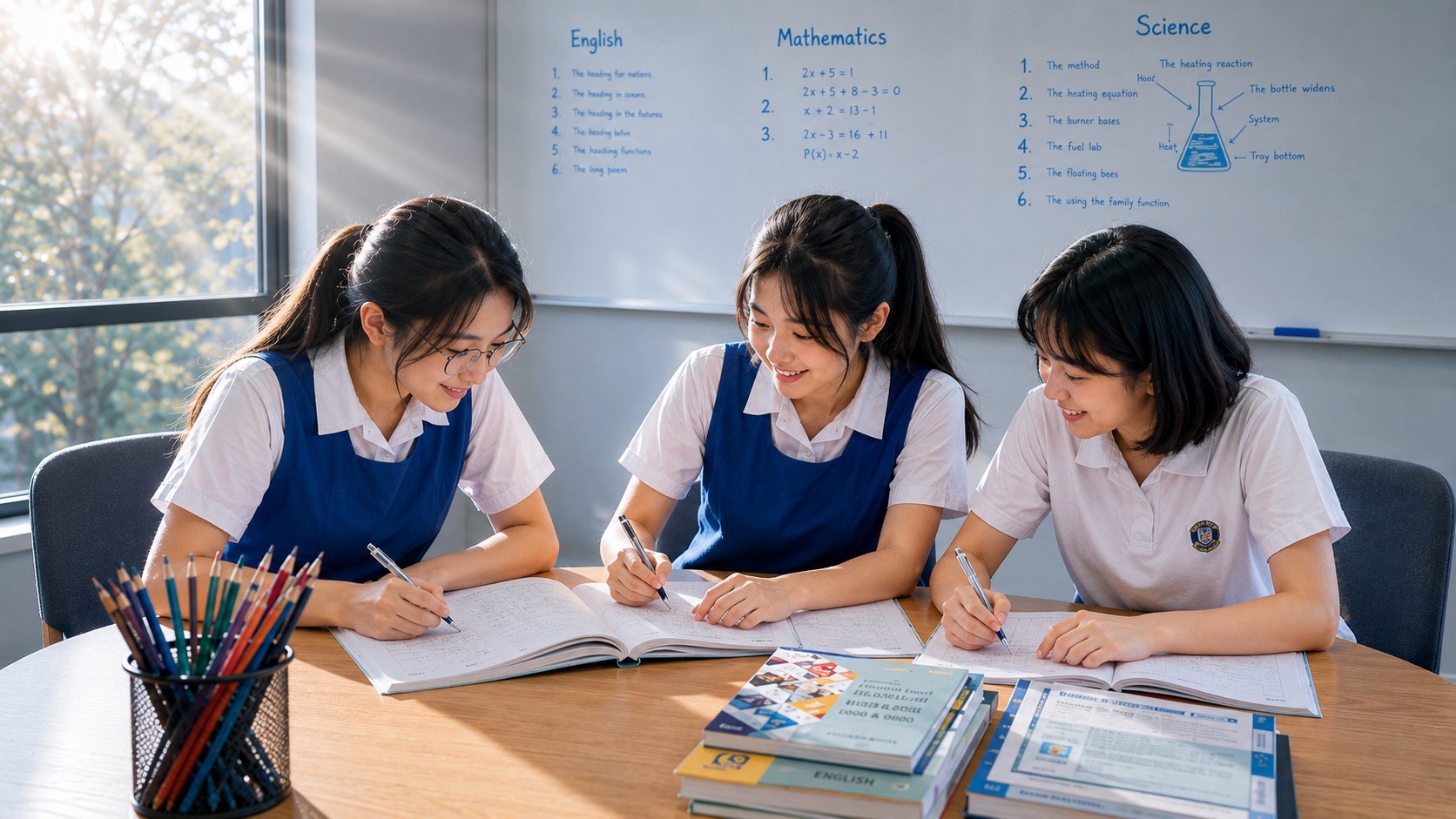
The illustrative classroom image at the top of this guide can support a simple discussion. It shows three learners at a table with open books and writing materials. A child can point to those details. The picture does not establish their examination results, how long they have known one another or whether one of them is finding the task difficult.
Teach three kinds of statements. “There are open books on the table” describes visible information. “They may be discussing their work” offers a reasonable possibility. “They all scored full marks yesterday” introduces a story that the image does not support. The distinction helps a child speak thoughtfully without becoming afraid to offer any interpretation.
Ask, “What suggests that this could be a learning activity?” A suitable answer refers to books, writing materials and the classroom setting. The pupil can then move towards a personal response: “I sometimes find it helpful to compare an answer with a friend.” This is a new idea connected to the scene, clearly presented as the pupil’s own experience.
A conversation question may move beyond the visible details. If asked whether working with others is helpful, listing the colour of every item in the photo will not answer it. A short observation can introduce the topic, but the main response should address the choice or opinion requested.
When using other pictures at home, choose ordinary situations the child can discuss in familiar language. There is no need to guess the participants’ identities or private circumstances. Ask what can be seen, what might be happening and what the pupil thinks about a relevant question. These are distinct speaking moves.
CHAPTER 7 OF 18 · Build a conversation
7. Develop an answer with a reason and an example
Back to contentsConsider this practice question: “Would you enjoy learning with a small group of classmates?” An answer such as “Yes, because it is fun” contains a position and a reason, but the reason is too broad to show much thinking. Ask what specifically becomes enjoyable or useful.
A fuller original response might be: “Yes, I would enjoy it when everyone has a chance to contribute. If I get stuck on a question, a classmate might explain the first step in a different way. During a recent class activity, my partner showed me how she organised the information, and I understood what I had missed. I would still try the task by myself first.”
This is a model of organisation, not a passage to memorise or a claim about the reader’s life. It answers the question, gives a reason, supplies an example and adds a condition. The child should replace the example with a truthful experience or an explicitly imagined situation.
A pupil who prefers working independently can give an equally thoughtful answer: “I often prefer starting on my own because I need quiet time to think. If we discuss a problem immediately, I may follow someone else before deciding what I understand. After I have made an attempt, I would like to compare methods with a group.”
The quality lies in the reasoning and relevance, not in choosing a supposedly approved opinion. Ask the child to explain a preference without guessing which answer an adult wants. If the pupil changes their mind after considering another point, that can become part of the response.
“Answer, reason, example” is a temporary organising aid. Some questions need a sequence of actions, a comparison or an explanation of a difficulty instead. A useful structure helps the child think; it should not force every answer into the same three sentences.
CHAPTER 8 OF 18 · Build a conversation
8. Listen when the next question changes direction
Back to contentsA conversation develops through listening. After an answer about enjoying group learning, the adult might ask, “What could make group work difficult?” The child must now consider a difficulty. Continuing to list benefits would miss the new task, however fluent the answer sounds.
Try this short original exchange. Adult: “What could make group work difficult?” Pupil: “One person might answer everything, so the others do not practise.” Adult: “What would you do about that?” Pupil: “I would suggest that we each try a question first, then take turns explaining. If someone is still unsure, we could ask a question instead of giving the whole answer.”
Notice how the second response proposes an action that matches the first problem. A generic statement such as “We should cooperate” does not explain what anyone would actually do. Encourage a concrete action and its likely effect.
Change the follow-up: “Could a group still help someone who is shy?” Now the pupil may discuss a smaller audience, preparation time or fair turns. The earlier answer about a dominant speaker is relevant only if the child connects it carefully to the new question.
During practice, let the child pause briefly to understand what has changed. You can ask them afterwards to summarise the question in their own words. Avoid teaching a fixed delay or a phrase to repeat before every answer; the goal is attentive listening.
If the child genuinely has not understood, practise a polite, specific clarification such as, “Do you mean what I would do during the activity?” Follow the school’s instructions for its assessment setting. At home, reward the useful act of resolving uncertainty rather than encouraging the pupil to launch into an unrelated prepared response.
Children sometimes believe that an oral answer needs an impressive event. Ordinary experiences are often easier to explain precisely: helping a younger child find a classroom, learning a game, choosing a library book or solving a disagreement over turns. The pupil needs a clear connection to the question.
For the question, “Tell me about a time you learned from someone else,” a child might say, “My cousin taught me a card game. At first I kept forgetting when it was my turn. She played one slow round and explained each choice. I understood better because I could see the rule being used.” The details make the answer meaningful without making the story dramatic.
If the child has never tried the activity in the question, teach an honest bridge. “I have not taken part in a book exchange, but I have borrowed books from a classmate. I liked hearing why she recommended one.” Alternatively, the pupil can say what they would do in an imagined situation and make that status clear.
Do not turn a fictional model into a personal claim the child must repeat. It is fine to invent a character or scenario for an explicitly fictional exercise. It is different to tell a pupil to present an invented incident as something they experienced.
A small experience notebook can help. After a real event, the child records what happened, one choice they made and what they learned. Three short lines are enough. Later, they can consider which experiences fit a question. The notebook supplies memories, not scripts.
Parents can contribute by asking interested questions at everyday moments. “What made that game confusing?” invites an explanation. “Say a good oral answer about teamwork” may push the child towards a performance before they have an idea they want to share.
CHAPTER 10 OF 18 · Build a conversation
10. Explain a choice without making every answer absolute
Back to contentsQuestions about preferences give pupils an opportunity to compare. Suppose the question is, “Would you rather learn a new game from written instructions or from someone showing you?” A child can prefer a demonstration while recognising that written instructions are useful later.
An original response could be: “I would prefer someone to show me the first round because I could see when each rule applies. I could also ask a question immediately. However, I would like to keep the written instructions so that I can check a rule when that person is not there.” The final sentence adds a useful qualification instead of cancelling the preference.
Compare that with “Demonstrations are always better because nobody understands instructions.” The claim is too sweeping. Ask, “Can you think of a situation where instructions would help?” This teaches the pupil to make a defensible judgement.
Use ordinary connecting words precisely. “Because” gives a reason. “For example” introduces a case that illustrates the point. “However” signals a contrast. Adding these words to unrelated sentences does not create reasoning. Ask the child to identify the actual relationship between the ideas.
A well-developed answer can be short. Two connected reasons and a clear example may communicate more than a long list of loosely related claims. Finish when the question has been answered, then listen for the next prompt. Oral practice should create room for an exchange.
CHAPTER 11 OF 18 · Build a conversation
11. Repair sentences while protecting the child’s idea
Back to contentsWhen a child says, “Yesterday my friend teach me and I understand already,” the parent can first acknowledge the idea. Then offer a clearer version: “Yesterday my friend taught me, and I understood it.” Ask the child to use the corrected form in another sentence about a past event. This makes the feedback usable.
Choose one correction that matters. If the response contains a relevant idea, an unclear pronoun and an awkward verb, start with whichever most affects understanding. Interrupting at every word can prevent the child from completing the thought you are trying to assess.
Vague words deserve attention when they hide meaning. “It was good” could mean clear, useful, enjoyable or fair. Ask which meaning the child intends. A pupil describing a game might choose “enjoyable”; a pupil describing instructions might choose “clear”. The better word comes from a more precise idea.
Practise useful combinations within sentences: “explain a method”, “take turns”, “ask for clarification”, “compare two choices” and “consider another opinion”. These phrases support ordinary communication. The child should understand and use them naturally, rather than inserting an impressive expression that does not fit.
After discussing a model answer, hide it and change one part of the question. Ask the pupil to respond again in their own words. This checks whether the teaching strengthened communication or only produced a better recitation of that model.
CHAPTER 12 OF 18 · Teach and practise
12. Give each pupil a useful role in a three-student lesson
Back to contentsA small group is valuable when its structure gives each child meaningful practice. It is possible for three pupils to share a table while only one does most of the talking. The tutor needs to plan who speaks, what the listeners do and how individual understanding will be checked.
Start with an independent response. Each pupil reads a short text or considers a question before hearing a classmate’s answer. This protects the tutor’s view of what the learner can do unaided. It also gives quieter pupils an idea to contribute.
Then rotate three roles. The speaker answers. One listener checks whether the response addressed the question. The other listener identifies a reason or example they heard. These are focused jobs; classmates should not be asked to make sweeping judgements about one another’s ability.
For reading, the listener might note one instruction that was especially clear and one phrase that was hard to follow. For conversation, the listener might ask a relevant follow-up. The tutor models respectful wording: “I understood your choice, but I was not sure why you preferred it.”
After feedback, the original speaker tries again. A revision is part of the lesson, not an optional reward if time remains. Finish with a different short question answered individually. If a child succeeds only after hearing two complete peer answers, the tutor should record that support honestly.
For parents considering tuition, ask how a lesson protects individual speaking time and how progress is reported. A sample of an initial answer, a specific correction and a later independent attempt can be more informative than a description of an energetic class.
Choose a routine that fits the family’s week. The following four short sessions are an example, not a school requirement or a promised timetable. Each has one clear purpose. Stop while the child can still attend to that purpose.
| Session | Task | What to notice |
|---|---|---|
| Read for meaning | Read one unfamiliar paragraph, explain its message and reread one sentence. | Does the second reading make the main idea clearer? |
| Explain a choice | Compare two familiar activities and give a reason for a preference. | Does the reason explain the choice? |
| Respond to a follow-up | Ask about a possible difficulty, then a practical response. | Does the answer change when the question changes? |
| Transfer independently | Use a new paragraph or picture without repeating the earlier model. | Which skill can the child now use with less help? |
Some families may prefer five minutes on two evenings. Others may use a longer conversation at the weekend. The duration is less important than making the target clear and observing whether it improves. A busy week does not need a backlog of recordings to complete.
Give the child genuine choices. They might select a passage from a suitable book or choose which everyday experience to discuss. The adult can retain the learning target while allowing the content to be interesting to the pupil.
Link speaking to other English work where it helps. Explaining why an answer is supported can strengthen comprehension; talking through a message’s purpose can help writing. The Primary 5 listening guide offers original tasks for attending to spoken information. Use a small number of connected activities, rather than turning every conversation into an assessment.
Independent reading practice: Read this original fictional passage once for meaning, then aloud. Unlike the earlier announcement, it tells a short story. Work out what changes for the character.
Leena checked the small cardboard bridge one last time. It had held ten counters at home, but now she was standing beside it in a classroom full of visitors.
“Would you like to test it?” a younger pupil asked.
Leena nodded and handed him the counters. He placed them on the bridge one by one. At the eighth counter, the middle began to bend. Leena reached forward, then stopped. This was something she needed to notice.
When the bridge finally folded, the younger pupil looked worried. Leena smiled. “You have helped me find its weakest point,” she said. “Next time, I will try a different support.”
She opened her notebook and drew the bend carefully. The bridge had not lasted as long as she hoped, but she now knew what to change.
After reading, ask where Leena’s response changes. The pupil should notice the move from concern to using the result to improve the bridge. Expression should follow that meaning. There is no need to imitate a younger child’s voice or make the final collapse dramatic.
Conversation practice: Imagine a school exhibition where pupils explain things they have made. This is a text-based idea exercise, not a reproduction of an official photo task. Ask: “Would you enjoy showing visitors something you had made?” Follow with: “What might be difficult?” Then ask: “How could a visitor help someone improve their work?”
Give the pupil room to answer before discussing a model. Note whether the response uses a relevant reason, whether the difficulty is specific and whether the final suggestion actually helps someone improve. A short independent answer is better diagnostic evidence than a polished answer supplied by an adult.
For the reading task, the phrase “then stopped” matters because it marks a change in Leena’s decision. A small pause can help the listener notice it. Her spoken response at the end is constructive: she sees the failed test as useful information. An angry delivery would conflict with the surrounding text.
Do not require one exact pattern of stress. Two pupils can make slightly different reading choices while conveying the same meaning clearly. Ask each to explain a choice. This gives feedback a reason beyond “that sounded better to me”.
For the exhibition question, a possible original answer is: “I would enjoy showing visitors a board game I had designed. I could explain why I chose the rules and see whether people understood them. I might feel unsure at first, so I would practise a short explanation before the exhibition.” This answers the preference question and develops the idea.
For the difficulty question, the pupil might say: “A visitor could ask something I had not considered. I would listen carefully and explain what I do know. If I could not answer, I would say that I needed to find out.” The answer is credible because it gives a response to a specific difficulty.
For the final question, “Visitors should say it is amazing” offers encouragement but little help with improvement. A stronger response is: “They could describe one part that was unclear and ask how it was supposed to work. For example, if they could not follow a game’s instructions, they could show the exact step that confused them.”
Compare the pupil’s own answer with these features, not with the exact wording. Identify one strength, choose one revision and offer a new question later. Record whether the revision transfers. A model answer is useful only if the child becomes better able to build a response without it.
CHAPTER 16 OF 18 · Review progress and next steps
16. Judge progress and decide what support is useful
Back to contentsKeep a simple progress note with the date, task, support given and next step. For example: “Answered the new question directly; needed one prompt to explain the reason; next time add a relevant example independently.” This describes something a parent or tutor can act on.
Compare unfamiliar tasks of similar difficulty. Repeating one passage until it sounds smooth demonstrates improvement on that passage. It does not by itself show that the pupil can read a fresh text fluently. Both kinds of practice have a role, but they answer different questions.
Useful progress may include fewer omitted words, more meaningful pauses, a clearer first sentence, better follow-up answers or a reason given without prompting. A child can improve in one area while another remains difficult. Avoid turning a mixed pattern into a single label such as “bad at oral”.
If the child communicates comfortably at home but struggles in classroom tasks, share the specific pattern with the teacher. Ask whether the difficulty involves unfamiliar material, preparation, language, turn-taking or the assessment setting. Coordinate the next practice step with what the teacher observes.
When considering a Bukit Timah tutor, take a recent task and explain what you have noticed. Ask how the tutor would identify the starting point, match materials to the pupil’s subject level, provide individual speaking time and check transfer. Clarify actual arrangements, fees and availability directly with the provider before enrolling.
Additional tuition is one possible support. School feedback, suitable reading and regular purposeful conversation may already address the need. The decision should follow the child’s work and the family’s practical circumstances. A useful programme makes its teaching visible and gives the parent evidence to review.
Should my child memorise model answers?
Use models to notice organisation and language, then close them and try a new question. Memorising a complete response can hide whether the child has understood the prompt. In its August 2026 explanation of oral assessment, SEAB emphasised communication rather than specialist topic knowledge or rehearsed responses. Build ideas the pupil can adapt and explain honestly.
Does a longer answer always show stronger oral skills?
No. An answer needs enough development to explain the point, but irrelevant detail can obscure it. Ask whether each sentence helps answer the question. A clear example is useful; a second unrelated story may not be.
What if my child is quiet?
Start with familiar content and a manageable speaking turn. Allow some preparation, listen without completing the answer and add one follow-up when the child is ready. Observe what the pupil can communicate, rather than treating a loud voice or quick response as the only sign of competence.
Must every answer include a personal story?
No. The question determines the response. A comparison may need reasons, while a question about solving a problem may need practical steps. Use personal experience when it helps, and distinguish real memories from imagined examples.
Can Foundation English pupils use these activities?
Yes, with suitable text length, vocabulary, pace and support. Match the work to what the child is learning at school. The two official subject documents should guide assessment expectations; this article’s teaching checklist is not an official scoring rubric.
What should we do after a disappointing oral result?
Ask for the specific feedback available, identify one teachable difficulty and choose a fresh task to practise it. Revisit that skill after instruction. A result can begin a useful conversation about the next step without becoming a prediction about the child’s final outcome.
CHAPTER 18 OF 18 · Review progress and next steps
18. Use the official references and choose a next step
Back to contentsThe sources below were checked for this guide in November 2026. The original passages, model responses, diagnostic table and practice routines are teaching resources, not official examination questions or a marking scheme.
- MOE English Language Syllabus 2020, Primary: curriculum reference.
- SEAB PSLE formats examined in 2026: official subject-document index.
- Standard English Language, subject code 0001: current format reference used above.
- Foundation English Language, subject code 0031: separate subject reference.
- SEAB explanation of oral assessment, 21 August 2026: communication and preparation context.
For the next practice, choose one task from this article, listen to an independent attempt and decide on one useful correction. If the difficulty is mainly understanding spoken information, continue with the listening guide linked earlier. If it concerns choosing language for a reader, the Primary 5 situational writing guide provides worked messages. The broader Primary 5 English guide places these skills within the subject.